
 100% FREE ACCESS
12th Standard CBSE Syllabus & Materials
12th Standard CBSE
CBSE 12th Economics Government Budget and the Economy Previous year Question Papers Study Material - QB365 Set A
NEW12th Standard CBSE
CBSE 12th Computer Science Interface Python with MySQL - New Previous year Question Papers Study Material - QB365 Set A
NEW12th Standard CBSE
CBSE 12th Computer Science Database Concept - New Previous year Question Papers Study Material - QB365 Set A
NEW12th Standard CBSE
CBSE 12th Computer Science Data Communication - New Previous year Question Papers Study Material - QB365 Set A
NEW12th Standard CBSE
CBSE 12th Computer Science Data Structures - New Previous year Question Papers Study Material - QB365 Set A
NEW12th Standard CBSE
CBSE 12th Computer Science Functions - New Previous year Question Papers Study Material - QB365 Set A

Published on: 06/09/2019
Alcohols , Phenols and Ethers
Download CBSE Class 12th Standard CBSE Chemistry question papers, sample papers, important questions, and previous year solved papers in PDF format. Get free study materials, NCERT solutions, and exam preparation resources for Class 12th Standard CBSE Chemistry
Questions + Answers key
Take MCQ Chemistry Test
1.
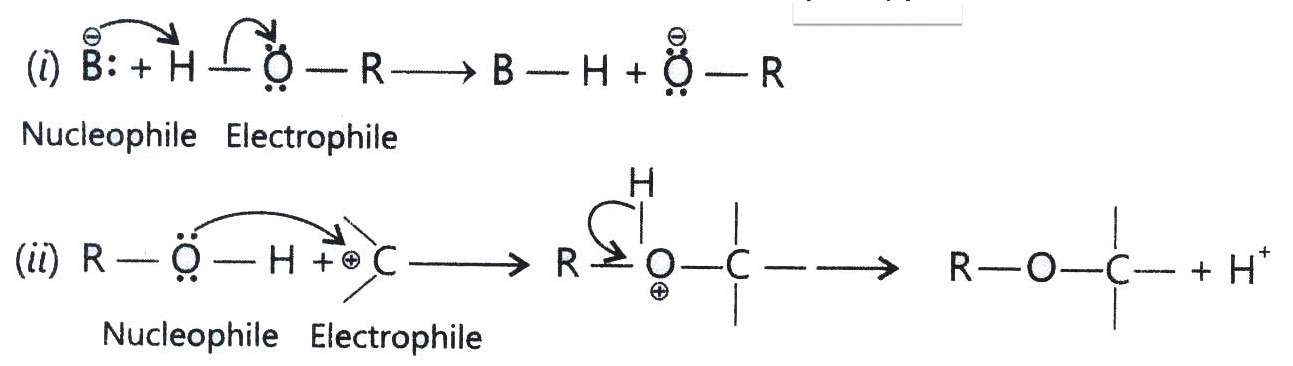
Describe the mechanism of alcohols reacting both as nucleophiles and as electrophiles in their reactions.
2.
Write the structure of the molecule of a compound whose IUPAC name is 1-phenylpropan-2-ol.
3.
Write the chemical equation for the preparation of phenol from benzene using oleum and sodium hydroxide.
4.
Write the mechanism of hydration of ethene to yield ethanol.
5.
Explain the fact that in aryl alkyl ethers,
(i) the alkoxy group activites the benzene ring towards electrophilic substitution and
(ii) it directs the incoming substitutions to ortho and para positions in benzene ring.
6.
Account the following:
(i) The boiling point of ethanol is higher than that of methanol.
(ii) Phenol is a stronger acid than an alcohol.
(iii) The boiling points of ethers are lower than isomeric alcohols.
7.
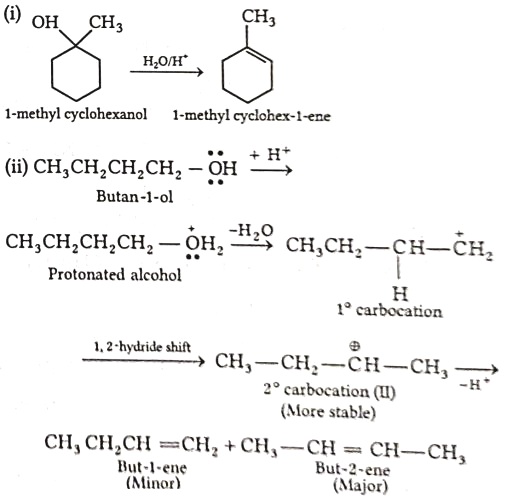
Predict the major product of acid catalysed dehydration of
(i) 1-methyl cyclohexanol, and
(ii) butan-1-ol
8.
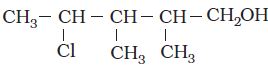
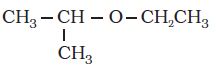
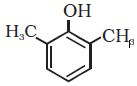
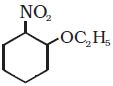
Give IUPAC names of the following compounds:
(i)
(ii)
(iii)
(iv)
9.
An ether is more volatile than alcohol having the same molecular formula. This is due to
intermolecular hydrogen bonding in alcohols
dipolar character of ethers
alcohols having resonance structures
intermolecular hydrigen bonding in ethers.
10.
When ethanol is heated with HI and red phosphorus, it gives
ethyl iodide
ethane
ethylene
ether
11.
Phenol reacts with bromine in CS2 to give
o-bromophenol
m-bromophenol
o-and p-bromophenol
2, 4, 6-tribromophenol
12.
The compound (C) in the following series of reactions is:
\(Aceton+{ CH }_{ 3 }MgBr\overset { Dry\ ether }{ \longrightarrow } A\overset { { H }_{ 3 }{ O }^{ + } }{ \longrightarrow } B\overset { 363K }{ \underset { 20%{ H }_{ 2 }{ SO }_{ 4 } }{ \longrightarrow } } C+H_{ 2 }O\)
2-Methylpropene
but-2-ene
but-1-ene
propene
13.
The general molecular formula which represents the homologous series of alkanols is
\({ C }_{ n }{ H }_{ 2n+2 }O\)
\({ C }_{ n }{ H }_{ 2n }{ O }_{ 2 }\)
\({ C }_{ 2 }{ H }_{ 2n }O\)
\({ C }_{ n }{ H }_{ 2n+1 }O\)
14.
An organic compound (A) with molecular formula C6H6O gives a characteristic colour with aqueous FeCl3 solution. When (A) is treated with CO2 and NaOH at 410K under pressure, it gives compound (B) which upon acidification gives compound (C). Compound (C) reacts with acetyl chloride to give (D) which is a popular pain killer, Deduce the structures of (A), (B), (C) and (D) and explain all the reactions involved.
15.
2,2-Dimethyloxirane can be cleaved by acid (H+).Write its mechanism.
16.
Reimer-Tiemann reaction
17.
Conversion of \({ 2 }^{ \circ }\) alcohol to ketone
18.
Williamson's synthesis
19.
Kolbe's reaction
20.
Methanol
1.
2.

3.

4.
Direct addition of H2O to ethene in presence of an acid does not occur. Indirectly, ethene is first passed through cone. H2SO4, when ethyl hydrogen sulphate is formed.

Ethyl hydrogen sulphate when boiled with water undergoes hydrolysis to form ethanol.

5.
(i) In aryl alkyl ethers, +R-effect of the alkoxy group (-OR) increases the electron density on the benzene ring thereby, activating the benzene ring towards electrophilic substitution reactions.
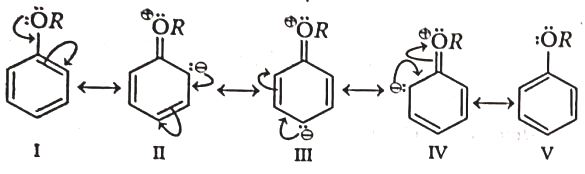
(ii) Alkoxy group (-OR) is ortho, para directing and activates the aromatic ring towards electrophilic substitution.
It directs the incoming electrophilic at o- and p-positions. This is because of the presence of the negative charges at o- and p-positions indicate the more electron density at these positions.
6.
(i) It is due to higher molecular weight, more surface area more vav deer waals, forces of Attraction in C2H2Oh.
(ii) Phenol is the strongest acid than alcohol because phenoxide ion is more stable due to resonance than ethoxide ion.
(iii) It is because ethers are not associated with inter molecular H- bonding, whereas ethanol.
7.
8.
(i) 4-Chloro-2,3-dimethylpentan-1-ol
(ii) 2-Ethoxypropane
(iii) 2,6-Dimethylphenol
(iv) 1-Ethoxy-2-nitrocyclohexane
9.
(a)
intermolecular hydrogen bonding in alcohols
10.
(b)
ethane
11.
(c)
o-and p-bromophenol
12.
(a)
2-Methylpropene
13.
(a)
\({ C }_{ n }{ H }_{ 2n+2 }O\)
14.
(i) Since compound (A) with M.F. C6H6O gives characteristic colour with FeCI3, therefore, (A) must be phenol.
(ii) Since compound (A), i.e., phenol reacts with CO2 and NaOR under pressure (i.e., Kolbe's reaction) to give compound (B) which on acidification gives compound (C), therefore, (B) must be sodium salicylate and (C) must be salicylic acid.
(iii) Since (C) reacts with acetyl chloride to form a popular pain killer (D), therefore, (D) must be aspirin.
15.
In the acidic medium, the oxygen atom of the oxirane ring gets protonated. The presence of positive charge on the oxygen atom weakens the C-O bond more on the side of C2 since the partial positive charge created on C2 will be stabilized by the + I- effect of the two CH3 groups in the transition state (T.S.). Consequently, the attack of the nucleophile, i.e., H2O preferentially ocurson C2 yielding 2-methyl propane- 1, 2-diol.
16.
()
Conversion of phenol to salicyaldehyde
17.
()
Heated copper at 573 K
18.
()
Reaction of alkyl halide with sodium alkoxide
19.
()
Conversion of phenol to o-hydroxybenzoic acid
20.
()
Wood spirit

12th Standard CBSE Syllabus & Materials
12th Standard CBSE
CBSE 12th Computer Science Python Revision Tour I - New Previous year Question Papers Study Material - QB365 Set A
NEW12th Standard CBSE
CBSE 12th Business Studies Planning Important Questions And Answers Study Material - QB365 Set A
NEW12th Standard CBSE
CBSE 12th Business Studies Business Environment Important Questions And Answers Study Material - QB365 Set A
NEW12th Standard CBSE
CBSE 12th Business Studies Principles of Management Important Questions And Answers Study Material - QB365 Set A



CBSE 12th Standard CBSE Subjects
CBSE Standards










