
 100% FREE ACCESS
12th Standard CBSE Syllabus & Materials
12th Standard CBSE
CBSE 12th Economics Government Budget and the Economy Previous year Question Papers Study Material - QB365 Set A
NEW12th Standard CBSE
CBSE 12th Computer Science Interface Python with MySQL - New Previous year Question Papers Study Material - QB365 Set A
NEW12th Standard CBSE
CBSE 12th Computer Science Database Concept - New Previous year Question Papers Study Material - QB365 Set A
NEW12th Standard CBSE
CBSE 12th Computer Science Data Communication - New Previous year Question Papers Study Material - QB365 Set A
NEW12th Standard CBSE
CBSE 12th Computer Science Data Structures - New Previous year Question Papers Study Material - QB365 Set A
NEW12th Standard CBSE
CBSE 12th Computer Science Functions - New Previous year Question Papers Study Material - QB365 Set A

Published on: 06/09/2019
Aldehydes , Ketones and Carboxylic Acids
Download CBSE Class 12th Standard CBSE Chemistry question papers, sample papers, important questions, and previous year solved papers in PDF format. Get free study materials, NCERT solutions, and exam preparation resources for Class 12th Standard CBSE Chemistry
Questions + Answers key
Take MCQ Chemistry Test
1.
Benzaldehyde reduces Tollens' reagent but not the Fehling's or the Benedict's solution. Explain.
2.
Arrange the following in decreasing order of their acidic strength. Give explanation for the arrangement.
C6H5COOH, FCH2COOH, NO2CH2COOH.
3.
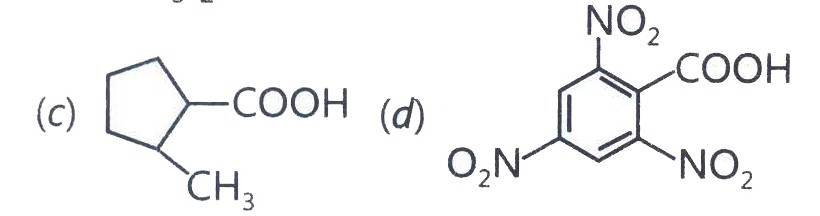
Give the IUPAC name of the following compounds:
(a) phCH2CH2COOH
(b) (CH3)2C - CHCOOH
4.
Give chemical tests to distinguish between the following pairs of compounds:
(i) Propanal and propanone
(ii) Benzaldehyde and benzoic acid.
5.
Name the electrophile produced in the reaction of benzene with benzoyl chloride in the presence of anhydrous AlCl3. Name the reaction also.
6.
Draw the structural formula of 1-phenylpropan-1-one molecule.
7.
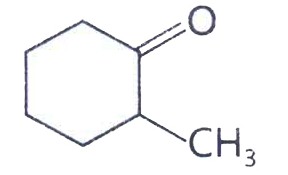
Write IUPAC name of
8.
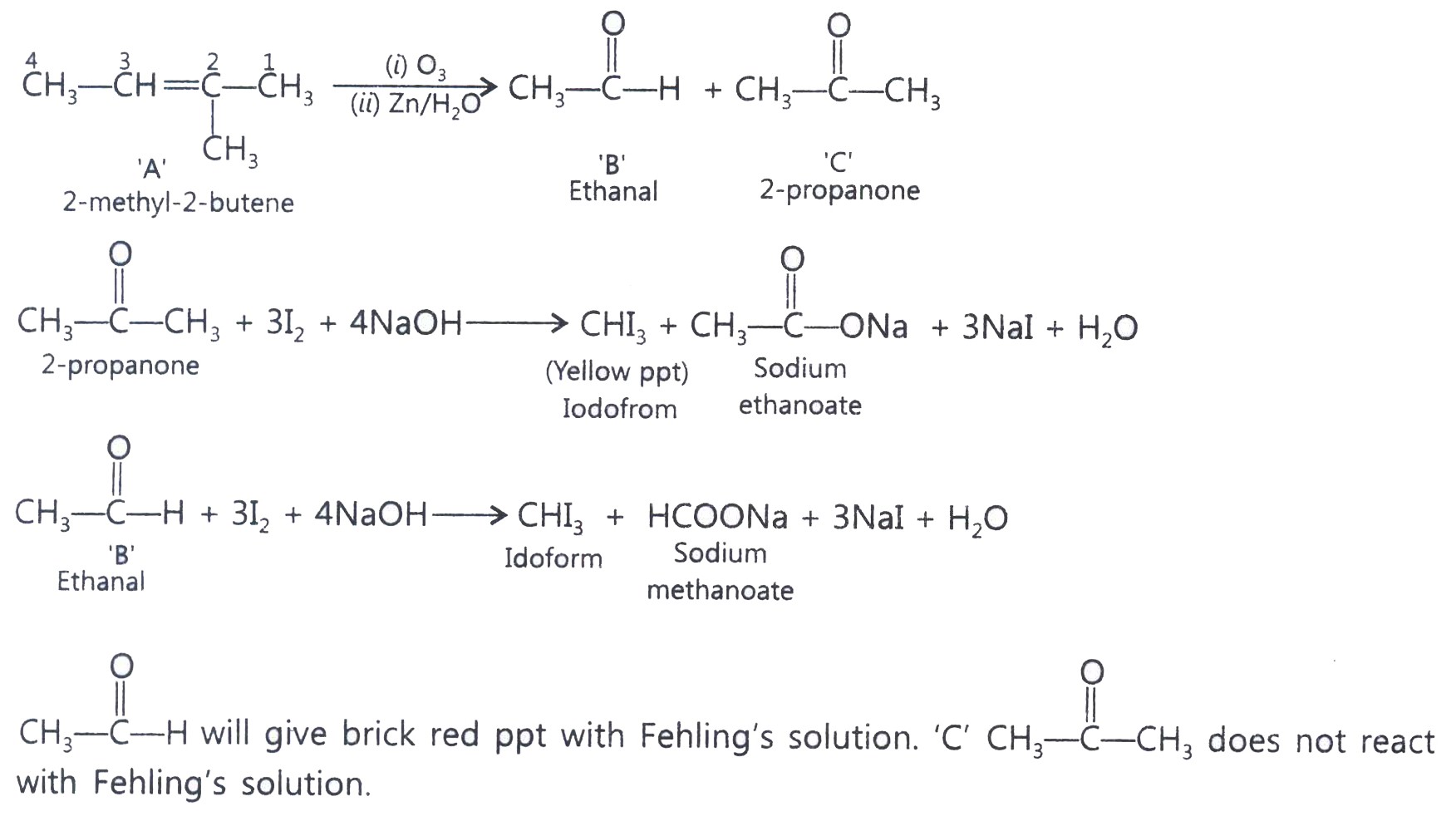
An alkene 'A' (Mol. formula C5H10) on ozonolysis gives a mixture of two compounds 'B' and 'C'. Compound 'B' gives positive Fehling's test and also forms iodoform on treatment with I2 and NaOH. Compound 'C' does not give Fehling's test but forms iodoform. Identify the compounds A, B and C. Write the reaction for ozonolysis and formation of iodoform from B and C.
9.
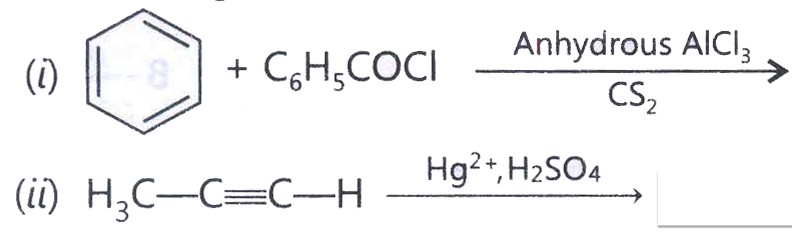
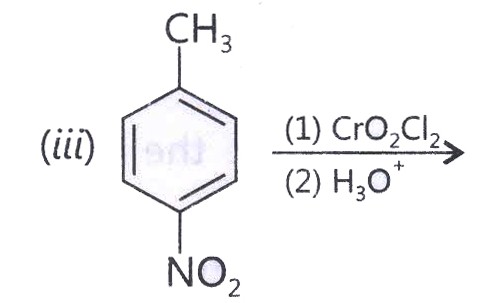
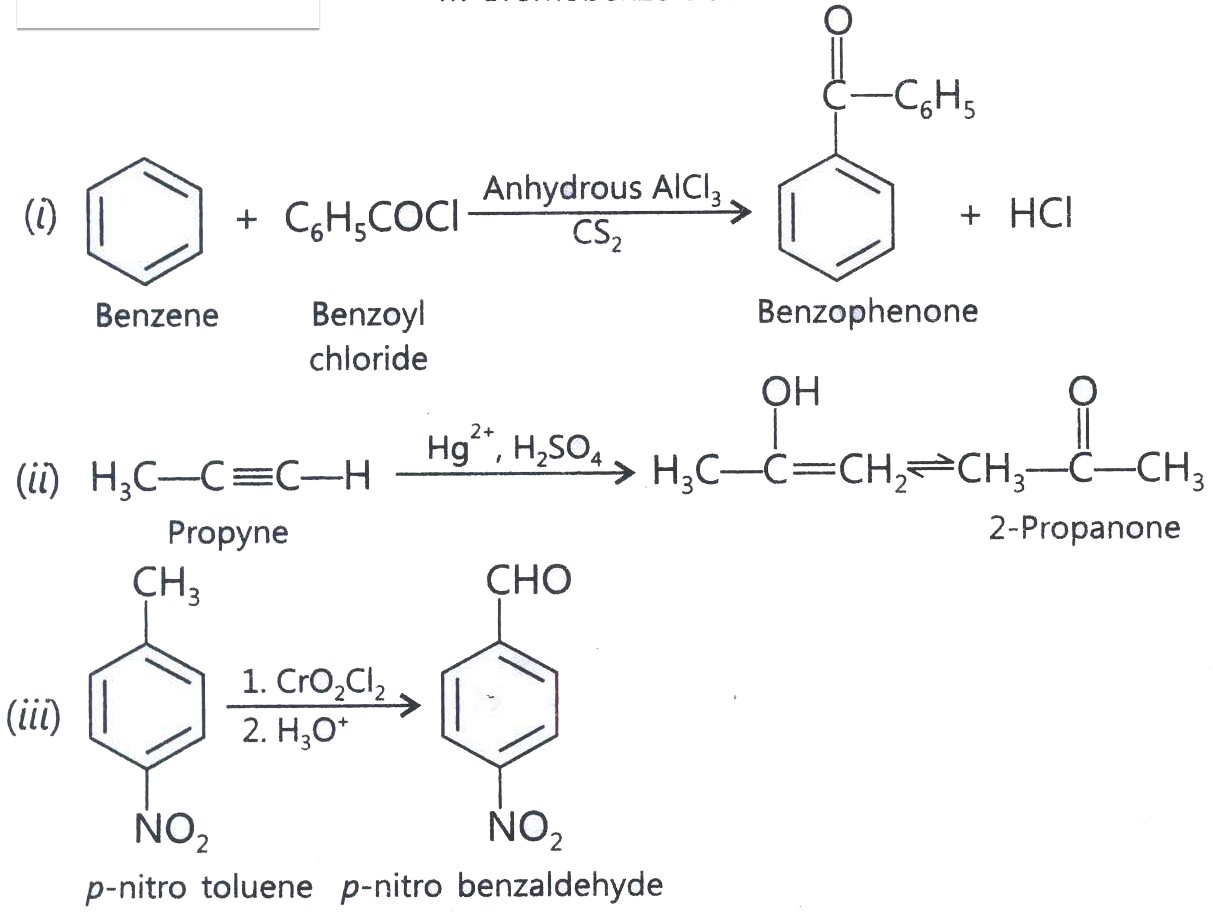
Write the structures of the main products of following reactions:
10.
A compound A on oxidation gives B (C2H4O2). A reacts with dil. NaOH and on subsequent heating forms C. C on catalytic hydrogenation gives D. Identify A, B, C, D and write down the reactions involved.
11.
Write chemical reactions to affect the following transformations:
(a) Butan-1-ol to butanoic acid
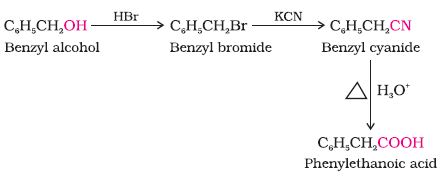
(b) Benzyl alcohol to phenylethanoic acid
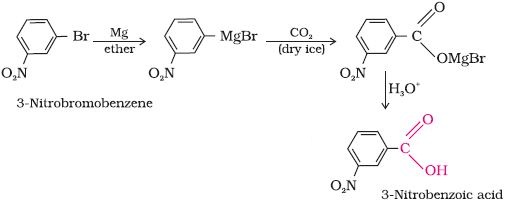
(c) 3-Nitrobromobenzene to 3-nitrobenzoic acid
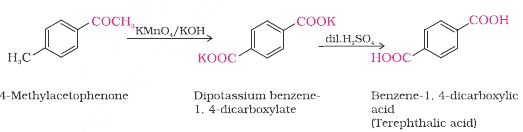
(d) 4-Methylacetophenone to benzene-1, 4-di-carboxylic acid
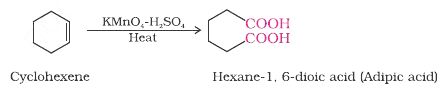
(e) Cyclohexene to hexane-1,6-dioic acid
(f) Butanal to butanoic acid.
12.
The compound that does not undergo Cannizzaro reaction is
formaldehyde
acetaldehyde
benzaldehyde
trimethylacetaldehyde
13.
A mixture of benzaldehyde and formaldehyde on heating with aqueous NaOH solution gives
benzyl alcohol and sodium formate
sodium benzoate and methyl alcohol
sodium benzoate and sodium formate
benzyl alcohol and methyl alcohol
14.
The formation of cyanohydrin from acetone is which type of reaction ?
Electrophilic substitution
Electrophilic addition
Nucleophilic addition
Nucleophilic substitution
15.
\({ 2CH }_{ 3 }CHO\underrightarrow { NaOH } { CH }_{ 3 }-CH=CHCHO\)
16.
\(Phenyl\ benzoate\rightarrow Benzaldehyde\)
17.
\(Cyclohexanone\rightarrow Cuclohexanol\)
18.
Acrolein
19.
Valeraldehyde
20.
Acetophenone
21.
CH3CHO \(\xrightarrow {AI(OC_2H_5)_3}\)
22.
CH3COCH3 + C6H5CHO \(\xrightarrow {OH^{-}}\)
1.
The electron-donating resonance effect (+R-effect) of the benzene ring increases the electron density in the carbonyl group of benzaldehyde. This, in turn, increases the electron density in the C-H bond of the aldehyde group. As a result, the C-H bond becomes stronger and hence only stronger oxidising agents like Tollens' reagent, Ag(NH3)\(+\\ 2\) \(({ E° }_{ { Ag }^{ + }/Ag }=+0.18V)\) can oxidise C-H to C-OH to form carboxylic acids but weaker oxidising agents like Fehling's solution (Cu2+ + tartrate ion + base) .and Benedict's (Cu2+ + citrate ion + base) solution \(({ E° }_{ { Cu }^{ + }/Cu }=0.18V)\) fail to oxidise benzaldehyde to benzoic acid.
Thus, in general, all these three reagents oxidise aliphatic aldehydes but only Tollens' reagent oxidises aromatic aldehydes.
2.
O2NCH2COOH > FCH2COOH > C6H5COOH
-NO2 is more electron-withdrawing group than 'F' there, 2-nitroethanoic acid is most acidic and benzoic acid is least acidic due to greater hydrocarbon part and less solution solubility in water.
3.
(a) 3-Phenylpropanoic acid
(b) 3-Methylbut-2-enoic acid
(c) 2-Methylcyclopentane carboxylic acid
(d) 2,4,6-Trinitrobenzoic acid.
4.
(i) Add Tollen's reagent. Propanal will give silver mirror whereas propanone will not react.
(ii) Add NaHCO3 solution. Benzaldehyde will not react whereas benzoic acid will give brisk effervescence due to CO2.
5.
Benzene, on reaction with benzoyl chloride gives benzophenone through an intermediate benzoylinium cation.
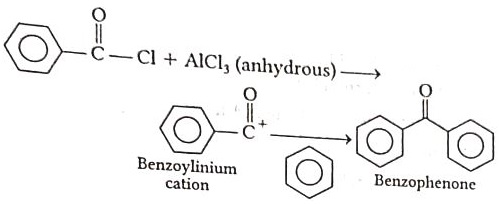
This is an example of Friedel-Crafts acylation reaction.
6.

7.
2 - Methylcyclohexanone
8.
9.
10.
(i) Since compound A on oxidation gives compound 8 with M.F. C2H4O2, therefore, compound 8 may be acetic acid, CH3COOH and A may be acetaldehyde, CH3CHO.
(ii) Since compound A, i.e., acetaldehyde reacts with dil. NaOH, therefore, it undergoes aldol condensation to afford an aldol.Further since this aldol on heating gives compound (C), therefore, (C) must be an α, β- unsaturated aldehyde, i.e., but-2-en-I-al (crotonaldehyde).
(iii) Since compound (C) on catalytic hydrogenation gives compound D, therefore, D may be either I-butanal or I-butanol depending upon the extent of hydrogenation.
AIl the reactions involved in this question are explained below:
11.
(i)

(ii)
(iii)
(iv)
(v)
(vi)

12.
acetaldehyde contains \(\alpha \)- hydrogens and hence does not undergo aldol condensation
13.
(a)
benzyl alcohol and sodium formate
14.
(c)
Nucleophilic addition
15.
()
Aldol condensation
16.
()
DIBAL - H
17.
()
LiAIH4
18.
()
Prop - 2 - enal
19.
()
Pentanal
20.
()
1 - Phenylethanone
21.
()
CH3COOC2H5
22.
()
C6H5CH = CHCOCH3

12th Standard CBSE Syllabus & Materials
12th Standard CBSE
CBSE 12th Computer Science Python Revision Tour I - New Previous year Question Papers Study Material - QB365 Set A
NEW12th Standard CBSE
CBSE 12th Business Studies Planning Important Questions And Answers Study Material - QB365 Set A
NEW12th Standard CBSE
CBSE 12th Business Studies Business Environment Important Questions And Answers Study Material - QB365 Set A
NEW12th Standard CBSE
CBSE 12th Business Studies Principles of Management Important Questions And Answers Study Material - QB365 Set A



CBSE 12th Standard CBSE Subjects
CBSE Standards










