
 100% FREE ACCESS
12th Standard CBSE Syllabus & Materials
12th Standard CBSE
CBSE 12th Economics Government Budget and the Economy Previous year Question Papers Study Material - QB365 Set A
NEW12th Standard CBSE
CBSE 12th Computer Science Interface Python with MySQL - New Previous year Question Papers Study Material - QB365 Set A
NEW12th Standard CBSE
CBSE 12th Computer Science Database Concept - New Previous year Question Papers Study Material - QB365 Set A
NEW12th Standard CBSE
CBSE 12th Computer Science Data Communication - New Previous year Question Papers Study Material - QB365 Set A
NEW12th Standard CBSE
CBSE 12th Computer Science Data Structures - New Previous year Question Papers Study Material - QB365 Set A
NEW12th Standard CBSE
CBSE 12th Computer Science Functions - New Previous year Question Papers Study Material - QB365 Set A

Published on: 08/10/2019
Aldehydes , Ketones and Carboxylic Acids
Download CBSE Class 12th Standard CBSE Chemistry question papers, sample papers, important questions, and previous year solved papers in PDF format. Get free study materials, NCERT solutions, and exam preparation resources for Class 12th Standard CBSE Chemistry
Questions + Answers key
Take MCQ Chemistry Test
1.
(a) An organic compound contains 69.77% carbon, 11.63% hydrogen and the rest is oxygen. The molecular mass of the compound is 86. It does not reduce Tollen's reagent but forms an addition compound with sodium hydrogen sulphite and gives a positive iodoform test. On vigorous oxidation it gives ethanoic and propanoic acids. Deduce the possible structure of the organic compound.
(b) State reasons for the following:
(i) Monochloroethanoic acid has a higher pKa value than dichloroethanoic acid.
(ii) Ethanoic acid is a weaker acid than benzoic acid.
2.
Describe the following reactions
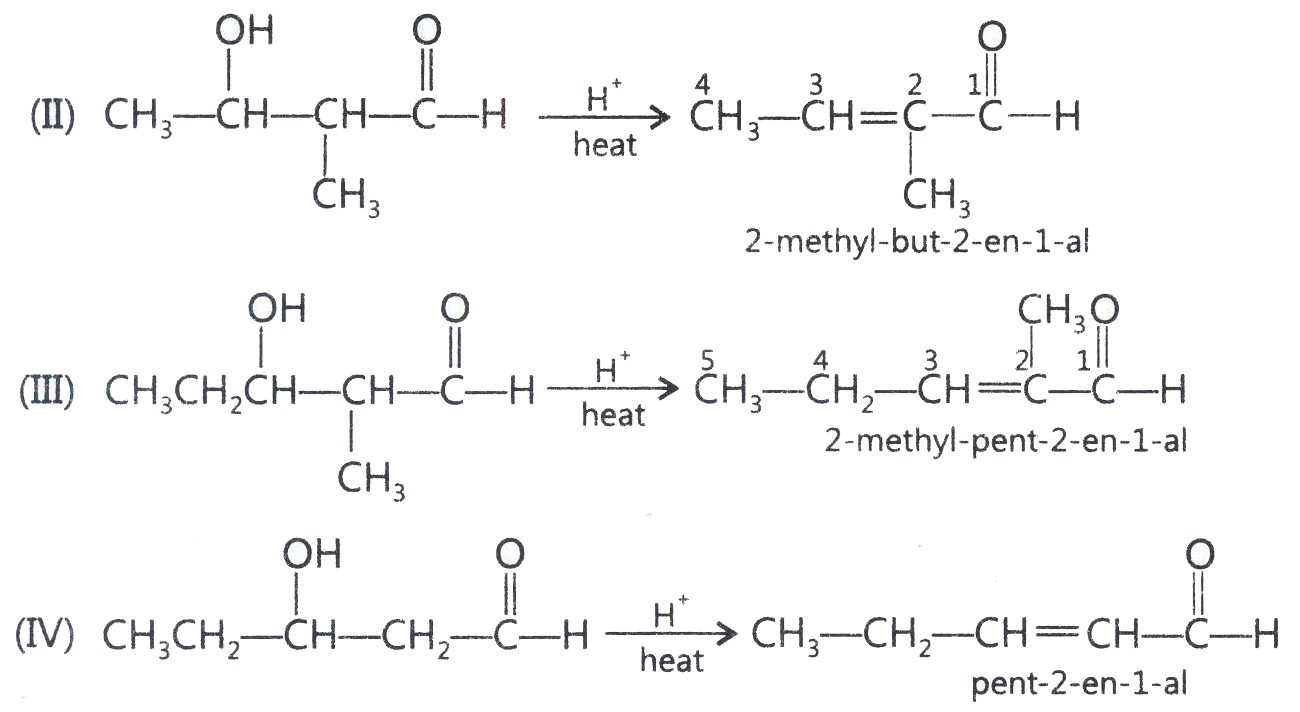
(i) Cannizzaro's reactions.
(ii) Cross aldol condensation
3.
(a) Write chemical equations to illustrate the following name bearing reactions:
(i) Cannizzaro's reaction
(ii) Hell-Volhard-Zelinsky reaction
(b) Give chemical tests to distinguish between the following pairs of compounds
(i) Propanal and Propanone
(ii) Acetophenone and Benzophenone
(iii) Phenol and Benzoic acid
4.
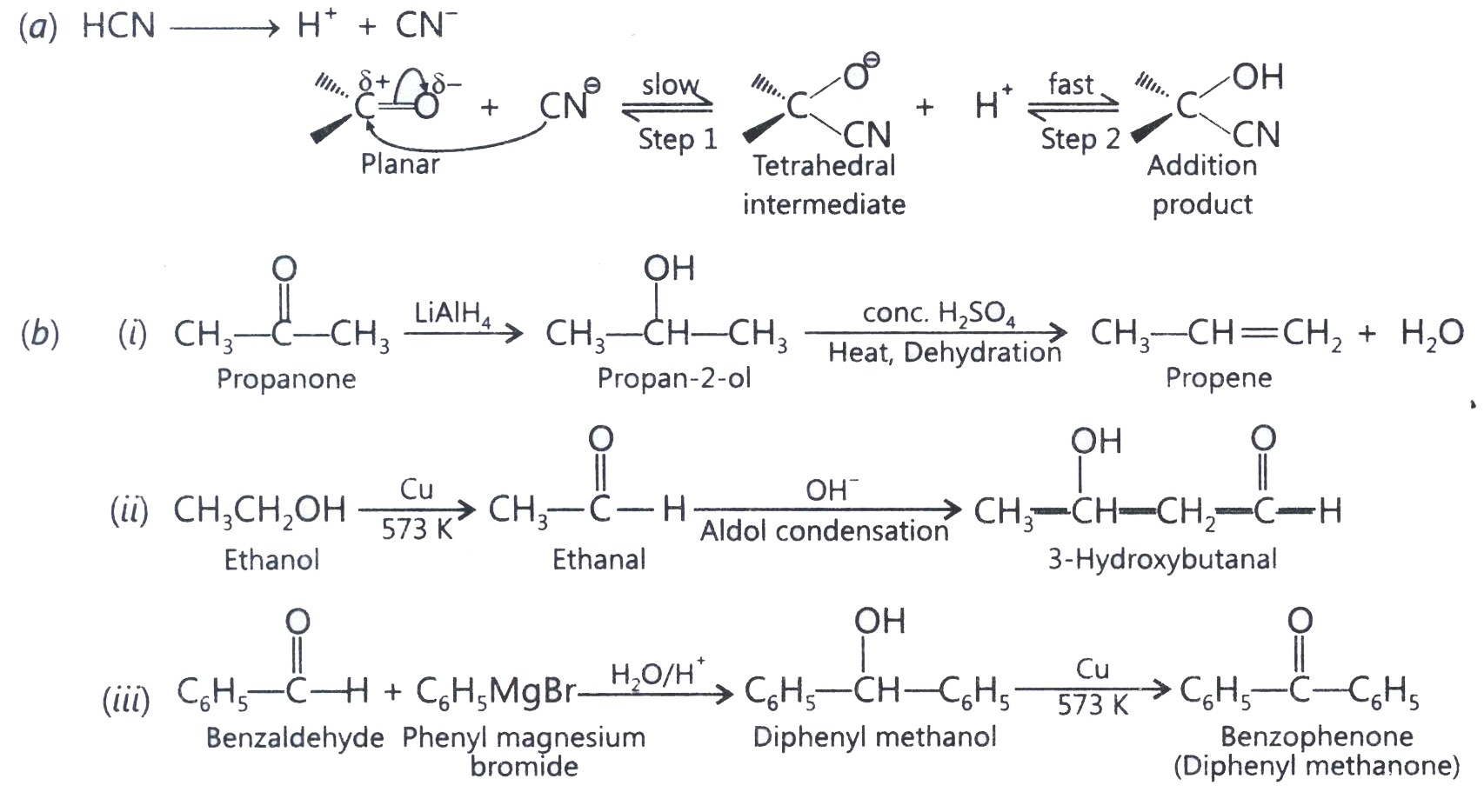
(a) Explain the mechanism of nucleophilic attack on a carbonyl group of an aldehyde or a ketone.
(b) How would you bring about the following conversions:
(i) Propanone to Propene
(ii) Ethanol to 3-hydroxybutanal
(iii) Benzaldehyde to Benzophenone
5.
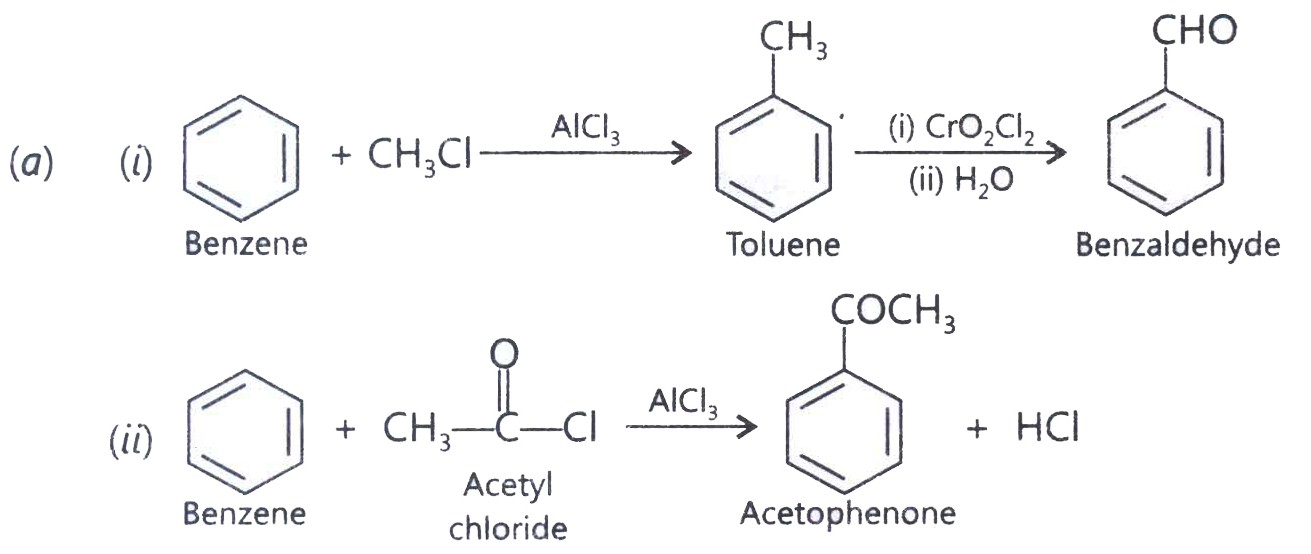
(a) How will you prepare the following compounds starting with benzene:
(i) Benzaldehyde
(ii) Acetophenone
(b) Give chemical tests to distinguish between the following pairs of compounds
(i) Ethanal and Propanal
(ii) Benzaldehyde and Acetophenone
(iii) Phenol and Benzoic acid
1.
(a) (i) First we find out the molecular formula of the compound
% of O2 = 100 - (% of C + % of H) = 100 - (69.77 + 11.63)
= 100 - (81.40)= 19.6%
Empirical formula of the compound = C5H10O
Empirical formula mass = 5 × 12 + 10 × 1 + 16 × 1 = 86
but given that molecular mass = 86
n = molar mass Emperical formula = 8686 = 1 molar mass Emperical formula = 8686 = 1
∴ molecular formula of the compound (C5H10O),
= C5H10O
(b) (i) The strength of an acid is indicated by pKa value, where, pKa = – log Ka
Since monochloroethanoic acid is weaker than dichloroethanoic acid so it has lower value of dissociation constant Ka.
Therefore, it has higher value of pKa.
(ii) The —COOH group in benzoic acid is attached to sp2 - carbon of the phenyl ring and is more acidic than acetic acid in which —COOH group is attached to sp3 – carbon atom of CH3 group. So, benzoic acid is stronger than acetic or acetic acid is weaker acid than benzoic acid.
2.
3.
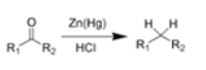
(a) (i) Clemmensen Reduction
The carbonyl group of aldehydes and ketones is reduced to the CH2 group on treatment with zinc amalgam and concentrated hydrochloric acid. This is known as Clemmensen reduction.
(ii) Hell-Volhard-Zelinsky (HVZ )reaction.
Carboxylic acids having a  hydrogen are halogenated at the
  position on treatment with chlorine or bromine in the presence of small amount of red phosphorus to give
  halocarboxylic acids. The reaction is known as Hell-Volhard-Zelinsky reaction.
.JPG)
(b) (i) Propanal (CH3CH2CHO) can be distinguished from propanone (CH3COCH3) by iodoform test.
Being a methyl ketone, propanone on treatment with I2/NaOHundergoes iodoform reaction to give a yellow ppt. of iodoform.
(ii) (ii) Benzaldehyde (C6H5CHO) and acetophenone (C6H5COCH3) can be distinguished by iodoform test.
(iii) Acetophenone, being a methyl ketone on treatment with I2 /NaOH undergoes iodoform reaction to give a yellow ppt. of iodoform. On the other hand, benzaldehyde does not give this test.
4.
5.
(b) (i) Ethanal and Propanal
Iodoform test – Methyl ketones give a positive iodoform test.
Ethanal has one methyl group linked to the carbonyl carbon atom and therefore, responds to this test.
Propanal does not respond to this test.
(ii) Benzaldehyde and Acetophenone
Tollen’s test – aldehydes give a positive Tollen’s test.
Benzaldehyde is an aldehyde. Therefore, it reduces Tollen’s reagent to give a reddish-brown precipitate.
Acetophenone is a ketone and therefore gives a negative test.
(iii) Phenol and Benzoic acid
Ferric chloride test – phenols give a violet coloration with this test.
Phenol reacts with neutral ferric chloride to form an iron-phenol complex, which gives a violet coloration.
Whereas, benzoic acid reacts with neutral ferric chloride to give a buff coloured precipitate of ferric benzoate.

12th Standard CBSE Syllabus & Materials
12th Standard CBSE
CBSE 12th Computer Science Python Revision Tour I - New Previous year Question Papers Study Material - QB365 Set A
NEW12th Standard CBSE
CBSE 12th Business Studies Planning Important Questions And Answers Study Material - QB365 Set A
NEW12th Standard CBSE
CBSE 12th Business Studies Business Environment Important Questions And Answers Study Material - QB365 Set A
NEW12th Standard CBSE
CBSE 12th Business Studies Principles of Management Important Questions And Answers Study Material - QB365 Set A



CBSE 12th Standard CBSE Subjects
CBSE Standards










