
 100% FREE ACCESS
12th Standard CBSE Syllabus & Materials
12th Standard CBSE
CBSE 12th Economics Government Budget and the Economy Previous year Question Papers Study Material - QB365 Set A
NEW12th Standard CBSE
CBSE 12th Computer Science Interface Python with MySQL - New Previous year Question Papers Study Material - QB365 Set A
NEW12th Standard CBSE
CBSE 12th Computer Science Database Concept - New Previous year Question Papers Study Material - QB365 Set A
NEW12th Standard CBSE
CBSE 12th Computer Science Data Communication - New Previous year Question Papers Study Material - QB365 Set A
NEW12th Standard CBSE
CBSE 12th Computer Science Data Structures - New Previous year Question Papers Study Material - QB365 Set A
NEW12th Standard CBSE
CBSE 12th Computer Science Functions - New Previous year Question Papers Study Material - QB365 Set A

Published on: 04/12/2019
Aldehydes , Ketones and Carboxylic Acids
Download CBSE Class 12th Standard CBSE Chemistry question papers, sample papers, important questions, and previous year solved papers in PDF format. Get free study materials, NCERT solutions, and exam preparation resources for Class 12th Standard CBSE Chemistry
Questions + Answers key
Take MCQ Chemistry Test
1.
How will you carry out the following conversions?
(i) Acetylene to acetic acid
(ii) Toluene to m-nitro benzoic acid
2.
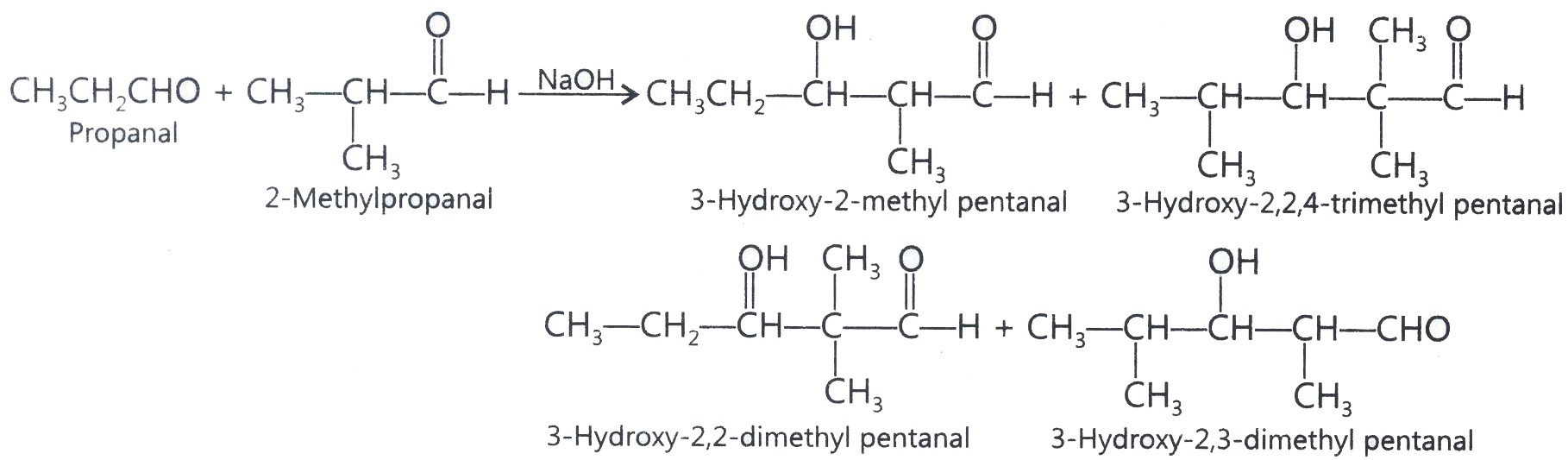
What product will be formed on reaction of propanal with 2-methylpropanal in the presence of NaOH? What products will be formed? Write the name of the reaction also.
3.
Give simple chemical tests to distinguish between the following pairs of compounds.
(i) Pentan-2-one and Pentan-3-one
(ii) Ethanal and Propanal
4.
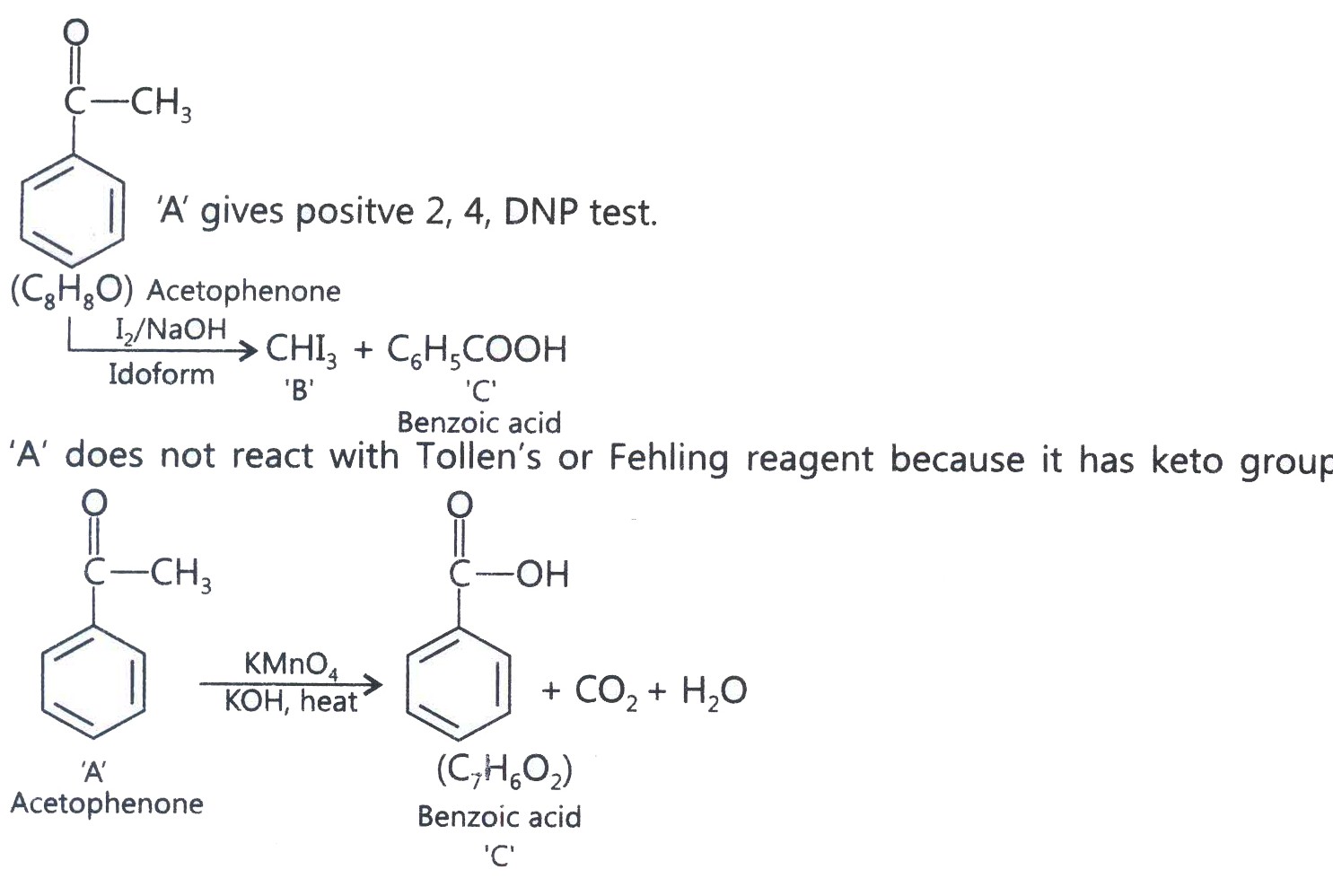
An aromatic compound 'A' (Molecular formula C8H8O) gives positive 2, 4-DNP test. It gives a yellow precipitates of compound 'B' on treatments with iodine and sodium hydroxide solution. Compound 'A' does not give Tollen's or Fehling's test. On drastic oxidation with potassium permanganate it forms a carboxylic acid 'C' (Molecular formula C7HO)6O2), which is also formed along with the yellow compound in the above reaction. Identify A, B and C write all the reacitons involved.
5.
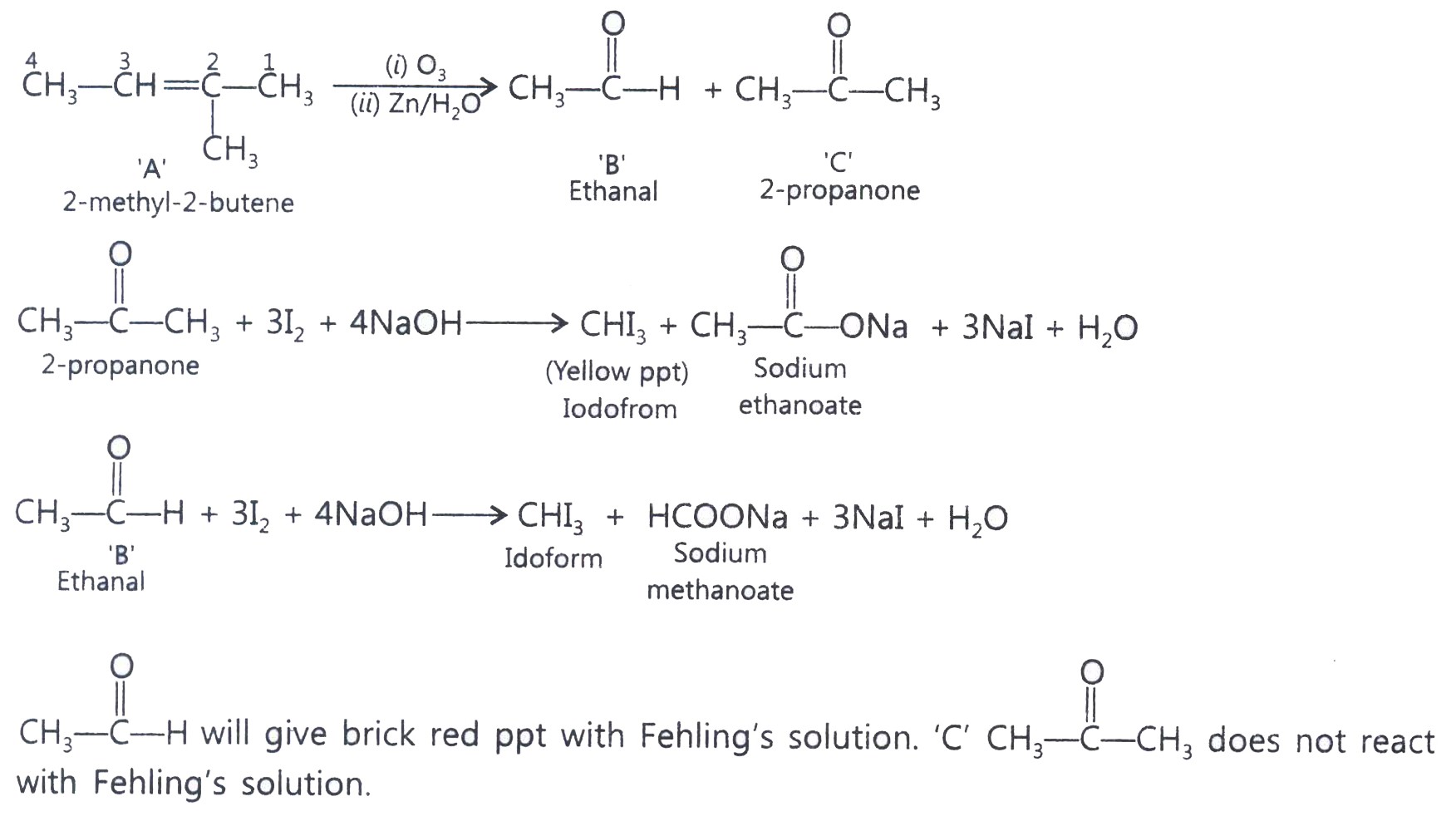
An alkene 'A' (Mol. formula C5H10) on ozonolysis gives a mixture of two compounds 'B' and 'C'. Compound 'B' gives positive Fehling's test and also forms iodoform on treatment with I2 and NaOH. Compound 'C' does not give Fehling's test but forms iodoform. Identify the compounds A, B and C. Write the reaction for ozonolysis and formation of iodoform from B and C.
6.
Give reasons for the following:
(a) Carboxylic acids do not give characteristic reactions of carbonyl group.
(b) Treatment of benzaldehyde with HCN gives a mixture of two isomers which cannot be separated even by careful fractional distillation.
(c) Sodium bisulphite is used for the purification of aldehydes and ketones.
7.
How are the following conversions carried out?
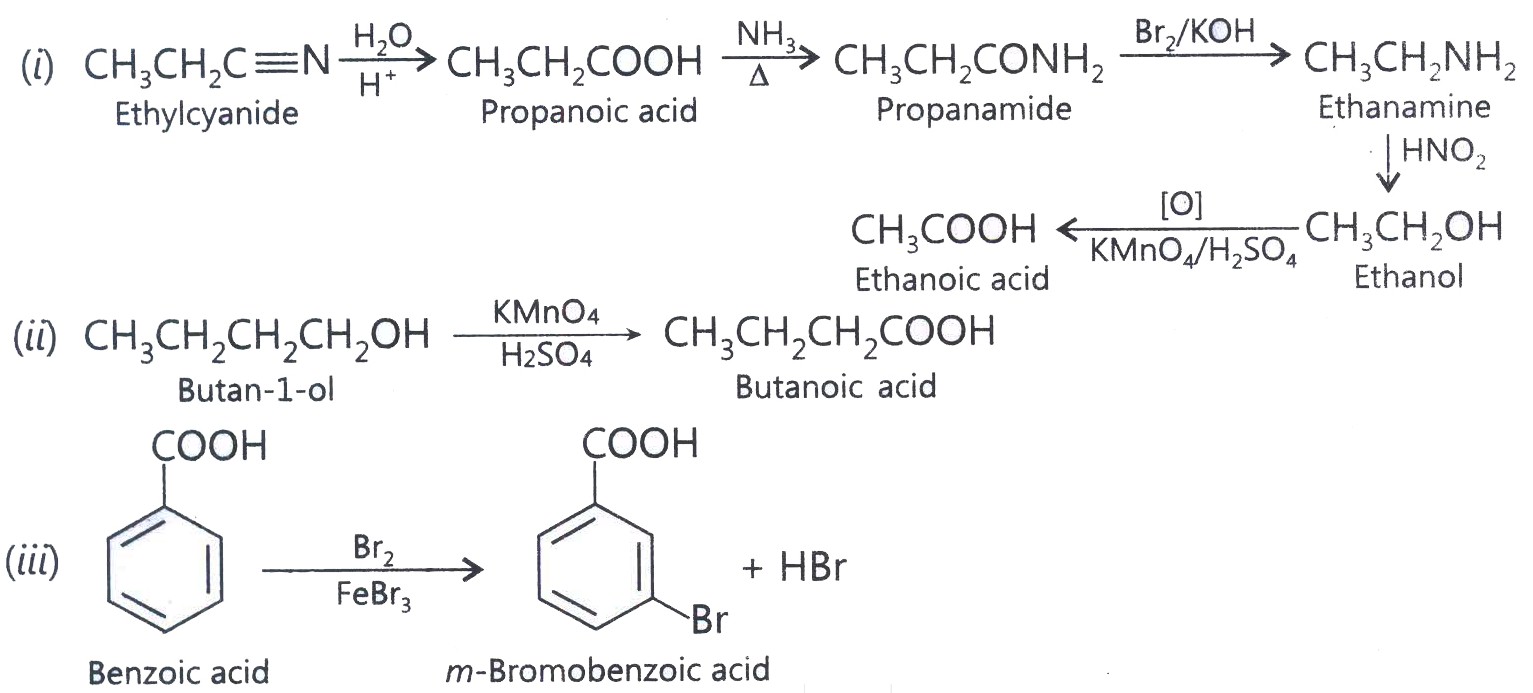
(i) Ethylcyanide to ethanoic acid
(ii) Butan-1-ol to butanoic acid
(iii) Benzoic acid to m-bromobenzoic acid.
8.
A compound A on oxidation gives B (C2H4O2). A reacts with dil. NaOH and on subsequent heating forms C. C on catalytic hydrogenation gives D. Identify A, B, C, D and write down the reactions involved.
9.
A compound with molecular formula, C4H10O3 on acetylation with acetic anhydride gives a compound with molecular weight 190. Find out the number of hydroxyl groups present in the compound.
10.
Write down functional isomers of a carbonyl compound with molecular formula C3H6O. Which isomer will react faster with HCN and why? Explain the mechanism of the reaction also. Will the reaction lead to the completion with the conversion of whole reactant into product at reaction condition. If a strong acid is added to the reaction mixture what will be the effect on concentration of the product and why?
11.
Which of the following is the industrial method of preparation of acetaldeyde ?
CH3CN \(\xrightarrow [ HCI ]{ Sn{ CI }_{ 2 } } \) CH3CH = NH \(\xrightarrow {H_3O^{+}}\)
CH3COCI + H2 \(\xrightarrow [ BaSO_4 ]{Pd } \) CH3CHO + HCI
CH2 = CH2 + H2O \(\xrightarrow {Pd ^{2+}}\)
All of the above.
12.
One mole of a symmetrical alkene on ozonolysis gives two moles of an aldehyde having a molecular mass of 44 u. The alkene is
2-butene
ethene
propane
1-butene
13.
The product formed in Aldol condensation is
an alpha, beta unsaturated ester
a beta hydroxy acid
a beta hydroxyaldehyde or ketone
an alpha hydroxy aldehyde or ketone
14.
Which of the following organic compounds answers both iodoform test and Fehling's test?
Ethanal
Propanone
Ethanol
Methanol
15.
In a reaction, RCHO is reduced to RCH3 using amalgamated zinc and concentrated HCl and warming the solution. The reaction is known as
Meerwein-Ponndorf reaction
Clemmensen reduction
Wolff-Kishner reduction
Schiff's reaction
1.
(i) \(CH\equiv CH\overset { dil{ H }_{ 2 }{ SO }_{ 4 } }{ \underset { { Hg }^{ 2+ } }{ \longrightarrow } } { CH }_{ 2 }=CHOH\overset { Tautomerisation }{ \longrightarrow } { CH }_{ 3 }CHO\overset { { K }_{ 2 }{ Cr }_{ 2 }{ O }_{ 7 } }{ \underset { { H }_{ 2 }{ SO }_{ 4 } }{ \longleftarrow } } \)
(ii)
.JPG)
2.
3.
(i) Add I2 and NaOH. P-2- one will give yellow ppt of iodoform, whereas pentan-3- one will not react.
(ii) Add I2 and NaOH. Ethanal will yellow precicipate of iodoform, whereas proponal does not react.
4.
5.
6.
(a) It is due to resonance.
.JPG)
(b) It is because we get two optical isomers which have same physical properties but differ in sign of optical rotation therefore, cannot be separated by fractional distillation.
.JPG)
(c) Aldehydes and ketones from addition compounds with NaHSO3 whereas impurities do not.
On hydrolysis, we get pure aldehydes and ketone back.
.JPG)
7.
8.
(i) Since compound A on oxidation gives compound 8 with M.F. C2H4O2, therefore, compound 8 may be acetic acid, CH3COOH and A may be acetaldehyde, CH3CHO.
(ii) Since compound A, i.e., acetaldehyde reacts with dil. NaOH, therefore, it undergoes aldol condensation to afford an aldol.Further since this aldol on heating gives compound (C), therefore, (C) must be an α, β- unsaturated aldehyde, i.e., but-2-en-I-al (crotonaldehyde).
(iii) Since compound (C) on catalytic hydrogenation gives compound D, therefore, D may be either I-butanal or I-butanol depending upon the extent of hydrogenation.
AIl the reactions involved in this question are explained below:
9.
During acetylation, one H-atom (at. mass = Iamu) of the OH group is replaced by an acetyl group, i.e., CH3CO (mol. mass = 43 amu). .
-OH + (CH3CO)2O ⇾ -O-COCH3 + CH3COOH
In other words, acetylation of each OH group increases the mass by 43 - I = 42 amu. Now the mol. mass of C4H10O = 106 amu while that of the acetylated product is 190 amu, therefore, the number of OH groups III the compound\(={190-106\over 42}=2\)
10.
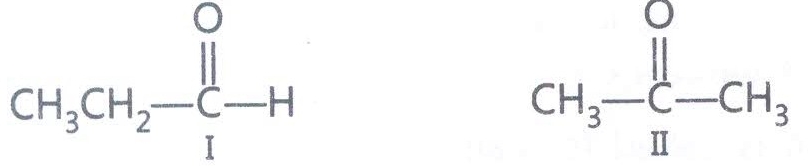
Compound I will react faster with HCN because it is less stearically hindered and has more positive charge on carbonyl compounds.
Mechanism of the reaction:
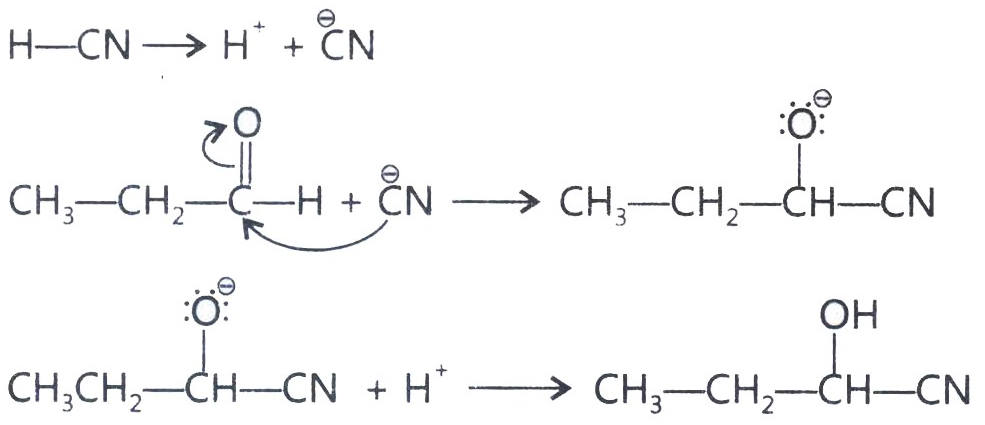
The reaction will not lead to completion.It is reversible reaction, hence equilibrium established.
Addition of strong acid will will inhibit the reaction because dissociation of HCN will be reduced due to common ion effect and formation of CN- is prevented.
11.
(c)
CH2 = CH2 + H2O \(\xrightarrow {Pd ^{2+}}\)
12.
(a)
2-butene
13.
(c)
a beta hydroxyaldehyde or ketone
14.
(a)
Ethanal
15.
(b)
Clemmensen reduction

12th Standard CBSE Syllabus & Materials
12th Standard CBSE
CBSE 12th Computer Science Python Revision Tour I - New Previous year Question Papers Study Material - QB365 Set A
NEW12th Standard CBSE
CBSE 12th Business Studies Planning Important Questions And Answers Study Material - QB365 Set A
NEW12th Standard CBSE
CBSE 12th Business Studies Business Environment Important Questions And Answers Study Material - QB365 Set A
NEW12th Standard CBSE
CBSE 12th Business Studies Principles of Management Important Questions And Answers Study Material - QB365 Set A



CBSE 12th Standard CBSE Subjects
CBSE Standards










