
 100% FREE ACCESS
12th Standard CBSE Syllabus & Materials
12th Standard CBSE
CBSE 12th Economics Government Budget and the Economy Previous year Question Papers Study Material - QB365 Set A
NEW12th Standard CBSE
CBSE 12th Computer Science Interface Python with MySQL - New Previous year Question Papers Study Material - QB365 Set A
NEW12th Standard CBSE
CBSE 12th Computer Science Database Concept - New Previous year Question Papers Study Material - QB365 Set A
NEW12th Standard CBSE
CBSE 12th Computer Science Data Communication - New Previous year Question Papers Study Material - QB365 Set A
NEW12th Standard CBSE
CBSE 12th Computer Science Data Structures - New Previous year Question Papers Study Material - QB365 Set A
NEW12th Standard CBSE
CBSE 12th Computer Science Functions - New Previous year Question Papers Study Material - QB365 Set A

Published on: 08/10/2019
Biomolecules
Download CBSE Class 12th Standard CBSE Chemistry question papers, sample papers, important questions, and previous year solved papers in PDF format. Get free study materials, NCERT solutions, and exam preparation resources for Class 12th Standard CBSE Chemistry
Questions + Answers key
Take MCQ Chemistry Test
1.
Shanti a domestic helper of Mrs. Anuradha, fainted while mopping the floor. Mrs. Anuradha immediately took her to the nearby hospital where she was diagnosed to be severely anaemic. The doctor prescribed an iron rich diet and multivitamins supplement to her. Mrs. Anuradha supported her 'financially to get the medicines. After a month, Shanti was diagnosed to be normal.
After reading the above passage, answer the following questions:
(i) What values are displayed by Mrs. Anuradha ?
(ii) Name the vitamins whose deficiency causes pernicious anaemia.
(iii) Give an example of water soluble vitamin.
2.
After watching a programme on TV about the adverse effect of junk food and soft drinks on the health of school children, Sonali, a student of class XII, discussed the issue with the school principal. Principal immediately instructed the canteen contractor to replace the fast food with fibre and vitamin rich food like sprouts, salad, fruits etc. This decision was welcomed by the parents and the students.
After reading the above passage, answer the following questions:
(i) What values are expressed by Sonali and the principal of the school?
(ii) Give two examples of water soluble vitamins.
3.
In 1985, a British chemist Alec [effryo developed a technique called DNA finger printings. We know the every individual has unique fingerprints. They appear as circles on the tips of fingers and are used for the identification of individuals. It is arranged that every person has its own sequence of bases in DNA. It can not match with those of any other person.
(i) What is the full form of DNA?
(ii) Which base is present in DNA and not in RNA ?
(iii) Which base is present in RNA and not in DNA?
(iv) What value does Alec jeffryo have?
4.
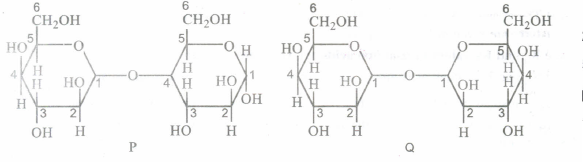
Which of the following will reduce Tollens ' reagent ? Explain.
5.
Write the structure of alanine at pH = 2 and pH = 10.
6.
The Ka and Kb values of \(\alpha\) - amino acids are very low. Explain.
7.
What forces are responsible for the stability of \(\alpha\) - helix ? Why is it named as 3.613 helix?
8.
Give reason for the following :
(i) On electrolysis in acidic solution, aminoacids migrate towards cathode while in alkaline solution these migrate towards anode.
(ii) The mononamino monocarboxylic acids have two pK values.
9.
Glucose and fructose give the same osazone ? Explain.
10.
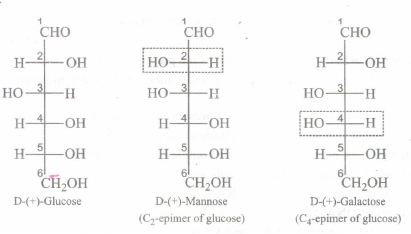
How do expimers differ from anomers ?
1.
(i) Concern for health of other person, kind, intelligent.
(ii) Vitamin B12
(iii) Vitamin B / Vitamin C
2.
Values expressed by Sonali : Awareness regarding deterimental consequences of junk food and also inclined towards the health of her school mates.
Values expressed by Principal : He showed responsible attitude in hearing to the opinion and taking immediate action for the health of students.
(ii) Vitamin B Complex and Vitamin C.
3.
(i) It is Deoxyribo Nucleic acid.
(ii) Base thymine is present in DNA and not in RNA.
(iii) Base uracil is present in RNA and not in DNA.
(iv) Allee was having scientific attitude.
4.
In disaccharide (Q), both the monosaccharides are linked through their reducing centres (\({ C }_{ 1 }\)), therefore, it is not a reducing disaccharide. In disaccharide (P), the reducing end (\({ C }_{ 1 }\)) of one monosaccharide is linked to non-reducing end (\({ C }_{ 4 }\)) of the other monosaccharide. In other words, reducing end of one monosaccharide is free. Therefore, it is a reducing disaccharide.
5.
Alanine exists as a zwitterion (I) in aqueous solution. In presence of acid (pH = 2), the basic - COO- group accepts a proton to give cation (II) but in presence of a base (pH = 10), the acidic - \({ NH }_{ 3 }\) group donates a proton to the base and thus exists as an anion (III).
\(\quad \quad \quad { CH }_{ 3 }\quad \quad \quad \quad \quad \quad \quad \quad \quad \quad \quad \quad { CH }_{ 3 }\\ \quad \quad \quad \quad |\quad \quad \quad \quad \quad \quad \quad \quad \quad \quad \quad \quad \quad |\\ \overset { + }{ { NH }_{ 3 } } -CH-{ COO }^{ - }\quad \overset { { H }^{ + } }{ \longrightarrow } \overset { + }{ { NH }_{ 3 } } -CH-{ COO }H\\ \quad \quad Alanine\quad (I)\quad \quad \quad \quad \quad \quad \quad \quad II\)
\(\\ \quad \quad \quad { CH }_{ 3 }\quad \quad \quad \quad \quad \quad \quad \quad \quad \quad \quad \quad { CH }_{ 3 }\\ \quad \quad \quad \quad |\quad \quad \quad \quad \quad \quad \quad \quad \quad \quad \quad \quad \quad |\\ \overset { + }{ { NH }_{ 3 } } -CH-{ COO }^{ - }\quad \overset { { OH }^{ - } }{ \longrightarrow } \overset { + }{ { NH }_{ 3 } } -CH-{ { COO }^{ - } }\\ \quad \quad Alanine\quad (I)\quad \quad \quad \quad \quad \quad \quad \quad III\\ \)
6.
The Ka and Kb values of a-amino acids are very low because, in a-amino acids, the acidic group is \({ NH }_{ 3 }\) instead of -COOH in carboxylic acids and basic group is -\({ COO }^{ - }\) instead of -\({ NH }_{ 2 }\) group in aliphatic amines. For example, the Ka and Kb values of glycine are \(1.6\times { 10 }^{ -10 }\) and \(2.5\times { 10 }^{ -12 }\) respectively.
7.
The stability of \(\alpha \) -helix structure is due to intramolecular H-bonding between -NH- and -CO- groups of the same polypeptide chain. The \(\alpha \) -helix is termed as \({ 3.6 }_{ 13 }\) helix since each turn of the helix has approximately 3·6 amino acids and the hydrogen bonding leads to the formation of a 13-membered ring.
8.
(i) Amino acids have zwitterionic structure. Therefore. in presence of strong acids the} exist as cations' (I) and thus on electrolysis, these migrate towards cathode.
\(\overset { + }{ { NH }_{ 3 } } -CHR-{ COO }^{ - }+{ H }^{ + }\longrightarrow \quad \overset { + }{ { NH }_{ 3 } } -CHR-{ COO }H\\ \quad \quad Zwitterion\quad \quad \quad \quad \quad \quad \quad \quad \quad \quad \quad \quad Cation(I)\)
In contrast, in presence of alkalies, the amino acids exist as anions (II) and thus on electrolysis, these migrate towards anode.
\(\overset { + }{ { NH }_{ 3 } } -CHR-{ COO }^{ - }+{ OH }^{ - }\longrightarrow \quad \overset { + }{ { NH }_{ 3 } } -CHR-{ COO }H\\ \quad \quad Zwitterion\quad \quad \quad \quad \quad \quad \quad \quad \quad \quad \quad \quad Anion(II)\\ \)
(ii) A monoamino monocarboxylic acid such as glycine exists as a dipolar ion \((\overset { + }{ { NH }_{ 3 } } -{ CH }_{ 2 }-{ COO }^{ - })\) .In this structure, \(\overset { + }{ { NH }_{ 3 } } \) group acts as the acid and \({ COO }^{ - }\) group acts as the base. Thus, monoamino monocarboxylic acids can act both as an acid as well as a base. Therefore, these acids have two pK values one as an acid (when titrated with a base) and other as a base (when titrated with an acid).
9.
During osazone formation, the reaction occurs only at CI and C2 while rest of the molecule remains intact. Since glucose and fructose differ from each other only in the arrangement of atoms at CI and C2, therefore, they. give the same osazone.
10.
Carbohydrates which differ in configuration at the glycosidic carbon (i.e. \({ C }_{ 1 }\) in aldoses and \({ C }_{ 2 }\) in ketoses) are called anomers while those which differ in configuration at any carbon other than glycosidic carbon are called epimers. For example, \(\alpha \)-D-glucose and \(\beta \)-D-glucose are anomers since they differ in configuration at \({ C }_{ 1 }\) (glycosidic carbon) while glucose and mannose are called epimers since they differ in configuration at \({ C }_{ 2 }\)(other than the glycosidic carbon \({ C }_{ 1 }\) ). In other words, glucose and mannose are Cr epimers. Similarly, we can show that glucose and galactose are \({ C }_{ 4 }\) -epimers since they differ in configuration only at \({ C }_{ 4 }\).

12th Standard CBSE Syllabus & Materials
12th Standard CBSE
CBSE 12th Computer Science Python Revision Tour I - New Previous year Question Papers Study Material - QB365 Set A
NEW12th Standard CBSE
CBSE 12th Business Studies Planning Important Questions And Answers Study Material - QB365 Set A
NEW12th Standard CBSE
CBSE 12th Business Studies Business Environment Important Questions And Answers Study Material - QB365 Set A
NEW12th Standard CBSE
CBSE 12th Business Studies Principles of Management Important Questions And Answers Study Material - QB365 Set A



CBSE 12th Standard CBSE Subjects
CBSE Standards










