
 100% FREE ACCESS
12th Standard CBSE Syllabus & Materials
12th Standard CBSE
CBSE 12th Economics Government Budget and the Economy Previous year Question Papers Study Material - QB365 Set A
NEW12th Standard CBSE
CBSE 12th Computer Science Interface Python with MySQL - New Previous year Question Papers Study Material - QB365 Set A
NEW12th Standard CBSE
CBSE 12th Computer Science Database Concept - New Previous year Question Papers Study Material - QB365 Set A
NEW12th Standard CBSE
CBSE 12th Computer Science Data Communication - New Previous year Question Papers Study Material - QB365 Set A
NEW12th Standard CBSE
CBSE 12th Computer Science Data Structures - New Previous year Question Papers Study Material - QB365 Set A
NEW12th Standard CBSE
CBSE 12th Computer Science Functions - New Previous year Question Papers Study Material - QB365 Set A

Published on: 04/12/2019
Biomolecules
Download CBSE Class 12th Standard CBSE Chemistry question papers, sample papers, important questions, and previous year solved papers in PDF format. Get free study materials, NCERT solutions, and exam preparation resources for Class 12th Standard CBSE Chemistry
Questions + Answers key
Take MCQ Chemistry Test
1.
Amylose and cellulose are both straight chain polysaccharides containing only D-glucose units. What is the structural difference between the two?
2.
Describe the following terms in reference to proteins:
(i) Primary structure
(ii) Denaturation
3.
State what do you understand by primary structure and secondary structure of proteins.
4.
Answer the following queries about proteins:
(i) How are proteins related to amino acids?
(ii) How are oligopeptides different from polypeptides?
(iii) When is a protein said to be denaturated?
5.
(a) What is denaturation and renaturation of proteins?
(b) Give reason:Amylase present in the saliva becomes inactive in the stomach
6.
Define the following, giving one example of each:
(i) Zwitter ion
(ii) Glycosidic linkage
7.
The two strands in DNA are not identical but are complementary. Explain.
8.
The amino acids are the product of the digestion of
lipid
fats
protein
alcohol
9.
Which of the following disaccharide gives a ketose and an aldose only on hydrolysis?
Sucrose
Maltose
Lactose
All the three
10.
The term anomer of glucose refers to
isomers of glucose that differ in configuration at carbons one and four (C-1 and C-4)
a mixture of (D)-glucose and (L)-glucose
enantiomers of glucose
isomers of glucose that differ in configuration at carbon one (C-1)
11.
Which of the following is incorrect for glucose?
It contains four > CHOH groups
It contains one ketone group
It contains one CH2OH group
It contains one-CHO group
12.
Carbohydrates form a group of naturally occuring organic compounds and are a major source of energy for our body. Some common examples are of cane sugar, glucose etc. Chemically these are either polyhydric aldehydes or polyhydric ketones and are classified as monosaccharides, oligosaccharides and polysaccharides.
(i) Name the carbohydrates which has maximum sweetners.
(ii) Which carbohydrate is present in milk?
(iii) Why is sucrose a non-reducing sugar ?
(iv) How do carbohydrates (starch in particular) act as a source of energy for our body?
13.
Which of the following will reduce Tollens ' reagent ? Explain.
14.
Give reason for the following :
(i) On electrolysis in acidic solution, aminoacids migrate towards cathode while in alkaline solution these migrate towards anode.
(ii) The mononamino monocarboxylic acids have two pK values.
15.
How do expimers differ from anomers ?
1.
Amylose is a straight chain polysaccharide having only D-glucose units joined together by a-glycosidic linkages between C-1 of one glucose and C-4 of next glucose. It has 100 to 300 D-glucose units. Its molecular mass is 10,000 to 50,000. Cellulose is straight chain linear polymer of f 3-D-glucose. It consists of 300 to 2500 D-glucose units having molecular mass 50,000 to 5,00,000.
2.
(i) The sequence in which amino acids are linked with each other is called primary structure of proteins.
(ii) Denaturation is a process in which secondary and tertiary structures are ruptured by heating or change in pH, etc.
3.
Primary Structure of Protein: The sequence in which the amino acids are arranged in a protein is called the primary structure of protein. Secondary Structure of Protein: The polypeptide chain gets folded due to intramolecular hydrogen bonding between the carboxyl and amino groups. In an \(\alpha\)-helix, the peptide chain coils and the turns of the coil are held together by hydrogen bonds. Another type of secondary structure is possible in which the protein chains are stretched out. This is the \(\beta\)-pleated sheet structure.
4.
(i) Proteins are biopolymers of amino acids which condense together forming peptide bonds.
(ii) Oligopeptides on hydrolysis give 3 to 12 \(\alpha \)-amino acids, where as polypeptides give large number of \(\alpha \)-amino acids on hydrolysis.
(iiI) When tertiary structure of protein is ruptured by,protein pH or on heating, protein is said to be denatured.It lose its biological activity.
5.
(a)The process of disruption of higher structure without changing its primary structure is called denaturation. If the disruptive agent is removed and protein recovers its original structure, it is called renaturation.
(b)In stomach pH is acidic, therefore, amylase becomes inactive, that is why digestion of carbohydrates does not take place in stomach.
6.
(i)The ion whose one end is positively charged and other end is negatively charged is called Zwitter ion, e.g.,
\({ H }_{ 2 }N-CH_{ 2 }-COOH\rightleftharpoons { H }_{ 3 }^{ \oplus }N-CH_{ 2 }-COO^{ - }\)
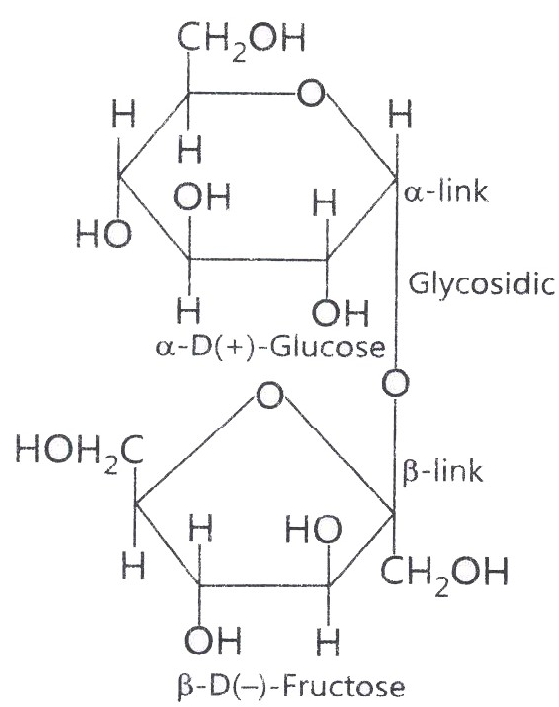
(ii) Glycosidic Linkage: The oxide linkage between monosachharide units in oligo and polysachharide is called glycosidic linkage, e.g.
7.
Each strand consist of 4 bases which are Adenine, Guanine, Thymine and Cytosine.
These complementary bases are the following:
Adenine (A) ⇔ Thymine (T)
Cytosine (C) ⇔ Guanine (G)
⇔ This symbol represents that both the left and right hand side bases are complementary to each other.
The two strands are internally connected by hydrogen bonding between complementary bases. The two strands of DNA are not identical because their sequence of bases has to be complementary to each other. Ex- If one sequence is ATCG the other has to be TAGC.
8.
(c)
protein
9.
(a)
Sucrose
10.
(d)
isomers of glucose that differ in configuration at carbon one (C-1)
11.
(b)
It contains one ketone group
12.
(i) Sucrose is the sweetest of all the known carbohydrates.
(ii) Lactose is present in milk.
(iii) Sucrose is a disaccharide in which two reducing monosaccharides are linked to each other by glycosidic linkange and are not free.
(iv) In our body starch get hydrolysed to glucose in the presence of enzymes. Glucose is slowly oxidised to CO2 and water in the presence of enzyme oxidase present in our body. The oxidation reaction is accompanied by the release of energy.
13.
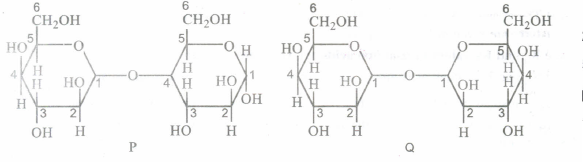
In disaccharide (Q), both the monosaccharides are linked through their reducing centres (\({ C }_{ 1 }\)), therefore, it is not a reducing disaccharide. In disaccharide (P), the reducing end (\({ C }_{ 1 }\)) of one monosaccharide is linked to non-reducing end (\({ C }_{ 4 }\)) of the other monosaccharide. In other words, reducing end of one monosaccharide is free. Therefore, it is a reducing disaccharide.
14.
(i) Amino acids have zwitterionic structure. Therefore. in presence of strong acids the} exist as cations' (I) and thus on electrolysis, these migrate towards cathode.
\(\overset { + }{ { NH }_{ 3 } } -CHR-{ COO }^{ - }+{ H }^{ + }\longrightarrow \quad \overset { + }{ { NH }_{ 3 } } -CHR-{ COO }H\\ \quad \quad Zwitterion\quad \quad \quad \quad \quad \quad \quad \quad \quad \quad \quad \quad Cation(I)\)
In contrast, in presence of alkalies, the amino acids exist as anions (II) and thus on electrolysis, these migrate towards anode.
\(\overset { + }{ { NH }_{ 3 } } -CHR-{ COO }^{ - }+{ OH }^{ - }\longrightarrow \quad \overset { + }{ { NH }_{ 3 } } -CHR-{ COO }H\\ \quad \quad Zwitterion\quad \quad \quad \quad \quad \quad \quad \quad \quad \quad \quad \quad Anion(II)\\ \)
(ii) A monoamino monocarboxylic acid such as glycine exists as a dipolar ion \((\overset { + }{ { NH }_{ 3 } } -{ CH }_{ 2 }-{ COO }^{ - })\) .In this structure, \(\overset { + }{ { NH }_{ 3 } } \) group acts as the acid and \({ COO }^{ - }\) group acts as the base. Thus, monoamino monocarboxylic acids can act both as an acid as well as a base. Therefore, these acids have two pK values one as an acid (when titrated with a base) and other as a base (when titrated with an acid).
15.
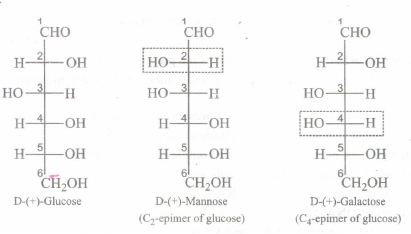
Carbohydrates which differ in configuration at the glycosidic carbon (i.e. \({ C }_{ 1 }\) in aldoses and \({ C }_{ 2 }\) in ketoses) are called anomers while those which differ in configuration at any carbon other than glycosidic carbon are called epimers. For example, \(\alpha \)-D-glucose and \(\beta \)-D-glucose are anomers since they differ in configuration at \({ C }_{ 1 }\) (glycosidic carbon) while glucose and mannose are called epimers since they differ in configuration at \({ C }_{ 2 }\)(other than the glycosidic carbon \({ C }_{ 1 }\) ). In other words, glucose and mannose are Cr epimers. Similarly, we can show that glucose and galactose are \({ C }_{ 4 }\) -epimers since they differ in configuration only at \({ C }_{ 4 }\).

12th Standard CBSE Syllabus & Materials
12th Standard CBSE
CBSE 12th Computer Science Python Revision Tour I - New Previous year Question Papers Study Material - QB365 Set A
NEW12th Standard CBSE
CBSE 12th Business Studies Planning Important Questions And Answers Study Material - QB365 Set A
NEW12th Standard CBSE
CBSE 12th Business Studies Business Environment Important Questions And Answers Study Material - QB365 Set A
NEW12th Standard CBSE
CBSE 12th Business Studies Principles of Management Important Questions And Answers Study Material - QB365 Set A



CBSE 12th Standard CBSE Subjects
CBSE Standards










