
 100% FREE ACCESS
12th Standard CBSE Syllabus & Materials
12th Standard CBSE
CBSE 12th Economics Government Budget and the Economy Previous year Question Papers Study Material - QB365 Set A
NEW12th Standard CBSE
CBSE 12th Computer Science Interface Python with MySQL - New Previous year Question Papers Study Material - QB365 Set A
NEW12th Standard CBSE
CBSE 12th Computer Science Database Concept - New Previous year Question Papers Study Material - QB365 Set A
NEW12th Standard CBSE
CBSE 12th Computer Science Data Communication - New Previous year Question Papers Study Material - QB365 Set A
NEW12th Standard CBSE
CBSE 12th Computer Science Data Structures - New Previous year Question Papers Study Material - QB365 Set A
NEW12th Standard CBSE
CBSE 12th Computer Science Functions - New Previous year Question Papers Study Material - QB365 Set A

Published on: 18/09/2019
Biomolecules
Download CBSE Class 12th Standard CBSE Chemistry question papers, sample papers, important questions, and previous year solved papers in PDF format. Get free study materials, NCERT solutions, and exam preparation resources for Class 12th Standard CBSE Chemistry
Questions + Answers key
Take MCQ Chemistry Test
1.
Enumerate two reactions of glucose which cannot be explained by its open chain structure.
2.
What are the products of hydrolysis of
(i) lactose
(ii) sucrose. Also name the enzyme used for reaction.
3.
Sugar is dextrorotatory but the mixture obtained after hydrolysis is laevorotatory. Explain. What is the name of the hydrolysis product? Also comment upon its sweetness.
4.
How do epimers differ from anomers? Give two examples.
5.
Glucose forms an oxime but glucose prntaacetate does not. Explain.
6.
Activation energy for the acid catalysed hydrolysis of surcose is 6.22 kJmol-1, while the activation energy is only 2.15 kJ mol-1 when hydrolysis is catalysed by the enzyme sucrase. Explain
7.
Why does compound (A) given below not form an oxime ?
8.
\(\alpha -\) Helix is a secondary structure of proteins formed by twisting of polypeptide chain into right handed screw like structures. which type of interactions are responsible for making the \(\alpha -\) helix structure stable ?
9.
Describe the term D-and L-configuration used for amino acids with examples.
10.
State two main differences between globular proteins and fibrous proteins.
1.
(i) Glucose does not give Schiff‘s Test although it contains aldehyde group.
(ii) Glucose does not form crystaline product with NaHSO3.
2.
(i) \(\underset { Lactose }{ C_{ 12 } } { H }_{ 22 }{ O }_{ 11 }+{ H }_{ 2 }O\overset { Lactose }{ \longrightarrow } \underset { glucose }{ { C }_{ 6 } } { H }_{ 12 }{ O }_{ 6 }+\underset { glactose }{ { C }_{ 6 } } { H }_{ 12 }{ O }_{ 6 }\)
(ii) \(\underset { Sucorse }{ C_{ 12 } } { H }_{ 22 }{ O }_{ 11 }+{ H }_{ 2 }O\overset { Invertase }{ \longrightarrow } \underset { glucose }{ { C }_{ 6 } } { H }_{ 12 }{ O }_{ 6 }+\underset { fructose }{ { C }_{ 6 } } { H }_{ 12 }{ O }_{ 6 }\)
3.
Sucrose is dextrorotatory having \({ \left[ \alpha \right] }_{ D }\)= +66.5°. On hydrolysis with dilute acids or enzymes, it gives equimolar D-(+)-glucose and D-(-)-fructose

Since D-(-)-fructose has larger specific rotation than D-(+)-glucose, the resulting mixture has specific rotation of-39.9°. Therefore, the mixture is laevorotatory.
4.
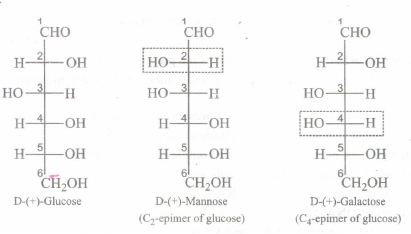
Carbohydrates which differ in configuration at the glycosidic carbon (i.e. \({ C }_{ 1 }\) in aldoses and \({ C }_{ 2 }\) in ketoses) are called anomers while those which differ in configuration at any carbon other than glycosidic carbon are called epimers. For example, \(\alpha \)-D-glucose and \(\beta \)-D-glucose are anomers since they differ in configuration at \({ C }_{ 1 }\) (glycosidic carbon) while glucose and mannose are called epimers since they differ in configuration at \({ C }_{ 2 }\)(other than the glycosidic carbon \({ C }_{ 1 }\) ). In other words, glucose and mannose are Cr epimers. Similarly, we can show that glucose and galactose are \({ C }_{ 4 }\) -epimers since they differ in configuration only at \({ C }_{ 4 }\).
5.
Glucose' reacts with\({ NH }_{ 2 }OH\) via the open chain form which has the free -CH = O group to form glucose oxime. Glucose pentaacetate, on the other hand, cannot be converted into the open chain form because its anomeric hydroxyl group (i.e. \({ C }_{ 1 }\)- OH) is acetylated and hence does not form the oxime.
6.
Enzymes are the essential biological catalysts which are needed to catalyse biochemical reactions. Enzymes are needed only in small quantities for the progress of a reaction. Like chemical catalysts, enzymes reduces the magnitude of activation energy by providing alternative pathway, e.g. in hydrolysis of sucrose, the enzyme sucrase reduces the activation energy from 6.22 kJ mol-1 to 2.15 kJ mol-1.Thus, enzyme catalysed reactions occur at a much faster rate.
7.
Glucose pentaacetate (structure A) does not have a free -OH group at\({ C }_{ 1 }\) and hence cannot be converted into the open chain form having a free -CHO group. Therefore, glucose pentaacetate does not form an oxime.
8.
The \(\alpha \) -helix structure of polypeptide chain is stabilized by intramolecular H-bonding in which >C = 0 of one amino acid residue in one turn forms a H-bond with - NH - group of the fourth amino acid in the adjacent turn.
9.
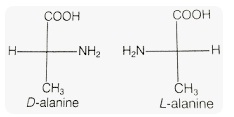
All naturally occurring α-amino acids (except glycine) are optically active due to the presence of chiral carbon atom. These have either D- or L-configuration D-form means that, the amino (-NH2) group is present towards the right hand side L-atom shows the presence of -NH2 group on the left hand side.
10.
| Globular Proteins | Fibrous Proteins |
| (i) They form \(\alpha\)-helix structure. | (i) They have \(\beta\)-pleated structure |
| (ii) They are soluble in water | (ii) They are insoluble in water |
| (iii) They are cross linked condensation polymers of acidic and basic amino acids. | (iii)They are linear condensation products. |
|
(iv) They are folded to give rise to three dimensional spherical shape. Examples : albumin, enzymes, hormones, casein(milk) |
(iv) The long linear protein chains form thread like structure. Example:Fibroin, Collagen, Myosine, Keratin etc. |

12th Standard CBSE Syllabus & Materials
12th Standard CBSE
CBSE 12th Computer Science Python Revision Tour I - New Previous year Question Papers Study Material - QB365 Set A
NEW12th Standard CBSE
CBSE 12th Business Studies Planning Important Questions And Answers Study Material - QB365 Set A
NEW12th Standard CBSE
CBSE 12th Business Studies Business Environment Important Questions And Answers Study Material - QB365 Set A
NEW12th Standard CBSE
CBSE 12th Business Studies Principles of Management Important Questions And Answers Study Material - QB365 Set A



CBSE 12th Standard CBSE Subjects
CBSE Standards










