
 100% FREE ACCESS
12th Standard CBSE Syllabus & Materials
12th Standard CBSE
CBSE 12th Economics Government Budget and the Economy Previous year Question Papers Study Material - QB365 Set A
NEW12th Standard CBSE
CBSE 12th Computer Science Interface Python with MySQL - New Previous year Question Papers Study Material - QB365 Set A
NEW12th Standard CBSE
CBSE 12th Computer Science Database Concept - New Previous year Question Papers Study Material - QB365 Set A
NEW12th Standard CBSE
CBSE 12th Computer Science Data Communication - New Previous year Question Papers Study Material - QB365 Set A
NEW12th Standard CBSE
CBSE 12th Computer Science Data Structures - New Previous year Question Papers Study Material - QB365 Set A
NEW12th Standard CBSE
CBSE 12th Computer Science Functions - New Previous year Question Papers Study Material - QB365 Set A

Published on: 04/12/2019
Chemical Kinetics
Download CBSE Class 12th Standard CBSE Chemistry question papers, sample papers, important questions, and previous year solved papers in PDF format. Get free study materials, NCERT solutions, and exam preparation resources for Class 12th Standard CBSE Chemistry
Questions + Answers key
Take MCQ Chemistry Test
1.
For a reaction, the graph of the rate reaction against molar concentration of the reactant is as shown. What is the order of the reaction ?
2.
Why are reactions of higher order less in number ?
3.
Why molecularity is applicable only for elementary reactions and order is applicable for elementary as well as complex reactions?
4.
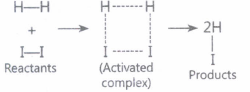
With the help of diagram explain the role of activated complex in a reaction.
5.
For the reaction, the energy of activation is 75KJ / mol. When a catalyst is added the reaction its energy of activation is lowered to 20KJ / mol. What is the effect of catalyst on the rate of reaction at 200C.
6.
At 300 oC the thermal dissociation of HI is found to be 20%. What will be the equilibrium concentrations of H2 and I2 in the system
H2 + I2 \(\rightleftharpoons \) 2HI at this temperature if the equilibrium concentration of HI in it be 0.96 mol L-1?
7.
In general it is observed that the rate of chemical reaction doubles with every 10o rise in temperature. If the generalization holds good for the reaction in the temperature range 295 K to 305 K, what would be the value of activation energy for the this reaction?
(R = 8.314 J mol-1 K-1)
8.
A first order reaction takes 100 minutes for completion of 60% of the reaction. Find the time when 90% of the reaction will be completed.
9.
Which of the following statements are in accordance with the Arhenius equation ?
Rate of a reaction increases with decrease in temperature
Rate of a reaction increases with decrease in activation energy
Rate constant decreases exponentially with increase in temperature
Rate of reaction decreases with decrease in activation energy
10.
For a complex reaction ............. .
order of overall reaction is same as molecularity of the slowest step
order of overall reaction is less than the molecularity of the lowest step
order of overall reaction is grater than molecularity of the slowest step
molecularity of the slowest step is never zero or non integer.
11.
The half-life period of a radioactive element is 20 days. What will be the remaining mass of 100 g of it after 60 days?
25 g
50 g
12.5 g
20 g
12.
75% of the first order reaction was completed in 32 min. 50% of the reaction was completed in
24 min
8 min
16 min
4 min
13.
Rate constant of a reaction (k) is 175 litre2 mol-2 sec-1. What is the order of reaction?
first
second
third
zero
14.
For the hydrolysis of methyl acetate in aqueous solution, the following results were obtained:
| t/s | 0 | 30 | 60 |
| [CH3COOCH3]/mol L-1 | 0.60 | 0.30 | 0.15 |
(i) Show that It follows pseudo first order reaction, as the concentration of water remains constant.
(ii) Calculate the average rate of reaction between the time interval 30 to 60 seconds. [Given log 2 = 0.3010, log 4 = 0.6021]
15.
The time required for 10% completion of a first order reaction at 298 K is equal to that required for its 25% completion at 318 K. If the pre-exponential factor for the reaction is 3.56 \(\times 10 ^{9} s^{-1}\), calculate its rate constant at 318 K and also the energy of activation.
1.
Zero order.
2.
A reaction takes place because the molecules collide. The chances for a large lnumber of molecules or ions to collide simultaneously are less. Hence, the reactions of higher order are less.
3.
Complex reaction proceeds through several elementary reactions. Molecularity of each elementary reaction may be different, therefore, molecularity of complex reaction can't be determined. Order of complex reaction is determined by slowest step in mechanism (involving elementary reactions).
4.
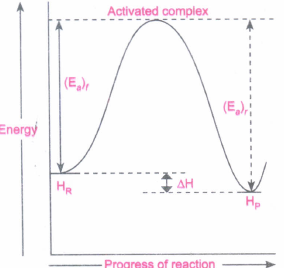
Activated complex is intermediate compound between reactants and products as shown above. It is highly unstable as it has highest energy. It readily charges into product. Those molecules which can form activated complex can lead to formation of products, e.g
5.
Log K = log A - Ea/2.303RT
Log K’ = log A - Ea/2.303RT
Log K = log A - Ea/2.303RT
Log K’/K = Ea-Ea/2.303 RT = 9.8037
Or K’/K = 6.36 x 10⁹
UR catalysted /UR uncatalysed = K’/K = 6.4 x 10 9
6.
2HI ⇌ H2 (g) + I2 (g)
Initial cone. 2x 0 0
Equilibrium cone. 2x-0.4x 0.2x 0.2x
At equilibrium [HI] = 0.96 mol L-1
2x - 0.4x = 0.96
1.6x = 0.96
x= 0.60 mol L-1
[H2] at equilibrium 0.2x = 0.2 x 0.60 = 0.12 mol L-1
[I2]at equilibrium O.2x = 0.2 x 0.60 = 0.12 mol L-1
7.
\({ T }_{ 1 }=295K, \ { T }_{ 2 }=305K, \ { k }_{ 2 }=2{ k }_{ 1 } \ (given)\)
\(\log { \frac { { k }_{ 2 } }{ { k }_{ 1 } } } =\frac { { E }_{ a } }{ 2.303R } \left( \frac { { T }_{ 2 }-{ T }_{ 1 } }{ { T }_{ 1 }{ T }_{ 2 } } \right) \)
\(\log { 2 } = \ \frac { { E }_{ a } }{ 2.303\times 8.314 } \left( \frac { 305-295 }{ 305\times 295 } \right) \)
\({ E }_{ a } \ = \ \frac { 19.147\times 305\times 295\times 0.3010 }{ 10 } \)
\( { E }_{ a } \ = \ 51854.8 \ J \ { mol }^{ -1 }\)
\(=51.85 \ KJ \ { mol }^{ -1 }\)
8.
\(k={2.303\over t}log{[R]_0\over [R]}\)
\(={2.303\over 100}log{[R]_0\over {40\over 100}[R]_0}\)
[60% is complete, 40% is left]
\(k={2.303\over 100}(log5-log2)\)
\(k={2.303\over 100}(0.6990-0.3010)\)
\(k={2.303\over 100}\times0.3980\ min^{-1}\)
\(t_{90./.}={2.303\over k}log{[R]_0\over [R]}\)
[90% is complete, 10% is left]
\(t_{90./.}={2.303\over k}log{[R]_0\over {10\over 100}[R]_0}\)
\(={2.303\times100\over 2.303\times0.3980}log10\)
\(={100\over 0.3980}=251.26min\)
9.
(b)
Rate of a reaction increases with decrease in activation energy
10.
(d)
molecularity of the slowest step is never zero or non integer.
11.
(c) : 60 days = 3 half-lives, i.e., n = 3 ; [A] = \(\frac { [A]_{ 0 } }{ { 2 }^{ n } } =\frac { 100 }{ { 2 }^{ 3 } } =\frac { 100 }{ 8 } =12.5g\)
12.
(c) : 75% of reaction is completed in two half-lived i.e., 2 \(\times\) t 12 = 32 min or t 1/2 = 16 min
13.
(c) : On the basis of given units of k, the reactions of 3 rd order.
14.
For the first order reaction
\(t_1=30sec\)
\(t_2=30sec\)
\(k_1=\frac{2.303}{t_1}\log \frac{a}{(a-x)}\)
\(\Rightarrow\ \ \ \ k_1=\frac{2.303}{30}\log \frac{0.60}{0.30}\)
\(=\frac{2.303}{30}\log 2\)
\(\Rightarrow\ \ \ \ k_1=\frac{2.303}{30}\times 0.3010\)
\(=0.0231 \ s^{-1}\)
and \(k_2=\frac{2.303}{t_2}\log \frac{a}{(a-x)}\)
\(=\frac{2.303}{60}\log \frac{0.60}{0.15}\)
\(=\frac{2.303}{60}\log 2^2\)
\(\Rightarrow\ \ k_2=\frac{2.303\times 2 \times 0.3010}{30}\)
\(=0.0231\ s^{-1}\)
\(\because\ k_1=k_2\)
Hence, the reaction is pseudo first order reaction.
(ii) \(Rate=\frac{\Delta x}{\Delta t}\)
\(=\frac{0.30-0.15}{60-30}=\frac{0.15}{30}\)
\(=0.005 \ mol\ L^{-1} \ s^{-1}\)
15.
\(t_1={2.303\over k_1}log{a\over 0.10a}=t_1={2.303\over k_2}log{a\over a-0.25a}\)
As t1 = t2 \({2.303\over k_1}log{a\over 0.90a}={2.303\over k_2}log{a\over 0.7a};\ {k_2\over k_1}={log(100/75)\over log(100/90)}=2.73\)
But \(log{k_2\over k_1}={E_a\over 2.303R}\left(T_2-T_1\over T_1T_2\right)\)
Putting k2/k1) = 2.73, R = 8.314 J K-1 mol-1, T1 = 298 K, T2 = 308 K, we get Ea = 76.6 kJ mol-1
Further, k - Ae-Ea / RT or log k = log A -\({E_a\over 2.303RT}\)
Putting A = 3.56 x 10⁹s-1, R = 8.314 x 10⁻³ kJ K-1 mol-1, Ea = 76.6 kJ mol-1, T = 318 K, we get
k = 9.3 x 10⁻⁴ S-1.

12th Standard CBSE Syllabus & Materials
12th Standard CBSE
CBSE 12th Computer Science Python Revision Tour I - New Previous year Question Papers Study Material - QB365 Set A
NEW12th Standard CBSE
CBSE 12th Business Studies Planning Important Questions And Answers Study Material - QB365 Set A
NEW12th Standard CBSE
CBSE 12th Business Studies Business Environment Important Questions And Answers Study Material - QB365 Set A
NEW12th Standard CBSE
CBSE 12th Business Studies Principles of Management Important Questions And Answers Study Material - QB365 Set A



CBSE 12th Standard CBSE Subjects
CBSE Standards










