
 100% FREE ACCESS
12th Standard CBSE Syllabus & Materials
12th Standard CBSE
CBSE 12th Economics Government Budget and the Economy Previous year Question Papers Study Material - QB365 Set A
NEW12th Standard CBSE
CBSE 12th Computer Science Interface Python with MySQL - New Previous year Question Papers Study Material - QB365 Set A
NEW12th Standard CBSE
CBSE 12th Computer Science Database Concept - New Previous year Question Papers Study Material - QB365 Set A
NEW12th Standard CBSE
CBSE 12th Computer Science Data Communication - New Previous year Question Papers Study Material - QB365 Set A
NEW12th Standard CBSE
CBSE 12th Computer Science Data Structures - New Previous year Question Papers Study Material - QB365 Set A
NEW12th Standard CBSE
CBSE 12th Computer Science Functions - New Previous year Question Papers Study Material - QB365 Set A

Published on: 16/09/2019
Coordination Compounds
Download CBSE Class 12th Standard CBSE Chemistry question papers, sample papers, important questions, and previous year solved papers in PDF format. Get free study materials, NCERT solutions, and exam preparation resources for Class 12th Standard CBSE Chemistry
Questions + Answers key
Take MCQ Chemistry Test
1.
Describe the shape and magnetic behaviour of the following complex. [Ni(CN)4]2-
2.
Write the state of hybridisation, shape and IUPAC name of the complex
[CO(NH3)6]3+ (Atomic no. of Co= 27).
3.
Explain why [Co(NH3)6]3+ is an inner complex whereas [Ni(NH3)6]2+ is an outer orbitals complex. (At. no. Co = 27, Ni = 28)
4.
(i) Write down the IUPAC name of the following complex: [Co(NH3)5Cl]2+
(ii) Write the formula for the following complex: Potassium tetrachloridonickelate (II)
5.
Write the IUPAC name of the complex [Cr(NH3)4Cl2]+. What type of isomerism does it exhibit?
6.
Using valence bond theory, explain the bonding in [Cr(H2O)6]3+. (At. No.of Cr = 24).
7.
Name the type of isomerism when ambidentate ligands are attached to central metal ion. Give two examples of ambidentate ligands.
8.
Out of the following two coordination entities which is chiral (optically active)?
(a) cis-[CrCl2(ox)2]3-
(b) trans-[CrCl2(ox)2]3-
1.
In [Ni(CN)4]2-, nickel is in +2 oxidation state and has the electronic configuration 3d8 4s0
s.png)
As CN- is a strong field ligand, pairing of electrons takes place and resulting in empty one 3d orbital, one 4s orbital and two 4p orbitals which undergoes hybridisation to form four dsp2-hybrid orbitals. These hybrid orbitals occupied by electron pairs of four CN- ions.
∴ [Ni(CN)4]2-=
s.png)
Thus, the hybridisation involved is dsp2 and therefore, the species is square planar and diamagnetic as all electrons are paired.
2.
lUPAC name is: Hexafluorocobaltate (III) ion
3.
When the complex formed involves the inner (n -1) d-orbitals for hybridization (d2sp3), the/complex is called inner orbital complex. [Co(NH3)6]3+ involves inner (n - 1) d-orbitals. Therefore, it is called inner orbitals complex. When the complex formed involves the use of outer n d-orbitals for hybridization (sp3d2), the complex is called outer orbital complex. [Ni(NH3)6]2+ involves (n - 1) d-orbitals. Therefore, it is outer complex.
[Co(NH3)6]3+ Co = 27 = 4s23d7
Co3+ = 3d6
4.
(i) Pentaamminechloridocobalt (Ill) ion
(ii) K2[NiCI4]
5.
Tetraamminedichlorochromium (III). It exhibits geometrical isomerism.
6.
Cr(24) has outer electronic configuration 4s13d5.
Cr3+(24):4s03d3.
H2O is weak field ligand, it cannot cause pairing of electrons.
7.
Linkage isomerism.
8.
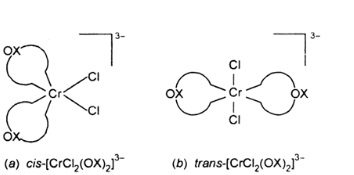
Out of the two, (a) cis - [CrCl2(ox)2]3- is chiral (optically active).

12th Standard CBSE Syllabus & Materials
12th Standard CBSE
CBSE 12th Computer Science Python Revision Tour I - New Previous year Question Papers Study Material - QB365 Set A
NEW12th Standard CBSE
CBSE 12th Business Studies Planning Important Questions And Answers Study Material - QB365 Set A
NEW12th Standard CBSE
CBSE 12th Business Studies Business Environment Important Questions And Answers Study Material - QB365 Set A
NEW12th Standard CBSE
CBSE 12th Business Studies Principles of Management Important Questions And Answers Study Material - QB365 Set A



CBSE 12th Standard CBSE Subjects
CBSE Standards










