
 100% FREE ACCESS
12th Standard CBSE Syllabus & Materials
12th Standard CBSE
CBSE 12th Economics Government Budget and the Economy Previous year Question Papers Study Material - QB365 Set A
NEW12th Standard CBSE
CBSE 12th Computer Science Interface Python with MySQL - New Previous year Question Papers Study Material - QB365 Set A
NEW12th Standard CBSE
CBSE 12th Computer Science Database Concept - New Previous year Question Papers Study Material - QB365 Set A
NEW12th Standard CBSE
CBSE 12th Computer Science Data Communication - New Previous year Question Papers Study Material - QB365 Set A
NEW12th Standard CBSE
CBSE 12th Computer Science Data Structures - New Previous year Question Papers Study Material - QB365 Set A
NEW12th Standard CBSE
CBSE 12th Computer Science Functions - New Previous year Question Papers Study Material - QB365 Set A

Published on: 04/11/2019
Download CBSE Class 12th Standard CBSE Chemistry question papers, sample papers, important questions, and previous year solved papers in PDF format. Get free study materials, NCERT solutions, and exam preparation resources for Class 12th Standard CBSE Chemistry
Questions + Answers key
Take MCQ Chemistry Test
1.
Crude copper containing Fe and Ag as contaminations was subjected to electro refining by using a current of 175 A for 6.434 min. The mass of anode was found to decrease by 22.260 g, while that of cathode was increased by 22.011 g. Estimate the % of copper, iron and silver in crude copper.
2.
State and explain Kohlrausch's law of independent migration of ions. How can the degree of dissociation of acetic acid be calculated from its molar conductance data?
3.
Conductivity of \(2.5\times { 10 }^{ -4 }\)M methanoic acid is \(5.25\times { 10 }^{ -5 }S{ cm }^{ -1 }\). Calculate its molar conductivity and degree of dissociation.
Given: \({ \lambda }^{ ° }\left( { H }^{ + } \right) \) = 349.5 S cm-2mol-1 and \({ \lambda }^{ ° }\left( { HCOO }^{ - } \right) \) = 50.5 S cm2mol-1
4.
An alkene 'A' (Mol. formula C5H10) on ozonolysis gives a mixture of two compounds 'B' and 'C'. Compound 'B' gives positive Fehling's test and also forms iodoform on treatment with I2 and NaOH. Compound 'C' does not give Fehling's test but forms iodoform. Identify the compounds A, B and C. Write the reaction for ozonolysis and formation of iodoform from B and C.
5.
Identify the first row transition metal ions which have outer electronic configurations of 3d4 and 3d6 and describe their oxidation states.
6.
What is a nickel-cadmium cell? State its one merit and one demerit over lead storage cell. Write the overall reaction that occurs during discharging of this cell.
7.
Conc. H2SO4 has a density of 1.9 gmL-1 and is 99 % by weight. calculate the molarity of is 99% by weight. Calculate the molarity of H2SO4 (Mol . Wt pf H2SO4 = 98 g mol-1).
8.
Assign reasons for the following:
(i) Phosphorus doped silicon is a semiconductor.
(ii) Schottky defect lowers the density of a solid.
(iii) Some of the very old glass objects appear slightly milky instead of being transparent.
9.
Silver forms ccp lattice and X-ray studies of its crystals show that the edge length of its unit cell is 408.6 pm. Calculate the density of silver (Atomic mass = 107.9 u)
10.
A 5% solution of cane-sugar (m.wt. = 342) is isotonic with 0.877% solution of urea. Find the molecular weight of urea.
1.
% of Cu, Fe, Ag are 98.88, 0.831, 0.289 respectively.
2.
Kohlrausch's law of independent migration of ions It states that limiting molar conductivity of an electrolyte can be represented as the sum of the individual contributions of the anion and cation-sf the electrolyte. If \(\Lambda ^{ 0 }_{ Na^{ + } }\)and \(\Lambda ^{ 0 }_{ CI^{ - } }\)
are limiting molar; conductivity of the sodium and chloride ions, respectively, then the limiting molar conductivity for NaCI is
\(\Lambda ^{ 0 }_{ Na^{ + } }(NaCI)\) \(\Lambda ^{ 0 }_{ Na }+\Lambda ^{ 0 }_{ ci }\)
Calculation of degree of dissociation of weak electrolyte such as acetic acid.
Degree of dissociation \(\left( \alpha \right) \)
\(=\frac { \Lambda ^{ c }_{ m }(Molar \ conductivity \ at \ any \ conc) }{ \Lambda ^{ c }_{ m }(Limiting \ molar \ conductivity) } \)
3.
K = 5.25 x 10⁻⁵ S cm-1, M = 2.5 x 10⁻⁴ M.
\(\lambda_{\mathrm{HCOOH}}^{0}=\lambda_{\left(\mathrm{HCOO}^{-}\right)}^{0}+\lambda_{\mathrm{H}}^{0}+\)
= 349.5 + 50.5 : 400 S cm2 mol-1.
\(\Lambda_{m}=\frac{1000 \kappa}{\mathrm{M}}=\frac{1000 \times 5.25 \times 10^{-5}}{2.5 \times 10^{-4}}\)
= \(\frac{1000 \times 525}{10 \times 2.5 \times 100}\)
\(\Rightarrow \quad \Lambda_{m}=\frac{525}{2.5}=\frac{5250}{25}=210 \mathrm{~S} \mathrm{~cm}^{2} \mathrm{~mol}^{-1}\)
\(\alpha=\frac{\Lambda_{\mathrm{m}}}{\Lambda_{\mathrm{m}}^{0}}=\frac{210}{400}=\frac{21}{40}=0.525\)
\(\Rightarrow \ \alpha\) = 0.525 x 100% = 52.5%
4.
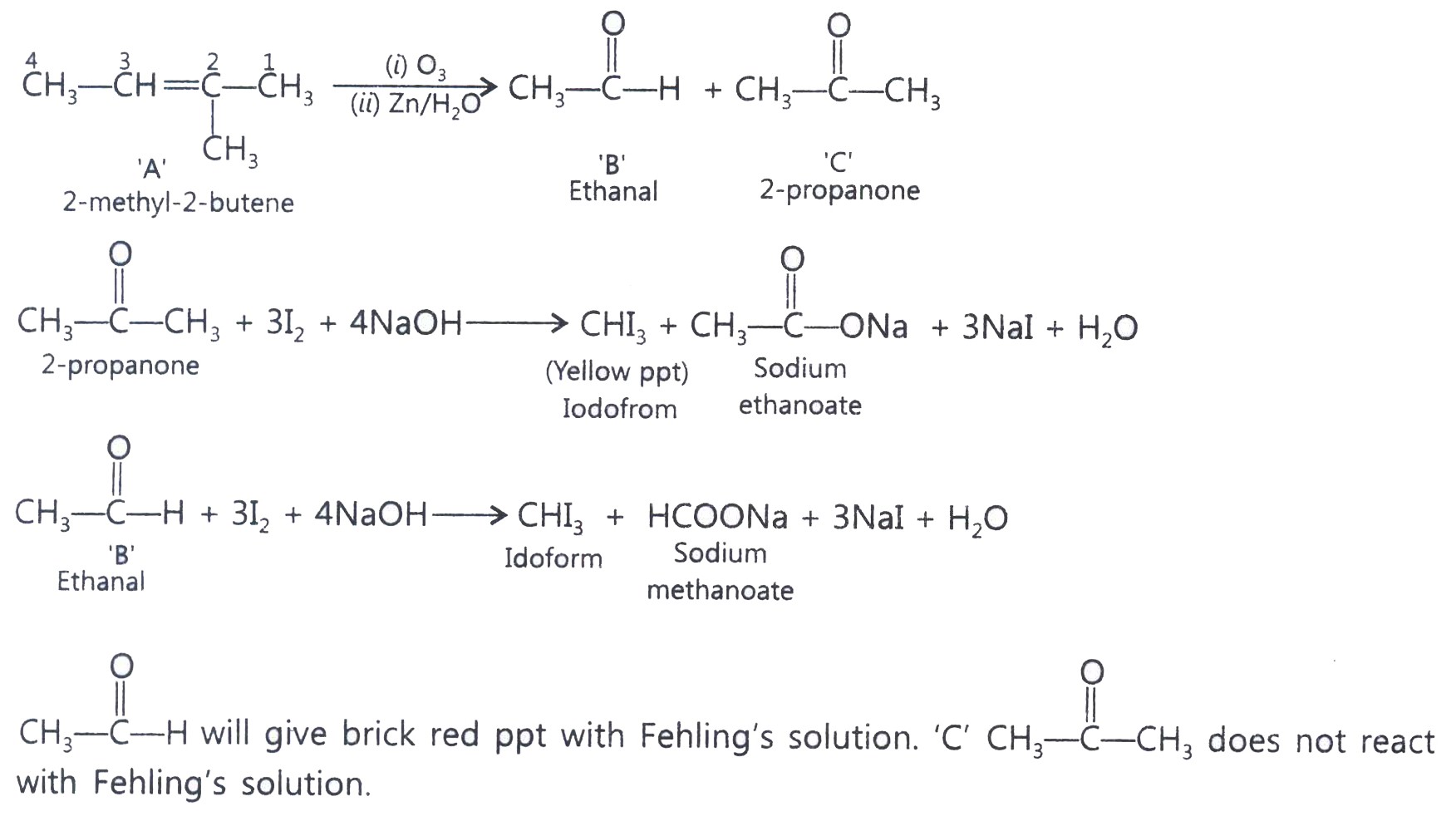
5.
Cr2+ has electronic configuration 3d4 Chromium also shows +3 and +6 oxidation states. Fe2+ has electronic configuration 3d6. Iron has oxidation states +2 and +3.
6.
Nickel-cadmium cell:
t is another type of secondary cell which has longer life than lead storage cell but more expensive to manufacture. The overall reaction during discharge is
\(Cd(s)+{ 2Ni(OH) }_{ 3 }(s)\rightarrow CdO(s)+{ 2Ni(OH) }_{ 2 }(s)+{ H }_{ 2 }O(l).\)
Merit:
It is easy to handle as it is less bulky than lead storage cell and has longer life than lead storage cell.
Demerit:
It is more expensive than lead storage cell.
7.
d = 1.9 9 mL-l, WB= 99.0 g, M8 = 98 9 mol-1,
\(Volume={Mass\over Density}={100\over 1.9}cm3\)
\(Molanty(M) ={W_B\over M_B}\times{1000\over vol.\ of\ solution}\)
\(={99\over 98}\times{1000\over {100\over 1.9}}=19.19M\)
8.
(i) It is because its conductance is intermediate between conductor and insulator.
(ii) In Schottky defect, both cations and anions are missing which lead to lowering in the density of a solid.
(iii) The glass is supercooled liquid, therefore, very old glass objects become slightly milky because of heating during the day and cooling at nights, i.e. annealing over a number of years, glass acquires some crystalline structure.
9.
Since the lattice is ccp, the number of silver atoms per unit cell = z = 4
Molar mass of silver = 107.9 mol-1 = 107.9 x 10⁻³ kg mol-1
Edge length of unit cell = a = 408.6 pm = 408.6×10⁻¹² m
\(\text { Density, } d=\frac{z \cdot \mathrm{M}}{\mathrm{a}^{3} \cdot \mathrm{N}_{\mathrm{A}}}\)
\(=\frac{4 \times\left(107.9 \times 10^{-3} \mathrm{~kg} \mathrm{~mol}^{-1}\right)}{\left(408.6 \times 10^{-12} \mathrm{~m}\right)^{3}\left(6.022 \times 10^{23} \mathrm{~mol}^{-1}\right)}=10.5 \times 10^{3} \mathrm{~kg} \mathrm{~m}^{-3}\)
= 10.5 g cm-3
10.
60 u

12th Standard CBSE Syllabus & Materials
12th Standard CBSE
CBSE 12th Computer Science Python Revision Tour I - New Previous year Question Papers Study Material - QB365 Set A
NEW12th Standard CBSE
CBSE 12th Business Studies Planning Important Questions And Answers Study Material - QB365 Set A
NEW12th Standard CBSE
CBSE 12th Business Studies Business Environment Important Questions And Answers Study Material - QB365 Set A
NEW12th Standard CBSE
CBSE 12th Business Studies Principles of Management Important Questions And Answers Study Material - QB365 Set A



CBSE 12th Standard CBSE Subjects
CBSE Standards










