
 100% FREE ACCESS
12th Standard CBSE Syllabus & Materials
12th Standard CBSE
CBSE 12th Economics Government Budget and the Economy Previous year Question Papers Study Material - QB365 Set A
NEW12th Standard CBSE
CBSE 12th Computer Science Interface Python with MySQL - New Previous year Question Papers Study Material - QB365 Set A
NEW12th Standard CBSE
CBSE 12th Computer Science Database Concept - New Previous year Question Papers Study Material - QB365 Set A
NEW12th Standard CBSE
CBSE 12th Computer Science Data Communication - New Previous year Question Papers Study Material - QB365 Set A
NEW12th Standard CBSE
CBSE 12th Computer Science Data Structures - New Previous year Question Papers Study Material - QB365 Set A
NEW12th Standard CBSE
CBSE 12th Computer Science Functions - New Previous year Question Papers Study Material - QB365 Set A

Published on: 06/09/2019
Haloalkanes and Haloarenes
Download CBSE Class 12th Standard CBSE Chemistry question papers, sample papers, important questions, and previous year solved papers in PDF format. Get free study materials, NCERT solutions, and exam preparation resources for Class 12th Standard CBSE Chemistry
Questions + Answers key
Take MCQ Chemistry Test
1.
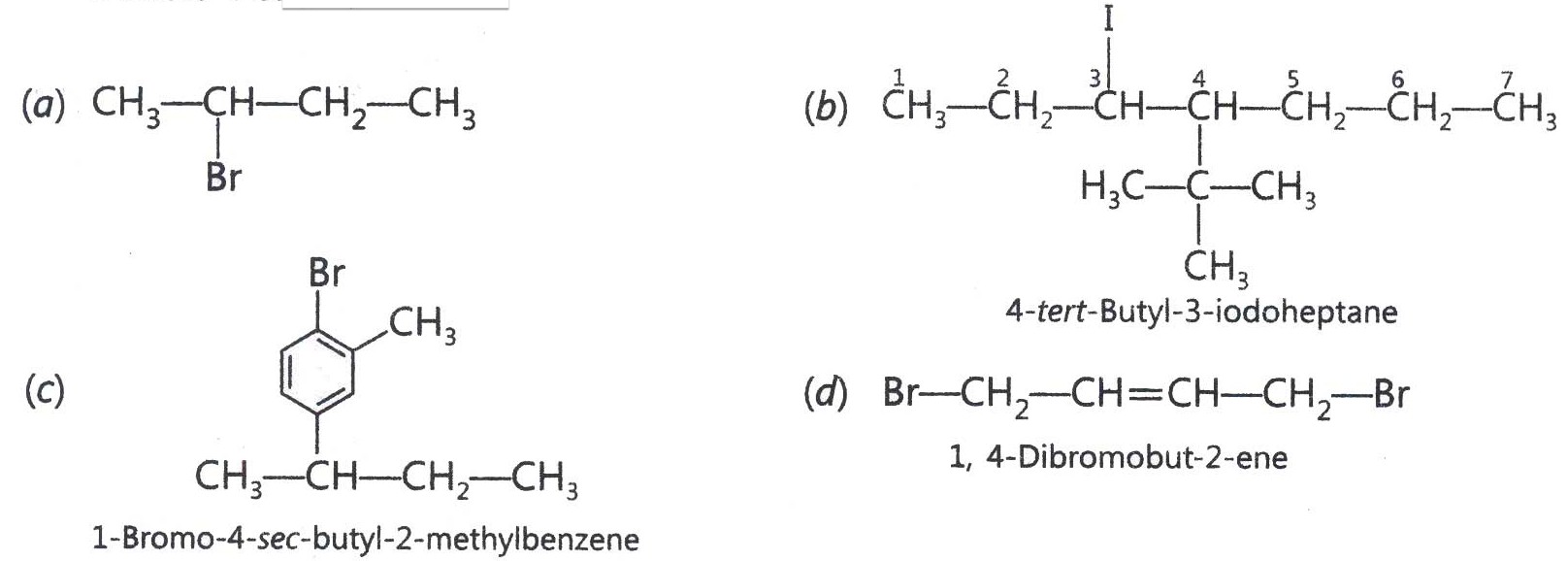
Write the structure of the following organic halogen compounds:
(a) 2-Bromobutane
(b) 4-tert-Butyl-3-iodoheptane
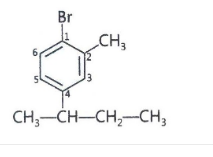
(c) 1-Bromo-4-sec-buty1-2-methyl benzene
(d) 1, 4-Dibromobut-2-ene.
2.
What are ambident nucleophiles? Explain with an example.
3.
A solution of KOH hydrolyses CH3 CHCICH2CH3 and CH3CH2CH2CH2Cl. Which one of these is more easily hydrolysed?
4.
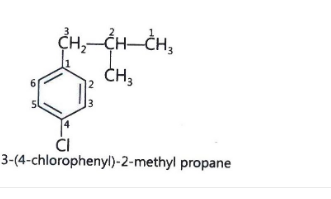
Write the structure of the following compound: 3-(4-chlorophenyl)-2-methylpropane.
5.
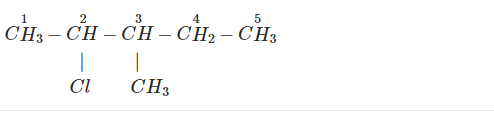
Write structure of the compound:
2-chorle-3-methylpentane.
6.
Write the structure of the following compound:
1-bromo-4-sec-butyl-2methylbenzene.
7.
How would you distinguish between \({ S }_{ N }1\) and \({ S }_{ N }2\) mechanisms of substitution reactions? Give one example of each.
8.
An organic compound \({ C }_{ 8 }{ H }_{ 18 }\) on monochlorination gives a single monochloride.Write the structure of the hydrocarbon.
9.
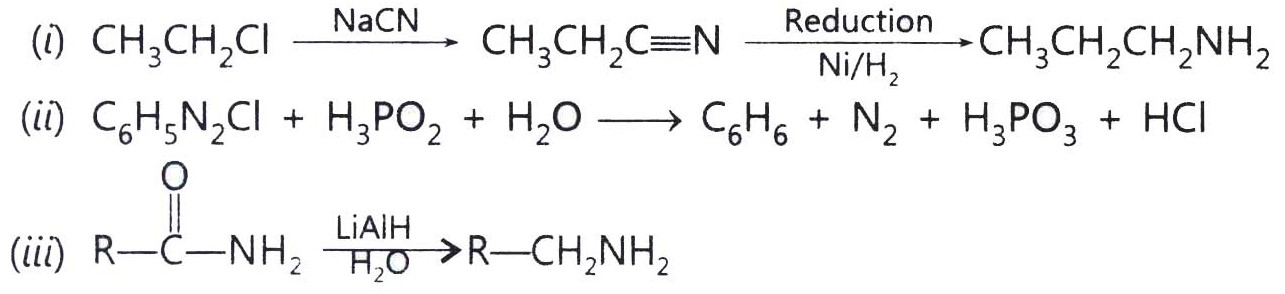
Complete the following chemical equations:
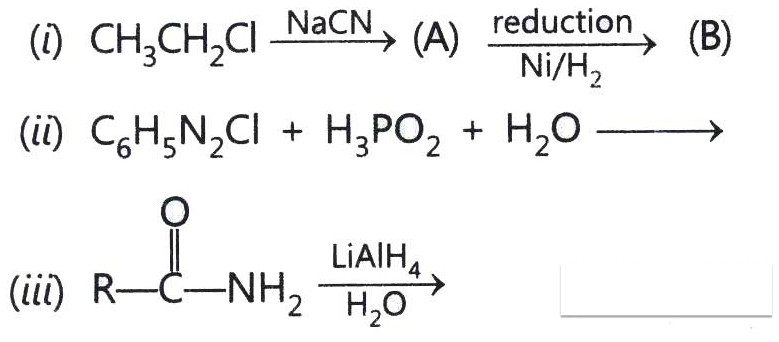
10.
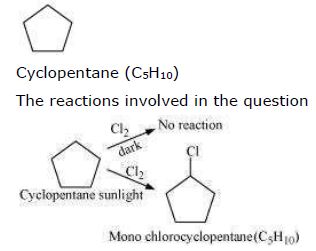
A hydrocarbon C5H10 does not react with chlorine in dark but gives a single monochloro compound C5H9Cl in bright sunlight. Identify the hydrocarbon.
11.
Carbon compounds containing more than one halogen atom are usually called polyhalogen compounds. Polyhalogen compounds are useful in industry and agriculture. One of the important polyhalogen compound is used as an insecticide.
(i) Name the polyhalogen compound for which Paul Muller won the Nobel Prize in medicine and physiology. Draw its structure also.
(ii) Why is the use of DDT banned in some countries?
(iii) What values do you derive from the answer of above question?
12.
Predict all the alkeness that would be formed by dehydrohalogenation of the following halides with sodium ethoxide in ethanol and identify the major alkene
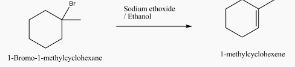
(a) 1-Bromo-1-methylcyclohexane
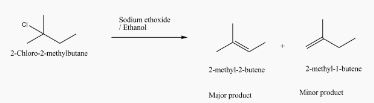
(b) 2-Chloro-2-methylbutane
(c) 2, 2, 3-Trimethyl-3-bromopentane.
13.
Which one of the following forms propanenitrile as the major product?
Ethyl bromide ||+ alcoholic KCN
Propyl bromide+alcoholic KCN
Propyl bromide +alcoholic AgCN
Ethyl bromide+alcoholic AgCN
14.
The reactivity order of halides for dehydrohalogenation is
R-F > R-Cl > R-Br > R-I
R-I > R-Br > R-Cl > R-F
R-I > R-Cl > R-Br > R-F
R- > R-I > R-Br > R-Cl
15.
When Chlorine is passed through propene at 400oC, which of the following is formed?
PVC
Allyl chloride
Vinyl chloride
1,2-Dichloroethane
16.
Which of the following halogen-exchange reaction will occur?
R-I+NaCl
R-F+KCl
R-Cl+NaI
CH3 -F+AgBr
17.
The reaction of hydrogen bromide with propene in absence of peroxide is an example of a/an
free radical addition
nucleophilic addition
electrophilic substitution
electrophilic addition
1.
2.
Ambident Nucleophile- An anionic nucleophile, which has two nucleophilic centers, or two negative sites is known as an ambident nucleophile. This negative charge is delocalized due to resonance.
Example – Cyanide and Thiocyanate are examples of ambident nucleophiles.
-C≡N ↔ :C=N-
S=C=N- ↔ -S - C≡ N
3.
CH3−CH(Cl)CH2CH3 will be more easily hydrolysed because it will form secondary carbocation which is more stable than primary carbocation.
4.
5.
6.
7.
(I) Unimolecular nucleophilic substitution reaction (SN1): Those substitution reactions in which rate of reaction depends upon the concentration of only one of the reactants, i.e. alkyl halides are called SN1 reactions, e.g. hydrolysis of tertiary butyl chloride follows SN1 reaction. This reaction takes place in two steps. The first step involves formation of carbocation.
The slowest step is rate determining step which involves one species only. Therefore, the rate of reaction depends only on the concentration of tertiary butyl chloride. Tertiary halides follow SN1 mechanism. Polar protic solvents like 'fater and alcohol favour SN1 because they stabilize carbocation by solvation.
(ii) Bimolecular nucleophilic substitution reaction (SN2): The reaction whose rate depends on the concentration of two species, alkyl halide and nucleophile. They involve one step mechanism. Back side attack of nucleophile and departing of leaving group take place simultaneously.
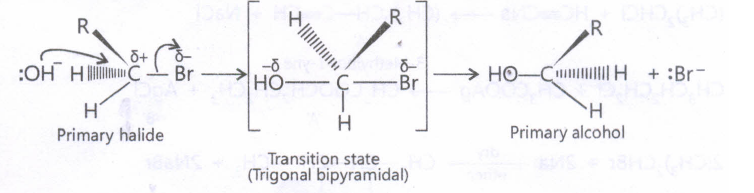
Non-polar solvents favour SN2 mechanism. Primary halides follow SN2 mechanism.
8.
Since the hydrocarbon gives a single monochloride all the I8H atoms are equivalent. This means it has six \({ CH }_{ 3 }\) groups attached to the interlinked C atoms.
Therefore, its structure is
\({ CH }_{ 3 }-\overset { \underset { | }{ { CH }_{ 3 } } }{ \underset { \overset { | }{ { CH }_{ 3 } } }{ C } } -\overset { \underset { | }{ { CH }_{ 3 } } }{ \underset { \overset { | }{ { CH }_{ 3 } } }{ C } } -{ CH }_{ 3 }\)
9.
10.
A hydrocarbon with the molecular formula, C5H10 belongs to the group with a general molecular formula CnH2n. Therefore, it may either be an alkene or a cycloalkane. Since hydrocarbon does not react with chlorine in the dark, it cannot be an alkene. Thus, it should be a cycloalkane. Further, the hydrocarbon gives a single monochloro compound, C5H9Cl by reacting with chlorine in bright sunlight. Since a single monochloro compound is formed, the hydrocarbon must contain H−atoms that are all equivalent. Also, as all H−atoms of a cycloalkane are equivalent, the hydrocarbon must be a cycloalkane.
11.
(i) The polyhalogen compound for which Paul Muller was awarded the Nobel Prize is DDT. (Dichlorodiphenyltrichloroethane). The structure of DOT is given below:
(ii) The use of DOT is banned in some countries because:
(a) it is toxic to aquatic life.
(b) it is not degraded rapidly by soil microorganisms due to its complex structure.
(c) it is not metabolized rapidly by animals and deposited in the fatty tissues.
(d) Because of its stability, it accumulates in food chain leading to biomagnification.
(iii) Environmental protection and sensitivity towards life.
12.
The reactions are given above:
(i) 1-methylcyclohexene is the major product.
Only one alkene is formed at beta H atoms on either side of Br atoms are equivalent.
(ii) 2-methyl-2-butene is the major product.
Two different alkenes are formed. More substituted alkene is the major product as it is more stable. This is in accordance with Saytzeff's rule.
(iii) 3,4,4-Trimethylpent-2-ene is the major product.
Two different alkenes are formed. More substituted alkene is the major product as it is more stable. This is in accordance with Saytzeff's rule.

13.
(a)
Ethyl bromide ||+ alcoholic KCN
14.
(b)
R-I > R-Br > R-Cl > R-F
15.
(b)
Allyl chloride
16.
(c)
R-Cl+NaI
17.
(d)
electrophilic addition

12th Standard CBSE Syllabus & Materials
12th Standard CBSE
CBSE 12th Computer Science Python Revision Tour I - New Previous year Question Papers Study Material - QB365 Set A
NEW12th Standard CBSE
CBSE 12th Business Studies Planning Important Questions And Answers Study Material - QB365 Set A
NEW12th Standard CBSE
CBSE 12th Business Studies Business Environment Important Questions And Answers Study Material - QB365 Set A
NEW12th Standard CBSE
CBSE 12th Business Studies Principles of Management Important Questions And Answers Study Material - QB365 Set A



CBSE 12th Standard CBSE Subjects
CBSE Standards










