
 100% FREE ACCESS
12th Standard CBSE Syllabus & Materials
12th Standard CBSE
CBSE 12th Economics Government Budget and the Economy Previous year Question Papers Study Material - QB365 Set A
NEW12th Standard CBSE
CBSE 12th Computer Science Interface Python with MySQL - New Previous year Question Papers Study Material - QB365 Set A
NEW12th Standard CBSE
CBSE 12th Computer Science Database Concept - New Previous year Question Papers Study Material - QB365 Set A
NEW12th Standard CBSE
CBSE 12th Computer Science Data Communication - New Previous year Question Papers Study Material - QB365 Set A
NEW12th Standard CBSE
CBSE 12th Computer Science Data Structures - New Previous year Question Papers Study Material - QB365 Set A
NEW12th Standard CBSE
CBSE 12th Computer Science Functions - New Previous year Question Papers Study Material - QB365 Set A

Published on: 04/12/2019
Haloalkanes and Haloarenes
Download CBSE Class 12th Standard CBSE Chemistry question papers, sample papers, important questions, and previous year solved papers in PDF format. Get free study materials, NCERT solutions, and exam preparation resources for Class 12th Standard CBSE Chemistry
Questions + Answers key
Take MCQ Chemistry Test
1.
Write chemical equations when
(i) ethyl chloride is treated with aqueous KOH
(ii) chlorobenzene is treated with CH3COCl in the presence of anhydrous AIC13
2.
Write the structural formulae of the organic compounds 'A', 'B', 'C' and 'D' in the following sequence of reaction
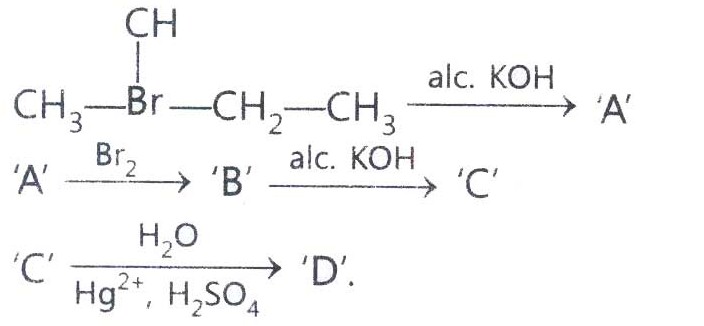
3.
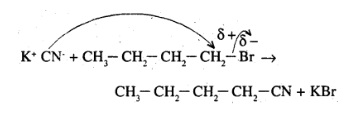
Suggest a possible mechanism for the following reaction:
\(n-BuBr + KCN \xrightarrow{EtOH_2,\ H_2O} n-BuCN\)
4.
What are ambident nucleophiles? Explain with an example.
5.
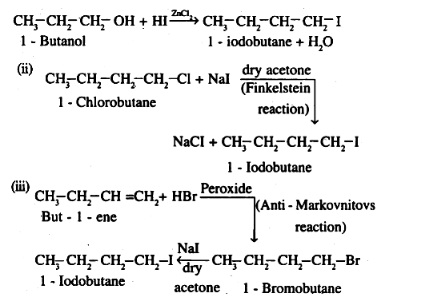
Write the equations for the preparation of 1-iodobutane from:
(a) 1-iodobutane from:
(b) 1-butanol
(c) but-1-ene.
6.
Explain why
(a) vinyl chloride is unreactive in nucleophilic substitution reactions?
(b) neo-pentyl bromide undergoes nucleophilic substitution reaction very slowly?
(c) 3-bromocyclohexene is more reactive than 4-bromocyclohexene in hydrolysis with aqueous NaOH?
(d) tert-butyl chloride reacts with aqueous sodium hydroxide by SN1 mechanism while n-butyl chloride reacts by SN2 mechanism?
7.
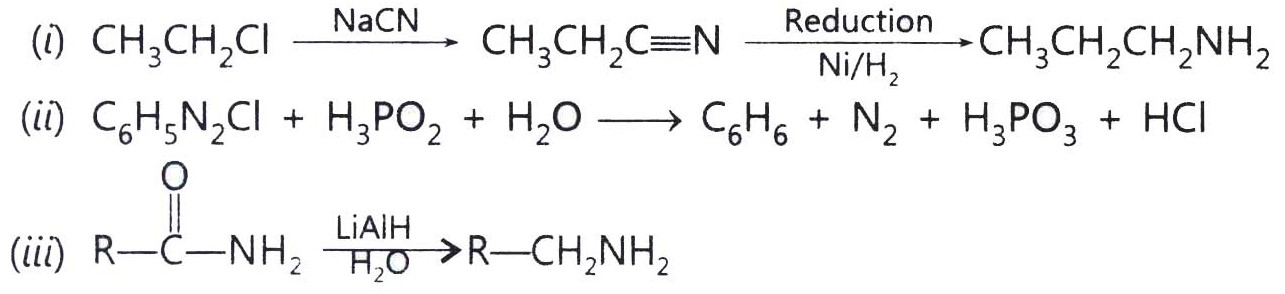
Complete the following chemical equations:
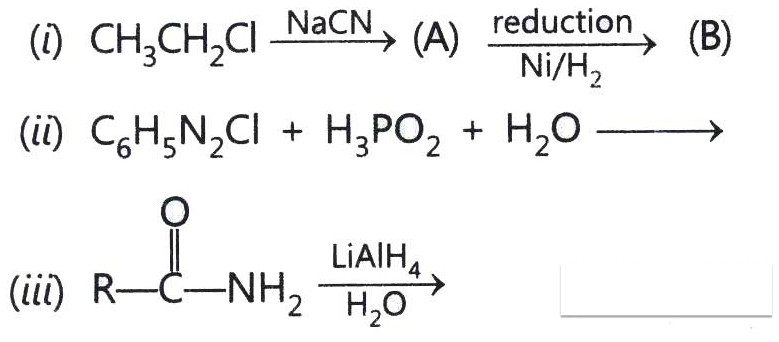
8.
In the addition of HBr to propene in the absence of peroxides, the first step involves the addition of
H+
Br-
\({ H }^{ \bullet }\)
\({ Br }^{ \bullet }\)
9.
Which of the following is not chiral?
2-Hydroxypropanoic acid
2-Butanol
2,3-Dibromobutane
3-Bromopentane
10.
Which of the following are arranged in the decreasing order of dipole moment?
CH3Cl, CH3Br, CH3F
CH3Cl, CH3F, CH3Br
CH3Br, CH3Cl, CH3F
CH3Br, CH3F, CH3Cl
11.
Which of the following possesses highest melting point?
Chlorobenzene
o-Dichlorobenzene
m-Dichlorobenzene
p-Dichlorobenzene
12.
A compound is formed by substitution of two chlorine for two hydrogens in propane. The number of possible isomeric compound is
4
3
5
2
13.
Carbon compounds containing more than one halogen atom are usually called polyhalogen compounds. Polyhalogen compounds are useful in industry and agriculture. One of the important polyhalogen compound is used as an insecticide.
(i) Name the polyhalogen compound for which Paul Muller won the Nobel Prize in medicine and physiology. Draw its structure also.
(ii) Why is the use of DDT banned in some countries?
(iii) What values do you derive from the answer of above question?
14.
Some halogen containing compounds are useful in daily life. Some compounds of this class are responsible for exposure of flora and fauna to more and more of UV light which causes destruction to a great extent. Name the class of these halo compounds. In your opinion, what should be done to minimise harmful effects of these compounds.
15.
Benzene on reaction with HOCI in presence of an acid produces organic compound (A), (A) on treatment with NaNH2/liq. NH3 furnishes another organic compound (B). (B) on treatment with HBF4 affords an organic compound (C) wich on heating with NaNO2 gives organic compound (D). Identify (A), (B), (C) and (D).
16.
Wurtz reaction falils in case of tert-alkyl halides. Explain.
1.
\(CH_{ 3 }Br+\underset { Ethylchloride }{ CH } -CI+KOH(aq)\rightarrow \underset { Ethanol }{ CH_{ 3 } } CH_{ 2 }OH+KCI\)
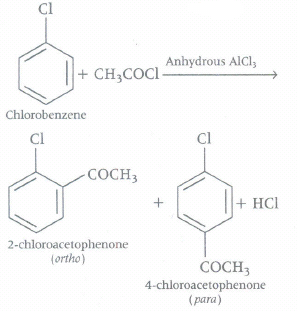
2.
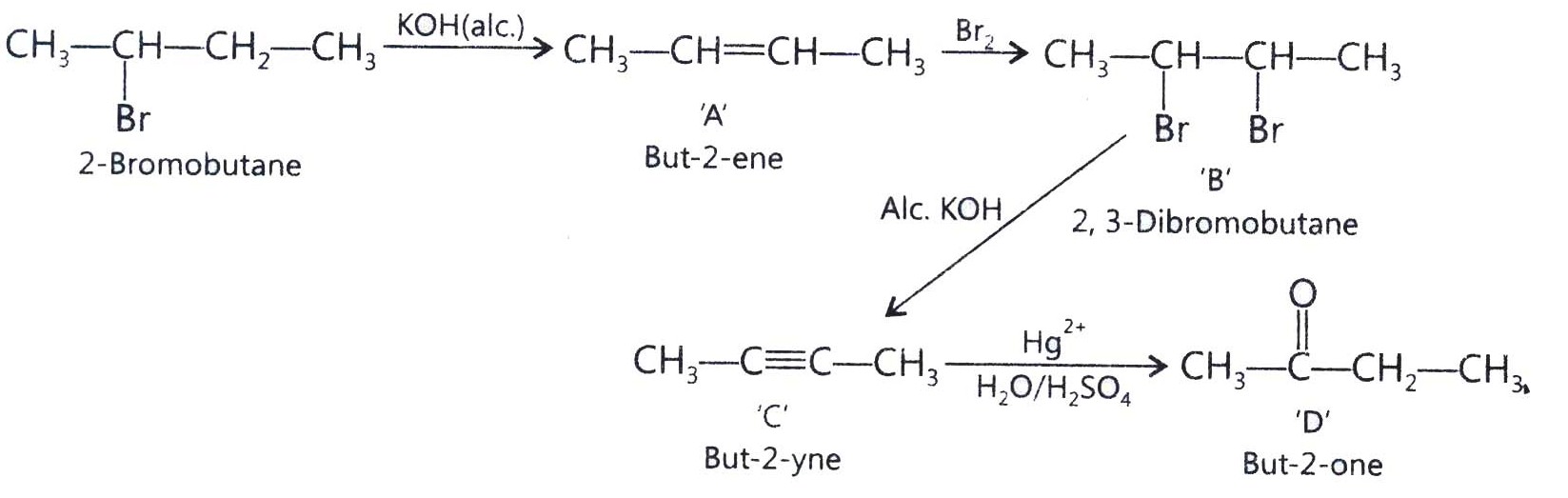
3.
The reaction is an SN2 reaction. In this reaction, CN- acts as the nucleophile and attacks the carbon atom to which Br is attacked. CN- is an ambident nucleophile and can attack through both C and N. In this case, it attacks through the C-atom.
4.
Ambident Nucleophile- An anionic nucleophile, which has two nucleophilic centers, or two negative sites is known as an ambident nucleophile. This negative charge is delocalized due to resonance.
Example – Cyanide and Thiocyanate are examples of ambident nucleophiles.
-C≡N ↔ :C=N-
S=C=N- ↔ -S - C≡ N
5.
(i) 1-butanol
6.
(a) Vinyl chloride is unreactive in nucleophilic substitution reactions because of double bond character between 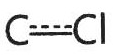 bond which is difficult to break.

(b) neo - Pentyl bromide is \({ 1 }^{ \circ }\) halide, forms \({ 1 }^{ \circ }\) carbocation which is less stable, changes \({ 3 }^{ \circ }\) to carbocation which requires energy, therefore, undergoes nucleophilic substitution reaction slowly.
(c) 3-Bromocyclohexene forms allyi carbocation which is more stable than carbocation formed by 4-bromocyclohexene, therefore, it can undergo hydrolysis faster.
7.
8.
(a)
H+
9.
(d)
3-Bromopentane
10.
(b)
CH3Cl, CH3F, CH3Br
11.
(d)
p-Dichlorobenzene
12.
(c)
5
13.
(i) The polyhalogen compound for which Paul Muller was awarded the Nobel Prize is DDT. (Dichlorodiphenyltrichloroethane). The structure of DOT is given below:
(ii) The use of DOT is banned in some countries because:
(a) it is toxic to aquatic life.
(b) it is not degraded rapidly by soil microorganisms due to its complex structure.
(c) it is not metabolized rapidly by animals and deposited in the fatty tissues.
(d) Because of its stability, it accumulates in food chain leading to biomagnification.
(iii) Environmental protection and sensitivity towards life.
14.
CFC (chlorofluoro carbons) are responsible for the destruction of ozone layer and UV light can reach earth which may cause skin cancer and affect flora and fauna.
These compounds should be banned and their use should be made to minimum extent.
15.
(i) HOCI in presence of an acid generates the reactive electrophile, chloronium ion «r, which attacks benzene to give chlorobenzene (A).
(ii) Chlorobenzene (A) on treatment with NaNH2/liq. NH3 undergaes-dehydrohalogenation via benzyne to afford aniline (B).
(iii) Aniline (B) on treatment with HBF4 forms the corresponding salt anilinium tetrafluoroborate (C) which on heating with NaNO2 undergoes Balz-Schiemann reaction through the intermedium formation of benzenediazonium tetrafluoroborate to afford fluorobenzene (D).
16.
tert-Alkyl halides prefer to undergo dehydrohalogenation in presence of a strong base such as Na metal instead of undergoing Wurtz reaction as explained below:
\(\underset{tert-Butyl\ bromide}{(CH_3)_3C-Br}+2Na\longrightarrow\underset{tert-Butylsodium}{(CH_3)_3Na^+}+Na^+Br^-\)
Thus, only rand 2° alkyl halides undergo Wurtz reaction while 3° alkyl halides prefer to undergo dehydrohalogenation to form alkenes.

12th Standard CBSE Syllabus & Materials
12th Standard CBSE
CBSE 12th Computer Science Python Revision Tour I - New Previous year Question Papers Study Material - QB365 Set A
NEW12th Standard CBSE
CBSE 12th Business Studies Planning Important Questions And Answers Study Material - QB365 Set A
NEW12th Standard CBSE
CBSE 12th Business Studies Business Environment Important Questions And Answers Study Material - QB365 Set A
NEW12th Standard CBSE
CBSE 12th Business Studies Principles of Management Important Questions And Answers Study Material - QB365 Set A



CBSE 12th Standard CBSE Subjects
CBSE Standards










