
 100% FREE ACCESS
12th Standard CBSE Syllabus & Materials
12th Standard CBSE
CBSE 12th Economics Government Budget and the Economy Previous year Question Papers Study Material - QB365 Set A
NEW12th Standard CBSE
CBSE 12th Computer Science Interface Python with MySQL - New Previous year Question Papers Study Material - QB365 Set A
NEW12th Standard CBSE
CBSE 12th Computer Science Database Concept - New Previous year Question Papers Study Material - QB365 Set A
NEW12th Standard CBSE
CBSE 12th Computer Science Data Communication - New Previous year Question Papers Study Material - QB365 Set A
NEW12th Standard CBSE
CBSE 12th Computer Science Data Structures - New Previous year Question Papers Study Material - QB365 Set A
NEW12th Standard CBSE
CBSE 12th Computer Science Functions - New Previous year Question Papers Study Material - QB365 Set A

Published on: 06/09/2019
Organic Compounds Containing Nitrogen
Download CBSE Class 12th Standard CBSE Chemistry question papers, sample papers, important questions, and previous year solved papers in PDF format. Get free study materials, NCERT solutions, and exam preparation resources for Class 12th Standard CBSE Chemistry
Questions + Answers key
Take MCQ Chemistry Test
1.
Name reagents required for preparation of methyl orange indicator (no reaction).
2.
How is phenylhydrazine prepared from aniline?
3.
A (C3H9N) reacts with benzenesulphonyl chloride to give a solid insoluble in alkali. Give the structure of A.
4.
What amine salts are used for determining their molecular masses?
5.
Amines are more basic than comparable alcohols.
6.
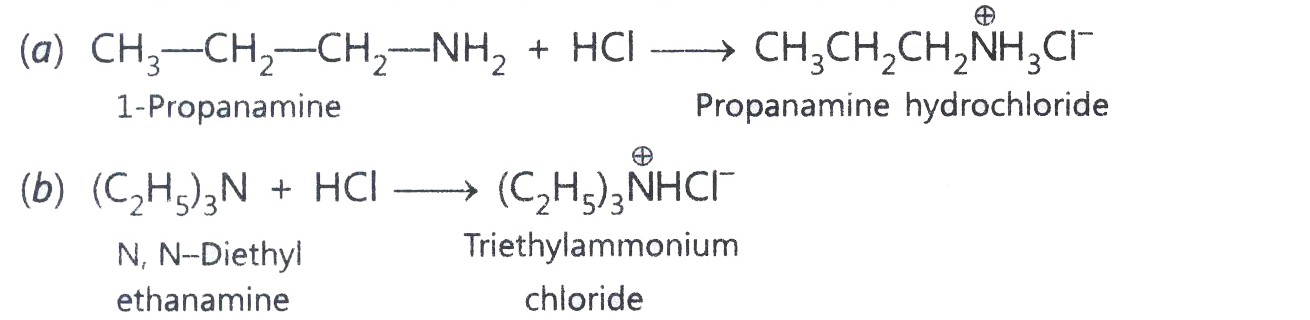
Complete the following acid-base reactions and name the products:
(a) CH3-CH2-CH2-NH2 + HCI \(\rightarrow \)
(b) (C2H5)3N+HCI \(\rightarrow \)
7.
Write a chemical reaction in which the iodide ion replaces the diazonium group in a diazonium salt.
8.
Arrange the following compounds in an increasing order of basic strengths in their aqueous solutions:
NH3 , CH3NH2 , (CH3)2NH , (CH3)3N
9.
Give the IUPAC name of
H2N-CH2-CH2-CH = CH2
10.
Write one reaction that can be used as a test for primary amines.
11.
Why is an alkylamine more basic than ammonia?
12.
Why does bromination of aniline, even under very mild conditions, gives 2, 4, 6-tribromoaniline instantaneously?
13.
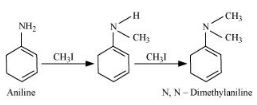
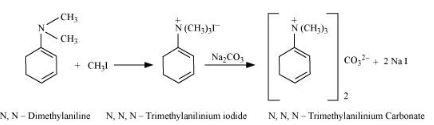
Write reactions of the final alkylation product of aniline with excess of methyl iodide in the presence of sodium carbonate solution.
14.
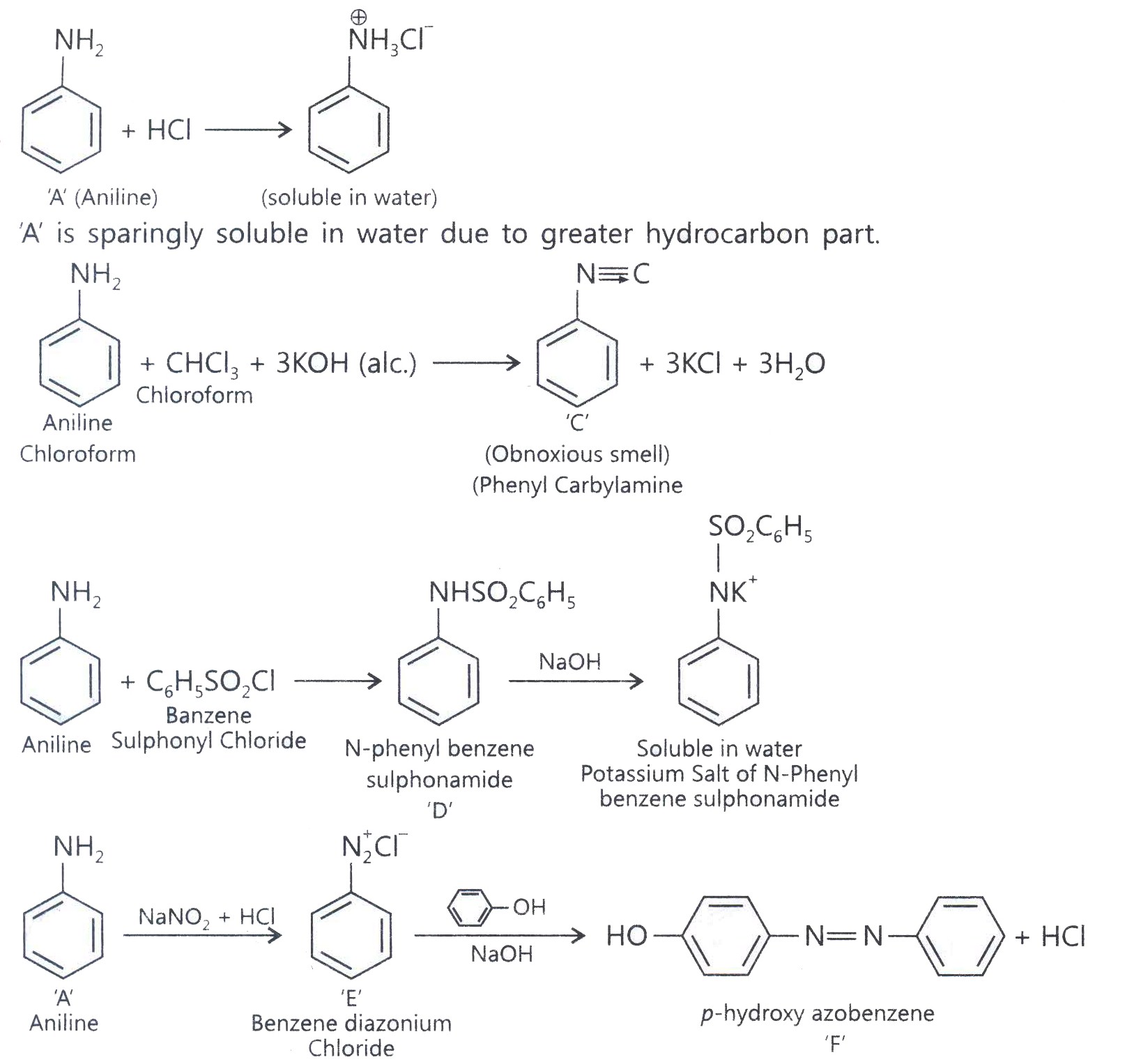
A colourless substance 'A' (C6H7N) is sparingly soluble in water and gives a water soluble compound 'B' on treating with mineral acid. On reacting with CHCl3 and alcoholic potash 'A' produces an obnoxious smell due to the formation of compoung 'C'. Reaction of 'A' with benzenesulphonyl chloride gives compound 'D' which is soluble in alkali. With NaNO2 and HCl, 'A' forms compound 'E' which reacts with phenol in alkaline medium to give an orange dye 'F' . Identify compounds 'A' to 'F'.
15.
Accomplish the following conversions:
(i) Benzene to m-bromophenol
(ii) Benzoic acid to aniline
16.
How are the following conversions carried out?
(i) Aniline to nitrobenzene
(ii) Ethanamine to N-ethylethanamid
(iii) Chloroethane to propan-1-amine
17.
Amines may be regarded as alkyl or aryl derivatives of ammonia. They may be primary, secondary or tertiary. Quaternary salts are also quite common. They occur in nature among proteins, vitamins,alkaloids and hormones. Several polymer, dyestuffs and drugs are amines.
(i) Name two drugs which contain secondary amino groups and are used to increase blood pressure.
(ii) Which amino drug is used as an anaesthetic in dentistry?
(iii) Benadryl is an antihistamine drug and is commonly used in cough syrups, what type of amino group does it contain?
(iv) Name a quaternary salt which is used both as detergent and as a germicide.
18.
A hydrocarbon 'A' (C4H8) on reaction with HCI gives a compound 'B' , (C4H11N). On reacting with NaNO2 and HCI followed by treatment with water, compound 'C'. Ozonolysis of 'A' gives 2 moles of acetaldehyde. Identify compounds 'A' to 'D' . Explain the reactions involved.
19.
Which of the following will not show coupling reaction with benzenediazonium chloride?
Aniline
Phenol
2-Naphthol
Benzyl alcohol
20.
Ethylamine on heating with CS2 in presence of HgCl2 forms
\({ C }_{ 2 }{ H }_{ 5 }NCS\)
\(\left( { C }_{ 2 }{ H }_{ 5 } \right) _{ 2 }S\)
\(\left( { C }_{ 2 }{ H }_{ 5 } \right) _{ 2 }CS\)
\({ C }_{ 2 }{ H }_{ 5 }\left( CS \right) _{ 2 }\)
21.
Which of the following is most basic?
Benzylamine
Aniline
Acetanilide
p-Nitroaniline
22.
Amine that cannot be prepared by Gabriel phthalimide synthesis is
aniline
benzylamine
methylamine
isobutylamine
tertiary-butylamine
23.
Nitration of nitrobonzene results in..............
o-dinitrobenzene
1, 3, 5-trinitrobenzene
p-dinitrobenzene
m-dinitrobenzene
1.
Reagents required are:
(i) sulphanilic acid
(ii) N, N-dimethylaniline
(iii) NaNO2 HCI and
(iv) a base.
2.
By reduction of benzenediazonium chloride with SnCI2/HCI or NaSO 2SO3.
3.
Since A (C3H9N)3H9N) reacts with benzenesulphonyl chloride to give a solid insoluble in alkali, (A) must be a 2o2o amine ; i.e., CH3-NH-CH2 CH3 (ethylmethylamine).
4.
Chloroplatinates. For example, (RN+H3)2PtCI62−
5.
It is because 'N' is less electronegative than 0, therefore, lone pair are easily available.
6.
7.

8.
(CH3)2NH > CH3NH2 > (CH3)3N > NH3 .
9.
But-3-en-1-amine.
10.
 is used as s test for primary.
11.
It is because alkyl groups are electron releasing in alkyl amines, they will increase electron density on 'N', therefore, they are more basic than NH3.
12.
Due to strong electron-donating effect of the -NH2 group, the electron density increases at the 0-, positions. Further, when aniline is treated with Br2 the Br+ attacks the benzene ring at o- and p-positions to form carbocation intermediates which are stabilized not only by the usual resonance of the Henzene ring. but also by the -NH2 group as shown below: In case of o-bromination, the carbocation intermediate is stabilized not only by usual resonating structure (I, III and IV) but is also stabilized by resonance structure (II) in which the lone pair of electrons on the N. atom interacts with the positively charged carbon of the ring. Similarly, in case of p-bromination, the carbocation is stabilized not only by the usual resonating structures (V, VI, and VIII) but is also stabilized by the resonance structure (VII) in which the lone pair of electrons on the N-atom interacts with the positively charged carbon of the ring. These additional resonating structures (II and VII) increase the stability of the carbocation to such an extent that bromination occurs instantaneously at the p- and two. o- positions giving 2, 4, 6-tribromoaniline.
13.
Aniline reacts with methyl iodide to produce N, N-dimethylaniline.
With excess methyl iodide, in the presence of Na2CO3 solution, N, N-dimethylaniline produces N, N, N-trimethylanilinium carbonate.
14.
15.
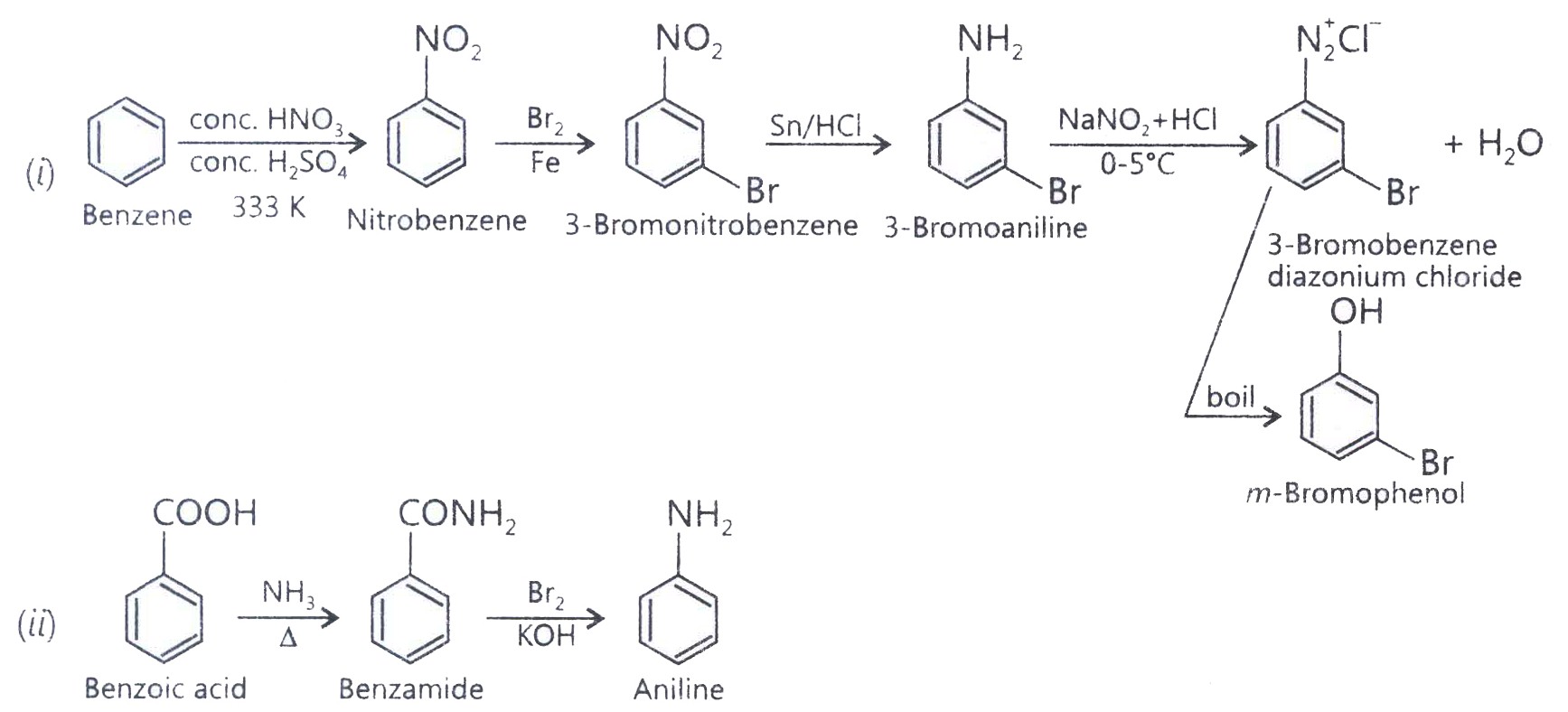
16.
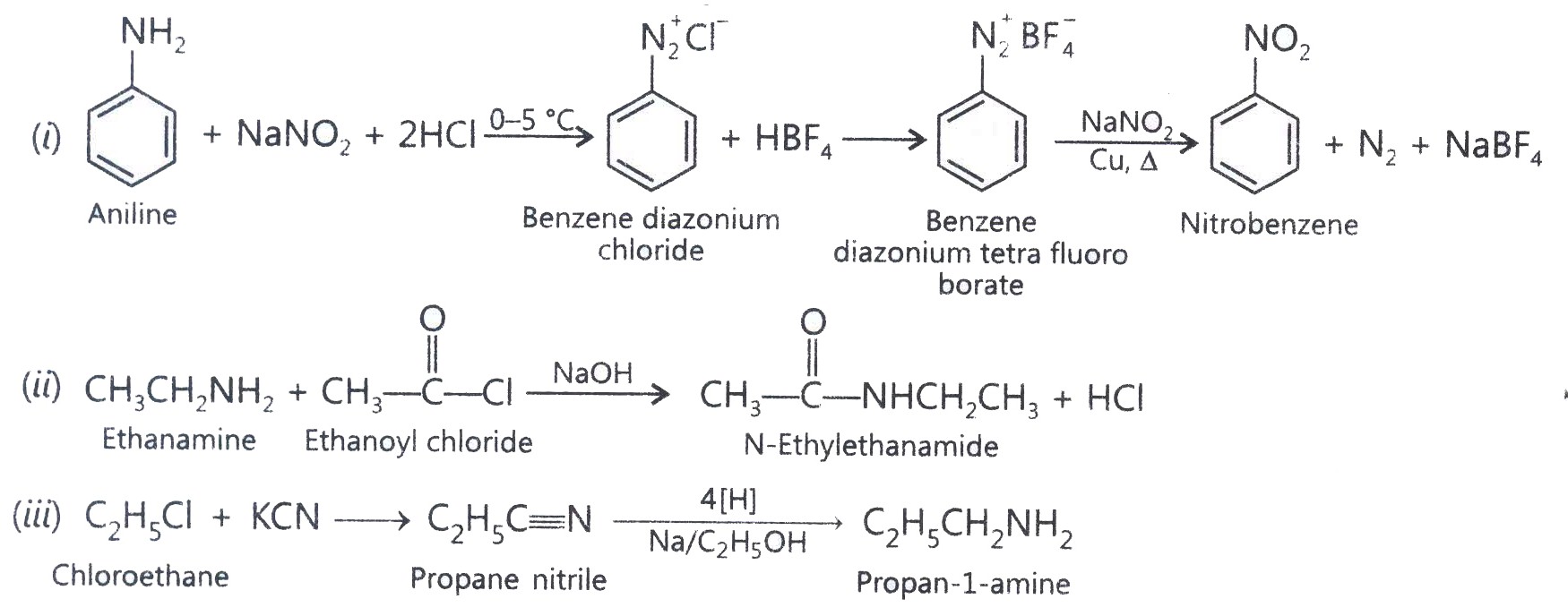
17.
(i) Adrenaline and ephedrine are used are to increase blood pressure, contain secondary amino group. 1
(ii) Novacain is used as an anaesthetic in dentistry.
(iii) Benadryl contains a tertiary amino group.
(iv) Cetyltrimethylammonium chloride is used as a cationic detergent as well as germicide.
18.
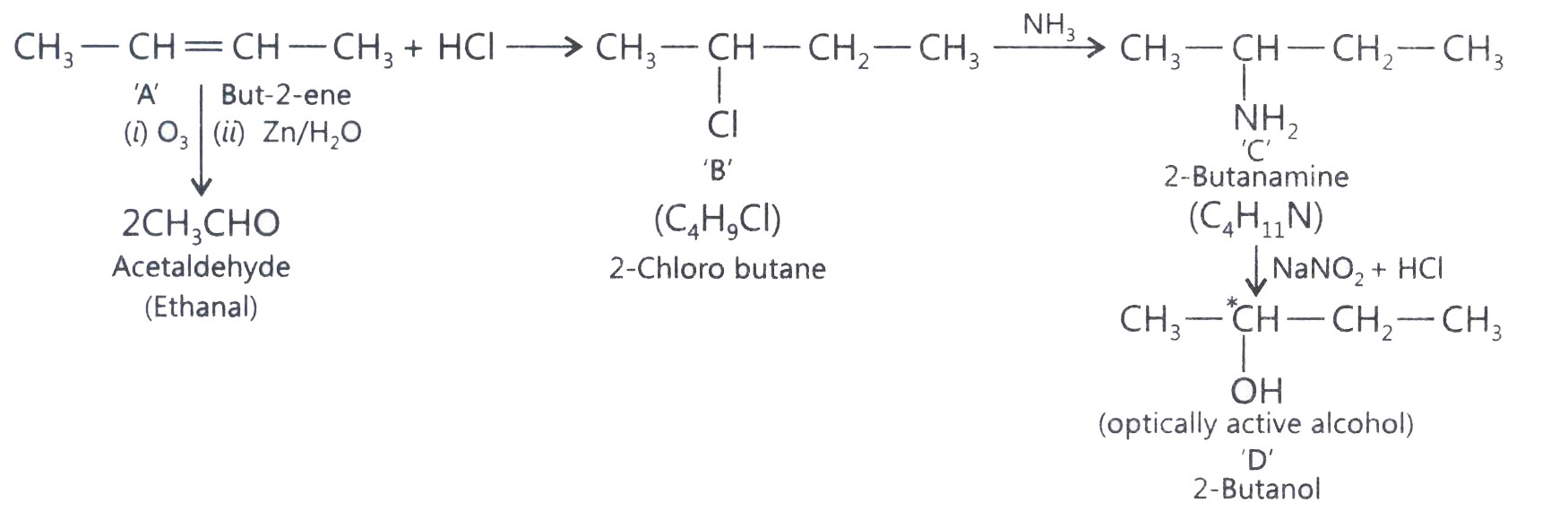
19.
only aromic \({ 1 }^{ \circ }\)amines and phenols show coupling reaction.
20.
(a)
\({ C }_{ 2 }{ H }_{ 5 }NCS\)
21.
Benzylamine is most basic
22.
(a)
aniline
23.
(d)
m-dinitrobenzene

12th Standard CBSE Syllabus & Materials
12th Standard CBSE
CBSE 12th Computer Science Python Revision Tour I - New Previous year Question Papers Study Material - QB365 Set A
NEW12th Standard CBSE
CBSE 12th Business Studies Planning Important Questions And Answers Study Material - QB365 Set A
NEW12th Standard CBSE
CBSE 12th Business Studies Business Environment Important Questions And Answers Study Material - QB365 Set A
NEW12th Standard CBSE
CBSE 12th Business Studies Principles of Management Important Questions And Answers Study Material - QB365 Set A



CBSE 12th Standard CBSE Subjects
CBSE Standards










