
 100% FREE ACCESS
12th Standard CBSE Syllabus & Materials
12th Standard CBSE
CBSE 12th Economics Government Budget and the Economy Previous year Question Papers Study Material - QB365 Set A
NEW12th Standard CBSE
CBSE 12th Computer Science Interface Python with MySQL - New Previous year Question Papers Study Material - QB365 Set A
NEW12th Standard CBSE
CBSE 12th Computer Science Database Concept - New Previous year Question Papers Study Material - QB365 Set A
NEW12th Standard CBSE
CBSE 12th Computer Science Data Communication - New Previous year Question Papers Study Material - QB365 Set A
NEW12th Standard CBSE
CBSE 12th Computer Science Data Structures - New Previous year Question Papers Study Material - QB365 Set A
NEW12th Standard CBSE
CBSE 12th Computer Science Functions - New Previous year Question Papers Study Material - QB365 Set A

Published on: 04/12/2019
Polymers
Download CBSE Class 12th Standard CBSE Chemistry question papers, sample papers, important questions, and previous year solved papers in PDF format. Get free study materials, NCERT solutions, and exam preparation resources for Class 12th Standard CBSE Chemistry
Questions + Answers key
Take MCQ Chemistry Test
1.
What is the primary feature necessary for a monomer to make it useful in a condensation polymerization reaction?
2.
Draw the structures of the monomers of the following polymers :
(i) Bakelite
(ii) Nylon-6
3.
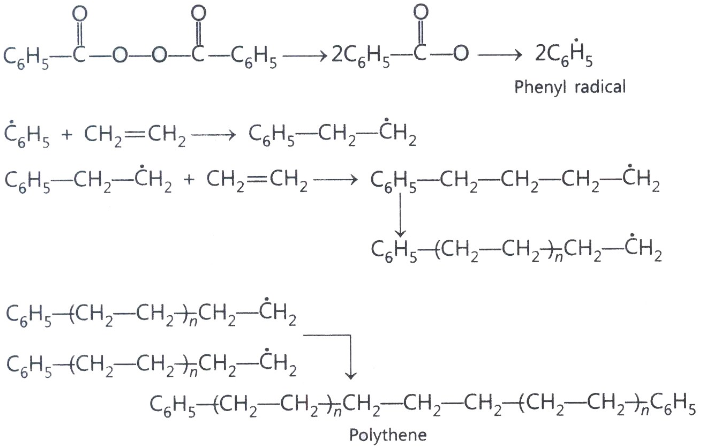
What is the role of benzoyl peroxide in addition polymerisation of alkenes ?
4.
Write the names and structures of the monomers of the following polymers:
(i) Bakelite
(ii) Nylon-6
(iii) Polyethene
5.
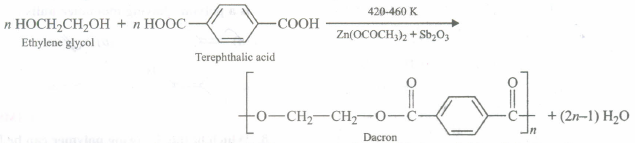
How is dacron obtained from ethylene glycol and terephthalic acid?
6.
Write chemical equations for the synthesis of
(a) terylene
(b) neoprene
(c) teflon
7.
What are addition polymers ? How are the two types of addition polymers different from each other ? Give one example of each type.
8.
Among cellulose,poly(vinyl chloride),nylon and natural rubber,the polymer in which the intermolecular force of attraction is weakest is
Nylon
Poly (vinyl chloride)
Cellulose
Natural rubber
9.
Which of the following polymers are condensation polymers?
Bakelite
Teflon
Butyl rubber
Melamine formaldehyde resin
10.
Which of the following is not a semisynthetic polymer?
cis-Polyisoprene
Cellulose nitrate
Cellulose acetate
Vulcanised rubber
11.
Given the polymers: A=Nylon ; B=Buna-S; C=Polythene. Arrange these in increasing order of their intermolecular forces (Lower to higher)
A > B > C
B > C > A
B < C < A
C < A < B
12.
Which of the following is a linear polymer?
Nylon
Bakelite
Low density polythene
Melamine - formaldehyde polymer
13.
Formaldehyde is a constituent of a number of polymers also called resins. These are non-volatile solids or semi-solids which are obtained from certain plants and also be synthesized in the laboratory.
(i) Name the main formaldehyde resins.
(ii) Mention the major components of these resins also called polymers.
(iii) Which out of these is useful in the manufacture of crockery?
(iv) Formaldehyde is obtained from plants. Similarly we obtain many useful things from plants. Is it worth to destroy plants for obtaining useful material ?
14.
Synthetic polymers both addition and condensation have given a boom to our industry. These have made our lives very comfortable. But these are mostly nonbiodegradable and cause major pollution problems. Polythene bags, broken polythene pipes etc, are very difficult to be disposed off. Recently certain biopolymers have been developed which are better than synthetic polymers.
(i)Name certain biopolymers that are naturally occuring.
(ii) What is the nature of synthetic biopolymers ?
(iii) Name two synthetic biopolymers.
(iv)What is the value associated with the use of biopolymers?
15.
Rubber is probably the most useful polymer which we come across. It is in fact, the backbone of the industry. It is present in rubber tree in the form of a colloidal suspension in water called latex. Chemically natural rubber is polyisoprene and is formed by polymerization of isoprene which is 2-Methyl-l,3-butadiene.
(i) Why is natural rubber quite soft?
(ii) How is vulcanisation of rubber carried?
(iii) Give anyone example of natural rubber.
(iv) What is the property of vulcanised rubber, which makes it's useful?
16.
After the ban on plastic bags, students of a school decided to make people aware of the harmful effects of plastic bags on the environment and Yamuna River. To make the awareness more impactful, they organised a rally by partnering with other schools and distributed paper bags to vegetable vendors, shopkeepers and departmental stores. All the students pledged not to use polythene bags in the future to save the Yamuna River.
After reading the above passage, answer the following questions:
(i) What values are shown by the students?
(ii) What are bio-degradable polymers ? Give one example.
(iii) Is polyethene a condensation or an addition polymer?
1.
The primary feature necessary for monomer units to undergo condensation polymerization is that each monomer unit must have two or three functional groups. For example, the monomers of polyester are: terephthatic acid and ethylene glycol each of which has two functional groups - terephthalic acid has two -COOH groups while ethylene glycol has two -OH groups
In contrast, glypal polymer can be obtained by condensation of phthalic acid or its anhydride with either ethylene glycol which has two -OH groups or glycerol which has three -OH groups.
2.
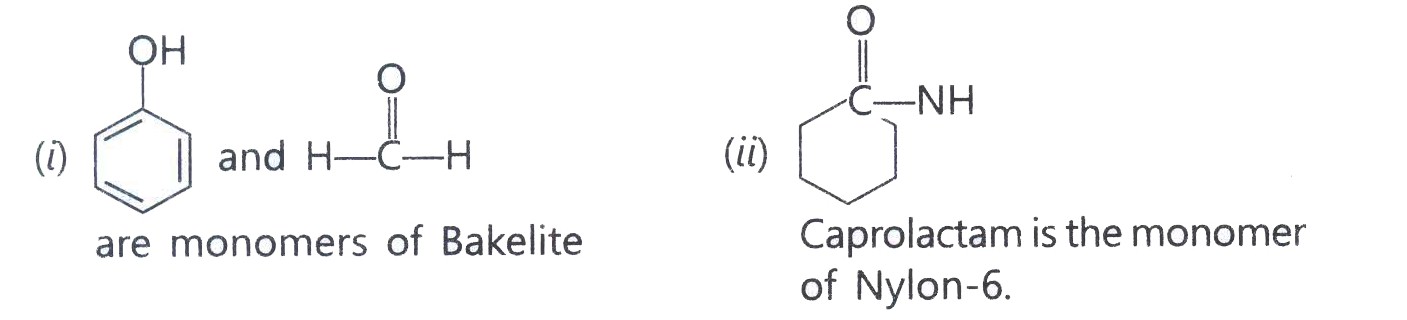
3.
It acts as initator in free radical polymerisation
4.
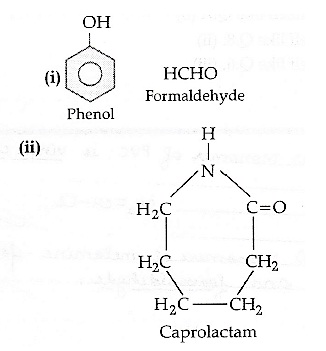
(iii) CH2=CH2(Ethene)
5.
Dacron is obtained by condensation polymerization of ethylene glycol and terephthalic acid with the elimination of water molecules. The reaction is carried out at 420-460 K in presence of a catalyst consisting of a mixture of zinc acetate and antimony trioxide.
6.
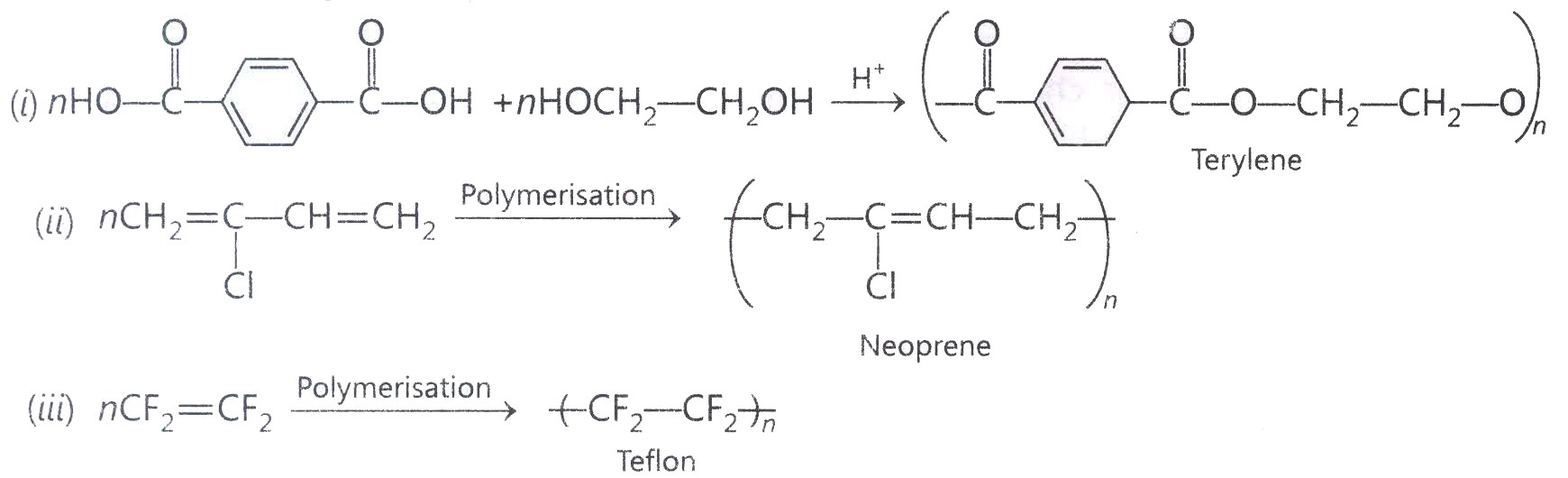
7.
Those polymers in unsaturated monomers combine together without loss of any molecule are called addition polymers.
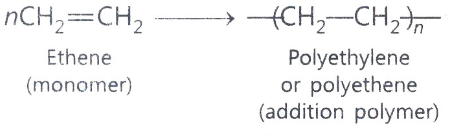
There are two types of addition polymers:
(i) Homopolymers: when addition polymerisation of single monomeric species take places, the polymer formed are called homopolymers, e.g. polythene is homopolymer.
(ii) Copolymers: The polymer made by addition polymerisation from two different monomers are called copolymers, .g. Buna-S is copolymer of 1,3-butadiene and styrene.
8.
Natural rubber has the weakest intermolecular forces of attraction.
9.
(d)
Melamine formaldehyde resin
10.
cis-Polyisoprene is a natural rubber.
11.
(c)
B < C < A
12.
(a)
Nylon
13.
(i) Main formaldehyde resins: Bakelite, melamine formaldehyde and urea Formaldehyde.
(ii) Bakelite: Phenol and formaldehyde.
Melamine formaldehyde: Melamine and formaldehyde.
Urea formaldehyde: Urea and formaldehyde.
(iii) Melamine is used for this purpose.
(iv) In the modern world, polymer industry has a major role. No doubt, natural polymers are also useful but synthetic polymers have an impact on most of our daily house hold necessity items. It may range from kitchen, bed room and also all luxury items. But it is not worth to destroy plants as they are life giving.
14.
(i) Polysaccharides (starch, cellulose) proteins and nucleic acids are the examples of naturally occurring biopolymers.
(ii) These are biodegradable in nature.
(iii) Poly-hydroxybutyrate-co-β-hydroxyvalerate(PHBV) and Nylon-2-Nylon-6.
(iv) Biopolymers have a wide range of applications. These are biodegradable so are environment friendly.
15.
(i) It is quite soft due to the absence of polar groups. Only weak van der Waals' forces are present.
(ii) Vulcanisation of natural rubber is carried by adding a certain amount of molten sulphur to the molten rubber at a temperature ranging 373 to 415K As a result, cross linking takes place and the vulcanised rubber can withstand wear and tear.
(iii) Polyisoprene.
(iv) Vulcanised rubber is hard and non-sticky. It is quite resistant to the attack of organic acids.
16.
(i) From the given passage, we can conclude that the students show awareness about the environment.
(ii) A polymer that can be decomposed by microorganisms within a definite period of time so that the polymer or its degraded product does not cause any harm to the environment, is called a bio-degradable polymer. For example, poly- \(\beta\)- hydroxybutyrate-co-\(\beta\)-hydroxy valerate.
(iii) Polythene is an addition polymer that is formed by the addition of ethene molecules.

12th Standard CBSE Syllabus & Materials
12th Standard CBSE
CBSE 12th Computer Science Python Revision Tour I - New Previous year Question Papers Study Material - QB365 Set A
NEW12th Standard CBSE
CBSE 12th Business Studies Planning Important Questions And Answers Study Material - QB365 Set A
NEW12th Standard CBSE
CBSE 12th Business Studies Business Environment Important Questions And Answers Study Material - QB365 Set A
NEW12th Standard CBSE
CBSE 12th Business Studies Principles of Management Important Questions And Answers Study Material - QB365 Set A



CBSE 12th Standard CBSE Subjects
CBSE Standards










