
 100% FREE ACCESS
12th Standard CBSE Syllabus & Materials
12th Standard CBSE
CBSE 12th Economics Government Budget and the Economy Previous year Question Papers Study Material - QB365 Set A
NEW12th Standard CBSE
CBSE 12th Computer Science Interface Python with MySQL - New Previous year Question Papers Study Material - QB365 Set A
NEW12th Standard CBSE
CBSE 12th Computer Science Database Concept - New Previous year Question Papers Study Material - QB365 Set A
NEW12th Standard CBSE
CBSE 12th Computer Science Data Communication - New Previous year Question Papers Study Material - QB365 Set A
NEW12th Standard CBSE
CBSE 12th Computer Science Data Structures - New Previous year Question Papers Study Material - QB365 Set A
NEW12th Standard CBSE
CBSE 12th Computer Science Functions - New Previous year Question Papers Study Material - QB365 Set A

Published on: 05/10/2019
The p-Block Elements
Download CBSE Class 12th Standard CBSE Chemistry question papers, sample papers, important questions, and previous year solved papers in PDF format. Get free study materials, NCERT solutions, and exam preparation resources for Class 12th Standard CBSE Chemistry
Questions + Answers key
Take MCQ Chemistry Test
1.
(a) \({ H }_{ 3 }PO_{ 3 }\) ,\({ H }_{ 3 }PO_{ 4 }\) \({ H }_{ 3 }PO_{ 4 }\) (Reducing character)
(b) \((a)NH_{ 3 },PH_{ 3 },AsH_{ 3 },SbH_{ 3 },BiH_{ 3 }\) (Base strength)
2.
(a) Account for the following:
(i) Ozone is thermodynamically unstable
(ii) Solid \(PCI_{ 5 }\)is ionic in nature.
(iii) Fluorine forms only one oxoacid HOF.
3.
(a) Give reasons for the following:
(i) Bond enthalpy of \({ F }_{ 2 }\) is lower than that of \(CI_{ 2 }\)
(ii)\(PH_{ 3 }\) has lower boiling point than
(b) Draw the structure of the following molecules:
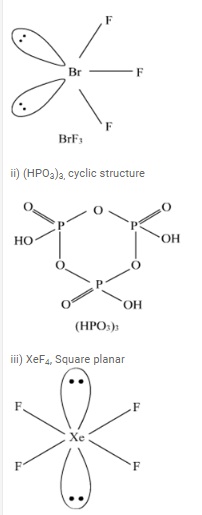
\((i)BrF_{ 3 }\quad (ii)(HPO_{ 3 })_{ 3 }\quad (iii)XeF_{ 4 }\quad \)
\(\)
4.
(a) Assign a reason for each of the following statements:
(i) All the bonds in \(PCI_{ 5 }\)are not equal in length.
(b) Write the structural formulae of the following compounds:
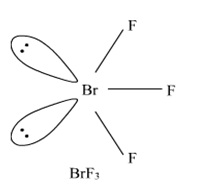
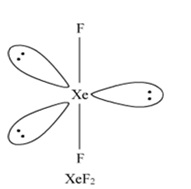
\((i)BrF_{ 3 }\quad (ii)XeF_{ 2 }\)
5.
On heating, lead (II) nitrate gives a brown gas 'A'. The gas 'A' on cooling changes to colourless solid 'B'. Solid 'B' on heating with NO changes to a blue solid 'C'. Identiy 'A', 'B' and 'C' and also write reactions involved and draw the structures of 'B' and 'C'.
6.
On heating compound (A) gives a gas (B) which is a constituent of air. This gas when treated with 3 mol of hydrogen (H2) in the presence of a catalyst gives another gas (C) Which is basic in nature. Gas C on further oxidation in moist condition gives a compound (D) which is a part of acid rain. Identify compound (A) to (D) and also give necessary equations of all the steps involved.
7.
(a) Explain the following:
(i) NF3 is an exothermic compound whereas NCl3 is not.
(ii) F2 is most reactive of all the four common halogens.
(b) Complete the following chemical equations:
(i) c + H2SO4 (conc.) \(\longrightarrow \)
(ii) P4 + NaOH + H2O \(\longrightarrow \)
(iii) Cl2 \(\to\) \(\underset{excess}{F_2}\) \(\longrightarrow \)
\(\)
8.
(a) Draw the structures of the following:
(i) XeF4 (ii) H2S2O7
(b) Explain the following observations:
(i) Phosphorus has a greater tendency for catenation than nitrogen.
(ii) The negative value of electron gain enthalpy is less for fluorine than that for chlorine.
(iii) Hydrogen fluoride has a much higher boiling point than hydrogen chloride.
9.
(a) Draw the structures of the following:
(i) N2O5
(ii) XeOF4
(b) Explain the following observations:
(i) The electron gain enthalpy of sulphur atom has a greater negative value than that of oxygen atom.
(ii) Nitrogen does not form pentahalides.
(iii) In aqueous solutions, HI is a stronger acid than HCl.
1.
(a) \({ H }_{ 3 }{ PO }_{ 2 }>{ H }_{ 3 }{ PO }_{ 3 }>{ H }_{ 3 }{ PO }_{ 4 }\)
(b) \({ NH }_{ 3 }>{ PH }_{ 3 }>As{ H }_{ 3 }>Sb{ H }_{ 3 }>Bi{ H }_{ 3 }\)
\(\)
2.
(a) (i) Ozone is thermodynamically unstable with respect to oxygen because it results in liberation of heat (\((\triangle H\quad is\quad -ve)\) ) and increase in entropy (\((\triangle S\quad is\quad -ve)\) ). These two factors reinforce each other resulting negative \(\triangle G(\triangle G=\triangle H-T\triangle S)\) for its conversion to oxygen.
\({ 2O }_{ 3 }\overset { 475k }{ \longrightarrow } { 3O }_{ 2 }\)
(ii) \({ PCI }_{ 5 }\) has trigonal bipyramidal structure and is not very stable. It splits up into more stable tetrahedral and octahedral structures which are stable as
\({ PCI }_{ 5 }\rightleftharpoons { [{ PCI }_{ 4 }] }^{ + }{ \quad [{ PCI }_{ 4 }] }^{ - }\)
Therefore, it exists as ionic.
(iii) Due to small size and high electronegativity, fluorine cannot act as central atom in higher oxoacids.
3.
(a) (i) Due to small size of F atom, there are strong repulsions between the non-bonding electrons of F atoms in the small sized \({ F }_{ 2 }\) molecule. Therefore, bond enthalpy of \({ F }_{ 2 }\) is lower than relatively \({ CI }_{ 2 }\) larger molecule in which repulsions between non bonding electrons are less.
(ii) Ammonia exists as associated molecules due to its tendency to form hydrogen bonding. Therefore, it has high boiling point. Unlike \({ NH }_{ 3 }\) , phosphine (\({ PH }_{ 3 }\)) molecules are not associated through hydrogen bonding in liquid state. This is because of low electronegativity of P than N. As a result, the boiling point of \({ PH }_{ 3 }\) is lower than that of \({ NH }_{ 3 }\) .
(b) (i)
4.
(i) \({ PCI }_{ 5 }\) has trigonal bipyramidal structure in which there are three P-Cl equatorial bonds and two P-Cl axial bonds. The two axial bonds are being repelled by three bond pairs at 90° while the three equatorial bonds are being repelled by two bond pairs at 90°. Therefore, axial bonds are repelled more by bond pairs than equatorial bonds and hence are larger (219 pm)
(b) (i)
(ii)
5.
\(2Pb{ { { { (NO }_{ 3 }) } } }_{ 2 }\xrightarrow { heat } 2PbO(s)+{ NO }_{ 2 }+{ O }_{ 2 }\)
Brown (A)
\({ 2NO }_{ 2 }(g)\overset { cooling }{ \rightleftharpoons } { N }_{ 2 }{ O }_{ 4 }(s)\)
(B) Colourless
\({ N }_{ 2 }{ O }_{ 4 }+2NO\overset { heat }{ \underset { 250k }{ \rightleftharpoons } } { 2N }_{ 2 }{ O }_{ 3 }(s)\)
(C) Blue solid
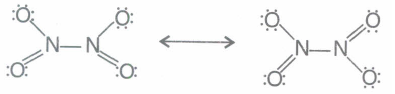
Resonating Structures of \({ N }_{ 2 }{ O }_{ 4 }\)
6.
(i) \({ NH }_{ 4 }{ NO }_{ 2 }(s)\underrightarrow { heat } { N }_{ 2 }+{ 2H }_{ 2 }O\)
'A' 'B'
(ii) \({ N }_{ 2 }+{ 3H }_{ 2 }\longrightarrow 2{ NH }_{ 3 }(g)\)
'C' basic
(iii) \({ 4NH }_{ 3 }+{ 5O }_{ 2 }\longrightarrow 4NO+{ 6H }_{ 2 }O\)
\(\\ 2NO+{ O }_{ 2 }\longrightarrow { 2NO }_{ 2 }\)
'D' (part of acid rain)
\({ 3NO }_{ 2 }+{ H }_{ 2 }O\longrightarrow 2{ HNO }_{ 3 }+NO\)
7.
(a) (i) It is because \({ NF }_{ 3 }\) is more stable than \({ NCI }_{ 3 }\)because \({ F }_{ 2 }\)is stronger oxidising agent than \({ CI }_{ 2 }\) .
(ii) It is due to low bond dissociation energy, high hydration energy, high electron affinity.
(b) \((i)\ C+{ 2H }_{ 2 }{ SO }_{ 4 }(conc.)\longrightarrow { CO }_{ 2 }+{ 2SO }_{ 2 }+2H_{ 2 }O\)
\(\\ (ii)\ { P }_{ 4 }+3NaOH+3H_{ 2 }O\longrightarrow { 3NaH }_{ 2 }{ PO }_{ 2 }+PH_{ 3 }\)
\(\\ (iii)\ { CI }_{ 2 }+3{ F }_{ 2 }\longrightarrow 2CIF_{ 3 }\)
8.
(a) (i)
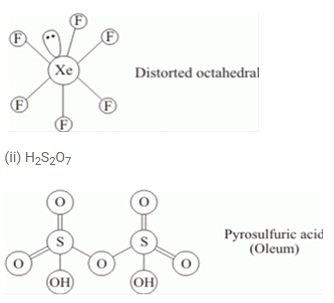
(b) (i) It is because P-P single bond is stronger than the single N-N bond.
(ii) It is because there is more interelectronic repulsion between valence electrons in 'F' atoms as compared to 'CI' atoms.
(iii) It is because HF molecules are associated with intermolecular H-bonding while HCI is not that is why HF is liquid and has higher boiling point than HCI which is a gas.
9.
(a) (i)
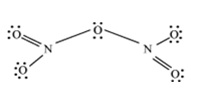
(ii)
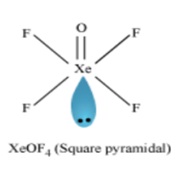
(b) (i) It is because there is more interelectronic repulsion in oxygen due to smaller size than sulphur, less energy is released on addition of electrons, therefore, its electron gain enthalpy is less than sulphur.
(ii) It is due to absence of d-orbitals in nitrogen atom, it cannot show pentavalently.
(iii) HI has lower bond dissociation energy than HCI due to longer bond length it is stronger acid than HCI.

12th Standard CBSE Syllabus & Materials
12th Standard CBSE
CBSE 12th Computer Science Python Revision Tour I - New Previous year Question Papers Study Material - QB365 Set A
NEW12th Standard CBSE
CBSE 12th Business Studies Planning Important Questions And Answers Study Material - QB365 Set A
NEW12th Standard CBSE
CBSE 12th Business Studies Business Environment Important Questions And Answers Study Material - QB365 Set A
NEW12th Standard CBSE
CBSE 12th Business Studies Principles of Management Important Questions And Answers Study Material - QB365 Set A



CBSE 12th Standard CBSE Subjects
CBSE Standards










