
 100% FREE ACCESS
12th Standard CBSE Syllabus & Materials
12th Standard CBSE
CBSE 12th Economics Government Budget and the Economy Previous year Question Papers Study Material - QB365 Set A
NEW12th Standard CBSE
CBSE 12th Computer Science Interface Python with MySQL - New Previous year Question Papers Study Material - QB365 Set A
NEW12th Standard CBSE
CBSE 12th Computer Science Database Concept - New Previous year Question Papers Study Material - QB365 Set A
NEW12th Standard CBSE
CBSE 12th Computer Science Data Communication - New Previous year Question Papers Study Material - QB365 Set A
NEW12th Standard CBSE
CBSE 12th Computer Science Data Structures - New Previous year Question Papers Study Material - QB365 Set A
NEW12th Standard CBSE
CBSE 12th Computer Science Functions - New Previous year Question Papers Study Material - QB365 Set A

Published on: 04/12/2019
The p-Block Elements
Download CBSE Class 12th Standard CBSE Chemistry question papers, sample papers, important questions, and previous year solved papers in PDF format. Get free study materials, NCERT solutions, and exam preparation resources for Class 12th Standard CBSE Chemistry
Questions + Answers key
Take MCQ Chemistry Test
1.
Write the conditions to maximise the yield of sulphuric acid by Contact process.
2.
Nitric acid forms an oxide of nitrogen on reaction with P4O10. Write the reaction involved. Also wirte the resonating structure of the oxide of nitrogen formed.
3.
Complete the following chemical reaction equations:
(i) Xe(g) + F2(g)\(\underset { (in\ excess) }{ F_{2}(g) } \) \(\xrightarrow [7 bar]{873\ K}\)
(ii) Li + N2 \(\rightarrow\)
4.
Account the following :
(i) Thermal stability of water is much higher than that of H2S.
(ii) White phosphorus is more reactive than red phosphorus.
5.
Explain the following the following facts giving appropriate reason in each case:
(i) NF3 is an exothermic compound whereas NCL3 is not.
(ii) All the bonds in SF4 are not equivalent.
6.
Phosphorus has three allotropic forms -
(i) white phosphorus
(ii) red phosphorus and
(iii) black phosphorus.
Write the difference between white and red phosphorus on the basis of their structure and reactivity.
7.
Draw the structures of the following molecules:
(i) NF3
(ii) H2S2O8
(iii) H3PO3
8.
On heating compound (A) gives a gas (B) which is a constituent of air. This gas when treated with 3 mol of hydrogen (H2) in the presence of a catalyst gives another gas (C) Which is basic in nature. Gas C on further oxidation in moist condition gives a compound (D) which is a part of acid rain. Identify compound (A) to (D) and also give necessary equations of all the steps involved.
9.
(a) Complete the following chemical reaction equations:
(i) \({ I }^{ - }(aq)+{ H }_{ 2 }O(l)+{ O }_{ 3 }(g)\) \(\rightarrow\)
(ii) P4 (s) + NaOH (aq) + H2O (l) \(\rightarrow\)
(b) Explain the following observations:
(i) H2S is less acidic than H2Te.
(ii) Fluorine is a stronger oxidising agent than chlorine.
(iii) Noble gases are the least reactive elements.
10.
Which of the following elements does not show allotropy?
Nitrogen
Bismuth
Antimony
Arsenic
11.
Affinity for hydrogen decreases in the group from fluorine to iodine. Which of the halogen acids should have highest bond dissociation enthalpy?
HF
HCl
HBr
HI
12.
The formation of O2+[PtF6]- is the basis for the formation of xenon fluorides. This is because
O2 and Xe have comparable sizes
both O2 and Xe are gases
O2 and Xe have comparable ionisation energies
O2 and Xe have comparable electronegativities.
13.
Which one of the following arrangements represents the correct order of electron gain enthalpy (with negative sign) of the given atomic species?
F<Cl<O<S
S<O<Cl>F
O<S<F<Cl
Cl<F<S<O
14.
Which of the following on heating does not give nitrogen gas?
NH4NO3
NH4NO2
Ba(N3)2
(NH4)2Cr2O7
1.
(i) High pressure (2 bar),
(ii) 720 K temperature,
(iii) V2O5 as catalyst.
2.
\({ P }_{ 4 }{ O }_{ 10 }\) is a strong dehydrating agent. It reacts with \({ HNO }_{ 3 }\) to form metaphosphoric acid \(\left( { HPO }_{ 3 } \right) \) and dinitrogen pentoxide, \({ N }_{ 2 }{ O }_{ 5 }\)
\(4HN{ O }_{ 3 }+{ P }_{ 4 }{ O }_{ 10 }\longrightarrow 4HP{ O }_{ 3 }+2{ N }_{ 2 }{ O }_{ 5 }\) \(\)
3.
(i) \(Xe +\underset {excess} {2F_{2}} \xrightarrow [7 bar] {873 k} XeF_{4}\)
(ii) \(6Li + N_{2} \rightarrow 2Li_{3}N\)
\(\)
4.
(i) It is because bond dissociation energy of H-O bond is highest as compared to H-E bond where 'E' is group 16 element.
(ii) It is because white phosphorus is monomeric and has less bond dissocation enthalpy whereas red phosphorus is polymeric.
5.
(i) It is because F2 is stronger oxidising agent than CL2, therefore NF3 is exothermic compound whereas NCL3 is endothermic.
(ii) In SF4, bonds are in different planes, therefore, they are not equivalent.
6.
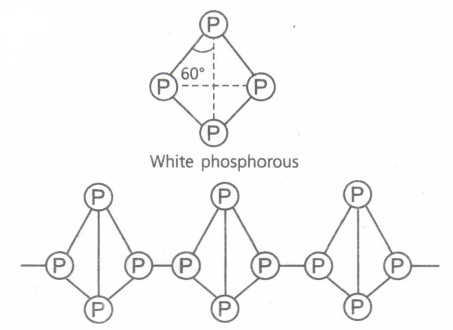
(a) White phosphorus exists as discrete (separate) tetrahedral molecules. Thus, it has tetrahedral structure with six P-P bonds. Red phosphorus has polymeric  structure in which molecules (tetrahedral) are linked through P-P bonds to form chain. Black phosphorus has two forms -black and -black phosphorus. It can be sublined in air and has opaque monoclinic or rhomohedral crystals; It does not oxidise in air. -black phosphorus does not burn in air up to 673 K. Black phosphorus is thermodynamically most stable.
Reactivity: White phosphorus is more reactive than red phosphorus because it is monomeric and has angular strain due to bond angles at 60°C. Black phosphorus is also less reactive.
7.
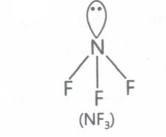
.png)
8.
(i) \({ NH }_{ 4 }{ NO }_{ 2 }(s)\underrightarrow { heat } { N }_{ 2 }+{ 2H }_{ 2 }O\)
'A' 'B'
(ii) \({ N }_{ 2 }+{ 3H }_{ 2 }\longrightarrow 2{ NH }_{ 3 }(g)\)
'C' basic
(iii) \({ 4NH }_{ 3 }+{ 5O }_{ 2 }\longrightarrow 4NO+{ 6H }_{ 2 }O\)
\(\\ 2NO+{ O }_{ 2 }\longrightarrow { 2NO }_{ 2 }\)
'D' (part of acid rain)
\({ 3NO }_{ 2 }+{ H }_{ 2 }O\longrightarrow 2{ HNO }_{ 3 }+NO\)
9.
(a)\((i)\quad { 2I }^{ - }+{ O }_{ 3 }+{ H }_{ 2 }{ O }\longrightarrow { I }_{ 2 }+{ O }_{ 2 }+2{ OH }^{ - }\)
\(\\ (ii)\quad { P }_{ 4 }(s)+3NaOH(aq)+{ 3H }_{ 2 }{ O }(l)\longrightarrow { PH }_{ 3 }{ (g) }+{ 3NaH }_{ 2 }{ PO }_{ 2 }\)
(b)(i) It is because bond dissociation energy of H-Te bond is less than H-S bond due to longer bond length.
(ii) It is due to higher standard reduction potential, low bond dissociation energy, high electron affinity and higher enthalpy of hydration.
(iii) It is due to stable electronic configuration i.e., their octet is complete except in He which has duplet i.e., 1st shell is complete having 2 electrons.
10.
(a)
Nitrogen
11.
(a)
HF
12.
(c)
O2 and Xe have comparable ionisation energies
13.
(c)
O<S<F<Cl
14.
(a)
NH4NO3

12th Standard CBSE Syllabus & Materials
12th Standard CBSE
CBSE 12th Computer Science Python Revision Tour I - New Previous year Question Papers Study Material - QB365 Set A
NEW12th Standard CBSE
CBSE 12th Business Studies Planning Important Questions And Answers Study Material - QB365 Set A
NEW12th Standard CBSE
CBSE 12th Business Studies Business Environment Important Questions And Answers Study Material - QB365 Set A
NEW12th Standard CBSE
CBSE 12th Business Studies Principles of Management Important Questions And Answers Study Material - QB365 Set A



CBSE 12th Standard CBSE Subjects
CBSE Standards










