
 100% FREE ACCESS
12th Standard CBSE Syllabus & Materials
12th Standard CBSE
CBSE 12th Economics Government Budget and the Economy Previous year Question Papers Study Material - QB365 Set A
NEW12th Standard CBSE
CBSE 12th Computer Science Interface Python with MySQL - New Previous year Question Papers Study Material - QB365 Set A
NEW12th Standard CBSE
CBSE 12th Computer Science Database Concept - New Previous year Question Papers Study Material - QB365 Set A
NEW12th Standard CBSE
CBSE 12th Computer Science Data Communication - New Previous year Question Papers Study Material - QB365 Set A
NEW12th Standard CBSE
CBSE 12th Computer Science Data Structures - New Previous year Question Papers Study Material - QB365 Set A
NEW12th Standard CBSE
CBSE 12th Computer Science Functions - New Previous year Question Papers Study Material - QB365 Set A

Published on: 14/09/2019
The Solid State
Download CBSE Class 12th Standard CBSE Chemistry question papers, sample papers, important questions, and previous year solved papers in PDF format. Get free study materials, NCERT solutions, and exam preparation resources for Class 12th Standard CBSE Chemistry
Questions + Answers key
Take MCQ Chemistry Test
1.
In terms of band theory, what is the difference
(i) between a conductor and a semiconductor?
(ii) between a conductor and an insulator?
2.
An element with density 2.8 g cm-3 forms a fcc unit cell with edge length 4 x 10⁻⁸ cm Calculate the molar mass of the element (Given NA = 6.022 x 10²³ mol-1)
3.
Silver metal crystallizes with a face centered cubic lattice.The length of unit cell is found to be 4.077 x 10⁻⁸ cm.Calculate atomic radius and density of silver. (Atomic mass of Ag = 108 u, NA = 6.02 x 10²³ mol-1)
4.
A metal crystallises in a fcc structure. Atomic radius of the metal is 125 pm. Calculate the edge length of the unit cell of the metal.
5.
Cesium chloride crystallizes as cubic lattice and has a density of 4.0 g cm -3 . Calculate the length of the edge of the unit cell of cesium chloride. (Molar mass of CsCI = 168.5 b mol-1).
6.
The density of chromium metal is 7.2 g cm-3 . If the unit cell is cubic with edge length of 289 pm, determine the type of unit cell (simple, body centred or face centred) [Atomic mass of Cr = 52 a.m.u., N0 = 6.02 \(\times\) 1023 mol-1 ].
7.
Solids can be classified into three types on the basis of their electrical conductivities.
(i) Name three types of solids classified on the basis of electrical conductivities.
(ii) How will you explain such classification based theory?
8.
Iron changes its crystal structure from body-centred to cubic close-packed structure when heated to 9160C.Calculate the ratio of the bcc crystal to that of ccp crystal,assuming that the metallic radius of the atom does not change.
9.
You are given marbles of diameter 10mm.They are to be placed such that their centres are lying in a square bound by four lines each of length 40mm.What will be the arrangement of marbles in a plane so that maximum number of marbles can be placed inside the area?Sketch the diagram and derive an expression for the number of marbles per unit area.
10.
Calcium metal crystallize in a face-centred cubic lattice with edge length of 0.556nm.Calculate the density of the metal if contains (i)0.5% Frenkel defects(ii)0.2% Schottky defects.
11.
Explain the following with suitable example:An n-type semiconductor.
12.
With the help of a labelled diagram show that there are four octahedral voids per unit cell in cubic close packed structure.
13.
How are the following properties of crystals affected by Schottky and Frenkel defects?
(i) Density
(ii) Electrical conductivity.
1.
(i) The energy gap between valence band and condition band in an insulator is very large where as in a conductor, the energy gap is very small or there is overlapping between valence band and conduction band.
(ii) In a conductor, there is verysmall energy gap or there is verlapping between valence band and conduction band but in a semiconductor, there is always a small energy gap between them.
2.
\(d=2.8 \ g \ cm^{ 3 };Z=4(for \ fcc),a=4\times 10^{ -8 }cm;N_{ A }=6.022\times 10^{ 23 }mol^{ -1 }\)
\(\Rightarrow M=\frac { d\times a^{ 3 }\times N_{ A } }{ Z } \)
\(=\frac { 28g\quad cm^{ 3 }(4\times 10^{ -8 }cm)^{ 3 }\times 6.022\times 10^{ 23 } }{ 4 } \)
\( \Rightarrow M=2.8\times 16\times 10^{ -1 }\times 6.022\\ =26.98 \ g \ mol^{ -1 }\)
3.
Given : a = 4.077 x 10⁻⁸cm, Z = 4,M = 108 g mol-1 NA = 6.023 x 10²³
\(d=\frac { Z\times M }{ a^{ 3 }\times N_{ A } } \)
\(=\frac { 4\times 108 }{ (4.077\times 10^{ -8 })^{ 3 }\times 6.023\times 10^{ 23 } } \)
\(r\quad =\frac { a }{ 2\sqrt { 2 } } =\frac { 4.077\times 10^{ -8 }cm }{ 2\sqrt { 2 } } \)
\(=1.44\times 10^{ -8 }cm\)
4.
353.3 nm
5.
Density, \(d=\frac { Z\times M }{ { a }^{ 3 }\times { N }_{ 0 } } \)
or \({ a }^{ 3 }=\frac { Z\times M }{ d\times { N }_{ 0 } } \)
\(d={ 4.0g\ cm }^{ -3 }\)
\(M={ 168.5gmol }^{ -1 }\)
For cubic lattice, \(Z=1\)
\(\therefore \) \({ a }^{ 3 }=\frac { 1\times 168.5 }{ 4.0\times 6.022\times { 10 }^{ 23 } } \)
\(=69.9\times { 10 }^{ -24 }{ cm }^{ 3 }\)
\(\therefore \) \(a=4.12\times { 10 }^{ -8 }cm=412 \ pm\)
6.
Length of the edge = \(289pm=289\times { 10 }^{ -12 }m=289\times { 10 }^{ -10 }cm\)
Atomic mass of Cr, \(A=52u\)
Density of metal, \(d=7.2g{ cm }^{ -3 }\)
Now, \(d=\frac { Z\times M }{ { a }^{ 3 }\times { N }_{ 0 } } \)
\({ 7.2 \ gcm }^{ -3 }=\frac { Z\times { 52g }\quad mol^{ -1 } }{ (289\times { 10 }^{ 10 }cm)^{ 3 }\times (6.022\times { 10 }^{ 23 }{ mol }^{ -1 }) } \)
or \(Z=\frac { { (7.2g\quad cm) }^{ -3 }\times (289\times { 10 }^{ 10 }cm)^{ 3 }\times (6.022\times { 10 }^{ 23 }{ mol }^{ -1 }) }{ { (52g\quad mol }^{ -1 }) } \)
\(=2.01\)
Since the unit cell contains 2 atoms, it is body centred cubic (bcc).
7.
Electrical properties of solids. Depending upon the electrical conductivity, solids can be broadly classified into three main types. These are
(i) Conductors (ii) Insulators and (iii) Semiconductors.
The conductivity of solids varies between 107 ohms in metals to about 10-20 ohms' in insulators.Solids can be classified into three types on the basis of their conductivities:
(i) Conductors with conductivities ranging between 104 to 107 ohms. Metals having conductivities in the order of 107 ohnr+ m-I are good conductors.
(ii) Insulators with very low conductivities ranging between 10-20 to 10-10 ohms.
(iii) Semiconductors with conductivities in the intermediate range from 10-6 to 104 ohms.
The electrical conductivity of solids may be due to the electrons, holes or ions. Ionic substances such as alkali metal halides, in which the conduction is mainly due to ions are poor conductors, generally insulators. However, due to some defects, they become conductors.
Unlike metals, the conductivity of insulators and semiconductors is mainly dependent on the impurities and defects present. The conduction of electricity is carried by the excess electrons or holes present in these solids.
8.
0.919
9.
1.125
10.
1.5427g cm-3
11.
When group 14 element is doped with group 15 elements, we get n-type semiconductor, e.g. silicon doped with arsenic.
12.
In a ccp structure, there is 1 octahedral void in the centre of the body and 12 octahedral voids are on 12 edges of the cube.Each octahedral void on the edge is
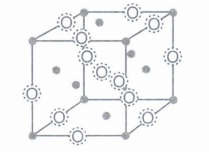
common to four other unit cells (as shown in figure). Thus, in cubic close-packed structure, octahedral voids in the centre of the cube = 1.
Effective number of octahedral voids on edges = 12 x 1/4 = 3
Total number of octahedral voids = 1 + 3 = 4
13.
(i) Density remains the same in Frenkel defect, where as Schottky defect leads to lowering of density.
(ii) Electrical conductivity increases in both Frenkel and Schottky defects.

12th Standard CBSE Syllabus & Materials
12th Standard CBSE
CBSE 12th Computer Science Python Revision Tour I - New Previous year Question Papers Study Material - QB365 Set A
NEW12th Standard CBSE
CBSE 12th Business Studies Planning Important Questions And Answers Study Material - QB365 Set A
NEW12th Standard CBSE
CBSE 12th Business Studies Business Environment Important Questions And Answers Study Material - QB365 Set A
NEW12th Standard CBSE
CBSE 12th Business Studies Principles of Management Important Questions And Answers Study Material - QB365 Set A



CBSE 12th Standard CBSE Subjects
CBSE Standards










