
 100% FREE ACCESS
12th Standard CBSE Syllabus & Materials
12th Standard CBSE
CBSE 12th Economics Government Budget and the Economy Previous year Question Papers Study Material - QB365 Set A
NEW12th Standard CBSE
CBSE 12th Computer Science Interface Python with MySQL - New Previous year Question Papers Study Material - QB365 Set A
NEW12th Standard CBSE
CBSE 12th Computer Science Database Concept - New Previous year Question Papers Study Material - QB365 Set A
NEW12th Standard CBSE
CBSE 12th Computer Science Data Communication - New Previous year Question Papers Study Material - QB365 Set A
NEW12th Standard CBSE
CBSE 12th Computer Science Data Structures - New Previous year Question Papers Study Material - QB365 Set A
NEW12th Standard CBSE
CBSE 12th Computer Science Functions - New Previous year Question Papers Study Material - QB365 Set A

Published on: 23/09/2019
Application of Derivatives
Download CBSE Class 12th Standard CBSE Maths question papers, sample papers, important questions, and previous year solved papers in PDF format. Get free study materials, NCERT solutions, and exam preparation resources for Class 12th Standard CBSE Maths
Questions + Answers key
Take MCQ Maths Test
1.
A man 2 meters high walks at a uniform speed of 5km/h away from a lamp-post 6 meters high. Find the rate at which length of his shadow increases.
2.
Show that the height of the cylinder, open at the top, of given surface area and greatest volume is equal to the radius of its base.
3.
Show that of all rectangles with a given perimeter, the square has the largest area.
4.
Find two positive numbers whose sum is 24 and their sum of squares is minimum
5.
Find the equations of the tangent and normal to the curve x = 1-\(cos\theta ,y-=\theta -sin\theta \) at \(\theta =\frac { \pi }{ 4 } \)
6.
Show that the function\(f(x)=4x^{ 3 }-18x^{ 2 }+27x-7\) has neither maximum nor minimum.
7.
Find the absolute maximum and minimum values of the function 'f' is given by:
\(f(x)=cos^{ 2 }x+sinx,x\in [0,\pi ]\)
8.
Prove that the function f(x) = tan x - 4x is strictly decreasing on \(\left( -\frac { \pi }{ 3 } ,\frac { \pi }{ 3 } \right) \)
9.
Prove that the function given by
\(f(x)=x^{ 3 }-3x^{ 2 }+3x-100\quad \)
10.
The total cost C(x) in Rupees associated with the production of x units of an item is given by
\(C(x)=0.007x^{ 3 }-0.003x^{ 2 }+15x+4000\)
Find the marginal cost when 17 units are produced.
11.
Show that the function given by:
\(f(x)=7x-3\) is strictly increasing on R.
12.
The volume of a cube is increasing at the rate of 9 cubic centimetres per second. How fast is the surface area increasing when the length of an edge is 10 centimetres?
1.
Let AB be the lamp post and a man CD be at a distance x
from the lamp post and let CE = y be his shadow
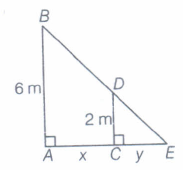
Given that
\( \frac{d x}{d t}=6 \mathrm{~km} / \mathrm{h}, A B=6 \mathrm{~m}=\frac{6}{1000} \mathrm{~km} \text { and }\)
\( C D=2 \mathrm{~m}=\frac{2}{1000} \mathrm{~km}[\because 1 \mathrm{~km}=1000 \mathrm{~m}] \)
Here,\(\Delta B A E \sim \Delta D C E\)
\( \Rightarrow \frac{6}{\frac{1000}{2}}{\frac{1000}{y}}=\frac{x+y}{y} \Rightarrow 3=\frac{x+y}{y}\)
\( \Rightarrow 3 y =x+y \Rightarrow 3 y-y=x \Rightarrow 2 y=x \)
On differentiating both sides w.r.t. t, we get
\(2 \frac{d y}{d t}=\frac{d x}{d t} \)
\( \Rightarrow 2 \frac{d y}{d t}=6 \quad\left[\because \frac{d x}{d t}=6\right] \)
\(\Rightarrow \frac{d y}{d t}=\frac{6}{2}=3 \mathrm{~km} / \mathrm{h}\)
2.
Let 'r' and 'h' be the radius and height respectively of the cylinder.
\(\therefore \) S, the surface area = \(\pi r^{ 2 }+2\pi rh\)
\(\Rightarrow \) \(x = {-b \pm \sqrt{b^2-4ac} \over 2a}\)....(1)
And V,the volume = \(\pi r^{ 2 }h\)
i.e. \(V=\pi r^{ 2 }\left( \frac { S-\pi r^{ 2 } }{ 2\pi r } \right) \) [Using (1)]
\(\Rightarrow \) \(V=\frac { r }{ 2 } (S-\pi r^{ 2 })\)
\(\Rightarrow \) \(V=\frac { r }{ 2 } (Sr-\pi r^{ 2 })\)
\(\therefore \) \(\frac { dV }{ dr } =\frac { 1 }{ 2 } (S-3\pi r^{ 2 })\)...(2)
and \(\frac { d^{ 2 }V }{ dr } =-\frac { 3\pi }{ 2 } (2r)=-3\pi r\) (3)
For greatest volume \(\frac { dV }{ dr } =0\Rightarrow -\frac { 1 }{ 2 } (S-3\pi r^{ 2 })=0\)
\(\Rightarrow \) \(S=3\pi r^{ 2 }\Rightarrow r=\sqrt { \frac { S }{ 3\pi } } \)
Putting in (3),
\(\frac { d^{ 2 }V }{ dr^{ 2 } } =-3\pi \sqrt { \frac { S }{ 3\pi } } =-\sqrt { 3\pi S } \) which is -ve.
Thus V is the greatest when \(r=\sqrt { \frac { s }{ 3\pi } } \)
And from (1),
\(h=\frac { S-\pi \left( \frac { S }{ 3\pi } \right) }{ 2\pi \sqrt { \frac { S }{ 3\pi } } } =\frac { \frac { 2S }{ 3 } }{ \frac { 2 }{ \sqrt { 3 } } \sqrt { \pi S } } =\sqrt { \frac { s }{ 3\pi } } \)
Hence, height = Radius of the base.
3.
Let 'x' and 'y' be the side of the rectangle.
By the equation, perimeter = p(say) [Given]
\(\Rightarrow 2x+2y=p\Rightarrow y=\frac { 1 }{ 2 } (p-2x)\)..(1)
Now area, A = xy = x .\(\frac { 1 }{ 2 } (p-2x)\) [Using (1)]
\(\frac { 1 }{ 2 } (p-2x^{ 2 })\)
For A to be largest, \(\frac { dA }{ dx } =0\) and \(\frac { d^{ 2 }A }{ dx } \) is -ve
Here \(\frac { dA }{ dx } \quad =\frac { 1 }{ 2 } (p-4x)\)
Now \(\frac { dA }{ dx } =0\) gives \(\frac { 1 }{ 2 } (p-4x)=0\)
\(\Rightarrow p-4x=0\Rightarrow p=4x\)
And \(\frac { d^{ 2 }A }{ dx^{ 2 } } \) is -ve
Thus A is the largest when p = 4x.
From(1), \(y=\frac { 1 }{ 2 } (4x-2x)\Rightarrow y=\frac { 1 }{ 2 } (2x)\Rightarrow y=x\)
Hence area is largest when x=y i.e when rectangle becomes a square.
4.
Let 'x' and 'y' be two positive numbers.
By the question x + y = 24....(1)
Let \(s=x^{ 2 }+y^{ 2 }\)
\(\Rightarrow \)\(s=x^{ 2 }+(24-x)^{ 2 }\) [Using (1)]
\(=x^{ 2 }+576+x^{ 2 }-48x\)
\(=2x^{ 2 }-48x+576\)
\(\therefore \) \(\frac { dS }{ dx } =4x-48\)
For S to be maximum, \(\frac { dS }{ dx } =0,\)which gives:
4x - 48 = 0\(\Rightarrow 4x=48\Rightarrow x=12\)
Now \(\frac { d^{ 2 }S }{ dx^{ 2 } } =4,\) which is +ve for x = 12
Hence S is minimum when the two positive numbers are 12 and (54-12) i.e. 12 and 12.
5.
The given curve is : x = 1 \(cos\theta ,y-=\theta -sin\theta \)
\(\therefore \frac { dx }{ d\theta } =sin\theta ,\frac { dy }{ d\theta } =1-cos\theta \)
\(\therefore \frac { dy }{ dx } =\frac { dy/d\theta }{ dx/d\theta } =\frac { 1-cos\theta }{ sin\theta } =\frac { 2sin^{ 2 }\frac { \theta }{ 2 } }{ 2sin\frac { \theta }{ 2 } cos\frac { \theta }{ 2 } } \)
\(=\frac { sin\frac { \theta }{ 2 } }{ cos\frac { \theta }{ 2 } } =tan\frac { \theta }{ 2 } \)
At \(\theta \) \(=\frac { \pi }{ 4 } \) \(x=1-cos\frac { \pi }{ 4 } =1-\frac { 1 }{ \sqrt { 2 } } \)
\(y=\frac { \pi }{ 4 } -sin\frac { \pi }{ 4 } =\frac { 1 }{ \sqrt { 2 } } \)
and \(\frac { dy }{ dx } =tan\frac { \pi }{ 8 } \)
6.
We have:\(f(x)=4x^{ 3 }-18x^{ 2 }+27x-7\)
\(\therefore f'(x)=12x^{ 2 }-36x+27\)
\( =3(4x^{ 2 }-12x+9)=3(2x-3)^{ 2 }\)
Now \(f'(x)=0\Rightarrow 3(2x-3)^{ 2 }=0(2x-3)^{ 2 }=0\)
\(\Rightarrow x=\frac { 3 }{ 2 } \) (Critical Point)
Since \(f'(x)>0\) for all \(x<\frac { 3 }{ 2 } \)Hence 'f' has neither maximum nor minimum. and for all \(x<\frac { 3 }{ 2 } \)
\(\therefore x=\frac { 3 }{ 2 } \) is a point of inflexion.
7.
We have: \(f(x)=cos^{ 2 }x+sinx,x\in [0,\pi ]\)
\(\therefore f'(x)=2cosx(-sinx)+cosx\)
For extreme values \(f'(x)=0\)
\(\Rightarrow cosx(-2sinx+1)=0\)
\(\Rightarrow Cosx=0or-2sinx+1=0\)
\(\Rightarrow x=\frac { \pi }{ 2 } orsinx=\frac { 1 }{ 2 } \Rightarrow x=\frac { \pi }{ 6 } \)
\(f(0)=cos^{ 2 }\frac { \pi }{ 6 } +sin\frac { \pi }{ 6 } \)
\(f\left( \frac { \pi }{ 6 } \right) =cos^{ 2 }\frac { \pi }{ 6 } +sin\frac { \pi }{ 6 }\)
\(=\left( \frac { \sqrt { 3 } }{ 2 } \right) ^{ 2 }+\frac { 1 }{ 2 } \)
\(=\frac { 3 }{ 4 } +\frac { 1 }{ 2 } =\frac { 5 }{ 4 } \)
\(f\left( \frac { \pi }{ 2 } \right) =cos^{ 2 }\frac { \pi }{ 2 } +sin\frac { \pi }{ 2 } =0+1=1\)
\( f(\pi )=cos^{ 2 }\pi +sin\pi \)
\(=(-1)^{ 2 }+0=1\)
Hence absolute max and min values are \(\frac { 5 }{ 4 } \)and 1 respectively.
8.
We have : \(f(x)\) = tan x - 4x.
\(f'(x)=sec^{ 2 }x-4\)
When \((\frac { -\pi }{ 3 } )\)
Thus for \( (\frac { -\pi }{ 3 } )\)
Hence 'f' is strictly decreasing on \(\left( -\frac { \pi }{ 3 } ,\frac { \pi }{ 3 } \right) \)
9.
We have:
\(f(x)=x^{ 3 }-3x^{ 2 }+3x-100\quad \)
\(\therefore f(x)=3x^{ 2 }-6x+3=3(x-1)^{ 2 }\)
Which is for all \(x\in R\)
Hence,f(x) is increasing function on R.
10.
Marginal cost is the rate of change of total cost with respect to output.
Now \(C(x)=0.007x^{ 3 }-0.003x^{ 2 }+15x+4000\)
\(\therefore \) Marginal Cost (MC)=\(\frac { dC }{ dx } \)
=\((0.007)(3x^{ 2 })-0.003(2x)+15\)
When x = 17, MC = (0.007) (3\(17)^{ 2 })\)- 0.003 (2(17)) + 15
= 6.069 - 0.102 + 15 = 20.967
Hence the reqd marginal cost is Rs. 21 (nearly).
11.
Let \(x_{ 1 }\quad and\quad x_{ 2 }\in R\)
Now \(x_{ 1 }<{ x }_{ 2 }\)
\(\Rightarrow 7x_{ 1 }<7x_{ 2 }\)
\( \Rightarrow 7x_{ 1 }-3<7x_{ 2 }-3\)
\(\Rightarrow f(x_{ 1 })\)
Hence,\(f\) is strictly increasing on \(R\)
12.
Let x be the length of a side, V be the volume and S be the surface area of the cube. Then, V = x3 and S = 6x2, where x is a function of time t.
Here \(\frac { dV }{ dt } =9cm3/s \)
\(9=\frac{d \mathrm{~V}}{d t}=\frac{d}{d t}\left(x^3\right)=\frac{d}{d x}\left(x^3\right) \cdot \frac{d x}{d t}\)(By Chain Rule)
\( =3 x^2 \cdot \frac{d x}{d t} \\ \frac{d x}{d t} =\frac{3}{x^2} \ \ ...(1) \)
\(\frac{d S}{d t}=\frac{d}{d t}\left(6 x^2\right)=\frac{d}{d x}\left(6 x^2\right) \cdot \frac{d x}{d t}\)(By Chain Rule)
\(=12 x \cdot\left(\frac{3}{x^2}\right)=\frac{36}{x}\)(Using (1))
Hence when, \(x=10 \mathrm{~cm}, \frac{d S}{d t}=3.6 \mathrm{~cm}^2 / \mathrm{s}\)

12th Standard CBSE Syllabus & Materials
12th Standard CBSE
CBSE 12th Computer Science Python Revision Tour I - New Previous year Question Papers Study Material - QB365 Set A
NEW12th Standard CBSE
CBSE 12th Business Studies Planning Important Questions And Answers Study Material - QB365 Set A
NEW12th Standard CBSE
CBSE 12th Business Studies Business Environment Important Questions And Answers Study Material - QB365 Set A
NEW12th Standard CBSE
CBSE 12th Business Studies Principles of Management Important Questions And Answers Study Material - QB365 Set A



CBSE 12th Standard CBSE Subjects
CBSE Standards










