
 100% FREE ACCESS
12th Standard CBSE Syllabus & Materials
12th Standard CBSE
CBSE 12th Economics Government Budget and the Economy Previous year Question Papers Study Material - QB365 Set A
NEW12th Standard CBSE
CBSE 12th Computer Science Interface Python with MySQL - New Previous year Question Papers Study Material - QB365 Set A
NEW12th Standard CBSE
CBSE 12th Computer Science Database Concept - New Previous year Question Papers Study Material - QB365 Set A
NEW12th Standard CBSE
CBSE 12th Computer Science Data Communication - New Previous year Question Papers Study Material - QB365 Set A
NEW12th Standard CBSE
CBSE 12th Computer Science Data Structures - New Previous year Question Papers Study Material - QB365 Set A
NEW12th Standard CBSE
CBSE 12th Computer Science Functions - New Previous year Question Papers Study Material - QB365 Set A

Published on: 04/11/2019
Download CBSE Class 12th Standard CBSE Maths question papers, sample papers, important questions, and previous year solved papers in PDF format. Get free study materials, NCERT solutions, and exam preparation resources for Class 12th Standard CBSE Maths
Questions + Answers key
Take MCQ Maths Test
1.
Find the inverse of the matrix A by elementary operations and verify that \({ A }^{ -1 }A=I\), when:
\(A=\left[ \begin{matrix} 1 & 2 & -2 \\ -1 & 3 & 0 \\ 0 & -2 & 1 \end{matrix} \right] .\)
2.
Define a binary operation '*' on the set A = {0, 1, 2, 3, 4, 5}, given by a*b=(ab) mod 6. Show that for *,1 and 5 are only invertible elements with \(1^{ -1 }=1\) and \(5^{ -1 }=5\).
[Here (a, b) mod 6, we mean the remainder after dividing ab by 6 ]
3.
Write the value of \(tan^{-1}\left[2sin\left(2cos^{-1}{\sqrt{3}\over2}\right)\right]\)
4.
If \(A=\begin{bmatrix} 4 & 1 \\ 5 & 8 \end{bmatrix}\), show that A + AT is a symmetric matrix, where AT denotes the transpose of matrix A.
5.
Using elementary transformations, find the inverse of the matrix
\(\left[ \begin{matrix} 1 & 3 & -2 \\ -3 & 0 & -1 \\ 2 & 1 & 0 \end{matrix} \right] \).
6.
Evaluate : \(\text { }\left|\begin{array}{ccc} \cos \alpha \cos \beta & \cos \alpha \sin \beta & -\sin \alpha \\ -\sin \beta & \cos \beta & 0 \\ \sin \alpha \cos \beta & \sin \alpha \sin \beta & \cos \alpha \end{array}\right|\)
7.
Two cards are drawn successively with replacement from a well shuffled pack of 52 cards. Find the probability distribution of the number of diamond cards drawn. Also, find the mean and the variance of the distribution.
8.
Find the co-ordinates of the point, where the line \(\frac { x-2 }{ 3 } =\frac { y+1 }{ 4 } =\frac { z-2 }{ 12 } \) intersects the pIane x - y + z - 5 = 0.
Also find the angle between the line and the plane.
9.
Mrs. Rodger got a weekly raise of $145. If she gets paid every other week, write an integer describing how the raise will affect her paycheck.
10.
Find the vector and Cartesian equations of the line passing through the point P (1,2,3) and parallel to the planes \(\vec { r } .(\hat { i } -\hat { j } +2\hat { k } )=5\) and \(\vec { r } .(3\hat { i } +\hat { j } +\hat { k } )=6\).
11.
A husband and a wife appear in an interview for two vacancies for the same post. The probability of husbands selection is \(1\over7\) and that of wife's selection is \(1\over5\). What is the probability that
(i) both will be selected
(ii) only one of them will be selected
(iii) none will be selected?
12.
An experiment succeeds twice as often as it fails. Find the probability that in the next six trails, there will be at least 4 successes.
13.
(Manufacturing Problem) A small firm manufactures gold rings and chains. The total number of rings and chains manufactured per day is atmost 24. It takes 1 hour to make a ring and 30 minutes to make a chain. The maximum number of hours available per day is 16. If the profit on a ring is Rs. 300 and that on a chain is Rs. 190, find the number of rings and chains that should be manufactured per day, so as to earn the maximum profit. Make it as an LPP and solve it graphically.
1.
\(A=\left[ \begin{matrix} 1 & 2 & -2 \\ -1 & 3 & 0 \\ 0 & -2 & 1 \end{matrix} \right]\)
\(\therefore \ { A }^{ -1 }=\left[ \begin{matrix} 3 & 2 & 6 \\ 1 & 1 & 2 \\ 2 & 2 & 5 \end{matrix} \right]\)
\(Now\ { A }^{ -1 }A=\left[ \begin{matrix} 3 & 2 & 6 \\ 1 & 1 & 2 \\ 2 & 2 & 5 \end{matrix} \right] \left[ \begin{matrix} 1 & 2 & -2 \\ -1 & 3 & 0 \\ 0 & -2 & 1 \end{matrix} \right] \)
\(=\left[ \begin{matrix} 3-2+0 & 6+6-12 & -6+0+6 \\ 1-1+0 & 2+3-4 & -2+0+2 \\ 2-2+0 & 4+6-10 & -4+0+5 \end{matrix} \right] \)
\(=\left[ \begin{matrix} 1 & 0 & 0 \\ 0 & 1 & 0 \\ 0 & 0 & 1 \end{matrix} \right] =I,\text{ Which is true.}\)
2.
Here a*1 = a mod 6 = a
and 1*a = a mod 6 = \(a\forall a\in A\).
Thus 1 is the identity operation for '*'.
and 5*5 = 25 mod 6 = 1
\(\Rightarrow \)1 is the inverse of 1 and 5 is the inverse of 5.
Also, \(\forall a\in A\), other than 1 and 5, we cannot find \(b\) such that a*b = ab mod 6 = 1
3.
\(\text {Consider } \tan ^{-1}\left[2 \sin \left(2 \cos ^{-1} \frac{\sqrt{3}}{2}\right)\right] \)
\(=\tan ^{-1}\left[2 \sin \left(2 \cdot \frac{\pi}{6}\right)\right]=\tan ^{-1}\left[2 \sin \frac{\pi}{3}\right] \)
\(=\tan ^{-1}\left(2 \cdot \frac{\sqrt{3}}{2}\right)=\tan ^{-1}(\sqrt{3})=\frac{\pi}{3} \)
4.
A matrix A is said to be symmetric if AT = A,
\(A+A^{T}=\left[\begin{array}{ll} 4 & 1 \\ 5 & 8 \end{array}\right]+\left[\begin{array}{ll} 4 & 5 \\ 1 & 8 \end{array}\right]=\left[\begin{array}{lc} 8 & 6 \\ 6 & 16 \end{array}\right] \)
\(\left(A+A^{T}\right)^{T}=\left[\begin{array}{cc} 8 & 6 \\ 6 & 16 \end{array}\right]^{T}=\left[\begin{array}{cc} 8 & 6 \\ 6 & 16 \end{array}\right]\)
=(A + AT)T = A + AT
5.
Use A=lA. Proceed. [Refer 2]
\(\left[ \begin{matrix} 1 & -2 & -3 \\ -2 & 4 & 7 \\ -3 & 5 & 9 \end{matrix} \right] \)
6.
\( \Delta=\left|\begin{array}{ccc} \cos \alpha \cos \beta & \cos \alpha \sin \beta & -\sin \alpha \\ -\sin \beta & \cos \beta & 0 \\ \sin \alpha \cos \beta & \sin \alpha \sin \beta & \cos \alpha \end{array}\right| \)
Expanding along \(\mathrm{C}_3\),
we have:
\( \Delta =-\sin \alpha\left(-\sin \alpha \sin ^2 \beta-\cos ^2 \beta \sin \alpha\right)+\cos \alpha\left(\cos \alpha \cos ^2 \beta+\cos \alpha \sin ^2 \beta\right) \)
\(=\sin ^2 \alpha\left(\sin ^2 \beta+\cos ^2 \beta\right)+\cos ^2 \alpha\left(\cos ^2 \beta+\sin ^2 \beta\right) \)
\(=\sin ^2 \alpha(1)+\cos ^2 \alpha(1) =1 \)
7.
Let X = denote the random variable. X = 0, 1, 2n = 2, p = 1/4, q = 3/4
| xi | 0 | 1 | 2 | Total |
| pi | \({ 3 }_{ { C }_{ 0 } }{ \left( \frac { 3 }{ 4 } \right) }^{ 2 }=\frac { 9 }{ 16 } \) | \({ 2 }_{ { C }_{ 1 } }{ \frac { 1 }{ 4 } \left( \frac { 3 }{ 4 } \right) }=\frac { 9 }{ 16 } \) | \({ 2 }_{ { C }_{ 2 } }{ { \left( \frac { 1 }{ 4 } \right) }^{ 2 } }=\frac { 1 }{ 16 } \) | |
| xipi | 0 | 6/16 | 2/16 | 1/2 |
| \({ x }_{ i }^{ 2 }{ p }_{ i }\) | 0 | 6/16 | 4/16 | 5/8 |
Mean = \(\sum { { x }_{ i }{ p }_{ i }=\frac { 1 }{ 2 } } \)
Variance = \(\sum { { x }_{ i }^{ 2 }{ p }_{ i } } -{ \sum { ({ x }_{ i }{ p }_{ i } } ) }^{ 2 }\)
= \(\frac { 5 }{ 8 } -\frac { 1 }{ 4 } =\frac { 3 }{ 8 } \)
8.
Let, \(\frac { x-2 }{ 3 } =\frac { y+1 }{ 4 } =\frac { z-2 }{ 12 } =\lambda\)
So, co-ordinates of any random point on this line, M
As the line intersect the plane, x-y+z-5 = 0
So, \( \left( 3\lambda +2 \right) -\left( 4\lambda -1 \right) +\left( 2\lambda +2 \right) -5=0\)
\(\Rightarrow\) \(3\lambda +2-4\lambda +1+2\lambda +2-5=0\)
\(\Rightarrow\) \(\lambda =0\)
So, required co-ordinates of point of intersection M(2, -1, 2)
Now the vector parallel to the given line,\(\vec { b } =3\hat { i } +4\hat { j } +2\hat { k } \) and the normal vector to the plane \(\vec { m } =\hat { i } -\hat { j } +\hat { k } \).
Let \(\theta \) be the angle between the line and the plane, then by formula \(\vec { b } .\vec { m } =\left| \vec { b } \right| \left| \vec { m } \right| \left| sin\ \theta \right| \)
or \(sin\ \theta =\frac { \vec { b } .\vec { m } }{ \left| \vec { b } \right| \left| \vec { m } \right| } \)
\(=\frac { \left( \hat { 3i } +4\hat { j } +2\hat { k } \right) .\left( \hat { i } -\hat { j } +\hat { k } \right) }{ \sqrt { { \left( 3 \right) }^{ 2 }+{ \left( 4 \right) }^{ 2 }+{ \left( 2 \right) }^{ 2 } } .\sqrt { { \left( 1 \right) }^{ 2 }+{ \left( -1 \right) }^{ 2 }+{ \left( 1 \right) }^{ 2 }} } =\frac { 3-4+2 }{ \sqrt { 87 } } =\frac { 1 }{ \sqrt { 87 } } \)
or \(\theta ={ sin }^{ -1 }\left( \frac { 1 }{ \sqrt { 87 } } \right) \)
9.
Let the 1st paycheck be x (integer).
Mrs. Rodger got a weekly raise of 145.
So after completing the 1st week she will get (x+145).
Similarly after completing the 2nd week she will get (x +145) + 145.
= (x + 145 + 145)
= (x + 290)
So in this way end of every week her salary will increase by 145.
10.
line is \(\vec { r } .(\hat { i } -2\hat { j } +3\hat { k } )+\lambda (-3\hat { i } +5\hat { j } +4\hat { k } )\)
In Cartesian from : \(\frac { x-1 }{ -3 } =\frac { y-2 }{ 5 } =\frac { z-3 }{ 4 } \)
11.
Here \(P(A)=\frac { 1 }{ 7 } ,P(B)=\frac { 1 }{ 5 } \)
\(P(\overset { \_ }{ A) } =1-\frac { 1 }{ 7 } =\frac { 6 }{ 7 } \)
\(P(\overset { \_ }{ B } )=1-\frac { 1 }{ 5 } =\frac { 4 }{ 5 } \)
Required probability =\(P(A\overset { \_ }{ B } )+P(\overset { \_ }{ A } B)=P(A)P(\overset { \_ }{ B } )+P(\overset { \_ }{ A } )P(B)\)
= \(\frac { 1 }{ 7 } \times \frac { 4 }{ 5 } +\frac { 6 }{ 7 } \times \frac { 1 }{ 5 } \)
\(=\frac { 4 }{ 35 } +\frac { 6 }{ 35 } =\frac { 10 }{ 35 } =\frac { 2 }{ 7 } \)
12.
Let 'p' be the probability of success and 'q' be tha probability of failure.
Then p + q = 1 and p = 2q
Solving, \(p=\frac { 2 }{ 3 } ,q=\frac { 1 }{ 3 } \) Also n = 6.
Required probability = \(P(X\ge 4)\)
= P(4)+P(5)+P(6)
= \(^6C_4\)q2p4+\(^6C_5\)q1p5+\(^6C_6\)q0p6
= \(15{ \left( \frac { 1 }{ 3 } \right) }^{ 2 }{ \left( \frac { 2 }{ 3 } \right) }^{ 4 }+6{ \left( \frac { 1 }{ 3 } \right) }{ \left( \frac { 2 }{ 3 } \right) }^{ 5 }+\left( 1 \right) \left( 1 \right) { \left( \frac { 2 }{ 3 } \right) }^{ 6 }\)
= \({ \left( \frac { 2 }{ 3 } \right) }^{ 4 }\left[ \frac { 15 }{ 9 } +\frac { 4 }{ 3 } +\frac { 4 }{ 9 } \right] =\frac { 31 }{ 9 } { \left( \frac { 2 }{ 3 } \right) }^{ 4 }\)
13.
Let 'x' and 'y' be the number of gold rings and chains respectively.
We have:
\(x\ge 0\) ...(1)
\(y\ge 0\)...(2)
\(x+y\le 24\)...(3)
\(x+\frac { y }{ 2 } \le 16\) ...(4)
The objective function, or the profit, Z is:
Z = 300x + 190y ..(5)
We have to maximise Z subject to (1)-(4).
For solution set, we draw the lines:
x = 0, y = 0, x + y = 24, 2x + y = 32.
The lines x + y = 24 and 2x + y = 32 meet at E (8,16).
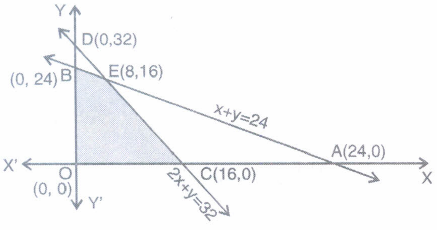
The shaded portion represents the feasible region, which is bounded.
Applying Corner Point Method, we have:
| Corner Point | Z = 300x + 190y |
| O : (0,0) | 0 |
| C : (16,0) | 4800 |
| E : (8,16) | 5440 (Maximum |
| B : (0,24) | 4560 |
Hence, the maximum profit is Rs. 5,440 and it is obtained when 8 gold rings and 16 chains are manufactured.

12th Standard CBSE Syllabus & Materials
12th Standard CBSE
CBSE 12th Computer Science Python Revision Tour I - New Previous year Question Papers Study Material - QB365 Set A
NEW12th Standard CBSE
CBSE 12th Business Studies Planning Important Questions And Answers Study Material - QB365 Set A
NEW12th Standard CBSE
CBSE 12th Business Studies Business Environment Important Questions And Answers Study Material - QB365 Set A
NEW12th Standard CBSE
CBSE 12th Business Studies Principles of Management Important Questions And Answers Study Material - QB365 Set A



CBSE 12th Standard CBSE Subjects
CBSE Standards










