
 100% FREE ACCESS
12th Standard CBSE Syllabus & Materials
12th Standard CBSE
CBSE 12th Economics Government Budget and the Economy Previous year Question Papers Study Material - QB365 Set A
NEW12th Standard CBSE
CBSE 12th Computer Science Interface Python with MySQL - New Previous year Question Papers Study Material - QB365 Set A
NEW12th Standard CBSE
CBSE 12th Computer Science Database Concept - New Previous year Question Papers Study Material - QB365 Set A
NEW12th Standard CBSE
CBSE 12th Computer Science Data Communication - New Previous year Question Papers Study Material - QB365 Set A
NEW12th Standard CBSE
CBSE 12th Computer Science Data Structures - New Previous year Question Papers Study Material - QB365 Set A
NEW12th Standard CBSE
CBSE 12th Computer Science Functions - New Previous year Question Papers Study Material - QB365 Set A

Published on: 04/11/2019
Download CBSE Class 12th Standard CBSE Maths question papers, sample papers, important questions, and previous year solved papers in PDF format. Get free study materials, NCERT solutions, and exam preparation resources for Class 12th Standard CBSE Maths
Questions + Answers key
Take MCQ Maths Test
1.
Two godowns A and B have grain capacity of 100 quintals and 50 quintals respectively. They supply to 3 ration shops, D, E and F whose requirements are 60, 50 and 40 quintals respectively. The cost of transportation per quintal from the godowns to the shops are given in the following table:
| Transportation Cost per Quintal (in RS) | ||
| From | A | B |
| To | ||
| D E F |
6 3 2.50 |
4 2 3 |
How should the supplies be transported in order that the transportation cost is minimum? What is the minimum cost?
2.
Two numbers are selected at random (without replacement)from first six positive integers 2, 3, 4, 5, 6 and 7. Let X denote the larger of the two numbers obtained. Find the probability distribution of X. Find the mean and variance of this distribution
3.
Show that the differential equation \(2y{ e }^{ \frac { x }{ y } }dx+\left( y-2x\quad { e }^{ \frac { x }{ y } } \right) dy=0\): is homogeneous and find the particular solution, given that x = 0 when y = 1.
4.
Solve the following Linear Programming Problem graphically:
Minimise Z = – 3x + 4 y
subject to constraints
\(x+2 y \leq 8,3 x+2 y \leq 12\)
and \(x, y \geq 0 \text {. }\)
5.
A and B throw a pair of dice alternately, till one of them gets a total 10 and wins tha game.Find their respective probability of winning if A starts first.
6.
If \(y={ e }^{ ax }cos\quad bx\quad \)then \(\frac { { d }^{ 2 }y }{ { dx }^{ 2 } } -2a\frac { dy }{ dx } +\left( { a }^{ 2 }+{ b }^{ 2 } \right) y=0\)
7.
Suppose that 90% of people are right-handed. What is the probability that at most 6 of a random sample of 10 people are right-handed.
8.
Probability that A speaks truth is \(\frac { 4 }{ 5 } \) . A coin is tossed. A reports that a head appears.The probability that actually there was head is:
(A) \(\frac { 4 }{ 5 } \)
(B) \(\frac { 1 }{ 2 } \)
(C) \(\frac { 1 }{ 5 } \)
(D) \(\frac { 2 }{ 5 } \)
9.
A and B throw a die alternatively till one of them gets a ‘6’ and wins the game. Find their respective probabilities of winning, if A starts the game first.
10.
If the mappings f and g are given by:
f = {(1, 2), (3, 5) (4, 1) and g = {(2, 3), (5, 1), (1, 3)}, write fog.
11.
If the area of the triangle is 35sq.units (2, -6), (5, 4) and (k, 4). Find the value of 'k'.
12.
If \(A=\begin{bmatrix} cos\alpha & -sin\alpha \\ sin\alpha & cos\alpha \end{bmatrix}\), then \(A+A\prime =I\), if the value of \(\alpha \)is:
(A) \(\frac { \pi }{ 6 } \)
(B) \(\frac { \pi }{ 3 } \)
(C) \(\pi \quad \)
(D) \(\frac { 3\pi }{ 2 } \).
13.
Let P be set of all subsets of given set X. Show that \(\cup :P\times P\rightarrow P\) given by \((A,B)\rightarrow A\cup B\) and \(\cap :P\times P\rightarrow P\) given by \((A,B)\rightarrow A\cap B\) are binary operations on the set P.
14.
Find te principal values of the following:
\({ cos }^{ -1 }\left( \frac { \sqrt { 3 } }{ 2 } \right) \)
15.
If a*b \(=\frac { a }{ 2 } +\frac { b }{ 3 } \)then value of 2*3 is.......
1.
Let godown A supply x and y quintals of grain to the shops D and E respectively. Then, (100 − x − y) will be supplied to shop F.
The requirement at shop D is 60 quintals since x quintals are transported from godown A. Therefore, the remaining (60 −x) quintals will be transported from godown B.
Similarly, (50 − y) quintals and 40 − (100 − x − y) = (x + y − 60) quintals will be transported from godown B to shop E and F respectively.
The given problem can be represented diagrammatically as follows.
\(60-x\ge 0\Leftrightarrow x\le 60\) ..(1)
\(50-y\ge 0\Leftrightarrow y\le 50\) .(2)
\(100-(x+y)\ge 0\Leftrightarrow x+y\le 100\) ..(3)
\(x+y-60\ge 0\Leftrightarrow x+y\ge 60\) ..(4)
and \(x,y\ge 0\) ...(5)
The given problem can be formulated as
Minimize z = 2.5x + 1.5y + 410 … (1)
subject to the constraints,
The feasible region determined by the system of constraints is as follows.
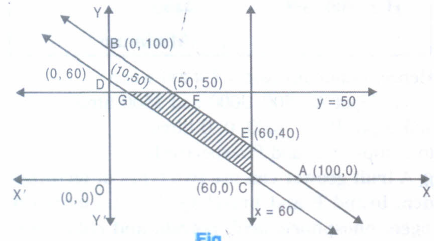
The corner points are A (60, 0), B (60, 40), C (50, 50), and D (10, 50).
The values of z at these corner points are as follows.
| Corner point | z = 2.5x + 1.5y + 41 | |
| A (60, 0) | 560 | |
| B (60, 40) | 620 | |
| C (50, 50) | 610 | |
| D (10, 50) | 510 | → Minimum |
The minimum value of z is 510 at (10, 50).
Thus, the amount of grain transported from A to D, E, and F is 10 quintals, 50 quintals, and 40 quintals respectively and from B to D, E, and F is 50 quintals, 0 quintals, and 0 quintals respectively.
The minimum cost is Rs. 510.
2.
We have : {1, 2, 3, 4, 5, 6}
Here 'X' is the larger of the two numbers obtained>
Now X = 2, 3, 4, 5, 6
\(P(X=2)=\frac { 1 }{ ^{ 6 }{ C }_{ 2 } } =\frac { 1 }{ 15 } \)
\(P(X=3)=\frac { 2 }{ ^{ 6 }{ C }_{ 2 } } =\frac { 2 }{ 15 } \)
\(P(X=4)=\frac { 3 }{ ^{ 6 }{ C }_{ 2 } } =\frac { 3 }{ 15 } \)
\(P(X=5)=\frac { 4 }{ ^{ 6 }{ C }_{ 2 } } =\frac { 4 }{ 15 } \)
\(P(X=6)=\frac { 5 }{ ^{ 6 }{ C }_{ 2 } } =\frac { 5 }{ 15 } \)
Hence, probability distribution is :
| X: | 2 | 3 | 4 | 5 | 6 |
| P(X): | \(\frac { 1 }{ 15 } \) | \(\frac { 2 }{ 15 } \) | \(\frac { 3 }{ 15 } \) | \(\frac { 4 }{ 15 } \) | \(\frac { 5 }{ 15 } \) |
(ii) we have
| xi | pi | pixi | xi2 | pixi2 |
| 2 | \(\frac { 1 }{ 15 } \) | \(\frac { 2 }{ 15 } \) | 4 | \(\frac { 4 }{ 15 } \) |
| 3 | \(\frac { 2 }{ 15 } \) | \(\frac { 6 }{ 15 } \) | 9 | \(\frac { 18 }{ 15 } \) |
| 4 | \(\frac { 3 }{ 15 } \) | \(\frac { 12 }{ 15 } \) | 16 | \(\frac { 48 }{ 15 } \) |
| 5 | \(\frac { 4 }{ 15 } \) | \(\frac { 20 }{ 15 } \) | 25 | \(\frac { 100 }{ 15 } \) |
| 6 | \(\frac { 5 }{ 15 } \) | \(\frac { 30 }{ 15 } \) | 36 | \(\frac { 180 }{ 15 } \) |
| Total |
(I) Mean \(\mu =\sum { { p }_{ i }-{ x }_{ i }=\frac { 70 }{ 15 } =\frac { 14 }{ 3 } } \)
(II) Variance \({ \sigma }^{ 2 }=\sum { { p }_{ i } } { x }_{ i }^{ 2 }-{ \mu }^{ 2 }\)
\(=\frac { 350 }{ 15 } -{ \left( \frac { 14 }{ 3 } \right) }^{ 2 }=\frac { 350 }{ 15 } -\frac { 196 }{ 9 } =\frac { 1050-980 }{ 45 } =\frac { 70 }{ 45 } =\frac { 14 }{ 9 } \)
3.
(i) The given equation is: \(2y{ e }^{ \frac { x }{ y } }dx+\left( y-2x\quad { e }^{ \frac { x }{ y } } \right) dy=0\)
\(\Rightarrow\) \(\frac { dx }{ dy } =\frac { 2x{ e }^{ \frac { x }{ y } }-y }{ 2y{ e }^{ \frac { x }{ y } } } \) .................. (1)
Here \(f\left( x,y \right) =\frac { 2x{ e }^{ \frac { x }{ y } }-y }{ 2y{ e }^{ \frac { x }{ y } } } .\)
\(\therefore \) \(f\left( \lambda x,\lambda y \right) =\frac { 2x{ e }^{ \frac { \lambda x }{ \lambda y } }-\lambda y }{ 2x{ e }^{ \frac { \lambda x }{ \lambda y } } } \)
\(=\frac { 2x{ e }^{ \frac { x }{ y } }-y }{ 2y{ e }^{ \frac { x }{ y } } } ={ \lambda }^{ 0 }f\left( x,y \right) \)
Thus \(\\ f\left( x,y \right) \) is homogeneous function of degree zero. Therefore, the given differential equation is a homogeneous differential equation.
To solve it, we make the substitution
x = vy ............... (2)
Differentiating equation (2) with respect to y, we get
\(\frac{d x}{d y}=v+y \frac{d v}{d y}\)
Substituting the value of and \(\frac{d x}{d y}\) in equation (1), we get
\(\Rightarrow \) \(y\frac { dv }{ dy } =\frac { 2v{ e }^{ v }-1 }{ 2\quad { e }^{ v }\quad } \quad \quad \)
\(
y \frac{d v}{d y}=\frac{2 v e^v-1}{2 e^v}-v \\
y \frac{d v}{d y}=-\frac{1}{2 e^v}
\)
or \(
2 e^v d v =\frac{-d y}{y}
\)
or \(\int 2 e^v \cdot d v =-\int \frac{d y}{y}
\)
or \(2 e^v =-\log |y|+\mathrm{C}
\)
\(2 e^{\frac{x}{y}}+\log |y|=\mathrm{C}\) ................. (3)
Substituting x = 0 and y = 1 in equation (3), we get
\(2 e^0+\log |1|=\mathrm{C} \Rightarrow \mathrm{C}=2\)
Substituting the value of C in equation (3), we get
\(2 e^{\frac{x}{y}}+\log |y|=2\)
which is the particular solution of the given differential equation.
4.
Given, Z = -3x + 4y
Subject to the constraints
x + 2y \( \leq\) 8; 3x + 2y \( \leq\) 12 and x \(\geq\)0, y \(\geq\) 0
Now, considering the inequations as equations, we get
x + 2y = 8 ...(i)
3x + 2y = 12 ...(ii)
Table for line x + 2y = 8 is
| x | 8 | 0 |
| y | 0 | 4 |
On putting (0, 0) in the inequality x + 2y \( \leq\) 8
0 \( \leq\) 8 (which is true)
So, half plane is towards the origin.
Table for line 3x + 2y = 12
| x | 4 | 0 |
| y | 0 | 6 |
On putting (0, 0) in the inequality 3x + 2y \( \leq\)12
0 \( \leq\) 12 (which is true)
So, half plane is towards the origin.
Also, x \(\geq\) 0 and y \(\geq\) 0, so the feasible region lies in the Ist quadrant.
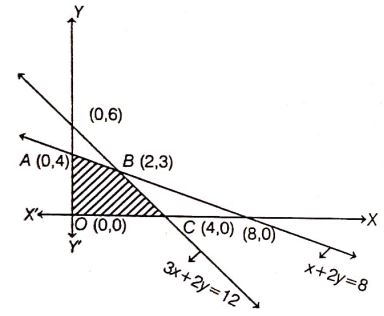
The point of intersection of Eqs. (i) and (ii) is (2, 3).
The graphical representation of the above system of inequations is given below.
| Corner points | Value of Z = -3x + 4y |
| A(0, 4) | 16 |
| B(2, 3) | 6 |
| C(4, 0) | -12 (Minimum) |
| O(0, 0) | 0 |
Hence, Z = -12 is minimum at (4, 0).
5.
Total number of outcomes=36
Favourable outcomes are:{(4, 6), (6, 4), (5, 5)}
\(\therefore \) \(P(A)=P(B)=\frac { 3 }{ 36 } =\frac { 1 }{ 12 } \)
and \(P(\overset { \_ }{ A } )=P(\overset { \_ }{ B } )=1-\frac { 1 }{ 12 } =\frac { 11 }{ 12 } \)
\(\therefore \) P(A wins) = \(P(A)+P(\overset { \_ }{ A } \overset { \_ }{ B } A)+P(\overset { \_ }{ A } \overset { \_ }{ B } \overset { \_ }{ A } \overset { \_ }{ B } A)+........\)
=\(\frac { 1 }{ 12 } +\frac { 11 }{ 12 } \times \frac { 11 }{ 12 } \times \frac { 1 }{ 12 } +\frac { 11 }{ 12 } \times \frac { 11 }{ 12 } \times \frac { 11 }{ 12 } \times \frac { 11 }{ 12 } \times \frac { 1 }{ 12 } \times ........|G.P\)
=\(\frac { \frac { 1 }{ 12 } }{ 1-{ \left( \frac { 11 }{ 12 } \right) }^{ 2 } } =\frac { 1 }{ 12 } \times \frac { 144 }{ 23 } =\frac { 12 }{ 23 } \)
And P(B wins) = \(P(\overset { \_ }{ A } B)+P(\overset { \_ }{ A } \overset { \_ }{ B } \overset { \_ }{ A } B)+.........\)
= \(\frac { 11 }{ 12 } \times \frac { 1 }{ 12 } +\frac { 11 }{ 12 } \times \frac { 11 }{ 12 } \times \frac { 11 }{ 12 } \times \frac { 1 }{ 12 } +.........|G.P\)
= \(\frac { \frac { 11 }{ 12 } \times \frac { 1 }{ 12 } }{ 1-{ \left( \frac { 11 }{ 12 } \right) }^{ 2 } } =\frac { 111 }{ 144 } \times \frac { 144 }{ 23 } =\frac { 11 }{ 23 } \)
6.
We have \(y={ e }^{ ax }cos\quad bx\) ...(1)
\(\frac { dy }{ dx } ={ e }^{ ax }(-sin\quad bx)(b)+a{ e }^{ ax }cos\quad bx\)
\(={ e }^{ ax }(a\quad cos\quad bx-b\quad sin\quad bx)....(2)\)
\(\frac { { d }^{ 2 }y }{ { dx }^{ 2 } } ={ e }^{ ax }(-ab\quad sin\quad bx-{ b }^{ 2 }cos\quad bx)+a{ e }^{ ax }(a\quad cos\quad bx-b\quad sin\quad bx)....(3)\)
\(\frac { { d }^{ 2 }y }{ { dx }^{ 2 } } =-2a\frac { dy }{ dx } +\left( { a }^{ 2 }+{ b }^{ 2 } \right) y\)
\(={ e }^{ ax }\left[ -ab\quad sin\quad bx-{ b }^{ 2 }cos\quad bx+{ a }^{ 2 }cos\quad bx-ab\quad sin\quad bx \right] \)
\(-2a({ e }^{ ax }(a\quad cos\quad bx-b\quad sin\quad bx))+\left( { a }^{ 2 }+{ b }^{ 2 } \right) { e }^{ ax }cos\quad bx]\)
7.
Here \(p=\frac { 90 }{ 100 } =\frac { 9 }{ 10 } \)
and \(q=1-p=1-\frac { 9 }{ 10 } =\frac { 1 }{ 10 } \) and n = 10
\(\therefore \) Required Probability = \(P(X\le 6)\)
= \(1-P(7\le X\le 10)\)
= \(1-\sum _{ r=7 }^{ 10 }{ ^{ 10 }{ C }_{ r } } { \left( \frac { 9 }{ 10 } \right) }^{ r }{ \left( \frac { 1 }{ 10 } \right) }^{ 10-r }\)
= \(1-\sum _{ r=7 }^{ 10 }{ ^{ 10 }{ C }_{ r }{ 0.9 }^{ r }{ 0.1 }^{ 10-r } } \)
8.
Part (A) is the correct answer
Let E1 and E2 be the events when speaks the truth or not respectively.
\(\therefore \) \(P({ E }_{ 1 })=\frac { 4 }{ 5 } ,P({ E }_{ 2 })=1-\frac { 4 }{ 5 } =\frac { 1 }{ 5 } \)
Let A be the event when head appears.
\(\therefore \) \(P(A/{ E }_{ 1 })=\frac { 1 }{ 2 } ,P(A/{ E }_{ 2 })=\frac { 1 }{ 2 } \)
By Bayes' Theorem,
\(P({ E }_{ 1 }/A)=\frac { P({ E }_{ 1 })P(A/{ E }_{ 1 }) }{ P({ E }_{ 1 })P(A/{ E }_{ 1 })+P({ E }_{ 2 })P(A/{ E }_{ 2 }) } \)
\(=\frac { \left( \frac { 4 }{ 5 } \right) \left( \frac { 1 }{ 2 } \right) }{ \left( \frac { 4 }{ 5 } \right) \left( \frac { 1 }{ 2 } \right) +\left( \frac { 1 }{ 5 } \right) \left( \frac { 1 }{ 2 } \right) } =\frac { \frac { 4 }{ 10 } }{ \frac { 1 }{ 2 } } =\frac { 4 }{ 5 } \)
9.
Let S denote the success (getting a ‘6’) and F denote the failure (not getting a ‘6’).
Thus \(\mathrm{P}(\mathrm{S})=\frac{1}{6}, \mathrm{P}(\mathrm{F})=\frac{5}{6}\)
P(A wins in the first throw) = P(S) = 1/6
A gets the third throw, when the first throw by A and second throw by B result into failures.
Therefore, P(A wins in the 3rd throw) = P(FFS) = P(F)P(F)P(S) \(=\frac{5}{6} \times \frac{5}{6} \times \frac{1}{6}\)
\(=\left(\frac{5}{6}\right)^2 \times \frac{1}{6}\)
P(A wins in the 5th throw) = P (FFFFS) \(=\left(\frac{5}{6}\right)^4\left(\frac{1}{6}\right)\) and so on.
Hence,
P(A wins ) \(=\frac{1}{6}+\left(\frac{5}{6}\right)^2\left(\frac{1}{6}\right)+\left(\frac{5}{6}\right)^4\left(\frac{1}{6}\right)+\ldots \)
\(=\frac{\frac{1}{6}}{1-\frac{25}{36}}=\frac{6}{11}\)
P(B wins) = 1 – P (A wins) \(=1-\frac{6}{11}=\frac{5}{11}\)
10.
\((fog)=f(g(x))\)
= {(2, 5), (5, 2), (1, 5)}.
\([\therefore Under\ g:2\rightarrow 3\Rightarrow (2,5);\ etc.\ Under\ f:3\rightarrow 2]\)
11.
By the equation, \(\frac { 1 }{ 2 } \left| \begin{matrix} 2 & -6 & 1 \\ 5 & 4 & 1 \\ k & 4 & 1 \end{matrix} \right| =\pm 35\)
\({1\over2}[2(4-4)+6(5-k)+(1)920-4k)]=\le35\)
\({1\over2}[0+30-6k+20-4k]=\le35\)
\(50-10k=\le70\)
\(10k=50\mp 70\)
10k = -20, 120.
Hence k = -2, 12
12.
(B) is the correct answer.
Reason: A= \(A=\begin{bmatrix} cos\alpha & -sin\alpha \\ sin\alpha & cos\alpha \end{bmatrix}\).
\(\therefore\ A\prime =\begin{bmatrix} cos\alpha & sin\alpha \\ -sin\alpha & cos\alpha \end{bmatrix}.\)
\(\therefore \ A+A\prime =\begin{bmatrix} cos\alpha & -sin\alpha \\ sin\alpha & cos\alpha \end{bmatrix}+\begin{bmatrix} cos\alpha & sin\alpha \\ -sin\alpha & cos\alpha \end{bmatrix}\)
\(=\begin{bmatrix} cos\alpha +cos\alpha & -sin\alpha +sin\alpha \\ sin\alpha -sin\alpha & cos\alpha +cos\alpha \end{bmatrix}\)
\(=\begin{bmatrix} 2cos\alpha & 0 \\ 0 & 2cos\alpha \end{bmatrix}.\)
\(Hence,\ A+A\prime =I\)
\(\Rightarrow \ 2cos\alpha =1 \ \Rightarrow \ cos\alpha =\frac { 1 }{ 2 } \)
\(\Rightarrow \alpha =\frac { \pi }{ 3 } .\)
13.
P is the set of all subsets of given set X.
Here \((A,B)\rightarrow (A\cup B)\in P\).
\(\because \) It is a binary operation on the set P.
Similarly, \((A,B)\rightarrow (A\cap B)\in P\)
Hence, it is a binary operation on the set P.
14.
Let \({ cos }^{ -1 }\left( \frac { \sqrt { 3 } }{ 2 } \right) =y\), where \(y\in [0,\pi ]\)
\(\Rightarrow cosy=\frac { \sqrt { 3 } }{ 2 } \Rightarrow cosy=cos\frac { \pi }{ 6 } \)
\(\Rightarrow \ y=\frac { \pi }{ 6 } \)
Hence, the required Principal value = \(\frac { \pi }{ 6 } \)
15.
\(2*3=\frac { 2 }{ 2 } +\frac { 3 }{ 2 } =1+1=2\)

12th Standard CBSE Syllabus & Materials
12th Standard CBSE
CBSE 12th Computer Science Python Revision Tour I - New Previous year Question Papers Study Material - QB365 Set A
NEW12th Standard CBSE
CBSE 12th Business Studies Planning Important Questions And Answers Study Material - QB365 Set A
NEW12th Standard CBSE
CBSE 12th Business Studies Business Environment Important Questions And Answers Study Material - QB365 Set A
NEW12th Standard CBSE
CBSE 12th Business Studies Principles of Management Important Questions And Answers Study Material - QB365 Set A



CBSE 12th Standard CBSE Subjects
CBSE Standards










