
 100% FREE ACCESS
12th Standard CBSE Syllabus & Materials
12th Standard CBSE
CBSE 12th Economics Government Budget and the Economy Previous year Question Papers Study Material - QB365 Set A
NEW12th Standard CBSE
CBSE 12th Computer Science Interface Python with MySQL - New Previous year Question Papers Study Material - QB365 Set A
NEW12th Standard CBSE
CBSE 12th Computer Science Database Concept - New Previous year Question Papers Study Material - QB365 Set A
NEW12th Standard CBSE
CBSE 12th Computer Science Data Communication - New Previous year Question Papers Study Material - QB365 Set A
NEW12th Standard CBSE
CBSE 12th Computer Science Data Structures - New Previous year Question Papers Study Material - QB365 Set A
NEW12th Standard CBSE
CBSE 12th Computer Science Functions - New Previous year Question Papers Study Material - QB365 Set A

Published on: 16/09/2019
Probability
Download CBSE Class 12th Standard CBSE Maths question papers, sample papers, important questions, and previous year solved papers in PDF format. Get free study materials, NCERT solutions, and exam preparation resources for Class 12th Standard CBSE Maths
Questions + Answers key
Take MCQ Maths Test
1.
If each element of a second order determinant is either 0 or 1, what is the probability that the value of determinant is positive? (Assume that the individual entries of the determinant are chosen independently, each value assumed with probability \(1\over2\)).
2.
If P(A)=\(\frac { 2 }{ 5 } ,P(B)=\frac { 1 }{ 3 } ,P(A\cap B)=\frac { 1 }{ 5 } ,\) then find \(P(\bar { A } /\bar { B } )\) .
3.
A couple has 2 children. Find the probability that both are boys, if it is known that (a) one of them is a boy (b) the older child is boys.
4.
A box contains 50 bolts and 50 nuts. Half of the bolts and nuts are rusted. If two items are drawn with replacement, what is the probability that either both are rusted or both are bolts.
5.
Three cards are drawn without replacement from a pack of 52 cards. Find the probability that
(a) the cards drawn are king, queen and jack respectively.
(b) the cards drawn are king, queen and jack.
6.
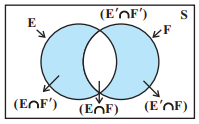
Prove that if E and F are independent events, then so are the events E and F′.
7.
If P(F) =\(\frac { 1 }{ 2 } and\ P(F)=\frac { 1 }{ 5 } \) find \(P(\overline { E\cup F } )\) If E and F are independent events.
8.
If P(F) = 0.35 and P(E\(\cup\)F) = 0.85 and E and F are independent events. Find P(E).
9.
If E and F be two events such that P(E) = \(\frac { 1 }{ 3 } ,P(F)=\frac { 1 }{ 4 } ,\) find \(P(E\cup F)\) if E and F are independent events.
10.
If P(E) = \(\frac { 7 }{ 13 } \) , P(F) = \(\frac { 9 }{ 13 } \) and P(E\(\cap\)F) = \(\frac { 4 }{ 13 } \),then evaluate :
(a) \(P(\overline { E } /F)\)
(b) \(P(\overline { E } /F)\)
11.
If P(E) = \(\frac { 6 }{ 11 } \), P(F) = \(\frac { 5 }{ 11 } \) and P(E \(\cup\)F) = \(\frac { 7 }{ 11 } \) then find (a) P(E/F), (b) P(F/E)
12.
If E and F are two events such that \(P(E)=\frac { 1 }{ 4 } ,\) \(P(E)=\frac { 1 }{ 2 } \) and \( P(E\cap F)=\frac { 1 }{ 8 } \), find
(a) P(E or F)
(b) P(not E and not F).
13.
A bag contain 2 red, 6 black and 8 green balls. A ball is drawn at random from the bag. Find the probabilty:
(a) a red ball
(b) a black ball
(c) a green ball
(d) a non-red ball
14.
One card is drawn is drawn from a pack of 52 cards. Find the probability of getting :
(a) a red card
(b) a jack of hearts
(c) a black face card
(d) a king.
1.
There are four entries determinant of 2 x 2 order. Each entry may be filled up in two ways with 0 or 1. Therefore, number of determinants that can be formed
= 24 = 16
The value of determinant is positive in the following cases
\(\begin{vmatrix} 1 &0 \\0 &1 \end{vmatrix},\begin{vmatrix}1 &0 \\1 &1 \end{vmatrix},\begin{vmatrix}1 & 1 \\ 0 & 1 \end{vmatrix}\)
i.e, 3 determinants
Thus, the probability that the determinants is positive \(={3\over 16}\)
2.
\(P(\bar { A } /\bar { B } )=\frac { P(\bar { A } \cap \bar { B } ) }{ P(\bar { B } ) } \)
\(=\frac { 1-P(A\cup B) }{ 1-P(B) } \)
\(=\frac { 1-[P(A)+P(B)-P(A\cap B)] }{ 1-P(B) } \)
\(=\frac { 7 }{ 10 } \)
3.
Sample space ={B1B2, B1G2, G1B2, G1G2}, B1 and G1 are the older boy and girl respectively.
Let E1 = both the children are boys;
E2 = one of the children are boys;
E3 = the older child is a boy
Then, (a) P(E1/E2) = \(P\left( \frac { { E }_{ 1 }\cap { E }_{ 2 } }{ { E }_{ 2 } } \right) =\frac { \frac { 1 }{ 4 } }{ \frac { 3 }{ 4 } } =\frac { 1 }{ 3 } \)
(b) P(E1/E3) = \(P\left( \frac { { E }_{ 1 }\cap { E }_{ 3 } }{ { E }_{ 3 } } \right) =\frac { \frac { 1 }{ 4 } }{ \frac { 2 }{ 4 } } =\frac { 1 }{ 2 } \)
4.
Total number of bolts = 50
Total number of nuts = 50
Total number of rusted bolts = 25
Total number of rusted nuts = 25
Total no. of items = 100
Total no. rusted items = 50
E = rusted item, F = Bolts
\(P(E\cup F)=P(F)+P(F)-P(E\cap F)\)
\(P(E)=\left( \frac { 25 }{ 100 } \times \frac { 25 }{ 100 } \right) \)
\(=\frac { 1 }{ 4 } \times \frac { 1 }{ 4 } =\frac { 1 }{ 16 } \)
\(P(F)=\left( \frac { 50 }{ 100 } \times \frac { 50 }{ 100 } \right) =\frac { 1 }{ 4 } \)
\(P(E\cap F)=\left( \frac { 25 }{ 100 } \times \frac { 25 }{ 100 } \right) \)
\(=\frac { 1 }{ 4 } \times \frac { 1 }{ 4 } =\frac { 1 }{ 16 } \)
\(P(E\cup F)=\frac { 1 }{ 16 } +\frac { 1 }{ 4 } -\frac { 1 }{ 16 } \)
\(=\frac { 1 }{ 4 } \)
5.
(a) K then Q then J(fix case)
\(\frac { 4 }{ 52 } \times \frac { 4 }{ 51 } \times \frac { 4 }{ 50 } =\frac { 1 }{ 13 } \times \frac { 4 }{ 51 } \times \frac { 2 }{ 25 } \)
\(=\frac { 8 }{ 16575 } \)
(b) KQJ or QKJ or JQK or KJQ or OJK or JKQ = 3!
\(6\left( \frac { 4 }{ 52 } \times \frac { 4 }{ 51 } \times \frac { 4 }{ 50 } \right) =6\times \frac { 8 }{ 16575 } =\frac { 48 }{ 16575 } \)
6.
Since E and F are independent, we have
P(E ∩ F) = P(E) . P(F) ....(1)
From the venn diagram in Fig 13.3, it is clear that E ∩ F and E ∩ F′ are mutually exclusive events and also E =(E ∩ F) ∪ (E ∩ F′). Therefore P(E) = P(E ∩ F) + P(E ∩ F′)
or P(E ∩ F′) = P(E) − P(E ∩ F)
= P(E) − P(E) . P(F) (by (1))
= P(E) (1−P(F))
= P(E). P(F′)
Hence, E and F′ are independent
7.
\(P(E\cup F)=P(E)+P(F)-P(E\cap F)\)
If E and F are independent, then
\(=P(E\cap F)=P(E)\times P(F)\)
\(P(E\cup F)=P(E)+P(F)-P(E)\times P(F)\)
\(P(E\cup F)=\frac { 1 }{ 2 } +\frac { 1 }{ 5 } -\frac { 1 }{ 2 } \times \frac { 1 }{ 5 } \)
\(=\frac { 1 }{ 2 } +\frac { 1 }{ 5 } -\frac { 1 }{ 10 } -\frac { 5+2-1 }{ 10 } \)
\(=\frac { 6 }{ 10 } =\frac { 3 }{ 5 } \)
\(P(\overline { E\cup F } )=1-P(E\cup F)\)
\(=1-\frac { 3 }{ 5 } =\frac { 2 }{ 5 } \)
8.
\(P(E\cap F)=P(E)\times P(F)\)
\(P(E\cup F)=P(E)+P(F)-P(E\cap F)\)
\(\Rightarrow P(E\cup F)=P(E)+P(F)-P(E)\times P(F)\)
\(\Rightarrow 0.85=P(E)+0.35-P(E)\times 0.35\)
\(\Rightarrow 0.85=P(E)(1-0.35)+0.35\)
\(\Rightarrow 0.85-0.35=P(E)(0.65)\)
\(\Rightarrow \frac { 0.52 }{ 0.65 } =P(E)\)
\(\Rightarrow P(E)=\frac { 50 }{ 65 } =\frac { 10 }{ 13 } \)
\(\therefore P(F)=1-\frac { 10 }{ 13 } =\frac { 3 }{ 13 } \)
9.
If E and F are independent events, then \(P\left( E\cap F \right) =P(E)\times P(F)\)
Now \(P(E\cup \bar { F } )=P(E)+P(F)-P(E\cap F)\)
\(\Rightarrow P(E\cup F)=P(E)+P(F)-P(E)\times P(F)\)
\(\Rightarrow P(E\cup F)=\frac { 1 }{ 3 } +\frac { 1 }{ 4 } -\frac { 1 }{ 3 } \times \frac { 1 }{ 4 } \)
\(\Rightarrow P(E\cup F)=\frac { 1 }{ 3 } +\frac { 1 }{ 4 } -\frac { 1 }{ 12 } =\frac { 4+3-1 }{ 12 } \)
\(\Rightarrow P(E\cup F)=\frac { 6 }{ 12 } \)
\(\therefore P(E\cup F)=\frac { 1 }{ 2 } \)
10.
P(E) = \(\frac { 7 }{ 13 } \)
P(F) = \(\frac { 9 }{ 13 } \)
and P(E\(\cap\)F) = \(\frac { 4 }{ 13 } \)
(a) \(P(\bar { E } /F)=\frac { P(\bar { E } \cap F) }{ P(F) } \)
\(=\frac { P(F)-P(E\cap F)) }{ P(F) } \)
\(=1-\frac { P(E\cap F) }{ P(F) } =1-\frac { \frac { 4 }{ 13 } }{ \frac { 9 }{ 13 } } \)
\(\Rightarrow P(\bar { E } /F)=1-\frac { 4 }{ 9 } =\frac { 5 }{ 9 } \)
(b) \(P(\bar { E } /\bar { F } )=\frac { P(\bar { E } \cap \bar { F } ) }{ P(\bar { F } ) } \)
\(=\frac { P\overline { (E\cup F) } }{ P(\bar { F } ) } \)
\(=\frac { 1-P(E\cup F) }{ 1-P(F) } \)
\(P(E\cup F)=P(E)+P(F)-P(E\cap F)\)
\(=\frac { 7 }{ 13 } +\frac { 9 }{ 13 } -\frac { 4 }{ 13 } \)
\(=\frac { 12 }{ 13 } \)
\(P(E/F)=\frac { 1-\frac { 12 }{ 13 } }{ 1-\frac { 9 }{ 13 } } \)
\(=\frac { \frac { 1 }{ 13 } }{ \frac { 4 }{ 13 } } \)
\(=\frac { 1 }{ 4 } \)
11.
P(E\(\cap\)F) = P(E) + P(F) - P(E\(\cup\)F)
\(=\frac { 6 }{ 11 } +\frac { 5 }{ 11 } -\frac { 7 }{ 11 } \)
\(=\frac { 4 }{ 11 } \)
(a) \(P(E/F)=\frac { P(E\cap F) }{ P(F) } \)
\(=\frac { \frac { 4 }{ 11 } }{ \frac { 5 }{ 11 } } =\frac { 4 }{ 5 } \)
(b) P(E/E) = \(\frac { P(E\cap F) }{ P(E) } \)
\(=\frac { \frac { 4 }{ 11 } }{ \frac { 6 }{ 11 } } =\frac { 4 }{ 6 } \)
\(=\frac { 2 }{ 3 } \)
12.
Given, \(P(E)=\frac { 1 }{ 4 } \)
\(P(F)=\frac { 1 }{ 2 } \)
and \(P(E\cap F) =\frac { 1 }{ 8 } \)
(a) P(E or F) = (E\(\cup\)F) = P(E) + P(F) - P(E\(\cap\)F)
\(=\frac { 1 }{ 4 } +\frac { 1 }{ 2 } -\frac { 1 }{ 8 } \)
\(=\frac { 2+4-1 }{ 8 } \)
\(=\frac { 5 }{ 8 } \)
(b) P(not E and not F) = \(P(\bar { E } \cap \bar { F } )=P\overline { (E\cup F) } \)
= 1 - P(E\(\cup\) F)
= 1 - \(\frac { 5 }{ 8 } =\frac { 3 }{ 8 } \)
13.
Total number of cards = 2 + 6 + 8 = 16
(a) Number of red balls = 2
\(\therefore\) Required probability = \(\frac { 2 }{ 16 } =\frac { 1 }{ 8 } \)
(b) Number of black balls = 6
\(\therefore\) Required probability = \(\frac { 6 }{ 16 } =\frac { 3 }{ 8 } \)
(c) number of green balls = 8
\(\therefore\) Required probability = \(\frac { 8 }{ 16 } =\frac { 1 }{ 2 } \)
(d) Number of non-red balls = 14
\(\therefore\) Required probability = \(\frac { 14 }{ 16 } \)
14.
Total number of cards = 52
(a) Number of favourable cases = 26
\(\therefore\) Required probability =\(\frac { 26 }{ 52 } =\frac { 1 }{ 2 } \)
(b) Number of favourable cases = 1
\(\therefore\) Required probability = \(\frac { 1 }{ 52 } \)
(c) Number of favourable cases = 6
\(\therefore\) Required probability =\(\frac { 6 }{ 52 } =\frac { 3 }{ 26 } \)
(d) Number of favourable cases = 4
\(\therefore\) Required probability = \(\frac { 4 }{ 52 } =\frac { 1 }{ 13 } \)

12th Standard CBSE Syllabus & Materials
12th Standard CBSE
CBSE 12th Computer Science Python Revision Tour I - New Previous year Question Papers Study Material - QB365 Set A
NEW12th Standard CBSE
CBSE 12th Business Studies Planning Important Questions And Answers Study Material - QB365 Set A
NEW12th Standard CBSE
CBSE 12th Business Studies Business Environment Important Questions And Answers Study Material - QB365 Set A
NEW12th Standard CBSE
CBSE 12th Business Studies Principles of Management Important Questions And Answers Study Material - QB365 Set A



CBSE 12th Standard CBSE Subjects
CBSE Standards










