
 100% FREE ACCESS
12th Standard CBSE Syllabus & Materials
12th Standard CBSE
CBSE 12th Economics Government Budget and the Economy Previous year Question Papers Study Material - QB365 Set A
NEW12th Standard CBSE
CBSE 12th Computer Science Interface Python with MySQL - New Previous year Question Papers Study Material - QB365 Set A
NEW12th Standard CBSE
CBSE 12th Computer Science Database Concept - New Previous year Question Papers Study Material - QB365 Set A
NEW12th Standard CBSE
CBSE 12th Computer Science Data Communication - New Previous year Question Papers Study Material - QB365 Set A
NEW12th Standard CBSE
CBSE 12th Computer Science Data Structures - New Previous year Question Papers Study Material - QB365 Set A
NEW12th Standard CBSE
CBSE 12th Computer Science Functions - New Previous year Question Papers Study Material - QB365 Set A

Published on: 02/11/2025
Download CBSE Class 12th Standard CBSE Maths question papers, sample papers, important questions, and previous year solved papers in PDF format. Get free study materials, NCERT solutions, and exam preparation resources for Class 12th Standard CBSE Maths
Questions + Answers key
Take MCQ Maths Test
1.
The maximum value of [x(x -1)+1]1/3, 0 ≤ x ≤ 1 is
0
1/2
1
\(3\sqrt{\frac{1}{3}}\)
2.
The least value of the function f(x) = 2cos x + x in the closed interval [0, π/2] is
2
π/5 + √3
π/2
the least value does not exist
3.
The area of a trapezium is defined by function f and given by f(x) = (10 + x) \( \sqrt{100 - x ^ 2}\) then the area when it is maximised is
75cm2
\(7\sqrt3\)cm2
\(75\sqrt 3\)cm2
5cm2
4.
A function f : R → R is defined as \(f(x) = x ^ 3 + 1\) Then, the function has
no minimum value
no maximum value
both maximum and minimum values
neither maximum nor minimum
5.
Find the intervals in which the function given by f(x) = x²- 4x + 6 is strictly increasing
(-∞, 2) U (2, ∞)
(2, ∞)
(-∞, 2)
(-∞, 2) U (3, ∞)
6.
The function y = x²e-x is decreasing in the interval
(0,2)
(2, ∞)
(-∞, 2)
(-∞, 2) U (2, ∞)
7.
The value of b for which the function f(x) = x + cosx + b is strictly decreasing over R is
b < 1
no value of b exists
b ≤ 1
b ≥ 1
8.
The real function f(x) = 2x3 - 3x² - 36x + 7 is
strictly increasing in (-∞, -2) and strictly decreasing in (-2,∞)
strictly decreasing in (-2,3)
strictly decreasing in (-∞,3) and strictly increasing in (3,∞)
strictly decreasing in (-∞, 2) U (3, ∞)
9.
The function f(x) = x3 + 3x is increasing in interval.
(- ∞, 0)
(0,∞)
R
(0, 1)
10.
If f(x) = a(x - cosx) is strictly decreasing in R, then a belongs to
{0}
(0, ∞)
(-∞, 0)
(-∞, ∞)
11.
The interval in which the function f(x) = 2x3 + 9x² + 12x - 1 is decreasing is
(-1,∞)
(-2, -1)
(-∞, -2)
(-1, 1)
12.
Let f(x) = \(\left|\begin{array}{cc} x^2 & \sin x \\ p & -1 \end{array}\right|\), where p is a constant. Then, the value of p for which f'(0) = 1 is
R
1
0
-1
13.
Given a curve y = 7x - x3 and x increases at the rate of 2 units per sec. The rate at which the slope of the curve is changing when x = 5 is
- 60 units/sec
60 units/sec
-70 units/sec
-140 units/sec
14.
The function f(x) = \(\frac{x}{2}+\frac{2}{x}\) has a local minima at x equal to
2
1
0
-2
15.
The function f(x) cos x - 2px is monotonically decreasing for
\(p<\frac{1}{2}\)
\(p>\frac{1}{2}\)
\(p<2\)
\(p>2\)
16.
The height of the cylinder of greatest volume which can be inscribed in a right circular cone, of height 17, is
\(\frac{h}{2}\)
\(\frac{h}{4}\)
\(\frac{h}{3}\)
none of these
17.
The maximum value of \(\left(\frac{1}{x}\right)^{x} \text { is }\)
e
ee
\(e^{\frac{1}{e}}\)
\(\left(\frac{1}{e}\right)^{\frac{1}{e}}\)
18.
Which of the following function is decreasing on \(\left(0, \frac{\pi}{2}\right)?\)
cos x
-cos 2x
cos 3x
tan x
19.
Given function \(f(x)=x^{2} e^{-x}\) then 'f' increases in the interval
\((-\infty, \infty)\)
\((-2, 0)\)
\((2, \infty)\)
\((0,2)\)
20.
For the function y x3 + 21, the value of x, when y increases 75 times as fast as X, is
\(\pm\)3
\(\pm 5 \sqrt{3}\)
\(\pm\)5
none of these
21.
It isgiven thatatx= I, the function f(x) = x4 - 62x2 + ax + 9 attains its maximum value, on the interval [0, 2]. The value of a is
20
-120
120
52
22.
A spherical balloon has a variable diameter \(\frac{3}{2}(2 x+1)\) The rate of change of its volume with respect to x is
\(\frac{27 \pi}{8}(2 x+1)^{2}\)
\(\frac{9}{4} \pi(2 x+1)^{3}\)
\(\frac{9 \pi}{16}(2 x+1)^{3}\)
\(\pi(2 x+1)^{2}\)
23.
The maximum value of xy, "subject to x + y = 8 is
8
16
20
24
24.
At \(x=\frac{5 \pi}{6}, f(x)=2 \sin 3 x+3 \cos 3 x\) is
maximum
minimum
zero
neither maximum nor minimum
25.
The area of greatest rectangle that can be inscribed in an ellipse \(\frac{x^{2}}{a^{2}}+\frac{y^{2}}{b^{2}}=1\) is
ab sq units
\(\frac{a b}{2} \text { sq units }\)
2ab sq units
3ab sq units
26.
Let \(g(x)=2 f\left(\frac{x}{2}\right)+f(2-x) \text { and } f^{\prime \prime}(x)<0\) for all \(x \in(0,2) \text { then, } g(x) \text { is }\)
increasing on (4/3,2) and increasing on (0,4/3)
decreas ling on (0,4/3) and increasing on (4 / 3, 2)
increasing on (0, 4 / 3) and decreasing on (4 / 3, 2)
None of the above
27.
If \(f: R \rightarrow R \text { be defined by } f(x)=2 x+\cos x \text { , then } f\)
has a minimum at \(x=\pi\)
has at maximum at x = 0
is a decreasing function
is an i ucreasing function
28.
For \(O t<\theta<\frac{\pi}{2}\) the value of θ, if it increases twice as fast and its sine is
\(\frac{\pi}{2}\)
\(\frac{\pi}{3}\)
\(\frac{\pi}{6}\)
None of these
29.
The distance covered by a particle in time t is given by \(x=3+8 t-4 t^{2}\) After 1s, its velocity will be
0 units/s
3 units/s
4 units/s
7 units/s
30.
Aright circular cylinder which is open at the top and has a given surface area, will have the greatest volume, if its height h and radius rare related by
2h =r
h = 4r
h =2r
h=r
31.
The functin f(x) = xx has a stationary point at
x =e
\(x=\frac{1}{e}\)
x = 1
\(x=\sqrt{e}\)
32.
The maximum slope of curve \(y=-x^{3}+3 x^{2}+9 x-27\) is
0
12
16
32
33.
The function \(f(x)=2 x^{3}-3 x^{2}-12 x+4\) has
two points of local maximum
two points of local minimum
one maxima and one minima
no maxima or minima
34.
If x is real, then the minimum value of \(x^{2}-8 x+17\) is
-1
0
1
2
35.
If an error of 10 is made. in measuring the angle of a sector of radius 30 cm, then the approximate error in its area is
450 cm2
\(25 \pi \mathrm{cm}^{2}\)
\(2.5 \pi \mathrm{cm}^{2}\)
None of these
36.
The circumference of a circle is measured as 56 cm with an error of 0.02 cm. The percentage error in area is
\(\frac{1}{2}\)
\(\frac{1}{28}\)
\(\frac{1}{14}\)
\(\frac{1}{56}\)
37.
If the radius of a sphere is measured as 7m with an error of 0.02 m, then the approximate error in calculating its volume is
\(1.92 \pi \mathrm{m}^{3}\)
\(3.92 \pi \mathrm{m}^{3}\)
\(0.285 \pi \mathrm{m}^{3}\)
\(2.98 \pi \mathrm{m}^{3}\)
38.
If \(y=x^{4}-10\) and x changes from 2 to 1.99,then what is the change in y?
0.32
0.032
5.68
5.98
39.
Which of the following functions is decreasing on \(\left(0, \frac{\pi}{2}\right)\)?
sin2x
tanx
cosx
cos3x
40.
The function \(f(x)=4 \sin ^{3} x-6 \sin ^{2} x+12 \sin x\) + 100 is strictly
increasing in \(\left(\pi, \frac{3 \pi}{2}\right)\)
decreasing in \(\left(\frac{\pi}{2}, \pi\right)\)
decreasing in \(\left[\frac{-\pi}{2}, \frac{\pi}{2}\right]\)
decreasing in \(\left[0, \frac{\pi}{2}\right]\)
41.
The function \(f(x)=\tan x-x\)
always increases
always decreases
never increases
sometimes increases and sometimes decreases
42.
If \(y=x(x-3)^{2}\) decreases for the values of x given by
\(1<x<3\)
\(x<0\)
\(x>0\)
\(0<x<\frac{3}{2}\)
43.
The total cost C(x) (in Rs) associated with the production of x units of an item is given by C(x) = 0.007x3 - 0.003x2 + 15x + 4000. The marginal cost when 17units are produced, is
Rs. 20.967
Rs. 21.96
Rs. 81.968
Rs. 11.967
44.
A kite is moving horizontally at a height of 151.5m. If the speed of kite is 10 m/ s, then the rate at which the string is being let out when the kite is 250 m away from the boy who is flying the kite and the height of the boy 1.5m is
4 m/s
6 m/s
7 m/s
8 m/s
45.
The radius of the base of a cone is increasing at the rate of 3 cm/min and the altitude is decreasing at the rate of 4 cm/min. The rate of change of lateral surface when the , radius = 7 cm and altitude 24 cm, is
\(54 \pi \mathrm{cm}^{2} / \mathrm{min}\)
\(7 \pi \mathrm{cm}^{2} / \mathrm{min}\)
\(27 \mathrm{~cm}^{2} / \mathrm{min}\)
None of the above
46.
A ladder, 5 m long, standing on a horizontal floor, leans against a vertical wall. If the top of the ladder slides downwards at the rate of 10 cm/s, then the rate at which the angle between the floor and the ladder is decreasing when lower end of ladder is 2 m from the wall is
\(\frac{1}{10} \mathrm{rad} / \mathrm{s}\)
\(\frac{1}{20} \mathrm{rad} / \mathrm{s}\)
\(20 \mathrm{rad} / \mathrm{s}\)
10 rad/s
47.
If the sides of an equilateral triangle are increasing at the rate of 4 cm/s, then the rate at which the area increases, when side is 5 cm, is
\(10 \mathrm{~cm}^{2} / \mathrm{s}\)
\(\sqrt{3} \mathrm{~cm}^{2} / \mathrm{s}\)
\(10 \sqrt{3} \mathrm{~cm}^{2} / \mathrm{s}\)
\(\frac{10}{3} \mathrm{~cm}^{2} / \mathrm{s}\)
48.
A stone is dropped into a quiet lake and waves move in circles at a speed of 2cm per second. At the instant, when the radius of the circular wave is 12 cm, how fast is the enclosed area changing ?
Decreasing at the rate of 48π cm2 / sec
Increasing at the rate of 24π cm2 / sec
Increasing at the rate of 48π cm2 / sec
Decreasing at the rate of 24π cm2 / sec
49.
The total cost associated with the production of x units of a product is given by c(x) = 5x2 + 14x + 6. Find marginal cost when 5 units are produced
Rs. 64
Rs. 70
Rs. 50
Rs. (10x + 14)
50.
The volume of cube is increasing at the constant rate of 3cm3/s. Find the rate of change of edge of the cube when its edge is 5 cm.
25 cm3/sec
25 cm/s
1/25 cm/s
1/25 cm3/s
51.
Find the approximate change in total surface area of a cube of side x metre caused by increase in side by 1%
12 m2
0.12x2 m2
1.2x m2
12x m2
52.
The total revenue in Rupees received from the sale of x units of a product is given by R(x) = 5x2 + 22x + 35. Find the marginal revenue, when x = 7, where by marginal revenue we mean the rate of change of total revenue with respect to the number of items sold at an instant.
7
Rs 127
Rs 92
Rs 48
53.
The radius of air bubble is increasing at the rate of 0. 25 cm/s. At what rate the volume of the bubble is increasing when the radius is 1 cm.
4π cm3/s
22π cm3/s
2π cm3/s
π cm3/s
54.
A cylindrical tank of radius 10 m is being filled with wheat at the rate of 314 cubic metre per hour. Then the depth of the wheat is increasing at the rate of
1 m/h
0.1 m/h
1.1 m/h
0.5 m/h
55.
The maximum value of \({ [x(x-1)+1] }^{ \frac { 1 }{ 3 } }\), \(0\le x\le 1\) is
\({ \left( \frac { 1 }{ 3 } \right) }^{ \frac { 1 }{ 3 } }\)
\(\frac { 1 }{ 2 } \)
1
0
56.
For all real values of x, the minimum value of \(\frac { 1-x+{ x }^{ 2 } }{ 1+x+{ x }^{ 2 } } \) is
0
1
3
\(\frac { 1 }{ 3 } \)
57.
The point on the curve x2 = 2y which is nearest to the point (0, 5) is
(2 \(\sqrt2\),4)
(2 \(\sqrt2\),0)
(0, 0)
(2, 2)
58.
The approximate change in the volume of a cube of side x metres caused by increasing the side by 3% is
0.06 x3 m3
0.6 x3 m3
0.09 x3 m3
0.9 x3 m3
59.
If f(x) = 3x2 + 15x + 5, then the approximate value of f (3.02) is
47.66
57.66
67.66
77.66
60.
The interval in which y = x2 e–x is increasing is
(– ∞, ∞)
(– 2, 0)
(2, ∞)
(0, 2)
61.
On which of the following intervals is the function f given by f (x) = x100 + sin x–1 decreasing?
(0, 1)
\(\frac{\pi}{2}\), ㅠ
0, \(\frac{\pi}{2}\)
None of these
62.
Which of the following functions are decreasing on 0, \(\frac{\pi}{2}\)?
cos x
cos 2x
cos 3x
tan x
63.
The total revenue in Rupees received from the sale of x units of a product is given by
R(x) = 3x2 + 36x + 5. The marginal revenue, when x = 15 is
116
96
90
126
64.
The rate of change of the area of a circle with respect to its radius r at r = 6 cm is
10π
12π
8π
11π
65.
The absolute maximum value of y = x3 – 3x + 2 in 0 ≤ x ≤ 2 is
4
6
2
0
66.
The point(s) on the curve y = x², at which y-coordinate is changing six times as fast as x-coordinate is/are
(2, 4)
(3, 9)
(3, 9), (9, 3)
(6, 2)
67.
The side of an equilateral triangle is increasing at the rate of 2 cm/s. The rate at which area increases when the side is 10 is
10 cm²/s
\(\sqrt3\) cm²/s
10 \(\sqrt3\) cm²/s
\(\frac{10}{3}\)cm²/s
68.
Assertion (A) If two positive numbers x and y are such that x + y = 35 and x2y5 is maximum, then the numbers are 10 and 25.
Reason (R) If f be a function defined on an interval I and c \(\in\)I and also, if f be twice differentiable at c, then x = c is a point of local maxima if f'(c) = 0 and f"(c) < 0 and the value f(c) is local maximum value of f.
(a) Both A and R are correct; R is the correct explanation of A
(b) Both A and R are correct; R is not the correct explanation of A
(c) A is correct; R is incorrect
(d) R is correct; A is incorrect
69.
Consider the information given below
The function f is given by f(x) = 2x3 - 3x2 - 36x + 7.
Assertion (A) The given function f is strictly increasing in intervals (-\(\infty\), +2) and (-3, \(\infty\)).
Reason (R) The given function f is strictly decreasing in interval (-2, 3).
(a) Both A and R are correct; R is the correct explanation of A
(b) Both A and R are correct; R is not the correct explanation of A
(c) A is correct; R is incorrect
(d) R is correct; A is incorrect
70.
Assertion (A) The function f(x) = x2 - 4x + 6 is strictly increasing in the interval (2, \(\infty\)).
Reason (R) The function f(x) = x2 - 4x + 6 is strictly decreasing in the interval (-\(\infty\), 2).
(a) Both A and R are correct; R is the correct explanation of A
(b) Both A and R are correct; R is not the correct explanation of A
(c) A is correct; R is incorrect
(d) R is correct; A is incorrect
71.
Assertion (A) A balloon, which always remains Spherical, has a variable radius, The rate, at which its volume is increasing with the radius when the radius is 10 cm, is 400 \(\pi\) Cm3/cm.
Reason (R) Rate of change of volume (v) of balloon with respect to radius(r) is \(\frac{dv}{dr}=(\frac {2}{3} \pi). 3r^2\)
(a) Both A and R are correct; R is the correct explanation of A
(b) Both A and R are correct; R is not the correct explanation of A
(c) A is correct; R is incorrect
(d) R is correct; A is incorrect
72.
Assertion: The function y2 = 4x has no absolute maximum or minimum.
Reason: In the graph of the function the value of increases unboundedly and decreases unboundedly as x increases.
(a) Assertion is correct, Reason is correct; Reason is a correct explanation for assertion.
(b) Assertion is correct, Reason is correct; Reason is not a correct explanation for Assertion
(c) Assertion is correct, Reason is incorrect
(d) Assertion is incorrect, Reason is correct.
73.
Assertion: The minimum value of the function y = cos x in [0,2\(\pi\)] is at x = \(\pi\).
Reason: The first derivative of the function is zero at x = \(\pi\) and second derivative is negative at x = \(\pi\).
(a) Assertion is correct, Reason is correct; Reason is a correct explanation for assertion.
(b) Assertion is correct, Reason is correct; Reason is not a correct explanation for Assertion
(c) Assertion is correct, Reason is incorrect
(d) Assertion is incorrect, Reason is correct.
74.
Assertion: The maximum value of the function y = sin x in [0,2\(\pi\)] is at x = \(\frac{\pi}{2}\)
Reason: The first derivative of the function is zero at x = \(\frac{\pi}{2}\)and second derivative is negative at x = \(\frac{\pi}{2}\)
(a) Assertion is correct, Reason is correct; Reason is a correct explanation for assertion.
(b) Assertion is correct, Reason is correct; Reason is not a correct explanation for Assertion
(c) Assertion is correct, Reason is incorrect
(d) Assertion is incorrect, Reason is correct.
75.
Consider the function
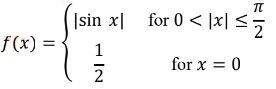
Assertion: f has a local maximum value at x = 0.
Reason: f'(0) = 0 and f''(0) < 0
(a) Assertion is correct, Reason is correct; Reason is a correct explanation for assertion.
(b) Assertion is correct, Reason is correct; Reason is not a correct explanation for Assertion
(c) Assertion is correct, Reason is incorrect
(d) Assertion is incorrect, Reason is correct.
76.
Assertion: If f'(x)=(x-1)3(x-2)8, then f(x) has neither maximum nor minimum at x= 2.
Reason: f'(x) changes sign from negative to positive at x = 2.
(a) Assertion is correct, Reason is correct; Reason is a correct explanation for assertion.
(b) Assertion is correct, Reason is correct; Reason is not a correct explanation for Assertion
(c) Assertion is correct, Reason is incorrect
(d) Assertion is incorrect, Reason is correct.
77.
Assertion: The ordinate of a point describing the circle x2 + y2 = 25 decreases at the rate of 1.5 cm/s.The rate of change of the abscissa of the point when ordinate equals 4 cm is 2 cm/s.
Reason: xdx + ydy = 0.
(a) Assertion is correct, Reason is correct; Reason is a correct explanation for assertion.
(b) Assertion is correct, Reason is correct; Reason is not a correct explanation for Assertion
(c) Assertion is correct, Reason is incorrect
(d) Assertion is incorrect, Reason is correct.
78.
Assertion: The function \(f(x)=\frac{ae^{x}+be^{-x}}{ce^{x}+de^{-x}}\)is increasing function of x, then bc > ad.
Reason: f(x) is increasing if f'(x) > 0 for all x.
(a) Assertion is correct, Reason is correct; Reason is a correct explanation for assertion.
(b) Assertion is correct, Reason is correct; Reason is not a correct explanation for Assertion
(c) Assertion is correct, Reason is incorrect
(d) Assertion is incorrect, Reason is correct.
79.
Assertion: f(x) = cos2 x + cos3 \(\left ( x+\frac{\pi}{3} \right )\)-cos xcos3 \(\left ( x+\frac{\pi}{3} \right )\)then f'(x) = 0
Reason: Derivative of constant function is zero.
(a) Assertion is correct, Reason is correct; Reason is a correct explanation for assertion.
(b) Assertion is correct, Reason is correct; Reason is not a correct explanation for Assertion
(c) Assertion is correct, Reason is incorrect
(d) Assertion is incorrect, Reason is correct.
80.
Assertion: Let f: R \(\rightarrow\)R be a function such that f(x) = x3 + x2 + 3x + sin x. Then f is one-one.
Reason: f(x) neither increasing nor decreasing function.
(a) Assertion is correct, Reason is correct; Reason is a correct explanation for assertion.
(b) Assertion is correct, Reason is correct; Reason is not a correct explanation for Assertion
(c) Assertion is correct, Reason is incorrect
(d) Assertion is incorrect, Reason is correct.
81.
Assertion: If two positive numbers are such that sum is 16 and sum of their cubes is minimum, then numbers are 8,8.
Reason: If f be a function defined on an interval I and c \(\in\)I and let f be twice differentiable at c, then x = c is a point of local minima if f'(c) = 0 and f''(c) > 0 and f(c) is local minimum value of f.
(a) Assertion is correct, Reason is correct; Reason is a correct explanation for assertion.
(b) Assertion is correct, Reason is correct; Reason is not a correct explanation for Assertion
(c) Assertion is correct, Reason is incorrect
(d) Assertion is incorrect, Reason is correct.
82.
Assertion: If the length of three sides of a trapezium other than base are equal to 10 cm,then the area of trapezium when it is maximum, is 75\(\sqrt{3}\) cm2.
Reason: Area of trapezium is maximum at x = 5.
(a) Assertion is correct, Reason is correct; Reason is a correct explanation for assertion.
(b) Assertion is correct, Reason is correct; Reason is not a correct explanation for Assertion
(c) Assertion is correct, Reason is incorrect
(d) Assertion is incorrect, Reason is correct.
83.
Assertion: f(x) = 2x3 - 9x2 + 12x - 3 is increasing outside the interval (1, 2).
Reason: f'(x) < 0 for x \(\in\)(1, 2).
(a) Assertion is correct, Reason is correct; Reason is a correct explanation for assertion.
(b) Assertion is correct, Reason is correct; Reason is not a correct explanation for Assertion
(c) Assertion is correct, Reason is incorrect
(d) Assertion is incorrect, Reason is correct.
84.
Assertion: Let f: R \(\rightarrow\) R be a function such that f(x) = x3 + x2 + 3x + sin x.Then f is one- one.
Reason: f(x) neither increasing nor decreasing function.
(a) Assertion is correct, Reason is correct; Reason is a correct explanation for assertion.
(b) Assertion is correct, Reason is correct; Reason is not a correct explanation for Assertion
(c) Assertion is correct, Reason is incorrect
(d) Assertion is incorrect, Reason is correct.
1.
(c)
1
2.
(c)
π/2
3.
(c)
\(75\sqrt 3\)cm2
4.
(d)
neither maximum nor minimum
5.
(b)
(2, ∞)
6.
(d)
(-∞, 2) U (2, ∞)
7.
(b)
no value of b exists
8.
(b)
strictly decreasing in (-2,3)
9.
(c)
R
10.
(c)
(-∞, 0)
11.
(b)
(-2, -1)
12.
(d)
-1
13.
(a)
- 60 units/sec
14.
(a)
2
15.
(b)
\(p>\frac{1}{2}\)
16.
(c)
\(\frac{h}{3}\)
17.
(c)
\(e^{\frac{1}{e}}\)
18.
(a)
cos x
19.
(d)
\((0,2)\)
20.
(c)
\(\pm\)5
21.
(c)
120
22.
(a)
\(\frac{27 \pi}{8}(2 x+1)^{2}\)
23.
(b)
16
24.
(b)
minimum
25.
(c)
2ab sq units
26.
(c)
increasing on (0, 4 / 3) and decreasing on (4 / 3, 2)
27.
(d)
is an i ucreasing function
28.
(b)
\(\frac{\pi}{3}\)
29.
(a)
0 units/s
30.
(d)
h=r
31.
(b)
\(x=\frac{1}{e}\)
32.
(b)
12
33.
(c)
one maxima and one minima
34.
(c)
1
35.
Let A be the area and \(\theta\) be the sector angle. Then
\(
A=\frac{1}{2} \times 30^{2} \times \theta=450 \theta \\
\frac{d A}{d \theta}=450
\)
Let \(\Delta \theta\) be an error in \(\theta \text { and } \Delta A\) be the corresponding error in A.
Then,\(\Delta A=\frac{d A}{d \theta} \Delta \theta\)
\(\begin{array}{ll}
\Rightarrow & \Delta A=450 \times \frac{\pi}{180} \quad\left[\because \Delta \theta=1^{\circ}=\frac{\pi}{180} \text { radians }\right] \\
\Rightarrow & \Delta A=2.5 \pi \mathrm{cm}^{2}
\end{array}\)
36.
Given, circumference of a circle \(S=2 \pi r=56\)
\(\Rightarrow r=\frac{28}{\pi}\)
\(\therefore \text { Error } \delta S=2 \pi \delta r=0.02\)
\(\Rightarrow \delta r=\frac{0.02}{2 \pi}\)
Let area of circle, \(A=\pi r^{2}\)
\( \therefore \text { Percentage error in } A=\frac{\delta A}{A} \times 100 \)
\(=2 \times \frac{\delta r}{r} \times 100 \)
\(=2 \times \frac{0.02 \times \pi}{2 \pi \times 28} \times 100=\frac{1}{14} \)
37.
Let r be the radius of the sphere and \(\Delta r\) be the error in measuring radius
Then, \(r=7 \mathrm{~m} \text { and } \Delta r=0.02 \mathrm{~m}\)
Now, volume of a sphere is given by \(V=\frac{4}{3} \pi r^{3}\)
On differentiate W.r.t. r, we get \(\frac{d V}{d r}=\left(\frac{4}{3} \pi\right)\left(3 r^{2}\right)=4 \pi r^{2}\)
\( \therefore \Delta V =\left(\frac{d V}{d r}\right) \Delta r=\left(4 \pi r^{2}\right) \Delta r \)
\(=4 \pi \times 7^{2} \times 0.02=3.92 \pi \mathrm{m}^{3} \)
Hence, the approximate error in calculating the volume is \(3.92 \pi \mathrm{m}^{3}\).
38.
We have, \(y=x^{4}-10 \Rightarrow d y / d x=4 x^{3}\)
and \(\Delta x=2.00-1.99=0.01\)
\(
\therefore \quad \Delta y =\frac{d y}{d x} \times \Delta x=4 x^{3} \times \Delta x \\
=4 \times 2^{3} \times 0.01=32 \times 0.01=0.32
\)
So, the approximate change in y is 0.32.
39.
In the interval \(\left(0, \frac{\pi}{2}\right), f(x)=\cos x\)
\(\Rightarrow \quad f^{\prime}(x)=-\sin x\)
which gives \(f^{\prime}(x)<0 \text { in }\left(0, \frac{\pi}{2}\right)\)
Hence, f(x) = cos x is decreasing in \(\left(0, \frac{\pi}{2}\right)\)
40.
We have,
\(
f(x)=4 \sin ^{3} x-6 \sin ^{2} x+12 \sin x+100 \\
\therefore f^{\prime}(x) =12 \sin ^{2} x \cdot \cos x-12 \sin x \cdot \cos x+12 \cos x \\
=12\left[\sin ^{2} x \cdot \cos x-\sin x \cdot \cos x+\cos x\right] \\
=12 \cos x\left[\sin ^{2} x-\sin x+1\right] \\
\Rightarrow f^{\prime}(x) =12 \cos x\left[\sin ^{2} x+(1-\sin x)\right] \\
\because \quad 1-\sin x \geq 0 \text { and } \sin ^{2} x \geq 0 \\
\therefore \sin ^{2} x +1+\sin x \geq 0
\)
Hence,\(f^{\prime}(x)>0\) when \(x \in\left(-\frac{\pi}{2}, \frac{\pi}{2}\right) \text { and } f^{\prime}(x)<0\)
when \(\cos x<0 \text { i.e., } x \in\left(\frac{\pi}{2}, \frac{3 \pi}{2}\right)\)
Hence, f(x) is decreasing when \(x \in\left(\frac{\pi}{2}, \frac{3 \pi}{2}\right)\)
Since,\(\left(\frac{\pi}{2}, \pi\right) \in\left(\frac{\pi}{2}, \frac{3 \pi}{2}\right)\)
Hence, f(x) is decreasing in \(\left(\frac{\pi}{2}, \pi\right)\)
41.
We have, f(x) = tan x - x
\(\therefore \quad f^{\prime}(x)=\sec ^{2} x-1 \Rightarrow f^{\prime}(x) \geq 0, \forall x \in R\)
So, f(x) always increases
42.
We have,\(y=x(x-3)^{2}\)
\(
\therefore \quad \frac{d y}{d x} =x \cdot 2(x-3) \cdot 1+(x-3)^{2} \cdot 1 \\
=2 x^{2}-6 x+x^{2}+9-6 x=3 x^{2}-12 x+9 \\
=3\left(x^{2}-3 x-x+3\right)=3(x-3)(x-1)
\)
So, y = x(x - 3)2 decreases for (1, 3).
[since, y' < 0 for all x E (1,3), hence y is decreasing on (1, 3)]
43.
(a)
Rs. 20.967
44.
(a)
4 m/s
45.
Let r, l and h denote respectively the radius, slant height and height of the cone at any time t. Then,
\(\begin{aligned}
l^{2} &=r^{2}+h^{2} \\
\Rightarrow & 2 l \frac{d l}{d t}=2 r \frac{d r}{d t}+2 h \frac{d h}{d t} \\
\Rightarrow & l \frac{d l}{d t}=r \frac{d r}{d t}+h \frac{d h}{d t}
\end{aligned}\)
\(\begin{array}{ll}
\Rightarrow & l \frac{d l}{d t}=7 \times 3+24 \times(-4) \quad\left[\because \frac{d h}{d t}=-4 \text { and } \frac{d r}{d t}=3\right] \\
\Rightarrow & l \frac{d l}{d t}=-75
\end{array}\)
When r = 7 and h = 24, then we have
\(
l^{2} =7^{2}+24^{2} \\
\Rightarrow \quad l =25 \\
\therefore \quad l \frac{d l}{d t} =-75 \Rightarrow \frac{d l}{d t}=-3
\)
Let S denote the lateral surface area, then
\(
S=\pi r l \\
\Rightarrow \frac{d S}{d t}=\pi\left(\frac{d r}{d t} l+r \frac{d l}{d t}\right)=\pi(3 \times 25+7 \times(-3)) \\
\Rightarrow 54 \pi \mathrm{cm}^{2} / \mathrm{min}
\)
46.
(b)
\(\frac{1}{20} \mathrm{rad} / \mathrm{s}\)
47.
Let the side of an equilateral triangle be x cm.
\(\therefore\) Area of equilateral triangle \(A=\frac{\sqrt{3}}{4} x^{2}\)
Also,\(\frac{d x}{d t}=4 \mathrm{~cm} / \mathrm{s}\)
On differentiating Eq. (i) w.r.t. t, we get
\(\frac{d A}{d t}=\frac{\sqrt{3}}{4} \cdot 2 x \cdot \frac{d x}{d t}\)
\(
=\frac{\sqrt{3}}{4} \cdot 2 \cdot 5 \cdot 4 {\left[\because x=5 \text { and } \frac{d x}{d t}=4\right]} \\
= 10 \sqrt{3} \mathrm{~cm}^{2} / \mathrm{s}
\)
48.
(c)
Increasing at the rate of 48π cm2 / sec
49.
50.
(c)
1/25 cm/s
51.
(b)
0.12x2 m2
52.
(c)
Rs 92
53.
(d)
π cm3/s
54.
(a)
1 m/h
55.
(c)
1
56.
(d)
\(\frac { 1 }{ 3 } \)
57.
(a)
(2 \(\sqrt2\),4)
58.
(c)
0.09 x3 m3
59.
(d)
77.66
60.
(d)
(0, 2)
61.
(d)
None of these
62.
(b)
cos 2x
63.
(d)
126
64.
(b)
12π
65.
As y’ = 3x² – 3, for a point of absolute maximum or minimum y’=0 ⇒ x = ± 1.
y]x=0 = 2,
y]x=1 = 1 – 3 + 2 = 0,
y]x=-1 = -1 +3+ 2 = 4,
y]x=2 = 8 – 6 + 2 = 4
66.
As \(\frac{dy}{dt}\) = 2x.\(\frac{dx}{dt}\)
⇒ 6.\(\frac{dx}{dt}\) = 2x.\(\frac{dx}{dt}\) ⇒ x = 3
From curve, y = 9. Point is (3, 9)
67.
As \(\frac { dx }{ dt } =2\) cm/s, x is side of equiolatral triangle.
A = \(\frac { \sqrt { 3 } }{ 4 } { x }^{ 2 }\)
\(\Rightarrow \frac { dA }{ dx } =\frac { \sqrt { 3 } }{ 2 } { x }\frac { dx }{ dt } \)
= \(\frac { \sqrt { 3 } }{ 2 } x2=\sqrt { 3 } x\)
∴\(|\frac{dA}{dx}|\)x=10 = 10\(\sqrt3\) cm2/s
68.
(a) Assertion Let the numbers be x and y and P = x2y5, then
x + y = 35
\(\Rightarrow\) x = 35 - y
\(\therefore\) P = (35 - y)2 y5
On differentiating twice w.r.t. y, we get
\(\frac{dP}{dy}\)= (35 - y)25y4 + y5 2(35 - y) (-1)
=y4 (35 - y) [5(35 - y) - 2y]
= y4 (35 - y) (175 - 5y - 2y)
= y4 (35 - y) (175 - 7y) = (35y4 - y5)(175 - 7y)
and \(\frac{d^2P}{dy^2}=\)(35y4 - y5) (-7) + (175 - 7y) (4 \(\times\)35 \(\times\) y3 - 5y4)
= - 7y4 (35 - y) + 7(25 - y) \(\times\) 5y3 (28 - y)
= -7y4 (35 - y) + 35y3 (25 - y) (28 - y)
For maxima, put \(\frac{dP}{dy}=0 \Rightarrow y^4 (35 - y)(175 - 7y) = 0\)
\(\Rightarrow\) y = 0.35 - y = 0, 175 - 7y = 0
\(\Rightarrow\) y = 0, y = 25, y = 35
When y = 0, x = 35 - 0 = 35 and the product x2y3 will be 0.
When y = 35 and x = 35 - 35 = 0. This will make the product x2y5 equal to 0.
\(\therefore\) y = 0 and y = 35 cannot be the possible value of y.
When y = 25, \((\frac{d^2P}{dy^2})_{y=25}\)= -7 \(\times\)(25)4 \(\times\) (35 - 25) + 35 \(\times\)(25)3 \(\times\)(25 - 25) (28 - 25)
= -7 \(\times\) 390625 \(\times\) 10 + 35 \(\times\) 15625 \(\times\)0 \(\times\)3
= - 27343750 + 0 = - 27343750 < 0
\(\therefore\) By second derivative test, p will be the maximum when y = 25 and x = 35 - 25 = 10.
Hence, both Assertion and Reason are true and Reason is the correct explanation for Assertion.
69.
(d) Given, f(x) = 2x3 - 3x2 - 36x + 7
\(\Rightarrow\) Differentiating w.r.t. x,
f'(x) = \(\frac{d}{dx}\)(2x3 - 3x2 - 36x + 7)
= 2.3 x2 - 3. 2x - 36.1 + 0
= 6x2 - 6x - 36 = 6(x2 - x - 6)
\(\Rightarrow\) f'(x) = 6(x - 3)(x + 2)
On putting f'(x) = 0, we get
6(x - 3)(x+2) = 0 \(\Rightarrow\) x = 3 and -2
which divides real line into three intervals namely
(-\(\infty\), -2), (-2, 3) and (3, \(\infty\)).

| Intervals | sign of f'(x) | Nature of f(x) |
| (-\(\infty\), -2) | (-)(-) = + ve (\(\because\)x < -2 i.e., x is -3, -4, -5 ... for these values, (x - 3) and (x+2) both will be negative) |
Strictly increasing |
| (-2, 3) | (-)(+) = - ve (\(\because\) -2 < x < 3 i.e., x is 1, 2, 0, -1 ... for these values (x - 3) will be negative and (x + 2) will be positive) |
Strictly decreasing |
| (3, \(\infty\)) | (+)(+) = + ve (\(\because\) x > 3 i.e., x is 4, 5, 6, ... for these values (x - 3) and (x + 2) both are positive) |
Strictly increasing |
Thus, the given function f is strictly increasing in intervals (-\(\infty\),- 2) and(3, \(\infty\)), while function f is strictly decreasing in the interval (- 2, 3).
Hence, Assertion is incorrect but Reason is correct.
70.
(b) We have, f(x) = x2 - 4x + 6 or f'(x) = 2x - 4

Therefore, f'(x) = 0 gives x = 2. Now, the point x = 2 divides the real line into two disjoint intervals namely, (- \(\infty\), 2) and (2, \(\infty\)). In the interval ( -\(\infty\), 2), f'(x) = 2x - 4 < 0.
Therefore,f is strictly decreasing in this interval. Also, in the interval (2, \(\infty\)), f'(x) > 0 and so the function f is strictly increasing in this interval.
Both Assertion and Reason are correct but Reason is not the correct explanation of Assertion.
71.
(c) Let r be the radius of spherical balloon and V be its volume. Then, r = 10 cm and \(V=\frac{4}{3}\pi \space r^3\),
Rate of change of volume w.r.t. radius r, \(\frac{DV}{dr}=(\frac {4}{3} \pi)3r^2\)
[differentiating w.r.t. r]
= 4 \(\pi\)r2 = 4\(\pi\)(10)2 = 400 \(\pi\) [\(\because\) r = 10 cm]
Hence, Assertion is correct but Reason is incorrect.
72.
(a) Assertion is correct, Reason is correct; Reason is a correct explanation for assertion.
73.
(c) Assertion is correct, Reason is incorrect
74.
(a) Assertion is correct, Reason is correct; Reason is a correct explanation for assertion.
75.
(c) Assertion is correct, Reason is incorrect
76.
(c) Assertion is correct, Reason is incorrect
77.
(b) Assertion is correct, Reason is correct; Reason is not a correct explanation for Assertion
78.
(d) Assertion is incorrect, Reason is correct.
79.
(a) Assertion is correct, Reason is correct; Reason is a correct explanation for assertion.
80.
(c) Assertion is correct, Reason is incorrect
81.
(a) Assertion is correct, Reason is correct; Reason is a correct explanation for assertion.
82.
(a) Assertion is correct, Reason is correct; Reason is a correct explanation for assertion.
83.
(b) Assertion is correct, Reason is correct; Reason is not a correct explanation for Assertion
84.
(c) Assertion is correct, Reason is incorrect

12th Standard CBSE Syllabus & Materials
12th Standard CBSE
CBSE 12th Computer Science Python Revision Tour I - New Previous year Question Papers Study Material - QB365 Set A
NEW12th Standard CBSE
CBSE 12th Business Studies Planning Important Questions And Answers Study Material - QB365 Set A
NEW12th Standard CBSE
CBSE 12th Business Studies Business Environment Important Questions And Answers Study Material - QB365 Set A
NEW12th Standard CBSE
CBSE 12th Business Studies Principles of Management Important Questions And Answers Study Material - QB365 Set A



NCERT Books

Syllabus

Exam Pattern

Sample Question Papers

Previous year Question Papers

Important Notes

MCQ Practice test

NCERT Exemplers

Case study Questions

Image Based Questions

Passage based Questions

HOT Questions

Value Based Questions

Model Questions Papers
NCERT ( Book Back ) Questions

Assertion and Reason
Important Questions And Answers

CBSE 12th Standard CBSE Subjects
CBSE Standards








