
 100% FREE ACCESS
12th Standard CBSE Syllabus & Materials
12th Standard CBSE
CBSE 12th Economics Government Budget and the Economy Previous year Question Papers Study Material - QB365 Set A
NEW12th Standard CBSE
CBSE 12th Computer Science Interface Python with MySQL - New Previous year Question Papers Study Material - QB365 Set A
NEW12th Standard CBSE
CBSE 12th Computer Science Database Concept - New Previous year Question Papers Study Material - QB365 Set A
NEW12th Standard CBSE
CBSE 12th Computer Science Data Communication - New Previous year Question Papers Study Material - QB365 Set A
NEW12th Standard CBSE
CBSE 12th Computer Science Data Structures - New Previous year Question Papers Study Material - QB365 Set A
NEW12th Standard CBSE
CBSE 12th Computer Science Functions - New Previous year Question Papers Study Material - QB365 Set A

Published on: 02/11/2025
Download CBSE Class 12th Standard CBSE Maths question papers, sample papers, important questions, and previous year solved papers in PDF format. Get free study materials, NCERT solutions, and exam preparation resources for Class 12th Standard CBSE Maths
Questions + Answers key
Take MCQ Maths Test
1.
Solve the following linear programming problem graphically.
Minimise Z = 6x + 3y subject to the constraints
\(4 x+y \geq 80, x+5 y \geq 115,3 x+2 y \leq 150, x \geq 0, y \geq 0\) .
2.
Write the sum of the order and degree of the differential equation \(\frac{d}{d x}\left\{\left(\frac{d y}{d x}\right)^{3}\right\}=0\) So, its order is 2. Also, .
3.
Find the area enclosed by the ellipse: \(\frac { { x }^{ 2 } }{ { a }^{ 2 } } +\frac { { y }^{ 2 } }{ { b }^{ 2 } } =1,a>b\)
4.
Form the differential equation representing the family of curves y = A cos 2 x + B sin 2x, where A and B are constants.
5.
Solve the differential equation: \(\frac {dy}{dx}\) + x = 1 + e -y
6.
Using integration find the area of the region bounded by the curves \(y={ x }^{ 2 }+2,y=x,x=0\quad and\quad x=3\)
7.
Find the area of the region \(\left\{ \left( x,\quad y \right) :{ x }^{ 2 }+{ y }^{ 2 }\le 4,\quad x+y\ge 2 \right\} \)
8.
Find the general solution of the differential equation \(\frac{d y}{d x}-y=\sin x\)
9.
Find the area bounded by the lines y = 4x + 5, y = 5 - x and 4y = x + 5.
10.
Using integration, find the area of the region given by {(x, y) : (x2 ≤ y ≤ |x| ) }
11.
A manufacturer produces nuts and bolts. It takes 2 hours work on machine A and 3 hours on machine B to produce a package of nuts. It takes 3 hours on machine A and 2 hours on machine B to produce a package of bolts. He earns a profit of Rs. 24 per package on nuts and Rs. 18 per package on bolts. How many packages of each should be produced each day so as to maximize his profit, if he operates his machines both for at the most 10 hours a days. Make an LPP from above and solve it graphically?
12.
Find the particular solution of the following differential equation given that : y = 0, when x = 1 : (x2 + xy) dy = (x2 + y2) dx.
13.
The solution of the differential equation \(\frac{d x}{x}+\frac{d y}{y}=0\) is
\(\frac{1}{x}+\frac{1}{y}=C\)
log x - log y = C
xy = C
x + y = C
14.
What is the product of the order and degree of the differential equation \(\frac{d^2 y}{d x^2} \sin y+\left(\frac{d y}{d x}\right)^3 \cos y=\sqrt{y} ?\)
3
2
6
not defined
15.
In a linear programming problem, the constraints on the decision variables x and y are \(x-3 y \geq 0, y \geq 0\), \(0 \leq x \leq 3\).The feasible region
is not in the first quadrant
is bounded in the first quadrant
is unbounded in the first quadrant
does not exist
16.
Area of the region bounded by the curve y2 = 4x and the X-axis between x = 0 and x = 1 is
\(\frac{2}{3}\)
\(\frac{8}{3}\)
3
\(\frac{4}{3}\)
17.
The linear inequalities or equations or restrictions on the variables of a linear programming problem are called
linear relations
constraints
functions
objective functions
18.
The solution of \(x \frac{d y}{d x}+y=e^{x}\) is
\(y=\frac{e^{x}}{x}+\frac{k}{x}\)
\(y=x e^{x}+c x\)
\(y=x e^{x}+k\)
\(x=\frac{e^{y}}{y}+\frac{k}{y}\)
19.
The area of the region bounded by the curve \(y=\sin x\) between \(0 \text { and } 2 \pi\)
2 sq. units
4 sq. units
3 sq. units
1 sq. unit
20.
Problems which seek to maximise or, minimise profit or, cost form a general class of problems called ………
Simple problems
Difficult problems
Non-linear problems
Optimisation problems
21.
Formation of the differential equation of the family of curves represented by y = Ae2x + Be-2x is:
\(\frac { { d }^{ 2 }y }{ d{ x }^{ 2 } } -4y=0\)
\(\frac { { d }^{ 2 }y }{ d{ x }^{ 2 } } -4y=0\)
\(\frac { dy }{ dx } =2y\)
\(\frac { { d }^{ 2 }y }{ { dx }^{ 2 } } +4y=0\)
22.
The area enclosed between the lines x = 2 and x = 7 is
Infinite
7 units
5 units
2 units
23.
Find the integrating factor of \(y \frac{d x}{d y}+x=y^{3}\).
24.
Find the order and degree, of each of the following differential equation, if defined
\(x \sqrt{1-y^{2}} d x+y \sqrt{1-x^{2}} d y=0\)
1.
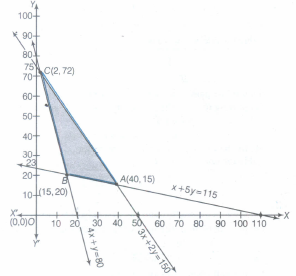
\(\begin{array}{c|c} \hline \text { Corner points } & \text { Value of Z } \\ \hline A(40,15) & 285 \\ B(15,20) & 150(\mathrm{~min}) \\ C(2,7 \mathrm{f}) & 228 \\ \hline \end{array}\)
= Minimum Z = 150, when x = 15, y = 20.
2.
Given equation is \(\frac{d}{d x}\left\{\left(\frac{d y}{d x}\right)^{3}\right\}=0\)
\(\Rightarrow 3\left(\frac{d y}{d x}\right)^{2} \frac{d^{2} y}{d x^{2}}=b\)
Clearly, the highest order derivative occurring in the differential equation is \(d^{2} y / d x^{2}\).
So, its order is 2. Also, it is a polynomial equation in derivatives and highest power raised to \(d^{2} y / d x^{2}\).1, so its degree is 1.
Hence, the sum of the order and degree of the above differential equation is 2 + 1 = 3.
3.
\(\pi{a}{b}sq.units\)
4.
\(\frac{d y}{d x} =-2 A \sin 2 x+2 B \cos 2 x \)
\(\text { and } \frac{d^{2} y}{d x^{2}} =-4 A \cos 2 x-4 B \sin 2 x=-4 y \)
\(\Rightarrow \frac{d^{2} y}{d x^{2}}+4 y =0
\)
5.
\(\Rightarrow\) ey . x = ey + y + c is the required solution.
6.
Given equations of curves are
\(y=x^{2}+2 \text { or } x^{2}=y-2\) ..(i)
y = x ...(ii)
x = 0 ...(iii)
and x = 3 ..(iv)
Equation (i) represents a parabola of the form \(x^{2}=4 ay\) with vertex at (0, 2) and axis along positive direction of y -axis
Equation (ii) represent a line which intersect the coordinate axes at (0, 0).
Equation (iii) and (iv) represent the lines perpendicular to the x-axis.
The graph of given curves is shown below
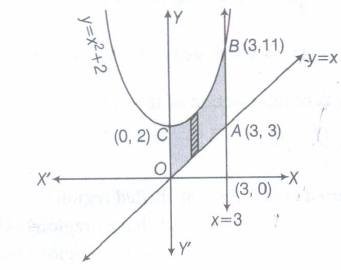
It is clear from the figure that the required region is OABCO.
Note that the line x = 3 intersects y= x at(3,3) and \(y=x^{2}+2 \text { at }(3,11)\) .
\(\therefore\) Required area = Area of shaded portion OABCO
\( =\int_{0}^{3}\left[y_{2} \text { (parabola) }-y_{1} \text { (line) }\right] d x \)
\(=\int_{0}^{3}\left(x^{2}+2-x\right) d x=\left[\frac{x^{3}}{3}-\frac{x^{2}}{2}+2 x\right]_{0}^{3} \)
\(=\frac{27}{3}-\frac{9}{2}+6=9+6-\frac{9}{2}=15-\frac{9}{2} \)
\(=\frac{30-9}{2}=\frac{21}{2} \mathrm{sq} \text { units } \)
Hence, the required area is \(\frac{21}{2} \text { sq units }\) .
7.
Given region \( \left\{(x, y): x^{2}+y^{2} \leq 4, x+y \geq 2\right\}\)
Corresponding equations are \( x^{2}+y^{2}=4 \text { , }\)
Centre : (0,0) and radius : 2 and line x + y = 2
On plotting the inequations \( x^{2}+y^{2} \leq 4 \text { and } x+y \geq 2 \text { , }\)
we have to find the shaded portion as required area.
\(\text {Area } =\int_{0}^{2}\left\{\sqrt{4-x^{2}}-(2-x)\right\} d x \)
\(=\left[\frac{x}{2} \sqrt{4-x^{2}}+\frac{4}{2} \sin ^{-1} \frac{x}{2}-2 x+\frac{x^{2}}{2}\right]_{0}^{2} \)
\(=\left(\frac{2}{2} \sqrt{0}+2 \sin ^{-1} 1-4+2\right)-0=(\pi-2) \mathrm{sq} \text { units } \)
8.
We have, \(\frac{d y}{d x}-y=\sin x\), which is a linear differential equation of the form
\(\frac{d y}{d x}+P y=Q\), here P = -1 and Q = sin x
\(\therefore \quad \mathrm{IF}=e^{\int P d x}=e^{\int(-1) d x}=e^{-x}\)
Now, the general solution of given differential equation is given by \(\begin{aligned}
y \cdot(\mathrm{IF}) & =\int(\mathrm{IF}) \cdot Q d x+C
\end{aligned}\)
\(\begin{aligned}
\Rightarrow \quad y \cdot e^{-x} & =\int e^{-x} \sin x d x+C
\end{aligned}\) ...(i)
Let \(I=\int_{II}^{e^{-x}} \)\(\underset{1}{sin}\) x.dx ...(ii)
By using the method of integration by parts, we get
\(\begin{aligned}
I & =\sin x \frac{e^{-x}}{(-1)}-\int \cos x \frac{e^{-x}}{(-1)} d x
\end{aligned}\)
= -sin x e-x + \(\int e_{\mathrm{II}}^{-x}\) \(\underset{I}{cos}\) x dx
Again, by using integration by parts, we get
\(\begin{aligned}
I & =-\sin x e^{-x}+\cos x \frac{e^{-x}}{(-1)}-\int(-\sin x) \frac{e^{-x}}{(-1)} d x
\end{aligned}\)
\(\begin{aligned}
=-\sin x e^{-x}-\cos x e^{-x}-\int e^{-x} \sin x d x
\end{aligned}\)
= -sin x e-x - cos x e-x - I [from Eq. (ii)]
\(\Rightarrow\) 2I = -e-x (sin x + cos x)
\(\Rightarrow \quad I=-\frac{e^{-x}}{2}(\sin x+\cos x)\)
Then, from Eq. (1), we get
\(\begin{aligned}
y \cdot e^{-x} & =-\frac{e^{-x}}{2}(\sin x+\cos x)+C
\end{aligned}\)
\(\begin{aligned}
\Rightarrow \quad y & =-\frac{1}{2}(\sin x+\cos x)+C e^x
\end{aligned}\)
9.
\(\frac{15}{2} \text { sq units }\)
10.
Given, x2 ≤ y..(i)
and y ≤ |x|...(ii)
Clearly, curve (i) is parabola directed upward with vertex at (0, 0) and symmetrical about y-axis.
Also \(y=|x|=\begin{cases} x\quad if\quad x\ge 0 \\ -x\quad ,if\quad x<\quad 0 \end{cases}\)
The lines y = x and y = - x both passes through origin and have slope of + 1& - 1 respectively.
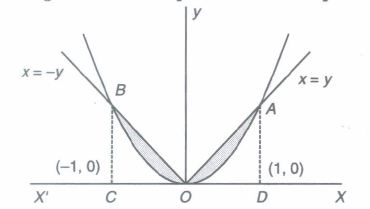
⇒ Required Area = 2x Standard Area on a side
= \(-\left[ \left( \frac { 1 }{ 2 } -1 \right) -\left( \frac { 16 }{ 2 } -4 \right) \right] \)
= \(2{ \left[ \frac { { x }^{ 2 } }{ 2 } -\frac { { x }^{ 3 } }{ 2 } \right] }_{ 0 }^{ 1 }\)
= \(2\left[ \frac { 1 }{ 2 } -\frac { 1 }{ 3 } \right] =2\times \frac { 1 }{ 6 } \)
= \(\frac { 1 }{ 3 } \) sq.units
11.
Let x and y be nut packages and bolt packages produced each day, respectively.
\(\therefore\) LPP is Maximize Z = 24x + 18y
Subject to 2x + 3y \(\le \) 10
3x + 2y \(\le \) 10
x, y \(\ge \) 0
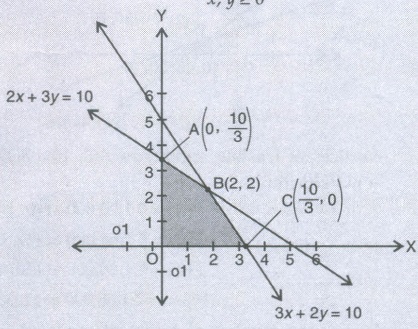
Vertices are
\(A\left( 0,\frac { 10 }{ 3 } \right) ,B(2,2)\quad and\quad C\left( \frac { 10 }{ 3 } ,0 \right) \)
| Points | Z = 24x + 18y |
| \(0,\frac { 10 }{ 3 } \) | z = 0+ 60 = Rs. 60 |
| (2, 2) | z = 48 + 36 = Rs. 84 (Max) |
| \(\left( \frac { 10 }{ 3 } ,0 \right) \) | z = 80 + 0 = Rs. 80 |
Hence, 2 nuts & 2 bolts to be produced to get max. profit of Rs. 84.
12.
We have, (x2 + xy) dy = (x2 + y2)dx
\(\Rightarrow \quad \frac{d y}{d x}=\left(\frac{x^2+y^2}{x^2+x y}\right)\) ...(i)
This is a homogeneous differential equation.
On putting \(y=v x \Rightarrow \frac{d y}{d x}=v \cdot 1+x \frac{d v}{d x}\) in Eq. (i),
we get
\(\begin{aligned}
v+x \frac{d v}{d x} & =\left(\frac{x^2+v^2 x^2}{x^2+x \cdot x v}\right)
\end{aligned}\)
\(\begin{aligned}
\Rightarrow \quad x \frac{d v}{d x} & =\frac{1+v^2}{1+v}-v=\frac{1+v^2-v-v^2}{1+v}=\frac{1-v}{1+v}
\end{aligned}\)
\(\therefore\left(\frac{1+v}{1-v}\right) d v=\frac{1}{x} d x\)
On integrating both sides, we get
\(\begin{aligned}
& \int\left(\frac{1+v}{1-v}\right) d v=\int \frac{1}{x} d x
\end{aligned}\)
\(\begin{aligned}
& \Rightarrow \quad \int\left[-1+\frac{2}{1-v}\right] d v=\log |x|+\log C
\end{aligned}\)
\(\begin{aligned}
& \Rightarrow \quad-v-2 \log (1-v)=\log |x|+\log C
\end{aligned}\)
\(\begin{aligned}
& \Rightarrow-v=2 \log (1-v)+\log |x|+\log C
\end{aligned}\)
\(\begin{aligned}
& \Rightarrow \quad-v=\log (1-v)^2+\log \{C|x|\}
\end{aligned}\)
[\(\because\) log m + log n = log mn]
\(\Rightarrow\) -v = log{C |x| (1 - v)2}
\(\Rightarrow\) C|x|(1 - v)2 = e-v
\(\Rightarrow C|x|\left(1-\frac{y}{x}\right)^2=e^{-y / x} \quad\left[\because v=\frac{y}{x}\right]\) ...(ii)
On puting x = 1 and y = 0 in Eq. (ii), we get
C.1(1 - 0) = e0 \(\Rightarrow\) C = 1
Thus, the required solution is
\(\begin{aligned}
|x|\left(1-\frac{y}{x}\right)^2 & =e^{-y / x}
\end{aligned}\)
\(\begin{aligned}
\Rightarrow \quad(x-y)^2 & =|x| e^{-y / x}
\end{aligned}\)
which is the required particular solutions.
13.
(c)
xy = C
14.
(b)
2
15.
(b)
is bounded in the first quadrant
16.
(b)
\(\frac{8}{3}\)
17.
(b)
constraints
18.
(a)
\(y=\frac{e^{x}}{x}+\frac{k}{x}\)
19.
(b)
4 sq. units
20.
(d)
Optimisation problems
21.
(b)
\(\frac { { d }^{ 2 }y }{ d{ x }^{ 2 } } -4y=0\)
22.
(a)
Infinite
23.
= y
24.
The given equation can be rewritten as
\(x \sqrt{1-y^{2}} d x=-y \sqrt{1-x^{2}} d y \Rightarrow \frac{d y}{d x}=\frac{-x \sqrt{1-y^{2}}}{y \sqrt{1-x^{2}}} \)
Since, the highest order derivative is \( \frac{d y}{d x}.\)is 1. So, its degree is 1.

12th Standard CBSE Syllabus & Materials
12th Standard CBSE
CBSE 12th Computer Science Python Revision Tour I - New Previous year Question Papers Study Material - QB365 Set A
NEW12th Standard CBSE
CBSE 12th Business Studies Planning Important Questions And Answers Study Material - QB365 Set A
NEW12th Standard CBSE
CBSE 12th Business Studies Business Environment Important Questions And Answers Study Material - QB365 Set A
NEW12th Standard CBSE
CBSE 12th Business Studies Principles of Management Important Questions And Answers Study Material - QB365 Set A



NCERT Books

Syllabus

Exam Pattern

Sample Question Papers

Previous year Question Papers

Important Notes

MCQ Practice test

NCERT Exemplers

Case study Questions

Image Based Questions

Passage based Questions

HOT Questions

Value Based Questions

Model Questions Papers
NCERT ( Book Back ) Questions

Assertion and Reason
Important Questions And Answers

CBSE 12th Standard CBSE Subjects
CBSE Standards








