
 100% FREE ACCESS
12th Standard CBSE Syllabus & Materials
12th Standard CBSE
CBSE 12th Economics Government Budget and the Economy Previous year Question Papers Study Material - QB365 Set A
NEW12th Standard CBSE
CBSE 12th Computer Science Interface Python with MySQL - New Previous year Question Papers Study Material - QB365 Set A
NEW12th Standard CBSE
CBSE 12th Computer Science Database Concept - New Previous year Question Papers Study Material - QB365 Set A
NEW12th Standard CBSE
CBSE 12th Computer Science Data Communication - New Previous year Question Papers Study Material - QB365 Set A
NEW12th Standard CBSE
CBSE 12th Computer Science Data Structures - New Previous year Question Papers Study Material - QB365 Set A
NEW12th Standard CBSE
CBSE 12th Computer Science Functions - New Previous year Question Papers Study Material - QB365 Set A

Published on: 02/11/2025
Download CBSE Class 12th Standard CBSE Maths question papers, sample papers, important questions, and previous year solved papers in PDF format. Get free study materials, NCERT solutions, and exam preparation resources for Class 12th Standard CBSE Maths
Questions + Answers key
Take MCQ Maths Test
1.
Polio drops are delivered to 50K children in a district. The rate at which polio drops are given is directly proportional to the number of children who have not been administered the drops.
By the end of 2nd week half the children have been given the polio drops. How many will have been given the drops by the end of 3rd week can be estimated using the solution to the differential equation \(\frac{d y}{d x}=k(50-y)\), where x denotes the number of weeks dx and y the number of children who have been given the drops.
On the basis of above information, answer the following questions
(i) State the order of the above given differential equation.
(ii) Which method of solving a differential equation can be used to solve \(\frac{d y}{d x}=k(50-y)\)?
(a) Variable separable method
(b) Solving Homogeneous differential equation
(c) Solving Linear differential equation
(d) All of the above
(iii)The solution of the differential equation \(\frac{d y}{d x}=k(50-y)\) is given by,
(a) log |50- y| = kx + C
(b) -log |50 - yl = kx + C
(c) log |50 -yl = log |kx| + C
(d) 50 - y = kx + C
(iv) The value of C in the particular solution given that y(0) = 0 and k = 0.049 is
| (a) | log 50 | (b) | log \(\frac{1}{50}\) |
| (c) | 50 | (d) | -50 |
(v) Which of the following solutions may be used to find the number of children who have been given the polio drops?
(a) y = 50 - ekx
(b) y = 50 - ekx
(c) y = 50 (1 - ekx)
(d) y = 50 (ekx - 1)
2.
A Veterinary doctor was examining a sick cat brought by a pet lover. When it was brought to the hospital, it was already dead. The pet lover wanted to find its time of death. He took the temperature of the Cat at 11:30 pm which was 94.6°F. He took the temperature again after 1 h; the temperature was lower than the first observation. lt was 93.4°F. The room in which the Cat was put is always at 70°F. The normal temperature of the cat is taken as 98.6°F when it was alive.
The doctor estimated the time of death using Newton law of cooling which is governed by the differential equation: \(\frac{d T}{d t} \propto(T-70)\), where 70°F is the room temperature and T is the temperature of the object at time t.
Substituting the two different observations of T and t made, in the solution of the differential equation \(\frac{d T}{d t}=k(T-70)\), where k is a constant of proportion, time of death is calculated.
On the basis of above information, answer the following questions.
(i) State the degree of the above given differential equation.
(ii) Which method of solving a differential equation helped in calculation of the time of death?
(a) Variable separable method
(b) Solving Homogeneous differential equation
(c) Solving Linear differential equation
(d) All of the above
(iii) If the temperature was measured 2 h after 11:30 pm, will the time of death change? (Yes/No)
(iv) The solution of the differential equation \(\frac{d T}{d t} =k(T-70)\) is given by,
(a) log |T- 70|= kt + C
(b) log |T - 70|= log |kt |+ C
(c) T - 70 = kt + C
(d) T - 70 = kt + C
(v) If t = 0 when T is 72, then the value of C is
| (a) | -2 | (b) | 0 |
| (c) | 2 | (d) | log 2 |
3.
An equation involving derivatives of the dependent variable with respect to the independent variables is called a differential equation. A differential equation of the form \(\frac{d y}{d x}=F(x, y)\) is said to be homogeneous if F(x, y) is a homogeneous function of degree zero. whereas a function F(x, y) is a homogenous function of degree n if \(F\left(\lambda x \cdot \lambda_y\right)=\lambda_0 F(x, y)\). To solve a homogeneous differential equation of the type \(\frac{d y}{d x}=F(x, y)=g\left(\frac{y}{x}\right)\) we make the substitution y = vx and then separate the variables.
Based on the above answer the following questions.
(i) Show that (x2 - y2)dx + 2xy dy = 0 is a differential equation of the type \(\frac{d y}{d x}=g\left(\frac{y}{x}\right)\)
(ii) Solve the above equation to find the general solution.
4.
If an equation is of the form \(\frac{d y}{d x}+P y=Q\) ,where P, Q are functions of x, then such equation is known as linear differential equation. Its solu~:n is given by \(y \cdot(\mathrm{I} . \mathrm{F} .)=\int \mathrm{Q} \cdot(\mathrm{I} . \mathrm{F} .) d x+c\) where \(\text { I.F. }=e^{\int P d x}\) .
Now, suppose the given equation is \((1+\sin x) \frac{d y}{d x}+y \cos x+x=0\)
Based on the above information, answer the following questions
(i) The value of P and Q respectively are
| (a) \(\frac{\sin x}{1+\cos x}, \frac{x}{1+\sin x}\) | (b) \(\frac{\cos x}{1+\sin x}, \frac{-x}{1+\sin x}\) | (c) \(\frac{-\cos x}{1+\sin x}, \frac{x}{1+\sin x}\) | (d) \(\frac{\cos x}{1+\sin x}, \frac{x}{1+\sin x}\) |
(ii) The value of I.F. is
| (a) 1 - sin x | (b) cos x | (c) 1 + sin x | (d) 1- cosx |
(iii) Solution of given equation is
| (a) y{1-sinx)=x+c | (b) y(l + sin x) = x2+c | (c) \(y(1-\sin x)=\frac{-x^{2}}{2}+c\) | (d) \(y(1+\sin x)=\frac{-x^{2}}{2}+c\) |
(iv) If y(0) = 1, then y,equals
| (a) \(\frac{2-x^{2}}{2(1+\sin x)}\) | (b) \(\frac{2+x^{2}}{2(1+\sin x)}\) | (c) \(\frac{2-x^{2}}{2(1-\sin x)}\) | (d) \(\frac{2+x^{2}}{2(1-\sin x)}\) |
(v) Value of \(y\left(\frac{\pi}{2}\right)\) is
| (a) \(\frac{4-\pi^{2}}{2}\) | (b) \(\frac{8-\pi^{2}}{16}\) | (c) \(\frac{8-\pi^{2}}{4}\) | (d) \(\frac{4+\pi^{2}}{2}\) |
5.
If the equation is of the form \(\frac{d y}{d x}+P y=Q\) , where P, Q are functions of x, then the solution of the differential equation is given by \(y e^{\int P d x}=\int Q e^{\int P d x} d x+c\), where \(e^{\int P d x}\) is called the integrating factor (I.F.).
Based on the above information, answer the following questions.
(i) The integrating factor of the differential equation \(\sin x \frac{d y}{d x}+2 y \cos x=1 \text { is }(\sin x)^{\lambda}, \text { where } \lambda=\)
| (a) 0 | (b) 1 | (c) 2 | (d) 3 |
(ii) Integrating factor of the differential equation \(\left(1-x^{2}\right) \frac{d y}{d x}-x y=1 \) is
| (a) -x | (b) \(\frac{x}{1+x^{2}}\) | (c) \(\sqrt{1-x^{2}}\) | (d) \( \frac{1}{2} \log \left(1-x^{2}\right)\) |
(iii) The solution of \(\frac{d y}{d x}+y=e^{-x}, y(0)=0\) is
| (a) \( y=e^{x}(x-1)\) | (b) \( y=x e^{-x}\) | (c) \(y=x e^{-x}+1\) | (d) \( y=(x+1) e^{-x}\) |
(iv) General solution of \(\frac{d y}{d x}+y \tan x=\sec x\) is
| (a) y see x = tan x + c | (b) y tan x = sec x + c | (c) tan x = y tan x + c | (d) x see x = tan y + c |
(v) The integrating factor of differential equation \(\frac{d y}{d x}-3 y=\sin 2 x\) is
| (a) e3x | (b) e-2x | (c) e-3x | (d) xe-3x |
6.
A differential equation is said to be in the variable separable form if it is expressible in the form j(x) dx = g(y) dy. The solution of this equation is given by \(\int f(x) d x=\int g(y) d y+c\) where c is the constant of integration.
Based on the above information, answer the following questions.
(i) If the solunon of the differential equation \(\frac{d y}{d x}=\frac{a x+3}{2 y+f}\) represents a circle, then the value of' a 'is
| (a) 2 | (b) - 2 | (c) 3 | (d) - 4 |
(ii) The diiftfterential equation \(\frac{d y}{d x}=\frac{\sqrt{1-y^{2}}}{y}\) deterrnines a family of circle with
| (a) variable radii and fixed centre (0,1) | (b) variable radii and fixed centre (0,-1) |
| (c) fixed radius 1 and variable centre on x-axis | (d) fixed radius 1 and variable centre on y-axis |
(iii) If y' = y + 1, y (0) = 1, theny (In 2) =
| (a) 1 | (b) 2 | (c) 3 | (d) 4 |
(iv) The solution of the differential equation \(\frac{d y}{d x}=e^{x-y}+x^{2} e^{-y}\) is
| (a) \(e^{x}=\frac{y^{3}}{3}+e^{y}+c\) | (b) \(e^{y}=\frac{x^{2}}{3}+e^{x}+c\) | (c) \(e^{y}=\frac{x^{3}}{3}+e^{x}+c\) | (d) none of these |
(v) If \(\frac{d y}{d x}=y \sin 2 x, y(0)=1\) then its solution is
| (a) y = esin2x | (b) y = sin2 | (c) y = cos2x | (d) y = cos2x |
7.
If the equation is of the form \(\frac{d y}{d x}=\frac{f(x, y)}{g(x, y)} \text { or } \frac{d y}{d x}=F\left(\frac{y}{x}\right)\) ,wheref (x, y), g(x, y) are homogeneous functions of the same degree in x and y, then put y = vx and \(\frac{d y}{d x}=v+x \frac{d v}{d x}\), so that the dependent variable y is changed to another variable v and then apply variable separable method. Based on the above information, answer the following questions.
(i) The general solution of \(x^{2} \frac{d y}{d x}=x^{2}+x y+y^{2}\) is
| (a) \(\tan ^{-1} \frac{x}{y}=\log |x|+c \) | (b) \( \tan ^{-1} \frac{y}{x}=\log |x|+c\) | (c) \(y=x \log |x|+c\) | (d) \(x=y \log |y|+c\) |
(ii) Solution of the differential equation \(2 x y \frac{d y}{d x}=x^{2}+3 y^{2} \) is
| (a) \( x^{3}+y^{2}=c x^{2}\) | (b) \( \frac{x^{2}}{2}+\frac{y^{3}}{3}=y^{2}+c\) | (c) \(x^{2}+y^{3}=c x^{2}\) | (d) \( x^{2}+y^{2}=c x^{3}\) |
(iii) Solution of the differential equation \(\left(x^{2}+3 x y+y^{2}\right) d x-x^{2} d y=0\) is
| (a) \(\frac{x+y}{x}-\log x=c\) | (b) \( \frac{x+y}{x}+\log x=c\) | (c) \(\frac{x}{x+y}-\log x=c\) | (d) \(\frac{x}{x+y}+\log x=c\) |
(iv) General solution ofthe differential equation \(\frac{d y}{d x}=\frac{y}{x}\left\{\log \left(\frac{y}{x}\right)+1\right\}\) is
| (a) \(\log (x y)=c\) | (b) \( \log y=c x\) | (c) \(\log \left(\frac{y}{x}\right)=c x\) | (d) \(\log x=c y\) |
(v) Solution ofthe differential equation \(\left(x \frac{d y}{d x}-y\right) e^{\frac{y}{x}}=x^{2} \cos x\) is
| (a) \(e^{\frac{y}{x}}-\sin x=c\) | (b) \(e^{\frac{y}{x}}+\sin x=c\) | (c) \(e^{\frac{-y}{x}}-\sin x=c \) | (d) \( e^{\frac{-y}{x}}+\sin x=c\) |
8.
Order: The order of a differential equation is the order of the highest order derivative appearing in the differential equation.
Degree : The degree of differential equation is the power of the highest order derivative, when differential coefficients are made free from radicals and fractions. Also, differential equation must be a polynomial equation
in derivatives for the degree to be defined.
Based on the above information, answer the following questions.
(i) Find the degree of the differential equation \(2 \frac{d^{2} y}{d x^{2}}+3 \sqrt{1-\left(\frac{d y}{d x}\right)^{2}-y}=0\)
| (a) 3 | (b) 4 | (c) 2 | (d) 1 |
(ii) Order and degree of the differential equation \(y \frac{d y}{d x}=\frac{x}{\frac{d y}{d x}+\left(\frac{d y}{d x}\right)^{3}}\) are respectively
| (a) 1,1 | (b) 1,2 | (c) 1,3 | (d) 1,4 |
(iii) Find order and degree of the equation \(y^{\prime \prime \prime}+y^{2}+e^{y^{\prime}}=0\)
| (a) order = 3, degree = undefined | (b) order = 1, degree = 3 | (c) order = 2, degree = undefined | (d) order = 1, degree = 2 |
(iv) Determine degree of the differential equation \((\sqrt{a+x}) \cdot\left(\frac{d y}{d x}\right)+x=0\)
| (a) 3 | (b) not defined | (c) 1 | (d) 2 |
(v) Order and degree of the differential equation \(\left(1+\left(\frac{d y}{d x}\right)^{3}\right)^{\frac{7}{3}}=7 \frac{d^{2} y}{d x^{2}}\) are respectively
| (a) 2, 1 | (b) 2,3 | (c) 1,3 | (d) \(1, \frac{7}{3}\) |
9.
A rumour on whatsapp spreads in a population of 5000 people at a rate proportional to the product of the number of people who have heard it and the number of people who have not. Also, it is given that 100 people initiate the rumour and a total of 500 people know the rumour after 2 days.
Based on the above information, answer the following questions
(i) If yet) denote the number of people who know the rumour at an instant t, then maximum value of yet) is
| (a) 500 | (b) 100 | (c) 5000 | (d) none of these |
(ii) \(\frac{d y}{d t}\) is proptional to
| (a) (y - 5000) | (b) y(y - 500) | (c) y(500 - y) | (d) y(5000 - y) |
(iii) The value of y(0) is
| (a) 100 | (b) 500 | (c) 600 | (d) 200 |
(iv) The value of y(2) is
| (a) 100 | (b) 500 | (c) 600 | (d) 200 |
(v) The value of y at any time t is given by
| (a) \(y=\frac{5000}{e^{-5000 k t}+1}\) | (b) \(y=\frac{5000}{1+e^{5000 k t}}\) | (c) \(y=\frac{5000}{49 e^{-5000 k t}+1}\) | (d) \(y=\frac{5000}{49\left(1+e^{-5000 k t}\right)}\) |
10.
In a murder investigation, a corpse was found by a detective at exactly 8 p.m. Being alert, the detective measured the body temperature and found it to be 70°F. Two hours later, the detective measured the body temperature again and found it to be 60°F, where the room temperature is 50°F. Also, it is given the body temperature at the time of death was normal, i.e., 98.6°F.
Let T be the temperature of the body at any time t and initial time is taken to be 8 p.m.
Based on the above information, answer the following questions.
(i) By Newton's law of cooling,\(\frac{d T}{d t}\) is proportional to
| (a) T - 60 | (b) T - 50 | (c) T - 70 | (d) T - 98.6 |
(ii) When t = 0, then body temperature is equal to
| (a) 50°F | (b) 60°F | (c) 70oF | (d) 98.6°F |
(iii) When t = 2, then body temperature is equal to
| (a) 50°F | (b) 60°F | (c) 70oF | (d) 98.6°F |
(iv) The value of T at any time tis
| (a) \(50+20\left(\frac{1}{2}\right)^{t}\) | (b) \(50+20\left(\frac{1}{2}\right)^{t-1}\) | (c) \(50+20\left(\frac{1}{2}\right)^{t / 2}\) | (d) None of these |
(v) If it is given that loge(2.43) = 0.88789 and loge(0.5) = -0.69315, then the time at which the murder occur is
| (a) 7:30 p.m. | (b) 5:30 p.m. | (c) 6:00 p.m. | (d) 5:00 p.m. |
11.
It is known that, if the interest is compounded continuously, the principal changes at the rate equal to the produd' of the rate of bank interest per annum and the principal. Let P denotes the principal at any time t and rate of interest be r % per annum.
Based on the above information, answer the following questions.
(i) Find the value of \(\frac{d P}{d t}\) .
| (a) \(\frac{\operatorname{Pr}}{1000}\) | (b) \(\frac{P r}{100}\) | (c) \(\frac{\operatorname{Pr}}{10}\) | (d) Pr |
(ii) fPo be the initial principal, then find the solution of differential equation formed in given situation.
| (a) \(\log \left(\frac{P}{P_{0}}\right)=\frac{r t}{100}\) | (b) \(\log \left(\frac{P}{P_{0}}\right)=\frac{r t}{10}\) | (c) \(\log \left(\frac{P}{P_{0}}\right)=r t\) | (d) \(\log \left(\frac{P}{P_{0}}\right)=100 r t\) |
(iii) If the interest is compounded continuously at 5% per annum, in how many years will Rs. 100 double itself?
| (a) 12.728 years | (b) 14.789 years | (c) 13.862 years | (d) 15.872 years |
(iv) At what interest rate will Rs.100 double itself in 10 years? (log e2 = 0.6931).
| (a) 9.66% | (b) 8.239% | (c) 7.341% | (d) 6.931% |
(v) How much will Rs. 1000 be worth at 5% interest after 10 years? (e0.5 = 1.648).
| (a) Rs. 1648 | (b) Rs. 1500 | (c) Rs. 1664 | (d) Rs. 1572 |
12.
A thermometer reading 800P is taken outside. Five minutes later the thermometer reads 60°F. After another 5 minutes the thermometer reads 50of At any time t the thermometer reading be TOP and the outside temperature be SoF.
Based on the above information, answer the following questions.
(i) If \(\lambda\) is positive constant of proportionality, then \(\frac{d T}{d t}\) is
| (a) \(\lambda(T-S)\) | (b) \(\lambda(T+S)\) | (c) \(\lambda T S\) | (d) \(-\lambda(T-S)\) |
(ii) The value of T(S) is
| (a) 300F | (b) 40oF | (c) 50oF | (d) 60oF |
(iii) The value of T(10) is
| (a) 50oF | (b) 40oF | (c) 50oF | (d) 60oF |
(iv) Find the general solution of differential equation formed in given situation.
| (a) logT=St+c | (b) \(\log (T-S)=-\lambda t+c\) | (c) log S = tT + c | (d) \(\log (T+S)=\lambda t+c\) |
(v) Find the valiie of constant of integration c in the solution of differential equation formed in given situation.
| (a) log (60 -S) | (b) log (80 + S) | (c) log (80 - S) | (d) log (60 + S) |
13.
In a college hostel accommodating 1000 students, one of the hostellers came in carrying Corona virus, and the hostel was isolated. The rate at which the virus spreads is assumed to be proportional to the product of the number of infected students and remaining students. There are 50 infected students after 4 days
Based on the above information, answer the following questions
(i) If n(t) denote the number of students infected by Corona virus at any time t, then maximum value of n(t) is
| (a) 50 | (b) 100 | (c) 500 | (d) 1000 |
(ii) \(\frac{d n}{d t}\) is proportional to
| (a) n(100-n) | (b) n(100+ n) | (c) n(100 - n) | (d) n(100 + n) |
(iii) The value of n( 4) is
| (a) 1 | (b) 50 | (c) 100 | (d) 1000 |
(iv) The most general solution of differential equation formed in given situation is
| (a) \(\frac{1}{1000} \log \left(\frac{1000-n}{n}\right)=\lambda t+c\) | (b) \(\log \left(\frac{n}{100-n}\right)=\lambda t+c\) | (c) \(\frac{1}{1000} \log \left(\frac{n}{1000-n}\right)=\lambda t+c\) | (d) None of these |
(v) The value of n at any time is given by
| (a) \(n(t)=\frac{1000}{1+999 e^{-0.9906 t}}\) | (b) \(n(t)=\frac{1000}{1-999 e^{-0.9906 t}}\) | (c) \(n(t)=\frac{100}{1-999 e^{-0.996 t}}\) | (d) \(n(t)=\frac{100}{999+e^{1000 t}}\) |
14.
Consider the following equations of curves y = cos x, y = x + 1 and y = 0. On the basis of above information, answer the following questions.
(i) The curves y = cos x and y = x + 1 meet at
| (a) (1, 0) | (b) (0, 1) | (c) (1, 1) | (d) (0,0) |
(ii) y = cos x meet the x-axis at
| (a) \(\left(\frac{-\pi}{2}, 0\right)\) | (b) \(\left(\frac{\pi}{2}, 0\right)\) | (c) both (a) and (b) | (d) None of these |
(iii) Value of the integral \(\int_{-1}^{0}(x+1) d x\) is
| (a) \(\frac{1}{2}\) | (b) \(\frac{2}{3}\) | (c) \(\frac{3}{4}\) | (d) \(\frac{1}{3}\) |
(iv) Value of the integral \(\int_{0}^{\pi / 2} \cos x d x\) is
| (a) 0 | (b) -1 | (c) 2 | (d) 1 |
(v) Area bounded by the given curves is
| (a) \(\frac{1}{2} \mathrm{sq} . \text { unit }\) | (b) \(\frac{3}{2} \text { sq. units }\) | (c) \(\frac{3}{4} \text { sq. unit }\) | (d) \(\frac{1}{4} \text { sq. unit }\) |
15.
A mirror in the shape of an ellipse represented by \(\frac{x^{2}}{9}+\frac{y^{2}}{4}=1\) was hanging on the wall. Arun and his sister were playing with ball inside the house, even their mother refused to do so. All of sudden, ball hit the mirror and got a scratch in the shape of line represented by \(\frac{x}{3}+\frac{y}{2}=1\) .
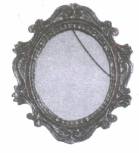
Based on the above information, answer the following questions
(i) Point(s) of intersection of ellipse and scratch (straight line) is (are)
| (a) (0, 2), (3, 0) | (b) (2, 0), (0, 3) | (c) (2, 3), (0, 0) | (d) (0, 3), (3, 0) |
(ii) Area of smaller region bounded by the ellipse and line is represented by

(iii) The value of \(\frac{2}{3} \int_{0}^{3} \sqrt{9-x^{2}} d x\) is
| (a) \(\frac{\pi}{2}\) | (b) \(\pi\) | (c) \(\frac{3 \pi}{2}\) | (d) \(\frac{\pi}{4}\) |
(iv) The value of \(2 \int_{0}^{3}\left(1-\frac{x}{3}\right) d x\) is
| (a) 0 | (b) 1 | (c) 2 | (d) 3 |
(v) Area of the smaller region bounded by the mirror and scratch is
| (a) \(3\left(\frac{\pi}{2}+1\right) \text { sq. units }\) | (b) \(\left(\frac{\pi}{2}+1\right) \text { sq. units }\) | (c) \(\left(\frac{\pi}{2}-1\right) \text { sq. units }\) | (d) \(3\left(\frac{\pi}{2}-1\right) \text { sq. units }\) |
16.
Ajay cut two circular pieces of cardboard and placed one upon other as shown in figure. One of the circle represents the equation (x - 1)2 +1 = 1, while other circle represents the equation x2 +1 = 1.
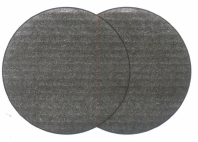
Based on the above information, answer the following questions.
(i) Both the circular pieces of cardboard meet each other at
| (a) x = 1 | (b) \(x=\frac{1}{2}\) | (c) \(x=\frac{1}{3}\) | (d) \(x=\frac{1}{4}\) |
(ii) Graph of given two curves can be drawn as

(iii) Value of \(\int_{0}^{1 / 2} \sqrt{1-(x-1)^{2}} d x\) is
| (a) \(\frac{\pi}{6}-\frac{\sqrt{3}}{8}\) | (b) \(\frac{\pi}{6}+\frac{\sqrt{3}}{8}\) | (c) \(\frac{\pi}{6}-\frac{\sqrt{3}}{8}\) | (d) \(\frac{\pi}{2}-\frac{\sqrt{3}}{4}\) |
(iv) Value of \(\int_{1 / 2}^{1} \sqrt{1-x^{2}} d x\) is
| (a) \(\frac{\pi}{6}-\frac{\sqrt{3}}{8}\) | (b) \(\frac{\pi}{6}+\frac{\sqrt{3}}{8}\) | (c) \(\frac{\pi}{6}-\frac{\sqrt{3}}{8}\) | (d) \(\frac{\pi}{2}-\frac{\sqrt{3}}{4}\) |
(v) Area of hidden portion of lower circle is
| (a) \(\left(\frac{2 \pi}{3}+\frac{\sqrt{3}}{2}\right) \text { sq. units }\) | (b) \(\left(\frac{\pi}{3}-\frac{\sqrt{3}}{8}\right) \text { sq. units }\) | (c) \(\left(\frac{\pi}{3}+\frac{\sqrt{3}}{8}\right) \text { sq. units }\) | (d) \(\left(\frac{2 \pi}{3}-\frac{\sqrt{3}}{2}\right) \text { sq. units }\) |
17.
Location of three houses of a society is represented by the points A(-1, 0), B(1, 3) and C(3, 2) as shown in figure. Based on the above information, answer the following questions
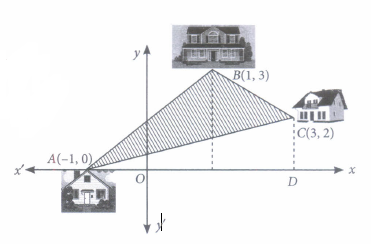
(i) Equation of line AB is
| (a) \(y=\frac{3}{2}(x+1)\) | (b) \(y=\frac{3}{2}(x-1)\) | (c) \(y=\frac{1}{2}(x+1)\) | (d) \(y=\frac{1}{2}(x-1)\) |
(ii) Equation of line BC is
| (a) \(y=\frac{1}{2} x-\frac{7}{2}\) | (b) \(y=\frac{3}{2} x-\frac{7}{2}\) | (c) \(y=\frac{-1}{2} x+\frac{7}{2}\) | (d) \(y=\frac{3}{2} x+\frac{7}{2}\) |
(iii) Area of region ABCD is
| (a) 2 sq. units | (b) 4 sq. units | (c) 6 sq. units | (d) 8 sq. units |
(iv) Area of \(\Delta A D C\) is
| (a) 4 sq. units | (b) 8 sq. units | (c) 16 sq. units | (d) 32 sq. units |
(iv) Area of \(\Delta A B C\) is
| (a) 3 sq. units | (b) 4 sq. units | (c) 5 sq. units | (d) 6 sq. units |
18.
Graphs of two function j(x) = sin x and g(x) = cas x is given below:
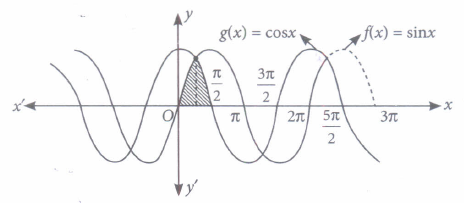
Based on the above information, answer the following questions.
(i) In \([0, \pi]\) ,the curves f(x) = sin x and g(x) = cos x intersect at x =
| (a) \(\frac{\pi}{2}\) | (b) \(\frac{\pi}{3}\) | (c) \(\frac{\pi}{4}\) | (d) \(\pi\) |
(ii) Value of \(\int_{0}^{\pi / 4} \sin x d x\) is
| (a) \(1-\frac{1}{\sqrt{2}}\) | (b) \(1+\frac{1}{\sqrt{2}}\) | (c) \(2-\frac{1}{\sqrt{2}}\) | (d) \(2+\frac{1}{\sqrt{2}}\) |
(iii) Value of \(\int_{\pi / 4}^{\pi / 2} \cos x d x\) is
| (a) \(1+\frac{1}{\sqrt{2}}\) | (b) \(1-\frac{1}{\sqrt{2}}\) | (c) \(2-\frac{1}{\sqrt{2}}\) | (d) \(2+\frac{1}{\sqrt{2}}\) |
(iv) Value of \(\int_{0}^{\pi} \sin x d x\) is
| (a) 0 | (b) 1 | (c) 2 | (d) -2 |
(v) Value of \(\int_{0}^{\pi / 2} \sin x d x\) is
| (a) 0 | (b) 1 | (c) 3 | (d) 4 |
19.
In a classroom, teacher explains the properties of a particular curve by saying that this particular curve has
beautiful up and downs. It starts at 1 and heads down until rt radian, and then heads up again and closely related to sine function and both follow each other, exactly \(\frac{\pi}{2}\) radians apart as shown in figure.
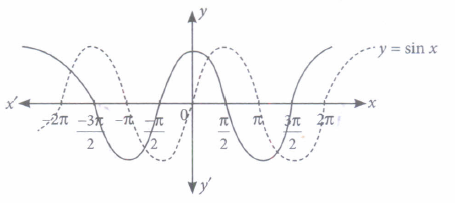
Based on the above information, answer the following questions
(i) Name the curve, about which teacher explained in the classroom
| (a) cosine | (b) sine | (c) tangent | (d) cotangent |
(ii) Area of curve explained in the passage from 0 to \(\frac{\pi}{2}\) is
| (a) \(\frac{1}{3} \mathrm{sq} . \text { unit }\) | (b) \(\frac{1}{2} \mathrm{sq} . \text { unit }\) | (c) 1 sq. unit | (d) 2 sq. units |
(iii) Area of curve discussed in classroom from \(\frac{\pi}{2} \text { to } \frac{3 \pi}{2}\) is
| (a) -2 sq. units | (b) 2 sq. units | (c) 3 sq. units | (d) -3 sq. units |
(iv) Area of curve discussed in classroom from \(\frac{3 \pi}{2} \text { to } 2 \pi\) is
| (a) 1 sq. unit | (b) 2 sq. units | (c) 3 sq. units | (d) 4 sq. units |
(v) Area of explained curve from 0 to \(2 \pi\) is
| (a) 1 sq. unit | (b) 2 sq. units | (c) 3 sq. units | (d) 4 sq. units |
20.
Consider the following equation of curve I' = 4x and straight line x + y = 3.
Based on the above information, answer the following questions.
(i) The line x + y = 3 cuts the x-axis and y-axis respectively at
| (a) (0, 2), (2, 0) | (b) (3, 3), (0, 0) | (c) (0, 3), (3, 0) | (d) (3, 0), (0, 3) |
(ii) Point(s) of intersection of two given curves is (are)
| (a) (1, -2), (-9, 6) | (b) (2, 1), (-6, 9) | (c) (1, 2), (9, -6) | (d) None of these |
(iii) Which of the following shaded portion represent the area bounded by given curves?

(iv) Value of the integral \(\int_{-6}^{2}(3-y) d y\) is
| (a) 10 | (b) 20 | (c) 30 | (d) 40 |
(v) Value of area bounded by given curves is
| (a) 56 sq. units | (b) \(\frac{63}{5} \text { sq; units }\) | (c) \(\frac{64}{3} \text { sq. units }\) | (d) 31 sq. units |
21.
A child cut a pizza with a knife. Pizza is circular in shape which is represented by knife represents a straight line given by \(x=\sqrt{3} y\) .
Based on the above information, answer the following questions
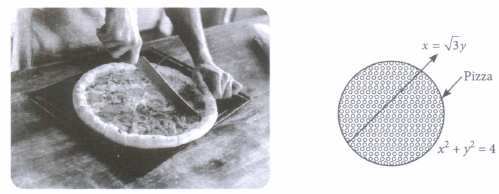
(i) The point(s) of intersection of the edge of knife (line) and pizza shown in the figure is (are)
| (a) \((1, \sqrt{3}),(-1,-\sqrt{3})\) | (b) \((\sqrt{3}, 1),(-\sqrt{3},-1)\) | (c) \((\sqrt{2}, 0),(0, \sqrt{3})\) | (d) \((-\sqrt{3}, 1),(1,-\sqrt{3})\) |
(ii) Which of the following shaded portion represent the smaller area bounded by pizza and edge of knife in first quadrant?

(iii) Value of area of the region bounded by circular pizza and edge of knife in first quadrant is
| (a) \(\frac{\pi}{2} \text { sq. units }\) | (b) \(\frac{\pi}{3} \text { sq. units }\) | (c) \(\frac{\pi}{5} \text { sq. units }\) | (d) \(\pi \text { sq. units }\) |
(iv) Area of each slice of pizza when child cut the pizza into 4 equal pieces is
| (a) \(\pi \text { sq. units }\) | (b) \(\frac{\pi}{2} \mathrm{sq} . \text { units }\)(c) \(3 \pi \text { sq. units }\) | (d) \(2 \pi \text { sq. units }\) |
(v) Area of whole pizza is
| (a) \(3 \pi \text { sq. units }\) | (b) \(2 \pi \text { sq. units }\) | (c) \(5 \pi \text { sq. units }\) | (d) \(4 \pi \text { sq. units }\) |
22.
Consider the curve x2 +y2 = 16 and line y = x in the first quadrant. Based on the above information, answer the following questions.
(i) Point of intersection of both the given curves is
| (a) (0, 4) | (b) \((0,2 \sqrt{2})\) | (c) \((2 \sqrt{2}, 2 \sqrt{2})\) | (d) \((2 \sqrt{2}, 4)\) |
(ii) Which of the following shaded portion represent the area bounded by given two curves?

(iii) The value of the integral \(\int_{0}^{2 \sqrt{2}} x d x\) is
| (a) 0 | (b) 1 | (c) 2 | (d).4 |
(iv) The value of the integral \(\int_{2 \sqrt{2}}^{4} \sqrt{16-x^{2}} d x\) is
| (a) \(2(\pi-2)\) | (b) \(2(\pi-8)\) | (c) \(4(\pi-2)\) | (d) \(4(\pi+2)\) |
(v) Area bounded by the two given curves is
| (a) \(3 \pi \text { sq. units }\) | (b) \(\frac{\pi}{2} \text { sq. units }\) | (c) \(\pi \text { sq. units }\) | (d) \(2 \pi \text { sq. units }\) |
23.
Consider the following equations of curves : x?- = y and y = x.
On the basis of above information, answer the following questions.
(i) The point(s) of intersection of both the curves is (are)
| (a) (0,0), (2, 2) | (b) (0,0), (1, 1) | (c) (0,0), (-1, -1) | (d) (0,0), (-2, -2) |
(ii) Area bounded by the curves is represented by which of the following graph?

(iii) The value of the integral \(\int_{0}^{1} x d x\) is
| (a) 1/4 | (b) 1/3 | (c) 1/2 | 1 |
(iv) The value of the integral \(\int_{0}^{1} x^{2} d x\)
| (a) 1/4 | (b) 1/3 | (c) 1/2 | 1 |
(v) The value of area bounded by the curves x?- = y and x = y is
| (a) \(\frac{1}{6} \mathrm{sq} . \text { unit }\) | (b) \(\frac{1}{3} \text { sq. unit }\) | (c) \(\frac{1}{2} \mathrm{sq} . \text { unit }\) | (d) 1 sq. unit |
1.
Given, differential equation is \(\frac{d y}{d x}=k(50-y) .\)
(i) Order of the given differential equation is 1.
(ii) (a) Method of solving differential equation \(\frac{d y}{d x}=k(50-y)\) is variable separable method.
(ii) (b) Given, differential equation,
\(\begin{aligned}
\frac{d y}{d x} & =k(50-y)
\end{aligned}\)
\(\begin{aligned}
\Rightarrow \quad \frac{d y}{50-y} & =k d x
\end{aligned}\)
On integration, we get
-log |50 - y| = kx + C
(iv) (b) Now, -log(50 - y) = kx + C
On Puttin x = 0, y = 0 and k = 0.049, we get
=log(50 - 0) = 0 + C
\(\Rightarrow \quad C=-\log 50=\log (50)^{-1}=\log \frac{1}{50}\)
(v) (c) Solving differential equation, we get
-loge (50 - y) = kx + C
\(\Rightarrow\) (50 - y) = e-kx - c = e-c.e-kx = Ae-kx
[put e-c = A]
\(\Rightarrow\) 50 - y = Ae-kx \(\Rightarrow\) y = 50 - Ae-kx
When x = 0, y = 0 then
0 = 50 - Ae0 \(\Rightarrow\) A = 50
\(\therefore \quad y=50-50 e^{-k x}=50\left(1-e^{-k x}\right)\)
\(\therefore\) The solution used to find the number of children who have been given the polio drops is
y = 50(1 - e-kx).
2.
Given, different equation,
\(\frac{d T}{d t} \propto(T-70) \Rightarrow \frac{d T}{T-70}=k d t\)
(i) Degree of the given differential equation is 1.
(ii) (a) Given differential equation is solved by variable separable method.
(iii) No; The time of death of Cat is 11:30 pm. Time of death is not depend on temperature
\(\therefore\) Time of death not change.
(iv) (a) We have, \(\frac{d T}{d t}=k(T-70)\)
\(\frac{d T}{T-70}=k d t\)
On integrating, we get
log |T - 70| = kt + C
(v) (d) Now, log |T - 70 | = kt + C
When t = 0,T = 72, we get
log(72 - 70) = 0 + C
\(\Rightarrow\) C = log 2
3.
(i) Given, differential equation is (x2 - y2)dx + 2xydy = 0
\(\begin{aligned}
\Rightarrow \frac{d y}{d x} & =\frac{-\left(x^2-y^2\right)}{2 x y}=\frac{y^2-x^2}{2 x y}
\end{aligned}\)
\(\begin{aligned}
=\frac{x^2\left(\frac{y^2}{x^2}-1\right)}{2 x y}=\frac{\left(\frac{y}{x}\right)^2-1}{2\left(\frac{y}{x}\right)}
\end{aligned}\)
\(\therefore\) In RHS, degree of numerator and denominator is same
\(\therefore\) It is a homogeneous differential equation and can be written as
\(\frac{d y}{d x}=g\left(\frac{y}{x}\right)\)
(ii) Given, differential equation is (x2 - y2)dx + 2xy dy = 0
\(\Rightarrow \quad \frac{d y}{d x}=-\frac{\left(x^2-y^2\right)}{2 x y}=\frac{y^2-x^2}{2 x y}\) ...(i)
This is a homogeneous differential equation
On putting y = vx \(\Rightarrow \frac{d y}{d x}=v+x \cdot \frac{d v}{d x}\)
\(\therefore\) From Eq (i), we get
\(\begin{aligned}
v+x \cdot \frac{d v}{d x} & =\frac{v^2-1}{2 v}
\end{aligned}\)
\(\begin{aligned}
\Rightarrow \quad x \frac{d v}{d x} & =\frac{v^2-1}{2 v}-v
\end{aligned}\)
\(\begin{aligned}
=\frac{v^2-1-2 v^2}{2 v}=\frac{-v^2-1}{2 v}
\end{aligned}\)
\(\Rightarrow \frac{2 v}{v^2+1} d v=\frac{-d x}{x}\)
on integrating both sides, we get
log |v2 + 1| = -log x + log c
\(\begin{aligned}
& \Rightarrow \quad \log \left|\frac{y^2}{x^2}+1\right|=-\log x+\log c
\end{aligned}\)
\(\begin{aligned}
& \Rightarrow \quad \log \left|\frac{y^2+x^2}{x^2} \cdot x\right|=\log c \\
\end{aligned}\)
\(\begin{aligned}
& \Rightarrow \quad \frac{y^2+x^2}{x}=c
\end{aligned}\)
\(\Rightarrow\) y2 + x2 = cx
which is the required solution.
4.
(i) (b) : The given differential equation can be written as \(\frac{d y}{d x}+\frac{\cos x}{1+\sin x} y=\frac{-x}{1+\sin x}\)
Compare it with \(\frac{d y}{d x}+P y=Q\) ,we get
\(P=\frac{\cos x}{1+\sin x}\) and \(Q=\frac{-x}{1+\sin x}\)
(ii) (c) : \(\text { I.F. }=e^{\int P d x}=e^{\int \frac{\cos x}{1+\sin x} d x}\)
Put \(1+\sin x=t \Rightarrow \cos x d x=d t\)
\(\therefore \quad \text { I.F. }=e^{\int \frac{1}{t} d t}=e^{\log t}=t=1+\sin x\)
(iii) (d) : Solution of given differential equation is given by \(y \cdot(\mathrm{I} . \mathrm{F} .)=\int Q(\mathrm{I.F.}) d x+c\)
\(\Rightarrow y(1+\sin x)=\int \frac{-x}{1+\sin x} \cdot(1+\sin x) d x+c\)
\(\Rightarrow \quad y(1+\sin x)=\frac{-x^{2}}{2}+c\)
(iv) (a) : We have, y(0) = 1 i.e., x = 0, y = 1
\(\therefore \quad 1(1+\sin 0)=c \Rightarrow c=1\)
\(\therefore \quad y(1+\sin x)=\frac{-x^{2}}{2}+1=\frac{2-x^{2}}{2}\)
\(\therefore \quad y=\frac{2-x^{2}}{2(1+\sin x)}\)
(v) (b) : We have, \(y=\frac{2-x^{2}}{2(1+\sin x)}\)
\(\therefore \quad y\left(\frac{\pi}{2}\right)=\frac{2-\left(\frac{\pi}{2}\right)^{2}}{2\left(1+\sin \frac{\pi}{2}\right)}=\frac{2-\frac{\pi^{2}}{4}}{4}=\frac{8-\pi^{2}}{16}\)
5.
(i) (c) : The given differential equation can be written as \( \frac{d y}{d x}+2 y \cot x=\operatorname{cosec} x\)
\(\therefore \text { I.F. }=e^{\int 2 \cot x d x}=e^{2 \log |\sin x|}=(\sin x)^{2} \)
\(\therefore \quad \lambda=2\)
(ii) (c) : We have, \(\left(1-x^{2}\right) \frac{d y}{d x}-x y=1\)
\(\Rightarrow \frac{d y}{d x}-\frac{x}{1-x^{2}} \cdot y=\frac{1}{1-x^{2}} \)
\(\therefore \text { I.F. }=e^{-\int \frac{x}{1-x^{2}} d x}=e^{\frac{1}{2} \int \frac{-2 x}{1-x^{2}} d x}\)
\(=e^{\frac{1}{2} \log \left(1-x^{2}\right)}=e^{\log \left(1-x^{2}\right)^{\frac{1}{2}}}=\sqrt{1-x^{2}}\)
(iii) (b) : We have, \(\frac{d y}{d x}+y=e^{-x} \)
It is a linear differential equation with I.F. = \(e^{\int d x}=e^{x}\)
Now, solution is \(y \cdot e^{x}=\int e^{x} \cdot e^{-x} d x+c\)
\(\Rightarrow y e^{x}=\int d x+c \Rightarrow y e^{x}=x+c \Rightarrow y=x e^{-x}+c e^{-x}\)
\(\because y(0)=0 \Rightarrow c=0 \quad \therefore y=x e^{-x}\)
(iv) (a) : We have,\( \frac{d y}{d x}+y \tan x=\sec x\)
It is a linear differential equation with I.F. = \(e^{\int \tan x d x}=e^{\log |\sec x|}=\sec x\)
Now, solution is \(y \sec x=\int \sec ^{2} x d x+c\)
\(\Rightarrow y \sec x=\tan x+c\)
(v) (c) : We have, \(\frac{d y}{d x}-3 y=\sin 2 x\)
It is a linear differential equation with \(\text { I.F. }=e^{\int-3 d x}=e^{-3 x}\)
6.
(i) (b) : We have,\(\frac{d y}{d x}=\frac{a x+3}{2 y+f}\)
\(\Rightarrow \quad(a x+3) d x=(2 y+f) d y\)
\(\Rightarrow \quad a \frac{x^{2}}{2}+3 x=y^{2}+f y+c\) (Integrating)
\(\Rightarrow-\frac{a}{2} x^{2}+y^{2}-3 x+f y+C=0\)
This will represent a circle, if \(\frac{-a}{2}=1 \Rightarrow a=-2\)
[\(\therefore\) In circle, coefficient of x2 = coefficient of y2]
(ii) (c) : We have,\(\frac{y d y}{\sqrt{1-y^{2}}}=d x\)
On integration, we get \(-\sqrt{1-y^{2}}=x+c\)
\(\Rightarrow \quad 1-y^{2}=(x+c)^{2} \Rightarrow(x+c)^{2}+y^{2}=1\) ,which represents a circle with radius 1 and centre on the x-axis.
(iii) (c) : \(y^{\prime}=y+1 \Rightarrow \frac{d y}{y+1}=d x\)
\(\Rightarrow \ln (y+1)=x+c\)
Now, \(y(0)=1 \Rightarrow c=\ln 2\)
\(\therefore \quad \ln \left(\frac{y+1}{2}\right)=x \Rightarrow y+1=2 e^{x}\)
So, y (In 2) = -1 + 2e1n 2 = -1 + 4 = 3
(iv) (c) : From the given differential equation, we have
\(\frac{d y}{d x}=\frac{e^{x}+x^{2}}{e^{y}} \Rightarrow e^{y} d y=\left(e^{x}+x^{2}\right) d x\)
Integrating, we get \(y=e^{x}+\frac{x^{3}}{3}+c\)
(v) (a) : We have, \(\frac{d y}{d x}=y \sin 2 x\)
\(\Rightarrow \quad \frac{d y}{y}=\sin 2 x d x \Rightarrow \log y=-\frac{\cos 2 x}{2}+c\)
Since x = 0, y = 1 therefore c = 1/2
Now, \(\log y=\frac{1}{2}(1-\cos 2 x)\)
\(\Rightarrow \log y=\sin ^{2} x \Rightarrow y=e^{\sin ^{2} x}\)
7.
(i) (b): We have, \(\frac{d y}{d x}=\frac{x^{2}+x y+y^{2}}{x^{2}}\)
Put y = vx and \(\frac{d y}{d x}=v+x \frac{d v}{d x}\)
\(\therefore v+x \frac{d v}{d x}=\frac{x^{2}+x \cdot v x+v^{2} x^{2}}{x^{2}}=1+v+v^{2}\)
\(\Rightarrow x \frac{d v}{d x}=1+v^{2} \Rightarrow \int \frac{d v}{1+v^{2}}=\int \frac{d x}{x}+c\)
\(\Rightarrow \tan ^{-1} v=\log |x|+c \Rightarrow \tan ^{-1} \frac{y}{x}=\log |x|+c\)
(ii) (d): We have, \( 2 x y \frac{d y}{d x}=x^{2}+3 y^{2} \Rightarrow \frac{d y}{d x}=\frac{x^{2}+3 y^{2}}{2 x y}\)
Put y = vx and \(\frac{d y}{d x}=v+x \frac{d v}{d x}\)
\(\therefore v+x \frac{d v}{d x}=\frac{x^{2}+3 v^{2} x^{2}}{2 v x^{2}} \Rightarrow x \frac{d v}{d x}=\frac{1+3 v^{2}}{2 v}-v\)
\(\Rightarrow x \frac{d v}{d x}=\frac{1+v^{2}}{2 v_{*}} \Rightarrow \int \frac{2 v}{1+v^{2}} d v=\int \frac{d x}{x}+\log c\)
\(\Rightarrow \log \left|1+v^{2}\right|=\log |x|+\log |c| \Rightarrow \log \left|v^{2}+1\right|=\log |x c|\)
\(\Rightarrow \quad v^{2}+1=x c \Rightarrow \frac{y^{2}}{2}+1=x c \Rightarrow x^{2}+y^{2}=x^{3} c\)
(iii) (d): We have, \(\left(x^{2}+3 x y+y^{2}\right) d x-x^{2} d y=0\)
\(\Rightarrow \frac{x^{2}+3 x y+y^{2}}{x^{2}}=\frac{d y}{d x}\)
Put y = vx and \(\frac{d y}{d x}=v+x \frac{d v}{d x}\)
\(\therefore \frac{x^{2}+3 x^{2} v+x^{2} v^{2}}{x^{2}}=\left(v+x \frac{d v}{d x}\right)\)
\(\Rightarrow 1+3 v+v^{2}=v+x \frac{d v}{d x} \Rightarrow 1+2 v+v^{2}=x \frac{d v}{d x}\)
\(\Rightarrow \int \frac{d x}{x}-\int(v+1)^{-2} d v=c \Rightarrow \log x+\frac{1}{v+1}=c\)
\(\Rightarrow \log x+\frac{x}{x+y}=c\)
(iv) (c): We have, \(\frac{d y}{d x}=\frac{y}{x}\left\{\log \left(\frac{y}{x}\right)+1\right\}\)
Put y = vx and \(\frac{d y}{d x}=v+x \frac{d v}{d x}\)
\(\therefore v+x \frac{d v}{d x}=v\{\log (v)+1\} \Rightarrow x \frac{d v}{d x}=v \log v\)
\(\Rightarrow \int \frac{d v}{v \log v}=\int \frac{d x}{x} \Rightarrow \log |\log v|=\log |x|+\log |c|\)
\(\Rightarrow \log \left(\frac{y}{x}\right)=c x\)
(v) (a): We have,\(\left(x \frac{d y}{d x}-y\right) e^{\frac{y}{x}}=x^{2} \cos x\)
\(\Rightarrow\left(\frac{d y}{d x}-\frac{y}{x}\right) e^{\frac{y}{x}}=x \cos x\)
\(\text { Put } y=v x \text { and } \frac{d y}{d x}=v+x \frac{d v}{d x}\)
\(\Rightarrow\left(v+x \frac{d v}{d x}-v\right) e^{v}=x \cos x \Rightarrow x e^{v} \frac{d v}{d x}=x \cos x\)
\(\Rightarrow \int e^{v} d v=\int \cos x d x \Rightarrow e^{v}=\sin x+c\)
\(\Rightarrow e^{\frac{y}{x}}-\sin x=c\)
8.
(i) (c) : We have, \(2 \frac{d^{2} y}{d x^{2}}+3 \sqrt{1-\left(\frac{d y}{d x}\right)^{2}-y}=0\)
\(\therefore \quad 2 \frac{d^{2} y}{d x^{2}}=-3 \sqrt{1-\left(\frac{d y}{d x}\right)^{2}-y}\)
Squaring both sides, we get
\(4\left(\frac{d^{2} y}{d x^{2}}\right)^{2}=9\left[1-\left(\frac{d y}{d x}\right)^{2}-y\right]\)
Here, highest order derivative is \(\frac{d^{2} y}{d x^{2}}\) and its power is 2. So, its degree is 2.
(ii) (d) : We have, \(y \frac{d y}{d x}=\frac{x}{\frac{d y}{d x}+\left(\frac{d y}{d x}\right)^{3}}\)
\(\Rightarrow y\left(\frac{d y}{d x}\right)^{2}+y\left(\frac{d y}{d x}\right)^{4}=x\)
\(\Rightarrow\) Here, highest order derivative is \(\frac{d y}{d x}\) is So , its order is 1 and degree is 4.
(iii) (a) : We have,\(y^{\prime \prime \prime}+y^{2}+e^{y^{\prime}}=0\)
\(\frac{d^{3} y}{d x^{3}}+y^{2}+e^{(d y / d x)}=0\)
Highest order derivative is \(\frac{d^{3} y}{d x^{3}}\) .So, its order is 3.
Also, the given differential cannot be expressed as a polynomial. So, its degree is not defined.
(iv) (c) : The given differential equation is,
\(\sqrt{a+x} \cdot\left(\frac{d y}{d x}\right)+x=0 \Rightarrow \frac{d y}{d x}=\frac{-x}{\sqrt{a+x}}\)
Clearly, degree = 1
(v) (b) : We have \(y \frac{d y}{d x}=\frac{x}{\frac{d y}{d x}+\left(\frac{d y}{d x}\right)^{3}}\)
\(\Rightarrow y\left(\frac{d y}{d x}\right)^{2}+y\left(\frac{d y}{d x}\right)^{4}=x\)
\(\Rightarrow\) Here, highest order derivative is \(\frac{d y}{d x}\) ,So , its order is 1 and degree is 4.
(iii) (a) : We have, y'" +y2 + ey = 0
\(\frac{d^{3} y}{d x^{3}}+y^{2}+e^{(d y / d x)}=0\)
Highest order derivative is \(\frac{d^{3} y}{d x^{3}}\) So, its order is 3.
Also, the given differential cannot be expressed as a polynomial. So, its degree is not defined
(iv) (c) :The given differential equation is,
\(\sqrt{a+x} \cdot\left(\frac{d y}{d x}\right)+x=0 \Rightarrow \frac{d y}{d x}=\frac{-x}{\sqrt{a+x}}\)
Clearly, degree = 1.
(v) (b) : We have \(\left(1+\left(\frac{d y}{d x} \mid\right)^{3}\right)^{\frac{1}{3}}=7 \frac{d^{2} y}{d x^{2}}\)
\(\therefore\) Order is 2 and degree is 3.
9.
(i) (c) : Since, size of population is 5000.
\(\therefore\) Maximum value of y(t) is 5000.
(ii) (d) : Clearly, according to given information
\(\frac{d y}{d t}=k y(5000-y)\) ,where k is the constant of proportionality.
(iii) (a): Since, rumour is initiated with 100 people.
\(\therefore\) When t = 0, then y = 100
Thus y(O) = 100
(iv) (b) : Since, rumour is spread in 500 people, after
2 days.
\(\therefore\) When t = 2, then y = 500.
Thus, y(2) = 500
(v) (c) : We know that, when t = 0, then y = 100
This condition is satisfied by option (c) only.
10.
(i) (b) : Given, T is the temperature of the body at any time t. Then, by Newton's law of cooling, we get \(\frac{d T}{d t}=k(T-50)\), where k is the constant of proportionality
(ii) (c) : From given information, we have
At 8 p.m. temperature is 70°F
\(\therefore\) At t = 0, T = 70°F
(iii) (b) : From given information, we have
At 10 p.m., temperature is 60°F.
\(\therefore\) At t = 2, T = 60° F
(iv) (c) : \(\frac{d T}{d t}=k(T-50) \Rightarrow \frac{d T}{T-50}=k d t\)
On integrating both sides, we get
\(\log |T-50|=k t+\log C \Rightarrow T-50=C e^{\wedge t}\)
Clearly, for t = 0, \(T=70^{\circ} \Rightarrow C=20\)
Thus, T - 50 = 20ekt
For \(t=2, T=60^{\circ} \Rightarrow 10=20 e^{2 k}\)
\(\Rightarrow 2 k=\log \left(\frac{1}{2}\right) \Rightarrow k=\frac{1}{2} \log \left(\frac{1}{2}\right)\)
Hence, \(T=50+20\left(\frac{1}{2}\right)^{\frac{t}{2}}\)
(v) (b) : We have, \(T=50+20\left(\frac{1}{2}\right)^{\frac{2}{2}}\)
11.
(i) (b) : Here, P denotes the principal at any time t and the rate of interest be r% per annum compounded continuously, then according to the law given in the problem, we get
\(\frac{d P}{d t}=\frac{P r}{100}\)
(ii) (a) : We have, \(\frac{d P}{d t}=\frac{\operatorname{Pr}}{100}\)
\(\Rightarrow \frac{d P}{P}=\frac{r}{100} d t \Rightarrow \int \frac{1}{P} d P=\frac{r}{100} \int d t\)
\(\Rightarrow \log P=\frac{r t}{100}+C\)
At t = 0, P = Po
\(\therefore \quad C=\log P_{0}\)
So, \(\log P=\frac{r t}{100}+\log P_{0}\)
\(\Rightarrow \log \left(\frac{P}{P_{0}}\right)=\frac{r t}{100}\)
(iii) (c) : We have, r = 5, Po = Rs. 100 and P = Rs. 200 = 2Po
Substituting these values in (2), we get
\(\log 2=\frac{5}{100} t\)
\(\Rightarrow\) t = 20 loge 2 = 20 x 0.6931 years = 13.862 years
(iv) (d) : We have
Po = Rs. 100, P = Rs. Rs. 200 = 2Po and t = 10 years
Substituting these values in (2), we get
\(\log 2=\frac{10 r}{100} \Rightarrow r=10 \log 2=10 \times 0.6931=6.931\)
(v) (a) : We have
Po = Rs. 1000, r = 5 and t = 10
Substituting these values in (2), we get
\(\log \left(\frac{P}{1000}\right)=\frac{5 \times 10}{100}=\frac{1}{2}=0.5 \Rightarrow \frac{P}{1000}=e^{0.5}\)
\(\Rightarrow\) P = 1000 x 1.648 = Rs. 1648
12.
(i) (d) :Given, at any time t the thermometer reading be ToF and the outside temperature be sop.
Then, by Newton's law of cooling, we have
\(\frac{d T}{d t} \propto(T-S) \Rightarrow \frac{d T}{d t}=-\lambda(T-S)\)
(ii) (d) : Since, after 5 minutes, thermometer reads 600F.
\(\therefore\) Value of T(5) = 600F
(iii) (a) : Clearly from given information, value of T( 10) is 50°F.
(iv) (b) : We have,\(\frac{d T}{d t}=-\lambda(T-S)\)
\(\Rightarrow \frac{d T}{T-S}=-\lambda d t \Rightarrow \int \frac{1}{T-S} d T=-\lambda \int d t\)
\(\Rightarrow \log (T-S)=-\lambda t+c\)
(v) (c) : Since, at t = 0, T = 80°
13.
(i) (d) : Since, maximum number of students in hostel is 1000.
\(\therefore\) Maximum value of n(t) is 1000.
(ii) (a) : Clearly, according to given information
\(\frac{d n}{d t}=\lambda n(1000-n)\) ,where \(\lambda\) is constant of proportionality.
(iii) (b) : Since, 50 students are infected after 4 days
\(\therefore\) n(4) = 50.
(iv) (c) : We have,\(\frac{d n}{d t}=\lambda n(100-n)\)
\(\Rightarrow \int \frac{d n}{n(1000-n)}=\lambda \int d t\)
\(\Rightarrow \frac{1}{1000} \int\left(\frac{1}{1000-n}+\frac{1}{n}\right) d n=\lambda \int d t\)
\(\Rightarrow \quad \frac{1}{1000}\left[\frac{\log (1000-n)}{-1}+\log n\right]=\lambda t+C\)
\(\Rightarrow \frac{1}{1000} \log \left(\frac{n}{1000-n}\right)=\lambda t+C\)
(v) (a) : When, t = 0, n = 1
This condition is satisfied by option (a) only.
14.
(i) b : Curves y = cos x and y = x + 1 meet at point C(O, 1).
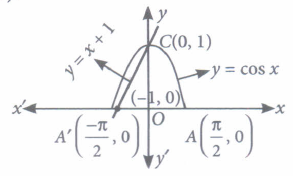
(ii) C : curve y=cosx meet the x axis at \(A^{\prime}\left(\frac{-\pi}{2}, 0\right)\) and \(A\left(\frac{\pi}{2}, 0\right)\) .
(iii) (a) : \(\int_{-1}^{0}(x+1) d x=\left[\frac{x^{2}}{2}+x\right]_{-1}^{0}=0-\left(\frac{1}{2}-1\right)=\frac{1}{2}\)
(iv) (d) : \(\int_{0}^{\pi / 2} \cos x d x=[\sin x]_{0}^{\pi / 2}=\sin \frac{\pi}{2}-\sin 0=1\)
(v) (b) : Required area \(\int_{-1}^{0}(x+1) d x+\int_{0}^{\pi / 2} \cos x d x\)
\(=\frac{1}{2}+1=\frac{3}{2} \text { sq. units }\)
15.
(i) (a) : Points (0, 2) and (3, 0) pass through both line and ellipse.
(ii) (b) :
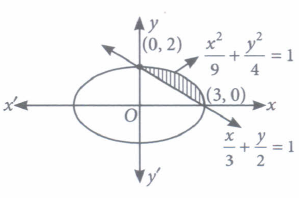
(iii) (c) : \(\frac{2}{3} \int_{0}^{3} \sqrt{9-x^{2}} d x=\frac{2}{3} \int_{0}^{3} \sqrt{(3)^{2}-x^{2}} d x\)
\(=\frac{2}{3}\left[\frac{1}{2} x \sqrt{9-x^{2}}+\frac{9}{2} \sin ^{-1}\left(\frac{x}{3}\right)\right]_{0}^{3}\)
\(=\frac{2}{3}\left[\frac{3}{2} \sqrt{0}+\frac{9}{2} \sin ^{-1}(1)-\frac{1}{2}(0)-\frac{9}{2} \sin ^{-1}(0)\right]\)
\(=\frac{2}{3}\left[\frac{9}{2} \cdot \frac{\pi}{2}\right]=\frac{3 \pi}{2}\)
(iv) d : \(2 \int_{0}^{3}\left(1-\frac{x}{3}\right) d x=2\left[x-\frac{x^{2}}{6}\right]_{0}^{3}\)
\(=2\left(3-\frac{9}{6}-0-0\right)=2 \times \frac{3}{2}=3\)
(v) (d) : Area of smaller region bounded by the mirrorand scratch
\(=\frac{2}{3} \cdot \int_{0}^{3} \sqrt{9-x^{2}} d x-2 \int_{0}^{3}\left(1-\frac{x}{3}\right) d x\)
\(=\frac{3 \pi}{2}-3=3\left(\frac{\pi}{2}-1\right) \text { sq. units }\)
16.
(i) (b) : We have, (x - 1)2+y2 = 1
\(\Rightarrow y=\sqrt{1-(x-1)^{2}}\) ...(i)
Also, \(x^{2}+y^{2}=1 \Rightarrow y=\sqrt{1-x^{2}}\) ...(ii)
From (i) and (ii), we get
\(\sqrt{1-(x-1)^{2}}=\sqrt{1-x^{2}}\)
\(\Rightarrow(x-1)^{2}=x^{2} \Rightarrow 2 x=1 \Rightarrow x=\frac{1}{2}\)
(ii) (c):
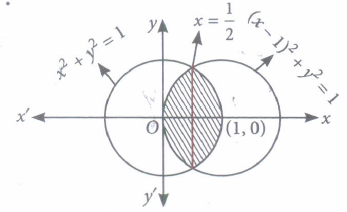
(iii) (a) : \(\int_{0}^{1 / 2} \sqrt{1-(x-1)^{2}} d x\)
\(=\left[\frac{x-1}{2} \sqrt{1-(x-1)^{2}}+\frac{1}{2} \sin ^{-1}\left(\frac{x-1}{1}\right)\right]_{0}^{1 / 2}\)
\(\begin{array}{r} =\frac{1}{2}\left(\frac{1}{2}-1\right) \sqrt{1-\frac{1}{4}}+\frac{1}{2} \sin ^{-1}\left(-\frac{1}{2}\right)-\left(-\frac{1}{2}\right)(0) -\frac{1}{2} \sin ^{-1}(-1) \end{array}\)
\(=\left[\frac{-1}{4} \cdot \frac{\sqrt{3}}{2}-\frac{1}{2} \cdot \frac{\pi}{6}+0+\frac{1}{2} \cdot \frac{\pi}{2}\right]=\frac{-\sqrt{3}}{8}-\frac{\pi}{12}+\frac{\pi}{4}\)
\(=\frac{\pi}{6}-\frac{\sqrt{3}}{8}\)
(iv) (c : \(\int_{1 / 2}^{1} \sqrt{1-x^{2}} d x=\left[\frac{x}{2} \sqrt{1-x^{2}}+\frac{1}{2} \sin ^{-1} x\right]_{1 / 2}^{1}\)
\(=0+\frac{1}{2} \sin ^{-1}(1)-\frac{1}{4} \sqrt{1-\frac{1}{4}}-\frac{1}{2} \sin ^{-1}\left(\frac{1}{2}\right)\)
\(=\frac{\pi}{4}-\frac{\sqrt{3}}{8}-\frac{\pi}{12}=\frac{\pi}{6}-\frac{\sqrt{3}}{8}\)
(v) (d) : Required area
\(=2\left[\int_{0}^{1 / 2} \sqrt{1-(x-1)^{2}} d x+\int_{1 / 2}^{1} \sqrt{1-x^{2}} d x\right]\)
\(=2\left[\frac{\pi}{6}-\frac{\sqrt{3}}{8}+\frac{\pi}{6}-\frac{\sqrt{3}}{8}\right]\)
\(=2\left[\frac{\pi}{3}-\frac{\sqrt{3}}{4}\right]=\left(\frac{2 \pi}{3}-\frac{\sqrt{3}}{2}\right) \text { sq. units }\)
17.
(i) (a) : Equation of line AB is
\(y-0=\frac{3-0}{1+1}(x+1) \Rightarrow y=\frac{3}{2}(x+1)\)
(ii) (c) : Equation of line BC is \(y-3=\frac{2-3}{3-1}(x-1)\)
\(\Rightarrow y=-\frac{1}{2} x+\frac{1}{2}+3 \Rightarrow y=\frac{-1}{2} x+\frac{7}{2}\)
(iii) (d) : Area of region ABCD
= Area of \(\triangle A B E\) + Area of region BCDE
\(=\int_{-1}^{1} \frac{3}{2}(x+1) d x+\int_{1}^{3}\left(\frac{-1}{2} x+\frac{7}{2}\right) d x\)
\(=\frac{3}{2}\left[\frac{x^{2}}{2}+x\right]_{-1}^{1}+\left[\frac{-x^{2}}{4}+\frac{7}{2} x\right]_{1}^{3}\)
\(=\frac{3}{2}\left[\frac{1}{2}+1-\frac{1}{2}+1\right]+\left[\frac{-9}{4}+\frac{21}{2}+\frac{1}{4}-\frac{7}{2}\right]\)
= 3 + 5 = 8 sq. units
(iv) (a) : Equation of line AC is \(y-0=\frac{2-0}{3+1}(x+1)\)
\(\Rightarrow y=\frac{1}{2}(x+1)\)
\(\therefore \text { Area of } \Delta A D C=\int_{-1}^{3} \frac{1}{2}(x+1) d x=\left[\frac{x^{2}}{4}+\frac{1}{2} x\right]_{-1}^{3}\)
\(=\frac{9}{4}+\frac{3}{2}-\frac{1}{4}+\frac{1}{2}=4 \text { sq. units }\)
(v) (b) : Area of \(\Delta A B C\)= Area of region ABCD - Area of \(\Delta A C D=8-4=4 \mathrm{sq} . \text { units }\)
18.
(i) (c) : For point of intersection, we have sin x = cos x
\(\Rightarrow \frac{\sin x}{\cos x}=1 \Rightarrow \tan x=1 \Rightarrow x=\frac{\pi}{4}\)
(ii) (a) : \(\int_{0}^{\pi / 4} \sin x d x=[-\cos x]_{0}^{\pi / 4}=-\cos \frac{\pi}{4}+\cos 0\) \(=1-\frac{1}{\sqrt{2}}\)
(iii) (b) : \(\int_{\pi / 4}^{\pi / 2} \cos x d x=[\sin x]_{\pi / 4}^{\pi / 2}=\sin \frac{\pi}{2}-\sin \frac{\pi}{4}\) \(=1-\frac{1}{\sqrt{2}}\)
(iv) (c) : \(\int_{0}^{\pi} \sin x d x=[-\cos x]_{0}^{\pi}=[-\cos \pi+\cos 0]=2\)
(v) (b) : \(\int_{0}^{\pi / 2} \sin x d x=[-\cos x]_{0}^{\pi / 2}=\left[-\cos \frac{\pi}{2}+\cos 0\right]\) = 0+1=1
19.
(i) (a) : Here, teacher explained about cosine curve.
(ii) (c) : Required area \(\int_{0}^{\pi / 2} \cos x d x\)
\(=[\sin x]_{0}^{\pi / 2}=\sin \frac{\pi}{2}-\sin 0=1-0=1 \text { sq. unit }\)
(iii) (b) : Required area = \(\left|\int_{\pi / 2}^{3 \pi / 2} \cos x d x\right|=\left|[\sin x]_{\pi / 2}^{3 \pi / 2}\right|\)
\(=\left|\sin \frac{3 \pi}{2}-\sin \frac{\pi}{2}\right|=|-1-1|=|-2|\)
= 2 sq. units [Since, area can't be negative]
(iv) (a) : Required area = \(\int_{3 \pi / 2}^{2 \pi} \cos x d x=[\sin x]_{3 \pi / 2}^{2 \pi}\)
\(=\sin 2 \pi-\sin \frac{3 \pi}{2}=0-(-1)=1 \text { sq. unit }\)
(v) (d) : Required area
\(=\int_{0}^{\pi / 2} \cos x d x+\left|\int_{\pi / 2}^{3 \pi / 2} \cos x d x\right|+\int_{3 \pi / 2}^{2 \pi} \cos x d x\)
= 1 + 2 + 1 = 4 sq. units.
20.
(i) (d) : Line x + y = 3 cuts the x-axis and y-axis at (3, 0) and (0, 3) respectively
[Since, at x-axis, y = 0 and at y-axis, x = 0]
(ii) (c) : We have, y2 = 4x and x + y = 3
From (i) and (ii), we have y2 = 4(3 - y)
\(\Rightarrow y^{2}+4 y-12=0 \Rightarrow y^{2}+6 y-2 y-12=0\)
\(\Rightarrow y(y+6)-2(y+6)=0\)
\(\Rightarrow (y+6)(y-2)=0 \Rightarrow y=2, y=-6\)
From (ii), x = 3 - 2 = 1 or x = 3 + 6 = 9
\(\therefore\) Required points of intersection are (1, 2), (9, - 6)
(iii) (b) :
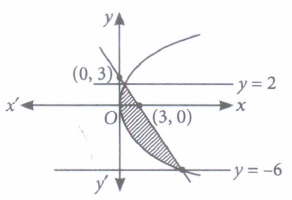
(iv) (d): \(\int_{-6}^{2}(3-y) d y=\left[3 y-\frac{y^{2}}{2}\right]_{-6}^{2}\)
\(=\left[6-\frac{4}{2}-\left[3(-6)-\frac{(-6)^{2}}{2}\right]\right]=4+36=40\)
(v) (c): Required area = \(\int_{-6}^{2}(3-y) d y-\int_{-6}^{2} \frac{y^{2}}{4} d y\)
\(=40-\frac{1}{4}\left[\frac{y^{3}}{3}\right]_{-6}^{2}=40-\frac{1}{4}\left[\frac{8}{3}-\frac{(-6)^{3}}{3}\right]\)
\(=40-\frac{2}{3}-\frac{216}{12}=\frac{480-8-216}{12}=\frac{256}{12}=\frac{64}{3} \mathrm{sq} . \text { units }\)
21.
(i) (b) : We have, y2 + 1 = 4 ...(i)
and \(x=\sqrt{3} y\) ...(ii)
From (i) and (ii), we get
\(3 y^{2}+y^{2}=4 \Rightarrow 4 y^{2}=4 \Rightarrow y^{2}=1 \Rightarrow y=\pm 1\)
From (ii), \(x=\sqrt{3},-\sqrt[4]{3}\)
\(\therefore\) Points of intersection of pizza and edge of knife are \((\sqrt{3}, 1),(-\sqrt{3},-1)\) .
(ii) (a) :
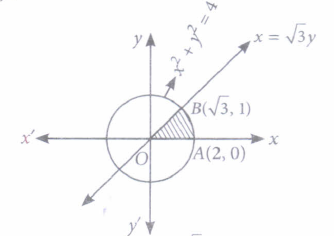
(iii) (b) : Required area = \(\int_{0}^{\sqrt{3}} \frac{x}{\sqrt{3}} d x+\int_{\sqrt{3}}^{2} \sqrt{4-x^{2}} d x\)
\(=\frac{1}{\sqrt{3}}\left[\frac{x^{2}}{2}\right]_{0}^{\sqrt{3}}+\left[\frac{x}{2} \sqrt{4-x^{2}}+\frac{4}{2} \sin ^{-1}\left(\frac{x}{2}\right)\right]_{\sqrt{3}}^{2}\)
\(=\frac{1}{\sqrt{3}}\left[\frac{3}{2}-0\right]+\left[2 \sin ^{-1}(1)-\left(\frac{\sqrt{3}}{2}+2 \sin ^{-1} \frac{\sqrt{3}}{2}\right)\right]\)
\(=\frac{\sqrt{3}}{2}+\frac{2 \pi}{2}-\frac{\sqrt{3}}{2}-\frac{2 \pi}{3}=\frac{\pi}{3} \text { sq. units }\)
(iv) (a) : We have,x2+y2=4
\(\Rightarrow(x-0)^{2}+(y-0)^{2}=(2)^{2}\)
\(\therefore\) Radius = 2
Area of \(\frac{1}{4} \text { th slice of pizza }=\frac{1}{4} \pi(2)^{2}=\pi \mathrm{sq} . \text { units }\)
(v) (d) : Area of whole pizza = \(\pi(2)^{2}=4 \pi \mathrm{sq} . \text { units }\)
22.
(i) (c) : We have, x2 +y2= 16 ..(i)
and y = x ...(ii)
From (i) and (ii), \(2 x^{2}=16 \Rightarrow x^{2}=8 \Rightarrow x=2 \sqrt{2}\) (\(\therefore\) x lies in first quadrant)
\(\therefore\) Point of intersection of (i) and (ii) in first quadrant is \((2 \sqrt{2}, 2 \sqrt{2})\) .
(ii) (b) : The shaded region which represent the areabounded by two given curves in first quadrant is shown below.
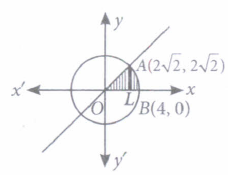
(iii)( d) : \(\int_{0}^{2 \sqrt{2}} x d x=\left[\frac{x^{2}}{2}\right]_{0}^{2 \sqrt{2}}=\frac{(2 \sqrt{2})^{2}}{2}=\frac{8}{2}=4\)
(iv) (a) : \(\int_{2 \sqrt{2}}^{4} \sqrt{16-x^{2}} d x=\left[\frac{x}{2} \sqrt{16-x^{2}}+\frac{16}{2} \cdot \sin ^{-1}\left(\frac{x}{4}\right)\right]_{2 \sqrt{2}}^{4}\)
\(=8 \sin ^{-1}(1)-4-8 \sin ^{-1}\left(\frac{1}{\sqrt{2}}\right)\)
\(=8\left(\frac{\pi}{2}\right)-4-8\left(\frac{\pi}{4}\right)=4 \pi-4-2 \pi=2 \pi-4=2(\pi-2)\)
(v) (d) : Required area = Area (OLA) + Area (BAL)
\(=\int_{0}^{2 \sqrt{2}} x d x+\int_{2 \sqrt{2}}^{4} \sqrt{16-x^{2}} d x\)
\(=4+2(\pi-2)=2 \pi \text { sq. units. }\)
23.
(i) (b) : We have, x2 = y ...(i) and x = y. , ...(ii)
From (i) and (ii), x2= x \(\Rightarrow\)x2 - x = 0
\(\Rightarrow\) x(x - 1) = 0 ~ x = 0, 1
From (ii), y = 0, 1
Required points of intersection are (0, 0), (1, 0)
(ii) (a) :
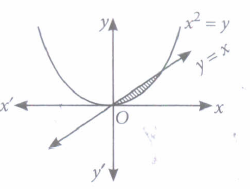
(iii) (c) : \(\int_{0}^{1} x d x=\left[\frac{x^{2}}{2}\right]_{0}^{1}=\frac{1}{2}-0=\frac{1}{2}\)
(iv) (b) : \(\int_{0}^{1} x^{2} d x=\left[\frac{x^{3}}{3}\right]_{0}^{1}=\frac{1}{3}-0=\frac{1}{3}\)
(v) (a) : Required area \(=\int_{0}^{1} x d x-\int_{0}^{1} x^{2} d x\)
\(=\frac{1}{2}-\frac{1}{3}=\frac{1}{6} \text { sq. units. }\)

12th Standard CBSE Syllabus & Materials
12th Standard CBSE
CBSE 12th Computer Science Python Revision Tour I - New Previous year Question Papers Study Material - QB365 Set A
NEW12th Standard CBSE
CBSE 12th Business Studies Planning Important Questions And Answers Study Material - QB365 Set A
NEW12th Standard CBSE
CBSE 12th Business Studies Business Environment Important Questions And Answers Study Material - QB365 Set A
NEW12th Standard CBSE
CBSE 12th Business Studies Principles of Management Important Questions And Answers Study Material - QB365 Set A



NCERT Books

Syllabus

Exam Pattern

Sample Question Papers

Previous year Question Papers

Important Notes

MCQ Practice test

NCERT Exemplers

Case study Questions

Image Based Questions

Passage based Questions

HOT Questions

Value Based Questions

Model Questions Papers
NCERT ( Book Back ) Questions

Assertion and Reason
Important Questions And Answers

CBSE 12th Standard CBSE Subjects
CBSE Standards








