
12th Standard CBSE Syllabus & Materials
12th Standard CBSE
CBSE 12th Economics Government Budget and the Economy Previous year Question Papers Study Material - QB365 Set A
NEW12th Standard CBSE
CBSE 12th Computer Science Interface Python with MySQL - New Previous year Question Papers Study Material - QB365 Set A
NEW12th Standard CBSE
CBSE 12th Computer Science Database Concept - New Previous year Question Papers Study Material - QB365 Set A
NEW12th Standard CBSE
CBSE 12th Computer Science Data Communication - New Previous year Question Papers Study Material - QB365 Set A
NEW12th Standard CBSE
CBSE 12th Computer Science Data Structures - New Previous year Question Papers Study Material - QB365 Set A
NEW12th Standard CBSE
CBSE 12th Computer Science Functions - New Previous year Question Papers Study Material - QB365 Set A

Published on: 20/08/2026
Download CBSE Class 12th Standard CBSE Maths question papers, sample papers, important questions, and previous year solved papers in PDF format. Get free study materials, NCERT solutions, and exam preparation resources for Class 12th Standard CBSE Maths
Questions + Answers key
Take MCQ Maths Test
1.
Choose the correct Answer:
The area bounded by the y = axis y = cos x and y = sin x, where \(0\le x\le \frac { \pi }{ 2 } \) is:
(A) \(2(\sqrt { 2 } -1)\)
(B) \(\sqrt { 2 } -1\)
(C) \(\sqrt { 2 } +1\)
(D) \(\sqrt { 2 } \)
2.
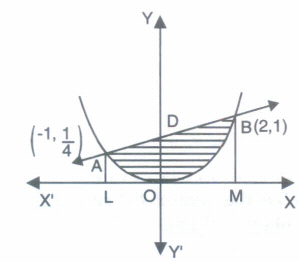
Find the area bounded by the curve x2 = 4y and the line x = 4y - 2.
3.
Find the area of the region bounded by teh line y=3x+2, the x-axis and ordinates at x=-1 and x=1.
4.
Find the area of the region included between the parabola \(y=\frac { 3 }{ 4 } { x }^{ 2 }\) and the line 3x - 2y + 12 =0.
5.
Find the area bounded by the curve \(y=x|x|\), x-axis and the ordinates x = - 3 and x = 3.
6.
Find the area of the minor segment of the circle \(x^{2}+y^{2}=a^{2}\) cut-off by the line \(x=\frac{a}{2}\)
7.
Draw a rough sketch of the curve \(y=\sqrt{x-1}\) the interval [1,5]. Find the area under the curve and the lines x = 1 and x = 5.
8.
Find the area under the curve \(y=\sqrt{3 x+4}\) between x = 0, x = 4 and the x-axis.
9.
On sketching the graph of \(y=\left| x-2 \right| \) and evaluating \(\int _{ -1 }^{ 3 }{ \left| x-2 \right| } dx\) , what does \(\int _{ -1 }^{ 3 }{ \left| x-2 \right| } dx\) represent on the graph ?
10.
Find the area of the region bounded by the curve 4x2 + y2 = 36 using integration.
11.
using integration, find the area of the region bounded by the curves y = x2 and y = x.
12.
Using integration, find the area of the \(\triangle \)PQR co-ordinates whose vertices are P(2, 0), Q(4, 5) and R(6, 3).
13.
The area of the region bounded by the curve y2= 4x and x = 1 is
\(\frac{4}{3}\)
\(\frac{8}{3}\)
\(\frac{64}{3}\)
\(\frac{32}{3}\)
14.
The area enclosed by the circle x2 + y2 = 16 is
20
20 \(\pi\)
16 \(\pi\)
256 \(\pi\)
15.
The area bounded by the curve \(y=x|x|\) X-axis and the coordinates x = -1 and x = 1 is given by
0 sq units
\(\frac{1}{3} \text { sq units }\)
\(\frac{2}{3} \text { sq units }\)
\(\frac{4}{3} \text { sq units }\)
16.
If the area above x-axis, bounded by the curves y = 2kx, x = 0 and x = 2 is \(\frac { 3 }{ { log }_{ e }2 } \) then k = ?
k = 0
k = 1
k = 2
k = -1
17.
Area of the shaded region in the given figure is:
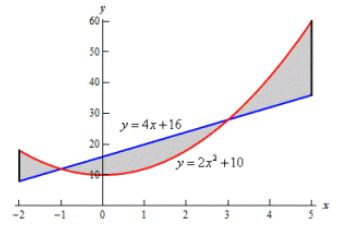
144/3 sq. units
142/3 sq. units
145/3 sq. units
143/2 sq. units
18.
In a classroom, teacher explains the properties of a particular curve by saying that this particular curve has
beautiful up and downs. It starts at 1 and heads down until rt radian, and then heads up again and closely related to sine function and both follow each other, exactly \(\frac{\pi}{2}\) radians apart as shown in figure.
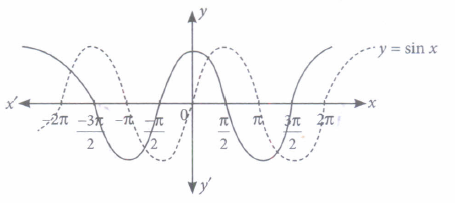
Based on the above information, answer the following questions
(i) Name the curve, about which teacher explained in the classroom
| (a) cosine | (b) sine | (c) tangent | (d) cotangent |
(ii) Area of curve explained in the passage from 0 to \(\frac{\pi}{2}\) is
| (a) \(\frac{1}{3} \mathrm{sq} . \text { unit }\) | (b) \(\frac{1}{2} \mathrm{sq} . \text { unit }\) | (c) 1 sq. unit | (d) 2 sq. units |
(iii) Area of curve discussed in classroom from \(\frac{\pi}{2} \text { to } \frac{3 \pi}{2}\) is
| (a) -2 sq. units | (b) 2 sq. units | (c) 3 sq. units | (d) -3 sq. units |
(iv) Area of curve discussed in classroom from \(\frac{3 \pi}{2} \text { to } 2 \pi\) is
| (a) 1 sq. unit | (b) 2 sq. units | (c) 3 sq. units | (d) 4 sq. units |
(v) Area of explained curve from 0 to \(2 \pi\) is
| (a) 1 sq. unit | (b) 2 sq. units | (c) 3 sq. units | (d) 4 sq. units |
1.
Part (B) is the correct answer.
Reason: The given curves are y = cos x and \(y=sinx;0\le x\le \frac { \pi }{ 2 } \)
The curves intersect, where
\(cosx=sinx\Rightarrow tanx=1\Rightarrow x=\frac { \pi }{ 4 } .\)
And \(y=cos\frac { \pi }{ 4 } =sin\frac { \pi }{ 4 } =\frac { 1 }{ \sqrt { 2 } } \)
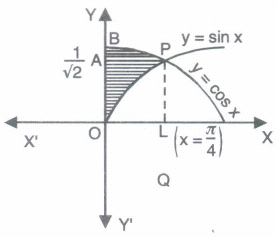
Therefore, Reqd, area = ar (OPBO) = ar (OPA) + ar (APBA)
\(=\overset { \frac { 1 }{ \sqrt { 2 } } }{ \underset { 0 }{ \int { } } } { sin }^{ -1 }ydy+\overset { 1 }{ \underset { \frac { 1 }{ \sqrt { 2 } } }{ \int { } } } { cos }^{ -1 }ydy\)
\(=\sqrt { 2 } -1\)
2.
The given curve is x2 = 4y
which is an upward parabola with vertex (0,0).
The given line is x = 4y - 2
Solving (1) and (2):
\( { (4y-2) }^{ 2 }=4y\)
\(\Rightarrow { 16y }^{ 2 }-16y+4=4y\)
\(\Rightarrow { 16y }^{ 2 }-20y+4=0\Rightarrow { 4y }^{ 2 }-5y+1=0\)
\(\Rightarrow (4y-1)(y-1)=0\Rightarrow y=\frac { 1 }{ 4 } ,1\)
\(When \ y=\frac { 1 }{ 4 } ,thenx=4\left( \frac { 1 }{ 4 } \right) -2\)
\(=1-2=-1\)
\(When \ y=1,thenx=4(1)-2=4-2=2\)
\(Thus(2)meets(1)at\)
\(A\left( -1,\frac { 1 }{ 4 } \right) andB(2,1).\)
\(\therefore Reqd.area=ar(ALOMBDA)-ar(LMBOAL)\)
\(=\overset { 2 }{ \underset { -1 }{ \int { } } } \frac { x+2 }{ 4 } dx-\overset { 2 }{ \underset { -1 }{ \int { } } } \frac { { x }^{ 2 } }{ 4 } dx\)
\(=\frac { 1 }{ 4 } \left[ \frac { { x }^{ 2 } }{ 2 } +2x \right] ^{ 2 }_{ -1 }-\frac { 1 }{ 4 } \left[ \frac { { x }^{ 3 } }{ 3 } \right] _{ -1 }^{ 2 }\)
\(=\frac { 1 }{ 4 } \left[ \left( 2+4 \right) -\left( \frac { 1 }{ 2 } -2 \right) \right] -\frac { 1 }{ 12 } \left[ 8-\left( -1 \right) \right] \)
\(=\frac { 1 }{ 4 } \left[ 6+\frac { 3 }{ 2 } \right] -\frac { 1 }{ 12 } [9]=\frac { 15 }{ 8 } -\frac { 3 }{ 4 } \)
\(=\frac { 15-6 }{ 8 } =\frac { 9 }{ 8 } sq.units.\)
3.
\(\text { Line is } y=3 x+2\)
\(\text { When } y=0, x=-\frac{2}{3}\)
\(\text { Area } =-\int_{-1}^{-2 / 3}(3 x+2) d x+\int_{-2 / 3}^{1}(3 x+2) d x\)
\(=-\left[\frac{3 x^{2}}{2}+2 x\right]_{-1}^{-2 / 3}+\left[\frac{3 x^{2}}{2}+2 x\right]_{-2 / 3}^{1} \)
\(=-\left(\frac{2}{3}-\frac{4}{3}\right)+\left(\frac{3}{2}-2\right)+\left(\frac{3}{2}+2\right)-\left(\frac{2}{3}-\frac{4}{3}\right) \)
\(=\frac{2}{3}-\frac{1}{2}+\frac{7}{2}+\frac{2}{3}=3+\frac{4}{3}=\frac{13}{3} \mathrm{sq} \text { units }
\)
4.
Eliminating y from the equations, we get
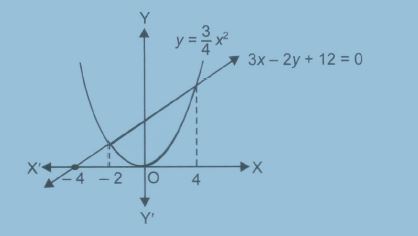
\(3 x-\frac{3}{2} x^{2}+12=0 \Rightarrow x^{2}-2 x-8=0 \)
\(\Rightarrow (x-4)(x+2)=0 \Rightarrow x=-2,4 \)
\(\text { Area }=\int_{-2}^{4}\left\{\frac{3 x+12}{2}-\frac{3}{4} x^{2}\right\} d x \)
\(=\left[\frac{3 x^{2}}{4}+6 x-\frac{x^{3}}{4}\right]_{-2}^{4} \)
\(=[(12+24-16)-(3-12+2)] \text { sq units } \)
\(=[20+7]=27 \text { sq units }
\)
5.
Given equation of curve is \(y=x|x|=\left\{\begin{array}{ll} x^{2}, & \text { if } x \geq 0 \\ -x^{2}, & \text { if } x< 0 \end{array}\right. \)
The graph of above curve between the ordinates x = - 3 and x = 3 is given below

Clearly, shaded portion is the required region.
∴ Required Area
= Area of region OALO + Area of region OBMO
\(=\left|\int_{-3}^{0} y_{2} d x\right|+\int_{0}^{3} y_{1} d x \)
\(=\left|\int_{-3}^{0}\left(-x^{2}\right) d x\right|+\int_{0}^{3} x^{2} d x=\left|\left[-\frac{x^{3}}{3}\right]_{-3}^{0}\right|+\left[\frac{x^{3}}{3}\right]_{0}^{3} \)
\(=\left|\left[\frac{(-3)^{3}}{3}\right]\right|+\left[\frac{27}{3}-0\right]=|-9|+[9-0 \)
= 9 + 9 = 18 sq.units
Hence,the required area is 18 sq units.
6.
\(= \frac{a^{2}}{12}(4 \pi-3 \sqrt{3}) \text { sq units }\)
7.
\(\frac{16}{3} \text { sq units }\)
8.
Given curve is \(y=\sqrt{3 x+4} \)
On squaring both sides, we get
\(y^{2}=3 x+4 \)
\(\Rightarrow y^{2}=3\left(x+\frac{4}{3}\right) \Rightarrow y^{2}=3\left[x-\left(\frac{-4}{3}\right)\right] \)
which is the equation of the parabola of the form
y2 = 4 a x. whose vertex is \(\left(-\frac{4}{3}, 0\right)\) and symmetrical about x-axis.
As \(y=\sqrt{3 x+4} \) is a positive square root, so we take a upper part of the parabola \(y^{2}=3 x+4 \)
upper part of the parabola \(y^{2}=3 x+4 \)
The area of the region bounded by the curve
\(y=\sqrt{3 x+4}\) between x = 0, x = 4 and the x-axis,is the area shown in the figure given below

∴ Required area \(= \int_{0}^{4} y d x=\int_{0}^{4}(\sqrt{3 x+4}) d x \)
\(=\int_{0}^{4}(3 x+4)^{1 / 2} d x=\left[\frac{(3 x+4)^{3 / 2}}{\frac{3}{2} \cdot 3}\right]_{0} \)
\(\begin{array}{l} =\frac{2}{9}\left[(12+4)^{3 / 2}-(4)^{3 / 2}\right] \quad\left[\because \int(a x+b)^{n} d x=\frac{(a x+b)^{n+1}}{a(n+1)}\right] \end{array} \)
\(=\frac{2}{9}\left[(16)^{3 / 2}-(4)^{3 / 2}\right] \)
\(=\frac{2}{9}\left[\left(2^{4}\right)^{3 / 2}-\left(2^{2}\right)^{3 / 2}\right] \)
\(=\frac{2^{4}}{9}\left[(2)^{6}-(2)^{3}\right]=\frac{2}{9}(64-8) \)
\(=\frac{2}{9} \times 56=\frac{112}{9} \text { sq units } \)
Hence, the required is \( \frac{112}{9} \text { sq units }.\)
9.
On the graph it represents the area bounded by the curve \(y=\left| x-2 \right| \), x-axis and between the ordinates at x = -1 and x = 3.
10.
Given curve is 4x2 + y2 = 36
\(\begin{array}{ll} \therefore & \frac{4 x^2}{36}+\frac{y^2}{36}=1 \end{array}\)
\(\begin{array}{ll} \therefore & \frac{x^2}{9}+\frac{y^2}{36}=1 \end{array}\) ...(i)
We know that the standard equation of ellipse is
\(\frac{x^2}{a^2}+\frac{y^2}{b^2}=1\) ...(ii)
On comparing Eqs. (i) and (ii), we get
a2 = 9 and b2 = 36
\(\Rightarrow\) a = 3 and b = 6
Here, we see that a < b, so the vertical ellipse will be formed.
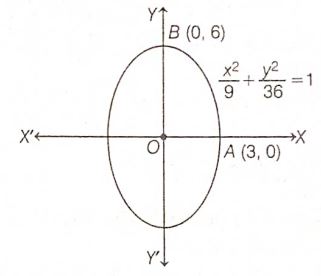
Now, required area = 4(Area of region OAB in first quadrant)
\(\begin{aligned} =4\left|\int_0^3 y d x\right| \end{aligned}\)
\(\begin{aligned} =\left|4 \int_0^3 2 \sqrt{9-x^2} d x\right| \end{aligned}\)
\(\begin{aligned} \left[\because \frac{y^2}{36}=1-\frac{x^2}{9} \Rightarrow y=2 \sqrt{9-x^2}\right] \end{aligned}\)
\(\begin{aligned} =8 \int_0^3 \sqrt{9-x^2} d x \end{aligned}\)
\(\begin{aligned} =8\left|\left[\frac{x}{2} \sqrt{9-x^2}+\frac{9}{2} \sin ^{-1}\left(\frac{x}{3}\right)\right]_0^3\right| \end{aligned}\)
\(\left[\because \sqrt{a^2-x^2} d x=\frac{x}{2} \sqrt{a^2-x^2}+\frac{a^2}{2} \sin ^{-1}\left(\frac{x}{a}\right)\right]\)
\(=8\left\{\left[\frac{3}{2} \sqrt{9-9}+\frac{9}{2} \sin ^{-1} \frac{3}{3}-0-\frac{9}{2} \sin ^{-1} 0\right]\right\}\)
\(\begin{aligned} =8\left|\left[0+\frac{9}{2} \times \frac{\pi}{2}-0\right]\right| \end{aligned}\)
\(\begin{aligned} =8 \times \frac{9 \pi}{4} \end{aligned}\)
\(=18 \pi\)
Hence, the required area is 18\(\pi\) sq units.
11.
The given curves are
y = x2 (parabola)
y = x (line)
These intersect at
O(0, 0) and A(1, 1).
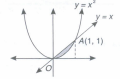
The area bounded by the curves = Shaded area
\(=\int _{ 0 }^{ 1 }{ \left( { y }_{ 2 }-{ y }_{ 1 } \right) } dx\)
\(=\int _{ 0 }^{ 1 }{ \left( x-{ x }^{ 2 } \right) } dx\)
\(=\left[ \frac { { x }^{ 2 } }{ 2 } -\frac { { x }^{ 3 } }{ 3 } \right] _{ 0 }^{ 1 }\)
\(=\frac { 1 }{ 2 } -\frac { 1 }{ 3 } =\frac { 1 }{ 6 } sq.units\)
12.
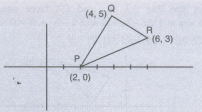
Eqns. of PQ, QR and PR are:
PQ : y = \(\frac{5}{2}\)(x-2)
QR : y = 9-x
PR : y = \(\frac{3}{4}\) (x-2)
Req. Area = \(=\int _{ 2 }^{ 4 }{ \frac { 5 }{ 2 } \left( x-2 \right) dx+\int _{ 4 }^{ 6 }{ \left( 9-x \right) dx-\int _{ 2 }^{ 6 }{ \frac { 3 }{ 4 } \left( x-2 \right) dx } } } \)
\(=\left[ \frac { 5 }{ 4 } { \left( x-2 \right) }^{ 2 } \right] _{ 2 }^{ 4 }-\frac { 1 }{ 2 } \left[ \left( 9-x \right) ^{ 2 } \right] _{ 4 }^{ 6 }-\frac { 3 }{ 8 } \left[ \left( x-2 \right) ^{ 2 } \right] _{ 2 }\)
= 5 + 8 - 6 = 7 sq.units.
13.
(b)
\(\frac{8}{3}\)
14.
(c)
16 \(\pi\)
15.
(c)
\(\frac{2}{3} \text { sq units }\)
16.
(b)
k = 1
17.
(b)
142/3 sq. units
18.
(i) (a) : Here, teacher explained about cosine curve.
(ii) (c) : Required area \(\int_{0}^{\pi / 2} \cos x d x\)
\(=[\sin x]_{0}^{\pi / 2}=\sin \frac{\pi}{2}-\sin 0=1-0=1 \text { sq. unit }\)
(iii) (b) : Required area = \(\left|\int_{\pi / 2}^{3 \pi / 2} \cos x d x\right|=\left|[\sin x]_{\pi / 2}^{3 \pi / 2}\right|\)
\(=\left|\sin \frac{3 \pi}{2}-\sin \frac{\pi}{2}\right|=|-1-1|=|-2|\)
= 2 sq. units [Since, area can't be negative]
(iv) (a) : Required area = \(\int_{3 \pi / 2}^{2 \pi} \cos x d x=[\sin x]_{3 \pi / 2}^{2 \pi}\)
\(=\sin 2 \pi-\sin \frac{3 \pi}{2}=0-(-1)=1 \text { sq. unit }\)
(v) (d) : Required area
\(=\int_{0}^{\pi / 2} \cos x d x+\left|\int_{\pi / 2}^{3 \pi / 2} \cos x d x\right|+\int_{3 \pi / 2}^{2 \pi} \cos x d x\)
= 1 + 2 + 1 = 4 sq. units.

12th Standard CBSE Syllabus & Materials
12th Standard CBSE
CBSE 12th Computer Science Python Revision Tour I - New Previous year Question Papers Study Material - QB365 Set A
NEW12th Standard CBSE
CBSE 12th Business Studies Planning Important Questions And Answers Study Material - QB365 Set A
NEW12th Standard CBSE
CBSE 12th Business Studies Business Environment Important Questions And Answers Study Material - QB365 Set A
NEW12th Standard CBSE
CBSE 12th Business Studies Principles of Management Important Questions And Answers Study Material - QB365 Set A



NCERT Books

Syllabus

Exam Pattern

Sample Question Papers

Previous year Question Papers

Important Notes

MCQ Practice test

NCERT Exemplers

Case study Questions

Image Based Questions

Passage based Questions

HOT Questions

Value Based Questions

Model Questions Papers
NCERT ( Book Back ) Questions

Assertion and Reason
Important Questions And Answers

CBSE 12th Standard CBSE Subjects
CBSE Standards








