
 100% FREE ACCESS
12th Standard CBSE Syllabus & Materials
12th Standard CBSE
CBSE 12th Economics Government Budget and the Economy Previous year Question Papers Study Material - QB365 Set A
NEW12th Standard CBSE
CBSE 12th Computer Science Interface Python with MySQL - New Previous year Question Papers Study Material - QB365 Set A
NEW12th Standard CBSE
CBSE 12th Computer Science Database Concept - New Previous year Question Papers Study Material - QB365 Set A
NEW12th Standard CBSE
CBSE 12th Computer Science Data Communication - New Previous year Question Papers Study Material - QB365 Set A
NEW12th Standard CBSE
CBSE 12th Computer Science Data Structures - New Previous year Question Papers Study Material - QB365 Set A
NEW12th Standard CBSE
CBSE 12th Computer Science Functions - New Previous year Question Papers Study Material - QB365 Set A

Published on: 02/11/2025
Download CBSE Class 12th Standard CBSE Maths question papers, sample papers, important questions, and previous year solved papers in PDF format. Get free study materials, NCERT solutions, and exam preparation resources for Class 12th Standard CBSE Maths
Questions + Answers key
Take MCQ Maths Test
1.
A man 1.6 m tall walks at the rate of 0.3 m/sec away from a street light that is 4 m above the ground. At what rate is the tip of his shadow moving? At what rate is his shadow lengthening?
2.
If \(y=\tan x+\sec x\), then prove that \(\frac{d^2 y}{d x^2}=\frac{\cos x}{(1-\sin x)^2}\)
3.
If \((\cos x)^y=(\cos y)^x\), then find \(\frac{d y}{d x}\)
4.
Find the values of a and b so that the following function is differentiable for all values of x
\(f(x)= \begin{cases}a x+b, & x>-1 \\ b x^2-3, & x \leq-1\end{cases}\)
5.
Differentiate w.r.t. x: \({ cot }^{ -1 }\left[ \frac { \sqrt { 1+sin\quad x } +\sqrt { 1-sin\quad x } }{ \sqrt { 1+sin\quad x } +\sqrt { 1-sin\quad x } } \right] \)
6.
Find the intervals in which the function \('f'\)is given by:
\(f(x)=x^{ 2 }-4x+6\) is
(a) strictly increasing
(b) strictly decreasing.
7.
The volume of a cube is increasing at the rate of 8 cm3/sec. How fast is the surface area increasing when the length of an edge is 12 cm?
8.
Sand is pouring from a pipe at the rate of 12 cm3/sec. The falling sand forms a cone on the ground in such a way that the height of the cone is always one-sixth of the radius of the base. How fast is the height of the sand-cone increasing, when the height is 4 cm?
9.
If x and y are connected parametrically by the equations given in Exercises
\(x=\frac{\sin ^3 t}{\sqrt{\cos 2 t}}, y=\frac{\cos ^3 t}{\sqrt{\cos 2 t}}\)
10.
Show that the semi-vertical angle of the cone of the maximum volume and of given slant height is \(\cos ^{-1} 1 / \sqrt{3}\).
11.
Show that the altitude of the right circular cone of maximum volume that can be inscribed in a sphere of radius r is \(\frac { 4r }{ 3 } \) Also show that the maximum volume of the cone is \(\frac { 8 }{ 27 } \) of the volume of the sphere.
12.
If \(y=(x+\sqrt{x^2+1})^m\) then show that: \((x^2+1)\frac{d^2y}{dx^2}+x\frac{dy}{dx}-m^2y=0\)
13.
If x = \(asec^{ 3 }\theta \) , \(y=atan^{ 3 }\theta \) find \(\frac { dy }{ dx } \theta =\frac { \pi }{ 4 } \)
14.
Find the points of local maxima, local minima and the points of inflexion of the function \(f(x)=x^5-5x^4+5x^3-1\). Also, find the corresponding local maximum and local minimum values.
15.
If y= tan-1 x , find \(\frac { { d }^{ 2 }y }{ { dx }^{ 2 } } \)in terms of y alone.
16.
The real function f(x) = 2x3 - 3x² - 36x + 7 is
strictly increasing in (-∞, -2) and strictly decreasing in (-2,∞)
strictly decreasing in (-2,3)
strictly decreasing in (-∞,3) and strictly increasing in (3,∞)
strictly decreasing in (-∞, 2) U (3, ∞)
17.
The function f(x) = x3 + 3x is increasing in interval.
(- ∞, 0)
(0,∞)
R
(0, 1)
18.
The interval in which the function f(x) = 2x3 + 9x² + 12x - 1 is decreasing is
(-1,∞)
(-2, -1)
(-∞, -2)
(-1, 1)
19.
If \(\sin (x y)=1\), then \(\frac{d y}{d x}\) is equal to
\(\frac{x}{y}\)
\(-\frac{x}{y}\)
\(\frac{y}{x}\)
\(-\frac{y}{x}\)
20.
The points, at which the function f given by \(f(x)=\left\{\begin{array}{ll}\frac{x}{|x|}, & x<0 \\ -1, & x \geq 0\end{array}\right.\) is continuous, is/are
\(x \in R\)
x=0
\(x \in R-\{0\}\)
x = -1 and 1
21.
The function f(x) = \(\frac{x}{2}+\frac{2}{x}\) has a local minima at x equal to
2
1
0
-2
22.
\(\text { If } x=a t^{2}, y=2 a t, \text { then } \frac{d^{2} y}{d x^{2}} \text { is }\)
\(\frac{1}{t}\)
\(-\frac{1}{t^{2}}\)
at2
\(\frac{-1}{2 a t^{3}}\)
23.
If \(y=3 \cos (\log x)+4 \sin (\log x)\),then
\(x y_{2}+y_{1}+y=0\)
\(x y_{2}+y_{1}-y=0\)
\(x^{2} y_{2}+x y_{1}+y=0\)
None of these
24.
The differential coefficient of sin (cos(x2) with respect to x is.
-2xsinx2cos(~os x2)
2xsin(x2)cos(x2)
2xsin(x2) cos(x2) cosx
None of the above
25.
The maximum value of \({ [x(x-1)+1] }^{ \frac { 1 }{ 3 } }\), \(0\le x\le 1\) is
\({ \left( \frac { 1 }{ 3 } \right) }^{ \frac { 1 }{ 3 } }\)
\(\frac { 1 }{ 2 } \)
1
0
26.
For all real values of x, the minimum value of \(\frac { 1-x+{ x }^{ 2 } }{ 1+x+{ x }^{ 2 } } \) is
0
1
3
\(\frac { 1 }{ 3 } \)
27.
The point on the curve x2 = 2y which is nearest to the point (0, 5) is
(2 \(\sqrt2\),4)
(2 \(\sqrt2\),0)
(0, 0)
(2, 2)
28.
Which of the following functions are decreasing on 0, \(\frac{\pi}{2}\)?
cos x
cos 2x
cos 3x
tan x
29.
The total revenue in Rupees received from the sale of x units of a product is given by
R(x) = 3x2 + 36x + 5. The marginal revenue, when x = 15 is
116
96
90
126
30.
The rate of change of the area of a circle with respect to its radius r at r = 6 cm is
10π
12π
8π
11π
31.
The absolute maximum value of y = x3 – 3x + 2 in 0 ≤ x ≤ 2 is
4
6
2
0
32.
If y = Ae5x,+ Be-5x x then \(\frac { { d }^{ 2 }y }{ dx^{ 2 } } \) is equal to
25y
5y
-25y
10y
33.
Derivative of cot x° with respect to x is
cosec x°
cosec x° cot x°
-1° cosec2 x°
-1° cosec x° cot x°
34.
Find the intervals in which the function. f given by f(x) = tan x - 4x,x \(\in\) (0, π/2) is
(i) strictly increasing
(ii) strictly decreasing
35.
The surface area of a cube increases at the rate of 72 cm2/sec. Find the rate of change of its volume when the edge of the cube measures 3 cm.
36.
Check for differentiability of the function f defined by f(x) = |x - 5| at the point x = 5.
37.
Verify whether the function f defined by \(f(x)=\left\{\begin{array}{cc} x \sin \left(\frac{1}{x}\right), & x \neq 0 \\ 0, & x=0 \end{array}\right.\) is continuous at x = 0 or not.
38.
The volume of a sphere is increasing at the rate of 8cm3/ s. Find the rate at which its surface area is increasing when the radius of the sphere is 12cm.
39.
A stone is dropped into a quiet lake and waves moves in circles at a speed of 5 cm/ s. At the instant when the radius of the circular wave is 8 cm, how fast is the enclosed area increasing?
40.
Determine the value of the constant 'k', so that function \(f(x)=\left\{\begin{array}{c} \frac{k x}{|x|}, \text { if } x<0 \\ 3, \text { if } x \geq 0 \end{array}\right.\) is continuous at x = 0.
41.
Consider the information given below
The function f is given by f(x) = 2x3 - 3x2 - 36x + 7.
Assertion (A) The given function f is strictly increasing in intervals (-\(\infty\), +2) and (-3, \(\infty\)).
Reason (R) The given function f is strictly decreasing in interval (-2, 3).
(a) Both A and R are correct; R is the correct explanation of A
(b) Both A and R are correct; R is not the correct explanation of A
(c) A is correct; R is incorrect
(d) R is correct; A is incorrect
42.
Assertion: If x = at2 and y = 2 at, then \(\frac{d^{2}y}{dx^{2}}|_{t=2}=\frac{-1}{6a}\)
Reason: \(\frac{d^{2}y}{dx^{2}}=\left ( \frac{dy}{dt} \right )^{2}\times \left ( \frac{dt}{dx} \right )^{2}\)
(a) Assertion is correct, Reason is correct; Reason is a correct explanation for assertion.
(b) Assertion is correct, Reason is correct; Reason is not a correct explanation for Assertion
(c) Assertion is correct, Reason is incorrect
(d) Assertion is incorrect, Reason is correct.
43.
Read the following passage and answer the questions given below

The temperature of a person during an intestinal illness is given by \(f(x)=-0.1 x^2+m x+98.6\), \(0 \leq x \leq 12\), where m being a constant and f(x) is the temperature in \({ }^{\circ} \mathrm{F}\) at x days.
(i) Is the function differentiable in the interval (0,12) ? Justify your answer.
(ii) If 6 is the critical point of the function, then find the value of the constant m.
(iii) Find the intervals in which the function is strictly increasing/strictly decreasing.
Or
Find the points of local maximum/local minimum, if any, in the interval (0,12) as well as the points of absolute maximum/absolute minimum in the interval [0,12]. Also, find the corresponding local maximum/local minimum and the absolute maximum/absolute minimum values of the function.
44.
In order to set up a rain water harvesting system, a tank to collect rain water is to be dug. The tank should have a square base and a capacity of \(250 \mathrm{~m}^3\). The cost of land is ₹ 5000 per square metre and cost of digging increases with depth and for the whole tank, it is ₹ 40,000 \(\mathrm{~h}^2\), where h is the depth of the tank in metres. x is the side of the square base of the tank in metres.
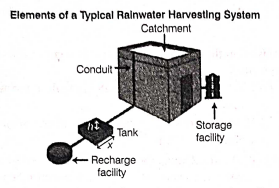
Based on the above information, answer the following questions.
(i) Find the total cost C of digging the tank in terms of x.
(ii) Find dC/dx.
45.
A volleyball player serves the ball which takes a parabolic path given by the equation \(h(t)=-\frac{7}{2} t^2+\frac{13}{2} t+1\), where h(t) is the height of ball at any time t (in sec), \((t \geq 0)\).
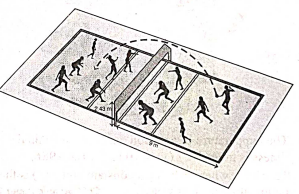
Based on the above information, answer the following questions.
(i) Is h(t) a continuous function ? Justify
(ii) Find the time at which the height of the ball is maximum.
1.
Let AB represent the height of the street light from the ground.
At any time t s, let the man represented as ED of height 1.6 m be at a distance of x m from A B and the length of his shadow EC be y m.
From similarity of \(\triangle A B C\) and \(\triangle E D C\), we have
\( \frac{4}{1.6}=\frac{x+y}{y} \Rightarrow 4 y=1.6 x+1.6 y \Rightarrow 2.4 y=1.6 x \)
\(\Rightarrow 3 y=2 x\)
Now, differentiating both sides of Eq. (i) w.r.t. t, we get
\(3 \frac{d y}{d t} =2 \frac{d x}{d t} \Rightarrow \frac{d y}{d t}=\frac{2}{3} \times 0.3 \quad\left[\because \frac{d x}{d t}=0.3 \mathrm{~m} / \mathrm{s}\right] \)
\(\Rightarrow \frac{d y}{d t} =0.2\)
At any time t s, the tip of his shadow is at a distance of (x+y) m from AB
\(\therefore\) The rate at which the tip of his shadow is moving
\(=\left(\frac{d x}{d t}+\frac{d y}{d t}\right)=(0.3+0.2)=0.5 \mathrm{~m} / \mathrm{s}\)
The rate at which his shadow is lengthening = dy/dx = 0.2 m/s
2.
Given, \(y=\tan x+\sec x\)
\(\Rightarrow \quad y=\frac{\sin x}{\cos x}+\frac{1}{\cos x}=\frac{\sin x+1}{\cos x}\)
On differentiating both sides w.r.t. x, we get
\(\frac{d y}{d x} =\frac{\cos x \frac{d}{d x}(\sin x+1)-(\sin x+1) \frac{d}{d x}(\cos x)}{(\cos x)^2}\)
\( =\frac{\cos x(\cos x)-(\sin x+1)(-\sin x)}{\cos ^2 x} \)
\(=\frac{\cos ^2 x+\sin ^2 x+\sin x}{\cos ^2 x}=\frac{1+\sin x}{\cos ^2 x} \)
\(\Rightarrow \frac{d y}{d x} =\frac{1+\sin x}{1-\sin ^2 x}=\frac{1}{1-\sin x}\)
Again, differentiating w.r.t. x, we get
\(\frac{d^2 y}{d x^2}=\frac{(1-\sin x)(0)-1(0-\cos x)}{(1-\sin x)^2}=\frac{\cos x}{(1-\sin x)^2}
\)
Hence proved.
3.
Given, \((\cos x)^y=(\cos y)^x\)
On taking log both sides, we get
On differentiating both sides w,r,t, x, we get
\(\log (\cos x)^y=\log (\cos y)^x\)
\(\Rightarrow \quad y \log (\cos x)=x \log (\cos y) \)
\({\left[\because \log x^n=n \log x\right]}\)
\( y \cdot \frac{d}{d x} \log (\cos x)+\log \cos x \cdot \frac{d}{d x}(y)\)
\(=x \frac{d}{d x} \log (\cos y)+\log (\cos y) \frac{d}{d x}(x) \)
\(\Rightarrow \quad y \cdot \frac{1}{\cos x} \frac{d}{d x}(\cos x)+\log (\cos x) \frac{d y}{d x}\)
\( =x \cdot \frac{1}{\cos y} \frac{d}{d x}(\cos y)+\log \cos y \cdot 1\)
\(\Rightarrow y \cdot \frac{1}{\cos x}(-\sin x)+\log (\cos x) \cdot \frac{d y}{d x}\)
\(=x \frac{1}{\cos y}(-\sin y) \cdot \frac{d y}{d x}+\log (\cos y) \cdot 1\)
\(\Rightarrow-y \tan x+\log (\cos x) \frac{d y}{d x}=-x \tan y \frac{d y}{d x}+\log (\cos y)\)
\(\Rightarrow[x \tan y+\log (\cos x)] \frac{d y}{d x}=\log (\cos y)+y \tan x\)
\(\therefore \quad \frac{d y}{d x}=\frac{\log (\cos y)+y \tan x}{x \tan y+\log (\cos x)}\)
4.
Given, \(f(x)= \begin{cases}a x+b, & x>-1 \\ b x^2-3, & x \leq-1\end{cases}\)
is differentiable at x = -1
\(\therefore\) Lf'(-1) = Rf'(-1)
here, Lf'(-1) = \(\lim _{h \rightarrow 0} \frac{f(-1-h)-f(-1)}{-h}\)
\(\begin{aligned} =\lim _{h \rightarrow 0} \frac{\left[b(-1-h)^2-3\right]-\left[b(-1)^2-3\right]}{-h} \end{aligned}\)
\(\begin{aligned} =\lim _{h \rightarrow 0} \frac{\left[b\left(1+h^2+2 h\right)-3\right]-[b-3]}{-h} \end{aligned}\)
\(\begin{aligned} =\lim _{h \rightarrow 0} \frac{b+b h^2+2 b h-3-b+3}{-h} \end{aligned}\)
\(\begin{aligned} =\lim _{h \rightarrow 0} \frac{h(b h+2 b)}{-h}=-\lim _{h \rightarrow 0}(2 b+b h) \end{aligned}\)
= -2b
and \(\begin{aligned} R f^{\prime}(-1) & =\lim _{h \rightarrow 0} \frac{f(-1+h)-f(-1)}{h} \end{aligned}\)
\(\begin{aligned} =\lim _{h \rightarrow 0} \frac{[a(-1+h)+6]-[a(-1)+6]}{h} \end{aligned}\)
\(\begin{aligned} =\lim _{h \rightarrow 0} \frac{[-a+a h+6+a-6]}{h} \end{aligned}\)
\(\begin{aligned} =\lim _{h \rightarrow 0} \frac{a h}{h}=a \end{aligned}\)
and f(-1) = b(-1)2 - 3 = b - 3
Since, f(-1) = Lf'(-1) = Rf'(-1)
So, f(-1) = Lf'(-1)
\(\Rightarrow\) b - 3 = -2b
\(\Rightarrow\) b + 2b = 3
\(\Rightarrow\) 3b = 3
\(\Rightarrow\) b = 1
and f(-1) = Rf'(-1)
\(\Rightarrow\) b - 3 = a
\(\Rightarrow\) 1 - 3 =a [\(\because\) b = 1]
\(\Rightarrow\) -2 = a
\(\therefore\) a = -2 and b = 1
5.
\(Let\quad y={ cot }^{ -1 }\left[ \frac { \sqrt { 1+sin\quad x } +\sqrt { 1-sin\quad x } }{ \sqrt { 1+sin\quad x } +\sqrt { 1-sin\quad x } } \right]\)
\( Now\quad \sqrt { 1+sin\quad x } \)
\(=\sqrt { { sin }^{ 2 }\frac { x }{ 2 } { cos }^{ 2 }\frac { x }{ 2 } +2sin\frac { x }{ 2 } cos\frac { x }{ 2 } } \)
\(=\sqrt { { \left( cos\frac { x }{ 2 } +sin\frac { x }{ 2 } \right) }^{ 2 } } =cos\frac { x }{ 2 } +sin\frac { x }{ 2 } \)
\(Similarly\quad \sqrt { 1-sin\quad x } =cos\frac { x }{ 2 } -sin\frac { x }{ 2 } \)
\(y={ cot }^{ -1 }\left\{ \frac { \left( cos\frac { x }{ 2 } +sin\frac { x }{ 2 } \right) +\left( cos\frac { x }{ 2 } -sin\frac { x }{ 2 } \right) }{ \left( cos\frac { x }{ 2 } +sin\frac { x }{ 2 } \right) -\left( cos\frac { x }{ 2 } -sin\frac { x }{ 2 } \right) } \right\} \)
\(={ cot }^{ -1 }\left\{ \frac { 2cos\frac { x }{ 2 } }{ 2sin\frac { x }{ 2 } } \right\} \)
\(={ cot }^{ -1 }\left\{ cot\frac { x }{ 2 } \right\} =\frac { x }{ 2 } \)
\( \frac { dy }{ dx } =0\)
6.
We have: \(f(x)=x^{ 2 }-4x+6\)
\(\therefore \) \(f'(x)=2x-4.\)
(a) Therefore, f ′(x) = 0 gives x = 2. Now the point x = 2 divides the real line into two disjoint intervals namely, (– ∞, 2) and (2, ∞). In the interval (– ∞, 2), f ′(x) = 2x – 4 < 0.
(b) Therefore, f is decreasing in this interval. Also, in the interval (2, ∞) , f'(x) > 0 and so the function f is increasing in this interval.
7.
Let x be the length of a side, V be the volume, and s be the surface area of the cube.
Then, V = x3 and S = 6x2 where x is a function of time t.
\(\therefore 8=\frac{d V}{d t}=\frac{d}{d t}\left(x^{3}\right)=\frac{d}{d x}\left(x^{3}\right) \cdot \frac{d x}{d t}=3 x^{2} \cdot \frac{d x}{d t}\)
\(\Rightarrow \frac{d x}{d t}=\frac{8}{3 x^{2}} \ \text { (1) } \quad \text { [By chain rule] } \)
\(\text { Now, } \frac{d \mathrm{~S}}{d t}=\frac{d}{d t}\left(6 x^{2}\right)=\frac{d}{d x}\left(6 x^{2}\right) \cdot \frac{d x}{d t} \ 0 .\)
\(=12 x \cdot \frac{d x}{d t}=12 x .\left(\frac{8}{3 x^{2}}\right)=\frac{32}{x}\)
\(\text {Thus, when } x=12 \mathrm{~cm}, \frac{d S}{d t}=\frac{32}{12} \mathrm{~cm}^{2} / \mathrm{s}=\frac{8}{3} \mathrm{~cm}^{2} / \mathrm{s}\)
Hence, if the length of the edge of the cube is 12 cm, then the surface area is increasing at the rate of \(\frac{8}{3}\) cm2/s
8.
Let r be the radius, h be the height and V be the volume of the sand cone
Also given that, \(\frac{d V}{d t}=12 \mathrm{~cm}^{3} / \mathrm{s}, h=\frac{1}{6} r\)
\(\Rightarrow r=6 h \text { and } h=4 \mathrm{~cm}\)
Volume of sand cone,
\(V=\frac{1}{3} \pi r^{2} h\)
\( \Rightarrow V=\frac{1}{3} \pi(6 h)^{2} h \)
\(\Rightarrow V=\frac{1}{3} \pi \times 36 h^{2} \times h=12 \pi h^{3} \)
On differentiating both sides w.r.t. t, we get
\( \frac{d V}{d t}=12 \pi \times 3 h^{2} \frac{d h}{d t}=36 \pi h^{2} \frac{d h}{d t} \)
\(\Rightarrow 12=36 \pi(4)^{2} \frac{d h}{d t} \)
\(\Rightarrow \frac{d h}{d t}=\frac{12}{36 \pi \times 16}=\frac{1}{48 \pi} \mathrm{cm} / \mathrm{s} \)
Hence, the height of the sand cone is increasing at the rate of \(\frac{1}{48 \pi} \mathrm{cm} / \mathrm{s}\). when the height is 4 cm,
9.
Given equations are
\(x=\frac{\sin ^3 t}{\sqrt{\cos 2 t}}, y=\frac{\cos ^3 t}{\sqrt{\cos 2 t}}\)
Now, differentiate both w.r.t t
We get,
\(\frac{d x}{d t}=\frac{d\left(\frac{\sin ^3 t}{\sqrt{\cos 2 t}}\right)}{d t}=\frac{\sqrt{\cos 2 t} \cdot \frac{d\left(\sin ^3 t\right)}{d t}-\sin ^3 t \cdot \frac{d(\sqrt{\cos 2 t})}{d t}}{(\sqrt{\cos 2 t})^2}=\frac{3 \sin ^2 t \cos t \cdot \sqrt{\cos 2 t}-\sin ^3 t \cdot \frac{1}{2 \sqrt{\cos 2 t}} \cdot(-2 \sin 2 t)}{\cos 2 t}\)
\(=\frac{3 \sin ^2 t \cos t \cdot \cos 2 t+\sin ^3 t \sin 2 t}{\cos 2 t \sqrt{\cos 2 t}} \)
\(=\frac{\sin ^3 t \sin 2 t(3 \cot t \cot 2 t+1)}{\cos 2 t \sqrt{\cos 2 t}} \quad\left(\because \frac{\cos x}{\sin x}=\cot x\right)\)
Similarly,
\(\frac{d y}{d t}=\frac{d\left(\frac{\cos ^3 t}{\sqrt{\cos 2 t})}\right.}{d t}=\frac{\sqrt{\cos 2 t} \cdot \frac{d\left(\cos ^3 t\right)}{d t}-\cos ^3 t \cdot \frac{d(\sqrt{\cos 2 t})}{d t}}{(\sqrt{\cos 2 t})^2}=\frac{3 \cos ^2 t(-\sin t) \cdot \sqrt{\cos 2 t}-\cos ^3 t \cdot \frac{1}{2 \sqrt{\cos 2 t}} \cdot(-2 \sin 2 t)}{(\sqrt{\cos 2 t})^2}\)
\(=\frac{-3 \cos ^2 t \sin t \cos 2 t+\cos ^3 t \sin 2 t}{\cos 2 t \sqrt{\cos 2 t}} \)
\( =\frac{\sin 2 t \cos ^3 t(1-3 \tan t \cot 2 t)}{\cos 2 t \sqrt{\cos 2 t}} \)
\( \text { Now, } \frac{d y}{d x}=\frac{\frac{d y}{d t}}{\frac{d x}{d t}}=\frac{\frac{\sin 2 t \cos ^3 t(1-3 \tan t \cot 2 t)}{\cos 2 t \sqrt{\cos 2 t}}}{\frac{\sin ^3 t \sin 2 t(3 \cot t \cot 2 t+1)}{\cos 2 t \sqrt{\cos 2 t}}}=\frac{\cot ^3 t(1-3 \tan t \cot 2 t)}{(3 \cot t \cot 2 t+1)} \)
\(=\frac{\cos ^3 t\left(1-3 \cdot \frac{\sin t}{\cos t} \cdot \frac{\cos 2 t}{\sin 2 t}\right)}{\sin ^3 t\left(3 \cdot \frac{\cos t}{\sin t} \cdot \frac{\cos 2 t}{\sin 2 t}+1\right)}=\frac{\cos ^2 t(\cos t \sin 2 t-3 \sin t \cos 2 t)}{\sin ^2 t(3 \cos t \cos 2 t+\sin t \sin 2 t)} \)
\( =\frac{\cos ^2 t\left(\cos t \cdot 2 \sin t \cos t-3 \sin t\left(2 \cos ^2 t-1\right)\right)}{\sin ^2 t\left(3 \cos t\left(1-2 \sin ^2 2 t\right)+\sin t \cdot 2 \sin t \cos t\right)} \)
\( \left(\because \sin 2 x=2 \sin x \cos x \text { and } \cos 2 x=2 \cos ^2 x-1 \text { and } \cos 2 x=1-2 \sin ^2 x\right) \)
\( =\frac{\cos ^2 t\left(2 \sin t \cos ^2 t-6 \sin t \cos ^2 t+3 \sin t\right)}{\sin ^2 t\left(3 \cos t-6 \cos t \sin ^2 t+2 \sin ^2 \cos t\right)} \)
\( =\frac{\sin t \cos t\left(-4 \cos ^3 t+3 \cos t\right)}{\sin t \cos t\left(3 \sin t-4 \sin ^3 t\right)} \)
\( \frac{d y}{d x}=\frac{-4 \cos ^3 t+3 \cos t}{3 \sin t-4 \sin ^3 t}=\frac{-\cos 3 t}{\sin 3 t}=-\cot 3 t \)
\( \left(\because \sin 3 t=3 \sin t-4 \sin ^3 t \text { and } \cos 3 t=4 \cos ^3 t-3 \cos t\right) \)
Therefore, the answer is \(\frac{d y}{d x}=-\cot 3 t\)
10.
Let \(\theta\) be the semi-vertical angle of the cone.

It is clear that \(\theta \in\left(0, \frac{\pi}{2}\right)\).
Let r, h and l be the radius, height and the slant height of the cone, respectively.
Since, slant height of the cone is given, so consider it as constant.
Now, in \(\triangle A B C, r=l \sin \theta\) and \(h=l \cos \theta\)
Let V be the volume of the cone.
Then, \(V=\frac{\pi}{3} r^2 h \Rightarrow V=\frac{1}{3} \pi\left(l^2 \sin ^2 \theta\right)(l \cos \theta)\)
\(\Rightarrow \quad V=\frac{1}{3} \pi l^3 \sin ^2 \theta \cos \theta\)
On differentiating both sides w.r.t. \(\theta\) two times, we get
\(\frac{d V}{d \theta} =\frac{l^3 \pi}{3}\left[\sin ^2 \theta(-\sin \theta)+\cos \theta(2 \sin \theta \cos \theta)\right] \)
\(=\frac{l^3 \pi}{3}\left(-\sin ^3 \theta+2 \sin \theta \cos ^2 \theta\right)\)
\( \text { and } \frac{d^2 V}{d \theta^2}=\frac{l^3 \pi}{3}\left(-3 \sin ^2 \theta \cos \theta+2 \cos ^3 \theta\right. - 4 \sin^2 \theta \cos \theta)\)
\(\Rightarrow \frac{d^2 V}{d \theta^2}=\frac{l^3 \pi}{3}\left(2 \cos ^3 \theta-7 \sin ^2 \theta \cos \theta\right)\)
For maxima or minima, put\(\frac{d V}{d \theta}=0\)
\(\Rightarrow \quad \sin ^3 \theta=2 \sin \theta \cos ^2 \theta \Rightarrow \tan ^2 \theta=2 \)
\( \Rightarrow \quad \tan \theta=\sqrt{2} \Rightarrow \theta=\tan ^{-1} \sqrt{2}\)
Now, when \(\theta=\tan ^{-1} \sqrt{2}\), then \(\tan ^2 \theta=2\)
\(\Rightarrow \quad \sin ^2 \theta=2 \cos ^2 \theta\)
Now, we have \(\frac{d^2 V}{d \theta^2} =\frac{l^3 \pi}{3}\left(2 \cos ^3 \theta-14 \cos ^3 \theta\right)\)
\(=-4 \pi l^3 \cos ^3 \theta<0, \text { for } \theta \in\left(0, \frac{\pi}{2}\right)\)
\(\therefore V\) is maximum, when \(\theta=\tan ^{-1} \sqrt{2}\) or
\(\theta =\cos ^{-1} \frac{1}{\sqrt{3}} \)
\({[\because \cos \theta} \left.=\frac{1}{\sqrt{1+\tan ^2 \theta}}=\frac{1}{\sqrt{1+2}}=\frac{1}{\sqrt{3}}\right]\)
Hence, for given slant height, the semi-vertical angle of the cone of maximum volume is \(\cos ^{-1} \frac{1}{\sqrt{3}}\).
11.
Let radius of cone be x and its height be h.
\(\therefore\) OD = (h - r)
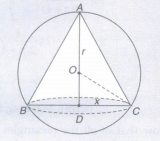
Volume of cone (V)
\(=\frac { 1 }{ 3 } \pi { x }^{ 2 }h\) ...(i)
In \(\Delta OCD,\quad { x }^{ 2 }+({ h-r) }^{ 2 }={ r }^{ 2 }or\quad { x }^{ 2 }={ r }^{ 2 }-{ (h-r) }^{ 2 }\)
\(\therefore V=\frac { 1 }{ 3 } \pi h\{ { r }^{ 2 }-(h-r{ ) }^{ 2 }\} \)
\(=\frac { 1 }{ 3 } \pi (-{ h }^{ 3 }+{ 2h }^{ 2 }r)\)
\(\Rightarrow \frac { dV }{ dh } =\frac { \pi }{ 3 } (-3{ h }^{ 2 }+4hr)\)
\(\therefore \quad \frac { dV }{ dh } =0\Rightarrow h=\frac { 4r }{ 3 } \)
\(\frac { { d }^{ 2 }V }{ { dh }^{ 2 } } =\frac { \pi }{ 3 } (-6h+4r)\)
\(=\frac { \pi }{ 3 } \left( -6\left( \frac { 4r }{ 3 } \right) +4r \right) \)
\(=-\frac { 4\pi r }{ 3 } <0\)
\(\therefore \ at\quad h=\frac { 4r }{ 3 } \), Volume is maximum
Maximum volume
\(=\frac { 1 }{ 3 } \pi .\left\{ -{ \left( \frac { 4r }{ 3 } \right) }^{ 3 }+2{ \left( \frac { 4r }{ 3 } \right) }^{ 2 }r \right\} \)
\(=\frac { 8 }{ 27 } .\left( \frac { 4 }{ 3 } \pi { r }^{ 3 } \right) \)
\(=\frac { 8 }{ 27 } \) (volume of sphere)
12.
Given: \(y=(x+\sqrt{x^2+1})^m\)
Differentiate with respect to 'x',
\(y'=m\{x+\sqrt{x^2+1}\}^{m-1}\{1+\frac{2x}{2\sqrt{x^2+1}}\}\)
\(=m\{x+\sqrt{x^2+1}\}^{m-1}\{1+\frac{\sqrt{x^2+1}+x}{\sqrt{x^2+1}}\}\)
\(=\{\frac{my}{\sqrt{x^2+1}}\}\)
\(\Rightarrow y'\sqrt{x^2+1}=my\)
Squaring both sides,
\(y'^2(x^2+1)=(m^2y^2)\)
Differentiate again with respect to 'x'
\(2y'y"(x^2+1)+2xy'^2=2m^2yy'\)
\(\Rightarrow y'[(x^2+1)y"+xy']=m^2yy'\)
\(\Rightarrow \ (x^2+1)\frac{d^2y}{dx^2}+x\frac{dy}{dx}-m^2y=0\)
13.
Given \(asec^{ 3 }\theta \)
\(\therefore \frac { dx }{ d\theta } =3asec^{ 3 }\theta tan\theta \)
\(y=atan^{ 3 }\theta \)
\(\therefore \frac { dx }{ d\theta } =tan^{ 2 }\theta sec^{ 2 }\theta \)
\(\frac { dy }{ dx } =\frac { dy/d\theta }{ dx/d\theta } \)
\(\Rightarrow \frac { dy }{ dx } =\frac { 3atan^{ 2 }\theta sec^{ 2 }\theta }{ 3asec^{ 3 }\theta tan\theta } =sin\theta \)
\(\frac { dy }{ dx } =sin\frac { \pi }{ 4 } \)
\( =\frac { 1 }{ \sqrt { 2 } } \)
14.
\(f(x)=x^5-5x^4+5x^3-1\)
\(\Rightarrow f'(x)=5x^4-20x^3+15x^2\)
\(\Rightarrow f'(x)=5x^2(x-1)(x-3)\)
\(f'(x)=0\Rightarrow x=0,x=1,x=3\)
\(f''(x)=20x^3-60x^2+30x\)
\(=10x[2x^2-6x+3]\)
\(f'(0)=0,f'(1)=-ve,f'(3)=+ve\)
also , \(f'(<0)=-ve\)
\(f'(>0)=-ve\)
x = 0 is a point of inflexion
x = 1 is a point of local maxima
x = 3 is a point of local minima
∴ Local max. value = f(1) = 0
and Local min. value = f(3) = -28
15.
\(\frac { dy }{ dx } =-2{ cos }^{ 3 }y\quad sin \ \ y\)
16.
(b)
strictly decreasing in (-2,3)
17.
(c)
R
18.
(b)
(-2, -1)
19.
(d)
\(-\frac{y}{x}\)
20.
(a)
\(x \in R\)
21.
(a)
2
22.
(d)
\(\frac{-1}{2 a t^{3}}\)
23.
We have,\(f(x)=x^{3}-3 x, x \in[0, \sqrt{3}]\)
For f(x), Rolle's theorem is satisfied
\( f^{\prime}(c) =0 \left[\because f^{\prime}(x)=3 x^{2}-3\right] \)
\(\Rightarrow 3 c^{2}-3 =0 \)
\( \Rightarrow c^{2}=\frac{3}{3}=1 \)
\( \Rightarrow c=\pm 1, \text { where } 1 \in(0, \sqrt{3}) \)
\(\therefore c=1 \)
24.
\(y=\sin \left(\cos x^{2}\right) \)
Therefore,\(\frac{d y}{d x}=\frac{d}{d x} \sin \left(\cos x^{2}\right)\)
\(
=\cos \left(\cos x^{2}\right) \frac{d}{d x}\left(\cos x^{2}\right) \\
=\cos \left(\cos x^{2}\right)\left(-\sin x^{2}\right) \frac{d}{d x}\left(x^{2}\right) \\
=-\sin x^{2} \cos \left(\cos x^{2}\right)(2 x) \\
=-2 x \sin x^{2} \cos \left(\cos x^{2}\right)
\)
25.
(c)
1
26.
(d)
\(\frac { 1 }{ 3 } \)
27.
(a)
(2 \(\sqrt2\),4)
28.
(b)
cos 2x
29.
(d)
126
30.
(b)
12π
31.
As y’ = 3x² – 3, for a point of absolute maximum or minimum y’=0 ⇒ x = ± 1.
y]x=0 = 2,
y]x=1 = 1 – 3 + 2 = 0,
y]x=-1 = -1 +3+ 2 = 4,
y]x=2 = 8 – 6 + 2 = 4
32.
As y' = 5Ae5x - 5Be-5x
and y'' = 25Ae5x + 25Be-5x
= 25y
33.
As xo = \(\frac { \pi }{ 180 } { x }^{ c }\)
\(\therefore \frac { d }{ dx } (cot{ x }^{ o })=\)\(\frac { d }{ dx } \left( cot\frac { \pi }{ 180 } x \right) \)
\(=-\frac { \pi }{ 180 } { cosec }^{ 2 }\frac { \pi }{ 180 } x\)
\(=-{ 1 }^{ o }{ cosec }^{ 2 }\frac { \pi }{ 180 } x\)
\(=-{ 1 }^{ o }{ cosec }^{ 2 }{ x }^{ 0 }\)
34.
We have, \(f(x)=\tan x-4 x\)
\(\Rightarrow \quad f^{\prime}(x)=\sec ^2 x-4\)
(i) For f(x) to be strictly increasing
\( f^{\prime}(x)>0 \)
\( \Rightarrow \quad \sec ^2 x-4>0 \Rightarrow \frac{1-4 \cos ^2 x}{\cos ^2 x}>0\)
\( \Rightarrow \frac{(1-2 \cos x)(1+2 \cos x)}{\cos ^2 x}>0\)
\( \therefore \quad \cos x \in\left(-\frac{1}{2}, \frac{1}{2}\right) \)
\( \Rightarrow \quad x \in\left(\frac{\pi}{3}, \frac{\pi}{2}\right)\)
\(\therefore f(x)\) is strictly increasing on \(\left(\frac{\pi}{3}, \frac{\pi}{2}\right)\)
\(\text { (ii) For } f(x) \text { to be strictly decreasing } f^{\prime}(x)<0\)
\( \Rightarrow \quad \sec ^2 x-4<0\)
\( \Rightarrow \quad \frac{1-4 \cos ^2 x}{\cos ^2 x}<0\)
\( \Rightarrow \quad \frac{(1-2 \cos x)(1+2 \cos x)}{\cos ^2 x}<0\)
\( \Rightarrow \cos x \in\left(-\infty,-\frac{1}{2}\right) \cup\left(\frac{1}{2}, \infty\right)\)
\( \Rightarrow \quad x \in\left(0, \frac{\pi}{3}\right)\) \( {\left[\because x \in\left(0, \frac{\pi}{2}\right)\right]}\)
\(\Rightarrow \quad \sec ^2 x-4<0\)
\(\Rightarrow \quad \frac{1-4 \cos ^2 x}{\cos ^2 x}<0\)
\(\Rightarrow \quad \frac{(1-2 \cos x)(1+2 \cos x)}{\cos ^2 x}<0\)
\(\Rightarrow \cos x \in\left(-\infty,-\frac{1}{2}\right) \cup\left(\frac{1}{2}, \infty\right)\)
\(\Rightarrow \quad x \in\left(0, \frac{\pi}{3}\right)\) \(\left[\because x \in\left(0, \frac{\pi}{2}\right)\right]\)
\(\therefore f(x)\) is strictly dcreasing on \(\left(\frac{\pi}{3}, 0\right)\)
35.
Let a be the side of cube, s be the surface area and v be volume of cube.
Given, \(\frac{d s}{d t}=72 \mathrm{~cm}^2 / \mathrm{sec}\) and a = 3 cm
Surface area of cube = 6a2
\(\Rightarrow \quad \frac{d s}{d t}=12 a \cdot \frac{d a}{d t} \Rightarrow \frac{d a}{d t}=\frac{72}{12 a}=\frac{6}{a}\)
Now, volume of cube, v = a3
On differentiating w.r.t. t, we get
\(\frac{d v}{d t}=3 a^2 \cdot \frac{d a}{d t}=3 a^2 \cdot \frac{6}{a} \Rightarrow \frac{d v}{d t}=18 a\)
\(\Rightarrow \quad\left(\frac{d v}{d t}\right)_{a=3}=18 \times 3=54 \mathrm{~cm}^3 / \mathrm{sec}\)
36.
We have, f(x) = |x - 5|
Test for differentiability at x =5
LHD = f'(5-) \(=\lim _{h \rightarrow 0} \frac{f(5-h)-f(5)}{-h}\)
\(\begin{aligned}
{\left[\because L f^{\prime}(a)=\lim _{h \rightarrow 0} \frac{f(a-h)-f(a)}{-h}\right]}
\end{aligned}\)
\(\begin{aligned}
=\lim _{h \rightarrow 0} \frac{|5-h-5|-|5-5|}{-h}
\end{aligned}\)
\(\begin{aligned}
=\lim _{h \rightarrow 0} \frac{|-h|}{-h}=\lim _{h \rightarrow 0} \frac{h}{-h}=-1
\end{aligned}\)
\([\because|-x|=x \text {, if } x>0]\)
RHD = f'(5+) \(=\lim _{h \rightarrow 0} \frac{f(5+h)-f(5)}{h}\)
\(\left[\because R f^{\prime}(a)=\lim _{h \rightarrow 0} \frac{f(a+h)-f(a)}{h}\right]\)
\(\begin{aligned}
=\lim _{h \rightarrow 0} \frac{|5+h-5|-|5-5|}{h}
\end{aligned}\)
\(\begin{aligned}
=\lim _{h \rightarrow 0} \frac{|h|}{h}=\lim _{h \rightarrow 0} \frac{h}{h}=1 \quad[\because|x|=x \text {, if } x>0]
\end{aligned}\)
Since, LHD \(≠\) RHD at x = 5
So, f is not differentiable.
37.
Given, \(f(x)=\left\{\begin{array}{cc} x \sin \frac{1}{x}, & \text { if } x \neq 0 \\ 0, & \text { if } x=0 \end{array}\right.\) and point is x = 0.
At x = 0, f(0) = 0
LHL = \(\lim _{x \rightarrow 0^{-}} f(x)=\lim _{h \rightarrow 0} f(0-h)\)
\(\begin{aligned} =\lim _{h \rightarrow 0} f(-h) \end{aligned}\)
\(\begin{aligned} =\lim _{h \rightarrow 0}(-h) \sin \left(\frac{1}{-h}\right) \end{aligned}\)
\(\begin{aligned} =\lim _{h \rightarrow 0} h \sin \frac{1}{h} \quad[\because \sin (-\theta)=-\sin \theta] \end{aligned}\)
= 0 \(\times\) (An oscillating value lies between - 1 and 1)
= 0
RHL = \(\lim _{x \rightarrow 0^{+}} f(x)=\lim _{h \rightarrow 0} f(0+h)\)
\(=\lim _{h \rightarrow 0} f(h)=\lim _{h \rightarrow 0} h \sin \left(\frac{1}{h}\right)\)
= 0 \(\times\) (An oscillating value lies between -1 and 1)
= 0
Here, LHL = f(0) = RHL = 0
Hence, f(x) is continuous at x = 0.
38.
Volume and surface area of sphere \(\mathrm{V}=\frac{4}{3} \pi \mathrm{r}^{3}\)
\(\mathrm{S}=4 \pi \mathrm{r}^{2}\)
Rate of volume and surface area is \(\frac{d V}{d t}=\frac{4}{3} \pi \times 3 r^{2} \times d r / d t\)
\( \frac{\mathrm{dS}}{\mathrm{dt}}=4 \pi \times 2 \mathrm{r} \times \mathrm{dr} / \mathrm{dt} \)
\(\frac{\mathrm{d} \mathrm{V}}{\mathrm{dt}}=8 \)
\(\Rightarrow \frac{4}{3} \pi \times 3 \mathrm{r}^{2} \times \frac{\mathrm{dr}}{\mathrm{dt}}=8 \)
\(\Rightarrow \frac{\mathrm{dr}}{\mathrm{dt}}=\frac{8 \times 7}{22 \times 4 \times 12^{2}}=0.00441 \)
\(\text { Now } \frac{\mathrm{dS}}{\mathrm{dt}}=4 \pi \times 2 \mathrm{r} \times \frac{\mathrm{dr}}{\mathrm{dt}}=\frac{4 \times 22 \times 2 \times 12}{7} \times 0.00441=65.33 \mathrm{~cm}^{2} / \mathrm{s}\)
39.
The area of a circle (A) with radius (r) is given by .
.
Therefore, the rate of change of area (A) with respect to time (t) is given by,
 [By chain rule]
It is given that .
.
Thus, when r = 8 cm,

Hence, when the radius of the circular wave is 8 cm, the enclosed area is increasing at the rate of 80 π cm2/s.
40.
If continuous at x = 0
\(\underset{x=0}{\mathrm{LHL}}=\underset{x=0}{\mathrm{RHL}}=f(0) \)
\(\Rightarrow \operatorname{Lim}_{x \rightarrow 0} \frac{k x}{|x|}=\operatorname{Lim}_{x \rightarrow 0}(3)=3 \)
\(\Rightarrow \frac{-k x}{x}=3=3 \Rightarrow k=-3\)
41.
(d) Given, f(x) = 2x3 - 3x2 - 36x + 7
\(\Rightarrow\) Differentiating w.r.t. x,
f'(x) = \(\frac{d}{dx}\)(2x3 - 3x2 - 36x + 7)
= 2.3 x2 - 3. 2x - 36.1 + 0
= 6x2 - 6x - 36 = 6(x2 - x - 6)
\(\Rightarrow\) f'(x) = 6(x - 3)(x + 2)
On putting f'(x) = 0, we get
6(x - 3)(x+2) = 0 \(\Rightarrow\) x = 3 and -2
which divides real line into three intervals namely
(-\(\infty\), -2), (-2, 3) and (3, \(\infty\)).

| Intervals | sign of f'(x) | Nature of f(x) |
| (-\(\infty\), -2) | (-)(-) = + ve (\(\because\)x < -2 i.e., x is -3, -4, -5 ... for these values, (x - 3) and (x+2) both will be negative) |
Strictly increasing |
| (-2, 3) | (-)(+) = - ve (\(\because\) -2 < x < 3 i.e., x is 1, 2, 0, -1 ... for these values (x - 3) will be negative and (x + 2) will be positive) |
Strictly decreasing |
| (3, \(\infty\)) | (+)(+) = + ve (\(\because\) x > 3 i.e., x is 4, 5, 6, ... for these values (x - 3) and (x + 2) both are positive) |
Strictly increasing |
Thus, the given function f is strictly increasing in intervals (-\(\infty\),- 2) and(3, \(\infty\)), while function f is strictly decreasing in the interval (- 2, 3).
Hence, Assertion is incorrect but Reason is correct.
42.
(c) Assertion is correct, Reason is incorrect
43.
(i) Given, function is \(f(x)=-0.1 x^2+m x+98.6\)
\(\because f(x)\) is a polynomial function.
\(\therefore\) It is differentiable everywhere and hence, differentiable in (0,12).
(ii) We have, \(f(x)=-0.1 x^2+m x+98.6\)
\(\therefore \quad f^{\prime}(x)=-0.2 x+m\)
because 6 is the critical point of the function.
\(\therefore f^{\prime}(6)=0 \)
\(\Rightarrow -0.2(6)+m=0 \Rightarrow m=1.2\)
(iii) We have, \(f(x)=-0.1 x^2+1.2 x+98.6\)
\(\therefore\)\(f(x)=-0.2 x+1.2 = -0.2(x - 6)\)
\(\begin{array}{c|c}
\hline \text { Interval } & \text { Sign of } f^{\prime}(x) \\
\hline(0,6) & + \text { ve } \\
\hline(6,12) & - \text { ve } \\
\hline
\end{array}\)
Hence, f(x) is strictly increasing in the interval (0, 6) and strictly decreasing in the interval (6, 12).
Or We have, \(f(x)=-0.1 x^2+1.2 x+98.6\)
\(\therefore f^{\prime}(x)=-0.2 x+1.2=-0.2(x-6) \)
\(\therefore f^{\prime}(x)=0 \Rightarrow x=6\)
Now, \(f^{\prime \prime}=-0.2\)
and \(f^{\prime \prime}(6)=-0.2<0\)
Hence, x=6 is the point of local maximum and the local maximum value.
\(\Rightarrow f(6)=-0.1 \times(6)^2+(1.2 \times 6)+98.6=102.2\)
Now, \(f(0)=98.6, f(6)=102.2\) and \(f(12)=98.6\)
Hence, x=6 is the point of absolute maximum and the absolute maximum value of the function at x=6 is 102.2 and x=0, x=12 both are the points of absolute minimum and the absolute minimum value of the function is 98.6.
44.
Given, $x$ is the side of the square base of the tank (in m ) and $h$ is the depth of the tank (in m ).
$\therefore$ Area of the base of the tank $=x^2 \mathrm{~m}^2$
$\therefore$ Cost of land $=₹ 5000 x^2$
Cost of digging the tank $=₹ 40000 h^2$, where $h$ is the depth of the tank (in m).
$\therefore$ Total cost of the tank $=₹\left(5000 x^2+40000 h^2\right)$
Given, capacity of tank $=250 \mathrm{~m}^3$
Volume of tank, $x^2 h=250$
$$
\Rightarrow \quad h=\frac{250}{x^2}
$$
(i) The total cost $C$ of digging the tank
$$
\begin{aligned}
C(x) & =5000 x^2+40000\left(\frac{250}{x^2}\right)^2 \\
& =5000\left(x^2+\frac{8 \times 625 \times 100}{x^4}\right) \\
& =5000\left(x^2+\frac{5 \times 10^5}{x^4}\right) \\
\Rightarrow C(x) & =₹ 5000\left(\frac{x^6+5 \times 10^5}{x^4}\right)
\end{aligned}
$$
Given, x is the side of the square base of the tank (in m ) and h is the depth of the tank (in m ).
Therefore Area of the base of the tank \(=x^2 \mathrm{~m}^2\)
Therefore Cost of land =₹ 5000 x2
Cost of digging the tank =₹ 40000 h2, where h is the depth of the tank (in m).
Therefore Total cost of the tank = (5000 x2+40000 h2)
Given, capacity of tank = 250 m3
Volume of tank, x2 h=250
\(\Rightarrow \quad h=\frac{250}{x^2}\)
(i) The total cost C of digging the tank
\(C(x) =5000 x^2+40000\left(\frac{250}{x^2}\right)^2\)
\(=5000\left(x^2+\frac{8 \times 625 \times 100}{x^4}\right)\)
\(=5000\left(x^2+\frac{5 \times 10^5}{x^4}\right)\)
\(\Rightarrow C(x) =₹ 5000\left(\frac{x^6+5 \times 10^5}{x^4}\right)\)
(ii) \(\frac{d C(x)}{d x}\)
\(=5000\left[\frac{x^4\left(6 x^5+0\right)-\left(x^6+5 \times 10^5\right) \times 4 x^3}{x^8}\right] \)
\(=5000\left(\frac{2 x^9-20 \times 10^5 x^3}{x^8}\right) \)
\(=5000\left(\frac{2 x^6-20 \times 10^5}{x^5}\right)\)
45.
\(\text { Given, } h(t)=-\frac{7}{2} t^2+\frac{13}{2} t+1\)
(i) Yes,
Since, h(t) is a polynomial function.
So, it is everywhere continuous.
(ii) \( h^{\prime}(t)=-\frac{7}{2}(2 t)+\frac{13}{2} \)
\(\Rightarrow \quad h^{\prime}(t)=-7 t+\frac{13}{2}\)
Also, \(h^{\prime \prime}(t)=-7\)
For maxima or minima, put \(h^{\prime}(t)=0\)
\(\Rightarrow -7 t+\frac{13}{2}=0 \)
\(\Rightarrow -7 t=-\frac{13}{2}\)
\(\Rightarrow t=\frac{13}{14}\)
At \(t=\frac{13}{14}, h^{\prime \prime}(t)<0\)
So, \(t=\frac{13}{14}\) is point of maxima.
Thus, at \(t=\frac{13}{14}\) the height of the ball is maximum.

12th Standard CBSE Syllabus & Materials
12th Standard CBSE
CBSE 12th Computer Science Python Revision Tour I - New Previous year Question Papers Study Material - QB365 Set A
NEW12th Standard CBSE
CBSE 12th Business Studies Planning Important Questions And Answers Study Material - QB365 Set A
NEW12th Standard CBSE
CBSE 12th Business Studies Business Environment Important Questions And Answers Study Material - QB365 Set A
NEW12th Standard CBSE
CBSE 12th Business Studies Principles of Management Important Questions And Answers Study Material - QB365 Set A



NCERT Books

Syllabus

Exam Pattern

Sample Question Papers

Previous year Question Papers

Important Notes

MCQ Practice test

NCERT Exemplers

Case study Questions

Image Based Questions

Passage based Questions

HOT Questions

Value Based Questions

Model Questions Papers
NCERT ( Book Back ) Questions

Assertion and Reason
Important Questions And Answers

CBSE 12th Standard CBSE Subjects
CBSE Standards








