
 100% FREE ACCESS
12th Standard CBSE Syllabus & Materials
12th Standard CBSE
CBSE 12th Economics Government Budget and the Economy Previous year Question Papers Study Material - QB365 Set A
NEW12th Standard CBSE
CBSE 12th Computer Science Interface Python with MySQL - New Previous year Question Papers Study Material - QB365 Set A
NEW12th Standard CBSE
CBSE 12th Computer Science Database Concept - New Previous year Question Papers Study Material - QB365 Set A
NEW12th Standard CBSE
CBSE 12th Computer Science Data Communication - New Previous year Question Papers Study Material - QB365 Set A
NEW12th Standard CBSE
CBSE 12th Computer Science Data Structures - New Previous year Question Papers Study Material - QB365 Set A
NEW12th Standard CBSE
CBSE 12th Computer Science Functions - New Previous year Question Papers Study Material - QB365 Set A

Published on: 02/11/2025
Download CBSE Class 12th Standard CBSE Maths question papers, sample papers, important questions, and previous year solved papers in PDF format. Get free study materials, NCERT solutions, and exam preparation resources for Class 12th Standard CBSE Maths
Questions + Answers key
Take MCQ Maths Test
1.
In a culture, the bacteria count is 1,00,000. The number is increased by 10% in 2 hours. In how many hours will the count reach 2,00,000, if the rate of growth of bacteria is proportional to the number present?
2.
find a particular solution satisfying the given condition: \(\frac{d y}{d x}=y \tan x ; y=1 \text { when } x=0\)
3.
Find the area enclosed by the ellipse \(\frac{x^{2}}{a^{2}}+\frac{y^{2}}{b^{2}}=1\)
4.
Find the area enclosed by the circle \(x^{2}+y^{2}=a^{2}\) .
5.
Find the general solution of the differential equation: \(\frac { dy }{ dx } =\frac { 1+{ y }^{ 2 } }{ 1+{ x }^{ 2 } } .\)
6.
Find the area of the region bounded by the ellipse \(\frac { { x }^{ 2 } }{ 16 } +\frac { { y }^{ 2 } }{ 9 } =1\)
7.
Solve the differential equation : (x3 + x2 + x + 1)\(\frac {dy}{dx}\) = 2x2 + x : y = 1 when x = 0
8.
Differential equation corresponding to the function y = ex (A cos x + B sin x), A, B being arbitrary constants is of order
1
2
3
none of these
9.
Area of the region bounded by the curve y = cos x between x = 0 and x = 2\(\pi\) is
4
3
2
1
10.
If a curve \(y=a \sqrt{x}+b x\) passes through the point (1, 2) and the area bounded by the curve, line x = 4 and x-axis is 8 sq units, then
a = 3, b = -1
a = 3, b = 1
a = -3, b = 1
a = -3, b = -1
11.
Smaller area enclosed by the circle x2 + y2 = 4 and the line x + y = 2 is
2 (ㅠ – 2)
ㅠ - 2
2ㅠ - 1
2(ㅠ+2)
12.
The degree of the differential equation
\({ \left( 1+\frac { dy }{ dx } \right) }^{ 3 }={ \left( \frac { dy }{ dx } \right) }^{ 2 }\) is
1
2
3
4
13.
Write the degree of the differential equation :\(\left(\frac{d y}{d x}\right)^{4}+3 y \frac{d^{2} y}{d x^{2}}=0\)
14.
verify that the given functions (explicit or implicit) is a solution of the corresponding differential equation : y = cos x + C : y′ + sin x = 0
15.
verify that the given functions (explicit or implicit) is a solution of the corresponding differential equation : y = ex + 1 : y'' – y′ = 0
16.
Find the area under the curve \(y=\sqrt{3 x+4}\) between x = 0, x = 4 and the x-axis.
17.
Solve the following differential equation \(\frac{d y}{d x}=1+x^2+y^2+x^2 y^2\), given that y = 1, when x = 0.
18.
Find the area of the region bounded by the line y = 3x + 2, the x-axis and the ordinates x = -1 and x = 1.
1.
Let y be the number of bacteria at any instant t.
It is given that the rate of growth of the bacteria is proportional to the number present.
\(\therefore \frac{d y}{d t} \propto y\)
\(\Rightarrow \frac{d y}{d t}=k y \text { (where } k \text { is a constant) }\)
\(\Rightarrow \frac{d y}{y}=k d t\)
Integrating both sides, we get:
\(\int \frac{d y}{y}=k \int d t \)
\(\Rightarrow \log y=k t+\mathrm{C} \)
Let y0 be the number of bacteria at t = 0.
\(\Rightarrow \log y_{0}=C\)
Substituting the value of C in equation (1), we get:
\(\log y=k t+\log y_{0} \)
\(\Rightarrow \log y-\log y_{0}=k t \)
\(\Rightarrow \log \left(\frac{y}{y_{0}}\right)=k t \)
\(\Rightarrow k t=\log \left(\frac{y}{y_{0}}\right) \)
Also, it is given that the number of bacteria increases by 10% in 2 hours.
\(\Rightarrow y=\frac{110}{100} y_{0} \)
\(\Rightarrow \frac{y}{y_{0}}=\frac{11}{10} \)
Substituting this value in equation (2), we get:
\(k \cdot 2=\log \left(\frac{11}{10}\right) \)
\(\Rightarrow k=\frac{1}{2} \log \left(\frac{11}{10}\right) \)
\(\)Therefore, equation (2) becomes:
\(\frac{1}{2} \log \left(\frac{11}{10}\right) \cdot t=\log \left(\frac{y}{y_{0}}\right) \)
\(\Rightarrow t=\frac{2 \log \left(\frac{y}{y_{0}}\right)}{\log \left(\frac{11}{10}\right)} \)
Now, let the time when the number of bacteria increases from 100000 to 200000 be t1
\(\Rightarrow y=2 y_{0} \text { at } t=t_{1}\)
From equation (4), we get:
\(t_{1}=\frac{2 \log \left(\frac{y}{y_{0}}\right)}{\log \left(\frac{11}{10}\right)}=\frac{2 \log 2}{\log \left(\frac{11}{10}\right)}\)
\(\text { Hence, in } \frac{2 \log 2}{\log \left(\frac{11}{10}\right)}\)hours the number of bacteria increases from 100000 to 200000 .
2.
\(\frac{d y}{d x}=y \tan x \)
\(\Rightarrow \frac{d y}{y}=\tan x d x\)
Integrating both side we get
\(\int \frac{d y}{y}=-\int \tan x d x \)
\(\Rightarrow \log y=\log (\sec x)+\log C \)
\(\Rightarrow \log y=\log (\mathrm{C} \sec x) \)
\(\Rightarrow y=\mathrm{Csec} x \)
\(\text { Now, } y=1 \text { when } x=0 . \)
\(\Rightarrow 1=\mathrm{C} \times \sec 0 \)
\(\Rightarrow 1=\mathrm{C} \times 1 \)
\(\Rightarrow \mathrm{C}=1\)
Substituting C = 1 in equation (1), we get:
\(y=\sec x\)
3.
From the figure, the area of the region ABA′B′A bounded by the ellipse
\(=4\left(\begin{array}{l} \text { area of the region AOBAin the first quadrantbounded } \\ \text { by thecurve, } x-\text { axis and the ordinates } x=0, x=a \end{array}\right)\)
(as the ellipse is symmetrical about both x-axis and y-axis)
\(=4 \int_{0}^{a} y d x \text { (taking verticalstrips) }\)
\(\text { Now } \frac{x^{2}}{a^{2}}+\frac{y^{2}}{b^{2}}=1 \text { gives } y=\pm \frac{b}{a} \sqrt{a^{2}-x^{2}} \text { , }\)but as the region AOBA lies in the first quadrant, y is taken as positive. So, the required area is
\(=4 \int_{0}^{a} \frac{b}{a} \sqrt{a^{2}-x^{2}} d x \)
\(=\frac{4 b}{a}\left[\frac{x}{2} \sqrt{a^{2}-x^{2}}+\frac{a^{2}}{2} \sin ^{-1} \frac{x}{a}\right]_{0}^{a} \)
\(=\frac{4 b}{a}\left[\left(\frac{a}{2} \times 0+\frac{a^{2}}{2} \sin ^{-1} 1\right)-0\right] \)
\(=\frac{4 b}{a} \frac{a^{2}}{2} \frac{\pi}{2}=\pi a b \)
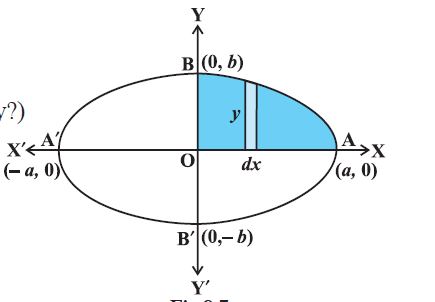
Alternatively, considering horizontal strips as shown in the Figure, the area of the ellipse is
\(=4 \int_0^b x d y=4 \frac{a}{b} \int_0^b \sqrt{b^2-y^2} d y\)
\(=\frac{4 a}{b}\left[\frac{y}{2} \sqrt{b^2-y^2}+\frac{b^2}{2} \sin ^{-1} \frac{y}{b}\right]_0^b\)
\( =\frac{4 a}{b}\left[\left(\frac{b}{2} \times 0+\frac{b^2}{2} \sin ^{-1} 1\right)-0\right] \\ =\frac{4 a}{b} \frac{b^2}{2} \frac{\pi}{2}=\pi a b \)
4.
From , the whole area enclosed by the given circle = 4 (area of the region AOBA bounded by the curve, x-axis and the ordinates x = 0 and x = a) [as the circle is symmetrical about both x-axis and y-axis]
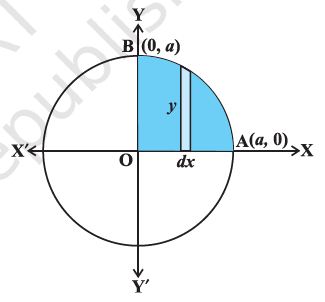
Clearly, area of region in I quadrant
\(=4 \int_0^a y d x\) (taking vertical strips)
\(=4 \int_0^a \sqrt{a^2-x^2} d x\)
Since \(x^2+y^2=a^2 \text { gives } \quad y= \pm \sqrt{a^2-x^2}\)
As the region AOBA lies in the first quadrant, y is taken as positive. Integrating, we get the whole area enclosed by the given circle
Now, required area = 4 x Area of region in I quadrant
\(=4\left[\frac{x}{2} \sqrt{a^2-x^2}+\frac{a^2}{2} \sin ^{-1} \frac{x}{a}\right]_0^a\)
\(=4\left[\left(\frac{a}{2} \times 0+\frac{a^2}{2} \sin ^{-1} 1\right)-0\right]=4\left(\frac{a^2}{2}\right)\left(\frac{\pi}{2}\right)=\pi a^2\)
Alternatively, considering horizontal strips as shown in Fig 8.6, the whole area of the region enclosed by circle
\( =4 \int_0^a x d y=4 \int_0^a \sqrt{a^2-y^2} d y \)
\(=4\left[\frac{y}{2} \sqrt{a^2-y^2}+\frac{a^2}{2} \sin ^{-1} \frac{y}{a}\right]_0^a \)
\(=4\left[\left(\frac{a}{2} \times 0+\frac{a^2}{2} \sin ^{-1} 1\right)-0\right] \)
\(=4 \frac{a^2}{2} \frac{\pi}{2}=\pi a^2 \)
5.
Since \(1+y^2 \neq 0\) therefore separating the variables, the given differential equation can be written as
\(\frac { dy }{ dx } =\frac { 1+{ y }^{ 2 } }{ 1+{ x }^{ 2 } } \)....(1)
Integrating both sides of equation (1), we get
\(\int \frac{d y}{1+y^2}=\int \frac{d x}{1+x^2}\)
or \(\tan ^{-1} y=\tan ^{-1} x+C\)
which is the general solution of equation (1).
6.
The given ellipse is \(\frac { { x }^{ 2 } }{ 16 } +\frac { { y }^{ 2 } }{ 9 } =1\)
Since (1) is symmetrical about both axes,
Therefore, area of the ellipse = 4 (Shaped area).
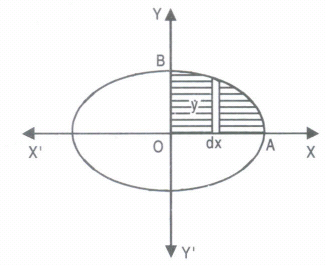
\(=4(area\ OAB)\)
\(But\ area\ OAB=\overset { 4 }{ \underset { 0 }{ \int { } } } ydx\quad [Taking\ vertical\ strips]\)
\(=\overset { 4 }{ \underset { 0 }{ \int { } } } \frac { 3 }{ 4 } \sqrt { 16-{ x }^{ 2 } } dx\)
\([\because \frac { { x }^{ 2 } }{ 16 } +\frac { { y }^{ 2 } }{ 9 } =1\Rightarrow \frac { { y }^{ 2 } }{ 9 } =1-\frac { { x }^{ 2 } }{ 16 } \Rightarrow y=\frac { 3 }{ 4 } \sqrt { 16-{ x }^{ 2 } } (\because y>0)]\)
\(=\frac { 3 }{ 4 } \left[ \frac { x\sqrt { 16-{ x }^{ 2 } } }{ 2 } +\frac { 16 }{ 2 } { sin }^{ -1 }\frac { x }{ 4 } \right] _{ 0 }^{ 4 }\)
\(=\frac { 3 }{ 4 } [[2(0)+8{ sin }^{ -1 }(1)]-[0-0]]\)
\(=\frac { 3 }{ 4 } \left[ 8\frac { \pi }{ 2 } \right] =3\pi \)
\(\therefore From\ (2),area\ of\ the\ ellipse =4(3\pi )=12\pi sq.units.\)
7.
\(\left(x^{3}+x^{2}+x+1\right) \frac{d y}{d x}=2 x^{2}+x \)
\(\Rightarrow \frac{d y}{d x}=\frac{2 x^{2}+x}{\left(x^{3}+x^{2}+x+1\right)} \)
\(\Rightarrow d y=\frac{2 x^{2}+x}{(x+1)\left(x^{2}+1\right)} d x \)
Integrating both sides, we get:
\(\int d y=\int \frac{2 x^{2}+x}{(x+1)\left(x^{2}+1\right)} d x \)
\(\text { Let } \frac{2 x^{2}+x}{(x+1)\left(x^{2}+1\right)}=\frac{A}{x+1}+\frac{B x+C}{x^{2}+1} . \)
\(\Rightarrow \frac{2 x^{2}+x}{(x+1)\left(x^{2}+1\right)}=\frac{A x^{2}+A+(B x+C)(x+1)}{(x+1)\left(x^{2}+1\right)}\)
\(\Rightarrow 2 x^{2}+x=A x^{2}+A+B x^{2}+B x+C x+C \)
\(\Rightarrow 2 x^{2}+x=(A+B) x^{2}+(B+C) x+(A+C) \)
Comparing the coefficients of \(x^{2} \text { and } x \text { , we get: }\)
\(A+B=2 \)
\(B+C=1 \)
\(A+C=0 \)
Solving these equations, we get:
\(A=\frac{1}{2}, B=\frac{3}{2} \text { and } C=\frac{-1}{2}\)
Substituting the values of A,B, and C in equation (2), we get:
\(\frac{2 x^{2}+x}{(x+1)\left(x^{2}+1\right)}=\frac{1}{2} \cdot \frac{1}{(x+1)}+\frac{1}{2} \frac{(3 x-1)}{\left(x^{2}+1\right)}\)
Therefore, equation (1) becomes:
\(\int d y=\frac{1}{2} \int \frac{1}{x+1} d x+\frac{1}{2} \int \frac{3 x-1}{x^{2}+1} d x \)
\(\Rightarrow y=\frac{1}{2} \log (x+1)+\frac{3}{2} \int \frac{x}{x^{2}+1} d x-\frac{1}{2} \int \frac{1}{x^{2}+1} d x \)
\(\Rightarrow y=\frac{1}{2} \log (x+1)+\frac{3}{4} \cdot \int \frac{2 x}{x^{2}+1} d x-\frac{1}{2} \tan ^{-1} x+\mathrm{C} \)
\(\Rightarrow y=\frac{1}{2} \log (x+1)+\frac{3}{4} \log \left(x^{2}+1\right)-\frac{1}{2} \tan ^{-1} x+\mathrm{C} \)
\(\Rightarrow y=\frac{1}{4}\left[2 \log (x+1)+3 \log \left(x^{2}+1\right)\right]-\frac{1}{2} \tan ^{-1} x+\mathrm{C} \)
\(\Rightarrow y=\frac{1}{4}\left[(x+1)^{2}\left(x^{2}+1\right)^{3}\right]-\frac{1}{2} \tan ^{-1} x+\mathrm{C} \)
Now, y = 1 when x = 0
\(\Rightarrow 1=\frac{1}{4} \log (1)-\frac{1}{2} \tan ^{-1} 0+\mathrm{C}\)
\(\Rightarrow 1=\frac{1}{4} \times 0-\frac{1}{2} \times 0+\mathrm{C}\)
\(\Rightarrow \mathrm{C}=1 \)
Substituting C = 1 in equation (3), we get:
\(y=\frac{1}{4}\left[\log (x+1)^{2}\left(x^{2}+1\right)^{3}\right]-\frac{1}{2} \tan ^{-1} x+1\)
8.
(b)
2
9.
(a)
4
10.
(a)
a = 3, b = -1
11.
(b)
ㅠ - 2
12.
As differential equation is
1+ \(3\frac { dy }{ dx } +3{ \left( \frac { dy }{ dx } \right) }^{ 2 }+{ \left( \frac { dy }{ dx } \right) }^{ 3 }={ \left( \frac { dy }{ dx } \right) }^{ 2 }\)
Exponent of highest order derivative is 3.
13.
Degree 1
14.
\(y=\cos x+\mathrm{C}\)
Differentiating both sides of this equation with respect to, we get:
\(y^{\prime}=\frac{d}{d x}(\cos x+\mathrm{C}) \)
\(\Rightarrow y^{\prime}=-\sin x \)
Substituting the value of y' in the given differential equation, we get:
\(\text {L.H.S. }=y^{\prime}+\sin x=-\sin x+\sin x=0=\text { R.H.S. }\)
Hence, the given function is the solution of the corresponding differential equation.
15.
y = ex + 1
Differentiating both sides of this equation with respect to x, we get:
\(\frac{d y}{d x}=\frac{d}{d x}\left(e^{x}+1\right) \)
\(\Rightarrow y^{\prime}=e^{x} \)
Now, differentiating equation (1) with respect to x, we get:
\(\frac{d}{d x}\left(y^{\prime}\right)=\frac{d}{d x}\left(e^{x}\right) \)
\(\Rightarrow y^{\prime \prime}=e^{x} \)
Substituting the values of y' and y'' in the given differential equation, we get the L.H.S. as:
\(y^{\prime \prime}-y^{\prime}=e^{x}-e^{x}=0=\text { R.H.S. }\)
Thus, the given function is the solution of the corresponding differential equation.
16.
Given curve is \(y=\sqrt{3 x+4} \)
On squaring both sides, we get
\(y^{2}=3 x+4 \)
\(\Rightarrow y^{2}=3\left(x+\frac{4}{3}\right) \Rightarrow y^{2}=3\left[x-\left(\frac{-4}{3}\right)\right] \)
which is the equation of the parabola of the form
y2 = 4 a x. whose vertex is \(\left(-\frac{4}{3}, 0\right)\) and symmetrical about x-axis.
As \(y=\sqrt{3 x+4} \) is a positive square root, so we take a upper part of the parabola \(y^{2}=3 x+4 \)
upper part of the parabola \(y^{2}=3 x+4 \)
The area of the region bounded by the curve
\(y=\sqrt{3 x+4}\) between x = 0, x = 4 and the x-axis,is the area shown in the figure given below

∴ Required area \(= \int_{0}^{4} y d x=\int_{0}^{4}(\sqrt{3 x+4}) d x \)
\(=\int_{0}^{4}(3 x+4)^{1 / 2} d x=\left[\frac{(3 x+4)^{3 / 2}}{\frac{3}{2} \cdot 3}\right]_{0} \)
\(\begin{array}{l} =\frac{2}{9}\left[(12+4)^{3 / 2}-(4)^{3 / 2}\right] \quad\left[\because \int(a x+b)^{n} d x=\frac{(a x+b)^{n+1}}{a(n+1)}\right] \end{array} \)
\(=\frac{2}{9}\left[(16)^{3 / 2}-(4)^{3 / 2}\right] \)
\(=\frac{2}{9}\left[\left(2^{4}\right)^{3 / 2}-\left(2^{2}\right)^{3 / 2}\right] \)
\(=\frac{2^{4}}{9}\left[(2)^{6}-(2)^{3}\right]=\frac{2}{9}(64-8) \)
\(=\frac{2}{9} \times 56=\frac{112}{9} \text { sq units } \)
Hence, the required is \( \frac{112}{9} \text { sq units }.\)
17.
Given, differential equation is \(\begin{aligned}
\frac{d y}{d x} & =1+x^2+y^2+x^2 y^2
\end{aligned}\)
\(\begin{aligned}
\Rightarrow \quad \frac{d y}{d x} & =1\left(1+x^2\right)+y^2\left(1+x^2\right)
\end{aligned}\)
\(\begin{aligned}
\Rightarrow \quad \frac{d y}{d x} & =\left(1+x^2\right)\left(1+y^2\right)
\end{aligned}\)
On separating the variables, we get \(\Rightarrow \frac{d y}{1+y^2}=\left(1+x^2\right) d x\)
On integrating both sides, we get \(\int \frac{d y}{1+y^2}=\int\left(1+x^2\right) d x\)
\(\Rightarrow \quad \tan ^{-1} y=x+\frac{x^3}{3}+C\) ...(i)
Also, given that y = 1, when x = 0.
On putting x = 0 and y = 1 in Eq. (i), we get
tan-1 1 = C
\(\Rightarrow \quad \tan ^{-1}(\tan \pi / 4)=C \quad\left[\because \tan \frac{\pi}{4}=1\right]\)
\(\Rightarrow \quad C=\pi / 4\)
On putting the value of C in Eq. (i), we get
\(\begin{aligned}
\tan ^{-1} y & =x+\frac{x^3}{3}+\frac{\pi}{4}
\end{aligned}\)
\(\begin{aligned}
\therefore \quad y & =\tan \left(x+\frac{x^3}{3}+\frac{\pi}{4}\right)
\end{aligned}\)
which is the required solution.
18.
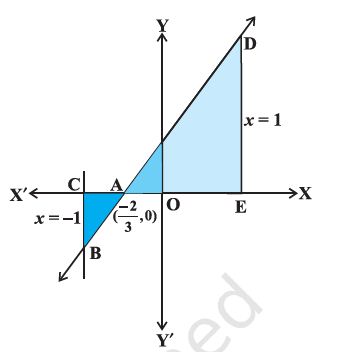
As shown in the Figure, the line y = 3x + 2 meets x-axis at x\(=\frac{-2}{3}\) and its graph lies below x-axis for \(x \in\left(-1, \frac{-2}{3}\right)\) and above x-axis for \(x \in\left(\frac{-2}{3}, 1\right)\)
The required area = Area of the region ACBA + Area of the region ADEA
\(=\left|\int_{-1}^{\frac{-2}{3}}(3 x+2) d x\right|+\int_{\frac{-2}{3}}^1(3 x+2) d x\)
\(=\left|\left[\frac{3 x^2}{2}+2 x\right]_{-1}^{\frac{-2}{3}}\right|+\left[\frac{3 x^2}{2}+2 x\right]_{\frac{-2}{3}}^1=\frac{1}{6}+\frac{25}{6}=\frac{13}{3}\)

12th Standard CBSE Syllabus & Materials
12th Standard CBSE
CBSE 12th Computer Science Python Revision Tour I - New Previous year Question Papers Study Material - QB365 Set A
NEW12th Standard CBSE
CBSE 12th Business Studies Planning Important Questions And Answers Study Material - QB365 Set A
NEW12th Standard CBSE
CBSE 12th Business Studies Business Environment Important Questions And Answers Study Material - QB365 Set A
NEW12th Standard CBSE
CBSE 12th Business Studies Principles of Management Important Questions And Answers Study Material - QB365 Set A



NCERT Books

Syllabus

Exam Pattern

Sample Question Papers

Previous year Question Papers

Important Notes

MCQ Practice test

NCERT Exemplers

Case study Questions

Image Based Questions

Passage based Questions

HOT Questions

Value Based Questions

Model Questions Papers
NCERT ( Book Back ) Questions

Assertion and Reason
Important Questions And Answers

CBSE 12th Standard CBSE Subjects
CBSE Standards








