
 100% FREE ACCESS
12th Standard CBSE Syllabus & Materials
12th Standard CBSE
CBSE 12th Economics Government Budget and the Economy Previous year Question Papers Study Material - QB365 Set A
NEW12th Standard CBSE
CBSE 12th Computer Science Interface Python with MySQL - New Previous year Question Papers Study Material - QB365 Set A
NEW12th Standard CBSE
CBSE 12th Computer Science Database Concept - New Previous year Question Papers Study Material - QB365 Set A
NEW12th Standard CBSE
CBSE 12th Computer Science Data Communication - New Previous year Question Papers Study Material - QB365 Set A
NEW12th Standard CBSE
CBSE 12th Computer Science Data Structures - New Previous year Question Papers Study Material - QB365 Set A
NEW12th Standard CBSE
CBSE 12th Computer Science Functions - New Previous year Question Papers Study Material - QB365 Set A

Published on: 02/11/2025
Download CBSE Class 12th Standard CBSE Maths question papers, sample papers, important questions, and previous year solved papers in PDF format. Get free study materials, NCERT solutions, and exam preparation resources for Class 12th Standard CBSE Maths
Questions + Answers key
Take MCQ Maths Test
1.
If function f is differentiable at x = a, find
\(\lim _{x \rightarrow a} \frac{x^{2} f(a)-a^{2} f(x)}{x-a} .\)
2.
Examine the consistency of the system of equations
3x - y - 2z = 2,
2y - z = -1 and
3x - 5y = 3.
3.
The sale figure of three car dealers during March 2015 showed that dealer A solds 6 deluxe, 4 premium and 5 standard cars, dealer B solds 8 deluxe, 3 premium and 4 standard cars and : dealer Csolds 4 deluxe, 2 premium and 3 standard cars. Write 3 x 3 matrices summarising sales data for March.
4.
State the reason for the following Binary Operation *, defined on the set Z of integers, to be not commutative : a*b = ab3
5.
Find the principal values of the following:
tan−1(-1)
6.
Find the intervals in which the following function is increasing or decreasing
\(f(x)=2 \log (x-2)-x^{2}+4 x+1\)
7.
Find the minimum value of n for which \(\tan ^{-1}\left(\frac{n}{\pi}\right)>\frac{\pi}{4}, n \in N\) is valid.
8.
If \(A=\begin{bmatrix} cos\theta & sin\theta \\ -sin\theta & cos\theta \end{bmatrix}\) , then prove that \({ A }^{ n }=\begin{bmatrix} cosn\theta & sinn\theta \\ -sinn\theta & cosn\theta \end{bmatrix}\) n ∈ N
9.
If\(\Delta=\left|\begin{matrix}0&b-a&c-a\\ a-b&0&c-b\\a-c&b-c&0\end{matrix}\right|\), then show that \(\Delta\) is equal to zero
10.
\(Find\quad \frac { { d }^{ 2 }y }{ { dx }^{ 2 } } ,\quad if\quad y={ x }^{ 3 }+tan\quad x.\)
11.
Discuss the continuity of function defined by
\(f(x)=\left\{\begin{array}{ll} \frac{1}{2}-x, & \text { if } 0 \leq x<\frac{1}{2} \\ 1, & \text { if } x=\frac{1}{2} \\ \frac{3}{2}-x, & \text { if } \frac{1}{2}
12.
solve the system of equations \(\frac{2}{x}+\frac{3}{y}+\frac{10}{z}=2, \frac{4}{x}-\frac{6}{y}+\frac{5}{z}=5\) and \(\frac{6}{x}+\frac{9}{y}-\frac{20}{z}=-4\)
13.
Compute the product of \(\left[\begin{array}{lll} 2 & 3 & 4 \\ 3 & 4 & 5 \\ 4 & 5 & 6 \end{array}\right]\) and \(\left[\begin{array}{rrr} 1 & -3 & 5 \\ 0 & 2 & 4 \\ 3 & 0 & 5 \end{array}\right]\)
14.
Let the * be the binary operation on N be defined a*b = H.C.F of a and b.Is * commutative? Is * associative? does there exist identify for this operation of N?
(i) 5 * 7, 20 * 16
(ii) Is * commutative?
(iii) Is * associative?
(iv) Find the identity of * in N
(v) Which elements of N are invertible for the operation *?
15.
If length of three sides of a trapezium other than base are equal to 10 cm, then find the area of the trapezium when it is maximum.
16.
Prove that : \({ \tan }^{ -1 }\left[ \frac { \sqrt { 1+x } -\sqrt { 1-x } }{ \sqrt { 1+x } +\sqrt { 1-x } } \right] =\frac { \pi }{ 4 } -\frac { 1 }{ 2 } { \cos }^{ -1 }x,-\frac { 1 }{ \sqrt { 2 } } \le x\le 1.\)
17.
\(\text { The value of } \cos ^{-1}\left(\frac{1}{2}\right)+3 \sin ^{-1}\left(\frac{1}{2}\right) \text { is equal to }\)
\(\frac{\pi}{4}\)
\(\frac{\pi}{6}\)
\(\frac{2\pi}{3}\)
\(\frac{5\pi}{6}\)
18.
Which of the following functions is decreasing on \(\left(0, \frac{\pi}{2}\right)\)?
sin2x
tanx
cosx
cos3x
19.
If \(y=x \cos x, \text { then } \frac{d^{2} y}{d x^{2}}\) is
\(-x \cos x-2 \sin x\)
xcosx + 2sinx
xsinx + cosx
None of these
20.
If \(A=\left|\begin{array}{llr} 2 & \lambda & -3 \\ 0 & 2 & 5 \\ 1 & 1 & 3 \end{array}\right|\) then A-I exists, if
\(\lambda=2\)
\(\lambda \neq 2\)
\(\lambda \neq-2\)
None of these
21.
If a matrix has 8 elements, then which of the following will not be a possible order of the matrix?
1x 8
2 x 4
4x2
4 x 4
22.
Let A = \(\left[ \begin{matrix} 1 & sin\theta & 1 \\ -sin\theta & 1 & sin\theta \\ -1 & -sin\theta & 1 \end{matrix} \right] \), where 0 ≤ θ ≤2ㅠ.Then
Det (A) = 0
Det (A) ∈ (2, ∞)
Det (A) ∈ (2, 4)
Det (A) ∈ [2, 4]
23.
Assume X, Y, Z, W and P are matrices of order 2 × n, 3 × k, 2 × p, n × 3 and p × k, respectively.
If n = p, then the order of the matrix 7X – 5Z is:
p × 2
2 × n
n × 3
p × n
24.
\({ \cos }^{ -1 }\left( \cos\frac { 7\pi }{ 6 } \right) \) is equal to
\(\frac { 7\pi }{ 6 } \)
\(\frac { 5\pi }{ 6 } \)
\(\frac { \pi }{ 3 } \)
\(\frac { \pi }{ 6 } \)
25.
Let f : R ⟶ R be defined as f(x) = x4. Choose the correct answer
f is one-one onto
f is many-one onto
f is one-one but not onto
f is neither one-one nor onto
26.
Given triangles with sides T1 : 3, 4, 5; T2 : 5, 12, 13; T3 : 6, 8, 10; T4 : 4, 7, 9 and a relation R in set of triangles defined as R = {(Δ1, Δ2) : Δ1 is similar to Δ2}. Which triangles belong to the same equivalence class?
T1 and T2
T2 and T3
T1 and T3
T1 and T4
27.
Two men on either side of a temple of 30 m high observe its top at the angles of elevation = α and ẞ respectively. (as shown in the figure below).
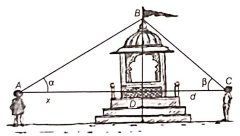
The distance between the two men is 40√3 m and the distance between the first person A and the temple is 30√3 m. Based on the above information answer the following questions.
∠CAB = α =
| a) sin-1 (2/√3) | b) sin-1 (1/2) | c) sin-1 (2) | d) sin-1 (√3/2) |
(ii) \(\angle C A B=\alpha=\)
| a) \(\cos ^{-1}\left(\frac{1}{5}\right)\) | b) \(\cos ^{-1}\left(\frac{2}{5}\right)\) | c) \(\cos ^{-1}\left(\frac{\sqrt{3}}{2}\right)\) | d) \(\cos ^{-1}\left(\frac{4}{5}\right)\) |
(iii) \(\angle B C A=\beta=\)
| a) \(\tan ^{-1}\left(\frac{1}{2}\right)\) | b) \(\tan ^{-1} (2)\) | c) \(\tan ^{-1}\left(\frac{1}{\sqrt{3}}\right)\) | d) \(\tan ^{-1}(\sqrt{3})\) |
(iv) \(\angle A B C=\)
| a) \(\frac{\pi}{4}\) | b) \(\frac{\pi}{6}\) | c) \(\frac{\pi}{2}\) | d) \(\frac{\pi}{3}\) |
(v) Domain and range of \(\cos ^{-1} x=\)
| a) \((-1,1),(0, \pi)\) | b) \([-1,1],(0, \pi)\) | c) \([-1,1],[0, \pi]\) | d) \((-1,1),\left[-\frac{\pi}{2}, \frac{\pi}{2}\right]\) |
28.
A general election of Lok Sabha is a gigantic exercise About 911 million people were eligible to vote and voter turnout was about 67%, the highest ever.

Let l be the set of all citizens of India who were eligible to exercise their voting right in general election held in 2019. A relation R is defined on I as follows
R = {(V1,V2) : V1,V2 ∈ l and both use their voting right in general election-2019).
Answer the following questions using the above information.
(i) Two neighbours X and Y ∈ 1. X exercised his voting right while y did not cast her vote in general election-2019. Which of the following is true?
(a) (X, Y) ∈ R
(b) (Y, X) ∈ R
(c) (X, X) ∈ R
(d) (X, Y) ∈ R
(ii) Mr. X and his wife W both exercised their voting right in general election 2019. Which of the following is true?
(a) both (X, W) and (W,X) ∈ R
(b) (X, W) ∈ R but (W,X) ∉ R
(c) both (X, W) and (W,X) ∉ R
(d) (W,X) ∈ R but (X, W) ∉ R
(iii) Three friends F1, F2 and F3 exercised their voting right in general election-2019, then which of the following is true?
(a) \(\left(F_1, F_2\right) \in R,\left(F_2, F_3\right) \in R\) and \(\left(F_1, F_3\right) \in R\)
(b) \(\left(F_1, F_2\right) \in R,\left(F_2, F_3\right) \in R\) and \(\left(F_1, F_3\right) \notin R\)
(c) \(\left(F_1, F_2\right) \in R,\left(F_2, F_2\right) \in R\) but \(\left(F_3, F_3\right) \notin R\)
(d) \(\left(F_1, F_2\right) \notin R,\left(F_2, F_3\right) \notin R\) and \(\left(F_1, F_3\right) \notin R\)
(iv) The above defined relation R is
(a) Symmetric and transitive but not reflexive z
(b) Universal relation
(c) Equivalence relation
(d) Reflexive but not symmetric and transitive
(v) Mr. Shyam exercised his voting right in General Election-2019, then Mr. Shyam is related to which of the following?
(a) All those eligible voters who cast their votes
(b) Family members of Mr.Shyam
(c) All citizens of India
(d) Eligible voters of India
29.
Shobhit's father wants to construct a rectangular garden using a brick wall on one side of the garden and wire fencing for the other three sides as shown in' figure. He has 200 ft of wire fencing.
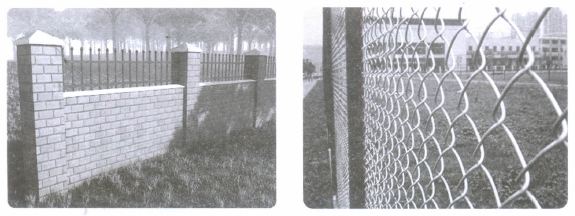
Based on the above information, answer the following questions.
(i) To construct a garden using 200 ft of fencing, we need to maximise its
| (a) volume | (b) area | (c) perimeter | (d) length of the side |
(ii) If x denote the length of side of garden perpendicular to brick wall and y denote the length, of side parallel to brick wall, then find the relation representing total amount of fencing wire.
| (a) x + 2y = 150 | (b) x+2y=50 | (c) y+2x=200 | (d) y+2x=100 |
(iii) Area of the garden as a function of x, say A(x), can be represented as
| (a) 200 + 2x2 | (b) x - 2x2 | (c) 200x - 2x2 | (d) 200-x2 |
(iv) Maximum value of A(x) occurs at x equals
| (a) 50 ft | (b) 30 ft | (c) 26ft | (d) 31 ft |
(v) Maximum area of garden will be
| (a) 2500 sq.ft | (b) 4000 sq.ft | (c) 5000 sq.ft | (d) 6000 sq. ft |
30.
Let \(\begin{equation} f: A \rightarrow B \end{equation}\) and \(\begin{equation} g: B \rightarrow C \end{equation}\) be two functions defined on non-empty sets A, B, C,
then \(\begin{equation} \text { gof }: A \rightarrow C \end{equation}\) be is called the composition off and g defined as, \(\begin{equation} g o f(x)=g\{f(x)\} \forall x \in A \end{equation}\) .
Consider the functions \(\begin{equation} f(x)=\left\{\begin{array}{ll} \sin x, & x \geq 0 \\ 1-\cos x, & x \leq 0 \end{array}, g(x)=e^{x}\right. \end{equation}\) and
then answer the following questions.
(i) The function gof(x) is defined as
| (a) \(\begin{equation} g o f(x)=\left\{\begin{array}{ll} e^{x} & , x \geq 0 \\ 1-e^{\cos x} & , x \leq 0 \end{array}\right. \end{equation}\) | (b) \(\begin{equation} \operatorname{gof}(x)=\left\{\begin{array}{ll} e^{\sin x} & , x \leq 0 \\ e^{1-\cos x} & , x \geq 0 \end{array}\right. \end{equation}\) |
| (c) \(\begin{equation} g o f(x)=\left\{\begin{array}{ll} e^{\sin x} & , x \leq 0 \\ 1-e^{\cos x} & , x \geq 0 \end{array}\right. \end{equation}\) | (d) \(\begin{equation} g o f(x)=\left\{\begin{array}{ll} e^{\sin x} & , x \geq 0 \\ e^{1-\cos x} & , x \leq 0 \end{array}\right. \end{equation}\) |
(ii) \(\begin{equation} \frac{d}{d x}\{\operatorname{gof}(x)\}= \end{equation}\)
| (a) \(\begin{equation} [g o f(x)]^{\prime}=\left\{\begin{array}{ll} \cos x \cdot e^{\sin x} & , x \geq 0 \\ e^{1-\cos x} \cdot \sin x & , x \leq 0 \end{array}\right. \end{equation}\) | (b) \(\begin{equation} [g o f(x)]^{\prime}=\left\{\begin{array}{ll} \cos x \cdot e^{\sin x} & , x \geq 0 \\ -\sin x \cdot e^{1-\cos x} & , x \leq 0 \end{array}\right. \end{equation}\) |
| (c) \(\begin{equation} [g o f(x)]^{\prime}=\left\{\begin{array}{ll} \cos x \cdot e^{\sin x} & , x \geq 0 \\ \sin x \cdot(1-\cos x) & , x \leq 0 \end{array}\right. \end{equation}\) | (d) \(\begin{equation} [g o f(x)]^{\prime}=\left\{\begin{array}{ll} \cos x \cdot e^{\sin x} & , x \geq 0 \\ (1-\sin x) \cdot e^{1-\cos x} & , x \leq 0 \end{array}\right. \end{equation}\) |
(iii) R.H.D. of gof(x) at x = 0 is
| (a) 0 | (b) 1 | (c) -1 | (d) 2 |
(iv) L.H.D. of gof(x) at x = 0 is
| (a) 0 | (b) 1 | (c) -1 | (d) 2 |
(v) The value of \(\begin{equation} f^{\prime}(x) \text { at } x=\frac{\pi}{4} \end{equation}\) is
| (a) 1/9 | (b) \(\begin{equation} 1 / \sqrt{2} \end{equation}\) | (c) 1/2 | (d) not defined |
31.
Minor of an element aij of a determinant is the determinant obtained by deleting its ith row and /h column in aij lies and is denoted by Mij.
Cofactor of an element aij'denoted by Aij,is defined by \(\begin{equation} A_{i j}=(-1)^{i+j} M_{i j} \end{equation}\), where Mij is minor of aij.
Also, the determinant of a square matrix A is the sum of the products of the elements of any row (or column with their corresponding cofactors.
For example if \(\begin{equation} A=\left[a_{i j}\right]_{3 \times 3}, \text { then }|A|=a_{11} A_{11}+a_{12} A_{12}+a_{13} A_{13} \end{equation}\) .
Based on the above information, answer the following questions
(i) Find the sum of the cofactors of all the elements of \(\begin{equation} \left|\begin{array}{cc} 1 & -2 \\ 4 & 3 \end{array}\right| \end{equation}\)
| (a) 1 | (b) -2 | (c) 4 | (d) 1 |
(ii) Find the minor of a21 of \(\begin{equation} \left|\begin{array}{ccc} 5 & 6 & -3 \\ -4 & 3 & 2 \\ -4 & -7 & 3 \end{array}\right| \end{equation}\)
| (a) 3 | (b) -3 | (c) 39 | (d) -39 |
(iii) In the determinant \(\begin{equation} \left|\begin{array}{ccc} 2 & -3 & 5 \\ 6 & 0 & 4 \\ 1 & 5 & -7 \end{array}\right| \end{equation}\) find the value of a32·A32
| (a) 27 | (b) -110 | (c) 110 | (d) -27 |
(iv) If \(\begin{equation} \Delta=\left|\begin{array}{lll} 5 & 3 & 8 \\ 2 & 0 & 1 \\ 1 & 2 & 3 \end{array}\right| \end{equation}\), find the value of a32·A32 .
| (a) -10 | (b) -7 | (c) 10 | (d) 7 |
(v) If \(\begin{equation} \Delta=\left|\begin{array}{ccc} 2 & -3 & 5 \\ 6 & 0 & 4 \\ 1 & 5 & -7 \end{array}\right| \end{equation}\), then find the value of \(\begin{equation} |\Delta| \end{equation}\).
| (a) 26 | (b)28 | (c) 72 | (d) 46 |
32.
Assertion (A) If exy + log (xy) + cos(xy) + 4 = 0, then \(\frac{dy}{dx}=-\frac{y}{x}\)
Reason (R) \(\frac{d}{d x}(x y)=0 \Rightarrow \frac{d y}{d x}=-\frac{y}{x}\)
(a) Both A and R are correct; R is the correct explanation of A
(b) Both A and R are correct; R is not the correct explanation of A
(c) A is correct; R is incorrect
(d) R is correct; A is incorrect
33.
Assertion: If f: R \(\rightarrow\)R and g : R \(\rightarrow\)R be two mappings such that f(x) = sin x and g(x) = x2, then fog \(\neq\)gof.
Reason: (fog) x = f(x)g(x) = (gof) x
(a) Assertion is correct, reason is correct; reason is a correct explanation for assertion.
(b) Assertion is correct, reason is correct; reason is not a correct explanation for assertion.
(c) Assertion is correct, reason is incorrect.
(d) Assertion is incorrect, reason is correct.
34.
Assertion: The value of tan-1 \(\left ( \frac{3}{4} \right )+tan^{-1}\left ( \frac{1}{7} \right )\)is \(\frac{\pi}{4}\)
Reason: If x > 0, y > 0 then \(tan^{-1}\left ( \frac{x}{y} \right )+tan^{-1}\left ( \frac{y-x}{y+x} \right )=\frac{\pi}{4}\)
(a) Assertion is correct, reason is correct;reason is a correct explanation for assertion.
(b) Assertion is correct, reason is correct; reason is not a correct explanation for assertion
(c) Assertion is correct, reason is incorrect
(d) Assertion is incorrect, reason is correct.
35.
Assertion: The order of the matrix A is 3 x 5 and that of B is 2 x 3.Then the matrix AB is not possible.
Reason: No. of columns in A is not equal to no. of rows in B.
(a) Assertion is correct, reason is correct; reason is a correct explanation for assertion.
(b) Assertion is correct, reason is correct; reason is not a correct explanation for assertion
(c) Assertion is correct, reason is incorrect
(d) Assertion is incorrect, reason is correct.
36.
Assertion: The matrix A=\(\begin{bmatrix}
2& 3& -\frac{1}{2}\\
7& 3& 2\\
3& 1& 1\\
\end{bmatrix}\)is singular.
Reason: The value of determinant of matrix A is zero.
(a) Assertion is correct, reason is correct; reason is a correct explanation for assertion.
(b) Assertion is correct, reason is correct; reason is not a correct explanation for assertion
(c) Assertion is correct, reason is incorrect
(d) Assertion is incorrect, reason is correct.
1.
2af(a)−a2f′(a)
2.
Given system of equations can be written as
3x - y - 2z = 2,
2y - z = -1 and
3x - 5y = 3. and its matrix form is AX = B , where
\(A=\left[\begin{array}{lll} 3 & -1 & -2 \\ 0 & 2 & -1 \\ 3 & -5 & 0 \end{array}\right], X=\left[\begin{array}{l} x \\ y \\ z \end{array}\right] \text { and } B=\left[\begin{array}{c} 2 \\ -1 \\ 3 \end{array}\right]\)
\(\text {Now, }|A|=3(0-5)-0+3(1+4)=-15+15=0\)
\(\therefore A \) is a singular matrix.
\((\text { adjA })=\left[\begin{array}{lll} -5 & 10 & 5 \\ -3 & 6 & 3 \\ -6 & 12 & 6 \end{array}\right] \)
\(\therefore(a d j A) B=\left[\begin{array}{lll} -5 & 10 & 5 \\ -3 & 6 & 3 \\ -6 & 12 & 6 \end{array}\right]\left[\begin{array}{c} 2 \\ -1 \\ 3 \end{array}\right]=\left[\begin{array}{l} -10-10+15 \\ -6-6+9 \\ -12-12+18 \end{array}\right]=\left[\begin{array}{l} -5 \\ -3 \\ -6 \end{array}\right] \neq O\)
Thus, the solution of the given system of equations does not exist. Hence, the system of equations is inconsistent
3.
\(\left.\begin{array}{l} \text { Deluxe } & \text { Premium } & \text { Standard } \\ A & 6 & 4 & 5 \\ B & 8 & 3 & 4 \\ \text { C } & 4 & 2 & 3 \end{array}\right] \text { . } \)
4.
Since 1*2 =1.2 3 = 8 but 2*1 = 2.13 = 2
So 1*2 is not equal to 2* 1, so the given Binary Operation is not Commutative
5.
Let y = tan−1(−1)
⇒ tan y = −1
We know that the range of the principal value branch of tan−1x is \(\left(-\frac{\pi}{2}, \frac{\pi}{2}\right) \text {. }\)
\( \Rightarrow \tan y=\tan \left(\frac{-\pi}{4}\right) \)
\(\therefore y=\frac{-\pi}{4} \)
Hence, the principal value of tan−1(−1) is \(\frac{-\pi}{4} \).
6.
\(\text { [Ans. } f(x) \text { is increasing in }(2,3], f(x) \text { is decreasing is } [3, \infty)]\)
7.
Given
\(\tan ^{-1}\left(\frac{n}{\pi}\right)>\frac{\pi}{4} \)
\(\Rightarrow \frac{n}{\pi}>\tan \frac{\pi}{4} \quad\left[\because \tan ^{-1} \theta>\phi \Rightarrow \theta>\tan \phi\right] \)
\(\Rightarrow \frac{n}{\pi}>1 \Rightarrow n>\pi \)
\(\Rightarrow n>3.14\)
Hence, the minimum value of n is 4 .
8.
We shall prove the result by using principle of mathematical induction
\(\mathrm{P}(n): \text { If } \mathrm{A}=\left[\begin{array}{cc} \cos \theta & \sin \theta \\ -\sin \theta & \cos \theta \end{array}\right] \text {, then } \mathrm{A}^n=\left[\begin{array}{cc} \cos n \theta & \sin n \theta \\ -\sin n \theta & \cos n \theta \end{array}\right], n \in \mathbf{N}\)
\(P(1): A=\left[\begin{array}{cc} \cos \theta & \sin \theta \\ -\sin \theta & \cos \theta \end{array}\right] \text {, so } A^1=\left[\begin{array}{cc} \cos \theta & \sin \theta \\ -\sin \theta & \cos \theta \end{array}\right]\)
Therefore, the result is true for n = 1.
Let the result be true for n = k. So
\(\mathrm{P}(k): \mathrm{A}=\left[\begin{array}{cc} \cos \theta & \sin \theta \\ -\sin \theta & \cos \theta \end{array}\right] \text {, then } \mathrm{A}^k=\left[\begin{array}{cc} \cos k \theta & \sin k \theta \\ -\sin k \theta & \cos k \theta \end{array}\right]\)
\( \mathrm{A}^{k+1} =\mathrm{A} \cdot \mathrm{A}^k=\left[\begin{array}{cc} \cos \theta & \sin \theta \\ -\sin \theta & \cos \theta \end{array}\right]\left[\begin{array}{cc} \cos k \theta & \sin k \theta \\ -\sin k \theta & \cos k \theta \end{array}\right] \)
\(=\left[\begin{array}{cc} \cos \theta \cos k \theta-\sin \theta \sin k \theta & \cos \theta \sin k \theta+\sin \theta \cos k \theta \\ -\sin \theta \cos k \theta+\cos \theta \sin k \theta & -\sin \theta \sin k \theta+\cos \theta \cos k \theta \end{array}\right]\)
\(=\left[\begin{array}{cc} \cos (\theta+k \theta) & \sin (\theta+k \theta) \\ -\sin (\theta+k \theta) & \cos (\theta+k \theta) \end{array}\right]=\left[\begin{array}{cc} \cos (k+1) \theta & \sin (k+1) \theta \\ -\sin (k+1) \theta & \cos (k+1) \theta \end{array}\right]\)
9.
Here \(\Delta\)is a skew-symmetric determinant of 3rd (odd) order
\(\Delta\)=0
10.
\(We\quad have:\quad y={ x }^{ 3 }+tan\quad x\)
\(\frac { dy }{ dx } ={ 3x }^{ 2 }+{ sec }^{ 2 }x\)
\(and\quad \frac { { d }^{ 2 }y }{ { dx }^{ 2 } } =6x+2secx.\frac { d }{ dx } (sec\quad x)\)
\(=6x+2secx.secxtanx\)
\(=6x+2{ sec }^{ 2 }xtanx\)
11.
We have, \(f(x)=\left\{\begin{array}{ll} \frac{1}{2}-x, & \text { if } 0 \leq x<\frac{1}{2} \\ 1, & \text { if } x=\frac{1}{2} \\ \frac{3}{2}-x, & \text { if } \frac{1}{2}
Here, given function is a polynomial function, so it is continuous in the given intervals.
Now, we have to check the continuity at \(x=\frac{1}{2}\) .
\( \mathrm{LHL} =\lim _{x \rightarrow \frac{1}{2}} f(x)=\lim _{x \rightarrow \frac{1}{2}}\left(\frac{1}{2}-x\right) \)
\(=\lim _{h \rightarrow 0}\left[\frac{1}{2}-\left(\frac{1}{2}-h\right)\right] \)
\(=\lim _{h \rightarrow 0} h=0\)
\(\left[\text { put } x=\frac{1}{2}-h ; \text { when } x \rightarrow \frac{1^{-}}{2}, \text { then } h \rightarrow 0\right]\)
and
\( \mathrm{RHL} =\lim _{x \rightarrow \frac{1^{+}}{2}} f(x)=\lim _{x \rightarrow \frac{1^{+}}{2}}\left(\frac{3}{2}-x\right) \)
\(=\lim _{h \rightarrow 0}\left[\frac{3}{2}-\left(\frac{1}{2}+h\right)\right] \)
\(=\lim _{h \rightarrow 0}\left[\frac{3}{2}-\frac{1}{2}-h\right]=\lim _{h \rightarrow 0}[1-h]=1\)
\(\because \mathrm{LHL} \neq \mathrm{RHL}\)
Hence, f(x) is not continuous at \(x=\frac{1}{2}\)
12.
Let \(\frac{1}{x}=p, \frac{1}{y}=q\) and \(\frac{1}{z}=r\)
Then, the given equations becomes \(2 p+3 q+10 r=2\)
\(4 p-6 q+5 r=5 \)
6 p+9 q-20 r=-4
This system can be written as AX = B, where
\(A=\left[\begin{array}{ccc} 2 & 3 & 10 \\ 4 & -6 & 5 \\ 6 & 9 & -20 \end{array}\right], X=\left[\begin{array}{l} p \\ q \\ r \end{array}\right], B=\left[\begin{array}{c} 2 \\ 5 \\ -4 \end{array}\right]\)
Here, \(|A|=\left|\begin{array}{ccc}2 & 3 & 10 \\ 4 & -6 & 5 \\ 6 & 9 & -20\end{array}\right|\)
=2(120-45)-3(-80-30)+10(36+36)
\( =150+330+720 =1200 \neq 0\)
Thus, A is non-singular, therefore its inverse exists.
Therefore, the above system has a unique solution given by X=A-1 B
Cofactors of A are
\(C_{11} =75, \quad C_{21}=150, \quad C_{31}=75\)
\(C_{12} =110, C_{22}=-100, \quad C_{32}=30\)
\(C_{13} =72, C_{23}=0 \text { and } C_{33}=-24 \)
\(\therefore \operatorname{adj}(A) =\left[\begin{array}{ccc}
75 & 110 & 72 \\
150 & -100 & 0 \\
75 & 30 & -24
\end{array}\right] \)
\(=\left[\begin{array}{ccc}
75 & 150 & 75 \\
110 & -100 & 30 \\
72 & 0 & -24
\end{array}\right]\)
\(\therefore \quad A^{-1} =\frac{1}{|A|}(\operatorname{adj} A)=\frac{1}{1200}\left[\begin{array}{ccc}
75 & 150 & 75 \\
110 & -100 & 30 \\
72 & 0 & -24
\end{array}\right]\)
Now, X=A-1B
\( \Rightarrow\left[\begin{array}{l}
p \\
q \\
r
\end{array}\right]=\frac{1}{1200}\left[\begin{array}{ccc}
75 & 150 & 75 \\
110 & -100 & 30 \\
72 & 0 & -24
\end{array}\right]\left[\begin{array}{c}
2 \\
5 \\
-4
\end{array}\right] \)
\(=\frac{1}{1200}\left[\begin{array}{c}
150+750-300 \\
220-500-120 \\
144+0+96
\end{array}\right] \)
\(=\frac{1}{1200}\left[\begin{array}{c}
900-300 \\
220-620 \\
144+96
\end{array}\right]=\frac{1}{1200}\left[\begin{array}{c}
600 \\
-400 \\
240
\end{array}\right]=\left[\begin{array}{c}
1 / 2 \\
-1 / 3 \\
1 / 5
\end{array}\right]\)
\(\Rightarrow \quad p=\frac{1}{2}, q=-\frac{1}{3}, r=\frac{1}{5}\)
\(\therefore \quad x =2, y=-3 \text { and } z=5\)
13.
\( \text { Let } A=\left[\begin{array}{lll} 2 & 3 & 4 \\ 3 & 4 & 5 \\ 4 & 5 & 6 \end{array}\right] \text { and } B=\left[\begin{array}{rrr} 1 & -3 & 5 \\ 0 & 2 & 4 \\ 3 & 0 & 5 \end{array}\right]\)
Here, number of columns of A = number of rows of B = 3, so AB is defined.
\(\text { Now, } \quad A B=\left[\begin{array}{lll} 2 & 3 & 4 \\ 3 & 4 & 5 \\ 4 & 5 & 6 \end{array}\right]\left[\begin{array}{rrr} 1 & -3 & 5 \\ 0 & 2 & 4 \\ 3 & 0 & 5 \end{array}\right]\)
\(c_{11}=R_{1} C_{1}=\left[\begin{array}{lll} 2 & 3 & 4 \end{array}\right]\left[\begin{array}{l} 0 \\ 3 \end{array}\right]=2+0+12=14 \)
\(c_{12}=R_{1} C_{2}=\left[\begin{array}{lll} 2 & 3 & 4 \end{array}\right]\left[\begin{array}{c} -3 \\ 2 \\ 0 \end{array}\right]=-6+6+0=0 \)
\(c_{21}=R_{2} C_{1}=\left[\begin{array}{lll} 3 & 4 & 5 \end{array}\right]\left[\begin{array}{l} 1 \\ 0 \\ 3 \end{array}\right]=3+0+15=18 \)
\(c_{22}=R_{2} C_{2}=\left[\begin{array}{lll} 3 & 4 & 5 \end{array}\right]\left[\begin{array}{r} -3 \\ 2 \\ 0 \end{array}\right]=-9+8+0=-1 \)
\(c_{23}=R_{2} C_{3}=\left[\begin{array}{lll} 3 & 4 & 5 \end{array}\right]\left[\begin{array}{l} 5 \\ 4 \\ 5 \end{array}\right]=15+16+25=56 \)
\(c_{31}=R_{3} C_{1}=\left[\begin{array}{lll} 4 & 5 & 6 \end{array}\right]\left[\begin{array}{l} 1 \\ 0 \\ 3 \end{array}\right]=4+0+18=22 \)
\(c_{32}=R_{3} C_{2}=\left[\begin{array}{lll} 4 & 5 & 6 \end{array}\right]\left[\begin{array}{r} -3 \\ 2 \\ 0 \end{array}\right]=-12+10+0=-2 \)
\( \text { and } c_{33}=R_{3} C_{3}=\left[\begin{array}{lll} 4 & 5 & 6 \end{array}\right]\left[\begin{array}{l} 5 \\ 4 \\ 5 \end{array}\right]=20+20+30=70 \)
\(\text { Hence, } C=A B=\left[\begin{array}{lll} c_{11} & c_{12} & c_{13} \\ c_{21} & c_{22} & c_{23} \\ c_{31} & c_{32} & c_{33} \end{array}\right]=\left[\begin{array}{ccc} 14 & 0 & 42 \\ 18 & -1 & 56 \\ 22 & -2 & 70 \end{array}\right] \)
14.
The binary operation * on N is defined as a * b = L.C.M. of a and b.
(i) 5 * 7 = L.C.M. of 5 and 7 = 35
20 * 16 = L.C.M of 20 and 16 = 80
(ii) It is known that:
L.C.M of a and b = L.C.M of b and a &mn For E; a, b ∈ N.
∴ a * b = b * a
Thus, the operation * is commutative.
(iii) For a, b, c ∈ N, we have:
(a * b) * c = (L.C.M of a and b) * c = LCM of a, b, and c
a * (b * c) = a * (LCM of b and c) = L.C.M of a, b, and c
∴ (a * b) * c = a * (b * c)
Thus, the operation * is associative.
(iv) It is known that:
L.C.M. of a and 1 = a = L.C.M. 1 and a &mnForE; a ∈ N
⇒ a * 1 = a = 1 * a &mnForE; a ∈ N
Thus, 1 is the identity of * in N.
(v) An element a in N is invertible with respect to the operation * if there exists an element b in N, such that a * b = e = b * a.
Here, e = 1
This means that:
L.C.M of a and b = 1 = L.C.M of b and a
This case is possible only when a and b are equal to 1.
Thus, 1 is the only invertible element of N with respect to the operation *.
15.
the required trapezium is as given in figure. Draw perpendiculars DP and CQ on AB. Let AP = x cm. Note that \(\Delta \)APD \(\cong \) \(\Delta \) BQC.
Therefore, QB = x cm. Also, by pythagoras theorem DP = QC = \(\sqrt { 100-{ x }^{ 2 } } \)
Let A be the area of the trapezium.
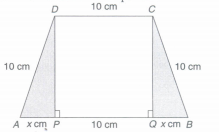
Then, A \(\equiv \) A(x)
\(=\frac { 1 }{ 2 } (sum\ of\ parallel\ sides)\times (height)\)
\(=\frac { 1 }{ 2 } (2x+10+10)\sqrt { 100-{ x }^{ 2 } } \)
= (x + 10)\(\sqrt { 100-{ x }^{ 2 } } \)
\(or\ A'(x)=(x+10)\frac { (-2x) }{ 2\sqrt { 100-{ x }^{ 2 } } } +(\sqrt { 100-{ x }^{ 2 }) } \)
\(=\frac { -2{ x }^{ 2 }-10x+100 }{ \sqrt { 100-{ x }^{ 2 } } } \)
Now, A'(x) = 0 gives 2x2 + 10x - 100 = 0,
i.e., x = 5 and x = -10
So, x = 5.
Now, A''(x) = \(\frac { \sqrt { 100-{ x }^{ 2 } } (-4x-10)-(-2x^{ 2 }-10x+100)\frac { (-2x) }{ 2\sqrt { 100-{ x }^{ 2 } } } }{ 100-{ x }^{ 2 } } \)
\(=\frac { { 2x }^{ 3 }-300x-1000 }{ { (100-{ x }^{ 2 }) }^{ \frac { 1 }{ 2 } } } \)
(on simplification)
or \(A''(5)=\frac { { 2(5) }^{ 3 }-300(5)-1,000 }{ (100-(5{ ) }^{ 2 })^{ \frac { 3 }{ 2 } } } \)
\(=\frac { -2,250 }{ 75\sqrt { 75 } } =\frac { -30 }{ \sqrt { 75 } } <0\)
Thus, area of trapezium is maximum at x = 5 and the maximum area is given by
A(5) = (5 + 10)\(\sqrt { 100-{ (5) }^{ 2 } } \)
= 15\(\sqrt { 75 } =75\sqrt { 3 } { cm }^{ 2 }\)
16.
Putting x = cos \(\theta \) in L.H.S., we get
\(LHS={ tan }^{ -1 }\left[ \frac { \sqrt { 1+cos\theta } -\sqrt { 1-cos\theta } }{ \sqrt { 1+cos\theta } +\sqrt { 1-cos\theta } } \right] \)
\(={ tan }^{ -1 }\left[ \frac { \sqrt { 2 } cos\frac { \theta }{ 2 } -\sqrt { 2 } sin\frac { \theta }{ 2 } }{ \sqrt { 2 } cos\frac { \theta }{ 2 } +\sqrt { 2 } sin\frac { \theta }{ 2 } } \right] \)
\(={ tan }^{ -1 }\left[ \frac { 1-tan\frac { \theta }{ 2 } }{ 1+tan\frac { \theta }{ 2 } } \right] \)
\(={ tan }^{ -1 }\left[ tan\left( \frac { \pi }{ 4 } -\frac { \theta }{ 2 } \right) \right] \)
\(=\frac { \pi }{ 4 } -\frac { \theta }{ 2 } \)
\(=\frac { \pi }{ 4 } -\frac { 1 }{ 2 } { cos }^{ -1 }x=RHS\)
17.
(d)
\(\frac{5\pi}{6}\)
18.
In the interval \(\left(0, \frac{\pi}{2}\right), f(x)=\cos x\)
\(\Rightarrow \quad f^{\prime}(x)=-\sin x\)
which gives \(f^{\prime}(x)<0 \text { in }\left(0, \frac{\pi}{2}\right)\)
Hence, f(x) = cos x is decreasing in \(\left(0, \frac{\pi}{2}\right)\)
19.
(a)
\(-x \cos x-2 \sin x\)
20.
\(A^{-1} \text {exist iff }|A| \neq 0\)
21.
We know that if a matrix is of order m x n, then it has mn elements. Thus, to find all possible orders of a matrix with 8 elements, we will find all ordered pairs of natural numbers, whose product is 8. Thus, all possible ordered pair are (1,8), (8, I), (2, 4), (4, 2).
22.
(d)
Det (A) ∈ [2, 4]
23.
(b)
2 × n
24.
(b)
\(\frac { 5\pi }{ 6 } \)
25.
(d)
f is neither one-one nor onto
26.
T1 and T3 are similar as their sides are proportional.
27.
(i) (b) \(\ln \triangle A B D\)
\(\tan \alpha =\frac{B D}{A D}\)
\( =\frac{30}{30 \sqrt{3}}=\frac{1}{\sqrt{3}} \)
\(\Rightarrow \alpha =30^{\circ}\)
\(\therefore \sin \alpha =\sin 30^{\circ}=\frac{1}{2}\)
\(\Rightarrow \alpha =\sin ^{-1}\left(\frac{1}{2}\right)\)
(ii) (c) \(\cos \alpha=\cos 30^{\circ}=\frac{\sqrt{3}}{2}\)
\(\Rightarrow \alpha =\cos ^{-1}\left(\frac{\sqrt{3}}{2})\right.\)
(iii) (d) \(\ln \triangle B DC\)
\(\tan \beta =\frac{(BD)}{(C D)}\)
\(=\frac{30}{10 \sqrt{3}}=\sqrt{3} \)
\(\Rightarrow \beta =\tan ^{-1}(\sqrt{3})\)
(iv) \( \text { (c) Since, } \alpha=\sin ^{-1}\left(\frac{1}{2}\right)=\frac{\pi}{6} \text {, } \)
\(\beta=\tan ^{-1}(\sqrt{3})=\frac{\pi}{3} \)
\(\therefore \quad \angle A B C=\pi-\left(\frac{\pi}{6}+\frac{\pi}{3}\right)\)
\( =\pi-\frac{\pi}{2}=\frac{\pi}{2}\)
(v) (c) We know that domain and range of \(\cos ^{-1} x\) are [-1,1] and \([0, \pi]\) respectively.
28.
(i) (d) Given, R = {(V1,V2) : V1,V2 ∈ l}and both use their voting right in general election-2019. Since, X,Y∈ I⋅X exercised his voting right while Y did not cast her vote in general election-2019.
∴ Clearly, (X,Y)∉R
(ii) (a) Relation is symmetric.
∴(X,W)∈R
⇒(W,X)∈R
(iii) (a) Since, (F,F)∈R,F ∈ I and F use their voting right.
⇒R is reflexive.
⇒(F1,F2)∈R
⇒(F2,F1)∈R
R is symmetric.
and (F1,F2) ∈ R
and (F2,F3) ∈ R
⇒ (F1,F3) ∈ R
(By transitive property)
(iv) (c) Given, relation RR is reflexive, symmetric and transitive.
∴R is equivalence relation.
(v) (a) Clearly, Mr. Shyam exercised his voting right in general election-2019, then Mr. Shyam is related to all those eligible voters who cast their votes.
29.
(i) (b) :To create a garden using 200 ft fencing, we
need to maximise its area.
(ii) (c) : Required relation is given by 2x + y = 200.
(iii) (c) : Area of garden as a function of x can be represented as
\(A(x)=x \cdot y=x(200-2 x)=200 x-2 x^{2}\)
(iv) (a) : \(\begin{equation} A(x)=200 x-2 x^{2} \Rightarrow A^{\prime}(x)=200-4 x \end{equation}\)
For the area to be maximum A'(x) = 0
\(\begin{equation} \Rightarrow 200-4 x=0 \Rightarrow x=50 \mathrm{ft} \end{equation}\)
(v) (c) : Maximum-area of the garden
= 200(50) - 2(50)2 = 10000 - 5000 = 5000 sq. ft
30.
(i) (d)
(ii) (a)
(iii) (b) ,
(iv) (a)
(v) (b)
31.
(i) (a) : Let \(\begin{equation} \Delta=\left|\begin{array}{cc} 1 & -2 \\ 4 & 3 \end{array}\right| \end{equation}\)
Cofactor of 1 = 3, cofactor of -2 =-4
Cofactor of 4 = 2, cofactor of 3 = 1
\(\therefore\) Required sum = 3 - 4 + 2 + 1 = 2
(ii) (b) : Let \(\begin{equation} \Delta=\left|\begin{array}{ccc} 5 & 6 & -3 \\ -4 & 3 & 2 \\ -4 & -7 & 3 \end{array}\right| \end{equation}\)
Minor of \(\begin{equation} a_{21}=\left|\begin{array}{cc} 6 & -3 \\ -7 & 3 \end{array}\right|=18-21=-3 \end{equation}\)
(iii) (c) : Let \(\begin{equation} \Delta=\left|\begin{array}{ccc} 2 & -3 & 5 \\ 6 & 0 & 4 \\ 1 & 5 & -7 \end{array}\right| \end{equation}\)
Clearly, a32 = 5
and A32 = cofactor of a32 in \(\begin{equation} \Delta=(-1)^{3+2}\left|\begin{array}{ll} 2 & 5 \\ 6 & 4 \end{array}\right| \end{equation}\)
= (-1)(8-30) = 22
\(\begin{equation} \therefore \end{equation}\) a32·A32 = 5 x 22 = 110
(iv) (d) : Here, \(\begin{equation} \Delta=\left|\begin{array}{lll} 5 & 3 & 8 \\ 2 & 0 & 1 \\ 1 & 2 & 3 \end{array}\right| \end{equation}\)
\(\therefore\) Minor of \(\begin{equation} a_{23}=\left|\begin{array}{ll} 5 & 3 \\ 1 & 2 \end{array}\right|=10-3=7 \end{equation}\)
(v) (b) : Here,\(\begin{equation} \Delta=\left|\begin{array}{ccc} 2 & -3 & 5 \\ 6 & 0 & 4 \\ 1 & 5 & -7 \end{array}\right| \end{equation}\)
\(\begin{equation} A_{11}=(-1)^{1+1}\left|\begin{array}{cc} 0 & 4 \\ 5 & -7 \end{array}\right|=1(0-20)=-20 \end{equation}\)
\(\begin{equation} A_{12}=(-1)^{1+2}\left|\begin{array}{cc} 6 & 4 \\ 1 & -7 \end{array}\right|=-1(-42-4)=46 \end{equation}\)
\(\begin{equation} A_{13}=(-1)^{1+3}\left|\begin{array}{ll} 6 & 0 \\ 1 & 5 \end{array}\right|=1(30-0)=30 \end{equation}\)
\(\begin{equation} \therefore \quad \Delta=a_{11} A_{11}+a_{12} a_{12}+a_{13} A_{13} \end{equation}\)
= 2(-20) -3(46) + 5(30) = -28
\(\begin{equation} \Rightarrow|\Delta|=28 \end{equation}\)
32.
(a) exy + log (xy) + cos(xy) + 4 = 0
\(\begin{array}{ll}
\Rightarrow & e^{x y} \frac{d}{d x}(x y)+\frac{1}{x y} \frac{d}{d x}(x y)-\sin (x y) \frac{d}{d x}(x y)=0
\end{array}\)
\(\begin{array}{ll}
\Rightarrow & \frac{d}{d x}(x y)\left\{e^{x y}+\frac{1}{x y}-\sin (x y)\right\}=0
\end{array}\)
\(\begin{array}{ll}
\because & e^{x y}+\frac{1}{x y}-\sin (x y) \neq 0
\end{array}\)
\(\begin{array}{ll}
\therefore & \frac{d}{d x}(x y)=0
\end{array}\)
33.
(c) Assertion is correct, reason is incorrect.
34.
(a) Assertion is correct, reason is correct;reason is a correct explanation for assertion.
35.
(a) Assertion is correct, reason is correct; reason is a correct explanation for assertion.
36.
(a) Assertion is correct, reason is correct; reason is a correct explanation for assertion.

12th Standard CBSE Syllabus & Materials
12th Standard CBSE
CBSE 12th Computer Science Python Revision Tour I - New Previous year Question Papers Study Material - QB365 Set A
NEW12th Standard CBSE
CBSE 12th Business Studies Planning Important Questions And Answers Study Material - QB365 Set A
NEW12th Standard CBSE
CBSE 12th Business Studies Business Environment Important Questions And Answers Study Material - QB365 Set A
NEW12th Standard CBSE
CBSE 12th Business Studies Principles of Management Important Questions And Answers Study Material - QB365 Set A



NCERT Books

Syllabus

Exam Pattern

Sample Question Papers

Previous year Question Papers

Important Notes

MCQ Practice test

NCERT Exemplers

Case study Questions

Image Based Questions

Passage based Questions

HOT Questions

Value Based Questions

Model Questions Papers
NCERT ( Book Back ) Questions

Assertion and Reason
Important Questions And Answers

CBSE 12th Standard CBSE Subjects
CBSE Standards








