
 100% FREE ACCESS
12th Standard CBSE Syllabus & Materials
12th Standard CBSE
CBSE 12th Economics Government Budget and the Economy Previous year Question Papers Study Material - QB365 Set A
NEW12th Standard CBSE
CBSE 12th Computer Science Interface Python with MySQL - New Previous year Question Papers Study Material - QB365 Set A
NEW12th Standard CBSE
CBSE 12th Computer Science Database Concept - New Previous year Question Papers Study Material - QB365 Set A
NEW12th Standard CBSE
CBSE 12th Computer Science Data Communication - New Previous year Question Papers Study Material - QB365 Set A
NEW12th Standard CBSE
CBSE 12th Computer Science Data Structures - New Previous year Question Papers Study Material - QB365 Set A
NEW12th Standard CBSE
CBSE 12th Computer Science Functions - New Previous year Question Papers Study Material - QB365 Set A

Published on: 02/11/2025
Download CBSE Class 12th Standard CBSE Maths question papers, sample papers, important questions, and previous year solved papers in PDF format. Get free study materials, NCERT solutions, and exam preparation resources for Class 12th Standard CBSE Maths
Questions + Answers key
Take MCQ Maths Test
1.
Prove that the function f given by
f (x) = | x – 1|, x \(\in\) R is not differentiable at x = 1.
2.
Find-the intervals in which the function f given by \(f(x)=\sin x+\cos x, 0 \leq x \leq 2 \pi\) is strictly increasing or strictly decreasing.
3.
A water tank has the shape of an inverted right circular cone with its axis vertical and vertex lowermost. Its semi-vertical angle is tan–1 (0.5). Water is poured into it at a constant rate of 5 cubic metre per hour. Find the rate at which the level of the water is rising at the instant when the depth of water in the tank is 4m.
4.
Show that the altitude of the right circular cone of maximum volume that can be inscribed in a sphere of radius r is \(\frac { 4r }{ 3 } \) Also show that the maximum volume of the cone is \(\frac { 8 }{ 27 } \) of the volume of the sphere.
5.
Let \(F(\alpha)=\begin{vmatrix}cos\alpha&-sin\alpha&0\\sin\alpha&cos\alpha&0\\0&0&1 \end{vmatrix}\) and \(G(\beta)=\begin{bmatrix} cos\beta&0&sin\beta\\0&1&0\\-sin\beta&0&cos\beta\end{bmatrix}\)Show that \([F(\alpha)G(\beta)]^{-1}=G(-\beta).F(-\alpha)\)
6.
Differentiate w.r.t. x or find \(\frac { dy }{ dx } \): \(x=\frac { { sin }^{ 3 }t }{ \sqrt { cos\quad 2t } } ,\quad y=\frac { cos^{ 3 }t }{ \sqrt { cos\quad 2t } } \)
7.
For what value of λ is the function defined by
\(f(x)=\begin{cases} \lambda ({ x }^{ 2 }-2x)\quad ,\ if\ x\le 0 \\ 4x+1\quad \quad \ ,\quad if\ x>0 \end{cases} \) continuous at x = 0?
What about continuity at x = 1?
8.
Determine whether each of the following relations are reflexive, symmetric and transitive:
Relation R in the set A = {1, 2, 3, 4, 5, 6} as R = {(x, y): y is divisible by x}
9.
A stone is dropped into a quiet lake and waves moves in circles at a speed of 5 cm/ s. At the instant when the radius of the circular wave is 8 cm, how fast is the enclosed area increasing?
10.
Show that the function f given by \(f(x)=x^{3}-3 x^{2}+4 x, x \in R\) is strictly increasing on R.
11.
If \(\left[\begin{array}{ccc}x+3 & z+4 & 2 y-7 \\ -6 & a-1 & 0 \\ b-3 & -21 & 0\end{array}\right]=\left[\begin{array}{ccc}0 & 6 & 3 y-2 \\ -6 & -3 & 2 c+2 \\ 2 b+4 & -21 & 0\end{array}\right]\) Find the values of a, b, c, x, y and z.
12.
Differentiate the following w.r.t. x, or find \(\frac { dy }{ dx } \).
\(y={ e }^{ x }+{ e }^{ { x }^{ 2 } }+{ e }^{ { x }^{ 3 } }+{ e }^{ { x }^{ 4 } }+{ e }^{ { x }^{ 5 } }.\)
13.
Examine the continuity of the function f (x) = \(\frac { 1 }{ x+3 } , x\ \in \ R\).
14.
Find dy/dx of the function : \(x={ 2at }^{ 2 },y={ at }^{ 4 }\)
15.
Prove that the function 'F' given by f(x) = log sin x is strictly increasing on \(\left( 0,\frac { \pi }{ 2 } \right) \) and strictly decreasing on \(\left( \frac { \pi }{ 2 } ,\pi \right) \)
16.
\(If\quad y=3{ e }^{ 2x }+{ 2e }^{ 3x },prove\quad that\quad \frac { { d }^{ 2 }y }{ d{ x }^{ 2 } } -5\frac { dy }{ dx } +6y=0\)
17.
\(Find\ \frac { dy }{ dx } \ if\ y+sin\ y=cos\ x\)
18.
Show that points A (a, b + c), B (b, c + a), C (c, a + b) are collinear.
19.
Find the principal value of \({ \cot }^{ -1 }\left( -\frac { 1 }{ \sqrt { 3 } } \right) \)
20.
The maximum value of \({ [x(x-1)+1] }^{ \frac { 1 }{ 3 } }\), \(0\le x\le 1\) is
\({ \left( \frac { 1 }{ 3 } \right) }^{ \frac { 1 }{ 3 } }\)
\(\frac { 1 }{ 2 } \)
1
0
21.
The point on the curve x2 = 2y which is nearest to the point (0, 5) is
(2 \(\sqrt2\),4)
(2 \(\sqrt2\),0)
(0, 0)
(2, 2)
22.
Which of the following functions are decreasing on 0, \(\frac{\pi}{2}\)?
cos x
cos 2x
cos 3x
tan x
23.
If Δ = \(\left| \begin{matrix} { a }_{ 11 } & { a }_{ 12 } & { a }_{ 13 } \\ { a }_{ 21 } & { a }_{ 22 } & { a }_{ 23 } \\ { a }_{ 31 } & { a }_{ 32 } & { a }_{ 33 } \end{matrix} \right| \) and Aij is Cofactors of aij, then value of Δ is given by
a11 A31+ a12 A32 + a13 A33
a11 A11+ a12 A21 + a13 A31
a21 A11+ a22 A12 + a23 A13
a11 A11+ a21 A21 + a31 A31
24.
If \(\begin{vmatrix} x & 2 \\ 18 & x \end{vmatrix}=\begin{vmatrix} 6 & 2 \\ 18 & 6 \end{vmatrix}\) , then x is equal to
6
土6
-6
0
25.
If the matrix A is both symmetric and skew symmetric, then
A is a diagonal matrix
A is a zero matrix
A is a square matrix
None of these
26.
The number of all possible matrices of order 3 × 3 with each entry
27
18
81
512
27.
If sin–1 x = y, then
0 ≤ y ≤ ㅠ
\(-\frac { \pi }{ 2 } \le y\le \frac { \pi }{ 2 } \)
0 < y < π
\(-\frac { \pi }{ 2 } < y < \frac { \pi }{ 2 }\)
28.
Let f : R ⟶ R be defined as f(x) = x4. Choose the correct answer
f is one-one onto
f is many-one onto
f is one-one but not onto
f is neither one-one nor onto
29.
Let R be the relation in the set N given by R = {(a, b): a = b − 2, b > 6}. Choose the correct answer.
(2, 4)∈ R
(3, 8) ∈ R
(6, 8)∈ R
(8, 7) ∈ R
1.
The given function is f (x) = | x – 1|, x R
It is known that a function f is differentiable at a point x = c in its domain if both are finite and equal
To check the differentiability of the given function at x = 1,
consider the left hand limit of f at x = 1
Since the left and right hand limits of f at x = 1 are not equal, f is not differentiable at x = 1
2.
We have
f(x) = sin x + cos x,
or f'(x) = cos x – sin x
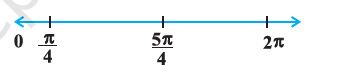
Now f'(x) = 0 gives sin x = cos x which gives that \(x=\frac{\pi}{4}, \frac{5 \pi}{4} \text { as } 0 \leq x \leq 2 \pi\)
The points \(x=\frac{\pi}{4} \text { and } x=\frac{5 \pi}{4}\) divide the interval [0, 2p] into three disjoint intervals namely,
\(\left[0, \frac{\pi}{4}\right),\left(\frac{\pi}{4}, \frac{5 \pi}{4}\right) \text { and }\left(\frac{5 \pi}{4}, 2 \pi\right]\)
\(\text {Note that } f^{\prime}(x)>0 \text {if } x \in\left[0, \frac{\pi}{4}\right) \cup\left(\frac{5 \pi}{4}, 2 \pi\right]\)
or f is increasing in the intervals \(\left[0, \frac{\pi}{4}\right) \text { and }\left(\frac{5 \pi}{4}, 2 \pi\right]\)
\(\text {Also }f^{\prime}(x)<0 \text { if } x \in\left(\frac{\pi}{4}, \frac{5 \pi}{4}\right)\)
or is plecreasing in \( \left(\frac{\pi}{4}, \frac{5 \pi}{4}\right)\)
| Interval | Sign of f'(x) | Nature of function |
| \(\left[0, \frac{\pi}{4}\right)\) | > 0 | f is increasing |
| \(\left(\frac{\pi}{4}, \frac{5 \pi}{4}\right)\) | < 0 | f is decreasing |
| \(\left(\frac{5 \pi}{4}, 2 \pi\right]\) | > 0 | f is increasing |
3.
Let r be the radius, h be the height, α be semi-vertical
Then \(\tan \alpha=\frac{r}{h}\)
Given, \( \alpha =\tan ^{-1}(0.5) \)
\(\frac{r}{h} =0.5 \\ r =\frac{h}{2} \)
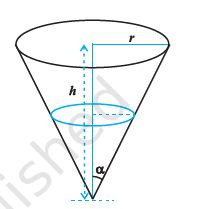
Let V be the volume of the cone. Then
\(\mathrm{V}=\frac{1}{3} \pi r^2 h=\frac{1}{3} \pi\left(\frac{h}{2}\right)^2 h=\frac{\pi h^3}{12}\)
Therefore \( \frac{d \mathrm{~V}}{d t} =\frac{d}{d h}\left(\frac{\pi h^3}{12}\right) \cdot \frac{d h}{d t} \)
\(=\frac{\pi}{4} h^2 \frac{d h}{d t} \)
Now rate of change of volume, i.e., \(\frac{d \mathrm{~V}}{d t}=5 \mathrm{~m}^3 / \mathrm{h} \text { and } h=4 \mathrm{~m}\)
\(5=\frac{\pi}{4}(4)^2 \cdot \frac{d h}{d t}\)
\(\frac{d h}{d t}=\frac{5}{4 \pi}=\frac{35}{88} \mathrm{~m} / \mathrm{h}\left(\pi=\frac{22}{7}\right)\)
Thus, the rate of change of water level is \(\frac{35}{88} \mathrm{~m} / \mathrm{h}\)
\(V=\frac{1}{3} \pi r^{2} h=\frac{1}{3} \pi\left(\frac{h}{2}\right) h \quad \text { Ans. } \left.\frac{35}{88} \mathrm{~m} / \mathrm{h}\right]\)
4.
Let radius of cone be x and its height be h.
\(\therefore\) OD = (h - r)
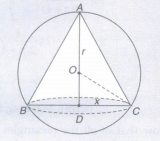
Volume of cone (V)
\(=\frac { 1 }{ 3 } \pi { x }^{ 2 }h\) ...(i)
In \(\Delta OCD,\quad { x }^{ 2 }+({ h-r) }^{ 2 }={ r }^{ 2 }or\quad { x }^{ 2 }={ r }^{ 2 }-{ (h-r) }^{ 2 }\)
\(\therefore V=\frac { 1 }{ 3 } \pi h\{ { r }^{ 2 }-(h-r{ ) }^{ 2 }\} \)
\(=\frac { 1 }{ 3 } \pi (-{ h }^{ 3 }+{ 2h }^{ 2 }r)\)
\(\Rightarrow \frac { dV }{ dh } =\frac { \pi }{ 3 } (-3{ h }^{ 2 }+4hr)\)
\(\therefore \quad \frac { dV }{ dh } =0\Rightarrow h=\frac { 4r }{ 3 } \)
\(\frac { { d }^{ 2 }V }{ { dh }^{ 2 } } =\frac { \pi }{ 3 } (-6h+4r)\)
\(=\frac { \pi }{ 3 } \left( -6\left( \frac { 4r }{ 3 } \right) +4r \right) \)
\(=-\frac { 4\pi r }{ 3 } <0\)
\(\therefore \ at\quad h=\frac { 4r }{ 3 } \), Volume is maximum
Maximum volume
\(=\frac { 1 }{ 3 } \pi .\left\{ -{ \left( \frac { 4r }{ 3 } \right) }^{ 3 }+2{ \left( \frac { 4r }{ 3 } \right) }^{ 2 }r \right\} \)
\(=\frac { 8 }{ 27 } .\left( \frac { 4 }{ 3 } \pi { r }^{ 3 } \right) \)
\(=\frac { 8 }{ 27 } \) (volume of sphere)
5.
We have \(F(\alpha)=\begin{vmatrix}cos\alpha&-sin\alpha&0\\sin\alpha&cos\alpha&0\\0&0&1 \end{vmatrix}\)
\(F(-\alpha)=\begin{bmatrix}cos(-\alpha) &-sin(-\alpha)&0\\sin(-\alpha)&cos{-\alpha}&0\\0&0&1\end{bmatrix}\)
\(=\begin{bmatrix} cos\alpha&sin\alpha&0\\-sin\alpha&cos\alpha&0\\0&0&1\end{bmatrix}\)
\(\therefore F(\alpha).F(-\alpha)=\begin{bmatrix}cos\alpha&-sin\alpha&0\\sin\alpha&cos\alpha&0\\0&0&1 \end{bmatrix}\begin{bmatrix}cos\alpha&sin\alpha&0\\-sin\alpha &cos\alpha &0\\0&0&1\end{bmatrix}\)
\(=\begin{bmatrix} cos^2\alpha+sin^2\alpha&cos\alpha sin\alpha-sin\alpha cos\alpha&0+0+0\\sin\alpha cos\alpha-sin\alpha cos\alpha&sin^2\alpha+cos^2\alpha&0+0+0\\0+0+0&0+0+0&0+0+0\end{bmatrix}\)
\(=\begin{bmatrix} 1&0&0\\0&1&0\\0&0&1\end{bmatrix}=I_3\)
\(\Rightarrow [F(\alpha)]^{-1}=F(\alpha)...(1)\)
Similarly \([G(\beta)]^{-1}=G(-\beta).....(2)\)
Now \([F(\alpha)G(\beta)]^{-1}=[G(\beta)]^{-1}[F(\alpha)]^{-1}=G(\beta)F(-\beta).\)
Hence the result
6.
\(\frac { 2{ cos }^{ 3 }t+3\ \ cos\ t }{ 2{ sin }^{ 3 }t+3 \ \ sin \ t } \)
7.
Here, \(f(x)=\left\{\begin{array}{cl} \lambda\left(x^{2}-2 x\right), & \text { if } x \leq 0 \\ 4 x+1, & \text { if } x>0 \end{array}\right.\)
At \(x=0, \mathrm{LHL}=\lim _{x \rightarrow 0^{-}} f(x)=\lim _{x \rightarrow 0^{-}} \lambda\left(x^{2}-2 x\right)\)
\(\therefore \mathrm{LHL}=\lim _{h \rightarrow 0} \lambda\left[(0-h)^{2}-2(0-h)\right]=\lim _{h \rightarrow 0}\left[\lambda\left(h^{2}+2 h\right)\right]=0\)
\(\mathrm{RHL}=\lim _{x \rightarrow 0^{+}} f(x)=\lim _{x \rightarrow 0^{+}}(4 x+1)\)
\(\therefore \mathrm{RHL}=\lim _{h \rightarrow 0}[4(0+h)+1]=\lim _{h \rightarrow 0}[4 h+1]=0+1=1\)
\(\text { [put } x=0+h \text { ; when } x \rightarrow 0^{+} \text {, then } \left.h \rightarrow 0\right] \)
\(\therefore \mathrm{LHL} \neq \mathrm{RHL}\)
Thus, f(x) is not continuous at x = 0 for any value of λ.
At x = 1,
\( \mathrm{LHL} =\lim _{x \rightarrow 1^{-}} f(x)=\lim _{x \rightarrow 1^{-}}(4 x+1) \)
\(\therefore \mathrm{LHL} =\lim _{h \rightarrow 0}[4(1-h)+1]=\lim _{h \rightarrow 0}[5-4 h]=5-0=5 \)
[put x=1−h; when x→1−,then h→0]
\( \mathrm{RHL}=\lim _{x \rightarrow 1^{+}} f(x)=\lim _{x \rightarrow 1^{+}}(4 x+1) \)
\(\therefore \lim _{h \rightarrow 0}[4(1+h)+1]=\lim _{h \rightarrow 0}(5+4 h)=5+0=5 \)
[put x=1+h; when x→1, then h→0]
Also, f(1)=4×1+1=5
\([\because f(x)=4 x+1]\)
Thus f(x) is continuous at x=1 for all values of λ.
8.
A = {1, 2, 3, 4, 5, 6}
R = {(x, y): y is divisible by x}
We know that any number (x) is divisible by itself.
⇒ (x, x) ∈R
∴ R is reflexive.
Now,
(2, 4) ∈R [as 4 is divisible by 2]
But,
(4, 2) ∉ R. [as 2 is not divisible by 4]
∴ R is not symmetric.
Let (x, y), (y, z) ∈ R. Then, y is divisible by x and z is divisible by y.
∴ z is divisible by x.
⇒ (x, z) ∈R
∴ R is transitive.
Hence, R is reflexive and transitive but not symmetric.
9.
The area of a circle (A) with radius (r) is given by .
.
Therefore, the rate of change of area (A) with respect to time (t) is given by,
 [By chain rule]
It is given that .
.
Thus, when r = 8 cm,

Hence, when the radius of the circular wave is 8 cm, the enclosed area is increasing at the rate of 80 π cm2/s.
10.
Note that
f '(x) = 3x2 – 6x + 4
= 3(x2 – 2x + 1) + 1
= 3(x – 1)2 + 1 > 0, in every interval of R
Therefore, the function f is increasing on R.
11.
As the given matrices are equal, therefore, their corresponding elements must be equal. Comparing the corresponding elements, we get
x + 3 = 0, z + 4 = 6, 2y – 7 = 3y – 2
a – 1 = – 3, 0 = 2c + 2 b – 3 = 2b + 4,
Simplifying, we get
a = – 2, b = – 7, c = – 1, x = – 3, y = –5, z = 2
12.
\(\frac{d y}{d x}=e^{x}+2 x e^{x^{2}}+3 x^{2} e^{x^{3}}+4 x^{3} e^{x^{4}}+5 x^{4} e^{x^{5}}\)
13.
For x = -3 function is not defined. Hence, not continuous for x ∈ R.
14.
\(We\quad have\quad :\quad x={ 2at }^{ 2 },y={ at }^{ 4 }\)
\(\frac { dx }{ dt } =4at,\frac { dy }{ dt } ={ 4at }^{ 3 }\)
\(\frac { dy }{ dx } =\frac { dy/dt }{ dx/dt } =\frac { { 4at }^{ 3 } }{ 4at } ={ t }^{ 2 }\)
15.
We have
\(f(x)=\log \sin x \)
\(\therefore f^{\prime}(x)=\frac{1}{\sin x} \cos x=\cot x \)
In interval \( \left(0, \frac{\pi}{2}\right), f^{\prime}(x)=\cot x>0\)
\(\therefore f \text { is strictly increasing in }\left(0, \frac{\pi}{2}\right) \text { . }\)
In interval \( \left(\frac{\pi}{2}, \pi\right), f^{\prime}(x)=\cot x<0\)
\(\therefore f \text { is strictly decreasing in }\left(\frac{\pi}{2}, \pi\right) \text { . }\)
16.
\(We\quad have:\quad y=3{ e }^{ 2x }+{ 2e }^{ 3x }\)
\(\frac { dy }{ dx } =6{ e }^{ 2x }+6{ e }^{ 3x }=6({ e }^{ 2x }+{ e }^{ 3x })\)
\(and\quad \frac { { d }^{ 2 }y }{ d{ x }^{ 2 } } =12{ e }^{ 2x }+18{ e }^{ 3x }=6(2{ e }^{ 2x }+3{ e }^{ 3x })\)
\(Now\quad \frac { { d }^{ 2 }y }{ d{ x }^{ 2 } } -5\frac { dy }{ { dx }^{ 2 } } +6y\)
\(=6(2{ e }^{ 2x }+3{ e }^{ 3x })-5.6({ e }^{ 2x }+{ e }^{ 3x })+6(3{ e }^{ 2x }+{ 2e }^{ 3x })\)
17.
We differentiate the relationship directly with respect to x, i.e.,
\(\frac{d y}{d x}+\frac{d}{d x}(\sin y)=\frac{d}{d x}(\cos x)\)
which implies using chain rule
\(\frac{d y}{d x}+\cos y \cdot \frac{d y}{d x}=-\sin x\)
This gives, \( \frac { dy }{ dx } =-\frac { sin\quad x }{ 1+cos\quad y } \)
\(where\ y\neq (2n+1)\pi ,\ n\epsilon I.\)
18.
Area of \(\Delta ABC={1\over 2}\left|\begin{matrix}x_1&y_1&1\\x_2&y_2&1\\x_3&y_3&1\end{matrix}\right|\)
\(={1\over2}\begin{vmatrix} a&a+b&1\\b&c+a&1\\c&a+b&1 \end{vmatrix}\)
\(={1\over2}\begin{vmatrix}a+b+C&b+c&1\\a+b+c&c+a&1\\a+b+c&a+b&1 \end{vmatrix}\)
\({1\over2}(a+b+c)\begin{vmatrix}1&b+c&1\\1&c+a&1\\1&a+b&1 \end{vmatrix}\)
\(={1\over2}(a+b+c)(0)=0\)
19.
Let \({ cot }^{ -1 }\left( -\frac { 1 }{ \sqrt { 3 } } \right) =y\), Then \(\cot y=\frac{-1}{\sqrt{3}}=-\cot \left(\frac{\pi}{3}\right)=\cot \left(\pi-\frac{\pi}{3}\right)=\cot \left(\frac{2 \pi}{3}\right)\)
We know that the range of principal value branch of cot–1 is (0, π) and \(\cot \left(\frac{2 \pi}{3}\right)=\frac{-1}{\sqrt{3}}\)
Hence, principal value of \({ cot }^{ -1 }\left( -\frac { 1 }{ \sqrt { 3 } } \right) =\frac { 2\pi }{ 3 } .\)
20.
(c)
1
21.
(a)
(2 \(\sqrt2\),4)
22.
(b)
cos 2x
23.
(d)
a11 A11+ a21 A21 + a31 A31
24.
(b)
土6
25.
(b)
A is a zero matrix
26.
(d)
512
27.
(b)
\(-\frac { \pi }{ 2 } \le y\le \frac { \pi }{ 2 } \)
28.
(d)
f is neither one-one nor onto
29.
(c)
(6, 8)∈ R

12th Standard CBSE Syllabus & Materials
12th Standard CBSE
CBSE 12th Computer Science Python Revision Tour I - New Previous year Question Papers Study Material - QB365 Set A
NEW12th Standard CBSE
CBSE 12th Business Studies Planning Important Questions And Answers Study Material - QB365 Set A
NEW12th Standard CBSE
CBSE 12th Business Studies Business Environment Important Questions And Answers Study Material - QB365 Set A
NEW12th Standard CBSE
CBSE 12th Business Studies Principles of Management Important Questions And Answers Study Material - QB365 Set A



NCERT Books

Syllabus

Exam Pattern

Sample Question Papers

Previous year Question Papers

Important Notes

MCQ Practice test

NCERT Exemplers

Case study Questions

Image Based Questions

Passage based Questions

HOT Questions

Value Based Questions

Model Questions Papers
NCERT ( Book Back ) Questions

Assertion and Reason
Important Questions And Answers

CBSE 12th Standard CBSE Subjects
CBSE Standards








