
 100% FREE ACCESS
12th Standard CBSE Syllabus & Materials
12th Standard CBSE
CBSE 12th Economics Government Budget and the Economy Previous year Question Papers Study Material - QB365 Set A
NEW12th Standard CBSE
CBSE 12th Computer Science Interface Python with MySQL - New Previous year Question Papers Study Material - QB365 Set A
NEW12th Standard CBSE
CBSE 12th Computer Science Database Concept - New Previous year Question Papers Study Material - QB365 Set A
NEW12th Standard CBSE
CBSE 12th Computer Science Data Communication - New Previous year Question Papers Study Material - QB365 Set A
NEW12th Standard CBSE
CBSE 12th Computer Science Data Structures - New Previous year Question Papers Study Material - QB365 Set A
NEW12th Standard CBSE
CBSE 12th Computer Science Functions - New Previous year Question Papers Study Material - QB365 Set A

Published on: 02/11/2025
Download CBSE Class 12th Standard CBSE Maths question papers, sample papers, important questions, and previous year solved papers in PDF format. Get free study materials, NCERT solutions, and exam preparation resources for Class 12th Standard CBSE Maths
Questions + Answers key
Take MCQ Maths Test
1.
Find the value of \(\cos ^{-1}\left(-\frac{1}{2}\right)+\tan ^{-1}(-\sqrt{3})-\operatorname{cosec}^{-1}(2)\)
2.
Solve for x : \(cos\left[ { tan }^{ -1 }(x) \right] =sin\left[ { cot }^{ -1 }\left( \frac { 3 }{ 4 } \right) \right] \)
3.
Prove that \({ cos }^{ -1 }(x)+{ cos }^{ -1 }\left( \frac { x }{ 2 } +\frac { \sqrt { 3-{ 3x }^{ 2 } } }{ 2 } \right) =\frac { \pi }{ 3 } \)
4.
Show that \({ cot }^{ -1 }\left( \frac { \sqrt { 1+sin\quad x } +\sqrt { 1-sin\quad x } }{ \sqrt { 1+sin\quad x } -\sqrt { 1-sin\quad x } } \right) =\frac { x }{ 2 } ,x\in \left( 0,\frac { \pi }{ 4 } \right) \)
5.
Solve for \(x,\ { tan }^{ -1 }3x+{ tan }^{ -1 }2x=\frac { \pi }{ 4 } \)
6.
Express \(\tan ^{-1}\left(\frac{\cos x}{1-\sin x}\right) \frac{-3 \pi}{2}<x<\frac{\pi}{2}\) in the simplest form.
7.
Find the value of \(\sin ^{-1}\left[\sin \frac{13 \pi}{7}\right]\)
8.
Find the value of \(\sin ^{-1}\left[\cos \frac{33 \pi}{5}\right]\)
9.
Draw the graph of \(f(x)=\sin ^{-1} x, x \in\left[-\frac{1}{\sqrt{2}}, \frac{1}{\sqrt{2}}\right]\). Also, write range of f(x).
10.
Evaluate \(3 \sin ^{-1}\left(\frac{1}{\sqrt{2}}\right)+2 \cos ^{-1}\left(\frac{\sqrt{3}}{2}\right)+\cos ^{-1}(0)\)
11.
Evaluate \(\cos ^{-1}\left[\cos \left(-\frac{7 \pi}{3}\right)\right]\)
12.
Find the domain of \(y=\sin ^{-1}\left(x^2-4\right)\)
13.
Evaluate \( \sin ^{-1}\left(\sin \frac{3 \pi}{4}\right)+\cos ^{-1}\left(\cos \frac{3 \pi}{4}\right)+\tan ^{-1}(1)\)
14.
Find the value of \(\tan ^{-1}\left[2 \cos \left(2 \sin ^{-1} \frac{1}{2}\right)\right]+\tan ^{-1} 1\)
15.
Write the domain and range (principle value branch) of the following function \(f(x)=\tan ^{-1} x\)
16.
Using principal values, write the value of \(\\ \\ \left[ { cos }^{ -1 }\left( \frac { 1 }{ 2 } \right) +2{ sin }^{ -1 }\left( \frac { 1 }{ 2 } \right) \right] \)
17.
Find the value of the following : \(cot\left( \frac { \pi }{ 2 } -2cot^{ -1 }\sqrt { 3 } \right) \)
18.
Write the principal value of tan-1\(\left[ sin\left( -\frac { \pi }{ 2 } \right) \right] \)
19.
Solve the equation \(\cos \left(\tan ^{-1} x\right)=\sin \left(\cot ^{-1} \frac{3}{4}\right)\)
20.
\(\text { Evaluate } \tan \left(\sin ^{-1} \frac{3}{5}+\cot ^{-1} \frac{3}{2}\right)\)
21.
The value of \(\tan ^{-1}\left(\frac{-1}{\sqrt{3}}\right)+\cot ^{-1}\left(\frac{1}{\sqrt{3}}\right)+\tan ^{-1}\left(\sin \left(-\frac{\pi}{2}\right)\right)\) is
\(\frac{\pi}{6}\)
\(\frac{\pi}{12}\)
\(-\frac{\pi}{12}\)
\(\frac{\pi}{3}\)
22.
Write the principal value of \({ tan }^{ -1 }\left( \sqrt { 3 } \right) +{ cot }^{ -1 }\left( -\sqrt { 3 } \right) \)
23.
Two men on either side of a temple of 30 m high observe its top at the angles of elevation = α and ẞ respectively. (as shown in the figure below).
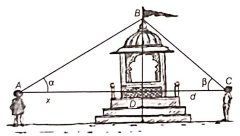
The distance between the two men is 40√3 m and the distance between the first person A and the temple is 30√3 m. Based on the above information answer the following questions.
∠CAB = α =
| a) sin-1 (2/√3) | b) sin-1 (1/2) | c) sin-1 (2) | d) sin-1 (√3/2) |
(ii) \(\angle C A B=\alpha=\)
| a) \(\cos ^{-1}\left(\frac{1}{5}\right)\) | b) \(\cos ^{-1}\left(\frac{2}{5}\right)\) | c) \(\cos ^{-1}\left(\frac{\sqrt{3}}{2}\right)\) | d) \(\cos ^{-1}\left(\frac{4}{5}\right)\) |
(iii) \(\angle B C A=\beta=\)
| a) \(\tan ^{-1}\left(\frac{1}{2}\right)\) | b) \(\tan ^{-1} (2)\) | c) \(\tan ^{-1}\left(\frac{1}{\sqrt{3}}\right)\) | d) \(\tan ^{-1}(\sqrt{3})\) |
(iv) \(\angle A B C=\)
| a) \(\frac{\pi}{4}\) | b) \(\frac{\pi}{6}\) | c) \(\frac{\pi}{2}\) | d) \(\frac{\pi}{3}\) |
(v) Domain and range of \(\cos ^{-1} x=\)
| a) \((-1,1),(0, \pi)\) | b) \([-1,1],(0, \pi)\) | c) \([-1,1],[0, \pi]\) | d) \((-1,1),\left[-\frac{\pi}{2}, \frac{\pi}{2}\right]\) |
1.
Firstly, assume the given inverse trigonometric function equal to y( or x) Let \(y=\cos ^{-1}\left(-\frac{1}{2}\right)\)
\(\Rightarrow \cos y=\frac{-1}{2}=-\cos \frac{\pi}{3}=\cos \left(\pi-\frac{\pi}{3}\right) \)
\(\Rightarrow \cos y=\cos \left(\frac{2 \pi}{3}\right) \Rightarrow y=\frac{2 \pi}{3}\)
Since, the principal value branch of \(\cos ^{-1} is [0, \pi]\) and
\(\frac{2 \pi}{3} \in[0, \pi]\)
So, the principal value of \(\cos ^{-1}\left(-\frac{1}{2}\right)\) is \(\frac{2 \pi}{3}\).
Now, find the principal value of \(tan ^{-1}(-\sqrt{3})\ Let\ x=\tan ^{-1}(-\sqrt{3})\)
\(\Rightarrow \tan x=-\sqrt{3}=-\tan \frac{\pi}{3} \quad\left[\because \tan \frac{\pi}{3}=\sqrt{3}\right]\)
\(\Rightarrow \tan x=\tan \left(\frac{-\pi}{3}\right) \quad[\because \tan (-\theta)=-\tan \theta]\)
\(\Rightarrow x=-\frac{\pi}{3}\)
Since, the principal value branch of \(\tan ^{-1}\) is \(\left(\frac{-\pi}{2}, \frac{\pi}{2}\right)\) and \(-\frac{\pi}{3} \in\left(\frac{-\pi}{2}, \frac{\pi}{2}\right)\)
Now, find the principal value of \(\operatorname{cosec}^{-1}\)
Let \(z=\operatorname{cosec}^{-1}(2) \Rightarrow \operatorname{cosec} z=2=\operatorname{cosec} \frac{\pi}{6} \Rightarrow z=\frac{\pi}{6}\)
Since, the principal value branch of \(\operatorname{cosec}^{-1}\) is \(\left[\frac{-\pi}{2}, \frac{\pi}{2}\right]-\{0\}\) and \(\frac{\pi}{6} \in\left[\frac{-\pi}{2}, \frac{\pi}{2}\right]-\{0\}\)
So, the principal value of \(\operatorname{cosec}^{-1}(2)\) is \(\frac{\pi}{6}\).
\(\therefore \cos ^{-1}\left(-\frac{1}{2}\right)+\tan ^{-1}(-\sqrt{3})-\operatorname{cosec}^{-1} 2\)
\(=\frac{2 \pi}{3}-\frac{\pi}{3}-\frac{\pi}{6}=\frac{(4-2-1) \pi}{6}=\frac{\pi}{6}\)
2.
\(cos\left[ { tan }^{ -1 }(x) \right] =sin\left[ { cot }^{ -1 }\frac { 3 }{ 4 } \right] \)
\(\Rightarrow \quad cos\left[ { cos }^{ -1 }\left( \frac { 1 }{ \sqrt { 1+{ x }^{ 2 } } } \right) \right] =sin\left[ { sin }^{ -1 }\left( \frac { 4 }{ 5 } \right) \right] \)
\(\Rightarrow \quad \quad \frac { 1 }{ \sqrt { 1+{ x }^{ 2 } } } =\frac { 4 }{ 5 } \)
\(\Rightarrow \quad \quad 1+{ x }^{ 2 }=\frac { 25 }{ 16 } \)
\(\Rightarrow \quad \quad { x }^{ 2 }=\frac { 25 }{ 16 } -1=\frac { 9 }{ 16 } \)
\(\Rightarrow \quad \quad x=\frac { 3 }{ 4 } ,-\frac { 3 }{ 4 } \)
\(\Rightarrow \quad x=-\frac { 3 }{ 4 } \) does not satisfy so \(x=\frac { 3 }{ 4 } \)
3.
Let, \({ cos }^{ -1 }x=\alpha \Rightarrow x=cos\alpha \)
LHS=\(\alpha +{ cos }^{ -1 }\left[ cos\alpha cos\left( \frac { \pi }{ 3 } \right) +\frac { \sqrt { 3 } }{ 2 } \sqrt { 1-{ cos }^{ 2 }\alpha } \right] \)
\(=\alpha +{ cos }^{ -1 }\left[ cos\left( \frac { \pi }{ 3 } \right) cos\alpha +sin\frac { \pi }{ 3 } sin\alpha \right] \)
\(=\alpha +{ cos }^{ -1 }\left[ cos\left( \frac { \pi }{ 3 } -\alpha \right) \right] \)
\(=\alpha +\frac { \pi }{ 3 } -\alpha \)
\(\left[ \because \quad { cos }^{ -1 }(cos\theta )=\theta \forall \theta \in (0,\pi ) \right] \)
\(=\frac { \pi }{ 3 } =RHS\)
4.
\({ cot }^{ -1 }\left( \frac { \sqrt { 1+sin\quad x } +\sqrt { 1-sin\quad x } }{ \sqrt { 1+sin\quad x } -\sqrt { 1-sin\quad x } } \right) \)
\(={ cot }^{ -1 }\left[ \frac { \sqrt { \left( { cos }^{ 2 }\frac { x }{ 2 } +{ sin }^{ 2 }\frac { x }{ 2 } +2sin\frac { x }{ 2 } cos\frac { x }{ 2 } \right) + } }{ \sqrt { \left( { cos }^{ 2 }\frac { x }{ 2 } +{ sin }^{ 2 }\frac { x }{ 2 } +2sin\frac { x }{ 2 } cos\frac { x }{ 2 } \right) - } } \frac { \sqrt { \left( { cos }^{ 2 }\frac { x }{ 2 } +{ sin }^{ 2 }\frac { x }{ 2 } -2sin\frac { x }{ 2 } cos\frac { x }{ 2 } \right) } }{ \sqrt { \left( { cos }^{ 2 }\frac { x }{ 2 } +sin^{ 2 }\frac { x }{ 2 } -2sin\frac { x }{ 2 } cos\frac { x }{ 2 } \right) } } \right] \)
\(={ cot }^{ -1 }\left[ \frac { \sqrt { { \left( cos\frac { x }{ 2 } +sin\frac { x }{ 2 } \right) }^{ 2 } } +\sqrt { { \left( cos\frac { x }{ 2 } -sin\frac { x }{ 2 } \right) }^{ 2 } } }{ \sqrt { { \left( cos\frac { x }{ 2 } +sin\frac { x }{ 2 } \right) }^{ 2 }-{ \sqrt { { \left( cos\frac { x }{ 2 } -sin\frac { x }{ 2 } \right) }^{ 2 } } } } } \right] \)
\(={ cot }^{ -1 }\left[ \frac { \left( cos\frac { x }{ 2 } +sin\frac { x }{ 2 } \right) +\left( cos\frac { x }{ 2 } -sin\frac { x }{ 2 } \right) }{ \left( cos\frac { x }{ 2 } +sin\frac { x }{ 2 } \right) -\left( cos\frac { x }{ 2 } -sin\frac { x }{ 2 } \right) } \right] \)
\(={ cot }^{ -1 }\left[ \frac { 2cos\frac { x }{ 2 } }{ 2sin\frac { x }{ 2 } } \right] \left[ \because \quad { cot }^{ -1 }(cot\quad \theta )=\forall \theta \in (0,\quad N) \right] \)
\(={ cot }^{ -1 }\left[ cot\frac { x }{ 2 } \right] \)
\(=\frac { x }{ 2 } \)
5.
\(\Rightarrow \tan ^{-1}\left(\frac{3 x+2 x}{1-3 x \times 2 x}\right)=\frac{\pi}{4}\)
\(\left[\because \tan ^{-1} x+\tan ^{-1} y=\tan ^{-1}\left(\frac{x+y}{1-x y}\right),\right. if \left.x y<1\right]\)
\(\Rightarrow\)\(\tan ^{-1}\left(\frac{5 x}{1-6 x^{2}}\right)=\frac{\pi}{4}\)
\(\Rightarrow \frac{5 x}{1-6 x^{2}}=\tan \frac{\pi}{4}\)
\(\left[\because \tan ^{-1}(\theta)=\phi \Rightarrow \theta=\tan \phi\right]\)
\(\Rightarrow \frac{5 x}{1-6 x^{2}}=1\)
\(\Rightarrow\)\(5 x=1-6 x^{2}\)
\(\Rightarrow 6 x^{2}+6 x-x-1=0\)
\(\Rightarrow 6 x(x+1)-1(x+1)=0\)
\(\Rightarrow(6 x-1)(x+1)=0\)
\( 6 x-1=0 \Rightarrow x=\frac{1}{6}\)
and \(x+1=0 \Rightarrow x=-1\)
Hence, the required value of \(x \text { is } \frac{1}{6}\)
6.
\(\text { We have, } \tan ^{-1}\left(\frac{\cos x}{1-\sin x}\right)=\tan ^{-1}\left[\frac{\sin \left(\frac{\pi}{2}-x\right)}{1-\cos \left(\frac{\pi}{2}-x\right)}\right]\)
\(=\tan ^{-1}\left[\frac{2 \sin \left(\frac{\pi}{4}-\frac{x}{2}\right) \cos \left(\frac{\pi}{4}-\frac{x}{2}\right)}{2 \sin ^2\left(\frac{\pi}{4}-\frac{x}{2}\right)}\right] \)
\(=\tan ^{-1} \cot \left(\frac{\pi}{4}-\frac{x}{2}\right)\)
\(=\tan ^{-1}\left[\tan \left(\frac{\pi}{2}-\left(\frac{\pi}{4}-\frac{x}{2}\right)\right)\right]\)
\(\text { Now, }-\frac{3 \pi}{2}<x<\frac{\pi}{2}\)
\(\Rightarrow \quad-\frac{3 \pi}{4}<\frac{x}{2}<\frac{\pi}{4} \Rightarrow-\frac{\pi}{2}<\frac{x}{2}+\frac{\pi}{4}<\frac{\pi}{2}\)
\(\tan ^{-1}\left(\frac{\cos x}{1-\sin x}\right)=\tan ^{-1} \tan \left(\frac{\pi}{4}+\frac{x}{2}\right)=\frac{\pi}{4}+\frac{x}{2} \)
\({\left[\because \tan \left(\tan ^{-1} x\right)=x, x \in\left[-\frac{\pi}{2}, \frac{\pi}{2}\right]\right]}\)
7.
\( \sin ^{-1}\left[\sin \left(\frac{13 \pi}{7}\right)\right]=\sin ^{-1}\left[\sin \left(2 \pi-\frac{\pi}{7}\right)\right] =\sin ^{-1}\left[\sin \left(\frac{-\pi}{7}\right)\right]=\frac{-\pi}{7} \quad\left[\because \frac{-\pi}{7} \in\left[\frac{-\pi}{2}, \frac{\pi}{2}\right]\right] \)
8.
\(\sin ^{-1}\left(\cos \frac{33 \pi}{5}\right)=\sin ^{-1}\left[\cos \left(6 \pi+\frac{3 \pi}{5}\right)\right]\)
\(=\sin ^{-1}\left(\cos \frac{3 \pi}{5}\right)=\sin ^{-1}\left[\cos \left(\frac{\pi}{2}+\frac{\pi}{10}\right)\right] \)
\(=\sin ^{-1}\left(-\sin \frac{\pi}{10}\right)=-\sin ^{-1}\left(\sin \frac{\pi}{10}\right)=-\frac{\pi}{10}\)
9.
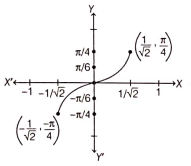
\(f(x)=\sin ^{-1} x, x \in\left[-\frac{1}{\sqrt{2}}, \frac{1}{\sqrt{2}}\right]\)
10.
\(3 \sin ^{-1}\left(\frac{1}{\sqrt{2}}\right)+2 \cos ^{-1}\left(\frac{\sqrt{3}}{2}\right)+\cos ^{-1}(0) \)
\(=3 \times \frac{\pi}{4}+2 \times \frac{\pi}{6}+\frac{\pi}{2} \)
\( =\frac{3 \pi}{4}+\frac{\pi}{3}+\frac{\pi}{2} \)
\( =\frac{9 \pi+4 \pi+6 \pi}{12}=\frac{19 \pi}{12}\)
11.
\(\cos ^{-1}\left[\cos \left(-\frac{7 \pi}{3}\right)\right]=\cos ^{-1}\left[\cos \frac{7 \pi}{3}\right][\because \cos (-\theta)=\cos \theta] \)
\( =\cos ^{-1}\left[\cos \left(2 \pi+\frac{\pi}{3}\right)\right] \)
\( =\cos ^{-1}\left(\cos \frac{\pi}{3}\right)=\frac{\pi}{3} \in[0, \pi]\)
12.
We have, \(y=\sin ^{-1}\left(x^2-4\right)\)
\(\Rightarrow -1 \leq x^2-4 \leq 1\)
\(\Rightarrow -1+4 \leq x^2 \leq 1+4\)
\(\Rightarrow 3 \leq x^2 \leq 5\)
\(\Rightarrow \sqrt{3} \leq|x| \leq \sqrt{5}\)
\(\Rightarrow x \in[-\sqrt{5},-\sqrt{3}] \cup[\sqrt{3}, \sqrt{5}]\)
Therefore The domain of y is \([-\sqrt{5},-\sqrt{3}] \cup[\sqrt{3}, \sqrt{5}]\)
13.
We have, \(\sin ^{-1} \left(\sin \frac{3 \pi}{4}\right)+\cos ^{-1}\left(\cos \frac{3 \pi}{4}\right)+\tan ^{-1}(1) \)
\(=\sin ^{-1}\left[\sin \left(\pi-\frac{\pi}{4}\right)\right]+\cos ^{-1}\left[\cos \frac{3 \pi}{4}\right]+\frac{\pi}{4} \)
\(=\sin ^{-1}\left(\sin \frac{\pi}{4}\right)+\frac{3 \pi}{4}+\frac{\pi}{4}\)
\(=\frac{\pi}{4}+\frac{3 \pi}{4}+\frac{\pi}{4}=\frac{5 \pi}{4}\)
14.
We have, \(\tan ^{-1} {\left[2 \cos \left(2 \sin ^{-1} \frac{1}{2}\right)\right]+\tan ^{-1} 1 } \)
\(=\tan ^{-1}\left[2 \cos \left(2 \sin ^{-1}\left(\sin \frac{\pi}{6}\right)\right)\right]+\tan ^{-1}\left(\tan \frac{\pi}{4}\right) \)
\(=\tan ^{-1}\left[2 \cos \left(2 \times \frac{\pi}{6}\right)\right]+\frac{\pi}{4}\)
\(=\tan ^{-1}\left[2 \cos \left(\frac{\pi}{3}\right)\right]+\frac{\pi}{4}\)
\(=\tan ^{-1}\left[2 \times \frac{1}{2}\right]+\frac{\pi}{4}\)
\(=\tan ^{-1}(1)+\frac{\pi}{4}=\frac{\pi}{4}+\frac{\pi}{4}=\frac{\pi}{2}\)
15.
We know that domain and range (principal value branch) of \(f(x)=\tan ^{-1} x\) are R and \(\left(\frac{-\pi}{2}, \frac{\pi}{2}\right)\) respectively.
16.
\(\left[\cos ^{-1}\left(\frac{1}{2}\right)+2 \sin ^{-1}\left(\frac{1}{2}\right)\right]=\frac{2 \pi}{3}\)
Alternative Method:
\( {\left[\cos ^{-1}\left(\frac{1}{2}\right)+2 \sin ^{-1}\left(\frac{1}{2}\right)\right]}\)
\( =\left[\cos ^{-1}\left(\cos \frac{\pi}{3}\right)+2 \sin ^{-1}\left(\sin \frac{\pi}{6}\right)\right]\)
\( =\left[\frac{\pi}{3}+2 \times \frac{\pi}{6}\right]\)
\( {\left[\because \quad \cos ^{-1}(\cos \quad \theta)=\theta \forall \theta[0, \quad \pi] \quad \text { and } \sin ^{-1}(\sin \quad \theta)=\theta \forall \theta=\left[-\frac{\pi}{2}, \frac{\pi}{2}\right]\right]} \)
\( =\frac{\pi}{3}+\frac{\pi}{3} =\frac{2 \pi}{3}\)
17.
\(cot\left( \frac { \pi }{ 2 } -2cot^{ -1 }\sqrt { 3 } \right) =\sqrt { 3 } \)
Alternative Method :
\(cot\left( \frac { \pi }{ 2 } -2{ cot }^{ -1 }\sqrt { 3 } \right) =cot\left[ \frac { \pi }{ 2 } -2{ cot }^{ -1 }\left( cot\frac { \pi }{ 6 } \right) \right] \)
\(=cot\left[ \frac { \pi }{ 2 } -2\left( \frac { \pi }{ 6 } \right) \right] \)
\(\left[ \because { cot }^{ -1 }(cot\quad \theta )=\theta \ \forall \theta \ \in \ (0,\quad \pi ) \right] \)
\(=cot\left[ \frac { \pi }{ 2 } -\frac { \pi }{ 3 } \right] \)
\(=cot\left( \frac { \pi }{ 6 } \right) \)
\(=\sqrt { 3 } \)
18.
tan-1\(\left[ sin\left( -\frac { \pi }{ 2 } \right) \right] =-\frac { \pi }{ 4 } \)
Alternative Method :
\({ tan }^{ -1 }\left[ sin\left( -\frac { \pi }{ 2 } \right) \right] ={ tan }^{ -1 }\left[ -1 \right] \)
\(=-{ tan }^{ -1 }\left( tan\frac { \pi }{ 4 } \right) \)
\(=-\frac { \pi }{ 4 } \)
\(\because { tan }^{ -1 }(tan\quad \theta )=\theta \quad \forall \ \theta \in \left( -\frac { \pi }{ 2 } ,\frac { \pi }{ 2 } \right) \)
19.
\(\cos \left(\tan ^{-1} x\right)=\sin \left(\cot ^{-1} \frac{3}{4}\right)\)
\(\Rightarrow \sin \left\{\frac{\pi}{2}-\tan ^{-1} x\right\}=\sin \left(\cot ^{-1} \frac{3}{4}\right)\)
On equating both sides, we get
\( \frac{\pi}{2}-\tan ^{-1} x =\cot ^{-1} \frac{3}{4} \)
\(\Rightarrow \cot ^{-1} x=\cot ^{-1} \frac{3}{4} \quad\left[\because \tan ^{-1} x+\cot ^{-1} x=\frac{\pi}{2}\right] \)
Again, equating both sides, we get \(x=\frac{3}{4}\)
20.
\( \tan \left(\sin ^{-1} \frac{3}{5}+\cot ^{-1} \frac{3}{2}\right)=\tan \left[\tan ^{-1} \frac{3}{4}+\tan ^{-1} \frac{2}{3}\right]\)
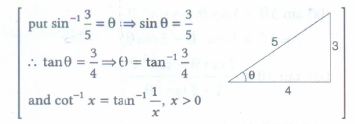
\(=\tan \left[\tan ^{-1} \frac{\left(\frac{3}{4}+\frac{2}{3}\right)}{1-\frac{3}{4} \times \frac{2}{3}}\right] \)
\(=\tan \left[\tan ^{-1} \frac{\frac{17}{12}}{\frac{1}{2}}\right] \)
\(=\tan \left[\tan ^{-1} \frac{17}{6}\right]=\frac{17}{6}\)
21.
\( \tan ^{-1}\left(\frac{-1}{\sqrt{3}}\right)+\cot ^{-1}\left(\frac{1}{\sqrt{3}}\right)+\tan ^{-1}\left(\sin \left(-\frac{\pi}{2}\right)\right)\)
\(\frac{-\pi}{6}+\frac{\pi}{3}+\tan ^{-1}(-1)\)
\( {\left[\because \tan ^{-1}\left(\frac{-1}{\sqrt{3}}\right)=\frac{-\pi}{6}, \cot ^{-1}\left(\frac{1}{\sqrt{3}}\right)=\frac{\pi}{3}, \sin \left(\frac{-\pi}{2}\right)=-1\right]} \)
\(=\frac{-\pi}{6}+\frac{\pi}{3}-\frac{\pi}{4}=\frac{-\pi}{12}\)
22.
\(\tan ^{-1} \sqrt{3}-\cot ^{-1}(-\sqrt{3}) =\tan ^{-1} \sqrt{3}-\left[\pi-\cot ^{-1}(\sqrt{3})\right] \)
\(=\left(\tan ^{-1} \sqrt{3}+\cot ^{-1} \sqrt{3}\right)-\pi \)
\(=\frac{\pi}{2}-\pi=\frac{-\pi}{2}\)
23.
(i) (b) \(\ln \triangle A B D\)
\(\tan \alpha =\frac{B D}{A D}\)
\( =\frac{30}{30 \sqrt{3}}=\frac{1}{\sqrt{3}} \)
\(\Rightarrow \alpha =30^{\circ}\)
\(\therefore \sin \alpha =\sin 30^{\circ}=\frac{1}{2}\)
\(\Rightarrow \alpha =\sin ^{-1}\left(\frac{1}{2}\right)\)
(ii) (c) \(\cos \alpha=\cos 30^{\circ}=\frac{\sqrt{3}}{2}\)
\(\Rightarrow \alpha =\cos ^{-1}\left(\frac{\sqrt{3}}{2})\right.\)
(iii) (d) \(\ln \triangle B DC\)
\(\tan \beta =\frac{(BD)}{(C D)}\)
\(=\frac{30}{10 \sqrt{3}}=\sqrt{3} \)
\(\Rightarrow \beta =\tan ^{-1}(\sqrt{3})\)
(iv) \( \text { (c) Since, } \alpha=\sin ^{-1}\left(\frac{1}{2}\right)=\frac{\pi}{6} \text {, } \)
\(\beta=\tan ^{-1}(\sqrt{3})=\frac{\pi}{3} \)
\(\therefore \quad \angle A B C=\pi-\left(\frac{\pi}{6}+\frac{\pi}{3}\right)\)
\( =\pi-\frac{\pi}{2}=\frac{\pi}{2}\)
(v) (c) We know that domain and range of \(\cos ^{-1} x\) are [-1,1] and \([0, \pi]\) respectively.

12th Standard CBSE Syllabus & Materials
12th Standard CBSE
CBSE 12th Computer Science Python Revision Tour I - New Previous year Question Papers Study Material - QB365 Set A
NEW12th Standard CBSE
CBSE 12th Business Studies Planning Important Questions And Answers Study Material - QB365 Set A
NEW12th Standard CBSE
CBSE 12th Business Studies Business Environment Important Questions And Answers Study Material - QB365 Set A
NEW12th Standard CBSE
CBSE 12th Business Studies Principles of Management Important Questions And Answers Study Material - QB365 Set A



NCERT Books

Syllabus

Exam Pattern

Sample Question Papers

Previous year Question Papers

Important Notes

MCQ Practice test

NCERT Exemplers

Case study Questions

Image Based Questions

Passage based Questions

HOT Questions

Value Based Questions

Model Questions Papers
NCERT ( Book Back ) Questions

Assertion and Reason
Important Questions And Answers

CBSE 12th Standard CBSE Subjects
CBSE Standards








