
12th Standard CBSE Syllabus & Materials
12th Standard CBSE
CBSE 12th Economics Government Budget and the Economy Previous year Question Papers Study Material - QB365 Set A
NEW12th Standard CBSE
CBSE 12th Computer Science Interface Python with MySQL - New Previous year Question Papers Study Material - QB365 Set A
NEW12th Standard CBSE
CBSE 12th Computer Science Database Concept - New Previous year Question Papers Study Material - QB365 Set A
NEW12th Standard CBSE
CBSE 12th Computer Science Data Communication - New Previous year Question Papers Study Material - QB365 Set A
NEW12th Standard CBSE
CBSE 12th Computer Science Data Structures - New Previous year Question Papers Study Material - QB365 Set A
NEW12th Standard CBSE
CBSE 12th Computer Science Functions - New Previous year Question Papers Study Material - QB365 Set A

Published on: 20/08/2026
Download CBSE Class 12th Standard CBSE Maths question papers, sample papers, important questions, and previous year solved papers in PDF format. Get free study materials, NCERT solutions, and exam preparation resources for Class 12th Standard CBSE Maths
Questions + Answers key
Take MCQ Maths Test
1.
Solve the following LPP graphically.
Maximise Z = 60x + 40y
subject to the constraints
\(\begin{aligned}
x+2 y \leq 12
\end{aligned}\)
\(\begin{aligned}
2 x+y \leq 12
\end{aligned}\)
\(\begin{aligned}
4 x+5 y \geq 20 \text { and } x, y \geq 0
\end{aligned}\)
2.
Differentiate \(\left( x+\frac { 1 }{ x } \right) ^{ x }+x^{ \left( x+\frac { 1 }{ x } \right) }\)
3.
Find graphically, the maximum value of Z = 2x + 5y, subject to constraints given below: 2x + 4y \(\le \) 8 \(\Rightarrow\) x + 2y \(\le \) 4
3x + y \(\le \) 6
x + y \(\le \) 4
x \(\\ \ge \) 0, y \(\\ \ge \) 0
4.
If \(x=\sqrt { { a }^{ { sin }^{ -1 }t } } ,\quad y=\sqrt { { a }^{ { cos }^{ -1 }tan } } ,\quad show\quad that\quad \frac { dy }{ dx } =\frac { -y }{ x } .\)
5.
For what value of λ is the function defined by
\(f(x)=\begin{cases} \lambda ({ x }^{ 2 }-2x)\quad ,\ if\ x\le 0 \\ 4x+1\quad \quad \ ,\quad if\ x>0 \end{cases} \) continuous at x = 0?
What about continuity at x = 1?
6.
If \(x=a \cos ^3 \theta\) and \(y=a \sin ^3 \theta\), then find the value of \(\frac{d^2 y}{d x^2}\) at \(\theta=\frac{\pi}{6}\).
7.
Solve the following LPP graphically Minimise Z = 5x + 10y subject to the constraints
\(x+2 y \leq 120, \)
\(x+y \geq 60,\)
\(x-2 y \geq 0 \text { and } \)
\(x, y \geq 0\)
8.
For what values of 'a' and 'b', the function 'f' is defined as:
\(f\left( x \right) =\begin{cases} 3ax+b\quad if\quad x<1 \\ 11\quad if\quad x=1 \\ 5ax-2b\quad if\quad x>1 \end{cases}\)is continuous at x = 1.
9.
Find dy/dx of the function : \(x=a(cos\theta +sin\theta ),\quad y=a(sin\theta -\theta cos\theta )\)
10.
Solve the following linear programming problem graphically:
Minimise Z = 200 x + 500 y
subject to the constraints
\(x+2y\ge 10,\)
\(3x+4y\le 24,\)
\(x\ge 0,y\ge 0.\)
11.
Find dy/dx in the following : \({ x }^{ 2 }+xy+{ y }^{ 2 }=100\)
12.
Show that :
\({ \sin }^{ -1 }(2x\sqrt { 1-{ x }^{ 2 } } )={ 2\sin }^{ -1 }x,\frac { 1 }{ \sqrt { 2 } } \le x\le \frac { 1 }{ \sqrt { 2 } } \)
13.
Simplify \(\tan ^{-1}\left[\sqrt{\frac{1-\cos x}{1+\cos x}}\right], x<\pi\)
14.
Find the value of \(\sin ^{-1}\left[\cos \left(\frac{33 \pi}{5}\right)\right]\)
15.
If x = \(\frac { at }{ 1+{ t }^{ 2 } } ,y=\frac { a{ t }^{ 2 } }{ 1+{ t }^{ 2 } } ,find\frac { dy }{ dx } at\) t = 2
16.
If x = \(\theta\)sin\(\theta\), y = \(\theta\)cos\(\theta\) find dy/dx at \(\theta\) = \(\pi/4\)
17.
If y = log(sin x), find \(\frac { { d }^{ 2 }y }{ d{ x }^{ 2 } } \)
18.
Simplify : \({ cot }^{ -1 }\frac { 1 }{ \sqrt { { x }^{ 2 }-1 } } for\quad x<-1\)
19.
If \(y=A e^{5 x}+B e^{-5 x}\), then \(\frac{d^2 y}{d x^2}\) is equal to
25 y
5 y
-25 y
15 y
20.
If \(y=\log \left(\cos e^x\right)\), then \(\frac{d y}{d x}\) is
\(\cos e^{x-1}\)
\(e^{-x} \cos e^x\)
\(e^x \sin e^x\)
\(-e^x \tan e^x\)
21.
If \(e^x+e^y=e^{x+y}\), then \(\frac{d y}{d x}\) is
\(e^{y-x}\)
\(e^{x+y}\)
\(-e^{y-x}\)
\(2 e^{x-y}\)
22.
The set of all points, where the function f(x) = x + |x| is differentiable, is
\((0, \infty)\)
\((-\infty, 0)\)
\((-\infty, 0) \cup(0, \infty)\)
\((-\infty, \infty)\)
23.
If \(y=\sin ^{-1} x\), then \(\left(1-x^2\right) y_2\) is equal to
\(x y_1\)
\(x y\)
\(x y_2\)
x2
24.
If \(y=\sin ^2\left(x^3\right)\), then \(\frac{d y}{d x}\) is equal to
\(2 \sin x^3 \cos x^3\)
\(3 x^3 \sin x^3 \cos x^3\)
\(6 x^2 \sin x^3 \cos x^3\)
\(2 x^2 \sin ^2\left(x^3\right)\)
25.
The value of k for which function \(f(x)=\left\{\begin{array}{ll}x^2, & x \geq 0 \\ k x, & x<0\end{array}\right.\) is differentiable at x = 0 is
1
2
any real number
0
26.
The function f(x) = [x], where [x] denotes the greatest integer less than or equal to x, is continuous at
x = 1
x = 1.5
x = -2
x = 4
27.
Let Z = ax + by is a linear objective function. Variables x and y are called ……… variables.
Independent
Continuous
Decision
Dependent
28.
The common region determined by all the constraints including non-negative constraints x, y ≥ 0 of a linear programming problem is called the ………
Bounded region
Simple region
Infeasible region
Feasible region
29.
The linear inequalities or equations or restrictions on the variables of a linear programming problem are called …… The conditions x ≥ 0 , y ≥ 0 are called …….
Objective functions, optimal value
Constraints, non-negative restrictions
Objective functions, non-negative restrictions
Constraints, negative restrictions
30.
Value of \({ sin }^{ -1 }\left( sin\frac { 7\pi }{ 4 } \right) \) in the range of sin -1x is
3π/4
π/4
7π/4
-π/4
31.
sin (tan–1 x), |x| < 1 is equal to
\(\frac { x }{ \sqrt { 1-{ x }^{ 2 } } } \)
\(\frac { 1 }{ \sqrt { 1-{ x }^{ 2 } } } \)
\(\frac { 1 }{ \sqrt { 1+{ x }^{ 2 } } } \)
\(\frac { x }{ \sqrt { 1+{ x }^{ 2 } } } \)
32.
\({ \tan }^{ -1 }\sqrt { 3 } -{ \cot }^{ -1 }(-\sqrt { 3 } )\) is equal to
\(\pi \)
\(-\frac { \pi }{ 2 } \)
0
\(2\sqrt { 3 } \)
33.
\(\sin\left( \frac { \pi }{ 3 } -{ \sin }^{ -1 }\left( -\frac { 1 }{ 2 } \right) \right) \) is equal to
\(\frac { 1 }{ 2 } \)
\(\frac { 1 }{ 3 } \)
\(\frac { 1 }{ 4 } \)
1
34.
\({ \cos }^{ -1 }\left( \cos\frac { 7\pi }{ 6 } \right) \) is equal to
\(\frac { 7\pi }{ 6 } \)
\(\frac { 5\pi }{ 6 } \)
\(\frac { \pi }{ 3 } \)
\(\frac { \pi }{ 6 } \)
35.
If sin–1 x = y, then
0 ≤ y ≤ ㅠ
\(-\frac { \pi }{ 2 } \le y\le \frac { \pi }{ 2 } \)
0 < y < π
\(-\frac { \pi }{ 2 } < y < \frac { \pi }{ 2 }\)
36.
tan-1{sin (-\(\frac{\pi}{2}\))} is equal to
-1
1
\(\frac{\pi}{2}\)
\(-\frac{\pi}{4}\)
37.
Two men on either side of a temple of 30 m high observe its top at the angles of elevation = α and ẞ respectively. (as shown in the figure below).
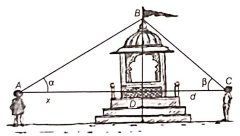
The distance between the two men is 40√3 m and the distance between the first person A and the temple is 30√3 m. Based on the above information answer the following questions.
∠CAB = α =
| a) sin-1 (2/√3) | b) sin-1 (1/2) | c) sin-1 (2) | d) sin-1 (√3/2) |
(ii) \(\angle C A B=\alpha=\)
| a) \(\cos ^{-1}\left(\frac{1}{5}\right)\) | b) \(\cos ^{-1}\left(\frac{2}{5}\right)\) | c) \(\cos ^{-1}\left(\frac{\sqrt{3}}{2}\right)\) | d) \(\cos ^{-1}\left(\frac{4}{5}\right)\) |
(iii) \(\angle B C A=\beta=\)
| a) \(\tan ^{-1}\left(\frac{1}{2}\right)\) | b) \(\tan ^{-1} (2)\) | c) \(\tan ^{-1}\left(\frac{1}{\sqrt{3}}\right)\) | d) \(\tan ^{-1}(\sqrt{3})\) |
(iv) \(\angle A B C=\)
| a) \(\frac{\pi}{4}\) | b) \(\frac{\pi}{6}\) | c) \(\frac{\pi}{2}\) | d) \(\frac{\pi}{3}\) |
(v) Domain and range of \(\cos ^{-1} x=\)
| a) \((-1,1),(0, \pi)\) | b) \([-1,1],(0, \pi)\) | c) \([-1,1],[0, \pi]\) | d) \((-1,1),\left[-\frac{\pi}{2}, \frac{\pi}{2}\right]\) |
38.
Let x = f(t) and y = get) be parametric forms with t as a parameter,
then \(\begin{equation} \frac{d y}{d x}=\frac{d y}{d t} \times \frac{d t}{d x}=\frac{g^{\prime}(t)}{f^{\prime}(t)} \end{equation}\) ,where \(\begin{equation} f^{\prime}(t) \neq 0 \end{equation}\) \(\begin{equation} \frac{d y}{d x}=\frac{d y}{d t} \times \frac{d t}{d x}=\frac{g^{\prime}(t)}{f^{\prime}(t)} \end{equation}\) where \(\begin{equation} f^{\prime}(t) \neq 0 \end{equation}\).
(i) The derivative off (tanx) w.r.t. \(\begin{equation} g(\sec x) \text { at } x=\frac{\pi}{4} \end{equation}\) ,where f'(1) and \(\begin{equation} g^{\prime}(\sqrt{2})=4 \end{equation}\) is
| (a) \(\begin{equation} \frac{1}{\sqrt{2}} \end{equation}\) | (b) \(\begin{equation} \sqrt{2} \end{equation}\) | (c) 1 | (d) 0 |
(ii) The derivate of \(\begin{equation} \sin ^{-1}\left(\frac{2 x}{1+x^{2}}\right) \end{equation}\) ,with respect to \(\begin{equation} \cos ^{-1}\left(\frac{1-x^{2}}{1+x^{2}}\right) \end{equation}\) is
| (a) -1 | (b) 1 | (c) 2 | (d) 4 |
(iii) The derivative of \(\begin{equation} e^{x^{3}} \end{equation}\) with respect to log x is
| (a) \(\begin{equation} e^{x^{3}} \end{equation}\) | (b) \(\begin{equation} 3 x^{2} 2 e^{x^{3}} \end{equation}\) | (c) \(\begin{equation} 3 x^{3} e^{x^{3}} \end{equation}\) | (d) \(\begin{equation} 3 x^{2} e^{x^{3}}+3 x \end{equation}\) |
(iv) The derivative of \(\begin{equation} \cos ^{-1}\left(2 x^{2}-1\right) \end{equation}\) w.r.t. cos-1x is
| (a) 2 | (b) \(\begin{equation} \frac{-1}{2 \sqrt{1-x^{2}}} \end{equation}\) | (c) \(\begin{equation} \frac{2}{x} \end{equation}\) | (d) 1 -x2 |
(v) If \(\begin{equation} y=\frac{1}{4} u^{4} \end{equation}\) and \(\begin{equation} u=\frac{2}{3} x^{3}+5 \end{equation}\) then \(\begin{equation} \frac{d y}{d x}= \end{equation}\)
| (a) \(\begin{equation} \frac{2}{27} x^{2}\left(2 x^{3}+15\right)^{3} \end{equation}\) | (b) \(\begin{equation} \frac{2}{7} x^{2}\left(2 x^{3}+15\right)^{3} \end{equation}\) | (c) \(\begin{equation} \frac{2}{27} x\left(2 x^{3}+5\right)^{3} \end{equation}\) | (d) \(\begin{equation} \frac{2}{7}\left(2 x^{3}+15\right)^{3} \end{equation}\) |
39.
Let f(x) be a real valued function, then its
Left Hand Derivative (L.H.D.) : \(\begin{equation} \mathrm{L} f^{\prime}(a)=\lim _{h \rightarrow 0} \frac{f(a-h)-f(a)}{-h} \end{equation}\)
Right Hand Derivative (R.H.D.) : \(\begin{equation} \mathrm{Rf}^{\prime}(a)=\lim _{h \rightarrow 0} \frac{f(a+h)-f(a)}{h} \end{equation}\)
Also, a function jfx) is said to be differentiable at x = a if its L.H.D. and R.H.D. at x = a exist and are equal
For the function \(\begin{equation} f(x)=\left\{\begin{array}{l} |x-3|, x \geq 1 \\ \frac{x^{2}}{4}-\frac{3 x}{2}+\frac{13}{4}, x<1 \end{array}\right. \end{equation}\) answer the following questions
(i) R.H.D. of f(x) at x = 1is
| (a) 1 | (b) -1 | (c) 0 | (d) 2 |
(ii) L.H.D. of f(x) at x = 1 is
| (a) 1 | (b) -1 | (c) 0 | (d) 2 |
(iii) f(x) is non-differentiable at
| (a) x = 1 | (b) x = 2 | (c) x = 3 | (d) x = 4 |
(iv) Find the value of f'(2).
| (a) 1 | (b) 2 | (c) 3 | (d) -1 |
(v) The value of f'( -1) is
| (a) 2 | (b) 1 | (c) -2 | (d) -1 |
40.
Assertion: The value of tan-1 \(\left ( \frac{3}{4} \right )+tan^{-1}\left ( \frac{1}{7} \right )\)is \(\frac{\pi}{4}\)
Reason: If x > 0, y > 0 then \(tan^{-1}\left ( \frac{x}{y} \right )+tan^{-1}\left ( \frac{y-x}{y+x} \right )=\frac{\pi}{4}\)
(a) Assertion is correct, reason is correct;reason is a correct explanation for assertion.
(b) Assertion is correct, reason is correct; reason is not a correct explanation for assertion
(c) Assertion is correct, reason is incorrect
(d) Assertion is incorrect, reason is correct.
41.
Assertion: For x < 0, \(\frac{d}{dx}\)(In |x| = -\(\frac{1}{x}\)
Reason: For x < 0, |x| = -x
(a) Assertion is correct, Reason is correct; Reason is a correct explanation for assertion.
(b) Assertion is correct, Reason is correct; Reason is not a correct explanation for Assertion
(c) Assertion is correct, Reason is incorrect
(d) Assertion is incorrect, Reason is correct.
1.
We have, maximise, Z = 60x + 40y ...(i)
Subject to the constraints, x + 2y \(\leq 12\) ...(ii)
\(\begin{aligned}
2 x+y & \leq 12
\end{aligned}\) ...(iii)
\(\begin{aligned}
4 x+5 y & \geq 20
\end{aligned}\) ...(iv)
and \(\begin{aligned}
x, y & \geq 0
\end{aligned}\) ...(v)
Table for line x + 2y = 12 is
| x | 0 | 12 |
| y | 6 | 0 |
So, the line x + 2y = 12 is passing through the points (0, 6) and (12, 0).
On putting (0,0) in the inequality \(x+2 y \leq 12\) we get \(0+2(0) \leq 12 \Rightarrow 0 \leq 12\), which is true
So,the half plane is towards the origin.
Table for line 2x + y = 12 is
| x | 0 | 6 |
| y | 12 | 0 |
So, the line 2x + y = 12 is passing through the points (0, 12) and (6, 0).
On putting (0, 0) in the inequality \(2 x+y \leq 12\) we get
\(2(0)+0 \leq 12 \Rightarrow 0 \leq 12\) , which is true.
So, the half plane is towards the origin.
Table for line 4x + 5y = 20 is
| x | 0 | 5 |
| y | 4 | 0 |
So, the line 4x + 5y = 20 is passing through the points (0,4) and (5, 0).
On putting (0, 0) in the inequality \(4 x+5 y \geq 20\), we get 4(0) + 5(0) \(\geq\) 20 \(\Rightarrow\) 0 > 20 which is not true.
So, the half plane is away from the origin.
Also, x, y \(\geq\) 0
So, the region lies in Ist quadrant.
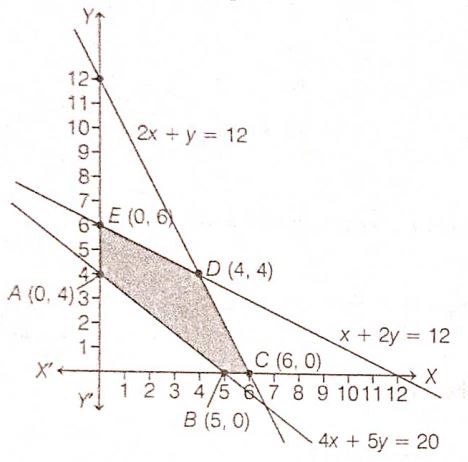
On solving Eqs. x + 2y = 12 and 2x + y = 12, we get D(4, 4)
Clearly, the feasible region is ABCDEA.
The corner points of the feasible region are A(0, 4), B(5, 0), C(6, 0), D(4, 4) and E(0, 6).
The value of Z at corner points are given below.
| Corner points | Z = 60x + 40y |
| A(0, 4) | Z = 60 \(\times\)0 + 40 \(\times\) 4 = 160 |
| B(5, 0) | Z = 60 \(\times\) 5 + 40\(\times\)0 = 300 |
| C(6, 0) | Z = 60 \(\times\) 6 + 40 \(\times\) 0 = 360 |
| D(4, 4) | Z = 60 \(\times\) 4 + 40 \(\times\) 4 = 400 (Maximum) |
| E(0, 6) | Z = 60 \(\times\) 0 + 40 \(\times\) 6 = 240 |
The maximum value of Z is 400 at D(4, 4).
2.
\(\left\{ \left( x+\frac { 1 }{ x } \right) ^{ x }\left[ \frac { { x }^{ 2 }-1 }{ { x }^{ 2 }+1 } +log\left( x+\frac { 1 }{ x } \right) \right] +{ x }^{ 1+\frac { 1 }{ x } }\left( \frac { x+1-logx }{ { x }^{ 2 } } \right) \right\} \)
3.
Given inequations are
\(2 x+4 y \leq 8 \text { or } \ x+2 y \leq 4 \)
\(3 x+y \leq 6, x+y \leq 4, \ x \geq 0, \ y \geq 0
\)
Maximise Z = 2x + 5y on plotting the graph of the inequations we notice shaded portion as feasible solution
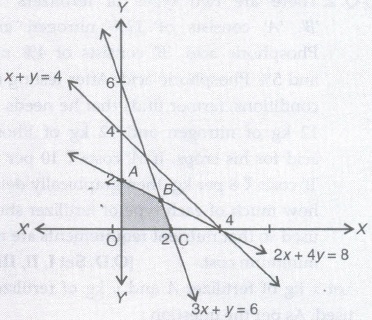
Possible points for maximum Z are A(2, 0),\(B\left(\frac{8}{5}, \frac{6}{5}\right)\) C (0,2)
| Points | Z= 2x + 5y | Values |
| A(2,0) | 4 + 0 | 4 |
| \(B\left(\frac{8}{5}, \frac{6}{5}\right)\) | \(\frac{16}{5}+\frac{30}{5}\) | \(\frac{46}{5}=9 \frac{1}{5}\) |
| C(0,2) | 0 + 10 | 10 \(\leftarrow\) Maximum |
Z is maximum at qo, 2), i.e. x = 0, y = 2, maximum value = 10
4.
\(\therefore \ \frac { dy }{ dx } =\frac { -y }{ x } \)
5.
Here, \(f(x)=\left\{\begin{array}{cl} \lambda\left(x^{2}-2 x\right), & \text { if } x \leq 0 \\ 4 x+1, & \text { if } x>0 \end{array}\right.\)
At \(x=0, \mathrm{LHL}=\lim _{x \rightarrow 0^{-}} f(x)=\lim _{x \rightarrow 0^{-}} \lambda\left(x^{2}-2 x\right)\)
\(\therefore \mathrm{LHL}=\lim _{h \rightarrow 0} \lambda\left[(0-h)^{2}-2(0-h)\right]=\lim _{h \rightarrow 0}\left[\lambda\left(h^{2}+2 h\right)\right]=0\)
\(\mathrm{RHL}=\lim _{x \rightarrow 0^{+}} f(x)=\lim _{x \rightarrow 0^{+}}(4 x+1)\)
\(\therefore \mathrm{RHL}=\lim _{h \rightarrow 0}[4(0+h)+1]=\lim _{h \rightarrow 0}[4 h+1]=0+1=1\)
\(\text { [put } x=0+h \text { ; when } x \rightarrow 0^{+} \text {, then } \left.h \rightarrow 0\right] \)
\(\therefore \mathrm{LHL} \neq \mathrm{RHL}\)
Thus, f(x) is not continuous at x = 0 for any value of λ.
At x = 1,
\( \mathrm{LHL} =\lim _{x \rightarrow 1^{-}} f(x)=\lim _{x \rightarrow 1^{-}}(4 x+1) \)
\(\therefore \mathrm{LHL} =\lim _{h \rightarrow 0}[4(1-h)+1]=\lim _{h \rightarrow 0}[5-4 h]=5-0=5 \)
[put x=1−h; when x→1−,then h→0]
\( \mathrm{RHL}=\lim _{x \rightarrow 1^{+}} f(x)=\lim _{x \rightarrow 1^{+}}(4 x+1) \)
\(\therefore \lim _{h \rightarrow 0}[4(1+h)+1]=\lim _{h \rightarrow 0}(5+4 h)=5+0=5 \)
[put x=1+h; when x→1, then h→0]
Also, f(1)=4×1+1=5
\([\because f(x)=4 x+1]\)
Thus f(x) is continuous at x=1 for all values of λ.
6.
Given, \(x=a \cos ^3 \theta\)and \(y=a \sin ^3 \theta\)
On differentiating both sides of x and y w.r.t. \(\theta\), we get
\(\frac{d x}{d \theta} =3 a \cos ^2 \theta \frac{d}{d \theta}(\cos \theta)=3 a \cos ^2 \theta \cdot(-\sin \theta)\)
\(=-3 a \cos ^2 \theta \cdot \sin \theta\)
and \(\frac{d y}{d \theta}=3 a \sin ^2 \theta \frac{d}{d \theta}(\sin \theta)\)
\(=3 a \sin ^2 \theta \cdot(\cos \theta)=3 a \sin ^2 \theta \cdot \cos \theta\)
Now, \(\frac{d y}{d x}=\left(\frac{d y / d \theta}{d x / d \theta}\right)\)
\(=\frac{3 a \sin ^2 \theta \cdot \cos \theta}{-3 a \cos ^2 \theta \cdot \sin \theta}=-\tan \theta\)
Again, on differentiating both sides w.r.t. x, we get
\(\frac{d^2 y}{d x^2}=\frac{d}{d x}(-\tan \theta)=-\frac{d}{d \theta}(\tan \theta) \frac{d \theta}{d x}\)
\(=-\sec ^2 \theta \cdot \frac{d \theta}{d x}\)
\(=-\sec ^2 \theta \cdot\left(\frac{-1}{3 a \cos ^2 \theta \cdot \sin \theta}\right) \)
\( \Rightarrow \quad\left[\because \frac{d \theta}{d x}=\frac{-1}{3 a \cos ^2 \theta \sin \theta}\right]\)
\(\therefore \quad \frac{d^2 y}{d x^2}=\frac{1}{3 a \cos ^4 \theta \cdot \sin \theta} \)
\(\therefore\left(\frac{d^2 y}{d x^2}\right)_{\text {at } \theta=\frac{\pi}{6}}=\frac{\frac{\pi}{6}}{3 a\left(\cos \frac{\pi}{6}\right)^4\left(\sin \frac{\pi}{6}\right)}\)
\(=\frac{1}{3 a\left(\frac{\sqrt{3}}{2}\right)^4\left(\frac{1}{2}\right)}\)
\(=\frac{1}{3 a\left(\frac{9}{16}\right)\left(\frac{1}{2}\right)}=\frac{32}{27 a}\)
7.
Our problem is to minirnise
Z = 5x + 10y ...(i)
subject to constraints
\(x+2 y \leq 120\) ...(ii)
\(x+y \geq 60\) ...(iii)
\(x-2 y \geq 0\) ...(iv)
and \(x \geq 0, y \geq 0\) ...(v)
Firstly, draw the graph of the line x + 2y = 120.
\(\begin{array}{c|c|c} \hline x & 0 & 120 \\ \hline y & 60 & 0 \\ \hline \end{array}\)
Put (0, 0) in the inequality \(x+2 y \leq 12 \overrightarrow{0}\) , we get
\(0+2 \times 0 \leq 120 \Rightarrow 0 \leq 120\) , which is true
So, the half plane is towards the origin. ,Secondly, draw the graph of the line x + y = 60.
\(\begin{array}{c|c|c} \hline x & 0 & 60 \\ \hline y & 60 & 0 \\ \hline \end{array}\)
Put (0, 0) in the inequality \(x+y \geq 60\) , we get
\(0+0 \geq 60 \Rightarrow 0 \geq 60\) ,which is false
So, the half plane is away from the origin.
Thirdly, draw the graph of the line x - 2y = 0.
\(\begin{array}{c|c|c} \hline x & 0 & 10 \\ \hline y & 0 & 5 \\ \hline \end{array}\)
Put (5, 0) in the inequality \(x-2 y \geq 0\) we get
\(5-2 \times 0 \geq 0=5 \geq 0\) which is true
So, the half plane is towards the x-axis. Since \(x, y \geq 0\) the feasible region lies in the first quadrant.
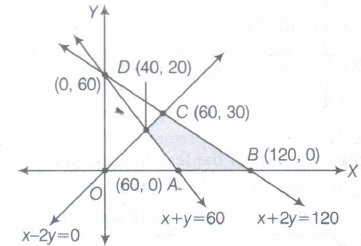
On solving equations x - 2y = 0 and x + y = 60, we get
D(40, 20) and solving equations x - 2y = 0 and
x + 2y = 120, we get C (60, 30)
So, the feasible region is ABCDA. The corner points of the feasible region are A (60, 0), B (120, 0), C (60, 30) and D (40, 20).
The values of Z at these points are as follows.
\(\begin{array}{c|c} \hline \text { Corner point } & z=5 x+10 y \\ \hline A(60,0) & 300 \text { (minimum) } \\ B(120,0) & 600 \\ C(60 \mid 30) & 600 \\ D(40,20) & 400 \\ \hline \end{array}\)
So, the minimum value of Z is 300 at the point (60, 0).
8.
\(\lim _{ x\rightarrow { 1 }^{ - } }{ f\left( x \right) } =\lim _{ x\rightarrow { 1 }^{ - } }{ \left( 3ax+b \right) } \)
\(=\lim _{ h\rightarrow 0 }{ [3a(1-h)+b] } \)
\(=3a(1-0)+b\)
\(=3a+b\)
\(\lim _{ x\rightarrow { 1 }^{ + } }{ f\left( x \right) } =\lim _{ x\rightarrow { 1 }^{ + } }{ \left( 5ax-2b \right) } \)
\(=\lim _{ h\rightarrow 0 }{ [5a(1+0)-2b] } \)
\(=5a-2b\)
\(f(1)=11\)
Also
Since'f' is continuous at x = 1
\(\lim _{ x\rightarrow { 1 }^{ - } }{ f\left( x \right) } =\lim _{ x\rightarrow { 1 }^{ + } }{ f\left( x \right) } =f(1)\)
From first and third 3a + b = 11 ....(1)
From last two 5a - 2b = 11 .....(2)
Multiplying (1) by 2, 6a + 2b = 22 .....(3)
Adding (2) and (3), 11a = 33 = a = 3
Putting in (1), 3(3) + b = 11
b = 11 - 9 = 2
Hence a = 3 and b = 2.
9.
\(We\quad have\quad :\quad x=a(cos\theta +sin\theta ),\quad y=a(sin\theta -\theta cos\theta )\)
\(\frac { dx }{ d\theta } =\alpha \left( -sin\theta +\theta cos\theta +sin\theta \right) =a\theta cos\theta \)
\(and\quad \frac { dy }{ d\theta } =\alpha (cos\theta +\theta sin\theta -cos\theta )=a\theta sin\theta \)
\(\frac { dy }{ dx } =\frac { dy/d\theta }{ dx/d\theta } =\frac { \alpha \theta sin\theta }{ \alpha \theta cos\theta } =tan\theta \)
10.
The shaded region is the feasible region ABC determined by the system of constraints (2) to (4), which is bounded. The coordinates of corner points
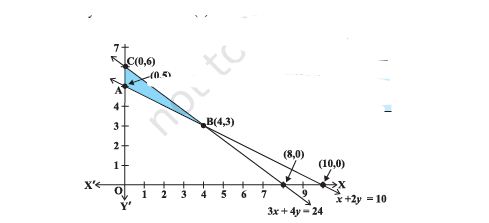
A, B and C are (0,5), (4,3) and (0,6) respectively. Now we evaluate Z = 200x + 500y at these points.
Hence, minimum value of Z is 2300 attained at the point (4, 3)
| Corner Point | Corresponding Value of Z |
| B : (0,5) | 2500 |
| D : (0,6) | 3000 |
| E : (4,3) | 2300 (Minimum) |
11.
\(we\ have\quad :\ { x }^{ 2 }+xy+{ y }^{ 2 }=100\)
\(Diff\ w.r.t.x,\ 2x+\left( x.\frac { dy }{ dx } +y.1 \right) +2y\frac { dy }{ dx } =0\)
\(\Rightarrow (x+2y)\frac { dy }{ dx } =\quad -2x-y\)
\(Hence,\ \frac { dy }{ dx } =-\frac { 2x+y }{ x+2y } \)
12.
Let sin-1 x = \(\theta\) then sin-1 x = \(\theta\). we have
sin-1 \((2x\sqrt { 1-{ x }^{ 2 } } )\) = sin-1\(2\sin { \theta } \sqrt { 1-{ sin }^{ 2 } } \)
= sin–1 (2sinθ cosθ) = sin–1 (sin2θ) = 2θ = 2 sin–1 x
13.
\( \left.\begin{array}{l} \text {We have, } \tan ^{-1}\left[\sqrt{\frac{1-\cos x}{1+\cos x}}\right. \end{array}\right]=\tan ^{-1}\left[\sqrt{\frac{2 \sin ^{2} x / 2}{2 \cos ^{2} x / 2}}\right] \text { [1] } \)
\(\left[\because 1-\cos \theta=2 \sin ^{2} \frac{\theta}{2}, 1+\cos \theta=2 \cos ^{2} \frac{\theta}{2}\right]\)
\( \left[ta n^{-1}\left[\sqrt{\tan ^{2} x / 2}\right]=\tan ^{-1}\left[\tan \frac{x}{2}\right]=\frac{x}{2}\right. \)
14.
\(\sin ^{-i}\left[\cos \left(\frac{33 \pi}{5}\right)\right]=\sin ^{-1}\left[\cos \left(6 \pi+\frac{3 \pi}{5}\right)\right] \)
\(=\sin ^{-1}\left[\cos \frac{3 \pi}{5}\right] \quad[\because \cos (2 n \pi+\theta)=\cos \theta] \)
\(=\sin ^{-1}\left[\cos \left(\frac{\pi}{2}+\frac{\pi}{10}\right)\right]=\sin ^{-1}\left[-\sin \left(\frac{\pi}{10}\right)\right] \)
\(=-\sin ^{-1}\left(\sin \frac{\pi}{10}\right) \quad[1]\)
\(=-\frac{\pi}{10} \quad\left[\because \sin ^{-1}(\sin x)=x, x \in\left[-\frac{\pi}{2}, \frac{\pi}{2}\right]\right][1] \)
15.
We have, x = \(\frac { at }{ 1+{ t }^{ 2 } } ,y=\frac { { at }^{ 2 } }{ 1+{ t }^{ 2 } } \)
\(\frac { dx }{ dt } =\frac { { (1+t) }^{ 2 }a-at(2t) }{ { (1+{ t }^{ 2 }) }^{ 2 } } \)
\(\Rightarrow\) \(\frac { dx }{ dt } =\)\(\frac { a+a{ t }^{ 2 }-2a{ t }^{ 2 } }{ { (1+{ t }^{ 2 }) }^{ 2 } } \)
=\(\frac { a-a{ t }^{ 2 } }{ { (1+{ t }^{ 2 }) }^{ 2 } } \)
and \(\frac { dy }{ dt } =\frac { { (1+{ t }^{ 2 } })^{ 2 }2at-a{ t }^{ 2 }(2t) }{ { (1+{ t }^{ 2 } })^{ 2 } } \)
\(\Rightarrow\)\(\frac { dy }{ dt } =\frac { 2at+2a{ t }^{ 3 }-2a{ t }^{ 3 } }{ { (1+{ t }^{ 2 }) }^{ 2 } } =\frac { 2at }{ { (1+{ t }^{ 2 }) }^{ 2 } } \)
\(\therefore\) \(\frac { dy }{ dx } =\frac { 2at }{ { (1+{ t }^{ 2 } })^{ 2 } } \times \frac { { (1+{ t }^{ 2 } })^{ 2 } }{ a-a{ t }^{ 2 } } \)
\(=\frac { 2at }{ a-a{ t }^{ 2 } } =\frac { 2t }{ 1-{ t }^{ 2 } } \)
\({ (\frac { dy }{ dx } ) }_{ att=2 }\) = \(\frac { 2(2) }{ 1-4 } \)
= -4/3
16.
\(\frac { dx }{ d\theta } =\theta cos\theta +sin\theta \)
\(\frac { dy }{ d\theta } =-\theta sin\theta +cos\theta \)
\(\frac { dy }{ dx } =\frac { cos\theta -\theta sin\theta }{ \theta cos\theta +sin\theta } \)
dy/dx at \(\theta\)= \(\pi/4\)
\(=\frac { cos\frac { \pi }{ 4 } -\frac { \pi }{ 4 } sin\frac { \pi }{ 4 } }{ \frac { \pi }{ 4 } cos\frac { \pi }{ 4 } +sin\frac { \pi }{ 4 } } \)
\(=\frac { \frac { 1 }{ \sqrt { 2 } } -\frac { \pi }{ 4 } \times \frac { 1 }{ \sqrt { 2 } } }{ \frac { \pi }{ 4 } \times \frac { 1 }{ \sqrt { 2 } } +\frac { 1 }{ \sqrt { 2 } } } \)
=\(\frac { 1-\frac { \pi }{ 4 } }{ \frac { \pi }{ 4 } +1 } \)
\(\Rightarrow\)\(\frac { dy }{ dx } =\frac { 4-\pi }{ 4+\pi } \)
17.
We have y = log(sin x)
dy/dx = d/dx \(\left| log(sinx) \right| \)
= \(\frac { 1 }{ sinx } \times cosx\)
\(\Rightarrow\) dy/dx = cot x
\(\therefore\) \(\frac { { d }^{ 2 }y }{ dx^{ 2 } } =-{ cosec }^{ 2 }x\)
18.
\(Let\quad { sec }^{ -1 }x=\theta ,\quad then\quad x=sec\theta \quad and\quad for\quad x<-1,\)
\(\frac { \pi }{ 2 } <\theta <\pi \)
Given expression = cot-1(-cot \(\theta \))
\(={ cot }^{ -1 }\left[ cot\left( \pi -\theta \right) \right] =\pi -{ sec }^{ -1 }x\quad as\quad 0<\pi -\theta <\frac { \pi }{ 2 } \)
19.
(a)
25 y
20.
(d)
\(-e^x \tan e^x\)
21.
(c)
\(-e^{y-x}\)
22.
(c)
\((-\infty, 0) \cup(0, \infty)\)
23.
(a)
\(x y_1\)
24.
(c)
\(6 x^2 \sin x^3 \cos x^3\)
25.
(d)
0
26.
(b)
x = 1.5
27.
(c)
Decision
28.
(d)
Feasible region
29.
(b)
Constraints, non-negative restrictions
30.
(d)
-π/4
31.
(d)
\(\frac { x }{ \sqrt { 1+{ x }^{ 2 } } } \)
32.
(b)
\(-\frac { \pi }{ 2 } \)
33.
(d)
1
34.
(b)
\(\frac { 5\pi }{ 6 } \)
35.
(b)
\(-\frac { \pi }{ 2 } \le y\le \frac { \pi }{ 2 } \)
36.
As sin (\(-\frac{\pi}{2}\))= -1, and tan<sup>-1</sup>(-1) = \(-\frac{\pi}{4}\).
37.
(i) (b) \(\ln \triangle A B D\)
\(\tan \alpha =\frac{B D}{A D}\)
\( =\frac{30}{30 \sqrt{3}}=\frac{1}{\sqrt{3}} \)
\(\Rightarrow \alpha =30^{\circ}\)
\(\therefore \sin \alpha =\sin 30^{\circ}=\frac{1}{2}\)
\(\Rightarrow \alpha =\sin ^{-1}\left(\frac{1}{2}\right)\)
(ii) (c) \(\cos \alpha=\cos 30^{\circ}=\frac{\sqrt{3}}{2}\)
\(\Rightarrow \alpha =\cos ^{-1}\left(\frac{\sqrt{3}}{2})\right.\)
(iii) (d) \(\ln \triangle B DC\)
\(\tan \beta =\frac{(BD)}{(C D)}\)
\(=\frac{30}{10 \sqrt{3}}=\sqrt{3} \)
\(\Rightarrow \beta =\tan ^{-1}(\sqrt{3})\)
(iv) \( \text { (c) Since, } \alpha=\sin ^{-1}\left(\frac{1}{2}\right)=\frac{\pi}{6} \text {, } \)
\(\beta=\tan ^{-1}(\sqrt{3})=\frac{\pi}{3} \)
\(\therefore \quad \angle A B C=\pi-\left(\frac{\pi}{6}+\frac{\pi}{3}\right)\)
\( =\pi-\frac{\pi}{2}=\frac{\pi}{2}\)
(v) (c) We know that domain and range of \(\cos ^{-1} x\) are [-1,1] and \([0, \pi]\) respectively.
38.
(i) (a) : Now, \(\begin{equation} \frac{d f(\tan x)}{d g(\sec x)}=\frac{f^{\prime}(\tan x) \sec ^{2} x}{g^{\prime}(\sec x) \sec x \tan x} \end{equation}\)
\(\begin{equation} =\frac{f^{\prime}(\tan x) \sec x}{g^{\prime}(\sec x) \tan x} \end{equation}\)
\(\begin{equation} \therefore\left[\frac{d f(\tan x)}{d g(\sec x)}\right]_{x=\pi / 4}=\frac{f^{\prime}(1) \sqrt{2}}{g^{\prime}(\sqrt{2}) \cdot 1}=\frac{2 \sqrt{2}}{4 \cdot 1}=\frac{1}{\sqrt{2}} \end{equation}\)
(ii) (b)
(iii) (c) : Let \(\begin{equation} y=e^{x^{3}}, z=\log x \end{equation}\)
Differentiating w.r.t. x, we get
\(\begin{equation} \frac{d y}{d x}=e^{x^{3}}\left(3 x^{2}\right)=3 x^{2} e^{x^{3}} \end{equation}\) and \(\begin{equation} \frac{d z}{d x}=\frac{1}{x} \end{equation}\)
\(\begin{equation} \therefore \ \frac{d y}{d z}=\frac{\frac{d x}{d x}}{\frac{d z}{d x}}=\frac{3 x^{2} e^{x^{3}}}{\left(\frac{1}{x}\right)}=3 x^{3} e^{x^{3}} \end{equation}\)
(iv) (a): Let y = cos-1(2x2 - 1) = 2cos-1x
Differentiating w.r.t. cos'" x, we get
\(\begin{equation} \frac{d y}{d\left(\cos ^{-1} x\right)}=\frac{2 d\left(\cos ^{-1} x\right)}{d\left(\cos ^{-1} x\right)}=2 \end{equation}\)
(v) (a) : We have \(\begin{equation} y=\frac{1}{4} u^{4} \Rightarrow \frac{d y}{d u}=\frac{1}{4} \cdot 4 u^{3}=u^{3} \end{equation}\)
and \(\begin{equation} u=\frac{2}{3} x^{3}+5 \Rightarrow \frac{d u}{d x}=\frac{2}{3} \cdot 3 x^{2}=2 x^{2} \end{equation}\)
\(\begin{equation} \therefore \ \frac{d y}{d x}=\frac{d y}{d u} \cdot \frac{d u}{d x}=u^{3} \cdot 2 x^{2}=\left(\frac{2}{3} x^{3}+5\right)^{3}\left(2 x^{2}\right) \end{equation}\)
\(\begin{equation} =\frac{2}{27} x^{2}\left(2 x^{3}+15\right)^{3} \end{equation}\)
39.
we have,\(\begin{equation} f(x)=\left\{\begin{array}{ll} x-3 & , x \geq 3 \\ 3-x & , 1 \leq x<3 \\ \frac{x^{2}}{4}-\frac{3 x}{2}+\frac{13}{4} & , x<1 \end{array}\right. \end{equation}\)
(i) (b) : \(\begin{equation} \mathrm{R} f^{\prime}(1)=\lim _{h \rightarrow 0} \frac{f(1+h)-f(1)}{h} \end{equation}\)
\(\begin{equation} =\lim _{h \rightarrow 0} \frac{3-(1+h)-2}{h}=\lim _{h \rightarrow 0}-\frac{h}{h}=-1 \end{equation}\)
(ii) (b) : \(\begin{equation} \mathrm{L}_{\mathrm{s}}^{\prime}(1)=\lim _{h \rightarrow 0} \frac{f(1-h)-f(1)}{-h} \end{equation}\)
\(\begin{equation} =\lim _{h \rightarrow 0} \frac{-1}{h}\left[\frac{(1-h)^{2}}{4}-\frac{3(1-h)}{2}+\frac{13}{4}-2\right] \end{equation}\)
\(\begin{equation} =\lim _{h \rightarrow 0}\left(\frac{1+h^{2}-2 h-6+6 h+13-8}{-4 h}\right) \end{equation}\)
\(\begin{equation} =\lim _{h \rightarrow 0}\left(\frac{h^{2}+4 h}{-4 h}\right)=-1 \end{equation}\)
(iii) (c) : Since, R.H.D. at x = 3 is 1 and L.H.D. at x = 3 is-1
\(\therefore\) f(x) is non-differentiable at x = 3.
(iv) (d)
(v) (c) : From above, we have
\(\begin{equation} f^{\prime}(x)=\frac{x}{2}-\frac{3}{2}, x<1 \end{equation}\)
\(\begin{equation} \therefore f^{\prime}(-1)=\frac{-1}{2}-\frac{3}{2}=-2 \end{equation}\)
40.
(a) Assertion is correct, reason is correct;reason is a correct explanation for assertion.
41.
(d) Assertion is incorrect, Reason is correct.

12th Standard CBSE Syllabus & Materials
12th Standard CBSE
CBSE 12th Computer Science Python Revision Tour I - New Previous year Question Papers Study Material - QB365 Set A
NEW12th Standard CBSE
CBSE 12th Business Studies Planning Important Questions And Answers Study Material - QB365 Set A
NEW12th Standard CBSE
CBSE 12th Business Studies Business Environment Important Questions And Answers Study Material - QB365 Set A
NEW12th Standard CBSE
CBSE 12th Business Studies Principles of Management Important Questions And Answers Study Material - QB365 Set A



NCERT Books

Syllabus

Exam Pattern

Sample Question Papers

Previous year Question Papers

Important Notes

MCQ Practice test

NCERT Exemplers

Case study Questions

Image Based Questions

Passage based Questions

HOT Questions

Value Based Questions

Model Questions Papers
NCERT ( Book Back ) Questions

Assertion and Reason
Important Questions And Answers

CBSE 12th Standard CBSE Subjects
CBSE Standards








