
 100% FREE ACCESS
12th Standard CBSE Syllabus & Materials
12th Standard CBSE
CBSE 12th Economics Government Budget and the Economy Previous year Question Papers Study Material - QB365 Set A
NEW12th Standard CBSE
CBSE 12th Computer Science Interface Python with MySQL - New Previous year Question Papers Study Material - QB365 Set A
NEW12th Standard CBSE
CBSE 12th Computer Science Database Concept - New Previous year Question Papers Study Material - QB365 Set A
NEW12th Standard CBSE
CBSE 12th Computer Science Data Communication - New Previous year Question Papers Study Material - QB365 Set A
NEW12th Standard CBSE
CBSE 12th Computer Science Data Structures - New Previous year Question Papers Study Material - QB365 Set A
NEW12th Standard CBSE
CBSE 12th Computer Science Functions - New Previous year Question Papers Study Material - QB365 Set A

Published on: 02/11/2025
Download CBSE Class 12th Standard CBSE Maths question papers, sample papers, important questions, and previous year solved papers in PDF format. Get free study materials, NCERT solutions, and exam preparation resources for Class 12th Standard CBSE Maths
Questions + Answers key
Take MCQ Maths Test
1.
Let \(f(x)=\left[ \begin{matrix} cosx & -sinx & 0 \\ sinx & cosx & 0 \\ 0 & 0 & 1 \end{matrix} \right] \) Show that f(x)f(y) = f(x+y).
2.
Solve the equation for x, y, z and t, if: \(2\begin{bmatrix} x & z \\ y & t \end{bmatrix}+3\begin{bmatrix} 1 & -1 \\ 0 & 2 \end{bmatrix}=3\begin{bmatrix} 3 & 5 \\ 4 & 6 \end{bmatrix}.\)
3.
Find X, if \(Y=\begin{bmatrix} 3 & 2 \\ 1 & 4 \end{bmatrix}\) and \(2X+Y=\begin{bmatrix} 1 & 0 \\ -3 & 2 \end{bmatrix}.\)
4.
\(A={ \left[ { a }_{ ij } \right] }_{ m\times n }\) is a square matrix, if:
(A) m < n
(B) m > n
(C) m=n
(D) None of these.
5.
Find X and Y, if \(2 x+3y=\left[\begin{array}{ll}2 & 3 \\ 4 & 0\end{array}\right] and \ 3 x+2 y=\left[\begin{array}{rr}2 & -2 \\ -1 & 5\end{array}\right]\)
6.
If is \(A=\left[ \begin{matrix} 0 & b & -2 \\ 3 & 1 & 3 \\ 2a & 3 & -1 \end{matrix} \right] \)skew symmetric matrix, find the values of a and b.
7.
If \(A=\left[ \begin{matrix} 2 & 1 \\ 3 & 4 \end{matrix} \right] ,B=\left[ \begin{matrix} -1 & 4 \\ 0 & 2 \end{matrix} \right] \), show that \(AB\neq BA\).
8.
Find the value of X and Y if
\(X+Y=\left[ \begin{matrix} 2 & 3 \\ 5 & 1 \end{matrix} \right] ,X-Y=\left[ \begin{matrix} 6 & 5 \\ 7 & 3 \end{matrix} \right] \)
9.
Solve the matrix equation \(\left[ \begin{matrix} { x }^{ 2 } \\ { y }^{ 2 } \end{matrix} \right] -3\left[ \begin{matrix} x \\ 2y \end{matrix} \right] =\left[ \begin{matrix} -2 \\ -9 \end{matrix} \right] \)
10.
Find the value of x, y, z if
\(\left[ \begin{matrix} 2x+y & x-y \\ x-z & x+y+z \end{matrix} \right] =\left[ \begin{matrix} 10 & -1 \\ 2 & 8 \end{matrix} \right] \)
11.
Which of the given values of x and y make the following pair of matrices equal \(\left[\begin{array}{cc} 3 x+7 & 5 \\ y+1 & 2-3 x \end{array}\right]\left[\begin{array}{cc} 0 & y-2 \\ 8 & 4 \end{array}\right] ?\)
\(x=\frac{-1}{3}, y=7\)
not possible to find
\(y=7, x=\frac{-2}{3}\)
\(x=\frac{-1}{3}, y=\frac{-2}{3}\)
12.
If the matrix A is both symmetric and skew symmetric, then
A is a diagonal matrix
A is a zero matrix
A is a square matrix
None of these
13.
If A = \(\begin{bmatrix} cos\alpha & -sin\alpha \\ sin\alpha & cos\alpha \end{bmatrix}\), and A + A' = I, then the value of a is
\(\frac { \pi }{ 6 } \)
\(\frac { \pi }{ 6 } \)
\(\pi \)
\(\frac { 3\pi }{ 2 } \)
14.
Assume X, Y, Z, W and P are matrices of order 2 × n, 3 × k, 2 × p, n × 3 and p × k, respectively.
The restriction on n, k and p so that PY + WY will be defined are:
k = 3, p = n
k is arbitrary, p = 2
p is arbitrary, k = 3
k = 2, p = 3
15.
The number of all possible matrices of order 3 × 3 with each entry
27
18
81
512
16.
A = [aij]m × n\ is a square matrix, if
m < n
m > n
m = n
None of these
17.
A trust fund has Rs. 35000 that must be invested in two different types of bonds, say X and Y. The first bond pays 10% interest p.a. which will be given to an old age home and second one pays 8% interest p.a. which will be given to WWA (Women Welfare Association). Let A be a 1 x 2 matrix and B be a 2 x 1 matrix, representing the investment and interest rate on each bond respectively.

Based on the above information, answer the following questions.
(i) . If Rs.15000 is invested in bond X, then

(ii) If Rs.15000 is invested in bond X, then total amount.of interest received on both bonds is
| (a) Rs.2000 | (b) Rs.2100 | (c) Rs. 3100 | (d) Rs.4000 |
(iii) If the trust fund obtains an annual total interest of Rs.3200, then the investment in two bonds is
| (a) Rs. 15000 in X, Rs. 20000 in Y | (b) Rs. 17000 in X, Rs. 18000 in Y | (c) Rs. 20000 in X, Rs. 15000 in Y | (d) Rs. 18000 in X, Rs. 17000 in Y |
(iv) The total amount of interest received on both bonds is given by
| (a) AB | (b) A'B | (c) B'A | (d) none of these |
(v) If the amount of interest given to old age home is Rs.500, then the amount of investment in bond Y is
| (a) Rs. 20000 | (b) Rs. 30000 | (c) Rs. 15000 | (d) Rs. 25000 |
18.
Three shopkeepers A, Band C go to a store to buy stationary. A purchase 12 dozen notebooks, 5 dozen pens and 6 dozen pencils. B purchases 10 dozen notebooks, 6 dozen pens and 7 dozen pencils. C purchases 11 dozen notebooks, 13 dozen pens and 8 dozen pencils. A notebook costs Rs.40, a pen costs Rs.12 and a pencil costs Rs.3.Based on the above information, answer the following questions
(i) The number of items purchased by shopkeepers A, Band C represented in matrix form as

(ii) If Y represents the matrix formed by the cost of each item, then XY equal
(iii) Bill of A is equal to
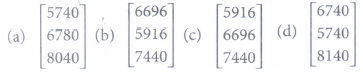
| (a) Rs.6740 | (b) Rs.8140 | (c) Rs. 5740 | (d) Rs.6696 |
(iv) If A 2 = A, then (A + 1)3 - 7A =
| (a) A | (b) -I | (c) I | (d) A+ I |
(v) If A and B are 3 x 3 matrices such that A 2 - B2 = (A - B) (A + B), then
| (a) either A or B is zero matrix | (b) either A or B is unit matrix | (c) Rs. A= B | (d) AB = BA |
19.
Two farmers Shyam and Balwan Singh cultivate only three varieties of pulses namely Urad, Masoor and Mung. The sale (in Rs.) of these varieties of pulses by both the farmers in the month of September and October are given by the following matrices A and B.
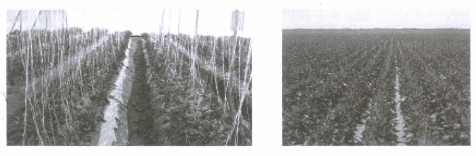

Using algebra of matrices, answer the following questions.
(i) The combined sales of Masoor in September and October, for farmer Balwan Singh, is
| (a) Rs. 80000 | (b) Rs. 90000 | (c) Rs. 40000 | (d) Rs. 135000 |
(ii) The combined sales of Urad in September and October, for farmer Shyam is
| (a) Rs. 20000 | (b) Rs. 30000 | (c) Rs. 36000 | (d) Rs. 15000 |
(iii) Find the decrease in sales of Mung from September to October, for the farmer Shyam.
| (a) Rs. 24000 | (b) Rs. 10000 | (c) Rs. 30000 | (d) No change |
(iv) If both farmers receive 2% profit on gross sales, compute the profit for each farmer and for each variety sold in October.

(v) Which variety of pulse has the highest selling value in the month of September for the farmer Balwan Singh?
| (a) Urad | (b) Masoor | (c) Mung | (d) All of these have the same price |
20.
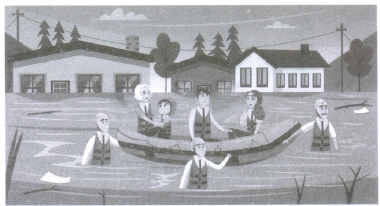
Three schools A, Band C organized a mela for collecting funds for helping the rehabilitation of flood victims. They sold hand made fans, mats and plates from recycled material at a cost of Rs. 25, Rs.100 and Rs.50 each. The number of articles sold by school A, B, C are given below.
| Artilcle\School | A | B | C |
| Fans | 40 | 25 | 35 |
| Mats | 50 | 40 | 50 |
| Plates | 20 | 30 | 40 |
Based on above information, answer the following questions.
(i) If P be a 3 x 3 matrix represent the sale of handmade fans, mats and plates by three schools A, Band C, then

(ii) If Q be a 3 x 1 matrix represent the sale prices (in Rs) of given products per unit, then

(iii) The funds collected by school A by selling the given articles is
| (a) Rs. 7000 | (b) Rs. 6125 | (c) Rs. 7875 | (d) Rs. 8000 |
(iv) The funds collected by school B by selling the given articles is
| (a) Rs. 5125 | (b) Rs. 6125 | (c) Rs. 7125 | (d) Rs. 8125 |
(v) The total funds collected for the required purpose is
| (a) Rs. 20000 | (b) Rs. 21000 | (c) Rs. 30000 | (d) Rs. 35000 |
21.
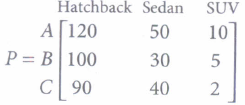
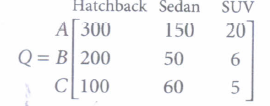
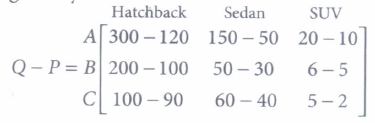
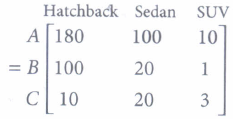
Three car dealers, say A, Band C, deals in three types of cars, namely Hatchback cars, Sedan cars, SUV cars. The sales figure of 2019 and 2020 showed that dealer A sold 120 Hatchback, 50 Sedan, 10 SUV cars in 2019 and 300 Hatchback, 150 Sedan, 20 SUV cars in 2020; dealer B sold 100 Hatchback, 30 Sedan,S SUV cars in 2019 and 200 Hatchback, 50 Sedan, 6 SUV cars in 2020; dealer C sold 90 Hatchback, 40 Sedan, 2 SUV cars in 2019 and 100 Hatchback, 60 Sedan,S SUV cars in 2020.

Based on the above information, answer the following questions.
(i) The matrix summarizing sales data of 2019 is

(ii) The matrix summarizing sales data of 2020 is

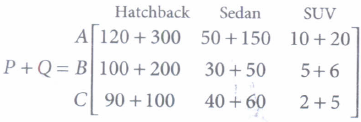
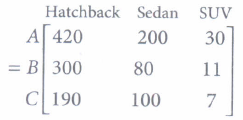
(iii) The total number of cars sold in two given years, by each dealer, is given by the matrix

(iv) The increase in sales from 2019 to 2020 is given by the matrix

(v) If each dealer receive profit of Rs. 50000 on sale of a Hatchback, Rs. 100000 on sale of a Sedan and Rs. 200000 on sale of a SUV (v) then amount of profit received in the year 2020 by each dealer is given by the matrix.

1.
Here,
\(f(x)f(y)=\left[ \begin{matrix} cosx & -sinx & 0 \\ sinx & cosx & 0 \\ 0 & 0 & 1 \end{matrix} \right] \left[ \begin{matrix} cosy & -siny & 0 \\ siny & cosy & 0 \\ 0 & 0 & 1 \end{matrix} \right] \)
\(=\left[ \begin{matrix} cosxcosy-sinxsiny & -sinycosx-sinxcosy & 0 \\ sinxcosy+cosxsiny & -sinxsiny+cosxcosy & 0 \\ 0 & 0 & 1 \end{matrix} \right]\)
\( =\left[ \begin{matrix} cos(x+y) & -sin(x+y) & 0 \\ sin(x+y) & cos(x+y) & 0 \\ 0 & 0 & 1 \end{matrix} \right] \)
\(=f(x+y).\)
2.
\(We\ have:\ 2\begin{bmatrix} x & z \\ y & t \end{bmatrix}+3\begin{bmatrix} 1 & -1 \\ 0 & 2 \end{bmatrix}=3\begin{bmatrix} 3 & 5 \\ 4 & 6 \ \end{bmatrix}\)
\( \Rightarrow \begin{bmatrix} 2x & 2z \\ 2y & 2t \end{bmatrix}+\begin{bmatrix} 3 & -3 \\ 0 & 6 \end{bmatrix}=\begin{bmatrix} 9 & 15 \\ 12 & 18 \end{bmatrix}\)
\(\Rightarrow \begin{bmatrix} 2x+3 & 2z-3 \\ 2y & 2t+6 \end{bmatrix}=\begin{bmatrix} 9 & 15 \\ 12 & 18 \end{bmatrix}.\)
Equating corresponding elements:
2x + 3 = 9 \(\Rightarrow \) 2x = 9-3 = 6 \(\Rightarrow \) x = 3
2y = 12 \(\Rightarrow \) y = 6
2z-3 = 15 \(\Rightarrow \)2z = 3 + 15 = 18 \(\Rightarrow \) z = 9
and 2t+6 = 18 \(\Rightarrow \)2t = 18 - 6 = 12 \(\Rightarrow \)t = 6.
Hence, x = 3, y = 6, z = 9 and t = 6.
3.
\(We\quad have:2X+Y=\begin{bmatrix} 1 & 0 \\ -3 & 2 \end{bmatrix}\)
\(\therefore \ 2X=\begin{bmatrix} 1 & 0 \\ -3 & 2 \end{bmatrix}-Y\)
\(=\begin{bmatrix} 1 & 0 \\ -3 & 2 \end{bmatrix}-\begin{bmatrix} 3 & 2 \\ 1 & 4 \end{bmatrix}\)
\(=\begin{bmatrix} 1-3 & 0-2 \\ -3-1 & 2-4 \end{bmatrix}\)
\(=\begin{bmatrix} -2 & -2 \\ -4 & -2 \end{bmatrix}\)
\(X=\frac { 1 }{ 2 } \begin{bmatrix} -2 & -2 \\ -4 & -2 \end{bmatrix}\)
\(=\begin{bmatrix} -1 & -1 \\ -2 & -1 \end{bmatrix}.\)
4.
The correct answer is C.
It is known that a given matrix is said to be a square matrix if the number of rows is equal to the number of columns.
Therefore, \(A={ \left[ { a }_{ ij } \right] }_{ m\times n }\) is a square matrix, if m = n.
5.
We have, \(2 X+3 Y=\left[\begin{array}{ll}2 & 3 \\ 4 & 0\end{array}\right]\) and
\(3 X+2 Y=\left[\begin{array}{rr} 2 & -2 \\ -1 & 5 \end{array}\right]\)
On multiplying Eq. (i) by 2 and Eq. (ii) by 3 , we get
\(4 X+6 Y=\left[\begin{array}{ll} 4 & 6 \\ 8 & 0 \end{array}\right]\) and \( 9 X+6 Y=\left[\begin{array}{rr}6 & -6 \\ -3 & 15\end{array}\right]\)
On subtracting Eq. (iii) from Eq. (iv), we get
\( (9 X+6 Y)-(4 X+6 Y)=\left[\begin{array}{rr} 6 & -6 \\ -3 & 15 \end{array}\right]-\left[\begin{array}{ll} 4 & 6 \\ 8 & 0 \end{array}\right] \)
\(\Rightarrow 9 X+6 Y-4 X-6 Y=\left[\begin{array}{rr} 6-4 & -6-6 \\ -3-8 & 15-0 \end{array}\right]=\left[\begin{array}{rr} 2 & -12 \\ -11 & 15 \end{array}\right] \)
\(\Rightarrow X=\frac{1}{5}\left[\begin{array}{rr}2 & -12 \\ -11 & 15\end{array}\right]=\left[\begin{array}{cc}\frac{2}{5} & \frac{-12}{5} \\ \frac{-11}{5} & 3\end{array}\right]\)
On substituting the value of X in Eq. (i), we get
\( \Rightarrow\left[\begin{array}{cc} \frac{2}{5} & \frac{-12}{5} \\ \frac{-11}{5} & 3 \end{array}\right]+3 Y=\left[\begin{array}{cc} 2 & 3 \\ 4 & 0 \end{array}\right] \)
\(\Rightarrow \left[\begin{array}{cc} \frac{4}{5} & \frac{-24}{5} \\ \frac{-22}{5} & 6 \end{array}\right]+3 Y=\left[\begin{array}{cc} 2 & 3 \\ 4 & 0 \end{array}\right] \)
\(\Rightarrow Y=\frac{1}{3}\left[\begin{array}{cc} 2-\frac{4}{5} & 3+\frac{24}{5} \\ 4+\frac{22}{5} & 0-6 \end{array}\right]\)
\(\Rightarrow Y=\frac{1}{3}\left[\begin{array}{cc} \frac{6}{5} & \frac{39}{5} \\ \frac{42}{5} & -6 \end{array}\right]=\left[\begin{array}{cc} \frac{2}{5} & \frac{13}{5} \\ \frac{14}{5} & -2 \end{array}\right] \)
6.
If A is symmetric matrix then
\(A={ A }^{ \prime }\)
\(\Rightarrow \left[ \begin{matrix} 0 & b & -2 \\ 3 & 1 & 3 \\ 2a & 3 & -1 \end{matrix} \right] =\left[ \begin{matrix} 0 & 3 & 2a \\ b & 1 & 3 \\ -2 & 3 & -1 \end{matrix} \right] \)
\(\therefore\) By equality of matrices,
b = 3 and a = - 1
7.
We have, \(A=\left[ \begin{matrix} 2 & 1 \\ 3 & 4 \end{matrix} \right] \) and \(B=\left[ \begin{matrix} -1 & 4 \\ 0 & 2 \end{matrix} \right] \)
\(AB=\left[ \begin{matrix} 2 & 1 \\ 3 & 4 \end{matrix} \right] \left[ \begin{matrix} -1 & 4 \\ 0 & 2 \end{matrix} \right] \)
\(AB=\left[ \begin{matrix} -2+0 & 8+2 \\ -3+0 & 12+8 \end{matrix} \right] \)
\(\left[ \begin{matrix} -2 & 10 \\ -3 & 20 \end{matrix} \right] \)
and \(BA=\left[ \begin{matrix} -1 & 4 \\ 0 & 2 \end{matrix} \right] \left[ \begin{matrix} 2 & 1 \\ 3 & 4 \end{matrix} \right] \)
\(=\left[ \begin{matrix} 10 & 15 \\ 6 & 8 \end{matrix} \right] \)
\(\therefore\) \(AB\neq BA\)
8.
We have, \(X+Y=\left[ \begin{matrix} 2 & 3 \\ 5 & 1 \end{matrix} \right] ,X-Y=\left[ \begin{matrix} 6 & 5 \\ 7 & 3 \end{matrix} \right] \)
\(\left( X+Y \right) +\left( X-Y \right) =\left[ \begin{matrix} 2 & 3 \\ 5 & 1 \end{matrix} \right] +\left[ \begin{matrix} 6 & 5 \\ 7 & 3 \end{matrix} \right] \)
\(2X=\left[ \begin{matrix} 8 & 8 \\ 12 & 4 \end{matrix} \right] \)
\(\Rightarrow X=\left[ \begin{matrix} 4 & 4 \\ 6 & 2 \end{matrix} \right] \)
\(\therefore \ X=\left[ \begin{matrix} 4 & 4 \\ 6 & 2 \end{matrix} \right] \)
and \(Y=\left[ \begin{matrix} 2 & 3 \\ 5 & 1 \end{matrix} \right] -\left[ \begin{matrix} 4 & 4 \\ 6 & 2 \end{matrix} \right] \)
\(=\left[ \begin{matrix} -2 & -1 \\ -1 & -1 \end{matrix} \right] \)
9.
We have, \(\left[ \begin{matrix} { x }^{ 2 } \\ { y }^{ 2 } \end{matrix} \right] -3\left[ \begin{matrix} x \\ 2y \end{matrix} \right] =\left[ \begin{matrix} -2 \\ -9 \end{matrix} \right] \)
\(\Rightarrow\) x2 - 3x = - 2 and y2 - 6y = - 9
\(\Rightarrow\) x2 - 3x + 2 = 0 and y2 - 6y + 9 = 0
\(\Rightarrow\) x2 - 2x - x + 2 = 0 and y2 - 3y - 3y + 9 = 0
\(\Rightarrow\) x(x - 2) - 1(x - 2) = 0 and y(y - 3) - 3(y - 3) = 0
\(\Rightarrow\) (x - 2)(x - 1) = 0 and (y - 3)(y - 3) = 0
\(\therefore\) x = 1, 2 and y = 3, 3
10.
We have, \(\left[ \begin{matrix} 2x+y & x-y \\ x-z & x+y+z \end{matrix} \right] =\left[ \begin{matrix} 10 & -1 \\ 2 & 8 \end{matrix} \right] \)
\(\Rightarrow\) 2x + y = 10, x - y = - 1
x - z = 2 and x + y + z = 8
\(\therefore\) 2(y - 1) + y = 10 \(\Rightarrow\) 2y + y + 2 = 10
\(\Rightarrow\)3y = 12 \(\Rightarrow\) y = 4
\(\therefore\) x = 3
3 - z, \(\Rightarrow\) z = 1
\(\therefore\) x = 3, y = 4, z = 1
11.
(b)
not possible to find
12.
(b)
A is a zero matrix
13.
(b)
\(\frac { \pi }{ 6 } \)
14.
(a)
k = 3, p = n
15.
(d)
512
16.
(c)
m = n
17.
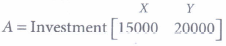
(i) (b) : If Rs. 15000 is invested in bond X, then the amount invested in bond Y = Rs. (35000 - 15000) = Rs. 20000.
and
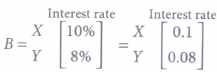
(ii) (c) : The amount of interest received on each bond is given by
\(A B=\left[\begin{array}{ll} 15000 & 20000 \end{array}\right] \times\left[\begin{array}{c} 0.1 \\ 0.08 \end{array}\right]\)
= [15000 x 0.1 + 20000 x 0.08] = [1500 + 1600] = 3100
(iii) (c) : Let Rs. x be invested in bond X and then Rs. (35000 - x) will be invested in bond Y.
Now, total amount of interest is given by
\(\left[\begin{array}{ll} x & 35000-x \end{array}\right]\left[\begin{array}{c} 0.1 \\ 0.08 \end{array}\right]=[0.1 x+(35000-x) 0.08]\)
But, it is given that total amount of interest = Rs. 3200
\(\therefore\) 0.1x + 2800 - 0.08x = 3200
\(\Rightarrow 0.02 x=400 \Rightarrow x=20000\)
Thus, Rs. 20000 invested in bond X and Rs. 35000 - Rs. 20000
= Rs. 15000 invested in bond Y.
(iv) (a) : AB will give the total amount of interest received on both bonds.
(v) (b) : Let Rs x invested in bond X, then we have
\(x \times \frac{10}{100}=500 \Rightarrow x=5000\)
Thus, amount invested in bond X is Rs.5000 and so investment in bond Y be Rs. (35000 - 5000) = Rs. 30000
18.
(i) (a) : Number of items purchased by shopkeepers A, B and C can be written in matrix form as
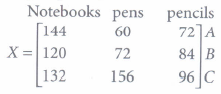
(ii) (b) : Since \(Y=\left[\begin{array}{c} 40 \\ 12 \\ 3 \end{array}\right]\)\(Note book\\ Pen\\ Penc\)
\(\therefore \quad X Y=\left[\begin{array}{lll} 144 & 60 & 72 \\ 120 & 72 & 84 \\ 132 & 156 & 96 \end{array}\right]\left[\begin{array}{c} 40 \\ 12 \\ 3 \end{array}\right]\)
\(=\left[\begin{array}{c} 5760+720+216 \\ 4800+864+252 \\ 5280+1872+288 \end{array}\right]=\left[\begin{array}{l} 6696 \\ 5916 \\ 7440 \end{array}\right]\)
(iii) (d) : Bill of A is Rs.6696.
(iv) (c) : (A + I)2 = A2 + 2A + 1= 3A + I
\(\Rightarrow\) (A + I)3 = (3A + I) (A + I)
= 3A2 + 4A + I = 7A + I
\(\therefore\) (A+I)3-7A = I
(v) (d) : A 2 - B2 = (A - B) (A + B) = A2 + AB - BA - B2
\(\therefore\) AB=BA.
19.
Combined sales in September and October for each farmer in each variety is given by
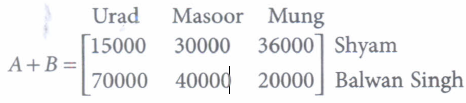
(i) (c) : Combined sales of Masoor in September and October for farmer Balwan Singh = Rs. 40000
(ii) (d) : Combined sales of Urad in September and October for farmer Shyam = Rs. 15000
(iii) (a) : Change in sales from September to October is given by
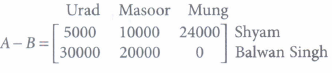
\(\therefore\) Decrease in sales of Mung from September to October for farmer Shyam = Rs. 24000.
(iv) (b) : Required profit is given by
\(2 \% \text { of } B=\frac{2}{100} \times B=0.02 \times B\)
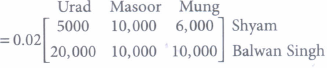
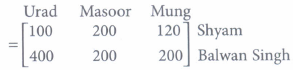
thus,in October Shyam receives Rs. 100, Rs. 200 and Rs. 120 as profit in the sale of each variety of pulses, respectively and Balwan Singh receives a profit of Rs. 400, Rs. 200 and Rs. 200 in the sale of each variety of pulses respectively.
20.
(i) (a) : Clearly,
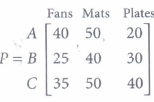
(ii) (d) : Since Q is a 3 x 1 matrix, therefore
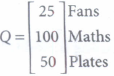
(iii) (a) : Clearly, total funds collected by each school is given by the matrix.
\(P Q=\left[\begin{array}{ccc} 40 & 50 & 20 \\ 25 & 40 & 30 \\ 35 & 50 & 40 \end{array}\right]\left[\begin{array}{c} 25 \\ 100 \\ 50 \end{array}\right]\)
\(=\left[\begin{array}{c} 1000+5000+1000 \\ 625+4000+1500 \\ 875+5000+2000 \end{array}\right]=\left[\begin{array}{l} 7000 \\ 6125 \\ 7875 \end{array}\right]\)
\(\therefore\) Funds collected by school A is Rs. 7000
Funds collected by school B is Rs. 6125
Pimds collected by school C is Rs. 7875
(iv) (b)
(v) (b) : Total funds collected for the required purpose
= Rs. (7000 + 6125 + 7875) = Rs. 21000
21.
(i) (b) : In 2019,dealer A sold 120 Hatchback, 50 Sedan and 10 SUV; dealer B sold 100 Hatchback, 30 Sedan and 5 SUV and dealer C sold 90 Hatchback, 40 Sedan and 2 SUV
\(\therefore\) Required matrix, say P, is given by
(ii) (a) : In 2020,
dealer A sold 300 Hatchback, 150 Sedan, 20 SUV
dealer B sold 200 Hatchback, 50 sedan, 6 SUV
dealer C sold 100 Hatchback, 60 sedan,S SUV
\(\therefore\) Required matrix, say Q, is given by
(iii) (c) : Total number of cars sold in two given years, by each dealer, is given by
(iv) (c): The increase in sales from 2019 to 2020 is given by
(v) (c) : The amount of profit in 2020 received by each dealer is given by the matrix
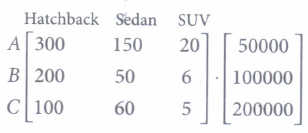
\(\begin{array}{c} A \\ B \\ C \end{array}\left[\begin{array}{c} 15000000+15000000+4000000 \\ 10000000+5000000+1200000 \\ 5000000+6000000+1000000 \end{array}\right]\)
\(\begin{array}{r} A \\ =B \\ C \end{array}\left[\begin{array}{l} 34000000 \\ 16200000 \\ 12000000 \end{array}\right]\)

12th Standard CBSE Syllabus & Materials
12th Standard CBSE
CBSE 12th Computer Science Python Revision Tour I - New Previous year Question Papers Study Material - QB365 Set A
NEW12th Standard CBSE
CBSE 12th Business Studies Planning Important Questions And Answers Study Material - QB365 Set A
NEW12th Standard CBSE
CBSE 12th Business Studies Business Environment Important Questions And Answers Study Material - QB365 Set A
NEW12th Standard CBSE
CBSE 12th Business Studies Principles of Management Important Questions And Answers Study Material - QB365 Set A



NCERT Books

Syllabus

Exam Pattern

Sample Question Papers

Previous year Question Papers

Important Notes

MCQ Practice test

NCERT Exemplers

Case study Questions

Image Based Questions

Passage based Questions

HOT Questions

Value Based Questions

Model Questions Papers
NCERT ( Book Back ) Questions

Assertion and Reason
Important Questions And Answers

CBSE 12th Standard CBSE Subjects
CBSE Standards








