
 100% FREE ACCESS
12th Standard CBSE Syllabus & Materials
12th Standard CBSE
CBSE 12th Economics Government Budget and the Economy Previous year Question Papers Study Material - QB365 Set A
NEW12th Standard CBSE
CBSE 12th Computer Science Interface Python with MySQL - New Previous year Question Papers Study Material - QB365 Set A
NEW12th Standard CBSE
CBSE 12th Computer Science Database Concept - New Previous year Question Papers Study Material - QB365 Set A
NEW12th Standard CBSE
CBSE 12th Computer Science Data Communication - New Previous year Question Papers Study Material - QB365 Set A
NEW12th Standard CBSE
CBSE 12th Computer Science Data Structures - New Previous year Question Papers Study Material - QB365 Set A
NEW12th Standard CBSE
CBSE 12th Computer Science Functions - New Previous year Question Papers Study Material - QB365 Set A

Published on: 02/11/2025
Download CBSE Class 12th Standard CBSE Maths question papers, sample papers, important questions, and previous year solved papers in PDF format. Get free study materials, NCERT solutions, and exam preparation resources for Class 12th Standard CBSE Maths
Questions + Answers key
Take MCQ Maths Test
1.
Two tailors A and B earn Rs. 300 and Rs. 400 per day, respectively. A can stitch 6 shirts and 4 pairs of trousers while B can stitch 10 shirts and 4 pairs of trousers per day. To find how many days should each of them work and if it is desired to produce at least 60 shirts and 32 pairs of trousers at a minimum labour cost, formulate this as an LPP.
2.
\(\left[ \begin{matrix} 2 & 3 \\ 1 & 0 \end{matrix} \right] \)= P+Q, where P is symmetric and Q is Skew symmetric matrix, find the matrices P and Q
3.
if A = [-1, 2, -5] B =\(\left[ \begin{matrix} 2 \\ -1 \\ 7 \end{matrix} \right] \) Write the orders of AB and BA
4.
If \(A=\left[ \begin{matrix} 0 & x & -4 \\ -2 & 0 & -1 \\ y & -1 & 0 \end{matrix} \right] \) is skew symmetric matrix, find the values of x and y.
5.
If A is a \(3\times 3\) matrix, whose elements are given by \({ a }_{ ij }=\frac { 1 }{ 3 } \left| -3i+j \right| \), then write the value \({ a }_{ 23 }\).
6.
If matrix \(A=\begin{bmatrix} 1 & -1 \\ -1 & 1 \end{bmatrix}\) and \({ A }^{ 2 }=kA\), then write the value of k.
7.
Evaluate \(\begin{vmatrix} sin\quad 30^{ o } & cos\quad 30^{ o } \\ -sin\quad 60^{ o } & cos\quad 60^{ o } \end{vmatrix}\)
8.
Find the minimum and maximum values of the objective function.
Z = 3x + 9y
Subject to constraints
\(\begin{aligned} x+3 y \leq 60, x+y \geq 10, x \leq y \end{aligned}\)
and \(\begin{aligned} x \geq 0, y \geq 0 \end{aligned}\)
9.
Solve the following LPP graphically.
Maximise Z = 60x + 40y
subject to the constraints
\(\begin{aligned}
x+2 y \leq 12
\end{aligned}\)
\(\begin{aligned}
2 x+y \leq 12
\end{aligned}\)
\(\begin{aligned}
4 x+5 y \geq 20 \text { and } x, y \geq 0
\end{aligned}\)
10.
If \(A=\left[\begin{array}{lll} 1 & 0 & 2 \\ 0 & 2 & 1 \\ 2 & 0 & 3 \end{array}\right]\) and A3 - 6A2 + 7A + kI3 = 0, find k.
11.
Express the matrix : \(B=\left[ \begin{matrix} 2 & -2 & -4 \\ -1 & 3 & 4 \\ 1 & -2 & -3 \end{matrix} \right] \), as the sum of a symmetric and a skew-symmetric matrix.
12.
Let A and B be symmetric matrices of the same order.Then show that:
(i) A+B is a symmetric matrix
(ii) AB-BA is a skew-symmetric matrix
(iii) AB+BA is a symmetric matrix.
13.
Use product \(\begin{bmatrix} 1 & -1 & 2 \\ 0 & 2 & -3 \\ 3 & -2 & 4 \end{bmatrix}\begin{bmatrix} -2 & 0 & 1 \\ 9 & 2 & -3 \\ 6 & 1 & -2 \end{bmatrix}\) to solve the system of equations.
x - y + 2z = 1;
2y - 3z = 1;
3x - 2y + 4z = 2
14.
Find the inverse of each of the matrices
\(\left[\begin{array}{lll} 1 & 2 & 3 \\ 0 & 2 & 4 \\ 0 & 0 & 5 \end{array}\right]\)
15.
Find a, b, c and d if \(\left[\begin{array}{cc} 3 a+4 b & 2 \\ c+d & 2 c-d \\ a-2 b & 1 \end{array}\right]=\left[\begin{array}{rr} 2 & 2 \\ 5 & -5 \\ 4 & 1 \end{array}\right]\)
16.
The matrix inequality is shown below
\(\left[\begin{array}{c} x+3 y \\ x+y \end{array}\right] \geq\left[\begin{array}{l} 3 \\ 2 \end{array}\right]\)
(i) Make a linear inequation from the above inequality of matrices.
(ii) Find the minimise Z = 3x + 5y, subject to the constraints as above linear inequations and \(x, y \geq 0\).
17.
Solve the following Linear Programming Problems graphically:
Maximise Z = 3x + 4y
subject to the constraints:
\(x+y\le 4,x\ge 0,y\ge 0.\)
18.
In a legislative assembly election, a political group hired a public relations firm to promote its candidate in three ways; telephone, house calls and letters.The cost per contact (in paise) is given in matrix A as:
\(\\ A=\overset { Cost\quad per\quad contact }{ \left[ \quad \quad \quad \begin{matrix} 40 \\ 100 \\ 50 \end{matrix}\quad \quad \quad \quad \right] } \begin{matrix} Telephone \\ House\ calls \\ Letter \end{matrix}\)
The number of contacts of each type made in two cities X and Y is given in matrix B as:
\(\begin{matrix} Telephone & Housecalls & Letter \end{matrix}\\ B=\overset { \quad \quad \quad \quad \quad \quad \quad \quad \quad \quad \quad }{ \left[ \quad \begin{matrix} \quad \quad 100\quad \quad & 500 & \quad \quad 5000 \\ 3000 & 1000 & \quad 10000 \end{matrix}\quad \quad \quad \right] } \begin{matrix} \rightarrow \quad X \\ \rightarrow \quad Y \end{matrix}\)
Find the total amount spent by the group in two cities X and Y.
19.
Solve the system of linear equations, using matrix method in
5x + 2y = 4
7x + 3y = 5
20.
Find values of k if area of triangle is 4 sq. units and vertices are
(i) (k, 0), (4, 0), (0, 2)
(ii) (–2, 0), (0, 4), (0, k)
21.
Show that the matrix \(A=\left| \begin{matrix} 2 & 3 \\ 1 & 2 \end{matrix} \right| \)satisfies the equation A2- 4A + I = 0, where I is 2 x 2 identity matrix and O is 2 x 2 zero matix. Using this equation, find A–1.
22.
For matrix \(A=\left[\begin{array}{cc}2 & 5 \\ -11 & 7\end{array}\right]\) then \((\operatorname{adj} A)^{\prime}\) is equal to
\(\left[\begin{array}{cc}-2 & -5 \\ 11 & -7\end{array}\right]\)
\(\left[\begin{array}{cc}7 & 5 \\ 11 & 2\end{array}\right]\)
\(\left[\begin{array}{cc}7 & 11 \\ -5 & 2\end{array}\right]\)
\(\left[\begin{array}{cc}7 & -5 \\ 11 & 2\end{array}\right]\)
23.
The value of the determinant \(\left|\begin{array}{ccc}2 & 7 & 1 \\ 1 & 1 & 1 \\ 10 & 8 & 1\end{array}\right|\) is
47
-79
49
-51
24.
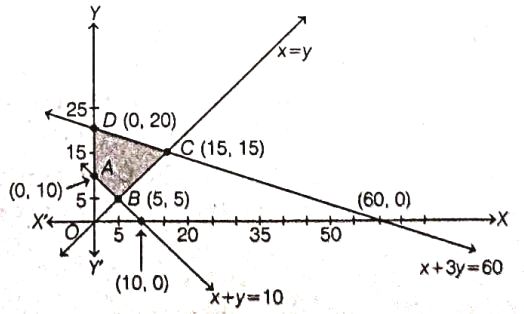
Based on the given shaded region as the feasible region in the graph, at which point (s) is the objective function Z = 3x + 9y maximum.
Point B
Point C
Point D
Every point on the line segment CD
25.
A linear programming problem is as follows Minimise Z = 30x + 50y Subjcct to the constraints, \(3 x+5 y \geq 15,2 x+3 y \leq 18 \text { and } x \geq 0, y \geq 0\) In the fcasible region, the minimum value of Z occurs at
a unique point
no point
infinitely many points
two points only
26.
Let A be a square matrix of order 3 x 3 and k a scalar, then |kA| is equal to
k|A|
|k||A|
k3|A|
none of these
27.
A matrix has 18 elements, then possible number of orders of a matrix are
3
4
6
5
28.
If Mu = - 40, M12 = - 10 and M13 = 35 of the determinant \(\Delta=\left|\begin{array}{rrr} 1 & 3 & -2 \\ 4 & -5 & 6 \\ 3 & 5 & 2 \end{array}\right|\) then the value of \(\Delta\) is
-80
60
70
100
29.
If \(\Delta=\left|\begin{array}{lll} 1 & a & b c \\ 1 & b & c a \\ 1 & c & a b \end{array}\right|\) then the minor M31 is
-c(a2 - b2)
c(b2-a2)
c(a2 + b2)
c(a2-b2)
30.
If area of a triangle is 35 sq. units with vertices (2, - 6), (5, 4) and (k, 4),then k is
12
-2
-12, -2
12, -2
31.
If \(\left|\begin{array}{cc} x & 2 \\ 18 & x \end{array}\right|=\left|\begin{array}{cc} 6 & 2 \\ 18 & 6 \end{array}\right|\) then, x is equal to
6
\(\pm 6\)
-6
zero
32.
If a matrix has 8 elements, then which of the following will not be a possible order of the matrix?
1x 8
2 x 4
4x2
4 x 4
33.
Every point of feasible region is called a ……… to the problem.
Simple solution
Normal solution
Difficult solution
Feasible solution
34.
The linear inequalities or equations or restrictions on the variables of a linear programming problem are called …… The conditions x ≥ 0 , y ≥ 0 are called …….
Objective functions, optimal value
Constraints, non-negative restrictions
Objective functions, non-negative restrictions
Constraints, negative restrictions
35.
Feasible region is the set of points which satisfy
the objective functions
some of the given constraints
all of the given constraints
none of these
36.
If \(\begin{vmatrix} 2x & -1 \\ 4 & 2 \end{vmatrix}=\begin{vmatrix} 3 & 0 \\ 2 & 1 \end{vmatrix}\) then x is
3
\(\frac { 2 }{ 3 } \)
\(\frac { 3 }{ 2 } \)
\(-\frac { 1 }{ 4 } \)
37.
The diagonal elements of a skew symmetric matrix are
all zeroes
are all equal to some scalar k(≠ 0)
can be any number
none of these
38.
If matrices A and B are inverse of each other then
AB = BA
AB = BA = I
AB = BA = 0
AB = 0, BA = I
39.
If A = [aij] is a 2 × 3 matrix, such that aij = \(\frac { { (-i+2j) }^{ 2 } }{ 5 }.\) Then a23 is ________
\(\frac15\)
\(\frac25\)
\(\frac95\)
\(\frac{16}{5}\)
40.
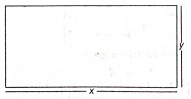
Manjit wants to donate a reciangular plot of land for a school in his village. When he was asked to give dimensions of the plot, he told that if its length is decreased by 50 m and breadth is increased by 50m, then its area will remain same, but if length is decreased by 10m and breadth is decreased by 20m, then its area will decrease by 5300 m².
Answer the following questions using the above information.
(i) The equations in terms of x and yare (a) xy=50 and 2x-y=550 (b) xy=50 and 2x + y = 550 (c) x + y = 50 and 2x + y = 550 (d) x+y=50 and 2x - y = 550
(ii) Which of the following matrix equation represent the information given above.
(a) \(\left[\begin{array}{cc}1 & -1 \\ 2 & 1\end{array}\right]\left[\begin{array}{l}x \\ y\end{array}\right]=\left[\begin{array}{c}50 \\ 550\end{array}\right]\)
(b) \(\left[\begin{array}{ll}1 & 1 \\ 2 & 1\end{array}\right]\left[\begin{array}{l}x \\ y\end{array}\right]=\left[\begin{array}{c}50 \\ 550\end{array}\right]\)
(c) \(\left[\begin{array}{cc}1 & 1 \\ 2 & -1\end{array}\right]\left[\begin{array}{l}x \\ y\end{array}\right]=\left[\begin{array}{c}50 \\ 550\end{array}\right]\)
(d) \(\left[\begin{array}{ll}1 & 1 \\ 2 & 1\end{array}\right]\left[\begin{array}{l}x \\ y\end{array}\right]=\left[\begin{array}{c}-50 \\ -550\end{array}\right]\)
(iii) The value of x (length of rectangular field) is
(a) 150 m
(b) 400 m
(c) 200 m
(d) 320 m
(iv) The value of y (breadth of rectangular field) is
(a) 150 m
(b) 200 m
(c) 430 m
(d) 350 m
(v) How much is the area of rectangular field?
(a) 60000 m²
(b) 30000 m²
(c) 30000 m
(d) 3000 m
41.
Deepa rides her car at 25 km/hr, She has to spend Rs. 2 per km on diesel and if she rides it at a faster speed of 40 km/hr, the diesel cost increases to Rs. 5 per km. She has Rs. 100 to spend on diesel. Let she travels x kms with speed 25 km/hr and y kms with speed 40 km/hr. The feasible region for the LPP is shown below:
Based on the above information, answer the following questions
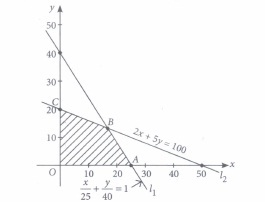
Based on the above information, answer the following questions.
(i) What is the point of intersection of line l1 and l2,
| \(\text { (a) }\left(\frac{40}{3}, \frac{50}{3}\right)\) | \(\text { (b) }\left(\frac{50}{3}, \frac{40}{3}\right)\) | \(\text { (c) }\left(\frac{-50}{3}, \frac{40}{3}\right)\) | \(\text { (d) }\left(\frac{-50}{3}, \frac{-40}{3}\right)\) |
(ii) The corner points of the feasible region shown in above graph are
| \(\text { (a) }(0,25),(20,0),\left(\frac{40}{3}, \frac{50}{3}\right)\) | \(\text { (b) }(0,0),(25,0),(0,20)\) | \(\text { (c) }(0,0),\left(\frac{40}{3}, \frac{50}{3}\right),(0,20)\) | \(\text { (d) }(0,0),(25,0),\left(\frac{50}{3}, \frac{40}{3}\right),(0,20)\) |
(iii) If Z = x + y be the objective function and max Z = 30. The maximum value occurs at point
| \(\text { (a) }\left(\frac{50}{3}, \frac{40}{3}\right)\) | (b) (0, 0) | (c) (25, 0) | (d) (0, 20) |
(iv) If Z = 6x - 9y be the objective function, then maximum value of Z is
| (a) -20 | (b) 150 | (c) 180 | (d) 20 |
(v) If Z = 6x + 3y be the objective function, then what is the minimum value of Z?
| (a) 120 | (b) 130 | (c) 0 | (d) 150 |
42.
A manufacturer produces three types of bolts, x, y and z which he sells in two markets. Annual sales (in Rs) are indicated below:
| Markets | Products | ||
| x | y | z | |
| I | 10000 | 2000 | 18000 |
| II | 6000 | 20000 | 8000 |
If unit sales prices of x, y and z are Rs.2.50, Rs.1.50 and Rs.1.00 respectively, then answer the following questions using the concept of matrices.
(i) Find the total revenue collected from the Market-I.
| (a) Rs. 44000 | (b) Rs. 48000 | (c) Rs. 46000 | (d) Rs. 53000 |
(ii) Find the total revenue collected from the Market-II.
| (a) Rs. 5100 | (b) Rs. 5300 | (c ) Rs. 46000 | (d) Rs. 49000 |
(iii) If the unit costs of the above three commodities are Rs.2.00, Rs.1.00 and 50 paise respectively, then find the gross profit from both the markets.
| (a) Rs. 53000 | (b) Rs. 46000 | (c) Rs. 34000 | (d) Rs. 32000 |
(iv) If matrix \(4=\left[a_{i j}\right]_{2 \times 2}\) , where \(a_{i j}=1, \text { if } i \neq j\) , and \(a_{i j}=0 \text { if } i=j\) , then A2 is equal to
| (a) I | (b) A | (c) 0 | (d) none of these |
(v) If A and B are matrices of same order, then (AB' - BA') is a
| (a) skew-symmetric matrix | (b) null matrix | (c) symmetric matrix | (d) unit matrix |
43.
Assertion: If A = \(\begin{bmatrix}
2& 3\\
1& 2\\
\end{bmatrix}\)and B = \(\begin{bmatrix}
2& -3\\
-1& 2\\
\end{bmatrix}\), then B is the inverse of A.
Reason: If A is a square matrix of order m and if there exists another square matrix B of the same order m, such that AB = BA = I, then B is called the inverse of A.
(a) Assertion is correct, reason is correct; reason is a correct explanation for assertion.
(b) Assertion is correct, reason is correct; reason is not a correct explanation for assertion
(c) Assertion is correct, reason is incorrect
(d) Assertion is incorrect, reason is correct.
44.
Consider the system
2x + 3y + 6z = 8
x + 2y + 3z = 5
x + y + 3z = 4
Assertion: The above system of equation has no solution.
Reason: detA = 0 and (adj A A)B = 0, where
\(A=\begin{bmatrix}
2& 3& 6\\
1& 2& 3\\
1& 1& 3\\
\end{bmatrix}\)and \(B=\begin{bmatrix}
8 \\
5 \\
4 \\
\end{bmatrix}\)
(a) Assertion is correct, reason is correct; reason is a correct explanation for assertion.
(b) Assertion is correct, reason is correct; reason is not a correct explanation for assertion
(c) Assertion is correct, reason is incorrect
(d) Assertion is incorrect, reason is correct.
1.
Suppose tailor A work for x days and tailor B work for y days.
The given data can be written in the tabular form as follows
\(\begin{array}{c|c|c|c} \hline \text { Tailor } & \begin{array}{c} \text { Number } \\ \text { of shirts } \end{array} & \begin{array}{c} \text { Number of } \\ \text { trousers } \end{array} & \text { Cost/day } \\ \hline A & 6 & 4 & Rs. 300 \\ B & 10 & 4 & \text { Rs. } 400 \\ \hline \text { Minimum requirement } & 60 & 32 & \\ \hline \end{array}\)
Required linear programming problem is
Min (Z) = 300x + 400y
subject to constraints
\(6 x+10 y \geq 60\)
\(4 x+4 y \geq 32\) and \(x \geq 0, y \geq 0\)
2.
\(P=\left[ \begin{matrix} 2 & 3 \\ 1 & 0 \end{matrix} \right] \ Q=\left[ \begin{matrix} 0 & 1 \\ -1 & 0 \end{matrix} \right] \)
3.
1 x 1, 3 x 3
4.
\(A=\left[ \begin{matrix} 0 & x & -4 \\ -2 & 0 & -1 \\ y & -1 & 0 \end{matrix} \right] \)
\({ A }^{ \prime }=\left[ \begin{matrix} 0 & -2 & y \\ x & 3 & -1 \\ -4 & -1 & 0 \end{matrix} \right] \)
For skew symmetric
\(A={ -A }^{ \prime }\)
\(\Rightarrow \left[ \begin{matrix} 0 & x & -4 \\ -2 & 0 & -1 \\ y & -1 & 0 \end{matrix} \right] =-\left[ \begin{matrix} 0 & -2 & y \\ x & 3 & -1 \\ -4 & -1 & 0 \end{matrix} \right] \)
x = 2, y = 4
5.
Given \({ a }_{ ij }=\frac { 1 }{ 3 } \left| -3i+j \right|
\)
\(\therefore \ { a }_{ 23 }=\frac { 1 }{ 3 } \left| -6+3 \right| =1\)
6.
Given \(A=\begin{bmatrix} 1 & -1 \\ -1 & 1 \end{bmatrix};kA\begin{bmatrix} k & -k \\ -k & k \end{bmatrix} \)
\({ A }^{ 2 }=\begin{bmatrix} 1 & -1 \\ -1 & 1 \end{bmatrix}\begin{bmatrix} 1 & -1 \\ -1 & 1 \end{bmatrix}=\begin{bmatrix} 1+1 & -1-1 \\ -1-1 & 1+1 \end{bmatrix}\) [multiplying row by column]
\({ A }^{ 2 }=kA\Rightarrow \begin{bmatrix} 2 & -2 \\ -2 & 2 \end{bmatrix}=\begin{bmatrix} 1 & -1 \\ -1 & 1 \end{bmatrix} \)
\(\Rightarrow k=2A\)
On comparing with Eq. (ii), we got k = 2
7.
1
8.
Given that,
Minimise and Maximise Z = 3x + 9y ...(i)
Subject to the constraints are
\(\begin{aligned} x+3 y & \leq 60 \end{aligned}\) ...(ii)
\(\begin{aligned} x+y & \geq 10 \end{aligned}\) ...(iii)
\(\begin{aligned} x & \leq y \end{aligned}\) ...(iv)
\(\begin{aligned} x \geq 0, y & \geq 0 \end{aligned}\) ...(v)
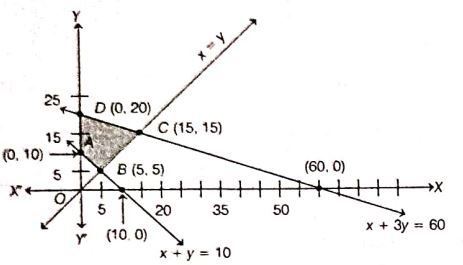
First of all,let us plot the graph of the feasible region of the system of linear inequalities (ii) to (v). The feasible region ABCDA is shown in the figure.
Note That the region is bounded. The coordinates of the corner points A, B, C and D are (0, 10), (5, 5), (15, 15) and (0, 20), respectively.
| Corner points | Corresponding value of Z = 3x + 9y |
| A (0, 10) | 90 |
| B(5, 5) | 60 (Minimum) |
| C(15, 15) | 180 (Maximum) Multiple optimal solutions) |
| D(0, 20) | 180 |
We, now find the minimum and maximum value of Z. From the table, we find that the minimum value of Z is 60 at the point B(5, 5) of the feasible region.
The maximum value of Z on the feasible region occurs at the two corner points C (15, 15) and D (0, 20) and it is 180 in each case.
Remark Observe that in the above example, the problem has multiple optimal solutions at the corner points C and D, i.e. the both points produce same maximum value 180.
In such cases, you can see that every point on the line segment CD joining the two corner points C and D also give the same maximum value. Same is also true in the case, if the two points produce same minimum value.
9.
We have, maximise, Z = 60x + 40y ...(i)
Subject to the constraints, x + 2y \(\leq 12\) ...(ii)
\(\begin{aligned}
2 x+y & \leq 12
\end{aligned}\) ...(iii)
\(\begin{aligned}
4 x+5 y & \geq 20
\end{aligned}\) ...(iv)
and \(\begin{aligned}
x, y & \geq 0
\end{aligned}\) ...(v)
Table for line x + 2y = 12 is
| x | 0 | 12 |
| y | 6 | 0 |
So, the line x + 2y = 12 is passing through the points (0, 6) and (12, 0).
On putting (0,0) in the inequality \(x+2 y \leq 12\) we get \(0+2(0) \leq 12 \Rightarrow 0 \leq 12\), which is true
So,the half plane is towards the origin.
Table for line 2x + y = 12 is
| x | 0 | 6 |
| y | 12 | 0 |
So, the line 2x + y = 12 is passing through the points (0, 12) and (6, 0).
On putting (0, 0) in the inequality \(2 x+y \leq 12\) we get
\(2(0)+0 \leq 12 \Rightarrow 0 \leq 12\) , which is true.
So, the half plane is towards the origin.
Table for line 4x + 5y = 20 is
| x | 0 | 5 |
| y | 4 | 0 |
So, the line 4x + 5y = 20 is passing through the points (0,4) and (5, 0).
On putting (0, 0) in the inequality \(4 x+5 y \geq 20\), we get 4(0) + 5(0) \(\geq\) 20 \(\Rightarrow\) 0 > 20 which is not true.
So, the half plane is away from the origin.
Also, x, y \(\geq\) 0
So, the region lies in Ist quadrant.
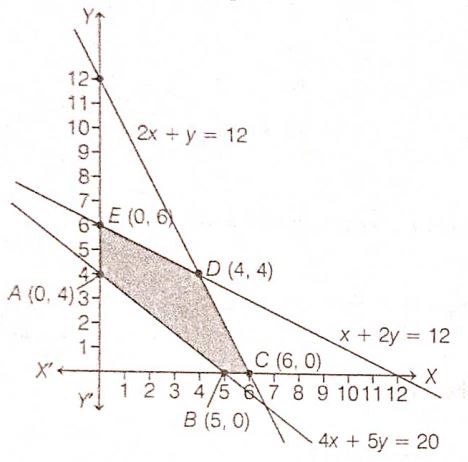
On solving Eqs. x + 2y = 12 and 2x + y = 12, we get D(4, 4)
Clearly, the feasible region is ABCDEA.
The corner points of the feasible region are A(0, 4), B(5, 0), C(6, 0), D(4, 4) and E(0, 6).
The value of Z at corner points are given below.
| Corner points | Z = 60x + 40y |
| A(0, 4) | Z = 60 \(\times\)0 + 40 \(\times\) 4 = 160 |
| B(5, 0) | Z = 60 \(\times\) 5 + 40\(\times\)0 = 300 |
| C(6, 0) | Z = 60 \(\times\) 6 + 40 \(\times\) 0 = 360 |
| D(4, 4) | Z = 60 \(\times\) 4 + 40 \(\times\) 4 = 400 (Maximum) |
| E(0, 6) | Z = 60 \(\times\) 0 + 40 \(\times\) 6 = 240 |
The maximum value of Z is 400 at D(4, 4).
10.
Given, \(A=\left[\begin{array}{lll} 1 & 0 & 2 \\ 0 & 2 & 1 \\ 2 & 0 & 3 \end{array}\right]\)
Now, \(A^{2}=\left[\begin{array}{lll} 1 & 0 & 2 \\ 0 & 2 & 1 \\ 2 & 0 & 3 \end{array}\right]\left[\begin{array}{lll} 1 & 0 & 2 \\ 0 & 2 & 1 \\ 2 & 0 & 3 \end{array}\right]\)
\(=\left[\begin{array}{lll} 1+0+4 & 0+0+0 & 2+0+6 \\ 0+0+2 & 0+4+0 & 0+2+3 \\ 2+0+6 & 0+0+0 & 4+0+9 \end{array}\right]=\left[\begin{array}{lll} 5 & 0 & 8 \\ 2 & 4 & 5 \\ 8 & 0 & 13 \end{array}\right]\)
and
\(A^{3} =A \cdot A^{2}=\left[\begin{array}{lll} 1 & 0 & 2 \\ 0 & 2 & 1 \\ 2 & 0 & 3 \end{array}\right]\left[\begin{array}{lll} 5 & 0 & 8 \\ 2 & 4 & 5 \\ 8 & 0 & 13 \end{array}\right] \)
\(=\left[\begin{array}{ccc} 5+0+16 & 0+0+0 & 8+0+26 \\ 0+4+8 & 0+8+0 & 0+10+13 \\ 10+0+24 & 0+0+0 & 16+0+39 \end{array}\right]\)
\(=\left[\begin{array}{ccc} 21 & 0 & 34 \\ 12 & 8 & 23 \\ 34 & 0 & 55 \end{array}\right] \)
Since, A3 - 6A2 + 7A + kI3 = 0
\(\begin{aligned} \therefore &\left[\begin{array}{lll} 21 & 0 & 34 \\ 12 & 8 & 23 \\ 34 & 0 & 55 \end{array}\right]-6\left[\begin{array}{lll} 5 & 0 & 8 \\ 2 & 4 & 5 \\ 8 & 0 & 13 \end{array}\right]+7\left[\begin{array}{lll} 1 & 0 & 2 \\ 0 & 2 & 1 \\ 2 & 0 & 3 \end{array}\right] &+k\left[\begin{array}{lll} 1 & 0 & 0 \\ 0 & 1 & 0 \\ 0 & 0 & 1 \end{array}\right]=\left[\begin{array}{lll} 0 & 0 & 0 \\ 0 & 0 & 0 \\ 0 & 0 & 0 \end{array}\right] \end{aligned}\)
\( \Rightarrow\left[\begin{array}{lll} 21 & 0 & 34 \\ 12 & 8 & 23 \\ 34 & 0 & 55 \end{array}\right]-\left[\begin{array}{ccc} 30 & 0 & 48 \\ 12 & 24 & 30 \\ 48 & 0 & 78 \end{array}\right] +\left[\begin{array}{ccc} 7 & 0 & 14 \\ 0 & 14 & 7 \\ 14 & 0 & 21 \end{array}\right]+\left[\begin{array}{lll} k & 0 & 0 \\ 0 & k & 0 \\ 0 & 0 & k \end{array}\right]=\left[\begin{array}{lll} 0 & 0 & 0 \\ 0 & 0 & 0 \\ 0 & 0 & 0 \end{array}\right] \)
\(\Rightarrow\left[\begin{array}{ccc} 21-30+7+k & 0-0+0+0 & 34-48+14+0 \\ 12-12+0+0 & 8-24+14+k & 23-30+7+0 \\ 34-48+14+0 & 0-0+0+0 & 55-78+21+k \end{array}\right]\) \(=\left[\begin{array}{lll} 0 & 0 & 0 \\ 0 & 0 & 0 \\ 0 & 0 & 0 \end{array}\right]\)
\(\Rightarrow\left[\begin{array}{ccc} -2+\mathrm{A} & 0 & 0 \\ 0 & -2+k & 0 \\ 0 & 0 & -2+k \end{array}\right]=\left[\begin{array}{lll} 0 & 0 & 0 \\ 0 & 0 & 0 \\ 0 & 0 & 0 \end{array}\right]\)
On equating the corresponding elements, we get
-2 + k = 0
k = 2
11.
We have : \(B=\left[ \begin{matrix} 2 & -2 & -4 \\ -1 & 3 & 4 \\ 1 & -2 & -3 \end{matrix} \right] \)
\(\therefore \ B'=\left[ \begin{matrix} 2 & -1 & 1 \\ -2 & 3 & -2 \\ -4 & 4 & -3 \end{matrix} \right] .\)
Let \(\mathrm{P}=\frac{1}{2}\left(\mathrm{~B}+\mathrm{B}^{\prime}\right)=\frac{1}{2}\left[\begin{array}{rrr} 4 & -3 & -3 \\ -3 & 6 & 2 \\ -3 & 2 & -6 \end{array}\right]=\left[\begin{array}{ccc} 2 & \frac{-3}{2} & \frac{-3}{2} \\ \frac{-3}{2} & 3 & 1 \\ \frac{-3}{2} & 1 & -3 \end{array}\right]\)
Now, \(\mathrm{P}^{\prime}=\left[\begin{array}{ccc} 2 & \frac{-3}{2} & \frac{-3}{2} \\ \frac{-3}{2} & 3 & 1 \\ \frac{-3}{2} & 1 & -3 \end{array}\right]=\mathrm{P}\)
Thus, \(P=\frac{1}{2}\left(B+B^{\prime}\right)\) which is symmetric.
Also let, \(Q=\frac{1}{2}\left(B-B^{\prime}\right)=\frac{1}{2}\left[\begin{array}{rrr} 0 & -1 & -5 \\ 1 & 0 & 6 \\ 5 & -6 & 0 \end{array}\right]=\left[\begin{array}{ccc} 0 & \frac{-1}{2} & \frac{-5}{2} \\ \frac{1}{2} & 0 & 3 \\ \frac{5}{2} & -3 & 0 \end{array}\right]\)
Then, \(\mathrm{Q}^{\prime}=\left[\begin{array}{ccc} 0 & \frac{1}{2} & \frac{5}{3} \\ \frac{-1}{2} & 0 & -3 \\ \frac{-5}{2} & 3 & 0 \end{array}\right]=-\mathrm{Q}\)
Thus \(\mathrm{Q}=\frac{1}{2}\left(\mathrm{~B}-\mathrm{B}^{\prime}\right)\) is a skew-symmetric.
\(\mathrm{P}+\mathrm{Q}=\left[\begin{array}{ccc} 2 & \frac{-3}{2} & \frac{-3}{2} \\ \frac{-3}{2} & 3 & 1 \\ \frac{-3}{2} & 1 & -3 \end{array}\right]+\left[\begin{array}{ccc} 0 & \frac{-1}{2} & \frac{-5}{2} \\ \frac{1}{2} & 0 & 3 \\ \frac{5}{2} & -3 & 0 \end{array}\right]=\left[\begin{array}{rrr} 2 & -2 & -4 \\ -1 & 3 & 4 \\ 1 & -2 & -3 \end{array}\right]=\mathrm{B}\)
Thus, B is represented as the sum of a symmetric and a skew symmetric matrix.
12.
Since A and B are symmetric matrices, [Given]
\(\therefore\ A\prime =A\ and\ B\prime =B...(1)\)
\((i)\ (A+B)\prime =A\prime +B\prime =A+B.\ \) [Using (1)]
Hence, \(A+B\) is a symmetric matrix
\((ii)\ (AB-BA)\prime =(AB)\prime -(BA)\prime \)
\(=B\prime A\prime -A\prime B\prime =BA-AB\) [Using (1)]
\(=-(AB-BA).\)
Hence, \(AB-BA\) is a skew-symmetric matrix.
\((iii)\ (AB+BA)\prime =(AB)\prime +(BA)\prime \)
\(=B\prime A\prime +A\prime B\prime =BA+AB\quad \) [Using (1)]
\(=AB+BA.\)
Hence, \(AB+BA\) is a skew-symmetric matrix.
13.
Consider the product \(\left[\begin{array}{ccc} 1 & -1 & 2 \\ 0 & 2 & -3 \\ 3 & -2 & 4 \end{array}\right]\left[\begin{array}{ccc} -2 & 0 & 1 \\ 9 & 2 & -3 \\ 6 & 1 & -2 \end{array}\right]\)
\(=\left[\begin{array}{ccc} -2-9+12 & 0-2+2 & 1+3-4 \\ 0+18-18 & 0+4-3 & 0-6+6 \\ -6-18+24 & 0-4+4 & 3+6-8 \end{array}\right]=\left[\begin{array}{ccc} 1 & 0 & 0 \\ 0 & 1 & 0 \\ 0 & 0 & 1 \end{array}\right]\)
Hence, \(\left[\begin{array}{ccc} 1 & -1 & 2 \\ 0 & 2 & -3 \\ 3 & -2 & 4 \end{array}\right]^{-1}=\left[\begin{array}{ccc} -2 & 0 & 1 \\ 9 & 2 & -3 \\ 6 & 1 & -2 \end{array}\right]\)
Now, given system of equations can be written, in matrix form, as follows
\(\left[\begin{array}{ccc} 1 & -1 & 2 \\ 0 & 2 & -3 \\ 3 & -2 & 4 \end{array}\right]\left[\begin{array}{l} x \\ y \\ z \end{array}\right]=\left[\begin{array}{l} 1 \\ 1 \\ 2 \end{array}\right]\)
\(\begin{aligned} &x \\ &y \\ &z \end{aligned}=\left[\begin{array}{rrr} 1 & -1 & 2 \\ 0 & 2 & -3 \\ 3 & -2 & 4 \end{array}\right]^{-1}\left[\begin{array}{l} 1 \\ 1 \\ 2 \end{array}\right]=\left[\begin{array}{lll} 2 & 0 & 1 \\ 9 & 2 & 3 \\ 6 & 1 & 2 \end{array}\right]\left[\begin{array}{l} 1 \\ 1 \\ 2 \end{array}\right]\)
\(=\left[\begin{array}{r} -2+0+2 \\ 9+2-6 \\ 6+1-4 \end{array}\right]=\left[\begin{array}{l} 0 \\ 5 \\ 3 \end{array}\right]\)
Hence, x = 0, y = 5, z = 3
14.
\(\text { Let } A=\left[\begin{array}{lll} 1 & 2 & 3 \\ 0 & 2 & 4 \\ 0 & 0 & 5 \end{array}\right]\)
\(\text { We have, }|A|=1(10-0)-2(0-0)+3(0-0)=10\)
\(\text { Now, }A_{11}=10-0=10, A_{12}=-(0-0)=0, A_{13}=0-0=0\)
\(A_{21}=-(10-0)=-10, A_{22}=5-0=5, A_{23}=-(0-0)=0\)
\(A_{31}=8-6=2, A_{32}=-(4-0)=-4, A_{33}=2-0=2 \)
\(\therefore \operatorname{adj} A=\left[\begin{array}{ccc} 10 & -10 & 2 \\ 0 & 5 & -4 \\ 0 & 0 & 2 \end{array}\right] \)
\(\therefore A^{-1}=\frac{1}{|A|} \text { adj } A=\frac{1}{10}\left[\begin{array}{ccc} 10 & -10 & 2 \\ 0 & 5 & -4 \\ 0 & 0 & 2 \end{array}\right]\)
15.
Using equality of matrices
3a + 4b = 2, c + d = 5, 2c - d = - 5, a - 2b = 4
Solving for a, b, c and d, we get
a = 2, b = -1, c = 0,d = 5
16.
(i) Our problem is to minirnise Z = 3x + 5y
subject to constraints \(x+3 y \geq 3\)
\(x+y \geq 2\)
and \(x \geq 0, y \geq 0\) .
(ii) Table for line x + 3y = 3 is
\(\begin{array}{c|c|c} \hline x & 0 & 3 \\ \hline y & 1 & 0 \\ \hline \end{array}\)
So, the line passes through the points (0, 1) and (3, 0).
On putting (0, 0) in the inequality \(x+3 y \geq 3\), we get
\(0+3 \times 0 \geq 3\)
\(\Rightarrow 0 \geq 3\), which is not true
So, the half plane is away from the origin.
Also, \(x, y \geq 0\) so the feasible region lies in the I quadrant.
Table for line x + y = 2 is
\(\begin{array}{|c|c|c|} \hline x & 0 & 2 \\ \hline y & 2 & 0 \\ \hline \end{array}\)
So, the line passes through the points (0, 2) and (2, 0). On putting (0, 0) in the inequality \(x+y \geq 2\), we get \(0+0 \geq 2 \Rightarrow 0 \geq 2\), which is not true
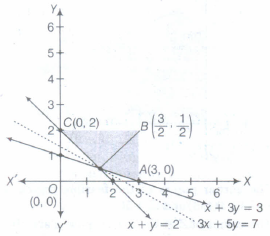
So, the half plane is away from the origin. It can be seen that the feasible region is unbounded. On solWng equations x + y = 2 and x + 3y = 3, we get
\(x=\frac{3}{2} \text { and } y=\frac{1}{2}\)
\(\therefore \text { Intersection point is } B\left(\frac{3}{2}, \frac{1}{2}\right)\)
The corner points of the feasible region are A(3,0), \(B\left(\frac{3}{2}, \frac{1}{2}\right) \text { and } C(0,2)\)
The values of Z at the corner points are given below
\(\begin{array}{c|c} \hline \text { Corner points } & z=3 x+5 y \\ \hline A(3,0) & z=3 \times 3+5 \times 0=9 \\ B\left(\frac{3}{2}, \frac{1}{2}\right) & z=3 \times \frac{3}{2}+5 \times \frac{1}{2}=7 \\ C(0,2) & z=3 \times 0+5 \times 2=10 \\ \hline \end{array}\)
As the feasible region is unbounded, therefore 7 may or may not be the minimum value of Z.
For this, we draw the graph of the inequality \(3 x+5 y<7\) and check whether the resulting half plane has points in common with the feasible region or not. It can be seen that, the feasible region has no common point with \(3 x+5 y<7\)
Therefore, the minimum value of Z is 7 at \(B\left(\frac{3}{2}, \frac{1}{2}\right)\).
17.
The system of constraints is:
\(x+y\le 4\) ..(1)
and \(x\ge 0,y\ge 0.\) ...(2)
The shaded region in the following figure is the feasible region determined by the system of constraints (1)-(2)
It is observed that the feasible region OAB is bounded.
Thus we use Corner Point Method to determine the maximum value of Z, where:
Z = 3x + 4y...(3)
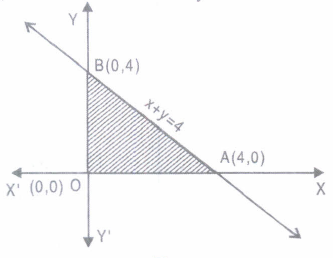
The co-ordinates of O, A and B are (0, 0), (4, 0) and (0, 4) respectively.
We evaluate Z at each corner point.
| Corner Point | Corresponding Value of Z |
| O : (0,0) | 0 |
| A : (4,0) | 12 |
| B : (0,4) | 16 (Maximum) |
Hence, \(Z_{ max }=16\) at the point (0, 4)
18.
We have \(=\left[\begin{array}{c} 4000+50000+250000 \\ 120000+100000+500000 \end{array}\right]=\left[\begin{array}{l} 304,000 \\ 720,000 \end{array}\right] \begin{aligned} &\rightarrow X \\ &\rightarrow Y \end{aligned}\)
\(=\left[\begin{array}{ll} 340,000 \\ 720,000 \end{array}\right] \begin{aligned} &\rightarrow \mathrm{X} \\ &\rightarrow \mathrm{Y} \end{aligned}\)
So the total amount spent by the group in the two cities is Rs. 340,000 paise and Rs. 720,000 paise, i.e., Rs. 3400 and Rs. 7200, respectively.
19.
The given system of equations is:
5x + 2y = 4
7x + 3y = 5
These can be written as AX=B
=X = A-1B ....(1)
where \(A=\begin{bmatrix} 5&2\\7&3\end{bmatrix},X=\begin{bmatrix}x\\y \end{bmatrix}and\ B=\begin{bmatrix}4\\5 \end{bmatrix}\)
\(|A|=\begin{vmatrix} 5&2\\ 7&3\end{vmatrix}=15-14=1\ne0\Rightarrow A^{-1}\) exists.
Now \(adj\ A=\begin{bmatrix}3&-7\\-2&5 \end{bmatrix}'=\begin{bmatrix} 3&-2\\-7&5\end{bmatrix}\)
\(A^{-1}={1\over |A|}(adj\ A)={1\over1}\begin{bmatrix}3&-2\\-7&5 \end{bmatrix}.\)
From (1), \(X=\begin{bmatrix}3&-2\\-7&5 \end{bmatrix}\begin{bmatrix} 4\\5\end{bmatrix}\)
\(=\begin{bmatrix} 12-10\\-28+25\end{bmatrix}\)
\(\begin{bmatrix} x\\y\end{bmatrix}=\begin{bmatrix}2\\-3 \end{bmatrix}\)
Hence x = 2, y = -3
20.
(i) Area of the triangle
\(={1\over2}\begin{vmatrix} x_1&y_1&1\\x_2&y_2&1\\x_3&y_3&1 \end{vmatrix}\)
\({1\over2}\begin{vmatrix}k&0&1\\4&0&1\\0&2&1 \end{vmatrix}\)
\({1\over2}(-2)[k-4]\)
\(-(k-4)\)
By the equation, -(k - 4) = \(\pm4\)
Taking +ve sign, -(k - 4) = 4 \(\Rightarrow\) k = 0
Taking -ve sign, -(k - 4) = -4 \(\Rightarrow\) k = 8
Hence k = 0, 8
(ii)Area ofg the triangle \(={1\over2}\begin{vmatrix} x_1&y_1&1\\x_2&y_2&1\\x_3&y_3&1 \end{vmatrix}\)
\({1\over2}\begin{vmatrix}-2&0&1\\0&4&1\\0&k&1 \end{vmatrix}\)
\({1\over2}(-2)[k-4]\)
\(-(k-4)\)
By the equation, k - 4 = \(\pm4\)
Taking +ve sign, k - 4 = 4 \(\Rightarrow\) k = 0
Taking -ve sign, k - 4 = -4 \(\Rightarrow\) k = 8
Hence k = 0, 8
21.
We have \(A^2=A \cdot A=\left[\begin{array}{ll} 2 & 3 \\ 1 & 2 \end{array}\right]\left[\begin{array}{ll} 2 & 3 \\ 1 & 2 \end{array}\right]=\left[\begin{array}{cc} 7 & 12 \\ 4 & 7 \end{array}\right]\)
Hence \(\mathrm{A}^2-4 \mathrm{~A}+\mathrm{I}=\left[\begin{array}{cc} 7 & 12 \\ 4 & 7 \end{array}\right]-\left[\begin{array}{cc} 8 & 12 \\ 4 & 8 \end{array}\right]+\left[\begin{array}{ll} 1 & 0 \\ 0 & 1 \end{array}\right]=\left[\begin{array}{ll} 0 & 0 \\ 0 & 0 \end{array}\right]=\mathrm{O}\)
\(\begin{array}{l} \mathrm{A}^2-4 \mathrm{~A}+\mathrm{I}=\mathrm{O} \\ \mathrm{A} \mathrm{A}-4 \mathrm{~A}=-\mathrm{I} \end{array}\)
or \( \mathrm{A} \mathrm{A}\left(\mathrm{A}^{-1}\right)-4 \mathrm{AA}^{-1}=-\mathrm{IA}^{-1} \) (Post multiplying by A–1 because |A| ≠ 0)
or \( {A}\left(\mathrm{~A} \mathrm{~A}^{-1}\right)-4 \mathrm{I}=-\mathrm{A}^{-1} \)
or \(\mathrm{AI}-4 \mathrm{I}=-\mathrm{A}^{-1} \)
or \(\mathrm{A}^{-1}=4 \mathrm{I}-\mathrm{A}=\left[\begin{array}{ll} 4 & 0 \\ 0 & 4 \end{array}\right]-\left[\begin{array}{ll} 2 & 3 \\ 1 & 2 \end{array}\right]=\left[\begin{array}{cc} 2 & -3 \\ -1 & 2 \end{array}\right]\)
Hence \(A^{-1}=\left[\begin{array}{cc} 2 & -3 \\ -1 & 2 \end{array}\right]\)
22.
(c)
\(\left[\begin{array}{cc}7 & 11 \\ -5 & 2\end{array}\right]\)
23.
(a)
47
24.
(d)
Every point on the line segment CD
25.
(c)
infinitely many points
26.
(c)
k3|A|
27.
(c)
6
28.
\( \Delta=a_{11} A_{11}+a_{12} A_{12}+a_{13} A_{13} \\ =a_{11} M_{11}-a_{12} M_{12}+a_{13} M_{13} \\ =1 (-40)-3(-10)+(-2)(35) \\ =-40+30-70=-80 \)
29.
(d)
c(a2-b2)
30.
\(\frac{1}{2}\left|\begin{array}{ccc} 2 & -6 & 1 \\ 5 & 4 & 1 \\ k & 4 & 1 \end{array}\right|=\pm 35\)
31.
Given \(\left|\begin{array}{cc} x & 2 \\ 18 & x \end{array}\right|=\left|\begin{array}{cc} 6 & 2 \\ 18 & 6 \end{array}\right| \Rightarrow x^{2}-36=36-36\)
\(\Rightarrow \quad x^{2}=36 \Rightarrow x=\pm 6\)
32.
We know that if a matrix is of order m x n, then it has mn elements. Thus, to find all possible orders of a matrix with 8 elements, we will find all ordered pairs of natural numbers, whose product is 8. Thus, all possible ordered pair are (1,8), (8, I), (2, 4), (4, 2).
33.
(d)
Feasible solution
34.
(b)
Constraints, non-negative restrictions
35.
(c)
all of the given constraints
36.
As \(\begin{vmatrix} 2x & -1 \\ 4 & 2 \end{vmatrix}=\begin{vmatrix} 3 & 0 \\ 2 & 1 \end{vmatrix}\)
⇒ 4x + 4 = 3 - 0
⇒ x = \(-\frac { 1 }{ 4 } \)
37.
As in skew symmetric matrix, aij = -aji
⇒ aii = – aii
⇒ 2aii = 0
⇒ aii = 0, i.e. diagonal elements are zeroes.
38.
By definition.
39.
As a23 = \(\frac { { (-2+6) }^{ 2 } }{ 5 } =\frac { 16 }{ 5 } \)
40.
According to the question, when length is decreased by 50 m and breadth is increased by 50 m
(x-50)(y+50) =xy
x - y = 50
and when length is decreased by 10 m and breadth is decreased by 20 m .
(i) (b) x-y=50 and 2 x+y=550
(ii) (a) Eqs. (i) and (ii) can be written in matrix form as
\(\left[\begin{array}{cc} 1 & -1 \\ 2 & 1 \end{array}\right]\left[\begin{array}{l} x \\ y \end{array}\right]=\left[\begin{array}{c} 50 \\ 550 \end{array}\right]\)
(iii) (c) We have, \( {\left[\begin{array}{cc} 1 & -1 \\ 2 & 1 \end{array}\right]\left[\begin{array}{l} x \\ y \end{array}\right]=\left[\begin{array}{c} 50 \\ 550 \end{array}\right] } \)
\(\Rightarrow {\left[\begin{array}{c} x \\ y \end{array}\right]=\left[\begin{array}{cc} 1 & -1 \\ 2 & 1 \end{array}\right]^{-1}\left[\begin{array}{c} 50 \\ 550 \end{array}\right] }\)
\(\therefore \quad(x-10)(y-20)=x y-5300\)
\( \Rightarrow \quad 2 x+y=550\)
\( =\frac{1}{1-(2)(-1)}\left[\begin{array}{cc} 1 & 1 \\ -2 & 1 \end{array}\right]\left[\begin{array}{c} 50 \\ 550 \end{array}\right] \)
\(=\frac{1}{3}\left[\begin{array}{cc} 50+550 \\ c & b \\ -100+550 \end{array}\right]=\frac{1}{3}\left[\begin{array}{l} 600 \\ 450 \end{array}\right]=\left[\begin{array}{l} 200 \\ 150 \end{array}\right]\)
\therefore x = 200 and y=150
Lenght of rectangular field
\(\Rightarrow x=200 \mathrm{~m}\)
(iv) (a) Breadth of rectangular field \(y=150 \mathrm{~m}\)
(v) (b) Area of rectangular field =200 x 150 \(=30000 \mathrm{~m}^2\)
41.
(i) (b): Let B(x, y) be the point of intersection of the given lines
2x + 5y = 100 ....(i)
and \(\frac{x}{25}+\frac{y}{40}=1 \Rightarrow 8 x+5 y=20\)...(ii)
Solving (i) and (ii), we get
\(x=\frac{50}{3}, y=\frac{40}{3}\)
ஃ The point of intersection \(B(x, y)=\left(\frac{50}{3}, \frac{40}{3}\right)\)
(ii) (d): The corner points of the feasible region shown in the given graph are
\((0,0), A(25,0), B\left(\frac{50}{3}, \frac{40}{3}\right), C(0,20)\)
(iii) (a): Here Z = x + y
| Corner Points | Value of Z = x + y |
| (0,0) | 0 |
| (25,0) | 25 |
| \(\left(\frac{50}{3}, \frac{40}{3}\right)\) | 30 ⇠ Maximum |
| (0,20) | 20 |
Thus, max Z = 30 occurs at point \(\left(\frac{50}{3}, \frac{40}{3}\right)\)
(iv) (b):
| Corner Points | Value of Z = 6x - 9y |
| (0,0) | 0 |
| (25,0) | 150 ⇠ Maximum |
| \(\left(\frac{50}{3}, \frac{40}{3}\right)\) | -20 |
| (0,20) | -180 |
(v) (c):
| Corner Points | Value of Z = 6x + 3y |
| (0,0) | 0 ⇠ Maximum |
| (25,0) | 150 |
| \(\left(\frac{50}{3}, \frac{40}{3}\right)\) | 140 |
| (0,20) | 60 |
42.
Let A be the 2 x 3 matrix representing the annual sales of products in two markets.
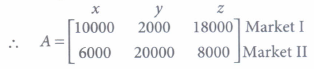
Let B be the column matrix representing the sale price of each unit of products x, y, z.
\(\therefore \quad B=\left[\begin{array}{c} 2.5 \\ 1.5 \\ 1 \end{array}\right]\)
Now, revenue = sale price x number of items sold
\(=\left[\begin{array}{ccc} 10000 & 2000 & 18000 \\ 6000 & 20000 & 8000 \end{array}\right]\left[\begin{array}{c} 2.5 \\ 1.5 \\ 1 \end{array}\right]\)
\(=\left[\begin{array}{l} 25000+3000+18000 \\ 15000+30000+8000 \end{array}\right]=\left[\begin{array}{l} 46000 \\ 53000 \end{array}\right]\)
Therefore, the revenue collected from Market I = Rs.46000 and the revenue collected from Market II = Rs. 53000.
(i) (c)
(ii) (b)
(iii) (d) : Let C be the column matrix representing cost price of each unit of products x, y, z.
Then, \(C=\left[\begin{array}{c} 2 \\ 1 \\ 0.5 \end{array}\right]\)
\(\therefore\) Total cost in each market is given by
\(A C=\left[\begin{array}{ccc} 10000 & 2000 & 18000 \\ 6000 & 20000 & 8000 \end{array}\right]\left[\begin{array}{c} 2 \\ 1 \\ 0.5 \end{array}\right]\)
\(=\left[\begin{array}{c} 20000+2000+9000 \\ 12000+20000+4000 \end{array}\right]=\left[\begin{array}{l} 31000 \\ 36000 \end{array}\right]\)
Now, Profit matrix = Revenue matrix, Cost matrix
\(=\left[\begin{array}{l} 46000 \\ 53000 \end{array}\right]-\left[\begin{array}{l} 31000 \\ 36000 \end{array}\right]=\left[\begin{array}{l} 15000 \\ 17000 \end{array}\right]\)
Therefore, the gross profit from both the markets
= Rs.15000+ Rs.17000= Rs.32000
(iv) (a) : We have \(A=\left[\begin{array}{ll} 0 & 1 \\ 1 & 0 \end{array}\right]\)
\(\therefore \quad A^{2}=\left[\begin{array}{ll} 0 & 1 \\ 1 & 0 \end{array}\right]\left[\begin{array}{ll} 0 & 1 \\ 1 & 0 \end{array}\right]=\left[\begin{array}{ll} 1 & 0 \\ 0 & 1 \end{array}\right]=I\)
(v) (a) : We have, (AB' -BA')' = (B')'A' - (A')'B'
= BA' - AB' = -(AB' - BA')
Thus, AB' - BA' is a skew-symmetric matrix.
43.
(a) Assertion is correct, reason is correct; reason is a correct explanation for assertion.
44.
(c) Assertion is correct, reason is incorrect

12th Standard CBSE Syllabus & Materials
12th Standard CBSE
CBSE 12th Computer Science Python Revision Tour I - New Previous year Question Papers Study Material - QB365 Set A
NEW12th Standard CBSE
CBSE 12th Business Studies Planning Important Questions And Answers Study Material - QB365 Set A
NEW12th Standard CBSE
CBSE 12th Business Studies Business Environment Important Questions And Answers Study Material - QB365 Set A
NEW12th Standard CBSE
CBSE 12th Business Studies Principles of Management Important Questions And Answers Study Material - QB365 Set A



NCERT Books

Syllabus

Exam Pattern

Sample Question Papers

Previous year Question Papers

Important Notes

MCQ Practice test

NCERT Exemplers

Case study Questions

Image Based Questions

Passage based Questions

HOT Questions

Value Based Questions

Model Questions Papers
NCERT ( Book Back ) Questions

Assertion and Reason
Important Questions And Answers

CBSE 12th Standard CBSE Subjects
CBSE Standards








