
 100% FREE ACCESS
12th Standard CBSE Syllabus & Materials
12th Standard CBSE
CBSE 12th Economics Government Budget and the Economy Previous year Question Papers Study Material - QB365 Set A
NEW12th Standard CBSE
CBSE 12th Computer Science Interface Python with MySQL - New Previous year Question Papers Study Material - QB365 Set A
NEW12th Standard CBSE
CBSE 12th Computer Science Database Concept - New Previous year Question Papers Study Material - QB365 Set A
NEW12th Standard CBSE
CBSE 12th Computer Science Data Communication - New Previous year Question Papers Study Material - QB365 Set A
NEW12th Standard CBSE
CBSE 12th Computer Science Data Structures - New Previous year Question Papers Study Material - QB365 Set A
NEW12th Standard CBSE
CBSE 12th Computer Science Functions - New Previous year Question Papers Study Material - QB365 Set A

Published on: 02/11/2025
Download CBSE Class 12th Standard CBSE Maths question papers, sample papers, important questions, and previous year solved papers in PDF format. Get free study materials, NCERT solutions, and exam preparation resources for Class 12th Standard CBSE Maths
Questions + Answers key
Take MCQ Maths Test
1.
Check whether the function f:R ➝ R defined as f(x) = x³ is one-one or not.
2.
A die, whose faces are marked 1, 2, 3 in red and 4, 5, 6 in green, is tossed. Let A be the event "number obtained is even" and B be the event "number obtained is red". Find if A and B are independent events.
3.
A stone is dropped into a quiet lake and waves moves in circles at a speed of 5 cm/ s. At the instant when the radius of the circular wave is 8 cm, how fast is the enclosed area increasing?
4.
Show that \(f(x)=e^{1 / x}\) is a strictly decreasing function for all x > O.
5.
Show that the function f given by \(f(x)=x^{3}-3 x^{2}+4 x, x \in R\) is strictly increasing on R.
6.
If \(A=\left[ \begin{matrix} 1 & 4 \\ 3 & 2 \\ 2 & 1 \end{matrix} \right] B=\left[ \begin{matrix} 5 & 2 \\ -1 & 0 \\ 1 & 1 \end{matrix} \right] \), then find the matrix X for which A + B - X = 0.
7.
If \(\left[ \begin{matrix} y & +2x & 5 \\ & -x & 3 \end{matrix} \right] =\begin{bmatrix} 7 & 5 \\ -2 & 3 \end{bmatrix}\), find the value of y.
8.
If \(A=\left[\begin{array}{rr} 2 & 3 \\ 5 & -2 \end{array}\right]\) be such that A-1 = kA, then find the value of k.
9.
If\(A=\left[\begin{array}{lll} 1 & 0 & 1 \\ 0 & 1 & 2 \\ 0 & 0 & 4 \end{array}\right]\) then show that | 3 A | = 27 | A |
10.
Show that the relation R in the set of real numbers, defined as:
\(R=\{ (a,b):a\le b^{ 2 }\} \) is neither reflexive nor symmetric nor transitive.
11.
Construct a \(3\times 4\) matrix whose elements are given by:
\((i)\ { a }_{ ij }=\frac { 1 }{ 2 } \left| -3i+j \right| \)
\((ii)\ { a }_{ ij }=2i-j\)
12.
Mother, father and son line up at random for a family picture
E : son on one end, F : father in middle
13.
Events A and B are such that P(A) = \(1\over2\) ,P(B) = \(7\over12\) and P(not A or not B) = \(1\over4\) State whether A and B are independent?
14.
A factory has two machines A and B. Past record shows that machine A produced 60% of the items of output and machine B produced 40% of the items. Further, 2% of the items produced by machine A and 1% produced by machine B were defective. All the items are put into one stockpile and then one item is chosen at random from this and is found to be defective. What is the probability that it was produced by machine B?
15.
A particle moves along the curve 6y = x3+2. Find the points on the curve at which the y-coordinate is changing 8 times as fast as x-coordinate .
16.
In answering a question on a multiple choice test, a student either knows the answers or guesses. Let \(\frac{3}{5}\) be the probability that he knows the answer and \(\frac{2}{5}\) be the probability that he guesses. Assuming that a student who guesses at the answer will be correct with probability \(\frac{1}{3}\) . What is the probability that the student knows the answer, given that he answered it correctly?
17.
Bag I contains 1 white, 2 black and 3 red balls; Bag II contains 2 white, 1 black and I red balls; Bag III contains 4 white, 3 black and 2 red balls. A bag is chosen at random and two balls are drawn from it with replacement. They happen to be one white and one red. What is the probability that they came from Bag III?
18.
Let \(A=R-\{2\} and B=R-\{1\} .\) If f : A \rightarrow B is a function defined by \(f(x)=\frac{x-1}{x-2},\) then show that f is one-one and onto. Hence find \(f^{-1}\) .
19.
Show that the relation R in the set A = {1, 2, 3, 4, 5} given by R = {(a, b) : |a - b| is divisible by 2} is an equivalence relation. Write all the equivalence classes of R.
20.
If \(A=\left[ \begin{matrix} 1 & 2 & 1 \\ -1 & 1 & 1 \\ 1 & -3 & 1 \end{matrix} \right] ,\) find A-1. Hence solve the system of equations : x + 2y + z = 4, -x + y+ z = 0, x - 3y + z = 4.
21.
\(Find\quad { A }^{ 2 }-5A=6I\quad if\quad A=\left[ \begin{matrix} 2 & 0 & 1 \\ 2 & 1 & 3 \\ 1 & -1 & 0 \end{matrix} \right] .\)
22.
Given that \(A=\left[\begin{array}{cc}\alpha & \beta \\ \gamma & -\alpha\end{array}\right]\) and \(A^2=3 I\), then
\(1+\alpha^2+\beta \gamma=0 \)
\(1-\alpha^2-\beta \gamma=0 \)
\(3-\alpha^2-\beta \gamma=0 \)
\(3+\alpha^2+\beta \gamma=0\)
23.
The total cost C(x) (in Rs) associated with the production of x units of an item is given by C(x) = 0.007x3 - 0.003x2 + 15x + 4000. The marginal cost when 17units are produced, is
Rs. 20.967
Rs. 21.96
Rs. 81.968
Rs. 11.967
24.
If \(\left|\begin{array}{cc} x & 2 \\ 18 & x \end{array}\right|=\left|\begin{array}{cc} 6 & 2 \\ 18 & 6 \end{array}\right|\) then, x is equal to
6
\(\pm 6\)
-6
zero
25.
Two events A and B will be independent, if ______.
A and B are mutually exclusive
P(A'B') = [1 – P(A)] [1 – P(B)]
P(A) = P(B)
P(A) + P(B) = 1
26.
If P(A) = \(\frac12\), P(B) = 0, then P(A|B) is ______.
0
\(\frac12\)
not defined
1
27.
A cylindrical tank of radius 10 m is being filled with wheat at the rate of 314 cubic metre per hour. Then the depth of the wheat is increasing at the rate of
1 m/h
0.1 m/h
1.1 m/h
0.5 m/h
28.
The point on the curve x2 = 2y which is nearest to the point (0, 5) is
(2 \(\sqrt2\),4)
(2 \(\sqrt2\),0)
(0, 0)
(2, 2)
29.
If A is an invertible matrix of order 2, then det (A–1) is equal to
det (A)
\(\frac{1}{det(A)}\)
1
0
30.
If Δ = \(\left| \begin{matrix} { a }_{ 11 } & { a }_{ 12 } & { a }_{ 13 } \\ { a }_{ 21 } & { a }_{ 22 } & { a }_{ 23 } \\ { a }_{ 31 } & { a }_{ 32 } & { a }_{ 33 } \end{matrix} \right| \) and Aij is Cofactors of aij, then value of Δ is given by
a11 A31+ a12 A32 + a13 A33
a11 A11+ a12 A21 + a13 A31
a21 A11+ a22 A12 + a23 A13
a11 A11+ a21 A21 + a31 A31
31.
Which of the following is correct
Determinant is a square matrix
Determinant is a number associated to a matrix
Determinant is a number associated to a square matrix
None of these
32.
If A = \(\begin{bmatrix} cos\alpha & -sin\alpha \\ sin\alpha & cos\alpha \end{bmatrix}\), and A + A' = I, then the value of a is
\(\frac { \pi }{ 6 } \)
\(\frac { \pi }{ 6 } \)
\(\pi \)
\(\frac { 3\pi }{ 2 } \)
33.
Assume X, Y, Z, W and P are matrices of order 2 × n, 3 × k, 2 × p, n × 3 and p × k, respectively.
The restriction on n, k and p so that PY + WY will be defined are:
k = 3, p = n
k is arbitrary, p = 2
p is arbitrary, k = 3
k = 2, p = 3
34.
Let f : R ➝ R be defined as f (x) = 3x. Choose the correct answer
f is one-one onto
f is many-one onto
f is one-one but not onto
f is neither one-one nor onto
35.
Let R be the relation in the set N given by R = {(a, b): a = b − 2, b > 6}. Choose the correct answer.
(2, 4)∈ R
(3, 8) ∈ R
(6, 8)∈ R
(8, 7) ∈ R
36.
The diagonal elements of a skew symmetric matrix are
all zeroes
are all equal to some scalar k(≠ 0)
can be any number
none of these
37.
If A = [aij] is a 2 × 3 matrix, such that aij = \(\frac { { (-i+2j) }^{ 2 } }{ 5 }.\) Then a23 is ________
\(\frac15\)
\(\frac25\)
\(\frac95\)
\(\frac{16}{5}\)
38.
Given a function lf as f(x) = 5x + 4, x ∈ R. If g : R → R is inverse of function ‘f then
g(x) = 4x + 5
g(x) = \(\frac{5}{4x-5}\)
g(x) = \(\frac{x-4}{5}\)
g(x) = 5x – 4
39.
Let R be a relation on the set L of lines defined by l1 R l2 if l1 is perpendicular to l2, then relation R is
reflexive and symmetric
symmetric and transitive
equivalence relation
symmetric
40.
Students of a school are taken to a railway museum to learn about railways heritage and its history.
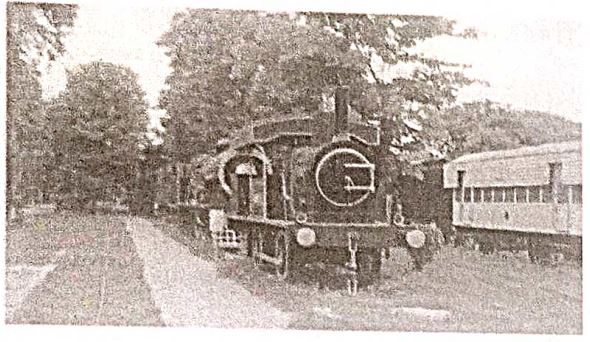
An exhibit in the museum depicted many rail lines on the track near the railway station. Let L be the set of all rail lines on the railway track and R be the relation on L defined by
R = {(l1, l2) : l1 is parallel to l2}
On the basis of the above information, answer the following questions.
(i) Find whether the relation R is symmetric or not.
(ii) Find whether the relation R is transitive or not.
(iii) If one of the rail lines on the railway track is represented by the equation y = 3x + 2, then find the set of rail lines in R related to it.
Or
Let S be the relation defined by S= ((l1,l2) : l1 is perpendicular to l2) check whether the relation S is symmetric and transitive.
41.
The Government declare that farmers can get Rs.300 per quintal for their onions on 1st July and after that,the price will be dropped by Rs. 3 per quintal per extra day.
Shyams father has 80 quintal of onions in the field on 1st July and he estimates that crop is increasing at the rate of 1 quintal per day.
Based on the above information, answer the following questions.
(i) If x is the number of days after 1st July, then price and quantity ofonion respectively can be expressed as
| (a) Rs. (300 - 3x), (80 + x) quintals | (b) Rs. (300 - 3x), (80 - x) quintals |
| (c) Rs. (300 + x), 80 quintals | (d) None of these |
(ii) Revenue R as a function of x can be represented as
| (a) R(x) = 3x2 - 60x - 24000 | (b) R(x) = -3x2 + 60x + 24000 |
| (c) R(x) = 3x2 + 40x - 16000 | (d) R(x) = 3x2- 60x - 14000 |
(iii) Find the number of days after 1stJuly, when Shyams father attain maximum revenue.
| (a) 10 | (b) 20 | (c) 12 | (d) 22 |
(iv) On which day should Shyam's father harvest the onions to maximise his revenue?
| (a) 11thuly | (b) 20th July | (c) 12th July | (d) 22nd July |
(v) Maximum revenue is equal to
| (a) Rs. 20,000 | (b) Rs. 24,000 | (c) Rs. 24,300 | (d) Rs. 24,700 |
42.
In a city there are two factories A and B. Each factory produces sports clothes for boys and girls. There are three types of clothes produced in both the factories, type I, II and III. For boys the number of units of types I, II and III respectively are 80, 70'and 65 in factory A and 85, 65 and 72 are in factory B. For girls the number of units of types I, II and III respectively are 80, 75, 90 in factory A and 50, 55, 80 are in factory B.
Based on the above information, answer the following questions.
(i) If P represents the matrix of number of units of each type produced by factory A for both boys and girls, then P is given by

(ii) If Q represents the matrix of number of units of each type produced by factory B for both boys and girls, then Q is given by
(iii) The total- production of sports clothes of each type for boys is given by the matrix

(iv) The total production of sports clothes of each type for girls is given by the matrix

(v) Let R be a 3 x 2 matrix that represent the total production of sports clothes of each type for boys and girls, then transpose of R is(iv) The total production of sports clothes of each type for girls is given by the matrix

43.
Assertion If |A| = 4, then |A-1| = - 4.
Reason |A-1| = \(\frac{1}{|A|}\)
(a) Both A and R are correct; R is the correct explanation of A
(b) Both A and R are correct; R is not the correct explanation of A
(c) A is correct; R is incorrect
(d) R is correct; A is incorrect
44.
Assertion: \(\Delta =\begin{vmatrix}
a_{1}& a_{2}& a_{3}\\
b_{1}& b_{2}& b_{3}\\
ka_{1}& ka_{2}& ka_{3}\\
\end{vmatrix}\)=0
Reason: If corresponding elements of any two rows of a determinant are proportional, then its value is zero.
(a) Assertion is correct, reason is correct; reason is a correct explanation for assertion.
(b) Assertion is correct, reason is correct; reason is not a correct explanation for assertion
(c) Assertion is correct, reason is incorrect
(d) Assertion is incorrect, reason is correct.
1.
We have, f(x) = x³
Let x1, x2 ∈ R such that
f(x1) = f(x2)
⇒ x13 = x23
⇒ x1 = x2
∴ f(x) is one-one function.
2.
When a die is thrown, then sample space is
\(S=\{1,2,3,4,5,6\} \Rightarrow n(S)=6\)
Also, A : number is even and B : number is red
\(\therefore A=\{2,4,6\} \text { and } B=\{1,2,3\} \text { and } A \cap B=\{2\}\)
\(\Rightarrow n(A)=3, n(B)=3 \text { and } n(A \cap B)=1\)
Now, \(P(A)=\frac{n(A)}{n(S)}=\frac{3}{6}=\frac{1}{2}, P(B)=\frac{n(B)}{n(S)}=\frac{3}{6}=\frac{1}{2}\)
and \(P(A \cap B)=\frac{n(A \cap B)}{n(S)}=\frac{1}{6}\)
Now, \(P(A) \times P(B)=\frac{1}{2} \times \frac{1}{2}=\frac{1}{4} \neq \frac{1}{6}=P(A \cap B)\)
\(\therefore P(A \cap B) \neq P(A) \times P(B)\)
Thus, A and B are not independent events.
3.
The area of a circle (A) with radius (r) is given by .
.
Therefore, the rate of change of area (A) with respect to time (t) is given by,
 [By chain rule]
It is given that .
.
Thus, when r = 8 cm,

Hence, when the radius of the circular wave is 8 cm, the enclosed area is increasing at the rate of 80 π cm2/s.
4.
1
5.
Note that
f '(x) = 3x2 – 6x + 4
= 3(x2 – 2x + 1) + 1
= 3(x – 1)2 + 1 > 0, in every interval of R
Therefore, the function f is increasing on R.
6.
We have A + B - X = 0
By adding X on both the sides,
A + B - X + X = 0 + X
\(\Rightarrow\) A + B = X
\(\Rightarrow X=\left[ \begin{matrix} 1 & 4 \\ 3 & 2 \\ 2 & 1 \end{matrix} \right] +\left[ \begin{matrix} 5 & 2 \\ -1 & 0 \\ 1 & 1 \end{matrix} \right] \)
\(\Rightarrow X=\left[ \begin{matrix} 6 & 6 \\ 2 & 2 \\ 3 & 2 \end{matrix} \right] \)
7.
\(y+2x=7,-x=-2\Rightarrow x=2,y=3\)
8.
\(|A|=\left|\begin{array}{rr} 2 & 3 \\ 5 & -2 \end{array}\right|=-4-15=-19 \neq 0\)
Matrix formed by cofactor of each element in IAI
\(A_{11}=-2 \quad A_{12}=-5 \quad A_{21}=-3 \quad A_{22}=2\)
\(\therefore \operatorname{adj} A =\left[\begin{array}{cc} -2 & -5 \\ -3 & 2 \end{array}\right]^{\prime}=\left[\begin{array}{lr} -2 & -3 \\ -5 & 2 \end{array}\right] \)
\(\therefore A^{-1} =\frac{1}{|A|} \operatorname{adj} A=\frac{1}{-19}\left[\begin{array}{rr} -2 & -3 \\ -5 & 2 \end{array}\right] \)
\(=\frac{-1}{-19}\left[\begin{array}{rr} 2 & 3 \\ 5 & -2 \end{array}\right]=\frac{1}{19} A . \)
\(\therefore A^{-1} =k A \)
\(\text { So, } k =\frac{1}{19}\)
9.
The given matrix is \(A=\left[\begin{array}{lll} 1 & 0 & 1 \\ 0 & 1 & 2 \\ 0 & 0 & 4 \end{array}\right]\)
It can be observed that in the first column, two entries are zero. Thus, we expand along the first column (C1) for easier calculation.
\(|A|=1\left|\begin{array}{ll} 1 & 2 \\ 0 & 4 \end{array}\right|-0\left|\begin{array}{ll} 0 & 1 \\ 0 & 4 \end{array}\right|+0\left|\begin{array}{cc} 0 & 1 \\ 1 & 2 \end{array}\right|=1(4-0)-0+0=4\)
\(\therefore 27|A|=27(4)=108 \\ \text { Now, } 3 A=3\left[\begin{array}{lll} 1 & 0 & 1 \\ 0 & 1 & 2 \\ 0 & 0 & 4 \end{array}\right]=\left[\begin{array}{llc} 3 & 0 & 3 \\ 0 & 3 & 6 \\ 0 & 0 & 12 \end{array}\right] \)
\(\begin{aligned} \therefore|3 A|=3\left|\begin{array}{lr} 3 & 6 \\ 0 & 12 \end{array}\right|-0\left|\begin{array}{rr} 0 & 3 \\ 0 & 12 \end{array}\right|+0\left|\begin{array}{ll} 0 & 3 \\ 3 & 6 \end{array}\right| \\ \end{aligned}\)
\(=3(36-0)=3(36)=108\)
From equations (i) and (ii), we have:
\(|3 A|=27|A|\)
Hence, the given result is proved.
10.
R = {(a, b): a ≤ b2}
It can be observed that \(\left(\frac{1}{2}, \frac{1}{2}\right) \in R, \operatorname{Since} \frac{1}{2}>\left(\frac{1}{2}\right)^{2}=\frac{1}{4}\)
∴ R is not reflexive.
Now, (1, 4) ∈ R as 1 < 42
But, 4 is not less than 12.
∴ (4, 1) ∉ R
∴ R is not symmetric.
Now,
(3, 2), (2, 1.5) ∈ R
(as 3 < 22 = 4 and 2 < (1.5)2 = 2.25)
But, 3 > (1.5)2 = 2.25
∴ (3, 1.5) ∉ R
∴ R is not transitive.
Hence, R is neither reflexive, nor symmetric, nor transitive.
11.
(i) We have : \({ a }_{ ij }=\frac { 1 }{ 2 } \left| -3i+j \right| \)
\(\therefore \ { a }_{ 11 }=\frac { 1 }{ 2 } \left| -3+1 \right| =\frac { 2 }{ 2 } =1;\quad { a }_{ 12 }=\frac { 1 }{ 2 } \left| -3+2 \right| =\frac { 1 }{ 2 } =1;\)
\({ a }_{ 13 }=\frac { 1 }{ 2 } \left| -3+3 \right| =0;\quad { a }_{ 14 }=\frac { 1 }{ 2 } \left| -3+4 \right| =\frac { 1 }{ 2 } ;\)
\({ a }_{ 21 }=\frac { 1 }{ 2 } \left| -6+1 \right| =\frac { 5 }{ 2 } ;\quad { a }_{ 22 }=\frac { 1 }{ 2 } \left| -6+2 \right| =2;\)
\( { a }_{ 23 }=\frac { 1 }{ 2 } \left| -6+3 \right| =\frac { 3 }{ 2 } ;\quad { a }_{ 24 }=\frac { 1 }{ 2 } \left| -6+4 \right| =1;\)
\({ a }_{ 31 }=\frac { 1 }{ 2 } \left| -9+1 \right| =4;\quad { a }_{ 32 }=\frac { 1 }{ 2 } \left| -9+2 \right| =\frac { 7 }{ 2 } ;\)
\({ a }_{ 33 }=\frac { 1 }{ 2 } \left| -9+3 \right| =3;\quad { a }_{ 32 }=\frac { 1 }{ 2 } \left| -9+4 \right| =\frac { 5 }{ 2 } ;\)
Hence, \(A=\left[ \begin{matrix} 1 & \frac { 1 }{ 2 } & 0 & \frac { 1 }{ 2 } \\ \frac { 5 }{ 2 } & 2 & \frac { 3 }{ 2 } & 1 \\ 4 & \frac { 7 }{ 2 } & 3 & \frac { 5 }{ 2 } \end{matrix} \right] \)
(ii) We have: \({ a }_{ ij }=2i-j.\)
\(\therefore {a }_{ 11 }=2-1=1;\quad { a }_{ 12 }=2-2=0;\)
\({ a }_{ 13 }=2-3=-1;\quad { a }_{ 14 }=2-4=-2;\)
\({ a }_{ 21 }=4-1=3;\quad { a }_{ 22 }=4-2=2;\)
\({ a }_{ 23 }=4-3=1;\quad { a }_{ 24 }=4-4=0;\)
\({ a }_{ 31 }=6-1=5;\quad { a }_{ 32 }=6-2=4;\)
\({ a }_{ 33 }=6-3=3;\quad { a }_{ 32 }=6-4=2;\)
Hence, \(A=\left[ \begin{matrix} 1 & 0 & -1 & -2 \\ 3 & 2 & 1 & 0 \\ 5 & 4 & 3 & 2 \end{matrix} \right] .\)
12.
E : Son on one end = {(s, m, f), (s, f, m), (f, m, s), (m, f, s)}
No.of exhaustive cases = 3! = 6
where s = son, m = mother and f = father
F : Father in middle = {(m, s ,f), (s, f, m)},
\(E\cap F\)={(m, s, f), (s, f, m)}
\(P(E\cap F)=\frac { 2 }{ 6 } =\frac { 1 }{ 3 } \)
and \(P(F)=\frac { 2 }{ 6 } =\frac { 1 }{ 3 } \)
\(P(E/F)=\frac { P(E\cap F) }{ P(F) } =\frac { \frac { 1 }{ 3 } }{ \frac { 1 }{ 3 } } =1\)
13.
\(P(\overset { \_ }{ A } \cup \overset { \_ }{ B } )=1-P(A\cap B)\)
\(\frac { 1 }{ 4 } =1-P(A\cap B)\)
\(P(A\cap B)=1-\frac { 1 }{ 4 } =\frac { 3 }{ 4 } \)
And P(A)P(B) = \(\frac { 1 }{ 2 } \times \frac { 7 }{ 12 } =\frac { 7 }{ 24 } \)
Thus \(P(A\cap B)\neq P(A)P(B)\)
Hence, A and B are not independent.
14.
Let the events be:
E1 : Item from machine A
E2 : Item from machine B
And A : Item is defective.
\(P({ E }_{ 1 })=\frac { 60 }{ 100 } =\frac { 3 }{ 5 } \)
\(P({ E }_{ 2 })=\frac { 40 }{ 100 } =\frac { 2 }{ 5 } \)
Also \(P(A/{ E }_{ 1 })=\frac { 2 }{ 100 } ,P(A/{ E }_{ 2 })=\frac { 1 }{ 100 } \)
By Bayes' Theorem,
\(P({ E }_{ 1 }/A)=\frac { P({ E }_{ 1 })P(A/{ E }_{ 1 }) }{ P({ E }_{ 1 })P(A/{ E }_{ 1 })+P({ E }_{ 2 })P(A/{ E }_{ 2 }) } \)
\(=\frac { \left( \frac { 2 }{ 5 } \right) \left( \frac { 1 }{ 100 } \right) }{ \left( \frac { 3 }{ 5 } \right) \left( \frac { 2 }{ 100 } \right) +\left( \frac { 2 }{ 5 } \right) \left( \frac { 1 }{ 100 } \right) } \)
\(=\frac { 2 }{ 6+2 } =\frac { 2 }{ 8 } =\frac { 1 }{ 4 } \)
15.
\(6 y=x^{3}+2\)
\(6 \frac{d y}{d t}=3 x^{2} \frac{d x}{d t}+0 \Rightarrow 2 \frac{d y}{d t}=x^{2} \frac{d x}{d t}\)
\(x \text { -coordinate i.e., }\left(\frac{d y}{d t}=8 \frac{d x}{d t}\right), \text { we have: }\)
\(2\left(8 \frac{d x}{d t}\right)=x^{2} \frac{d x}{d t} \)
\(\Rightarrow 16 \frac{d x}{d t}=x^{2} \frac{d x}{d t} \)
\(\Rightarrow\left(x^{2}-16\right) \frac{d x}{d t}=0 \)
\(\Rightarrow x^{2}=16 \)
\(\Rightarrow x=\pm 4 \)
\(\text { When } x=4, y=\frac{4^{3}+2}{6}=\frac{66}{6}=11 \text { . }\)
\(\text { When } x=-4, y=\frac{(-4)^{3}+2}{6}=-\frac{62}{6}=-\frac{31}{3} \text { . }\)
16.
Let E1: Event that the student knows the answer
E2 : Event that the student guesses the answer
E : Event that the answer is correct
Here, E1 and E2 are mutually exclusive and exhaustive events.
\(\therefore \quad P\left(E_1\right)=\frac{3}{5} \text { and } P\left(E_2\right)=\frac{2}{5}\)
Now, \(P\left(\frac{E}{E_1}\right)=P\) (the student answered correctly, given he knows the answer)
= 1
\(\begin{aligned}
P\left(\frac{E}{E_2}\right) & =P
\end{aligned}\) ( the student answered correctly, given he guesses)
\(=\frac{1}{3}\)
The probability that the student knows the answer given that he answered it correctly is given by \(P\left(\frac{E_1}{E}\right)\)
By using Baye's theorem, we get
\(P\left(\frac{E_1}{E}\right)=\frac{P\left(\frac{E}{E_1}\right) \cdot P\left(E_1\right)}{P\left(\frac{E}{E_1}\right) P\left(E_1\right)+P\left(\frac{E}{E_2}\right) \cdot P\left(E_2\right)}\)
\(\begin{aligned}
=\frac{1 \times \frac{3}{5}}{1 \times \frac{3}{5}+\frac{1}{3} \times \frac{2}{5}}=\frac{\frac{3}{5}}{\frac{3}{5}+\frac{2}{15}}
\end{aligned}\)
\(\begin{aligned}
=\frac{3 \times 15}{5 \times 11}=\frac{3 \times 3}{11}=\frac{9}{11}
\end{aligned}\)
17.
Let E1, E2, E3 and A denote the following events.
E1 = Bag I is chosen, E2 = Bag II is chosen,
E3 = bag III is chosen, A = The balls drawn from the chosen bag are white and red.
Since, one of the bags is chosen at random.
\(\therefore \quad P\left(E_1\right)=\frac{1}{3}=P\left(E_2\right)=P\left(E_3\right)\)
If one white and red balls are chosen from bag I with replacement.
Then, \(P\left(\frac{A}{E_1}\right)=\frac{1}{6} \times \frac{3}{6} \times 2\)
Similarly, \(P\left(\frac{A}{E_2}\right)=\frac{2}{4} \times \frac{1}{4} \times 2 \text { and } P\left(\frac{A}{E_3}\right)=\frac{4}{9} \times \frac{2}{9} \times 2\)
By Baye's theorem,
Required probability \(P\left(\frac{E_3}{A}\right)=\frac{P\left(E_3\right) \times P\left(\frac{A}{E_3}\right)}{\sum_{i=1}^3 P\left(E_i\right) \times P\left(\frac{A}{E_i}\right)}\)
\(=\frac{\frac{1}{3} \times \frac{4}{9} \times \frac{2}{9} \times 2}{\frac{1}{3} \times \frac{1}{6} \times \frac{3}{6} \times 2+\frac{1}{3} \times \frac{2}{4} \times \frac{1}{4} \times 2+\frac{1}{3} \times \frac{4}{9} \times \frac{2}{9} \times 2}=\frac{64}{199}\)
18.
Given, \(f(x)=\frac{x-1}{x-2}\) and \(f: A \rightarrow B\) , where \(A=R-\{2\}\) and \(B=R-\{1\}\)
For one-one Let \(f\left(x_{1}\right)=f\left(x_{3}\right),\) for some \(x_{1}, x_{2} \in A\) \(\Rightarrow \frac{x_{1}-1}{x_{1}-2}=\frac{x_{2}-1}{x_{2}-2}\)
\( \Rightarrow \left(x_{1}-1\right)\left(x_{2}-2\right)=\left(x_{2}-1\right)\left(x_{1}-2\right)\)
\( \Rightarrow x_{1} x_{2}-2 x_{1}-x_{2}+2=x_{1} x_{2}-2 x_{2}-x_{1}+2 \)
\(\Rightarrow -x_{1}=-x_{2} \Rightarrow x_{1}=x_{2}\)
Thus,
\(f\left(x_{1}\right)=f\left(x_{2}\right)\)
\(\Rightarrow\)\(x_{1}=x_{2}\)
So, \(f(x) is one-ont function. For onto Let y=\frac{x-1}{x-2} \Rightarrow x y-2 y=x-1\)
\(\Rightarrow x(y-1)=2 y-1 \Rightarrow x=\frac{2 y-1}{y-1} \)
\(\text { Clearly, } x \in R-\{2\}, \forall y \in R-\{1\} \)
\(\left[\text { if } \frac{2 y-1}{y-1}=2,\right. \text { then } 2 y-1=2 y-2\)
\(\Rightarrow-1=-2,\) which is not true So, range of \(f(x)=R-\{1\}\)
\(\therefore\) Range = Codomain So, f(x) is onto function and hence invertible.
Also, from Equation (i), we get
\(f^{-1}(y)=\frac{2 y-1}{y-1} \quad\left[\because y=f(x) \Rightarrow x=f^{-1}(y)\right]\)
on \(f^{-1}(x)=\frac{2 x-1}{x-1}\)
19.
We have a relation R in set A = {1, 2, 3, 4, 5} defined as
R = {(a, b): la - bl is divisible by 2}
Clearly, R = {(1, 1), (1, 3), (1, 5), (2, 2), (2, 4), (3, 1), (3, 3), (3, 5), (4, 2), (4, 4), (5, 1), (5, 3), (5, 5)}
Reflexive For any a ∈ A, we have |a - a| = 0, which is divisible by 2.
⇒ (a, a) ∈ R, ∀ a ∈ A
Thus, R is reflexive.
Symmetric Let a, b∈A,such that(a, b)∈R
\( \Rightarrow |a-b| \) Iis divisible by 2
\( \Rightarrow |a-b| \) = \(2\lambda\) for some \( \lambda \epsilon N\)
\(\Rightarrow |b-a|=2 \lambda \) for some \( \lambda \epsilon N\) \([\because|a-b|=|b-a|] \)
Thus, R is symmetric
Transitive Let a, b, c ∈ A, such that (a, b) ∈ R and
⇒ |a - b| is divisible by 2 and |b - c| is divisible by 2.
⇒ |a - b| = 2λand |b - c| = 2, for some λ μ∈N
⇒ (a-b) = ±2A and (b-c) = ±2μ
Now, |a-c| = |(a-b) + (b-c)| = |±2λ + (±2λ)1
= I± 2λ ± 2μ = 2|± λ ± μ| [some positive number]
⇒ |a-c|is divisible by 2 ⇒ (a, c) ∈ R
Thus, R is transitive.
Hence, R is an equivalence relation.
Now, [a] = {xe A : (a, x)e R}
ஃ Equivalence class [1] = {1, 3, 5}, [2] = {2, 4}, [3] = {1, 3, 5},
[4] = {2, 4} and [5] = {1, 3, 5}
Hence, [1] = [3] = [5] = {1, 3, 5} and [2] = [4] = {2, 4}
20.
Given \(A=\left[ \begin{matrix} 1 & 2 & 1 \\ -1 & 1 & 1 \\ 1 & -3 & 1 \end{matrix} \right] \)
|A| = 1(1+3)-2(-1-1)+1(3-1)
= 4 + 4 + 2 = 10
Co-factor Matrix is :
\(=\left[ \begin{matrix} 4 & 2 & 2 \\ -5 & 0 & 5 \\ 1 & -2 & 3 \end{matrix} \right] \)
\(\therefore\) adj A = transpose of above matrix
\(=\left[ \begin{matrix} 4 & -5 & 2 \\ 2 & 0 & -2 \\ 2 & 5 & 3 \end{matrix} \right] \quad \)
\(\therefore { A }^{ -1 }=\frac { adj\quad A }{ |A| } \)
\(=\frac { 1 }{ 10 } \left[ \begin{matrix} 4 & -5 & 2 \\ 2 & 0 & -2 \\ 2 & 5 & 3 \end{matrix} \right] \quad \)
\(\Rightarrow { A }^{ -1 }=\left[ \begin{matrix} 2/5 & -1/2 & 1/10 \\ 1/5 & 0 & -1/5 \\ 1/5 & 1/2 & 3/10 \end{matrix} \right] \)
Given set of equations are:
x + 2y + z = 4
-x + y + z = 0
x - 3y + z = 4
\(\Rightarrow \quad \left[ \begin{matrix} 1 & 2 & 1 \\ -1 & 1 & 1 \\ 1 & -3 & 1 \end{matrix} \right] \left[ \begin{matrix} x \\ y \\ z \end{matrix} \right] =\left[ \begin{matrix} 4 \\ 0 \\ 4 \end{matrix} \right] \)
\(\Rightarrow \quad A.X=B\)
Multiplying both sides by A-1 , we get
\({ A }^{ -1 }AX={ A }^{ -1 }B\)
\(\Rightarrow X={ A }^{ -1 }B\)
\(\Rightarrow \left[ \begin{matrix} x \\ y \\ z \end{matrix} \right] =\left[ \begin{matrix} 2/5 & -1/2 & 1/10 \\ 1/5 & 0 & -1/5 \\ 1/5 & 1/2 & 3/10 \end{matrix} \right] \left[ \begin{matrix} 4 \\ 0 \\ 4 \end{matrix} \right] \)
\(\Rightarrow \left[ \begin{matrix} x \\ y \\ z \end{matrix} \right] =\left[ \begin{matrix} \frac { 8 }{ 5 } +\frac { 2 }{ 5 } \\ \frac { 4 }{ 5 } -\frac { 4 }{ 5 } \\ \frac { 4 }{ 5 } +\frac { 6 }{ 5 } \end{matrix} \right] \)
\(\Rightarrow \left[ \begin{matrix} x \\ y \\ z \end{matrix} \right] =\left[ \begin{matrix} 2 \\ 0 \\ 2 \end{matrix} \right] \)
\(\therefore \ x=2,y=0,z=2\)
21.
We have: \(A=\left[ \begin{matrix} 2 & 0 & 1 \\ 2 & 1 & 3 \\ 1 & -1 & 0 \end{matrix} \right] \)
\(\therefore \quad \quad { A }^{ 2 }=AA=\left[ \begin{matrix} 2 & 0 & 1 \\ 2 & 1 & 3 \\ 1 & -1 & 0 \end{matrix} \right] \left[ \begin{matrix} 2 & 0 & 1 \\ 2 & 1 & 3 \\ 1 & -1 & 0 \end{matrix} \right] \)
\(=\left[ \begin{matrix} 2\times 2+0\times 2+1\times 1 & 2\times 0+0\times 1+1\times (-1) & 2\times 1+0\times 3+1\times 0 \\ 2\times 2+1\times 2+3\times 1 & 2\times 0+1\times 1+3\times (-1) & 2\times 1+1\times 3+3\times 0 \\ 1\times 2+(-1)\times 2+0\times 1 & 1\times 0+(-1)\times 1+0\times (-1) & 1\times 1+(-1)\times 3+0\times 0 \end{matrix} \right]\)
\( =\left[ \begin{matrix} 4+0+1 & 0+0-1 & 2+0+0 \\ 4+2+3 & 0+1-3 & 2+3+0 \\ 2-2+0 & 0-1-0 & 1-3+0 \end{matrix} \right] \)
\(=\left[ \begin{matrix} 5 & -1 & 2 \\ 9 & -2 & 5 \\ 0 & -1 & -2 \end{matrix} \right] .\)
\(\therefore \quad { A }^{ 2 }-5A=6I=\left[ \begin{matrix} 5 & -1 & 2 \\ 9 & -2 & 5 \\ 0 & -1 & -2 \end{matrix} \right] -5\left[ \begin{matrix} 2 & 0 & 1 \\ 2 & 1 & 3 \\ 1 & -1 & 0 \end{matrix} \right] +6\left[ \begin{matrix} 1 & 0 & 0 \\ 0 & 1 & 0 \\ 0 & 0 & 1 \end{matrix} \right] \)
\(=\left[ \begin{matrix} 5 & -1 & 2 \\ 9 & -2 & 5 \\ 0 & -1 & -2 \end{matrix} \right] +\left[ \begin{matrix} -10 & 0 & -5 \\ -10 & -5 & -15 \\ -5 & 5 & 0 \end{matrix} \right] +\left[ \begin{matrix} 6 & 0 & 0 \\ 0 & 6 & 0 \\ 0 & 0 & 6 \end{matrix} \right]\)
\(=\left[ \begin{matrix} 5-10+6 & -1+0+0 & 2-5+0 \\ 9-10+0 & -2-5+6 & 5-15+0 \\ 0-5+0 & -1+5+0 & -2+0+6 \end{matrix} \right] \)
\(=\left[ \begin{matrix} 1 & -1 & -3 \\ -1 & -1 & -10 \\ -5 & 4 & 4 \end{matrix} \right] \)
22.
(c)
\(3-\alpha^2-\beta \gamma=0 \)
23.
(a)
Rs. 20.967
24.
Given \(\left|\begin{array}{cc} x & 2 \\ 18 & x \end{array}\right|=\left|\begin{array}{cc} 6 & 2 \\ 18 & 6 \end{array}\right| \Rightarrow x^{2}-36=36-36\)
\(\Rightarrow \quad x^{2}=36 \Rightarrow x=\pm 6\)
25.
(b)
P(A'B') = [1 – P(A)] [1 – P(B)]
26.
(c)
not defined
27.
(a)
1 m/h
28.
(a)
(2 \(\sqrt2\),4)
29.
(b)
\(\frac{1}{det(A)}\)
30.
(d)
a11 A11+ a21 A21 + a31 A31
31.
(c)
Determinant is a number associated to a square matrix
32.
(b)
\(\frac { \pi }{ 6 } \)
33.
(a)
k = 3, p = n
34.
(a)
f is one-one onto
35.
(c)
(6, 8)∈ R
36.
As in skew symmetric matrix, aij = -aji
⇒ aii = – aii
⇒ 2aii = 0
⇒ aii = 0, i.e. diagonal elements are zeroes.
37.
As a23 = \(\frac { { (-2+6) }^{ 2 } }{ 5 } =\frac { 16 }{ 5 } \)
38.
y = f(x)
⇒ 5x + 4
⇒ \(\frac{y-4}{5}\)
∴ f-1(y) = \(\frac{y-4}{5}\)
or f-1(x) = \(\frac{x-4}{5}\)
39.
Not reflexive, as l1 R l2
⇒ l1 ⊥ l1 Not true
Symmetric, true as l1 R l2 ⇒ l2R h
Transitive, false as l1 R l2, l2 R l3
⇒ l1 || l3 . l1 R l2.
40.
We have, R = {(l1,l2) :l1 is parallel to l2}
(i) If l1 is parallel to l2, then l2 is parallel to l1.
So, if (l1, l2) \(\in R,\) then (l2, l1) \(\in R\)
\(\therefore\) R is symmetric.
(ii) If l1 is parallel to l2 and l2 is parallel to l3, then l1 is parallel to l3.
So, if \(\left(l_1, l_2\right) \in R,\left(l_2, l_3\right) \in R\), then (l1,l3)\(\in R\)
\(\therefore\) R is transitive.
(iii) Let equation of line parallel to y = 3x + 2 be y = mx + c, where m is the slope of line. Since, y = 3x + 2 and y = mx + c are parallel. Slope of (y =3x + 2) = Slope of(y = mx + c)
\(\Rightarrow\) 3 = m i.e. m = 3
Hence, the required line is
y = 3x + c, where c \(\in R\)
Or
We have, S = {(I1, I2) : l1 is perpendicular to l2}
For Symmetric If I1, is perpendicular to I2, then l2 is perpendicular to l1.
So, if (l1,l2) \(\in S\), then (l2, l1) \(\in S\)
\(\therefore\) S is symmetric.
For Transitive If I1, is perpendicular to l2, and l2, is perpendicular to l3, then I1, is not perpendicular to l3, it is parallel to I3.
So, if \(\left(l_1, l_2\right) \in S,\left(l_2, l_3\right) \in S \text {, then }\left(l_1, l_3\right) \notin S \text {. }\)
\(\therefore\) S is not transitive.
41.
(i) (a) : Let x be the number of extra days after 1st July.
\(\therefore\) Price = Rs.(300 - 3Xx) = Rs.(300 - 3x)
Quantity = 80 quintals + x(1 quintal per day)
= (80 + x) quintals
(ii) (b) : R(x) = Quantity x Price
= (80 + x) (300 - 3x) = 24000 - 240x + 300x -3x2
= 24000 + 60x - 3x2
(iii) (a) : We have, R(x) = 24000 + 60x - 3x2
\(\begin{equation} \Rightarrow R^{\prime}(x)=60-6 x \Rightarrow R^{\prime \prime}(x)=-6 \end{equation}\)
For R(x) to be maximum, R'(x) = 0 and R"(x) < 0
\(\begin{equation} \Rightarrow 60-6 x=0 \Rightarrow x=10 \end{equation}\)
(iv) (a) : Shyams father will attain maximum revenue after 10 days.
So, he should harvest the onions after 10 days of 1st July i.e., on 11th July.
(v) (c) : Maximum revenue is collected by Shyams father when x = 10
\(\therefore\) Maximum revenue = R(10)
= 24000 + 60(10) - 3(10)2 = 24000 + 600 - 300 = 24300
42.
(I) (d) : In factory A, number of units of types I, II and III for boys are 80, 70, 65 respectively and for girls number of units of types I, II and III are 80, 75, 90 respectively.
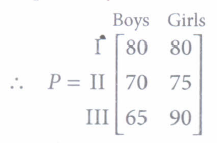
(ii) (a) : In factory B, number of units of types I, II and III for boys are 85, 65, 72 respectively and for girls number of units of types I, II and III are 50, 55, 80 respectively.
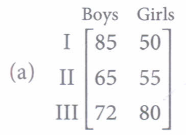
(iii) (c) : Let X be the matrix that represent the number of units of each type produced by factory A for boys, and Y be the matrix that represent the number of units of each type produced by factory B for boys.
Then, X = \(\begin{array}{ccc} \text { I } & \text { II } & \text { III } \\ {[170} & 130 & 130] \end{array}\) and Y = \(\begin{array}{ccc} \text { I } & \text { II } & \text { III } \\ {[85} & 65 & 72] \end{array}\)
Now, required matrix = X + Y = [80 70 65] + [85 65 72]
= [165 135 137]
(iv) (a): Required matrix = [80 75 90] + [50 55 80]
= [130 130 170]
(v) (a) : Clearly,R = P+Q
\(=\left[\begin{array}{ll} 80 & 80 \\ 70 & 75 \\ 65 & 90 \end{array}\right]+\left[\begin{array}{ll} 85 & 50 \\ 65 & 55 \\ 72 & 80 \end{array}\right]=\left[\begin{array}{ll} 165 & 130 \\ 135 & 130 \\ 137 & 170 \end{array}\right]\)
\(\therefore \quad R^{\prime}=\left[\begin{array}{lll} 165 & 135 & 137 \\ 130 & 130 & 170 \end{array}\right]\)
43.
(d) R is correct; A is incorrect
44.
(a) Assertion is correct, reason is correct; reason is a correct explanation for assertion.

12th Standard CBSE Syllabus & Materials
12th Standard CBSE
CBSE 12th Computer Science Python Revision Tour I - New Previous year Question Papers Study Material - QB365 Set A
NEW12th Standard CBSE
CBSE 12th Business Studies Planning Important Questions And Answers Study Material - QB365 Set A
NEW12th Standard CBSE
CBSE 12th Business Studies Business Environment Important Questions And Answers Study Material - QB365 Set A
NEW12th Standard CBSE
CBSE 12th Business Studies Principles of Management Important Questions And Answers Study Material - QB365 Set A



NCERT Books

Syllabus

Exam Pattern

Sample Question Papers

Previous year Question Papers

Important Notes

MCQ Practice test

NCERT Exemplers

Case study Questions

Image Based Questions

Passage based Questions

HOT Questions

Value Based Questions

Model Questions Papers
NCERT ( Book Back ) Questions

Assertion and Reason
Important Questions And Answers

CBSE 12th Standard CBSE Subjects
CBSE Standards








