
 100% FREE ACCESS
12th Standard CBSE Syllabus & Materials
12th Standard CBSE
CBSE 12th Economics Government Budget and the Economy Previous year Question Papers Study Material - QB365 Set A
NEW12th Standard CBSE
CBSE 12th Computer Science Interface Python with MySQL - New Previous year Question Papers Study Material - QB365 Set A
NEW12th Standard CBSE
CBSE 12th Computer Science Database Concept - New Previous year Question Papers Study Material - QB365 Set A
NEW12th Standard CBSE
CBSE 12th Computer Science Data Communication - New Previous year Question Papers Study Material - QB365 Set A
NEW12th Standard CBSE
CBSE 12th Computer Science Data Structures - New Previous year Question Papers Study Material - QB365 Set A
NEW12th Standard CBSE
CBSE 12th Computer Science Functions - New Previous year Question Papers Study Material - QB365 Set A

Published on: 02/11/2025
Download CBSE Class 12th Standard CBSE Maths question papers, sample papers, important questions, and previous year solved papers in PDF format. Get free study materials, NCERT solutions, and exam preparation resources for Class 12th Standard CBSE Maths
Questions + Answers key
Take MCQ Maths Test
1.
If a line makes angles 90°, 135°, 45° with the x, y and z-axes, respectively. Find its direction cosines.
2.
Fin the value(s) of p, so that the lines \(\frac { 1-x }{ 3 } =\frac { 7y-14 }{ 2p } =\frac { z-3 }{ 2 } \) and \(\frac { 7-7x }{ 3p } =\frac { y-5 }{ 1 } =\frac { 6-z }{ 5 } \) are at right angles.
3.
The Catesian equations of a line are 3x + 1 = 6y - 2 = 1 - z. Find the fixed point through which it passes its direction ratios and also its vector equation.
4.
Find the distance between the parallel planes 2x-y+3z-4=0 and 6x-3y+9z+13=0.
5.
Find the equation of the line passing through the point P(4, 6, 2) and the point of intersection of the line \(\frac { x-1 }{ 3 } =\frac { y }{ 2 } =\frac { z+1 }{ 7 } \) and the plane x + y - z = 8.
6.
If a line makes angles 90°, 60° and 30° with the positive direction of x, y and z- axis respectively, then find its direction cosines.
7.
Find the distance of a point (2, 3, 4) from X-axis.
8.
Show that the line through the points (0, 3, 2), (3, 5, 6) is perpendicular of the line through the points (1, - 1, 2) and (3,4, - 2).
9.
Find the value of p, so that lines \(\frac { x-1 }{ -2 } =\frac { y-4 }{ 3p } =\frac { z-3 }{ 4 } \) and \(\frac { x-2 }{ 4p } =\frac { y-5 }{ 2 } =\frac { 1-z }{ 7 } \) are perpendicular to each other.
10.
Using direction ratios, show that the points (2, 3, 4), (-1, -2, 1) and (5, 8, 7) are collinear.
11.
Find the vector and cartesian equation of the line through the point (1, 2, -4) and perpendicular to the two lines
\(\begin{aligned}
& \vec{r}=(8 \hat{i}-19 \hat{j}+10 \hat{k})+\lambda(3 \hat{i}-16 \hat{j}+7 \hat{k})
\end{aligned}\)
and \(\begin{aligned}
\vec{r}=(15 \hat{i}+29 \hat{j}+5 \hat{k})+\mu(3 \hat{i}+8 \hat{j}-5 \hat{k})
\end{aligned}\)
12.
Find the shortest distance between the lines L1 and L2 given below
L1 : The line passing through (2, -1, 1) and parallel to \(\frac{x}{1}=\frac{y}{1}=\frac{z}{3}\) \(L_2: \vec{r}=\hat{i}+(2 \mu+1) \hat{j}-(\mu+2) \hat{k}\).
13.
Show that the lines \(\frac{x-1}{3}=\frac{y-1}{-1}, z+1=0\) and \(\frac{x-4}{2}=\frac{z+1}{3}, y=0\) intersect each other. Also, find their point of intersection.
14.
Find the co-ordinates of the foot of the .\(\bot \) and the length of the .L drawn from the point P(5, 4, 2) to the line
\(\overset { \rightarrow }{ r } =-\hat { i } +3\hat { j } +\hat { k } +\lambda (2\hat { i } +3\hat { j } -\hat { k } )\) Also find the image of P in this line.
15.
The angle between the lines 2x = 3y = -z and 6x = -y = -4z is
0°
30°
45°
90°
16.
The equation of a line passing through the point (-3, 2, -4) and equally inclined to the axes are
\(x-3=y+2=z-4\)
x + 3 = Y - 2 = z + 4
\(\frac{x+3}{1}=\frac{y-2}{2}=\frac{z+4}{3}\)
None of these
17.
If a line makes angles 45°, 150°, 135°, with x, y and z-axes respectively, find its direction cosines.
\(\frac { 1 }{ \sqrt { 2 } } ,-\frac { \sqrt { 3 } }{ 2 } ,\frac { 1 }{ \sqrt { 2 } } \)
\(\frac { 1 }{ \sqrt { 2 } } ,\frac { \sqrt { 3 } }{ 2 } ,\frac { 1 }{ \sqrt { 2 } } \)
\(\frac { 1 }{ \sqrt { 2 } } ,-\frac { 1 }{ 2 } ,-\frac { \sqrt { 3 } }{ \sqrt { 2 } } \)
\(\frac { 1 }{ \sqrt { 2 } } ,\frac { \sqrt { 3 } }{ 2 } ,-\frac { 1 }{ \sqrt { 2 } } \)
18.
If l, m , n are the direction cosines of any line, then sum of the squares of the direction cosines of the line is always
-1
\(\sqrt3\)
1
0
19.
Find the direction cosines of the x axis.
1, 0, 0
0, 0, 0
0, 1, 0
0, 0, 1
20.
Find the direction cosines of a line which makes an angle with all three the coordinate axes.
± 1/\(\sqrt2\)
1/\(\sqrt3\)
1/\(\sqrt2\)
1/\(\sqrt3\)
21.
A line makes angle α, β, γ with x-axis, y-axis and z-axis respectively then cos 2α + cos 2β + cos 2γ is equal to
2
1
-2
-1
22.
A mobile tower stands at the top of a hill. Consider the surface on which tower stand as a plane having points A(0, 1,2), B(3, 4, -1) and C(2, 4, 2) on it. The mobile tower is tied with 3 cables from the point A, Band C such that it stand vertically on the ground. The peak of the tower is at the point (6, 5, 9), as shown in the figure.
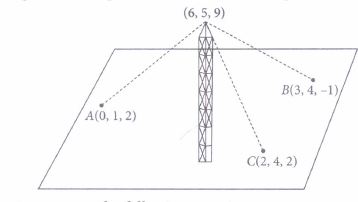
Based on the above information, answer the following questions
(i) The equation of plane passing through the points A, Band C is
| (a) 3x - 4y + z = 0 | (b) 3x - 2y + z = 0 | (c) 4x - 3y + z = 0 | (d) 4x - 3y + 3z = 0 |
(ii) The height of the tower from the ground is
| (a) 6 units | (b) 5 units | (c) \( \frac{17}{\sqrt{14}} units\) | (d) \((d) \frac{5}{\sqrt{14}} units\) |
(iii) The equation of line of perpendicular drawn from the peak of tower to the ground is
| (a) \( \frac{x-6}{3}=\frac{y-4}{-2}=\frac{z-9}{1}\) | (b) \( \frac{x-6}{3}=\frac{y-5}{-2}=\frac{z-9}{1}\) | (c) \(\frac{x-6}{3}=\frac{y-4}{2}=\frac{z-9}{1}\) | (d) none of these |
(iv) The coordinates of foot of perpendicular drawn from the peak of tower to the ground are
| (a)\( \left(\frac{33}{14}, \frac{104}{14}, \frac{109}{14}\right) \) | (b) \(\left(\frac{33}{14}, \frac{109}{14}, \frac{104}{14}\right)\) | (c)\(\left(\frac{33}{14}, \frac{105}{14}, \frac{109}{14}\right)\) | (d) none of these |
(v) The area of \(\Delta\)ABC is
| (a) \(\frac{1}{2} \sqrt{14} \text { sq. units }\) | (b) \(\frac{3}{2} \sqrt{14} \mathrm{sq} \text { units }\) | (c) \(\sqrt{14} \mathrm\ {sq}.\ units\) | (d)\(2\sqrt{14} \mathrm\ {sq}.\ units\) |
23.
If a1,b1,c1 and a2, b2, c2 are direction ratios of two lines say L1 and L2 respectively. Then L1 II L2 iff
\(\frac{a_{1}}{a_{2}}=\frac{b_{1}}{b_{2}}=\frac{c_{1}}{c_{2}}\) and \( L_{1} \perp L_{2} \text { iff } a_{1} a_{2}+b_{1} b_{2}+c_{1} c_{2}=0\) .
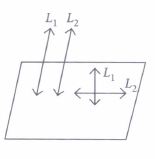
Based on the above information, answer the following questions
(i) If l1,m1,n1 and l2,m2, n2 are the direction cosines of L, and L2 respectively, then L1, will be perpendicular to L2, iff
| (a) \(l_{1} l_{2}+m_{1} m_{2}+n_{1} n_{2}=0\) | (b) \(l_{1} m_{2}+m_{1} l_{2}+n_{1} n_{2}=0\) | (c) \(\frac{l_{1}}{l_{2}}=\frac{m_{1}}{m_{2}}=\frac{n_{1}}{n_{2}}\) | (d) none of these |
(ii) If l1,m1,n1 and l2,m2, n2 are direction cosines of L1, and L2 respectively, then L1, will be parallel to L2, iff
| (a) \( l_{1} l_{2}+m_{1} m_{2}+n_{1} n_{2}=0\) | (b) \(l_{1} m_{2}+m_{1} l_{2}+n_{1} n_{2}=0\) | (c) \( \frac{l_{1}}{l_{2}}=\frac{m_{1}}{m_{2}}=\frac{n_{1}}{n_{2}}\) | (d) \( m_{1} n_{2}+m_{2} n_{2}+l_{1} l_{2}=0\) |
(iii) The coordinates of the foot of the perpendicular drawn from the point A (1, 2, 1) to the line joining B (1, 4, 6) and C (5, 4, 4), are
| (a) (1,2,1) | (b) (2,4,5) | (c) (3,4,5) | (d) (4,3,5) |
(iv) The direction ratios of the line which is perpendicular to the lines with direction ratios proportional to (1, -2, -2) and (0, 2, 1) are
| (a) < 1,2,1> | (b) < 2, -1, 2 > | (c) < -1, 2, 2 > | (d) none of these |
(v) The lines \(\frac{x-2}{3}=\frac{y+1}{-2}=\frac{z-2}{0} \text { and } \frac{x-1}{1}=\frac{y+3 / 2}{3 / 2}=\frac{z+5}{2}\) are
| (a) parallel | (b) perpendicular | (c) skew lines | (d) non-intersecting |
1.
Let direction cosines of the line be I, m and n.
Given \(\alpha=90^{\circ}, \beta=135^{\circ} \text { and } \gamma=45^{\circ}\)
\(m=\cos \beta=\cos 135^{\circ}=\frac{-1}{\sqrt{2}}\)
and \(n=\cos \gamma=\cos 45^{\circ}=\frac{1}{\sqrt{2}}\)
Hence, the direction cosines of a line are 0, \(\frac{-1}{\sqrt{2}} \text { and } \frac{1}{\sqrt{2}}\)
2.
\(p=\frac { 70 }{ 11 } \)
3.
Equation of the line is
\( 3\left(x+\frac{1}{3}\right)=6\left(y-\frac{1}{3}\right)=-1(z-1) \)
\(\Rightarrow \frac{x+\frac{1}{3}}{2}=\frac{y-\frac{1}{3}}{1}=\frac{z-1}{-6}
\)
Line passes through fixed point \(\left(-\frac{1}{3}, \frac{1}{3}, 1\right)\) and direction ratios are 2, 1, - 6
Vector equation \(\vec { r } =\left( -\frac { 1 }{ 3 } \hat { i } +\frac { 1 }{ 3 } \hat { j } +\hat { k } \right) +\lambda (2\hat { i } +\hat { j } -6\hat { k } )\)
4.
\(\frac { 25\sqrt { 14 } }{ 42 } \) units
5.
General point on the line \( \frac{x-1}{3}=\frac{y}{2}=\frac{z+1}{7} \text { is }\)
\(Q(3 \lambda+1,2 \lambda, 7 \lambda-1)\)
If this point lies on the plane then
\(3 \lambda+1+2 \lambda-7 \lambda+1=8 \)
\(\Rightarrow-2 \lambda=6 \Rightarrow \lambda=-3 \)
Substituting in (i), point of intersection is
\(Q(-8,-6,-22)\)
Direction ratios of P Q are12,12, 24 or 1, 1, 2
Equation of PQ is \(\frac { x-4 }{ 1 } =\frac { y-6 }{ 1 } =\frac { z-2 }{ 2 } \)
6.
Let the d.c. 's of the lines be l, m, n.
Then \(\mathrm{I}=\cos 90^{\circ}=0, \mathrm{~m}=\cos 60^{\circ}=\frac{1}{2} n=\cos 30^{\circ}=\frac{\sqrt{3}}{2}\)
7.
= 5 units
8.
Let A(0, 3, 2), B(3, 5, 6)
Direction ratios of AB(a, b, c) are (3 - 0), (5 - 3), (6 - 2)
\((a_{ 1 },b_{ 1 },c_{ 1 })\) = (3, 2, 4)
Let C(1, - 1, 2), 0(3, 4, - 2)
Direction ratios of CD \((a_{ 2 },b_{ 2 },c_{ 2 })\) are (3 - 1), (4 + 1) (-2,2) \((a_{ 2 },b_{ 2 },c_{ 2 })\) are (2,56,-4)
When two lines are perpendicular if
\(a_{ 1 },a_{ 2 }+b_{ 1 },b_{ 2 },+c_{ 1 },c_{ 2 }=0\)
\(\Rightarrow 3\times 2+2\times 5+4\times -4=0\)
\(\Rightarrow 6+10-16=0\)
\(\Rightarrow 16-16=0\)
\(\therefore AB\bot to\quad CD\)
9.
The given lines are written as \(\frac{x-1}{-2}=\frac{y-4}{3 p}=\frac{z-3}{4} \text { and } \frac{x-2}{4 p}=\frac{y-5}{2}=\frac{z-1}{-7}\)
Here, direction ratios of above lines are (-2, 3p, 4) and (4p, 2, -7).
We know that two lines are perpendicular, if
a1a2 + b1b2 + c1c2 = 0
\(\begin{array}{ll}
\therefore & -2 \times 4 p+3 p \times 2+4 \times(-7)=0
\end{array}\)
\(\begin{array}{ll}
\Rightarrow & -8 p+6 p-28=0
\end{array}\)
\(\begin{array}{ll}
\Rightarrow & -2 p=28 \Rightarrow p=-14
\end{array}\)
Hence, the value of p is -14.
10.
Let points be A(2, 3, 4), B(- 1, - 2, 1) and C(5, 8, 7)
Direction ratios or AB are 2 + 1, 3 + 2, 4 - 1, i.e. 3, 5, 3;
Direction ratios of Be are 5 + 1, 8 + 2, 7 - 1, i.e. 3,5,3
As \(\frac{3}{3}=\frac{5}{5}=\frac{3}{3}\)
⇒ AB is parallel to BC, B is common.
Hence, A, B, C are collinear.
11.
Given, equations of lines are
\(\begin{aligned}
\vec{r}=(8 \hat{i}-19 \hat{j}+10 \hat{k})+\lambda(3 \hat{i}-16 \hat{j}+7 \hat{k})
\end{aligned}\)
and \(\begin{aligned}
\vec{r}=(15 \hat{i}+29 \hat{j}+5 \hat{k})+\mu(3 \hat{i}+8 \hat{j}-5 \hat{k})
\end{aligned}\)
On comparing with vector form of equation of a line,
i.e., \(\vec{r}=\vec{a}+\lambda \vec{b}\) we get
\(\vec{b}_1=3 \hat{i}-16 \hat{j}+7 \hat{k} \text { and } \vec{b}_2=3 \hat{i}+8 \hat{j}-5 \hat{k}\)
Now, we determine
\(\begin{aligned}
\vec{b} & =\vec{b}_1 \times \vec{b}_2=\left|\begin{array}{rrr}
\hat{i} & \hat{j} & \hat{k} \\
3 & -16 & 7 \\
3 & 8 & -5
\end{array}\right|
\end{aligned}\)
\(=\hat{i}(80-56)-\hat{j}(-15-21)+\hat{k}(24+48) \)
\(=24 \hat{i}+36 \hat{j}+72 \hat{k}=12(2 \hat{i}+3 \hat{j}+6 \hat{k})\)
Since, the required line is perpendicular to the given lines. So, it is parallel to \(\vec{b}_1 \times \vec{b}_2\). Now, the equation of a line passing through the point (1, 2, -4) and parallel to \(24 \hat{i}+36 \hat{j}+72 \hat{k} \text { or }(2 \hat{i}+3 \hat{j}+6 \hat{k})\) is
\(\vec{r}=(\hat{i}+2 \hat{j}-4 \hat{k})+\lambda(2 \hat{i}+3 \hat{j}+6 \hat{k})\)
which is required vector equation of a line.
For cartesian equation, put \(\vec{r}=x \hat{i}+y \hat{j}+z \hat{k}\), we get
\(x \hat{i}+y \hat{j}+z \hat{k}=(1+2 \lambda) \hat{i}+(2+3 \lambda) \hat{j}+(-4+6 \lambda) \hat{k}\)
On comparing the coefficients of \(\hat{i}, \hat{j} \text { and } \hat{k}\), we get
\(\begin{aligned}
x=1+2 \lambda, y=2+3 \lambda \text { and } z=-4+6 \lambda
\end{aligned}\)
\(\begin{aligned}
\Rightarrow \quad \frac{x-1}{2}=\lambda, \frac{y-2}{3}=\lambda \text { and } \frac{z+4}{6}=\lambda
\end{aligned}\)
\(\begin{aligned}
\therefore \quad \frac{x-1}{2}=\frac{y-2}{3}=\frac{z+4}{6}
\end{aligned}\)
which is the required cartesian equation of a line.
Alternate Method
Let the equation of line passing through (1, 2, -4) is
\(\vec{r}=(\hat{i}+2 \hat{j}-4 \hat{k})+\lambda_1\left(b_1 \hat{i}+b_2 \hat{j}+b_3 \hat{k}\right)\) ...(i)
Since, the line (i) is perpendicular to the given lines
\(\begin{aligned}
\vec{r}=(8 \hat{i}-19 \hat{j}+10 \hat{k})+\lambda(3 \hat{i}-16 \hat{j}+7 \hat{k})
\end{aligned}\)
and \(\begin{aligned}
\vec{r}=(15 \hat{i}+29 \hat{j}+5 \hat{k})+\mu(3 \hat{i}+8 \hat{j}-5 \hat{k})
\end{aligned}\)
Therefore, we have
\(\begin{aligned}
\Rightarrow \quad\left(b_1 \hat{i}+b_2 \hat{j}+b_3 \hat{k}\right) \cdot(3 \hat{i}-16 \hat{j}+7 \hat{k})=0
\end{aligned}\)
\(\begin{aligned}
\Rightarrow \quad 3 b_1-16 b_2+7 b_3=0
\end{aligned}\) ...(ii)
\(\begin{aligned}
\text { and } \quad\left(b_1 \hat{i}+b_2 \hat{j}+b_3 \hat{k}\right) \cdot(3 \hat{i}+8 \hat{j}-5 \hat{k})=0 \\
\end{aligned}\)
\(\begin{aligned}
\Rightarrow \quad 3 b_1+8 b_2-5 b_3=0
\end{aligned}\) ...(iii)
[\(\because\) if two lines \(\vec{r}=\vec{a}_1+\lambda \vec{b}_1 \text { and } \vec{r}=\vec{a}_2+\lambda \vec{b}_2\) are perpendicular, then \(\vec{b}_1 \cdot \vec{b}_2=0 .\)]
Now, on solving Eqs. (ii) and (iii), we get
\(\begin{array}{rlrl}
\frac{b_1}{80-56}= \frac{b_2}{21+15}=\frac{b_3}{24+48}
\end{array}\)
\(\begin{array}{rlrl}
\Rightarrow & \frac{b_1}{24} & =\frac{b_2}{36}=\frac{b_3}{72}
\end{array}\)
\(\begin{array}{rlrl}
\Rightarrow & \frac{b_1}{2} & =\frac{b_2}{3}=\frac{b_3}{6}
\end{array}\) [multiplying by 12]
\(\Rightarrow\) b1 = 2k, b2 = 3k and b3 = 6k, for some constant k.
Thus, the required vector equation of line is
\(\vec{r}=(\hat{i}+2 \hat{j}-4 \hat{k})+\lambda(2 \hat{i}+3 \hat{j}+6 \hat{k})\),
where \(\lambda=\lambda_1 k\) is any constant.
Now, for cartesian equation do same as in above method.
12.
Given, L1 : the line passing through (2, -1, 1) and parallel to \(\frac{x}{1}=\frac{y}{1}=\frac{z}{3}\)
\(L_2: \vec{r}=\hat{i}+(2 \mu+1) \hat{j}-(\mu+2) \hat{k}\)
Write the given equations of line in standard form
\(\begin{aligned}
L_1: \vec{r}=(2 \hat{i}-\hat{j}+\hat{k})+\lambda(\hat{i}+\hat{j}+3 \hat{k})\end{aligned}\) ....(i)
\(L_2: \vec{r}=(\hat{i}+\hat{j}-2 \hat{k})+\mu(2 \hat{j}-\hat{k})\) ...(ii)
On comparing Eqs. (i) and (ii) with \(\vec{r}=a_1+\lambda b_1\) and \(\vec{r}=a_2+\lambda b_2\) respectively, we get
\(\vec{a}_1=2 \hat{i}-\hat{j}+\hat{k} \cdot \vec{b}_1=\hat{i}+\hat{j}+3 \hat{k}\)
and \(\vec{a}_2=(\hat{i}+\hat{j}-2 \hat{k}) \cdot \overrightarrow{b_x}=2 \hat{j}-\hat{k}\)
Clearly, \(\vec{b}_1 \times \vec{b}_2=\left|\begin{array}{ccc}
\hat{i} & \hat{j} & \hat{k} \\
1 & 1 & 3 \\
0 & 2 & -1
\end{array}\right|\)
\(\begin{aligned}
=\hat{i}(-1-6)-\hat{j}(-1-0)+\hat{k}(2-0)
\end{aligned}\)
\(\begin{aligned}
=-7 \hat{i}+\hat{j}+2 \hat{k}
\end{aligned}\)
\(\begin{aligned}
\Rightarrow \quad\left|\vec{b}_1 \times \vec{b}_2\right| & =|-7 \hat{i}+\hat{j}+2 \hat{k}|
\end{aligned}\)
\(\begin{aligned}
=\sqrt{(-7)^2+(1)^2+(2)^2}
\end{aligned}\)
\(\begin{aligned}
=\sqrt{49+1+4}=\sqrt{54}=3 \sqrt{6}
\end{aligned}\)
Now, \(\begin{aligned}
\overrightarrow{a_2}-\overrightarrow{a_1} & =(\hat{i}+\hat{j}-2 \hat{k})-(2 \hat{i}-\hat{j}+\hat{k})
\end{aligned}\)
\(\begin{aligned}
=-\hat{i}+2 \hat{j}-3 \hat{k}
\end{aligned}\)
Required SD \(=\frac{\left|\left(\vec{a}_2-\vec{a}_1\right) \cdot\left(\vec{b}_1 \times \vec{b}_2\right)\right|}{\left|\vec{b}_1 \times \vec{b}_2\right|}\)
\(\begin{aligned}
=\frac{|(-\hat{i}+2 \hat{j}-3 \hat{k}) \cdot(-7 \hat{i}+\hat{j}+2 \hat{k})|}{3 \sqrt{6}}
\end{aligned}\)
\(\begin{aligned}
=\frac{|7+2-6|}{3 \sqrt{6}}=\frac{3}{3 \sqrt{6}}=\frac{1}{\sqrt{6}} \text { unit }
\end{aligned}\)
13.
The given equations can be rewritten as
= \(\frac{x-1}{3}=\frac{y-1}{-1}=\frac{z+1}{0} \text { and } \frac{x-4}{2}=\frac{y-0}{0}=\frac{z+1}{3}\)
= (4, 0, -1)
14.
Converting the given equation of the line into cartesian form, we have
\(\frac { x+1 }{ 2 } =\frac { y-3 }{ 3 } =\frac { z-1 }{ -1 } =\lambda \)
Any point on the line (i) is :
\(Q(2\lambda -1,3\lambda +3,-\lambda +1)\)
For some values of A, let Q be perpendicular from P on the line (i).
Direction ratio's of PQ are:
\(2\lambda -6,3\lambda -1,-\lambda -1\)
Also, d.r.'s of line (i) are 2, 3, -1.
Since AM .Lt line (i), then
\(2(2\lambda -6)+3(3\lambda -1)-1(-\lambda -1)=0\)
\(\Rightarrow 14\lambda -14=0\)
\(\Rightarrow \lambda =1\)
\(\therefore \) From (ii), coordinates of foot of perpendicular Q are (10; 6, 0).
Now \(\bot \) distance PQ
\(=\sqrt { (1-5)^{ 2 }+(6-4)^{ 2 }+(0-2)^{ 2 } } \)
\(=\sqrt { 16+4+4 } =\sqrt { 24 } =2\sqrt { 6 } \)
Again, let the image of P in the line (i) is \(p^{ ' }(x_{ 1 },y_{ 1 },z_{ 1 })\) then is the mid-point of PP'.
\(\therefore \frac { 5+x_{ 1 } }{ 2 } ,=1\)
\(\frac { 4+y_{ 1 } }{ 2 } =6\)
\(\frac { 2+z_{ 1 } }{ 2 } =0\)
\(\therefore \quad x_{ 1 }=-3,y_{ 1 }=8,z_{ 1 }=-2\)
\(\therefore \) ImageofP in the line (i)is P' (-3, 5, -2).
15.
(d)
90°
16.
(b)
x + 3 = Y - 2 = z + 4
17.
(b)
\(\frac { 1 }{ \sqrt { 2 } } ,\frac { \sqrt { 3 } }{ 2 } ,\frac { 1 }{ \sqrt { 2 } } \)
18.
(d)
0
19.
(a)
1, 0, 0
20.
(d)
1/\(\sqrt3\)
21.
As \({ cos }^{ 2 }\alpha +{ cos }^{ 2 }\beta +{ cos }^{ 2 }\gamma =1\)
\(\Rightarrow \frac { 1+cos2\alpha }{ 2 } +\frac { 1+cos2\beta }{ 2 } +\frac { 1+cos2\gamma }{ 2 } =1\)
= cos 2α + cos 2β + cos 2γ = 1
22.
(i) (b) : The equation of plane passing through three non - collinear points is given by
\(\left|\begin{array}{ccc} x-x_{1} & y-y_{1} & z-z_{1} \\ x_{2}-x_{1} & y_{2}-y_{1} & z_{2}-z_{1} \\ x_{3}-x_{1} & y_{3}-y_{1} & z_{3}-z_{1} \end{array}\right|=0\)
\(\Rightarrow\left|\begin{array}{ccc} x & y-1 & z-2 \\ 3-0 & 4-1 & -1-2 \\ 2-0 & 4-1 & 2-2 \end{array}\right|=0\)
\(\Rightarrow\left|\begin{array}{ccc} x & y-1 & z-2 \\ 3 & 3 & -3 \\ 2 & 3 & 0 \end{array}\right|=0\)
\( \Rightarrow \ln x(0+9)-(y-1)(0+6)+(z-2)(9-6)=0 \)
\(\Rightarrow 9 x-6 y+6+3 z-6=0 \Rightarrow 3 x-2 y+z=0\)
(ii) (c) : Height of tower = Perpendicular distance from the point (6, 5, 9) to the plane 3x - 2y + z = 0
\(=\left|\frac{18-10+9}{\sqrt{3^{2}+(-2)^{2}+1^{2}}}\right|=\frac{17}{\sqrt{14}} \text { units }\)
(iii) (b) : D.R.'s of perpendicular are < 3, -2, 1 >
[ஃ Perpendicular is parallel to the normal to the plane] Since, perpendicular is passing through the point (6, 5, 9), therefore its equation is
\(\frac{x-6}{3}=\frac{y-5}{-2}=\frac{z-9}{1}\)
(iv) (a) : Let the coordinates of foot of perpendicular are
Since, this point lie on the plane 3x - 2y + z = 0, therefore we get, \((3 \lambda+6,-2 \lambda+5, \lambda+9)\)
\( 3(3 \lambda+6)-2(-2 \lambda+5)+(\lambda+9)=0 \)
\(\Rightarrow 9 \lambda+4 \lambda+\lambda+18-10+9=0 \)
\(\Rightarrow 14 \lambda=-17 \Rightarrow \lambda=\frac{-17}{14}\)
Thus, the coordinates of foot of perpendicular are
\(\left(\frac{-51}{14}+6, \frac{34}{14}+5, \frac{-17}{14}+9\right) \text { i.e., }\left(\frac{33}{14}, \frac{104}{14}, \frac{109}{14}\right)\)
(v) (b) : Clearly, area of ABC =\(\frac{1}{2}|\overrightarrow{A B} \times \overrightarrow{A C}|\)
\( =\frac{1}{2}|(3 \hat{i}+3 \hat{j}-3 \hat{k}) \times(2 \hat{i}+3 \hat{j})| \)
\(=\frac{1}{2}\left\|\begin{array}{cc} \hat{i} & \hat{j} & \hat{k} \\ 3 & 3 & -3 \\ 2 & 3 & 0 \end{array}\right\|=\frac{1}{2}|9 \hat{i}-6 \hat{j}+3 \hat{k}|\)
\( =\frac{1}{2} \sqrt{9^{2}+6^{2}+3^{2}}=\frac{1}{2} \sqrt{126}=\frac{3}{2} \sqrt{14} \text { sq. units } \)
23.
(i) (a) : Since, D.R.'s are proportional to D.C.'s, therefore L; will be perpendicular to L2 iff
\(l_{1} l_{2}+m_{1} m_{2}+n_{1} n_{2}=0\)
(ii) (c) : Since, D.R.'s are proportional to D.C.'s, therefore L, will be parallel to L2, iff
\(\frac{l_{1}}{l_{2}}=\frac{m_{1}}{m_{2}}=\frac{n_{1}}{n_{2}}\)
(iii) (c) : Equation of line joining Band C is \(\frac{x-1}{4}=\frac{y-4}{0}=\frac{z-6}{-2}\)
Let coordinates of foot of perpendicular be D(x, y, z).
ஃD.R.'s of AD are < x-1, y-2, z-1 >.
Now, 4(x - 1) + 0(y - 2) -2(z - 1) = 0 ⇒ 4x - 2z = 2
Also, (x, y, z) will satisfy equation of line BC.
Here, (3, 4, 5) satisfy both the conditions.
ஃ Required coordinates are (3, 4, 5).
(iv) (b) : Let a, b, c be the direction ratios of the required line. Since it is perpendicular to the lines
whose direction ratios are (1, -2, -2) and (0, 2, 1) respectively.
ஃ a - 2b - 2c = 0 ..... (i)
0 .a + 2b + c = 0 .......(ii)
On solving (i) and (ii) by cross-multiplication, we get
\(\frac{a}{-2+4}=\frac{b}{0-1}=\frac{c}{2} \Rightarrow \frac{a}{2}=\frac{b}{-1}=\frac{c}{2}\)
Thus, the direction ratios of the required line are < 2, -1, 2 >.
(v) (b) : D.R 's of given lines are < 3, -2, 0 > and < 1, -\(\frac{3}{2}\) ,2 >
Now, as 3.1 + (-2).(\(\frac{3}{2}\)) +0·2 = 3 -3 + 0 = 0
ஃ Given lines are perpendicular to each other.

12th Standard CBSE Syllabus & Materials
12th Standard CBSE
CBSE 12th Computer Science Python Revision Tour I - New Previous year Question Papers Study Material - QB365 Set A
NEW12th Standard CBSE
CBSE 12th Business Studies Planning Important Questions And Answers Study Material - QB365 Set A
NEW12th Standard CBSE
CBSE 12th Business Studies Business Environment Important Questions And Answers Study Material - QB365 Set A
NEW12th Standard CBSE
CBSE 12th Business Studies Principles of Management Important Questions And Answers Study Material - QB365 Set A



NCERT Books

Syllabus

Exam Pattern

Sample Question Papers

Previous year Question Papers

Important Notes

MCQ Practice test

NCERT Exemplers

Case study Questions

Image Based Questions

Passage based Questions

HOT Questions

Value Based Questions

Model Questions Papers
NCERT ( Book Back ) Questions

Assertion and Reason
Important Questions And Answers

CBSE 12th Standard CBSE Subjects
CBSE Standards








