
 100% FREE ACCESS
12th Standard CBSE Syllabus & Materials
12th Standard CBSE
CBSE 12th Economics Government Budget and the Economy Previous year Question Papers Study Material - QB365 Set A
NEW12th Standard CBSE
CBSE 12th Computer Science Interface Python with MySQL - New Previous year Question Papers Study Material - QB365 Set A
NEW12th Standard CBSE
CBSE 12th Computer Science Database Concept - New Previous year Question Papers Study Material - QB365 Set A
NEW12th Standard CBSE
CBSE 12th Computer Science Data Communication - New Previous year Question Papers Study Material - QB365 Set A
NEW12th Standard CBSE
CBSE 12th Computer Science Data Structures - New Previous year Question Papers Study Material - QB365 Set A
NEW12th Standard CBSE
CBSE 12th Computer Science Functions - New Previous year Question Papers Study Material - QB365 Set A

Published on: 02/11/2025
Download CBSE Class 12th Standard CBSE Maths question papers, sample papers, important questions, and previous year solved papers in PDF format. Get free study materials, NCERT solutions, and exam preparation resources for Class 12th Standard CBSE Maths
Questions + Answers key
Take MCQ Maths Test
1.
Let \(\vec{a} \text { and } \vec{b}\) be any two vectors, and l be any scalar. Then \((\lambda \vec{a}) \cdot \vec{b}=(\lambda \vec{a}) \cdot \vec{b}=\lambda(\vec{a} \cdot \vec{b})=\vec{a} \cdot(\lambda \vec{b})\)
2.
The scalar product of vector \(\overrightarrow { a } =\hat { i } +\hat { j } +\hat { k } \) with a unit vector along the sum of vector \(\overrightarrow { b } =2\hat { i } +4\hat { j } -5\hat { k } \) and \(\overrightarrow { c } =\lambda \hat { i } +2\hat { j } +3\hat { k } \) is equal to one. Find the value of \(\lambda\) and hence find the unit vector along \(\overrightarrow { b } +\overrightarrow { c } \)
3.
If \(\overset { \rightarrow }{ a } \) and \(\overset { \rightarrow }{ b } \) are two unit vectorssuch that \(\overset { \rightarrow }{ a } +\overset { \rightarrow }{ b } \) is also a unit vector, then find the angle between \(\overset { \rightarrow }{ a } \) and \(\overset { \rightarrow }{ b } \).
4.
If A,B,C are position vectors: \(\hat{i}+\hat{j}-\hat{k}, 2 \hat{i}-\hat{j}+3 \hat{k}, \hat{i}-2 \hat{j}+\hat{k}\)
Respectively, find the projection of \(\overset { \rightarrow }{ AB } \) along \(\overset { \rightarrow }{ CD } \).
5.
If \(\overrightarrow { a } =\hat { i } +\hat { j } +\hat { k } ,\overrightarrow { b } =4\hat { i } -2\hat { j } +3\hat { k } \) and \(\overrightarrow { c } =\hat { i } -2\hat { j } +\hat { k } \) find a vector of a magnitude 6 units which is parallel to the vector \(2\overrightarrow { a } -\overrightarrow { b } +3\overrightarrow { c } \)
6.
If A, B, P,Q and R be the five points in a plane then show that the sum of the vectors \(\overrightarrow{A P}, \overrightarrow{A Q}, \overrightarrow{A R}, \overrightarrow{P B}, \overrightarrow{Q B} \text { and } \overrightarrow{R B} \text { is } 3 \overrightarrow{A B}\).
7.
Find \(\overrightarrow a.(\overrightarrow b\times\overrightarrow c)\), if \(\overrightarrow a=2\overset\wedge i+\overset\wedge j+3\overset\wedge k,\overrightarrow b=-\overset\wedge i+2\overset\wedge j+\overset\wedge k \ and \ \overrightarrow c=3\overset\wedge i+\overset\wedge j+2\overset\wedge k\)
8.
Write the value of \((\overset\wedge k\times\overset\wedge i).\overset\wedge j+\overset\wedge i.\overset\wedge k\)
9.
Find the position vector of a point which divides the join of points with position vectors \((\overset\rightarrow a-2\overset\rightarrow b)\)and \((2\overset\rightarrow a+\overset\rightarrow b)\)externally in the ration 2:1.
10.
Given \(\overrightarrow { AB } =3\hat { i } -\hat { j } -5\hat { k } \) and coordinates of the terminal point are (0,1,3). Find the coordinates of the initial point.
11.
Find the vector \(\vec{p}\)which is perpendicular to both \(\vec{\alpha}=4 \hat{i}+5 \hat{j}-\hat{k} \text { and } \vec{\beta}=\hat{i}-4 \hat{j}+5 \hat{k} \text { and } \vec{p} \cdot \vec{q}=21\), where \(\vec{q}=3 \hat{i}+\hat{j}-\hat{k}\).
12.
If \(\overrightarrow { a } ,\overrightarrow { b } ,\overrightarrow { c } \) are unit vectors such that \(\overrightarrow { a } .\overrightarrow { b } =\overrightarrow { a } .\overrightarrow { c } =0\) and the angle between \(\overrightarrow { b } \) and \(\overrightarrow { c } \) is \(\frac{\pi}{6}\) , then prove that:
(i) \(\overrightarrow { a } =\pm 2\left( \overrightarrow { b } \times \overrightarrow { c } \right) \)
(ii) \(\left[ \overrightarrow { a } +\overrightarrow { b } ,\overrightarrow { b } +\overrightarrow { c } ,\overrightarrow { c } +\overrightarrow { a } \right] =\pm 1\)
13.
\(\text { If }|\vec{a}|=5,|\vec{b}|=\mid 3 \text { and }|\vec{a} \times \vec{b}|=25 \text { , then } \vec{a} \cdot \vec{b} \text { is equal to }\)
12
5
13
60
14.
Iffor non-zero vectors \(\vec{a}, \vec{b}, \vec{c}, \vec{a} \times \vec{b}=\vec{c} \text { and } \vec{b} \times \vec{c}=\vec{a}\) then
\(\vec{a}, \vec{b} \text { and } \vec{c} \text { are parallel to each other }\)
\(\vec{a}, \vec{b}, \vec{c} \text { are perpendicular to each other }\)
\(\vec{c} \times \vec{a}=\vec{b} \times \vec{a}\)
none of these
15.
The position vector of the point which divides the join of points \(2 \vec{a}-3 \vec{b} \text { and } \vec{a}+\vec{b}\) in the ratio
\(\frac{3 \vec{a}-2 \vec{b}}{2}\)
\(\frac{7 \vec{a}-8 \vec{b}}{4}\)
\(\frac{3 \vec{a}}{4}\)
\(\frac{5 \vec{a}}{4}\)
16.
The direction cosines of the vector \(\hat{i}+2 \hat{j}+3 \hat{k}\) are
\(\frac{1}{\sqrt{14}}, \frac{2}{\sqrt{14}}, \frac{3}{\sqrt{14}}\)
\(\frac{2}{\sqrt{14}}, \frac{3}{\sqrt{14}}, \frac{4}{\sqrt{14}}\)
\(\frac{11}{\sqrt{14}}, \frac{13}{\sqrt{14}}, \frac{21}{\sqrt{14}}\)
None of these
17.
If \(\overrightarrow { a } =2\widehat { i } +3\widehat { j } -6\widehat { k } \) and \(\overrightarrow { b } =6\widehat { i } -2\widehat { j } +3\widehat { k } \), then
\(|\overrightarrow { a } |=|\overrightarrow { b } |\)
\(\overrightarrow { a } +\overrightarrow { b } =0\)
\(\overrightarrow { a } =\overrightarrow { b } \)
\(2\overrightarrow { a } =\overrightarrow { b } \)
18.
A barge is pulled into harbour by two tug boats as shown in the figure.
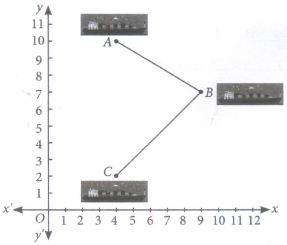
Based on the above information, answer the following questions.
(i) Position vector of A is
| (a) \(4 \hat{i}+2 \hat{j}\) | (b) \(4 \hat{i}+10 \hat{j}\) | (c)\(4 \hat{i}-10 \hat{j}\) | (d) \(4 \hat{i}-2 \hat{j}\) |
(ii) Position vector of B is
| (a) \(4 \hat{i}+4 \hat{j}\) | (b) \(6 \hat{i}+6 \hat{j}\) | (c) \( 9 \hat{i}+7 \hat{j}\) | (d) \(3 \hat{i}+3 \hat{j}\) |
(iii) Find the vector \(\vec{AC}\) in terms of \(\hat{i}, \hat{j}\)
| (a) \(8 \hat{j}\) | (b) \(-8 \hat{j}\) | (c) \(8 \hat{i}\) | (d) None of these |
(iv) If \(\vec{A}=\hat{i}+2 \hat{j}+3 \hat{k}\), then its unit vector is
| (a)\(\frac{\hat{i}}{\sqrt{14}}+\frac{2 \hat{j}}{\sqrt{14}}+\frac{3 \hat{k}}{\sqrt{14}}\) | (b) \(\frac{3 \hat{i}}{\sqrt{14}}+\frac{2 \hat{j}}{\sqrt{14}}+\frac{\hat{k}}{\sqrt{14}}\) | (c) \(\frac{2 \hat{i}}{\sqrt{14}}+\frac{3 \hat{j}}{\sqrt{14}}+\frac{\hat{k}}{\sqrt{14}}\) | (d) None of these |
(v) If \(\vec{A}=4 \hat{i}+3 \hat{j}\) and \(\vec{B}=3 \hat{i}+4 \hat{j}\), then IAI+ IBI = ___________.
| (a) 12 | (b) 13 | (c) 14 | (d) 10 |
19.
Three slogans on chart papers are to be placed on a school bulletin board at the points A, Band C displaying A (Hub of Learning), B (Creating a better world for tomorrow) and C (Education comes first). The coordinates of these points are (1, 4, 2), (3, -3, -2) and (-2, 2, 6) respectively.
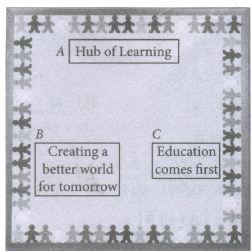
Based on the above information, answer the following questions.
(i) Let \(\vec{a}\), \(\vec{b}\)and \(\vec{c}\) be the position vectors of points A, B and C respectively, then \(\vec{a}\) + \(\vec{b}\)+ \(\vec{c}\) is equal to
| (a) \(2 \hat{i}+3 \hat{j}+6 \hat{k} \) | (b) \(2 \hat{i}-3 \hat{j}-6 \hat{k}\) | (c) \(2 \hat{i}+8 \hat{j}+3 \hat{k} \) | (d) \(2(7 \hat{i}+8 \hat{j}+3 \hat{k})\) |
(ii) Which of the following is not true?
| (a) \(\overrightarrow{A B}+\overrightarrow{B C}+\overrightarrow{C A}=\overrightarrow{0}\) | (b) \(\overrightarrow{A B}+\overrightarrow{B C}-\overrightarrow{A C}=\overrightarrow{0}\) | (c) \(\overrightarrow{A B}+\overrightarrow{ BC}-\overrightarrow{C A}=\overrightarrow{0}\) | (d) \(\overrightarrow{A B}-\overrightarrow{C B}+\overrightarrow{C A}=\overrightarrow{0}\) |
(iii) Area of \(\Delta\)ABC is
| (a) 19 sq. units | (b) \(\sqrt 1937 sq. unit\) | (c) \(\frac{1}{2}\sqrt 1937 sq. unit\) | (d) \(\sqrt 1837 sq. unit\) |
(iv) Suppose, if the given slogans are to be placed on a straight line, then the value of \(|\vec{a} \times \vec{b}+\vec{b} \times \vec{c}+\vec{c} \times \vec{a}|\) will be equal to
| (a) -1 | (b) -2 | (c) 2 | (d) 0 |
(v) If \(\vec{a}=2 \hat{i}+3 \hat{j}+6 \hat{k}\) then unit vector in the direction of vector \(\vec{a}\)is
| (a) \(\frac{2}{7} \hat{i}-\frac{3}{7} \hat{j}-\frac{6}{7} \hat{k}\) | (b) \(\frac{2}{7} \hat{i}+\frac{3}{7} \hat{j}+\frac{6}{7} \hat{k}\) | (c) \(\frac{3}{7} \hat{i}+\frac{2}{7} \hat{j}+\frac{6}{7} \hat{k}\) | (d) None of these |
1.
If two \(\vec{a} \text { and } \vec{b}\) vectors are given in component form as \(a_1 \hat{i}+a_2 \hat{j}+a_3 \hat{k} \text { and }\) \(b_1 \hat{i}+b_2 \hat{j}+b_3 \hat{k}\) then their scalar product is given as
\(
\vec{a} \cdot \vec{b} =\left(a_1 \hat{i}+a_2 \hat{j}+a_3 \hat{k}\right) \cdot\left(b_1 \hat{i}+b_2 \hat{j}+b_3 \hat{k}\right) \\
=a_1 \hat{i} \cdot\left(b_1 \hat{i}+b_2 \hat{j}+b_3 \hat{k}\right)+a_2 \hat{j} \cdot\left(b_1 \hat{i}+b_2 \hat{j}+b_3 \hat{k}\right)+a_3 \hat{k} \cdot\left(b_1 \hat{i}+b_2 \hat{j}+b_3 \hat{k}\right) \\
=a_1 b_1(\hat{i} \cdot \hat{i})+a_1 b_2(\hat{i} \cdot \hat{j})+a_1 b_3(\hat{i} \cdot \hat{k})+a_2 b_1(\hat{j} \cdot \mid \hat{i})+a_2 b_2(\hat{j} \cdot \hat{j})+a_2 b_3(\hat{j} \cdot \hat{k})
a_3 b_1(\hat{k} \cdot \hat{i})+a_3 b_2(\hat{k} \cdot \hat{j})+a_3 b_3(\hat{k} \cdot \hat{k})\)
\(
= a_1 b_1+a_2 b_2+a_3 b_3 \)
Thus \( \vec{a} \cdot \vec{b}=a_1 b_1+a_2 b_2+a_3 b_3
\)
2.
Sum of vectors \(\overrightarrow { b } =2\hat { i } +4\hat { j } -5\hat { k } \) and \(\overrightarrow { c } =\lambda \hat { i } +2\hat { j } +3\hat { k } \)
\(=(2+\lambda )\hat { i } +6\hat { j } -2\hat { k } \)
\(\therefore\) Unit vector along the sum \(=\frac { (2+\lambda )\hat { i } +6\hat { j } -2\hat { k } }{ \sqrt { { (2+\lambda ) }^{ 2 }+36+4 } } \)
by the question \(\left( \hat { i } +\hat { j } +\hat { k } \right) =\left( \frac { (2+\lambda )\hat { i } +6\hat { j } -2\hat { k } }{ \sqrt { { (2+\lambda ) }^{ 2 } } +40 } \right) =1\)
\(\Rightarrow (1){ (2+\lambda ) }+(1)(6)+(1)(-2)=\sqrt { { (2+\lambda ) }^{ 2 }+40 } \)
\(\Rightarrow 2+\lambda +6-2\quad =\sqrt { { (2+\lambda ) }^{ 2 }+40 } \)
\(\Rightarrow 6+2= \sqrt { { (2+\lambda ) }^{ 2 }+40 } \)
Squaring \({ (\lambda +6) }^{ 2 }={ { (2+\lambda ) } }^{ 2 }+40\quad \)
\(\Rightarrow { \lambda }^{ 2 }+12+36=4+{ \lambda }^{ 2 }+4\lambda +40\)
\(\Rightarrow 12\lambda +36=4\lambda +44\Rightarrow 8\lambda =8\)
Hence \(\lambda =1\)
(ii) Unit vector along \(\overrightarrow { b } +\overrightarrow { c } =\frac { (2+1)\hat { i } +2\hat { j } -6\hat { k } }{ \sqrt { { (2+1) }^{ 2 }+36+4 } } \)
\(=\frac { 1 }{ 7 } (3\hat { i } +6\hat { j } -2\hat { k } ).\)
3.
We have : \(\Rightarrow { \overset { \rightarrow }{ |a| } =1=\overset { \rightarrow }{ |b| } }\ and\ \overset { \rightarrow }{ |a| } +\overset { \rightarrow }{ |b| } =1\)
sqaring \(|\overset { \rightarrow }{ a } +{ \overset { \rightarrow }{ { b| }^{ 2 } } }=1\Rightarrow (\overset { \rightarrow }{ a } +{ \overset { \rightarrow }{ { b) }^{ 2 } } }\)
\(\Rightarrow \overset { \rightarrow }{ { b| }^{ 2 } } +\overset { \rightarrow }{ { b| }^{ 2 } } +2|\overset { \rightarrow }{ a| } |\overset { \rightarrow }{ b| } =1\)
\( \Rightarrow { a }^{ 2 }+{ b }^{ 2 }+2|\overset { \rightarrow }{ a| } |\overset { \rightarrow }{ b| } cos\theta =1\)
Where '\(\theta \)' is the angle between \(\overset { \rightarrow }{ a } \) and \(\overset { \rightarrow }{ b } \)
\(\Rightarrow 1+1+2(1)(1)cos\theta =1\)
\(\Rightarrow cos\theta =-\frac { 1 }{ 2 } \)
Hence, \(\theta =120°\)
4.
Here \(\overset { \rightarrow }{ AB } =(2\overset { \wedge }{ i } -\overset { \wedge }{ j } +3\overset { \wedge }{ k } )-(\overset { \wedge }{ i } +\overset { \wedge }{ j } -\overset { \wedge }{ k } )\)
\(=\overset { \wedge }{ i } -2\overset { \wedge }{ j } +4\overset { \wedge }{ k } \)
and \(\overset { \rightarrow }{ CD } =(3\overset { \wedge }{ i } -2\overset { \wedge }{ j } +\overset { \wedge }{ k } )-(2\overset { \wedge }{ i } -3\overset { \wedge }{ k } )\)
\(=\overset { \wedge }{ i } -2\overset { \wedge }{ j } +4\overset { \wedge }{ k } \)
\(\therefore\) The projcetionj of \(\overset { \rightarrow }{ AB } \) along \(\overset { \rightarrow }{ CD } \) \(=\frac { \overset { \rightarrow }{ AB } .\overset { \rightarrow }{ CD } }{ |\overset { \rightarrow }{ CD } | } \)
\(=\frac { (\overset { \wedge }{ i } -2\overset { \wedge }{ j } +4\overset { \wedge }{ k } ).(\overset { \wedge }{ i } -2\overset { \wedge }{ j } +4\overset { \wedge }{ k } ) }{ |\overset { \wedge }{ i } -2\overset { \wedge }{ j } +4\overset { \wedge }{ k } | } \)
\(=\frac { (1)(1)+(-2)(-2)+(4)(4) }{ \sqrt { 1+4+16 } } =\frac { 1+4+16 }{ \sqrt { 21 } } =\frac { 21 }{ \sqrt { 21 } } =\sqrt { 21 } \)
5.
\(\vec{r} =2 \vec{a}-\vec{b}+3 \vec{c} \)
\(=2 \hat{i}+2 \hat{j}+2 \hat{k}-4 \hat{i}+2 \hat{j}-3 \hat{k}+3 \hat{i}-6 \hat{j}+3 \hat{k} \)
\(\Rightarrow \vec{r}=\hat{i}-2 \hat{j}+2 \hat{k} \)
Vector of magnitude 6 units and parallel to
\((2 \hat a-\hat b+3\hat c) \text { is } 6 \hat{r}\)
\(\text { Vector }=6\left(\frac{\hat{i}-2 \hat{j}+2 \hat{k}}{\sqrt{1+4+4}}\right)=2 \hat{i}-4 \hat{j}+4 \hat{k}\)
6.
Applying triangle law of addition of vectors in triangles
APB, AQB and ARB, we get
\(\overrightarrow{A P}+\overrightarrow{P B}=\overrightarrow{A B}, \overrightarrow{A Q}+\overrightarrow{Q B}=\overrightarrow{A B}\)
and \(\overrightarrow{A R}+\overrightarrow{R B}=\overrightarrow{A B}\)
On adding all these, we get
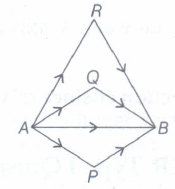
\(\overrightarrow{A P}+\overrightarrow{P B}+\overrightarrow{A Q}+\overrightarrow{Q B}+\overrightarrow{A R}+\overrightarrow{R B}=3 \overrightarrow{A B}\)
7.
\(\overrightarrow b\times \overrightarrow c=\left| \begin{matrix} \overset { \wedge }{ i } & \overset { \wedge }{ j } & \overset { \wedge }{ k } \\ -1 & 2 & 1 \\ 3 & 1 & 2 \end{matrix} \right| \)
\(=\overset\wedge i(4-1)-\overset\wedge j(-2-3)+\overset\wedge k(-1-6)\)
\(=3\overset\wedge i+5\overset\wedge j-7\overset\wedge k\)
\(\therefore \overrightarrow a.(\overrightarrow b\times\overrightarrow c)=(2\overset\wedge i+\overset\wedge j+3\overset\wedge k).(3\overset\wedge i+5\overset\wedge j-7\overset\wedge k)\)
= 6 + 5 - 21 = -10
8.
\((\hat{k} \times \hat{i}) \cdot \hat{j}+\hat{i} \cdot \hat{k}=\hat{j} \cdot \hat{j}+\hat{i} \cdot \hat{k}\)
= 1 + 0 = 1
9.
Let given position vectors are \(\overrightarrow{O A}=\vec{a}-2 \vec{b}\) and \(\overrightarrow{O B}=2 \vec{a}+\vec{b}\)
Let \(\overrightarrow{O C}\) be the position vector of a point C which divides the join of points, with position vectors \(\overrightarrow{O A}\) and \(\overrightarrow{O B}\), externally in the ratio 2 : 1.
\(\therefore \overrightarrow{O C}=\frac{2 \overrightarrow{O B}-1 \overrightarrow{O A}}{2-1}\) [by external section formula)
\(\begin{aligned}
=\frac{2(2 \vec{a}+\vec{b})-1(\vec{a}-2 \vec{b})}{1}
\end{aligned}\)
\(\begin{aligned}
=4 \vec{a}+2 \vec{b}-\vec{a}+2 \vec{b}=3 \vec{a}+4 \vec{b}
\end{aligned}\)
10.
\(\text { Let initial point be }(\alpha, \beta, \gamma) \text { . }\)
\(\therefore 3 \hat{i}-\hat{j}-5 \hat{k}=(0-\alpha) \hat{i}+(1-\beta) \hat{j}+(3-\gamma) \hat{k} \)
\(\Rightarrow 3=-\alpha,-1=1-\beta,-5=3-\gamma \)
\(\Rightarrow \alpha_{0}=-3, \beta=2, \gamma=8 \)
Coordinates of initial point are (-3,2,8)
11.
Given, \(\vec{\alpha}=4 \hat{i}+5 \hat{j}-\hat{k}, \vec{\beta}=\hat{i}-4 \hat{j}+5 \hat{k}\)
and \(\vec{q}=3 \hat{i}+\hat{j}-\hat{k}\)
Also, vector \(\vec{p}\) is perpendicular to \(\alpha\) and \(\beta\).
Then, \(\vec{p}=\lambda(\vec{\alpha} \times \vec{\beta})\) ...(i)
Now, \(\vec{\alpha} \times \vec{\beta}=\left|\begin{array}{ccc}
\hat{i} & \hat{j} & \hat{k} \\
4 & 5 & -1 \\
1 & -4 & 5
\end{array}\right|\)
\(\begin{aligned}
=\hat{i}(25-4)-\hat{j}(20+1)+\hat{k}(-16-5)
\end{aligned}\)
\(\begin{aligned}
=\hat{i}(21)-\hat{j}(21)+\hat{k}(-21)
\end{aligned}\)
\(\Rightarrow \quad \vec{\alpha} \times \vec{\beta}=21 \hat{i}-21 \hat{j}-21 \hat{k}\)
So, \(\vec{p}=21 \lambda \hat{i}-21 \lambda \hat{j}-21 \lambda \hat{k}\) [from Eq. (i)] ...(ii)
Also, given that \(\vec{p} \cdot \vec{q}=21\)
\(\begin{aligned}
\therefore \quad(21 \lambda \hat{i}-21 \lambda \hat{j}-21 \lambda \hat{k}) \cdot(3 \hat{i}+\hat{j}-\hat{k})=21
\end{aligned}\)
\(\begin{aligned}
\Rightarrow \quad 63 \lambda-21 \lambda+21 \lambda=21
\end{aligned}\)
\(\begin{aligned}
\Rightarrow \quad 63 \lambda=21
\end{aligned}\)
\(\begin{aligned}
\Rightarrow \quad \lambda=1 / 3
\end{aligned}\)
On putting \(\lambda=\frac{1}{3}\) in Eq. (ii), we get
\(\vec{p}=21 \times \frac{1}{3} \hat{i}-21 \times \frac{1}{3} \hat{j}-21 \times \frac{1}{3} \hat{k}\)
\(\therefore \quad \vec{p}=7 \hat{i}-7 \hat{j}-7 \hat{k}\)
which is the required vector.
12.
As given \(\overrightarrow { a } .\overrightarrow { b } =\overrightarrow { a } .\overrightarrow { c } =0=\overrightarrow { a } \bot \)both \(\overrightarrow { b } \) and \(\overrightarrow { c } \)
⇒ \(\overrightarrow { a } \parallel \left( \overrightarrow { b } \times \overrightarrow { c } \right) \)
Let \(\overrightarrow { a } =\lambda \left( \overrightarrow { b } \times \overrightarrow { c } \right) \)
then \(\left| \overrightarrow { a } \right| =\left| \lambda \right| \left| \left( \overrightarrow { b } \times \overrightarrow { c } \right) \right| \)
⇒ \(\frac { \left| \overrightarrow { a } \right| }{ \left| \left( \overrightarrow { b } \times \overrightarrow { c } \right) \right| } =\left| \lambda \right| \)
⇒ \(\left| \lambda \right| =\frac { 1 }{ sin\frac { \pi }{ 6 } } =2\)
λ = 士2
\(\overrightarrow { a } =\pm 2\left( \overrightarrow { b } \times \overrightarrow { c } \right) \)
Hence proved
(ii) Now \(\left[ \overrightarrow { a } +\overrightarrow { b } ,\overrightarrow { b } +\overrightarrow { c } ,\overrightarrow { c } +\overrightarrow { a } \right] \)
= \(\left[ \left( \overrightarrow { a } +\overrightarrow { b } \right) \times \left( \overrightarrow { b } \times \overrightarrow { c } \right) \right] .\left( \overrightarrow { c } +\overrightarrow { a } \right) \)
= \(\left( \overrightarrow { a } \times \overrightarrow { b } \right) .\overrightarrow { c } +\left( \overrightarrow { b } \times \overrightarrow { c } \right) .\overrightarrow { a } \)
(As the scalar triple product = 0, if any two vectors are equal)
Hence, \(\overrightarrow { a } .\left( \overrightarrow { b } \times \overrightarrow { c } \right) +\left( \overrightarrow { a } \times \overrightarrow { b } \right) .\overrightarrow { c } \) = \(\overrightarrow { a } .\left( \overrightarrow { b } \times \overrightarrow { c } \right) +\overrightarrow { c } \left( \overrightarrow { b } \times \overrightarrow { c } \right) \)
= 2\(\overrightarrow { a } \left( \overrightarrow { b } \times \overrightarrow { c } \right) \)
= \(2\overrightarrow { a } \left( \pm \frac { 1 }{ 2 } \overrightarrow { a } \right) \)
= 士1
Hence proved
13.
(d)
60
14.
(b)
\(\vec{a}, \vec{b}, \vec{c} \text { are perpendicular to each other }\)
15.
(a)
\(\frac{3 \vec{a}-2 \vec{b}}{2}\)
16.
(a)
\(\frac{1}{\sqrt{14}}, \frac{2}{\sqrt{14}}, \frac{3}{\sqrt{14}}\)
17.
(a)
\(|\overrightarrow { a } |=|\overrightarrow { b } |\)
18.
(i) (b): Here, (4, 10) are the coordinates of A.
\(\therefore\) P.V. of A = \(4 \hat{i}+10 \hat{j}\)
(ii) (c): Here, (9, 7) are the coordinates of B.
\(\therefore\) P.V. of B \(=9 \hat{i}+7 \hat{j}\)
(iii) (b): Here, P.V. of A = \(4 \hat{i}+10 \hat{j}\) and P.V. of \(C=4 \hat{i}+2 \hat{j}\)
\(\therefore \ \overrightarrow{A C}=(4-4) \hat{i}+(2-10) \hat{j}=-8 \hat{j}\)
(iv) (a): Here \(\vec{A}=\hat{i}+2 \hat{j}+3 \hat{k}\)
\( \therefore \ |\vec{A}|=\sqrt{1^{2}+2^{2}+3^{2}}=\sqrt{1+4+9}=\sqrt{14} \)
\(\therefore \ \hat{A}=\frac{\vec{A}}{|\vec{A}|}=\frac{\hat{i}+2 \hat{j}+3 \hat{k}}{\sqrt{14}}=\frac{1}{\sqrt{14}} \hat{i}+\frac{2}{\sqrt{14}} \hat{j}+\frac{3}{\sqrt{14}} \hat{k}\)
(v) (d): We have, \(\vec{A}=4 \hat{i}+3 \hat{j}\) and \( \vec{B}=3 \hat{i}+4 \hat{j}\)
\(\therefore|\vec{A}|=\sqrt{4^{2}+3^{2}}=\sqrt{16+9}=\sqrt{25}=5\)
and \(|\vec{B}|=\sqrt{3^{2}+4^{2}}=\sqrt{9+16}=\sqrt{25}=5\)
Thus, \(|\vec{A}|+|\vec{B}|=5+5=10\)
19.
(i) (a) : \(\vec{a}=\hat{i}+4 \hat{j}+2 \hat{k}, \vec{b}=3 \hat{i}-3 \hat{j}-2 \hat{k}\) and \(\vec{c}=-2 \hat{i}+2 \hat{j}+6 \hat{k}\)
\(\therefore \ \vec{a}+\vec{b}+\vec{c}=2 \hat{i}+3 \hat{j}+6 \hat{k}\)
(ii) (c): Using triangle law of addition in \(\Delta\)ABC, we get
\(\overrightarrow{A B}+\overrightarrow{B C}+\overrightarrow{C A}=\overrightarrow{0}\) which can be rewritten as
\(\overrightarrow{A B}+\overrightarrow{B C}-\overrightarrow{A C}=\overrightarrow{0} \text { or } \overrightarrow{A B}-\overrightarrow{C B}+\overrightarrow{C A}=\overrightarrow{0}\)
(iii) (c) : We have, A(1, 4, 2), B(3, -3, -2) and C(-2, 2, 6)
Now, \(\overrightarrow{A B}=\vec{b}-\vec{a}=2 \hat{i}-7 \hat{j}-4 \hat{k}\)
and \(\overrightarrow{A C}=\vec{c}-\vec{a}=-3 \hat{i}-2 \hat{j}+4 \hat{k}\)
\(\therefore \overrightarrow{A B} \times \overrightarrow{A C}=\left|\begin{array}{ccc} \hat{i} & \hat{j} & \hat{k} \\ 2 & -7 & -4 \\ -3 & -2 & 4 \end{array}\right|\)
\(=\hat{i}(-28-8)-\hat{j}(8-12)+\hat{k}(-4-21)=-36 \hat{i}+4 \hat{j}-25 \hat{k}\)
Now, \(|\overrightarrow{A B} \times \overrightarrow{A C}|=\sqrt{(-36)^{2}+4^{2}+(-25)^{2}}\)
\(=\sqrt{1296+16+625}=\sqrt{1937}\)
\(\therefore \text { Area of } \Delta A B C=\frac{1}{2}|\overrightarrow{A B} \times \overrightarrow{A C}|=\frac{1}{2} \sqrt{1937} \text { sq. units }\)
(iv) (d): If the given points lie on the straight line, then the points will be collinear and so area of \( \Delta A B C=0 \)
\(\Rightarrow |\vec{a} \times \vec{b}+\vec{b} \times \vec{c}+\vec{c} \times \vec{a}|=0\)
If a, b, c are the position vectors of the three vertices A, Band C of \( \Delta A B C \), then area of triangle
\(\left.=\frac{1}{2}|\vec{a} \times \vec{b}+\vec{b} \times \vec{c}+\vec{c} \times \vec{a}|\right]\)
(v) (b): Here, \( |\vec{a}| =\sqrt{2^{2}+3^{2}+6^{2}}=\sqrt{4+9+36} \)
\(=\sqrt{49}=7\)
\(\therefore\) Unit vector in the direction of vector \(\vec{a}\) is
\(\hat{a}=\frac{2 \hat{i}+3 \hat{j}+6 \hat{k}}{7}=\frac{2}{7} \hat{i}+\frac{3}{7} \hat{j}+\frac{6}{7} \hat{k}\)

12th Standard CBSE Syllabus & Materials
12th Standard CBSE
CBSE 12th Computer Science Python Revision Tour I - New Previous year Question Papers Study Material - QB365 Set A
NEW12th Standard CBSE
CBSE 12th Business Studies Planning Important Questions And Answers Study Material - QB365 Set A
NEW12th Standard CBSE
CBSE 12th Business Studies Business Environment Important Questions And Answers Study Material - QB365 Set A
NEW12th Standard CBSE
CBSE 12th Business Studies Principles of Management Important Questions And Answers Study Material - QB365 Set A



NCERT Books

Syllabus

Exam Pattern

Sample Question Papers

Previous year Question Papers

Important Notes

MCQ Practice test

NCERT Exemplers

Case study Questions

Image Based Questions

Passage based Questions

HOT Questions

Value Based Questions

Model Questions Papers
NCERT ( Book Back ) Questions

Assertion and Reason
Important Questions And Answers

CBSE 12th Standard CBSE Subjects
CBSE Standards








