
 100% FREE ACCESS
12th Standard CBSE Syllabus & Materials
12th Standard CBSE
CBSE 12th Economics Government Budget and the Economy Previous year Question Papers Study Material - QB365 Set A
NEW12th Standard CBSE
CBSE 12th Computer Science Interface Python with MySQL - New Previous year Question Papers Study Material - QB365 Set A
NEW12th Standard CBSE
CBSE 12th Computer Science Database Concept - New Previous year Question Papers Study Material - QB365 Set A
NEW12th Standard CBSE
CBSE 12th Computer Science Data Communication - New Previous year Question Papers Study Material - QB365 Set A
NEW12th Standard CBSE
CBSE 12th Computer Science Data Structures - New Previous year Question Papers Study Material - QB365 Set A
NEW12th Standard CBSE
CBSE 12th Computer Science Functions - New Previous year Question Papers Study Material - QB365 Set A

Published on: 02/11/2025
Download CBSE Class 12th Standard CBSE Maths question papers, sample papers, important questions, and previous year solved papers in PDF format. Get free study materials, NCERT solutions, and exam preparation resources for Class 12th Standard CBSE Maths
Questions + Answers key
Take MCQ Maths Test
1.
If two vectors \(\vec{a}\)and \(\vec{b}\) are such that \(|\vec{a}|=2,|\vec{b}|=3\) and \(\vec{a} \cdot \vec{b}=4\), then \(|\vec{a}-2 \vec{b}|\) is equal to
\(\sqrt{2}\)
2\(\sqrt{6}\)
24
2\(\sqrt{2}\)
2.
The equation of the line in vector form passing through the point (-1, 3, 5) and parallel to line \(\frac{x-3}{2}=\frac{y-4}{3}\), z = 2 is
\(\vec{r}=(-\hat{i}+3 \hat{j}+5 \hat{k})+\lambda(2 \hat{i}+3 \hat{j}+\hat{k})\)
\(\vec{r}=(-\hat{i}+3 \hat{j}+5 \hat{k})+\lambda(2 \hat{i}+3 \hat{j})\)
\(\vec{r}=(2 \hat{i}+3 \hat{j}-2 \hat{k})+\lambda(-\hat{i}+3 \hat{j}+5 \hat{k})\)
\(\vec{r}=(2 \hat{i}+3 \hat{j})+\lambda(-\hat{i}+3 \hat{j}+5 \hat{k})\)
3.
The lines \(\frac{x-2}{1}=\frac{y-3}{1}=\frac{4-z}{k}\) and \(\frac{x-1}{k}=\frac{y-4}{2}=\frac{z-5}{-2}\) are mutually perpendicular, if the value of k is
\(-\frac{2}{3}\)
\(\frac{2}{3}\)
-2
2
4.
The sine of the angle between the straight line \(\frac{x-2}{3}=\frac{y-3}{4}=\frac{z-4}{5}\) and the plane \(2 x-2 y+z=5\) is
\(\frac{10}{6 \sqrt{5}}\)
\(\frac{4}{5 \sqrt{2}}\)
\(\frac{2 \sqrt{3}}{5}\)
\(\frac{\sqrt{2}}{10}\)
5.
If \(\vec{a} \mid=4 \text { and }-3 \leq \lambda \leq 2\) ,then the range of \(|\lambda \vec{a}|\) is
[0,8]
[-12, 8)
[0,12)
[8,12)
6.
The value of \(\hat{i} \cdot(\hat{j} \times \hat{k})+\hat{j} \cdot(\hat{k} \times \hat{i})+\hat{k} \cdot(\hat{i} \times \hat{j})\) is
zero
-1
1
3
7.
The value of \(\lambda\) for which the vectors \(\vec{a}=2 \hat{i}+\lambda \hat{j}+\hat{k} \text { and } \vec{b}=\hat{i}+2 \hat{j}+3 \hat{k}\) are orthogonal os
0
1
\(\frac{3}{2}\)
\(\frac{-5}{2}\)
8.
The solution of \(\frac{d y}{d x}+y=e^{-x}, y(0)=0\) is
\(y=e^{x}(x-1)\)
\(y=x e^{-x}\)
\(y=x e^{-x}+1\)
\(y=(x+1) e^{-x}\)
9.
Find the direction cosines of the x axis.
1, 0, 0
0, 0, 0
0, 1, 0
0, 0, 1
10.
A vector of magnitude 14 units, which is parallel to the \(\widehat { i } +2\widehat { j } -3\widehat { k } \) vector
\(\frac { (\widehat { i } +2\widehat { j } -3\widehat { k } ) }{ 14 } \)
\(\frac { (\widehat { i } +2\widehat { j } -3\widehat { k } ) }{ \sqrt{14 } }\)
\(\sqrt { 14 } (\widehat { i } +2\widehat { j } -3\widehat { k } )\)
14\((\widehat { i } +2\widehat { j } -3\widehat { k } )\)
11.
For what values of x and y, the vectors \(\overrightarrow { a } =3\widehat { i } +y\widehat { j } -\widehat 3{ k } \) and \(\overrightarrow { b } =2x\widehat { i } +2x\widehat { i } -3\widehat { k } \) are equal?
\(x=3,y=\frac { 3 }{ 2 } \)
x = 3, y = 6
\(x=\frac{3}{2},y=3\)
x = 6, y = 3
12.
The degree of the differential equation \({ \left( \frac { { d }y }{ d{ x } } \right) }^{ 2 }+\frac { 1 }{ (dy/dx) } =1\)
2
1
3
0
13.
The dif \(3\frac { { d }^{ 2 }y }{ d{ x }^{ 2 } } ={ \left[ 1+{ \left( \frac { dy }{ dx } \right) }^{ 2 } \right] }^{ 3/2 }\)
second order, third degree equation.
second order, first degree equation
third order, third degree equation.
second order, second degree equation.
14.
The general solution of a differential equation of the type \(\frac { dx }{ dy } +{ P }_{ 1 }x={ Q }_{ 1 }\) is
\(y{ e }^{ \int { { P }_{ 1 }dy } }=\int { ({ Q }_{ 1 }{ e }^{ \int { { P }_{ 1 }dy } } } )dy+C\)
\(y{ .e }^{ \int { { P }_{ 1 }dy } }=\int { ({ Q }_{ 1 }{ e }^{ \int { { P }_{ 1 }dx } } } )dx+C\)
\(x{ e }^{ \int { { P }_{ 1 }dy } }=\int { ({ Q }_{ 1 }{ e }^{ \int { { P }_{ 1 }dy } } } )dy+C\)
\(x{ e }^{ \int { { P }_{ 1 }dy } }=\int { ({ Q }_{ 1 }{ e }^{ \int { { P }_{ 1 }dx } } } )dx+C\)
15.
The Integrating Factor of the differential equation x\(\frac { dy }{ dx } \)- y = 2x2 is
e-x
e-y
\(\frac1x\)
x
16.
The number of arbitrary constants in the particular solution of a differential equation of third order are:
3
2
1
0
17.
The degree of the differential equation
\({ \left( \frac { { d }^{ 2 }y }{ d{ x }^{ 2 } } \right) }^{ 3 }+ { \left( \frac { dy }{ dx } \right) }^{ 2 }+sin{ \left( \frac { dy }{ dx } \right) }+1=0\)
3
2
1
not defined
18.
If for non zero vectors \(\vec { a } \) and \(\vec { b } \), \(\vec { a } \) x \(\vec { b } \) is a unit vector and |\(\vec { a } \)| = |\(\vec { b } \)| = \(\sqrt2\), then angle θ between vectors \(\vec { a } \) and \(\vec { b } \) is
\(\frac { \pi }{ 2 } \)
\(\frac { \pi }{ 3 } \)
\(\frac { \pi }{ 6 } \)
\(-\frac { \pi }{ 2 } \)
19.
A vector equally inclined to axes is
\(\widehat { i } +\widehat { j } +\widehat { k } \)
\(\widehat { i } -\widehat { j } +\widehat { k } \)
\(\widehat { i } -\widehat { j } -\widehat { k } \)
\(-\widehat { i } +\widehat { j } -\widehat { k } \)
20.
The differential equation of the family of lines passing through origin is
y = mx
\(\frac{dy}{dx}=m\)
x dy – y dx = 0
\(\frac{dy}{dx}=0\)
21.
Consider the points A, B, C with position vectors \(2 \hat{i}-\hat{j}+\hat{k}, \hat{i}-3 \hat{j}-5 \hat{k} \text { and } 3 \hat{i}-4 \hat{j}-4 \hat{k}\)
On the basis of above information, answer the following questions.
(i) \(\overrightarrow{B C}\) is equal to
| (a) | \(\begin{aligned} -\hat{i}-2 \hat{j}-6 \hat{k} \end{aligned}\) |
| (b) | \(\begin{aligned} 2 \hat{i}-\hat{j}+\hat{k} \end{aligned}\) |
| (c) | \(\begin{aligned} -\hat{i}+3 \hat{j}+5 \hat{k} \end{aligned}\) |
| (d) | None of the above |
(ii) \(\overrightarrow{CA}\) is equal to
| (a) | \(\begin{aligned} -\hat{i}-2 \hat{j}-6 \hat{k} \end{aligned}\) | (b) | \(2 \hat{i}-\hat{j}+\hat{k}\) |
| (c) | \(\begin{aligned} -\hat{i}+3 \hat{j}+5 \hat{k} \end{aligned}\) | (d) | None of these |
(iii) \(\overrightarrow{B C} \cdot \overrightarrow{C A}\) is equal to
| (a) | -1 | (b) | 1 |
| (c) | 0 | (d) | 2 |
(iv) \(\overrightarrow{B C} \times \overrightarrow{C A}\) is equal to
| (a) | \(\begin{aligned} 8 \hat{i}+11 \hat{j}-5 \hat{k} \end{aligned}\) |
| (b) | \(\begin{aligned} -8 \hat{i}-11 \hat{j}+5 \hat{k} \end{aligned}\) |
| (c) | \(\begin{aligned} 8 \hat{i}-11 \hat{j}-5 \hat{k} \end{aligned}\) |
| (d) | None of the above |
(v) Area of \(\Delta\)ABC (in sq units) is equal to
| (a) | \(\begin{aligned} & \frac{\sqrt{210}}{2} \end{aligned}\) | (b) | \(\begin{aligned} \sqrt{210} \end{aligned}\) |
| (c) | \(\begin{aligned} 2 \sqrt{210} \end{aligned}\) | (d) | None of these |
22.
A boy see a design in a park which is shown below.
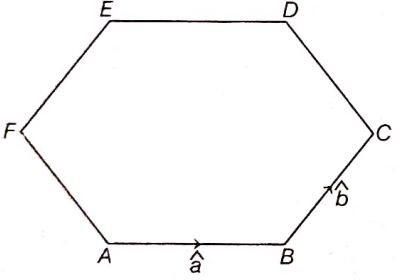
Now, he thought that if, \(\hat{a} \text { and } \hat{b}\) are the vectors determined by two adjacent sides of the given regular hexagon.
On the basis of above information, answer the following questions.
(i) \(\overrightarrow{A C}\) is equal to
| (a) | \(\hat{a}-\hat{b}\) | (b) | \(\hat{b}-\hat{a}\) |
| (c) | \(\hat{a}+\hat{b}\) | (c) | \(\hat{0}\) |
(ii) \(\overrightarrow{A D}\) is equal to
| (a) | \(\begin{aligned} 2 \hat{a} \end{aligned}\) | (b) | \(\begin{aligned} 2 \hat{b} \end{aligned}\) |
| (c) | \(\begin{aligned} 2(\hat{a}+\hat{b}) \end{aligned}\) | (c) | \(\begin{aligned} 2(\hat{a}-\hat{b}) \end{aligned}\) |
(iii) \(\overrightarrow{C D}\) is equal to
| (a) | \(\begin{aligned} \hat{a}-\hat{b} \end{aligned}\) | (b) | \(\begin{aligned} 2(\hat{a}-\hat{b}) \end{aligned}\) |
| (c) | \(\begin{aligned} \hat{b}-\hat{a} \end{aligned}\) | (c) | \(\begin{aligned} 2(\hat{b}-\hat{a}) \end{aligned}\) |
(iv) \(\overrightarrow{EF}\) is equal to
| (a) | \(\hat{a}\) | (b) | \(\hat{b}\) |
| (c) | - \(\hat{a}\) | (c) | - \(\hat{b}\) |
(v) \(\overrightarrow{FA}\) is equal to
| (a) | \(\begin{aligned} \hat{a}-\hat{b} \end{aligned}\) | (b) | \(\begin{aligned} 2(\hat{a}-\hat{b}) \end{aligned}\) |
| (c) | \(\begin{aligned} \hat{b}-\hat{a} \end{aligned}\) | (c) | \(\begin{aligned} 2(\hat{b}-\hat{a}) \end{aligned}\) |
23.
Order: The order of a differential equation is the order of the highest order derivative appearing in the differential equation.
Degree : The degree of differential equation is the power of the highest order derivative, when differential coefficients are made free from radicals and fractions. Also, differential equation must be a polynomial equation
in derivatives for the degree to be defined.
Based on the above information, answer the following questions.
(i) Find the degree of the differential equation \(2 \frac{d^{2} y}{d x^{2}}+3 \sqrt{1-\left(\frac{d y}{d x}\right)^{2}-y}=0\)
| (a) 3 | (b) 4 | (c) 2 | (d) 1 |
(ii) Order and degree of the differential equation \(y \frac{d y}{d x}=\frac{x}{\frac{d y}{d x}+\left(\frac{d y}{d x}\right)^{3}}\) are respectively
| (a) 1,1 | (b) 1,2 | (c) 1,3 | (d) 1,4 |
(iii) Find order and degree of the equation \(y^{\prime \prime \prime}+y^{2}+e^{y^{\prime}}=0\)
| (a) order = 3, degree = undefined | (b) order = 1, degree = 3 | (c) order = 2, degree = undefined | (d) order = 1, degree = 2 |
(iv) Determine degree of the differential equation \((\sqrt{a+x}) \cdot\left(\frac{d y}{d x}\right)+x=0\)
| (a) 3 | (b) not defined | (c) 1 | (d) 2 |
(v) Order and degree of the differential equation \(\left(1+\left(\frac{d y}{d x}\right)^{3}\right)^{\frac{7}{3}}=7 \frac{d^{2} y}{d x^{2}}\) are respectively
| (a) 2, 1 | (b) 2,3 | (c) 1,3 | (d) \(1, \frac{7}{3}\) |
24.
It is known that, if the interest is compounded continuously, the principal changes at the rate equal to the produd' of the rate of bank interest per annum and the principal. Let P denotes the principal at any time t and rate of interest be r % per annum.
Based on the above information, answer the following questions.
(i) Find the value of \(\frac{d P}{d t}\) .
| (a) \(\frac{\operatorname{Pr}}{1000}\) | (b) \(\frac{P r}{100}\) | (c) \(\frac{\operatorname{Pr}}{10}\) | (d) Pr |
(ii) fPo be the initial principal, then find the solution of differential equation formed in given situation.
| (a) \(\log \left(\frac{P}{P_{0}}\right)=\frac{r t}{100}\) | (b) \(\log \left(\frac{P}{P_{0}}\right)=\frac{r t}{10}\) | (c) \(\log \left(\frac{P}{P_{0}}\right)=r t\) | (d) \(\log \left(\frac{P}{P_{0}}\right)=100 r t\) |
(iii) If the interest is compounded continuously at 5% per annum, in how many years will Rs. 100 double itself?
| (a) 12.728 years | (b) 14.789 years | (c) 13.862 years | (d) 15.872 years |
(iv) At what interest rate will Rs.100 double itself in 10 years? (log e2 = 0.6931).
| (a) 9.66% | (b) 8.239% | (c) 7.341% | (d) 6.931% |
(v) How much will Rs. 1000 be worth at 5% interest after 10 years? (e0.5 = 1.648).
| (a) Rs. 1648 | (b) Rs. 1500 | (c) Rs. 1664 | (d) Rs. 1572 |
1.
(b)
2\(\sqrt{6}\)
2.
(b)
\(\vec{r}=(-\hat{i}+3 \hat{j}+5 \hat{k})+\lambda(2 \hat{i}+3 \hat{j})\)
3.
(a)
\(-\frac{2}{3}\)
4.
(d)
\(\frac{\sqrt{2}}{10}\)
5.
(c)
[0,12)
6.
(d)
3
7.
(d)
\(\frac{-5}{2}\)
8.
(b)
\(y=x e^{-x}\)
9.
(a)
1, 0, 0
10.
(c)
\(\sqrt { 14 } (\widehat { i } +2\widehat { j } -3\widehat { k } )\)
11.
(b)
x = 3, y = 6
12.
(c)
3
13.
(d)
second order, second degree equation.
14.
(c)
\(x{ e }^{ \int { { P }_{ 1 }dy } }=\int { ({ Q }_{ 1 }{ e }^{ \int { { P }_{ 1 }dy } } } )dy+C\)
15.
(c)
\(\frac1x\)
16.
(d)
0
17.
(d)
not defined
18.
As sin \(\theta \) = \(\frac { |\vec { a } \times \vec { b } | }{ |\vec { b } ||\vec { b } | } \)
\(=\frac { 1 }{ \sqrt { 2 } .\sqrt { 2 } } =\frac { 1 }{ 2 } \)
\(\Rightarrow \theta =\frac { \pi }{ 6 } \)
19.
As direction ratios are 1, 1, 1 and direction cosines \(\frac { 1 }{ \sqrt { 3 } } ,\frac { 1 }{ \sqrt { 3 } } ,\frac { 1 }{ \sqrt { 3 } } \)
⇒ cos α = cos β = cos γ
⇒ α = β = γ
20.
As general equation of line through origin is
y = mx
⇒ \(\frac{dy}{dx}=m\)
Substituting in (i), we get dy
y = \(\frac{dy}{dx}.x\)
⇒ x dy – y dx = 0
21.
(i) (b) \(\overrightarrow{B C}\) = Position vector of C - position vector of B
\(=(3 \hat{i}-4 \hat{j}-4 \hat{k})-(\hat{i}-3 \hat{j}-5 \hat{k})=2 \hat{i}-\hat{j}+\hat{k}\)
(ii) (c) \(\overrightarrow{CA}\) = Position vector of A - Position vector of C
\(\begin{aligned} =(2 \hat{i}-\hat{j}+\hat{k})-(3 \hat{i}-4 \hat{j}-4 \hat{k})\end{aligned}\)
\(\begin{aligned} =-\hat{i}+3 \hat{j}+5 \hat{k} \end{aligned}\)
(iii) (c) \(\overrightarrow{B C} \cdot \overrightarrow{C A}=(2 \hat{i}-\hat{j}+\hat{k}) \cdot(-\hat{i}+3 \hat{j}+5 \hat{k})\)
= -2 - 3 + 5 = 0
(iv) (b) \(\begin{aligned} \overrightarrow{B C} \times \overrightarrow{C A} & =\left|\begin{array}{ccc} \hat{i} & \hat{j} & \hat{k} \\ 2 & -1 & 1 \\ -1 & 3 & 5 \end{array}\right| \\ \end{aligned}\)
\(\begin{aligned} =-8 \hat{i}-11 \hat{j}+5 \hat{k} \end{aligned}\)
(v) (a) Since, \(\overrightarrow{B C} \cdot \overrightarrow{C A}=0 \text {, so } \overrightarrow{B C} \perp \overrightarrow{C A}\)
Hence, \(\Delta\)ABC is right angled triangle at C.
\(\begin{aligned} \therefore \text { Area }(\triangle A B C) & =\frac{1}{2} \times|\overrightarrow{B C}||\overrightarrow{C A}| \end{aligned}\)
\(\begin{aligned} =\frac{1}{2} \sqrt{4+1+1} \sqrt{1+9+25} \end{aligned}\)
\(\begin{aligned} =\frac{\sqrt{210}}{2} \text { sq units } \end{aligned}\)
22.
(i) (c) We have, \(\overrightarrow{A B}=\hat{a} \text { and } \overrightarrow{B C}=\hat{b}\)
By triangle law of addition of vectors,
\(\overrightarrow{A C}=\overrightarrow{A B}+\overrightarrow{B C}=\hat{a}+\hat{b}\)
(ii) (b) We know that AD|| BC
\(\therefore \quad \overrightarrow{A D}=2 \overrightarrow{B C}=2 \hat{b}\)
(iii) (c) By triangle law, we have
\(\begin{aligned}
\overrightarrow{A C}+\overrightarrow{C D} & =\overrightarrow{A D}
\end{aligned}\)
\(\begin{aligned}
\Rightarrow \quad \overrightarrow{C D} & =\overrightarrow{A D}-\overrightarrow{A C} \end{aligned}\)
\(\begin{aligned}
=2 \hat{b}-(\hat{a}+\hat{b})=\hat{b}-\hat{a}
\end{aligned}\)
(iv) (d) \(\begin{aligned}
\overrightarrow{E F}=-\overrightarrow{B C}=-\hat{b}
\end{aligned}\)
(v) (a) \(\begin{aligned}
\overrightarrow{F A}=-\overrightarrow{C D}=-(\hat{b}-\hat{a})=\hat{a}-\hat{b}
\end{aligned}\)
23.
(i) (c) : We have, \(2 \frac{d^{2} y}{d x^{2}}+3 \sqrt{1-\left(\frac{d y}{d x}\right)^{2}-y}=0\)
\(\therefore \quad 2 \frac{d^{2} y}{d x^{2}}=-3 \sqrt{1-\left(\frac{d y}{d x}\right)^{2}-y}\)
Squaring both sides, we get
\(4\left(\frac{d^{2} y}{d x^{2}}\right)^{2}=9\left[1-\left(\frac{d y}{d x}\right)^{2}-y\right]\)
Here, highest order derivative is \(\frac{d^{2} y}{d x^{2}}\) and its power is 2. So, its degree is 2.
(ii) (d) : We have, \(y \frac{d y}{d x}=\frac{x}{\frac{d y}{d x}+\left(\frac{d y}{d x}\right)^{3}}\)
\(\Rightarrow y\left(\frac{d y}{d x}\right)^{2}+y\left(\frac{d y}{d x}\right)^{4}=x\)
\(\Rightarrow\) Here, highest order derivative is \(\frac{d y}{d x}\) is So , its order is 1 and degree is 4.
(iii) (a) : We have,\(y^{\prime \prime \prime}+y^{2}+e^{y^{\prime}}=0\)
\(\frac{d^{3} y}{d x^{3}}+y^{2}+e^{(d y / d x)}=0\)
Highest order derivative is \(\frac{d^{3} y}{d x^{3}}\) .So, its order is 3.
Also, the given differential cannot be expressed as a polynomial. So, its degree is not defined.
(iv) (c) : The given differential equation is,
\(\sqrt{a+x} \cdot\left(\frac{d y}{d x}\right)+x=0 \Rightarrow \frac{d y}{d x}=\frac{-x}{\sqrt{a+x}}\)
Clearly, degree = 1
(v) (b) : We have \(y \frac{d y}{d x}=\frac{x}{\frac{d y}{d x}+\left(\frac{d y}{d x}\right)^{3}}\)
\(\Rightarrow y\left(\frac{d y}{d x}\right)^{2}+y\left(\frac{d y}{d x}\right)^{4}=x\)
\(\Rightarrow\) Here, highest order derivative is \(\frac{d y}{d x}\) ,So , its order is 1 and degree is 4.
(iii) (a) : We have, y'" +y2 + ey = 0
\(\frac{d^{3} y}{d x^{3}}+y^{2}+e^{(d y / d x)}=0\)
Highest order derivative is \(\frac{d^{3} y}{d x^{3}}\) So, its order is 3.
Also, the given differential cannot be expressed as a polynomial. So, its degree is not defined
(iv) (c) :The given differential equation is,
\(\sqrt{a+x} \cdot\left(\frac{d y}{d x}\right)+x=0 \Rightarrow \frac{d y}{d x}=\frac{-x}{\sqrt{a+x}}\)
Clearly, degree = 1.
(v) (b) : We have \(\left(1+\left(\frac{d y}{d x} \mid\right)^{3}\right)^{\frac{1}{3}}=7 \frac{d^{2} y}{d x^{2}}\)
\(\therefore\) Order is 2 and degree is 3.
24.
(i) (b) : Here, P denotes the principal at any time t and the rate of interest be r% per annum compounded continuously, then according to the law given in the problem, we get
\(\frac{d P}{d t}=\frac{P r}{100}\)
(ii) (a) : We have, \(\frac{d P}{d t}=\frac{\operatorname{Pr}}{100}\)
\(\Rightarrow \frac{d P}{P}=\frac{r}{100} d t \Rightarrow \int \frac{1}{P} d P=\frac{r}{100} \int d t\)
\(\Rightarrow \log P=\frac{r t}{100}+C\)
At t = 0, P = Po
\(\therefore \quad C=\log P_{0}\)
So, \(\log P=\frac{r t}{100}+\log P_{0}\)
\(\Rightarrow \log \left(\frac{P}{P_{0}}\right)=\frac{r t}{100}\)
(iii) (c) : We have, r = 5, Po = Rs. 100 and P = Rs. 200 = 2Po
Substituting these values in (2), we get
\(\log 2=\frac{5}{100} t\)
\(\Rightarrow\) t = 20 loge 2 = 20 x 0.6931 years = 13.862 years
(iv) (d) : We have
Po = Rs. 100, P = Rs. Rs. 200 = 2Po and t = 10 years
Substituting these values in (2), we get
\(\log 2=\frac{10 r}{100} \Rightarrow r=10 \log 2=10 \times 0.6931=6.931\)
(v) (a) : We have
Po = Rs. 1000, r = 5 and t = 10
Substituting these values in (2), we get
\(\log \left(\frac{P}{1000}\right)=\frac{5 \times 10}{100}=\frac{1}{2}=0.5 \Rightarrow \frac{P}{1000}=e^{0.5}\)
\(\Rightarrow\) P = 1000 x 1.648 = Rs. 1648

12th Standard CBSE Syllabus & Materials
12th Standard CBSE
CBSE 12th Computer Science Python Revision Tour I - New Previous year Question Papers Study Material - QB365 Set A
NEW12th Standard CBSE
CBSE 12th Business Studies Planning Important Questions And Answers Study Material - QB365 Set A
NEW12th Standard CBSE
CBSE 12th Business Studies Business Environment Important Questions And Answers Study Material - QB365 Set A
NEW12th Standard CBSE
CBSE 12th Business Studies Principles of Management Important Questions And Answers Study Material - QB365 Set A



NCERT Books

Syllabus

Exam Pattern

Sample Question Papers

Previous year Question Papers

Important Notes

MCQ Practice test

NCERT Exemplers

Case study Questions

Image Based Questions

Passage based Questions

HOT Questions

Value Based Questions

Model Questions Papers
NCERT ( Book Back ) Questions

Assertion and Reason
Important Questions And Answers

CBSE 12th Standard CBSE Subjects
CBSE Standards








