
 100% FREE ACCESS
12th Standard CBSE Syllabus & Materials
12th Standard CBSE
CBSE 12th Economics Government Budget and the Economy Previous year Question Papers Study Material - QB365 Set A
NEW12th Standard CBSE
CBSE 12th Computer Science Interface Python with MySQL - New Previous year Question Papers Study Material - QB365 Set A
NEW12th Standard CBSE
CBSE 12th Computer Science Database Concept - New Previous year Question Papers Study Material - QB365 Set A
NEW12th Standard CBSE
CBSE 12th Computer Science Data Communication - New Previous year Question Papers Study Material - QB365 Set A
NEW12th Standard CBSE
CBSE 12th Computer Science Data Structures - New Previous year Question Papers Study Material - QB365 Set A
NEW12th Standard CBSE
CBSE 12th Computer Science Functions - New Previous year Question Papers Study Material - QB365 Set A

Published on: 02/11/2025
Download CBSE Class 12th Standard CBSE Physics question papers, sample papers, important questions, and previous year solved papers in PDF format. Get free study materials, NCERT solutions, and exam preparation resources for Class 12th Standard CBSE Physics
Questions + Answers key
Take MCQ Physics Test
1.
When a plane wave front, of light, of wavelength I, is incident on a narrow slit, an intensity distribution pattern, of the form shown is observed on a screen, suitable kept behind the slit. Name the phenomenon observed.
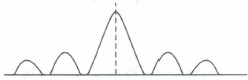
(i) Obtain the conditions for the formation of central maximum and secondary maxima and the minima.
(ii) Why is there significant fall in intensity of the secondary maxima compared to the central maximum, where as in double slit experiment all the bright fringes are of the same intensity?
(iii) When the width of the slit is made double the original width, how is the size of the central band affected?
2.
Identify the type of waves which are produced by the following way and write one application for each:
(i) Radioactive decay of the nucleus.
(ii) Rapid acceleration and decelerations of electrons in aerials.
(iii) Bombarding a metal target by high energy electrons.
3.
Use Lenz’s law to determine the direction of induced current in the situations described by Fig.
(a) A wire of irregular shape turning into a circular shape;
(b) A circular loop being deformed into a narrow straight wire

4.
A jar of height is filled with a transparent liquid of refractive index \(\mu \)(figure). At the centre of the jar on the bottom surface is a dot. Find the minimum diameter of a disc, such that when placed on the top surface symmetrically about the centre, the dot is invisible.

The problem is based on the principle of total inter reflection and area of visibility.
5.
In the given figure, a bar magnet is quickly moved towards a conducting loop having a capacitor. Predict the polarity of the plates A and B of the capacitor.

6.
(i) State Faraday's law of electromagnetic induction.
(ii) A jet plane is travelling west at the speed of 1800 km/h. What is the voltage difference developed between the ends of the wing 25m long, if the earth's magnetic field at the location has a magnitude of 5.0\(\times\)10-4 T and the dip angle is \({ 30 }^{ \circ }\)?
7.
Fig (a) and (b) show refraction of a ray in air incident at with the normal to a \({ 60 }^{ \circ }\) glass in air and water-air interface respectively. Predict the angle of refraction in glass when the angle of incidence in water at \({ 45 }^{ \circ }\) with the normal to a water-glass interface
-Q.png)
-Q.png)
-Q.png)
8.
Define the resolving power of a telescope. Write any two advantages of a reflecting telescope over a refracting telescope.
9.
State Brewster's law. The value of Brewster angle for a transparent medium is different for light of different colours. Give reason.
10.
Which part of the electromagnetic spectrum is used in satellite communication?
11.
Figure shows a ray of light passing through a prism. If the refracted ray QR is parallel to the base BC, show that (i) r1 = r2 = A/2, (ii) angle of minimum deviation, D or Dm = 2i -A.
.jpg)
12.
Widths of two slits in Young's experiment are in the ratio 4:1.What is the ratio of the amplitudes of light waves from them?
13.
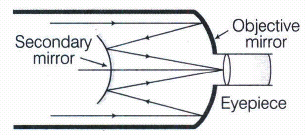
A Cassegrain telescope uses two mirrors as shown in the figure. Such a telescope is built with the mirrors 20mm apart. If the radius of curvature of large mirror is 220mm and the small mirror is 140 mm, where will the final image of an object at infinity be?
14.
A power transmission line feeds input power at 2300 V to a step-down transformer with its primary windings having 4000 turns. What should be the number of turns in the secondary in order to get output power at 230 V?
15.
Name the electromagnetic waves used for the following and arrange them in increasing order of their penetrating power:
(a) water purification
(b) remote sensing
(c) treatment of cancer
16.
An electrical element X when connected to an alternating voltage source has current through it leading the voltage by \(\pi /2\) radian. Identify X and write an expression for its reactance.
17.
Write down Maxwell's equation for the steady electric field.
18.
Which of the following combinations should be selected for better tuning of an LCR circuit used for communication?
R = 20\(\Omega \), L = 1.5H, C = 35\(\mu\)F
R = 25\(\Omega \), L = 2.5H, C = 45\(\mu\)F
R = 15\(\Omega \), L = 3.5H, C = 30\(\mu\)F
R = 25\(\Omega \), L = 1.5H, C = 45\(\mu\)F
19.
A telescope uses an objective lens of focal length \(f_{ 0 }\) and an eye lens of focal length \(f_{ e }\). In normal adjustment, distance between the two lenses is
\(f_{ o }/f_{ e }\)
\(f_{ e }/f_{ o }\)
\((f_{ o }-f_{ e })\)
\((f_{ o }+f_{ e })\)
20.
The correct formula for magnifying power of a simple microscope is
\(m=\left( 1+\frac { f }{ d } \right) \)
\(m=\left( 1-\frac { d }{ f } \right) \)
\(m=\left( 1+\frac { d }{ f } \right) \)
\(m=\left( 1-\frac { f }{ d } \right) \)
21.
Optical fibres are based on the phenomenon of
reflection
refraction
dispersion
total internal reflection
22.
Which one of the following phenomena confirms that light waves are transverse?
interference
diffraction
dispersion
polarization
23.
Polarizing angle for a medium is \(60°\) . Its refractive index is
1.732
1
1.414
2
24.
The alternating current from a source is represented by I = 0.5 sin 314t. The frequency of a.c. is
314 Hz
100 Hz
50 Hz
zero
25.
If \({ \mu }_{ 0 },{ \mu }_{ r },{ \epsilon }_{ 0 }and{ { \epsilon }_{ r } }\) as the absolute permeability relative permeability, absolute permittivity and relative permittivity of the medium, then the velocity of electromagnetic wave in a medium is
\(\frac { 1 }{ \sqrt { { \mu }_{ 0 }{ \epsilon }_{ 0 } } } \)
\(\frac { 1 }{ \sqrt { { \mu }_{ r }{ \epsilon }_{ r } } } \)
\(\frac { 1 }{ \sqrt { { \mu }_{ 0 }{ \epsilon }_{ 0 }{ \mu }_{ r }{ \epsilon }_{ r } } } \)
\(\sqrt { \frac { { \mu }_{ r }{ \epsilon }_{ r } }{ { \mu }_{ 0 }{ \epsilon }_{ 0 } } } \)
26.
Out of the following, choose the correct relation
1henry = \(\frac{1\ volt}{1\ ampere}\)
1henry = \(\frac{1\ amp}{1\ volt}\)
1 henry = \(\frac{1volt}{1\ amp/sec}\)
1 henry = \(\frac{1volt}{1\ amp\ .\ sec}\)
27.
The waves used in Telecommunications are
infrared
ultraviolet
microwaves
cosmic rays
28.
In a compound microscope, the objective lens and............are................ .
29.
An a.c. generator is based on the phenomenon of................................. .
30.
For total internal reflection, light must travel..............to.............. .
31.
In an a.c. circuit containing R only......................and.......................are in.........................phase.
32.
Lenz's law is..............with the law...................... .
33.
(a) Draw a ray diagram showing the image formation by a compound microscope. Obtain expression for total magnification when the image is formed at infinity.
(b) How does the resolving power of a compound microscope get affected, when
(i) focal length of the objective is decreased.
(ii) the wavelength of light is increased? Give reasons to justify your answer.
34.
(a) In Young's double slit experiment, describe briefly how bright and dark fringes are obtained
on the screen kept in front of a double slit. Hence obtain the expression for the fringe width.
(b) The ratio of the intensities at minima to the maxima in the Young's double slit experiment is 9 : 25. Find the ratio of the width of the slits
1.
The phenomenon observed is the phenomenon of diffraction
(i) At the cental maxima The contributions due to the secondary wavelets, frotn all parts of the wave front (at the slit), arrive in phase at the central maxima \(\theta\) = a
At the secondary maxima
It is only the contributions from (nearly) 1/3 (or 1/5, or 117,...) of the secondary maxima. These occur at points for which
\(\theta\cong \left(n+{1\over2}\right){\lambda\over a}(n=0,1,2,3,...)\)
At the minima
The contribution, from 'corresponding pairs', of the sub-parts of the incident wavefront, cancel each other and the net contribution, at the location of the minima, is zero. The minima occur at points for which \(\theta=n{\lambda\over a}(n=1,2,3,...)\)
(ii) There is a significant fall in intensity at the secondary maxima because the intensity there, is only due to the contribution of (nearly)(1/3 or 1/5 or 1/7,......) of the incident wavefronts.
(iii) The size of the central maxima would get halved when width of the slit is doubled.
2.
| S.No | Type of Wave | Application |
| (i) | Gamma rays | Treatment of tumors |
| (ii) | Radio waves | Radio and television Communication system |
| (iii) | X-rays | Study of crystals |
3.
(i) Here, the direction of magnetic field is perpendicularly inwards to the plane of paper. If a wire of irregular shape turns into a circular shape, then its area increases (\(\because \) the circular loop has greater area than the loop of irregular shape) so that, the magnetic flux linked also increases. Now, the induced current is produced in a direction such that it decreases the magnetic field [i.e. the current will flow in such a direction, so that the wire forming the loop is pulled inward in all directions (to decrease the area)], i.e current is in anti-clockwise direction, ie. along adcba.
(ii) When a circular loop deforms into a narrow straight wire, the magnetic flux linked with it also decreases. The current induced due to change in flux will flow in such a direction that it will oppose the decrease in magnetic flux, so it will flow anti-clockwise, i.e along adcba due to which the magnetic field produced will be out of the plane of paper.
4.
Let d be the diameter of the disc. The sopt shall be invisible, if the incident rays OA and OB suffer total internal reflection.
Let i be the angle of incidence

Using relationship between refractive index and critical angle, then
\(\sin { i=\frac { 1 }{ \mu } }\)
Using geometry and trigonometry,
Now,
\(\frac { d/2 }{ h } =\tan { i } \Rightarrow \frac { d }{ 2 } =h\tan { i } =h[\sqrt { { \mu }^{ 2 }-1{ ] }^{ -1 } }\)
\( [\because \ From \ the \ figure,\ tani=\frac { 1 }{ \sqrt { { \mu }^{ 2 } } -1 } ]\)
\( d=\frac { 2h }{ \sqrt { { \mu }^{ 2 } } -1 } \)
This is required expression of d.
5.
Since the North pole of the bar magnet is approachng the loop, therefore the induced current wall flow in such a way that when loop viewed from left side. it will behave like a north pole and when viewed from right side, it will behave like a South pole. So, the flow of induced current in the loop will be clockwise. Hence, A acquires positive polarity and B acquires negative polarity.
6.
(i) For statement of Faraday's law of electromagnetic induction
(ii) v = 1800 km/h = \(1800\times \frac { 5 }{ 18 } \) m/s = 500 m/s, e = ?, l = 25m,
R = 5.0 \(\times\)10-4 T and \(\delta ={ 30 }^{ \circ }\)
e = Blv = Vlv , where V is vertical component of earth's field
= (R sin \(\delta \))lv = 5.0\(\times\)10-4 \(\times\) \(sin\ { 30 }^{ \circ }\) \(\times\) 25 \(\times\) 500 = 3.1 volt
7.
\(First\ case,\)
\(angle \ of \ incidence \ i={ 60 }^{ \circ }\)
\(angle \ of \ refraction \ r={ 35 }^{ \circ }\)
\({ \alpha }_{ { \mu }_{ g } }= \ \frac { 1 }{ { g }_{ { \mu }_{ \alpha } } } =\frac { sin\ i }{ sin \ r } \)
\(Second \ case,\)
\( { \alpha }_{ { \mu }_{ \omega } }=\frac { sin\ { 60 }^{ \circ } }{ sin\ { 47 }^{ \circ } } =1.18\)
\( { \omega }_{ { \mu }_{ g } }= { \alpha }_{ { \mu }_{ g } }\times { \omega }_{ { \mu }_{ \alpha } }\)
\(=\frac { { \alpha }_{ { \mu }_{ g } } }{ { \alpha }_{ { \mu }_{ \omega } } } =\frac { 1.51 }{ 1.18 } =1.28\)
\(Third \ case,\)
\( angle \ of \ incidence \ i={ 45 }^{ \circ }\)
\( angle \ of \ refraction \ r=?\)
\( { \omega }_{ { \mu }_{ g } }=\frac { sin\ i }{ sin\ r } \)
\(\frac { sin \ i }{ sin\ r } =1.28\)
\(sin \ r=\frac { sin \ { 45 }^{ \circ } }{ 1.28 } =0.5525\)
\( sin \ r= \ sin{ 33 }^{ \circ }54'\)
\(r= \ { 33 }^{ \circ }54'\)
8.
Resolving power of a microscope is defined as the reciprocal of its limit of resolution (d) i.e.
RP of microscope = 1/d
where, limit of resolution is equal to the smallest distance between two closest objects whose vivid or clean image can be seen through the
microscope and given by d = \(\frac { \lambda }{ 2\mu sin\theta } \)
Resolving power of microscope = \(\frac { 2\mu sin\theta }{ \lambda } \)
where, \(\lambda \) = wavelength of light used,
\(\theta =\) semivertical angle of the cone formed by object
at objective and \(\mu \) = refractive index of molecule between object and lens.
(a) Resolving power increases with the increase of \(\mu \)
(b) Resolving power decreases as resolving power \(\propto 1/\lambda \)
9.
According to Brewster's law, when a light ray fall on a surface of transparent medium in such a way that reflected ray is perpendicular to the refracted ray, the reflected ray is a totally polarised ray. The angle of incidence, in this case, is 'called Brewster's angle iB.
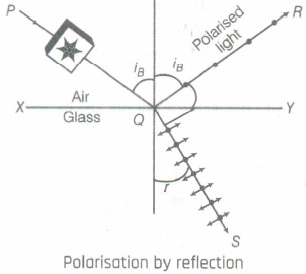
The tangent of the polarising angle of incidence of a transparent medium is equal to its refractive index, i.e., \({ \mu }_{ 1 }=\tan { \left( { i }_{ B } \right) } \)
\(\therefore\) Brewster's angle \({ i }_{ B }=\tan ^{ -1 }{ { \mu } } \)
As we have seen, the value of iB depends on the refractive index of the medium and the refractive index of a medium depends on the wavelength of incident light. Thus, the value of iB will different for different colours of light (i.e. wavelength of light)
10.
Short radio waves \(\lambda>01 \mathrm{~m} \text { or } \mathrm{v}<3 \times 10^9 \mathrm{~Hz}\) are used in satellite communication.
11.
(i) From given figure, A = r1 + r2
As ray QR is parallel to the base BC, then
Therefore, 2r1(or 2r2) = A(ii) D = x + y, r1 = r2 = A/2
D = (i - r1) + (e - r2)
D = (i + e) - (r1 + r2)
D = 2i - A
12.
We know that \(\frac{W_{1}}{W_{2}}=\frac{I_{1}}{I_{2}}=\frac{a^{2}}{b^{2}}=\frac{4}{1} \Rightarrow \frac{a}{b}=2: 1\)
13.
Radius of curvature of objectrive mirror,
R1 = 220 mm
\({ f }_{ 1 }=\frac { { R }_{ 1 } }{ 2 } =\frac { 220 }{ 2 } =110 \ mm\)
Radius of curvature of secondary mirrors, R2 = 140 mm
\({ f }_{ 2 }=\frac { { R }_{ 2 } }{ 2 } =\frac { 140 }{ 2 } =70 \ mm\)
Distance between two mirrors, d = 20 mm from objective mirror.
Now, for secondary mirror, u = f1 - d = 110 - 20
= 90 mm
From mirror formula,
\(\frac { 1 }{ v } +\frac { 1 }{ u } =\frac { 1 }{ { f }_{ 2 } } \Longrightarrow \frac { 1 }{ v } =\frac { 1 }{ { f }_{ 2 } } -\frac { 1 }{ u } \)
\( =\frac { 1 }{ 70 } -\frac { 1 }{ 90 } \Longrightarrow v=\frac { 630 }{ 2 } =315\ mm\)
i.i., final image will be at 31.5 cm to the right of secondary mirror.
14.
Given, primary voltage, Vp = 2300 V
Secondary voltage, Vs = 230V
Primary turns, Np = 4000 turns
Her, we assume that the transformer is ideal. No power loss in the form of heat, etc.,
Using the formula, \(\frac { { V }_{ s } }{ { V }_{ p } } =\frac { N_{ s } }{ N_{ p } } or\frac { 230 }{ 2300 } =\frac { { N }_{ s } }{ 4000 } \)
\({ N }_{ s }=400\)
15.
(a) For water purification, ultraviolet rays are used
(b) For remote sensing, microwaves are used
(c) For treatment of cancer, Gamma rays are used order of their penetrating power of these radiations microwaves.
16.
As current through element X leads the alternating voltage applied by \(\pi /2\) radian, therefore X is a pure capacitance. Its reactance is \(X_C=\frac{1}{\omega C}=\frac{1}{2 \pi v C} .\)
17.
\(\text { (i) } \oint_s \vec{E} \cdot \overrightarrow{d s}=\frac{q}{\epsilon_0}\)
\(\text { (ii) } \oint \vec{E} \cdot \overrightarrow{d t}=0\)
18.
(c)
R = 15\(\Omega \), L = 3.5H, C = 30\(\mu\)F
19.
(d)
\((f_{ o }+f_{ e })\)
20.
(c)
\(m=\left( 1+\frac { d }{ f } \right) \)
21.
(d)
total internal reflection
22.
(d)
polarization
23.
(a)
1.732
24.
(c)
50 Hz
25.
(c)
\(\frac { 1 }{ \sqrt { { \mu }_{ 0 }{ \epsilon }_{ 0 }{ \mu }_{ r }{ \epsilon }_{ r } } } \)
26.
(c)
1 henry = \(\frac{1volt}{1\ amp/sec}\)
27.
(c)
microwaves
28.
()
eye lens ; fixed distance apart.
29.
()
electromagnetic induction
30.
()
from denser medium ; rarer medium
31.
()
alternating current; alternating voltage; same
32.
()
in accordance; of conservation of energy.
33.
(a) The ray diagram, showing image formation by a compound microscope, is given below:
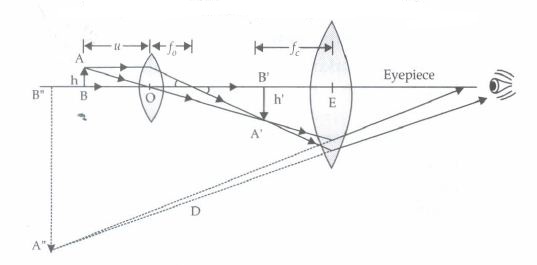
Linear magnification due to the objective = \(=\frac { h^{ ' } }{ h } =\frac { L }{ f_{ 0 } } \)
\(\left( \therefore tan\beta =\frac { h }{ f_{ 0 } } =\frac { h^{ ' } }{ L } \right) \)
Here, L = tube length = distance between the second focal point of the objective and the first focal point of the eyepiece.
When the final image is formed at infinity, the angular magnification due to the eyepiece equals
\(\frac { D }{ f_{ e } } \) (D = least distance of distinct vision)
\(\therefore \) Total magnification when the final image is formed
at infinity = \(\left( \frac { L }{ f_{ 0 } } ,\frac { D }{ f_{ e } } \right) \)
(b) Resolving power increases when the focal length of the objective is decreased.
(i) This is because the minimum separation \(d_{ min }\left( =\frac { 1.22f\lambda }{ D } \right) \) decreases when f is decreased
(ii) Resolving power decreases when the wavelength of light is increased.
This is because the minimum separation, \(d_{ min }\left( =\frac { 1.22f\lambda }{ d } \right) \) increases when \(\lambda \) is increased.
34.
(a) The light rays from the two (coherent) slits, reaching a point 'P' on the screen, have a path
difference (S2P - S1P). The point 'P' would, therefore be a
(i) Point of maxima (bright fringe), If
S2P - S1P = n\(\lambda\) .
(ii) Point of minima (dark fringle), If
S2P- S1P = (2n + 1) \(\lambda\)/2
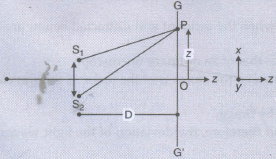
We have (S2P)2- (S1P)2
\(=\left\{D^2-\left(x+{d\over2}\right)^2\right\}-\left\{D^2+\left(x-{d\over2}\right)^2\right\}\)
= 2 xd
\(S_2P-S_1P={2xd\over S_3P+S_1P}={2xd\over 2D}={xd\over D}\)
We have maxima at point, where
\({xd\over D}=n\lambda\)
and minima at points where
\({xd\over D}=\left(2n+1\over 2\right)\lambda\)
Now, fringe width \(\beta\) = separation between two successive maxima (or two successaive minima)
= xn - xn-1
\(\beta={\lambda D\over d}\)
(b) We have \({I_{max}\over {I_{min}}}={(a_1+a_2)^2\over (a_1-a_2)^2}={25\over 9}\)
\(\therefore\ \ {a_1+a_2\over a_1-a_2}={5\over 3}\Rightarrow{a_1\over a_2}={4\over 1}\)
\(\therefore\ {W_1\over W_2}={I_1\over I_2}={(a_1)^2\over (a_2)^2}={16\over 1}\)

12th Standard CBSE Syllabus & Materials
12th Standard CBSE
CBSE 12th Computer Science Python Revision Tour I - New Previous year Question Papers Study Material - QB365 Set A
NEW12th Standard CBSE
CBSE 12th Business Studies Planning Important Questions And Answers Study Material - QB365 Set A
NEW12th Standard CBSE
CBSE 12th Business Studies Business Environment Important Questions And Answers Study Material - QB365 Set A
NEW12th Standard CBSE
CBSE 12th Business Studies Principles of Management Important Questions And Answers Study Material - QB365 Set A



NCERT Books

Syllabus

Exam Pattern

Sample Question Papers

Previous year Question Papers

Important Notes

MCQ Practice test

NCERT Exemplers

Case study Questions

Image Based Questions

Passage based Questions

HOT Questions

Value Based Questions

Model Questions Papers
NCERT ( Book Back ) Questions

Assertion and Reason
Important Questions And Answers

CBSE 12th Standard CBSE Subjects
CBSE Standards








