
12th Standard CBSE Syllabus & Materials
12th Standard CBSE
CBSE 12th Economics Government Budget and the Economy Previous year Question Papers Study Material - QB365 Set A
NEW12th Standard CBSE
CBSE 12th Computer Science Interface Python with MySQL - New Previous year Question Papers Study Material - QB365 Set A
NEW12th Standard CBSE
CBSE 12th Computer Science Database Concept - New Previous year Question Papers Study Material - QB365 Set A
NEW12th Standard CBSE
CBSE 12th Computer Science Data Communication - New Previous year Question Papers Study Material - QB365 Set A
NEW12th Standard CBSE
CBSE 12th Computer Science Data Structures - New Previous year Question Papers Study Material - QB365 Set A
NEW12th Standard CBSE
CBSE 12th Computer Science Functions - New Previous year Question Papers Study Material - QB365 Set A

Published on: 20/08/2026
Download CBSE Class 12th Standard CBSE Physics question papers, sample papers, important questions, and previous year solved papers in PDF format. Get free study materials, NCERT solutions, and exam preparation resources for Class 12th Standard CBSE Physics
Questions + Answers key
Take MCQ Physics Test
1.
An AC generator consists of coil of 100 turns and cross-sectional area of 3 m2, rotating at a constant angular speed of 60 rad s-1 in a uniform magnetic field 0.04 T. The resistance of the coil is 500\(\Omega\). Calculate
(i) maximum current drawn from the generator and
(ii) minimum power dissipation of the coil.
2.
What will happen, if the field were not uniform?
3.
(i) Depict the equipotential surfaces for a system of two identical positive point charges placed a distance d apart.
(ii) Deduce the expression for the potential energy of a system of two point charges
q1 and q2 brought from infinity to the points with positions r1 and r2 respectively, in presence of external electric field E.
4.
What is the magnetic flux through each turn of a solenoid of self inductance \(8.0 \times { 10 }^{ -5 }H,\) when a current of 3.0 A flows through it? Assume that the solenoid has 1000 turns and is wound from wire of diameter 1.0 mm. What is the cross sectional area of the solenoid?
5.
A solenoid of length 0.20 m, having 120 turns carries a current of 2.5 A. Find the magnetic field: (a) in the interior of the solenoid, (b) at one end of the solenoid. Given \({ \mu }_{ o }=4\pi \times { 10 }^{ -7 }\) S.I. units.
6.
For a given AC, i = im sin \(\omega t\) , show that the average power dissipated in a resistor R over a complete cycle is \({{1}\over{2}}{ i }_{ m }^{ 2 }R.\)A light bulb is rated at 100W for a 220V supply. Find
(a) the resistance of the bulb;
(b) the peak voltage of the source; and
(c) the rms current through the bulb.
7.
The relaxation time \(\tau \) is nearly independent of applied E field whereas it changes significantly with temperature T. First fact is responsible for Ohm's law whereas the second fact lends to variation of \(\rho \) with temperature. Elaborate why?
8.
A silver wire has a resistance of 2.1\(\Omega\) at 27.5oC and a resistance of 2.7\(\Omega\) at 100oC. Determine the temperature coefficient of resistivity of silver.
9.
(i) The emf of a cell is always greater than its terminal voltage. Why? Give reason.
(ii) Plot a graph showing the variation of terminal potential difference across a cell of emf E and internal resistance r with current drawn from it. Using this graph, how does one determine the emf of the cell?
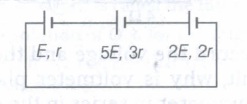
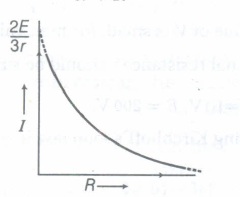
(iii) Three cells of emf E, 2E and 5E having internal resistances r, 2r and 3r, variable resistance R as shown in the figure. Find the expression for the current. Plot a graph for variation of current with R.
10.
A resistor of 400 0, an inductor of 5/ \(\pi\)H and a capactor of \(\frac{50}{\pi} \mu \mathrm{F}\) are connected in series across a source of alternating voltage of 140 sin 100 \(\pi t V\) Find the voltage (rms) across the resistor, the inductor and the capacitor. Is the algebraic sum of these voltage more than the source voltage? If yes, resolve the paradox.
11.
A device X is connected across an AC source of voltage V = V0 sin \(\omega\)t. The current through X is given as \(I=I_{0} \sin \left(\omega t+\frac{\pi}{2}\right)\)
(a) Identify the device X and write the expression for its reactance.
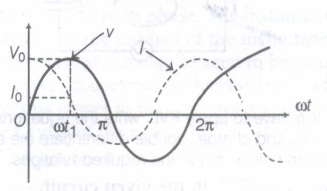
(b) Draw graphs showing variation of voltage and current with time over one cycle of AC, for X.
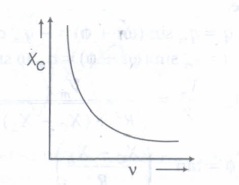
(c) How does the reactance of the device X vary with frequency of the AC? Show this variation graphically.
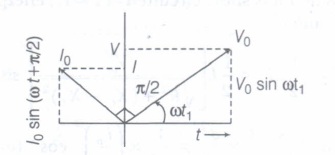
(d) Draw the phasor diagram for the device X.
12.
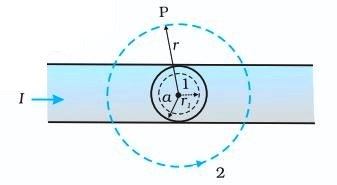
Figure shows a long straight wire of a circular cross-section of (radius a) carrying steady current I. The current I is uniformly distributed across this cross-section. Calculate the magnetic field in the region r < a and r > a.
13.
State Biot-Savart law giving the mathematical expression for it. Use this law to derive the expression. Use this law to derive the expression for the magnetic field due to a circular coil carrying current at a point along its axis. How does a circular loop carrying current behave as a magnet?
14.
A storage battery of emf 8.0 V and internal resistance 0.5 \(\Omega\) is being charged by a 120V dc supply using a series resistor of 15.5 \(\Omega\). What is the terminal voltage of the battery during charging? What is the purpose of having a series resistor in the charging circuit?
15.
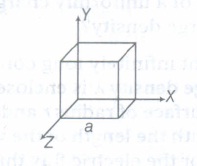
Given the electric field in the region E = 2x\(\hat i\), find the net electric flux through the cube and the charge enclosed by it.
16.
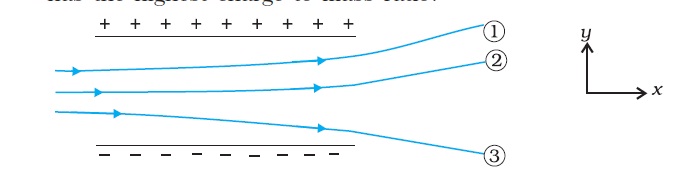
The Figure shows tracks of three charged particles in a uniform electrostatic field. Give the signs of the three charges. Which particle has the highest charge to mass ratio?
17.
Two Capacitors of capacitace 6\(\mu \)F and 12\(\mu \)F ae connnected in series with tha battery the volatage across the 6\(\mu \)F capacitor is 2 volt, Compute the total battery voltage.
18.
A magnetic dipole is situated in the direction of a magnetic field. What is its potential energy ? If it is rotated by 180o , then what amount of work will be done?
19.
Define the term 'drift velocity' of charge carriers in a conductor and write its relationship with the current flowing through it.
20.
A 12pF capacitor is connected to a 50V battery. How much electrostatic energy is stored in the capacitor?
21.
If a ferromagnetic material is inserted in a current carrying solenoid, the magnetic field of solenoid
largely increases
slightly increases.
largely decreases
slightly decreases
22.
A rectangular loop carrying a current i is situated near a long straight wire such that the wire is parallel to the one of the sides of the loop and is in the plane of the loop. If a steady current I is established in wire as shown in figure, the loop will
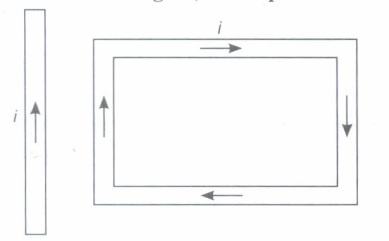
rotate about an axis parallel to the wire.
move away from the wire or towards right
move towards the wire
remain stationary.
23.
For a cell, the graph between the potential difference (V) across the terminals of the cell and the current (I) drawn from the cell is shown in the figure.
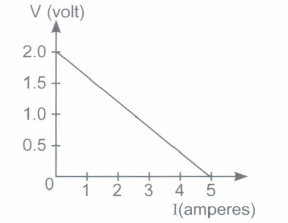
\(2 \mathrm{~V}, 0.5 \Omega\)
\(2 \mathrm{~V}, 0.4 \Omega\)
\(>2 \mathbf{V}, \mathbf{0 . 5} \Omega\)
\(>2 \mathbf{V}, \mathbf{0 . 4} \Omega\)
24.
The electric field inside a spherical shell of uniform surface charge density is
zero.
constant, less than zero.
directly proportional to the distance from the centre.
none of the these
25.
Which of the following draws no current from the voltage source being measured?
Meter bridge
Wheatstone bridge
Potentiometer
None of these
26.
A magnetic field can be produced
only by moving charge
only by changing electric field
Both (a) and (b)
None of the above
27.
If an AC main supply is given to be 220 V. What would be the average emf during a positive half-cycle?
198 V
386 V
256 V
None of these
28.
A 50 turns circular coil has a radius of 3 cm, it is kept in a magnetic field acting normal to the area of the coil. The magnetic field B increased from 0.10 T to 0.35 T in 2 ms-1, The average induced emf in the coil is
1.77V
17.7V
177V
0.177V
29.
If the rms current in a 50 Hz AC circuit is 5 A, the value of the current 1/300 s after its value becomes zero is
5\(\sqrt{2} A\)
5\(\sqrt{3/2}\) A
5 / 6 A
5 / \(\sqrt{2} A\)
30.
What is the angle between the electric dipole moment and the electric field strength due to it on the equatorial line?
0o
90o
180o
None of these
31.
What happens when charge is placed on a soap bubble?
It collapses
Its radius increases
Its radius decreases
None of the above
32.
Amount of charge induced in a circuit of resistance R is given by
\(dQ=(d\phi )\times R\)
\(dQ=\frac { d\phi }{ R } \)
\(dQ={ R }^{ 2 }d\phi \)
\(dQ=\frac { d\phi }{ R^{ 2 } } \)
33.
(a) If both Assertion and Reason are correct and the Reason is a correct explanation of the Assertion.
(b) If both Assertion and Reason are correct but Reason is not a correct explanation of the Assertion.
(c) If the Assertion is correct but Reason is incorrect.
(d) If both the Assertion and Reason are incorrect.
34.
Assertion (A) Diamagnetic substances exhibit magnetism.
Reason (R) Diamagnetic materials do not have permanent magnetic dipole moment.
(a) Both Assertion and Reason are true and Reason is the correct explanation of Assertion.
(b) Both Assertion and Reason are true but Reason is not the correct explanation of Assertion.
(c) Assertion is true but Reason is false.
(d) Assertion is false but Reason is true
35.
Assertion (A) : When the capacitor is connected to an AC source, it limits or regulates the current, but does not completely prevent the flow of charge.
Reason (R) : The capacitor is alternately charged and discharged as the current reverses each half-cycle.
(a) Both Assertion and Reason are true and Reason is the correct explanation of Assertion.
(b) Both Assertion and Reason are true but Reason is not the correct explanation of Assertion.
(c) Assertion is true but Reason is false.
(d) Assertion is false but Reason is true.
36.
Assertion (A) : The microwaves are better carriers of signals than radio waves.
Reason (R) : The electromagnetic waves do not required any material medium for propagation.
Codes:
(a) Both A and R are true and R is the correct explanation of A
(b) Both A and R are true but R is NOT the correct explanation of A
(c) A is true but R is false
(d) A is false and R is also false
37.
38.
Electrostatic Potential and Capacitance, explores the concepts of electric potential energy, electric potential, and capacitance. The electric potential at a point in an electric field is the amount of work done per unit charge in bringing a positive test charge from infinity to that point against the electric force. It’s important to note that the potential energy of a system of charges is defined as the work done in assembling the system of charges from infinity. The chapter further introduces the concept of capacitance. A capacitor is a device that stores electrical energy in an electric field. It’s essentially a system of two conductors separated by an insulator, and its capacitance is the ratio of the amount of charge stored on one conductor to the potential difference between the conductors.
1.What is the electric potential at a point in an electric field?
A) The amount of work done per unit charge in bringing a negative test charge from infinity to that point.
B) The amount of work done per unit charge in bringing a positive test charge from infinity to that point.
C) The force experienced by a unit positive charge at that point.
D) The force experienced by a unit negative charge at that point.
2.How is the potential energy of a system of charges defined?
A) As the work done in disassembling the system of charges to infinity.
B) As the work done in assembling the system of charges from infinity.
C) As the force experienced by the system of charges.
D) As the amount of charge in the system.
3.What is a capacitor?
A) A device that measures the potential difference between two points.
B) A device that measures the amount of charge in an electric field.
C) A device that stores electrical energy in an electric field.
D) A device that converts electrical energy into mechanical energy.
4.What is the capacitance of a capacitor?
A) The ratio of the potential difference between the conductors to the amount of charge stored on one conductor.
B) The ratio of the amount of charge stored on one conductor to the potential difference between the conductors.
C) The total amount of charge stored on the conductors.
D) The potential difference between the conductors.
5.What does a capacitor essentially consist of?
A) Two conductors separated by an insulator.
B) Two insulators separated by a conductor.
C) A single conductor surrounded by an insulator.
D) A single insulator surrounded by a conductor.
1.
Here, total number of turns,
\(N=100, A=3 \mathrm{~m}^{2}, \omega=60 \mathrm{rads}^{-1}, B=0.04 \mathrm{~T}\)
(i) Maximum emf produced in the coil,
\(e_{0}=N B A \omega=100 \times 0.04 \times 3 \times 60\)
\(e_{0}=720 \mathrm{~V}\)
Since, resistance of the coil is 500\(\Omega\), the maximum current drawn from the generator is
\(I_{0}=\frac{e_{0}}{R}=\frac{720}{500}=1.44 \mathrm{~A}\)
(ii) Maximum power dissipation in the coil
\(P=e_{0} I_{0}=720 \times 1.44=1036.8 \mathrm{~W}\)
2.
If the field is non-uniform, the net force will be non-zero.
3.
(i) The figure is shown as below :1
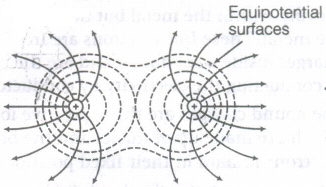
equipotential surfaces of two identical positive charges
(ii) By definition, electric potential energy of any charge q placed in the region of electric field is equal to the work done in bringing charge q from infinity to that point and given by
U = qV
where, V is the electric potential (as potential at infinity is assumed to be zero) where, the charge q is placed. Now, considering the electric potentials at positions r1 and r2 as V1 and V2
respectively. Therefore, total potential energy of the system of two charges q1 and q2 placed at points with position vectors r1 and r2 in the region of E is given by U = work done in bringing charge q from infinity to that position in E is equal to work done for charge q2 from infinity to that position in E + work done to that of charge q2 at these positions in presence of q1.
\({ U }={ q }_{ 1 }{ V }_{ 1 }+{ q }_{ 2 }{ V }_{ 2 }\Rightarrow U=\frac { 1 }{ 4\pi { \varepsilon }_{ 0 } } .\frac { { q }_{ 1 }{ q }_{ 2 } }{ \left| { r }_{ 2 }-{ r }_{ 1 } \right| } \)
4.
\(2.4 \times { 10 }^{ -7 }Wb;6.37 \times { 10 }^{ -5 }{ m }^{ 2 }\)
5.
\((i) \ B={ \mu }_{ o }\frac { NI }{ l } ;\)
\( here,l=0.20 \ m;N=120;I=2.5A\)
\( (ii) \ B=\frac { { \mu }_{ o }NI }{ 2l } \)
6.
\(Given \ P=100W, \ V=220V\)
\((a) \ R=\frac { V^{ 2 } }{ P } =\frac { { \left( 220 \right) }^{ 2 } }{ 100 } =484\Omega \)
\((b) \ { E }_{ 0 }=\sqrt { 2 } { E }_{ v }=\sqrt { 2 } \times 220=311V\)
\((c) \ I=\frac { P }{ V } =\frac { 100 }{ 220 } =0.45A\)
The average power dissipated,
P = (i2R) = (\({ i }_{ m }^{ 2 } \)R sin2 \(\omega t\) ) = \({ i }_{ m }^{ 2 }R({sin}^{2}\omega t)\)
\(\because\) \({sin}^{2}\omega t = {{1}\over{2}}(1-cos\ 2\omega t)\)
\(\therefore\) \(({sin}^{2}\ \omega t)={{1}\over{2}}[1-(cos\ 2\omega t)]={{1}\over{2}}\) \((\because \ cos\ 2\omega t=0)\)
\(\therefore\) \(\bar{P}={{1}\over{2}}{ i }_{ m }^{ 2 }R\)
7.
Relaxation time is inversely proportional to the velocities of electrons and ions. The applied electric field produces the insignificant change in velocities of electrons of the order of 1 mm/s, whereas the change in temperature T affects velocities at the order of 102 m/s
This decreases the relaxation time cinsiderably in metals and consequently resistivity of metal or conductor increases as, \(\rho=\frac{1}{\sigma}=\frac{m}{n e^2 \tau}\)
8.
Temperature, T1 = 27.5°C
Resistance of the silver wire at T1, R1 = 2.1 Ω
Temperature, T2 = 100°C
Resistance of the silver wire at T2, R2 = 2.7 Ω
Temperature coefficient of silver = α
It is related with temperature and resistance as
\(\alpha=\frac{R_{2}-R_{1}}{R_{2}\left(T_{2}-T_{1}\right)}\)
\(=\frac{2.7-2.1}{2.1(100-27.5)}=0.0039^{\circ} \mathrm{C}^{-1}\)
Therefore, the temperature coefficient of silver is 0.0039°C−1.
9.
(i) The emf of a cell is greater than its terminal voltage because there is some potential drop across the cell due to its small internal resistance.
(ii) ∵ \(V=\left(\frac{E}{R+r}\right) R=\frac{E}{1+r / R}\)
i.e. with the increase of R, V increases
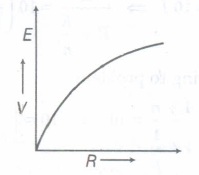
One can determine the emf of cell by finding terminal potential difference when current I becomes zero.
(iii) In these, type of questions, we have to look out the connections of different cells, if the opposite terminals of all the cells are connected, then they support each other, i.e. these individual emfs are added up. If the same terminals of the cells are connected, then the equivalent emf is obtained by taking the difference of emfs. Net emf of combination
= E - 2E + 5E = 4 E
Net resistance of current
= r + 2r + 3r + R = 6r + R
∴ Current, \(I=\frac{V}{R}\) (from Ohm's law)
⇒ \(I=\frac{4 E}{6 r+R}\)
10.
Given, applied voltage, V = 140sin100\(\pi t\) V
\(C=\frac{50}{\pi} \mu \mathrm{F}=\frac{50}{\pi} \times 10^{-6} \mathrm{~F}\)
\(L=\frac{5}{\pi} \mathrm{H}, R=400 \Omega\)
Comparing with V = V0 sin \(\omega\)t, we get
V0 = 140 V and \(\omega\) = 100\(\pi\)
Inductive reactance, \(X_{L}=\omega L=100 \pi \times \frac{5}{\pi}=500 \Omega\)
Capacitive reactance, \(X_{C}=\frac{1}{\omega C}=\frac{1}{100 \pi \times \frac{50}{\pi} \times 10^{-6}}\)
= 200 \(\Omega\)
Impedance of the circuit, \(Z=\sqrt{R^{2}+\left(X_{L}-X_{C}\right)^{2}}\)
\(=\sqrt{(400)^{2}+(500-200)^{2}}\)
\(=\sqrt{160000+90000}=500 \Omega\)
Maximum current in the circuit,
\(I_{0}=\frac{V_{0}}{Z}=\frac{140}{500}\)
\(I_{\mathrm{rms}}=\frac{I_{0}}{\sqrt{2}}=\frac{140}{500 \times \sqrt{2}}=0.2 \mathrm{~A}\)
Vrms across resistor, VR = IrmsR
= 0.2 x 400 = 80V
Vrms across inductor, VL = Irms XL
= 0.2 x 500 = 100V
Vems across capacitor, Vc = Irms XC
= 0.2 x 200 = 40 V
Now, V \(\ne \) VR + VL + VC
Because VC VL and VR are not in same phase, instead
\(V=\sqrt{V_{R}^{2}+\left(V_{L}-V_{C}\right)^{2}}\)
\(=\sqrt{80^{2}+(100-40)^{2}}=100 \mathrm{~V}\)
which is same as that of applied rms voltage.
11.
(a) Given, V = V0 sin \(\omega\)t
\(I=I_{0} \sin \left(\omega t+\frac{\pi}{2}\right)\)
As it is clear that, the current leads the voltage by a phase angle \(\frac{\pi}{2}\)
\(\therefore\)The device X is a capacitor.
(b)
(c) The reactance of the capacitance is given as
\(X_{C}=\frac{1}{\omega C}\)
where, \(\omega\) = angular frequency and C = capacitance of capacitor.
\(\therefore \quad X_{C}=\frac{1}{2 \pi v C}\)
where, V = frequency of AC or XC \(\propto \frac{1}{V}\)
\(\therefore\) The graphical representation between reactance of capacitance and frequency is given as
(d) Phasor diagram
12.
(a) Consider the case r > a. The Amperian loop, labelled 2, is a circle concentric with the cross-section. For this loop,
L = 2 π r
Ie = Current enclosed by the loop = I
The result is the familiar expression for a long straight wire
B (2π r) = μ0I
\(B=\frac{\mu_{0} I}{2 \pi r}\)
\(B \propto \frac{1}{r} \quad(r>a)\)
Now the current enclosed Ie is not I, but is less than this value. Since the current distribution is uniform, the current enclosed is
\(I_{e}=I\left(\frac{\pi r^{2}}{\pi a^{2}}\right)=\frac{I r^{2}}{a^{2}}\)
Using Ampere’s law, \(B(2 \pi r)=\mu_{0} \frac{I r^{2}}{a^{2}}\)
\(B=\left(\frac{\mu_{0} I}{2 \pi a^{2}}\right) r\)
B ∝ r (r < a)
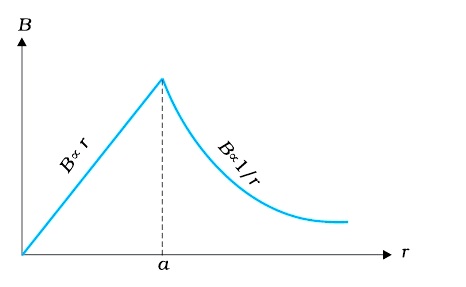
Figure shows a plot of the magnitude of B with distance r from the centre of the wire. The direction of the field is tangential to the respective circular loop (1 or 2) and given by the right-hand rule described earlier in this section.
This example possesses the required symmetry so that Ampere’s law can be applied readily.
13.
Statement for Biot-Savart Law: The magnitude of magnetic field \(d\overrightarrow { B } \) due to current element is directly proportional to the current I, the elements length \(\left| dl \right| \) and inversely proportional to the square of the distance r of the field point. Its direction is perpendicular to the plane containing \(\overrightarrow { dl } \)and \(\overrightarrow{r}\).
\(d\overrightarrow B\alpha\frac{I\overrightarrow dl \times \overrightarrow r}{r^{ 3}}\)
Or \(d\overrightarrow B=\frac {\mu_0}{4 \pi}\frac{I\overrightarrow dl \times \overrightarrow r}{r^{ 3}}\)
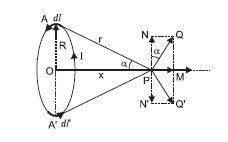
The magnetic field due to \(\overrightarrow {dl}\) is given by Biot Savart law as
\(dB=\frac {\mu_0}{4\pi}.\frac { I\left| \overrightarrow { dl } \times \overrightarrow { r } \right| }{ { r }^{ 3 } } \)
Now dBx= Db Cos \(\theta\) = \(\frac { \mu _{ 0 } }{ 4\pi } .\frac { Idl }{ \left( { x }^{ 2 }+{ R }^{ 2 } \right) } \cos { \theta } \)
\(=\frac { \mu _{ 0 } }{ 4\pi } .\frac { Idl }{ \left( { x }^{ 2 }+{ R }^{ 2 } \right) } \frac { R }{ \left( { x }^{ 2 }+{ R }^{ 2 } \right) ^{ 1/2 } } \)
So, \({ B }_{ x }=\int { dB_{ s }=\frac { { \mu }_{ 0 } }{ 4\pi } } \frac { IR }{ \left( { x }^{ 2 }+{ R }^{ 2 } \right) ^{ 3/2 } } \int { dl } \)
\(=\frac { { \mu }_{ 0 }IR^{ 2 } }{ 2\left( { x }^{ 2 }+{ R }^{ 2 } \right) ^{ 3/2 } } \)
(The y-components, of the field, add up to zero,due to symmetry)
\(\therefore\)Magnetic field at P due to a circular loop
\(=B={ B }_{ x }\overrightarrow { i } =\frac { { \mu }_{ 0 }IR^{ 2 } }{ 2\left( { x }^{ 2 }+{ R }^{ 2 } \right) ^{ 3/2 } } \overrightarrow { i } \)
Explanation: A circular current loop produces magnetic field and its magnetic moment is the product of current and its area \(\overrightarrow M=\overrightarrow {LA}\)
14.
Emf of the storage battery, E = 8.0 V
Internal resistance of the battery, r = 0.5 Ω
DC supply voltage, V = 120 V
Resistance of the resistor, R = 15.5 Ω
Effective voltage in the circuit = V1
R is connected to the storage battery in series. Hence, it can be written as
V1 = V - E
V1 = 120 - 8 = 112 V
Current flowing in the circuit = I, which is given by the relation,
\(I=\frac{V^{1}}{R+r}\)
\(=\frac{112}{15.5+5}=\frac{112}{16}=7 A\)
Voltage across resistor R given by the product, IR = 7 x 15.5 = 108.5 V
DC supply voltage = Terminal voltage of battery + Voltage drop across R
Terminal voltage of battery = 120 - 108.5 = 11.5 V
A series resistor in a charging circuit limits the current drawn from the external source. The current will be extremely high in its absence. This is very dangerous.
15.
Since, the electric field has only x-component, for faces normal to x- direction, the angle between E and \(\triangle\)S is \(\pm \frac{\pi}{2} .\) Therefore, the flux is separately zero for each of the cube except the shaded ones.
The magnitude of the electric field at the left face is
E L = 0 [as x = Oat the left face]
The magnitude of the electric field at the right face is
E R = 3a [as, x = a at the right face]
The corresponding fluxes are
\(\phi_{L}=\mathbf{E}_{L} \cdot \Delta \mathbf{S}=0\)
and \(\phi_{R}=\mathbf{E}_{L} \cdot \Delta \mathbf{S}=E_{R} \Delta S \cos \theta=E_{R} \Delta S\) [\(\because\) \(\theta\)= 0°]
\(\Rightarrow\) \(\phi\)R = ERa2
Net flux (\(\phi\)) through the cube
= \(\phi_L\)L+ \(\phi_R\)
= 0 + E Ra2 = ERa2
\(\Rightarrow\) q = 2a(a)2 = 2a3
We can use Gauss' law to find the total charge q inside the cube
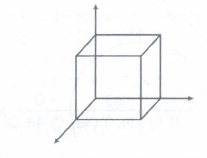
\(\phi=\frac{q}{\varepsilon_{0}} \Rightarrow \phi=\frac{2 a^{3}}{\varepsilon_{0}}\)
16.
Opposite charges attract each other and same charges repel each other. It can be observed that particles 1 and 2 both move towards the positively charged plate and repel away from the negatively charged plate. Hence, these two particles are negatively charged. It can also be observed that particle 3 moves towards the negatively charged plate and repels away from the positively charged plate. Hence, particle 3 is positively charged.
The charge to mass ratio (emf) is directly proportional to the displacement or amount of deflection for a given velocity. Since the deflection of particle 3 is the maximum, it has the highest charge to mass ratio.
17.
V = V1 + V2
Q = C1V = 6 x 10-6 x 2 = 12\(\mu \)C
As C2 is in series same amount of charge will also flow through it now V2 = Q/C2 = (12 x 10-6) /(12 x 10-6) = 1 volt
Total Battery voltage, V = 2 + 1 = 3 Volt
18.
P.E. of dipole = -MB cos 0o = -MB
Work done = MB (cos 0o - cos 180o)
= MB (1+1) = 2 MB.
19.
Drift velocity is the average velocity with which the free electrons get drifted towards the positive end of the conductor under the influence of an external electric field applied.
The relation between current I and drift velocity vd is I = nAevd
Where n is the number density of electrons in a conductor of area of cross-section A and e is the charge on an electron.
20.
Given,
Capacitance of the capacitor, C = 12pF = 12 x 10-12 F
Potential difference, V = 50 V
Electrostatic energy stored in the capacitor is given by the relation,
\(\mathrm{E}=\frac{1}{2} \mathrm{CV}^{2}=\frac{1}{2} \times 12 \times 10^{-12} \mathrm{\times}(50)^{2} \mathrm{~J}=1.5 \times 10^{-8} \mathrm{~J}\)
Therefore, the electrostatic energy stored in the capacitor is 1.5 x 10⁻⁸ J. was disconnected.
21.
(a)
largely increases
22.
(c)
move towards the wire
23.
(b)
\(2 \mathrm{~V}, 0.4 \Omega\)
24.
(a)
zero.
25.
(c)
Potentiometer
26.
(a)
only by moving charge
27.
(a)
198 V
28.
(b)
17.7V
29.
(b)
5\(\sqrt{3/2}\) A
30.
(c)
180o
31.
(b)
Its radius increases
32.
(b)
\(dQ=\frac { d\phi }{ R } \)
33.
34.
(a) Both Assertion and Reason are true and Reason is the correct explanation of Assertion.
35.
(a) Both Assertion and Reason are true and Reason is the correct explanation of Assertion.
36.
(b): Microwaves are the electromagnetic waves of wavelength of the order of a few millimetres, which is less than those of T.V. signals. On account of smaller wavelength, the microwaves can be transmitted as beam signals in a particular direction and are much better than radiowaves because microwaves do not spread or bend around the corners of any obstacle coming in their way. Therefore microwaves are better carriers of signals than radiowaves.
37.
38.
1.B) The amount of work done per unit charge in bringing a positive test charge from infinity to that point.
2.B) As the work done in assembling the system of charges from infinity.
3.C) A device that stores electrical energy in an electric field.
4.B) The ratio of the amount of charge stored on one conductor to the potential difference between the conductors.
5.A) Two conductors separated by an insulator.

12th Standard CBSE Syllabus & Materials
12th Standard CBSE
CBSE 12th Computer Science Python Revision Tour I - New Previous year Question Papers Study Material - QB365 Set A
NEW12th Standard CBSE
CBSE 12th Business Studies Planning Important Questions And Answers Study Material - QB365 Set A
NEW12th Standard CBSE
CBSE 12th Business Studies Business Environment Important Questions And Answers Study Material - QB365 Set A
NEW12th Standard CBSE
CBSE 12th Business Studies Principles of Management Important Questions And Answers Study Material - QB365 Set A



NCERT Books

Syllabus

Exam Pattern

Sample Question Papers

Previous year Question Papers

Important Notes

MCQ Practice test

NCERT Exemplers

Case study Questions

Image Based Questions

Passage based Questions

HOT Questions

Value Based Questions

Model Questions Papers
NCERT ( Book Back ) Questions

Assertion and Reason
Important Questions And Answers

CBSE 12th Standard CBSE Subjects
CBSE Standards








