
12th Standard CBSE Syllabus & Materials
12th Standard CBSE
CBSE 12th Economics Government Budget and the Economy Previous year Question Papers Study Material - QB365 Set A
NEW12th Standard CBSE
CBSE 12th Computer Science Interface Python with MySQL - New Previous year Question Papers Study Material - QB365 Set A
NEW12th Standard CBSE
CBSE 12th Computer Science Database Concept - New Previous year Question Papers Study Material - QB365 Set A
NEW12th Standard CBSE
CBSE 12th Computer Science Data Communication - New Previous year Question Papers Study Material - QB365 Set A
NEW12th Standard CBSE
CBSE 12th Computer Science Data Structures - New Previous year Question Papers Study Material - QB365 Set A
NEW12th Standard CBSE
CBSE 12th Computer Science Functions - New Previous year Question Papers Study Material - QB365 Set A

Published on: 20/08/2026
Download CBSE Class 12th Standard CBSE Physics question papers, sample papers, important questions, and previous year solved papers in PDF format. Get free study materials, NCERT solutions, and exam preparation resources for Class 12th Standard CBSE Physics
Questions + Answers key
Take MCQ Physics Test
1.
The radius of the innermost electron orbit of a hydrogen atom is 5.3 x10⁻¹¹ m. What are the radii of the n = 2 and n = 3 orbits?
2.
Suppose you are given a chance to repeat the alpha-particle scattering experiment using a thin sheet of solid hydrogen in place of the gold foil. (Hydrogen is a solid at temperatures below 14 K.) What results do you expect?
3.
In the Rutherford’s nuclear model of the atom, the nucleus (radius about 10–15 m) is analogous to the sun about which the electron move in orbit (radius \(\approx \) 10–10 m) like the earth orbits around the sun. If the dimensions of the solar system had the same proportions as those of the atom, would the earth be closer to or farther away from the sun than actually it is? The radius of earth’s orbit is about 1.5 x 10¹¹ m. The radius of sun is taken as 7 x 10⁸ m.
4.
When is \({ H }_{ \alpha }\) -line of the Balmer series in the emission spectrum of H-atom obtained?
5.
Imagine removing one election from He4 and He3.Their energy levels, as worked out on the basis of Bohr's model will be very close. Explain why?
6.
How is nuclear size related to its mass number?
7.
Define ionisation energy. How would the ionisation energy change when electron in hydrogen atom is replaced by a particle 200 times heavier than electron, but having the same charge?
8.
Draw the graph showing variation of scattered particles detected (N) with the scattering angle (\(\theta\)) in Geiger-Marsden experiment. Write two conclusions that you can draw from this graph. Obtain the expression for the distance of closest approach in this experiment.
9.
(a) Differentiate between nuclear fission and fusion.
(b) The fission properties of 94Pu239 are very similar to those of 92U235. How much energy (in MeV), is released,if all the atoms in 1 g of pure 94Pu239 undergo fission? The average energy released per fission is 180 MeV.
10.
(a) State Bohr's postulate to define stable orbits in hydrogen atom. How does de-Broglie's hypothesis explain the stability of these orbits?
(b) A hydrogen atom initially in the ground state absorbs a photon which excites it to the n = 4 level. Estimate the frequency of the photon.
11.
(a) The size of the atom in Thomson’s model is ______ the atomic size in Rutherford’s model. (much greater than/no different from/much less than.)
(b) In the ground state of ________ electrons are in stable equilibrium, while in .......... electrons always experience a net force. (Thomson’s model/ Rutherford’s model).
(c) A classical atom based on _________ is doomed to collapse. (Thomson’s model/ Rutherford’s model.
(d) An atom has a nearly continuous mass distribution in a _______ but has a highly non-uniform mass distribution in ______ (Thomson’s model/ Rutherford’s model)
(e) The positively charged part of the atom possesses most of the mass in ________ (Rutherford’s model/both the models.)
12.
According to the classical electromagnetic theory, calculate the initial frequency of the light emitted by the electron revolving around a proton in hydrogen atom.
13.
It is found experimentally that 13.6 eV energy is required to separate a hydrogen atom into a proton and an electron. Compute the orbital radius and the velocity of the electron in a hydrogen atom.
14.
(i) The number of nuclei of a given radioactive sample at time t = 0 and t = T are N0 and N 0/n, respectively. Obtain an expression for the half-life (T1/2) of the nucleus in terms of n and T.
(ii) Write the basic nuclear process underlying \(\beta ^{ - }\) - decay of a given radioactive nucleus.
15.
Calculate shortest wavelength of Balmer series. Given \(R=1.097\times { 10 }^{ 7 }{ m }^{ -1 }\).
16.
In accordance with the Bohr’s model, find the quantum number that characterises the earth’s revolution around the sun in an orbit of radius 1.5 x 10¹¹ m with orbital speed 3 x 10⁴ m/s. (Mass of earth = 6.0 x 1024 kg.)
17.
(a) Using the Bohr’s model calculate the speed of the electron in a hydrogen atom in the n = 1, 2, and 3 levels.
(b) Calculate the orbital period in each of these levels.
18.
A hydrogen atom initially in the ground level absorbs a photon, which excites it to the n = 4 level. Determine the wavelength and frequency of photon.
19.
A difference of 2.3 eV separates two energy levels in an atom. What is the frequency of radiation emitted when the atom make a transition from the upper level to the lower level?
20.
In a Geiger-Marsden experiment, what is the distance of closest approach to the nucleus of a 7.7 MeV \(\alpha\)-particle before it comes momentarily to rest and reverses its direction?
21.
The half life of \(_{ 92 }{ { U }^{ 238 } }\)against is\(\alpha \ decay\) \(1.5\times { 10 }^{ 17 }s\) What is the activity of the sample of \(_{ 92 }{ { U }^{ 238 } }\) having atoms \(2.5\times { 10 }^{ 21 }\)?
1.
he radius of the innermost orbit of a hydrogen atom, r1 = 5.3 x 10⁻¹¹ m.
Let r2 be the radius of the orbit at n = 2. It is related to the radius of the innermost orbit as:
r2 = (n)2 r1
= 4 x 5.3 x 10 -11 = 2.12 x 10 -10 m
For n = 3, we can write the corresponding electron radius as:
r3 = (n)2 r1
= 9 x 5.3 x 10 -11 = 4.77 x 10 -10 m
Hence, the radii of an electron for n = 2 and n = 3 orbits are 2.12 x 10⁻¹⁰ m and 4.77 x 10⁻¹⁰ m respectively.
2.
In the alpha-particle scattering experiment, if a thin sheet of solid hydrogen is used in place of a gold foil, then the scattering angle would not be large enough. This is because the mass of hydrogen (1.67 x 10⁻²⁷ kg) is less than the mass of incident α−particles (6.64 x 10⁻²⁷ kg). Thus, the mass of the scattering particle is more than the target nucleus (hydrogen). As a result, the α−particles would not bounce back if solid hydrogen is used in the α-particle scattering experiment.
3.
The ratio of the radius of electron’s orbit to the radius of nucleus is (10–10 m) /(10–15 m) = 105, that is, the radius of the electron’s orbit is 105 times larger than the radius of nucleus. If the radius of the earth’s orbit around the sun were 105 times larger than the radius of the sun, the radius of the earth’s orbit would be 105 x 7 x 108 m = 7 x 10¹³ m. This is more than 100 times greater than the actual orbital radius of earth. Thus, the earth would be much farther away from the sun. It implies that an atom contains a much greater fraction of empty space than our solar system does.
4.
\(H_\alpha-\) line of the Balmer series in the emission spectrum of H-atom is obtained in visible region.
5.
On removing one electron from He4 and He3, the energy levels, as worked out on the basis of Bohr's model will be very close as both the nuclei are very heavy as compared to electron mass. Also, after removing one electron, He4 and He3 atoms contain one electron and are hydrogen like atoms.
6.
The radius R of atomic nucleus related to mass number A of the nucleus as \(R=R_0 A^{1 / 3} \text { where } R_0=1.2 \times 10^{-15} \mathrm{~m}\) an empty constant.
7.
Ionisation energy is the minimum energy required to knock out an electron from an atom.Its value will be different for different atoms. Ionisation energy will also depend on the orbit from which electron is to be removed.
When an electron in hydrogen atom is replaced by a particle 200 times heavier than electron but having the same charge, ionisation energy will not change, as it depends only on charge and not on mass of particle.
8.
9.
(a)
| Nuclear fission | Nuclear fusion |
| 1. A heavier nucleus breaks to form lighter nuclei with the release of large amount of energy. 2. Energy released is higher as compared to the energy released during achemical reaction 3. It does not occur in nature normally |
1. Two lighter nuclei combine together to form a heavier nuclei with release of a large amount of energy. 2. Energy released is much higher than that of nuclear fission process. 3. It occurs in sun and other starts. |
(b) Number of atoms in 1 kg of pure Pu
\(=\frac{6.023 \times 10^{23}}{239} \times 1000=2.52 \times 10^{24}\)
As average energy released in fission is 18O MeV, the total energy released
= 2.52 \(\times\) 1024 \(\times\)180 MeV = 4.53 \(\times\) 1026 MeV
10.
(a) Bohr's second postulate defines the stable orbits. This postulate states that the electron revolves around the nucleus only in those orbits for which the angular momentum is some integral multiple of h/2\(\pi\), where h is the Planck's constant (= 6.63 x 10⁻³⁴ J-s).
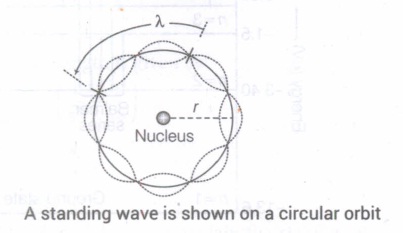
According to de-Broglie wavelength of moving electron \(\lambda=\frac{h}{m v_{n}}\)
where, v. is speed of electron revolving in nth orbit
As, 2 \(\pi\)rn. = n\(\lambda\)
\(\therefore\) \(2 \pi r_{n}=\frac{n h}{m v_{n}}\)
or \(m v_{n} r_{n}=\frac{n h}{2 \pi}=n(h / 2 \pi)\)
i.e, Angular momentum of electron revolving in nth orbit must be an integral multiple of h/2\(\pi\),which is the quantum condition proposed by Bohr in his second postulate.
(b) We know that, energy of electron in nth orbit is
\(E_{n}=-\frac{13.6}{n^{2}} \mathrm{eV}\)
For n = 1, E1 = -13.6 eV
Similarly, for n = 4,\(E_{4}=-\frac{13.6}{(4)^{2}} \mathrm{eV}\)
\(\therefore\) Energy difference, \(\triangle\)E = E4 - E1
\(=\left[-\frac{13.6}{16}-(-13.6)\right] \mathrm{eV}\)
Also, energy of photon is
\(\triangle\)E = hv \(\Rightarrow \quad v=\frac{\Delta E}{h}\)
From Eqs. (i) and (ii), we get
\(v=\left(-\frac{13.6}{16}+13.6\right) \times \frac{1.6 \times 10^{-19}}{6.63 \times 10^{-34}}\)
\(\therefore\) V = 3.1 x 10¹⁵ Hz
11.
(a) The sizes of the atoms taken in Thomson’s model and Rutherford’s model have the same order of magnitude.
(b) In the ground state of Thomson’s model, the electrons are in stable equilibrium. However, in Rutherford’s model, the electrons always experience a net force.
(c) A classical atom based on Rutherford’s model is doomed to collapse.
(d) An atom has a nearly continuous mass distribution in Thomson’s model, but has a highly non-uniform mass distribution in Rutherford’s model.
(e) The positively charged part of the atom possesses most of the mass in both the models.
12.
we know that velocity of electron moving around a proton in hydrogen atom in an orbit of radius 5.3 × 10⁻¹¹ m is 2.2 × 10⁻⁶ m/s. Thus, the frequency of the electron moving around the proton is
\(v=\frac{v}{2 \pi r}=\frac{2.2 \times 10^{6} \mathrm{~m} \mathrm{~s}^{-1}}{2 \pi\left(5.3 \times 10^{-11} \mathrm{~m}\right)}\)
\(\approx \) 6.6 × 10¹⁵ Hz
According to the classical electromagnetic theory we know that the frequency of the electromagnetic waves emitted by the revolving electrons is equal to the frequency of its revolution around the nucleus. Thus the initial frequency of the light emitted is 6.6 × 10¹⁵ Hz.
13.
Total energy of the electron in hydrogen atom is –13.6 eV = –13.6 × 1.6 × 10–19 J = –2.2 ×10⁻¹⁸ J. Thus from Equation we have
\(-\frac{e^{2}}{8 \pi \varepsilon_{0} r}=-2.2 \times 10^{-18} \mathrm{~J}\)
This gives the orbital radius
\(r=-\frac{e^{2}}{8 \pi \varepsilon_{0} E}=-\frac{\left(9 \times 10^{9} \mathrm{~N} \mathrm{~m}^{2} / \mathrm{C}^{2}\right)\left(1.6 \times 10^{-19} \mathrm{C}\right)^{2}}{(2)\left(-2.2 \times 10^{-18} \mathrm{~J}\right)}\)
= 5.3 × 10⁻¹¹ m
The velocity of the revolving electron can be computed from Eq.uation with m = 9.1 × 10⁻³¹ kg,
\(v=\frac{e}{\sqrt{4 \pi \varepsilon_{0} m r}}=2.2 \times 10^{6} \mathrm{~m} / \mathrm{s}\)
14.
(i) According to the law of radioactive decay.
\(N={ N }_{ 0 }{ e }^{ -\lambda t }=\frac { { N }_{ 0 } }{ n } \)
\(\therefore \frac { { N }_{ 0 } }{ n } ={ N }_{ 0 }{ e }^{ -\lambda t } \ \Rightarrow \ n={ e }^{ \lambda t } \ \Rightarrow \ \lambda =\frac { \log { \left( n \right) } }{ T } \)
\(\therefore \) Half-life, \({ T }_{ 1/2 }=\frac { 0.6931 }{ \lambda } =\frac { 0.693T }{ \log { \left( n \right) } } \)
(ii) In \(\beta ^{ - }\) - decay process, a nuclei emits a negative charge from the nucleus. A neutron is converted to a proton, causing the nuclide's atomic number to increase by one, but the atomic mass remains the same.
e.g. \(_{ 6 }^{ 14 }{ C\longrightarrow _{ 7 }^{ 14 }{ N+{ e }^{ - } } }+{ v }_{ e }^{ - }\).
15.
\(3646.8\mathring { A } \)
\(Take \ { n }_{ 1 }=2 \ and \ { n }_{ 2 }=\infty \)
16.
Radius of the orbit of the Earth around the Sun, r = 1.5 x 10¹¹ m
Orbital speed of the Earth, ν = 3 x 10⁴ m/s
Mass of the Earth, m = 6.0 x 1024 kg
According to Bohr’s model, angular momentum is quantized and given as:
\(m v r=\frac{\mathrm{nh}}{2 \pi}\)
Where,
h = Planck’s constant = 6.62 x 10⁻³⁴ Js
n = Quantum number
\(\therefore n=\frac{\operatorname{mvr} 2 \pi}{h}\)
\(=\frac{2 \pi \times 6 \times 10^{24} \times 3 \times 10^{4} \times 1.5 \times 10^{11}}{6.62 \times 10^{-34}}\)
= 25.61 x 1073 = 2.6 x 1074
Hence, the quanta number that characterizes the Earth’ revolution is 2.6 x 1074
17.
(a) Let ν1 be the orbital speed of the electron in a hydrogen atom in the ground state level, n1 = 1. For charge (e) of an electron, ν1 is given by the relation,
\(v_{1}=\frac{e^{2}}{n_{14} \pi \in_{0}\left(\frac{h}{2 \pi}\right)}=\frac{e^{2}}{2 \epsilon_{0} h}\)
Where,e = 1.6 x 10⁻¹⁹ C`
∈0 = Permittivity of free space = 8.85 x 10⁻¹² N−1 C2 m−2
h = Planck’s constant = 6.62 x 10⁻³⁴ Js
\(\therefore v_{1}=\frac{\left(1.6 \times 10^{-19}\right)^{2}}{2 \times 8.85 \times 10^{-12} \times 6.62 \times 10^{34}}\)
= 0.0218 x 108 =2.18 x 10⁶ m/s
For level n2 = 2, we can write the relation for the corresponding orbital speed as:
\(v_{2}=\frac{e^{2}}{n_{3} 2 \in_{0} h}\)
\(=\frac{1.6 \times 10^{-19}}{3 \times 2 \times 8.85 \times 10^{-12} \times 6.62 \times 10^{-34}}\)
= 7.27 x 10⁵ m/s
Hence, the speed of the electron in a hydrogen atom in n = 1, n = 2, and n = 3 is 2.18 x 10⁶ m/s, 1.09 x10⁶ m/s, 7.27x 10⁵ m/s respectively.
(b) Let T1 be the orbital period of the electron when it is in level n1 = 1.
Orbital period is related to orbital speed as:
\(T_{1}=\frac{2 \pi r_{1}}{v_{1}}\)
Where
r1 = Radius of the orbit
\(\frac{n_{1}^{2} h^{2} \in_{0}}{\pi m e^{2}}\)
h = Planck’s constant = 6.62 x 10⁻³⁴ Js
e = Charge on an electron = 1.6 x 10⁻¹⁹ C
∈0 = Permittivity of free space = 8.85 x 10⁻¹² N−1 C2 m−2
m = Mass of an electron = 9.1 x 10⁻³¹ kg
\(\therefore T_{1}=\frac{2 \pi r_{1}}{v_{1}}\)
\(=\frac{2 \pi \times(1)^{2} \times\left(6.62 \times 10^{-34}\right)^{2} \times 8.85 \times 10^{-12}}{2.18 \times 10^{6} \times \pi \times 9.1 \times 10^{-31} \times\left(1.6 \times 10^{-19}\right)^{2}}\)
= 15.27 x 10- 17 =1.527 x 10⁻¹⁶s
For level n2 = 2, we can write the period as:
\(T_{2}=\frac{2 \pi r_{2}}{v_{2}}\)
Where,
r2 = Radius of the electron in n2 = 2
\(=\frac{\left(n_{2}\right)^{2} h^{2} \in_{0}}{\pi m e^{2}}\)
\(\therefore T_{2}=\frac{2 \pi r^{2}}{v_{2}}\)
\(=\frac{2 \pi \times(2)^{2} \times\left(6.62 \times 10^{-34}\right)^{2} \times 8.85 \times 10^{-12}}{1.09 \times 10^{6} \times \pi \times 9.1 \times 10^{-31} \times\left(1.6 \times 10^{-19}\right)^{2}}\)
= 1.22 x 10⁻¹⁵ s
And, for level n3 = 3, we can write the period as:
\(T_{3}=\frac{2 \pi r_{3}}{v_{3}}\)
Where,
r3 = Radius of the electron in n3 = 3
\(=\frac{\left(n_{3}\right)^{2} h^{2} \in_{0}}{\pi m e^{2}}\)
\(\therefore T_{3}=\frac{2 \pi r_{3}}{v_{3}}\)
\(=\frac{2 \pi \times(3)^{2} \times\left(6.62 \times 10^{-34}\right)^{2} \times 8.85 \times 10^{-12}}{7.27 \times 10^{5} \times \pi \times 9.1 \times 10^{-31} \times\left(1.6 \times 10^{-19}\right)}\)
= 4.12 x 10⁻¹⁵ s
Hence, the orbital period in each of these levels is 1.52 x 10⁻¹⁶ s, 1.22 x 10⁻¹⁵ s, and 4.12 x 10⁻¹⁵ s respectively.
18.
For ground level, n1 = 1
Let E1 be the energy of this level. It is known that E1 is related with n1 as:
\(E_{1}=\frac{-13.6}{n_{1}^{2}} e V\)
\(=-\frac{13.6}{1^{2}}=-13.6 \mathrm{eV}\)
The atom is excited to a higher level, n2 = 4.
Let E2 be the energy of this level.
\(\therefore E_{2}=\frac{-13.6}{n_{2}^{2}} e V\)
\(=\frac{-13.6}{4^{2}}=-\frac{13.6}{16} e V\)
The amount of energy absorbed by the photon is given as:
E = E2 − E1
\(=-\frac{13.6}{16}-\left(-\frac{13.6}{1}\right)\)
\(=\frac{13.6 \times 15}{16} e V\)
\(=\frac{13.6 \times 15}{16} \times 1.6 \times 10^{-19}=2.04 \times 10^{-18} J\)
For a photon of wavelength λ, the expression of energy is written as:
\(E=\frac{\mathrm{hc}}{\lambda}\)
\(=\frac{6.6 \times 10^{-34} \times 3 \times 10^{8}}{2.04 \times 10^{-18}}\)
= 9.7 x 10⁻⁸ x m= 97nm
And, frequency of a photon is given by the relation,
\(v=\frac{v}{\lambda}\)
\(=\frac{3 \times 10^{8}}{9.7 \times 10^{-8}} \approx 3.1 \times 10^{15} \mathrm{~Hz}\)
Hence, the wavelength of the photon is 97 nm while the frequency is 3.1 x 10¹⁵ Hz.
19.
Separation of two energy levels in an atom,
\(\begin{aligned}
\Delta E & =2.3 \mathrm{eV}=2.3 \times 1.6 \times 10^{-19}
\end{aligned}\)
\(\begin{aligned}
=3.68 \times 10^{-19} \mathrm{~J}
\end{aligned}\)
Let v be the frequency of radiation emitted, when the atom transits from the upper level to the lower level.
We have the relation for energy as, \(\Delta\) E = hv
where, \(h=6.63 \times 10^{-34} \mathrm{Js}\)
\(\therefore \quad v=\frac{\Delta E}{h}=\frac{3.68 \times 10^{-19}}{6.63 \times 10^{-34}}=5.6 \times 10^{14} \mathrm{~Hz}\)
Hence, the frequency of the radiation is 5.6 \(\times\) 1014 Hz.
20.
The key idea here is that throughout the scattering process, the total mechanical energy of the system consisting of an\(\alpha\) -particle and a gold nucleus is conserved. The system’s initial mechanical energy is Et, before the particle and nucleus interact, and it is equal to its mechanical energy Ef when the (-particle momentarily stops. The initial energy Et is just the kinetic energy K of the incoming \(\alpha\)- particle. The final energy Ef is just the electric potential energy U of the system. The potential energy U can be calculated from equation.
Let d be the centre-to-centre distance between the (-particle and the gold nucleus when the (-particle is at its stopping point. Then we can write the conservation of energy Et = Ef as
\(K=\frac{1}{4 \pi \varepsilon_{0}} \frac{(2 e)(Z e)}{d}=\frac{2 Z e^{2}}{4 \pi \varepsilon_{0} d}\)
Thus the distance of closest approach d is given by
\(d=\frac{2 Z e^{2}}{4 \pi \varepsilon_{0} K}\)
The maximum kinetic energy found in\(\alpha\) -particles of natural origin is 7.7 MeV or 1.2 × 10⁻¹² J. Since 1/4 \(\pi\) E0= 9.0 × 10⁹ N m2/C2. Therefore with e = 1.6 × 10⁻¹⁹ C, we have
\(d=\frac{(2)\left(9.0 \times 10^{9} \mathrm{Nm}^{2} / \mathrm{C}^{2}\right)\left(1.6 \times 10^{-19} \mathrm{C}\right)^{2} \mathrm{Z}}{1.2 \times 10^{-12} \mathrm{~J}}\)
= 3.84 × 10⁻¹⁶ Z m
The atomic number of foil material gold is Z = 79, so that d (Au) = 3.0 × 10⁻¹⁴ m = 30 fm. (1 fm (i.e. fermi) = 10–15 m.)
The radius of gold nucleus is, therefore, less than 3.0 × 10⁻¹⁴ m. This is not in very good agreement with the observed result as the actual radius of gold nucleus is 6 fm. The cause of discrepancy is that the distance of closest approach is considerably larger than the sum of the radii of the gold nucleus and the \(\alpha\)-particle. Thus, the \(\alpha\)-particle reverses its motion without ever actually touching the gold nucleus.
21.
\(T=1.5\times { 10 }^{ 17 }s;\)
\( R=?\)
\( N=2.5\times { 10 }^{ 21 }\)
\(R=\lambda N=\frac { 0.693N }{ T } =\frac { 0.693\times 2.5\times { 10 }^{ 21 } }{ 1.5\times { 10 }^{ 17 } } \)
\(=11550\ disintegrations/sec.\)

12th Standard CBSE Syllabus & Materials
12th Standard CBSE
CBSE 12th Computer Science Python Revision Tour I - New Previous year Question Papers Study Material - QB365 Set A
NEW12th Standard CBSE
CBSE 12th Business Studies Planning Important Questions And Answers Study Material - QB365 Set A
NEW12th Standard CBSE
CBSE 12th Business Studies Business Environment Important Questions And Answers Study Material - QB365 Set A
NEW12th Standard CBSE
CBSE 12th Business Studies Principles of Management Important Questions And Answers Study Material - QB365 Set A



NCERT Books

Syllabus

Exam Pattern

Sample Question Papers

Previous year Question Papers

Important Notes

MCQ Practice test

NCERT Exemplers

Case study Questions

Image Based Questions

Passage based Questions

HOT Questions

Value Based Questions

Model Questions Papers
NCERT ( Book Back ) Questions

Assertion and Reason
Important Questions And Answers

CBSE 12th Standard CBSE Subjects
CBSE Standards








