
 100% FREE ACCESS
12th Standard CBSE Syllabus & Materials
12th Standard CBSE
CBSE 12th Economics Government Budget and the Economy Previous year Question Papers Study Material - QB365 Set A
NEW12th Standard CBSE
CBSE 12th Computer Science Interface Python with MySQL - New Previous year Question Papers Study Material - QB365 Set A
NEW12th Standard CBSE
CBSE 12th Computer Science Database Concept - New Previous year Question Papers Study Material - QB365 Set A
NEW12th Standard CBSE
CBSE 12th Computer Science Data Communication - New Previous year Question Papers Study Material - QB365 Set A
NEW12th Standard CBSE
CBSE 12th Computer Science Data Structures - New Previous year Question Papers Study Material - QB365 Set A
NEW12th Standard CBSE
CBSE 12th Computer Science Functions - New Previous year Question Papers Study Material - QB365 Set A

Published on: 02/11/2025
Download CBSE Class 12th Standard CBSE Physics question papers, sample papers, important questions, and previous year solved papers in PDF format. Get free study materials, NCERT solutions, and exam preparation resources for Class 12th Standard CBSE Physics
Questions + Answers key
Take MCQ Physics Test
1.
When 14 cells in series, are connected to the ends of a resistance of 82.6 Ω, then the current is found to be 0.25A. When same cells after being connected in parallel are joined to the ends of a resistance of 0.053 Ω, then the current is 25A. Calculate the internal resistance and the emf of each cell.
2.
An old woman who had suffered from a heart stroke was taken to the hospital by her grandson who is in class XII. The grandson has studied in physics that, to save a person who is suffering from a heart stroke, regular beating of the heart is to be restored by delivering a jolt to the heart using a defibrillator, whose capacity is 70microfarad and charged to a potential of 5000V and energy stored in 875J; 200J of energy is passed through a person's body in a pulse lasting 2 milliseconds. The old woman gets panicked and refuses to be treated by defibrillator. Her grandson then explains to her the process that would be adopted by medical staff and how the result of that would bring her back to normalcy. The woman was then treated and was back to normal.
(a) What according to you, are the values displayed by the grandson?
(b) How much power is delivered to the body to save a person's life from heart attack?
3.
In an atom an electron revolves around the nucleus in a circular orbit at the rate of 6 x 10¹⁵ revolutions per second. Calculate the equivalent current in milliampere. Take value of electronic charge = 1.6 x 10⁻¹⁹ C.
4.
Four identical cells, each of emf 2V are joined in parallel providing supply of current to external circuit consisting of two 15\(\Omega\) resistors joined in parallel. The terminal voltage of the cells as read by an ideal voltmeter is 1.6V Calculate the internal resistance of each cell.
5.
In the circuit shown in figure E, F, G, H are cells of emf 2, 1, 3 and 1 V respectively, and their internal resistances are 2, 1, 3 and 1 Ω, respectively. Calculate
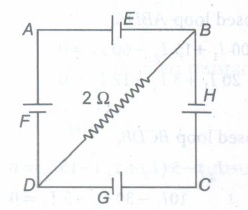
(i) the potential difference between B and D and
(ii) the potential difference across the terminals of each cells G and H.
6.
Write the principle of working of a potentiometer. Describe briefly, with the help of a circuit diagram, how a potentiometer is used to determine the internal resistance of a given cell.
7.
(a) State the underlying principle of a potentiometer. Why is it necessary to
(i) use a long wire,
(ii) have uniform area of cross-section of the wire and
(iii) use a driving cell whose emf is taken to be greater than the emf of the primary cells?
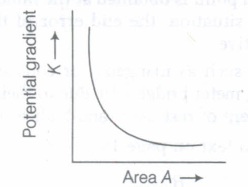
(b) In a potentiometer experiment, if the area of the cross-section of the wire increases uniformly from one end to the other, draw a graph showing how potential gradient would vary as the length of the wire increases from one end.
8.
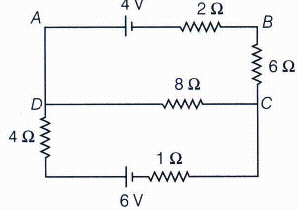
Using Kirchhoff's rule, calculate the potential difference across the 8\(\Omega \) resistance in the given circuit.
9.
A cell of emf E and Internal resistance r gives a current of 0.5 A with an external resistance of 12 \(\Omega \) and a current of 0.25 A with an external resistance of 25 \(\Omega \) Calculate the
(i) internal resistance of the cell
(ii) emf of the cell
10.
In a Wheatstone bridge circuit, P = 7\(\Omega \) ,Q = 8 \(\Omega \), R = 12\(\Omega \) and S = 7\(\Omega \). Find the additional resistance to be used in series with S, so that the bridge is balanced.
11.
In Bohr model of hydrogen atom, the electron revolves around the nucleus in a circular orbit of radius 5.1 x 10⁻¹¹ m at a frequency of 6.8 x 10¹⁵ revolutions per second. Find the equivalent current at any point on the orbit of the electron.
12.
Consider a current carrying wire in the shape of a circle. Note that as the current progresses along the wire, the direction of j changes in an exact manner, while the current I remain unaffected. The agent that is essentially responsible for is
(a) source of e.m.f.
(b) electric field produced by charges accumulated on the surface of wire.
(c) the charges just behind a given segment of wire which push them just the right way by repulsion.
(d) the charges ahead.
13.
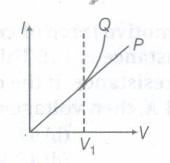
Figure below shows a plot of current versus voltage for two different materials P and Q. Which of the two materials satisfies Ohm's law?
Explain
14.
A low voltage supply from which one needs high currents must have very low internal resistance. Why?
15.
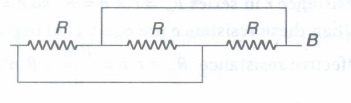
Find the equivalent resistance between points A and B of the circuit given below.
16.
Three resistance 3Ω, 6Ω and 9Ω are connected to a battery. In which of them will the power dissipation be maximum if
a) They are all connected in parallel
b) They are all connected in series Give reason.
17.
Two students X and Y perform an experiment on potentiometer separately using the circuit given below.
Keeping other parameters unchanged, how will the position of the null point be affected, if
(i) X increases the value of resistance R in the set up by keeping the key K1 closed and the key K2 open?
(ii) Y decreases the value of resistance S in the set up, while the key K2 remains open and then K1 closed?
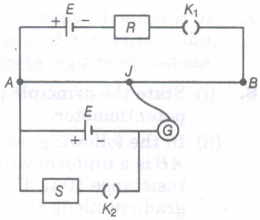
18.
Three bulbs 40 W, 60 W and 100 W are connected in series to 220 V 4 mains. Which bulb will glow brightly?
19.
What are two practical forms of Wheatstone bridge?
20.
There is an impression among many people that a person touching a high power line gets stuck with the line. Is that true? Explain.
21.
Two resistors having value in ratio 2 : 1 are connected in parallel with one cell then the ratio of power dissipated is _________.
22.
Two wires of the same metal have same length but their cross-sections are in the ratio 3 : 1, they are joined in series. The resistance of the thicker wire is 10 Ω. The total resistance of the combination is _________.
23.
When the current i is flowing through a conductor, the drift velocity is v. If 2i current flows through the same metal but having the double area of cross-section, then the drift velocity will be ________.
24.
Kirchhoff's second law is based on the law of conservation of ___________.
25.
A cell of emf E is connected with an external resistance R, then p.d. across cell is V. The internal resistance of cell will be ________.
1.
Let E and r be the emf and internal resistance of each cell.
Case I When the cells are in series.
Total emf of cells = 14E
Total resistance of circuit = 82.6 + 14r
∴ Current in the circuit is given by
\(\frac{14 E}{82.6+14 r}=0.25 \mathrm{~A}\)
Case II When the cells are in parallel.
Total emf of cells = E
Total resistance of circuit = 0.053 \(+\frac{r}{14}\)
∴ Current in the circuit is given by
\(\frac{E}{0.053+\frac{r}{14}}=25 \mathrm{~A}\)
Dividing Eq. (i) by Eq. (ii), we get
\(14 \frac{\left(0.053+\frac{r}{14}\right)}{(82.6+14 r)}=10^{-2}\)
\(\Rightarrow \ 14 \times \frac{14 \times 0.053+r}{14} \times 10^{2}=82.6+14 r\)
⇒ 53 x 14 + 100r = 82.6 + 14r
Solving, we get
r = 0.097Ω ≈ 0.1 Ω
Substituting the value of r in Eq. (i), we get
E = 1.5V
2.
(a) Presence of mind, Knowledge of subject, Concern for his grandmother, Empathy, Helping and caring, attitude
(b) Power = energy/time = \(\frac{200}{2\times10^{-3}}\)
= 100kW
3.
Here,
v = 6 x 10¹⁵ s-1;
e = 1.6 x 10⁻¹⁹ C
Equivalent current I = ev
= (1.6 x 10-19) x 6 x 1015
= 9.6 x 10⁻⁴ A
= 9.6 x 10-4 x 103 mA
= 0.96 mA
4.
According to the question, the circuit can be drawn as shown in the figure
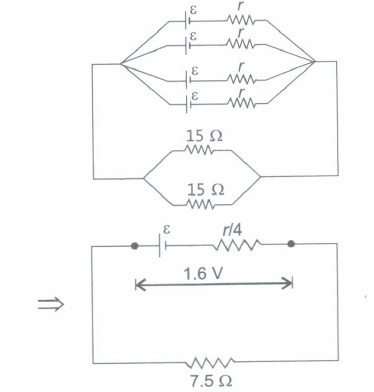
where ε = 2 V, and r = internal resistance of each cell
An equivalent circuit can be redraw as shown.
\(
\frac{r}{4} =\left[\frac{E-V}{V}\right] \times R
\)
\(=\left[\frac{2-1.6}{1.6}\right] \times 7.5
\)
\(r =7.5 \Omega
\)
5.
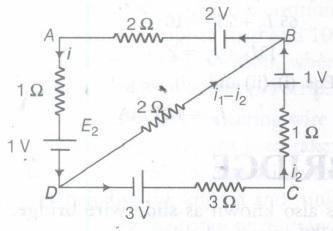
Applying Kirchhoffs second law in loop BADB,
2 - 2i1 - i1 - 1 - 2 (i1 - i2) = 0 ......... (i)
Similarly; applying Kirchhoffs second law in loop BDCB,
2 (i1 - i2) + 3 - 3i2 - i2 - 1 = 0 ........(ii)
Solving Eqs. (i) and (ii), we get
\(i_{1}=\frac{5}{13}, i_{2}=\frac{6}{13}\)
and \(i_{1}-i_{2}=-\frac{1}{13}\)
(i) Potential difference between B and D,.
VB + 2(i1 - i2) = VD
∴ \(V_{B}-V_{D}=-2\left(i_{1}-i_{2}\right)=\frac{2}{13} \mathrm{~V}\)
(ii) VG = EG - i2rG = 3 - \(\frac{6}{13} \times 3=\frac{21}{13} \mathrm{~V}\)
\(V_{H}=E_{H}+i_{2} r_{H}=1+\frac{6}{13} \times 1=\frac{19}{13} \mathrm{~V}\)
6.
Working principle: When constant current flows through a wire of uniform cross section then potential difference across the wire is directly proportional to the length. V a l With key K2 open, balance is obtained at length I1 (AN1). Then,
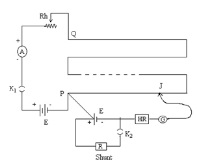
When key K2 is closed, the cell sends a current (I) through the resistance box (RB). If V is the terminal potential difference of the cell and balance is obtained at length l2 (AN2).
\(V=\varphi l_2\)
\(\Rightarrow\ \varepsilon /V=l_2/l_2\)
But \(\frac{\varepsilon}{V}\) =\(\frac{I(R+r)}{IR}=(1+\frac{r}{R})\)
\(\therefore\ \ (1+\frac{r}{R})=\frac{l_1}{l_2}\)
\(\Rightarrow \ r=\frac{(l_1-l_2)}{l_2}R\)
7.
(a) Principle of potentiometer:
The potential drop across the length of a steady current carrying wire of uniform cross-section is proportional to the length of the wire.
(i) We use a long wire to have a lower value of potential gradient (i.e. a lower 'least count' or greater sensitivity of the potentiometer.
(ii) The area of cross-section has to be uniform to get a 'uniform wire' as per the principle of the potentiometer.
(iii) The emf of the driving cell has to be greater than the emf of the primary cells as otherwise no balance point would be obtained.
ஃ The required graph is as shown below
8.
The circuit can be redrawn as

Let the current through the various arms of the network are as shown above. Applying Kirchhoff's second rule to close mesh ABCDA, we have
4 - 2I1 - 6I1 - 8(I1 + I2) = 0
16I1 + 8I2 = 4 ............(i)
and for closed mesh CDEFC, we have
-8(I1 + I2) - 4I2 + 6 - 1I2 = 0
8I1 + 13I2 = 6 ............(ii)
Solving Eqs. (i) and (ii), we get
\({ I }_{ 1 }=\frac { 1 }{ 36 } A \ and \ I_{ 2 }=\frac { 4 }{ 9 } A\)
Potential difference across 8\(\Omega \) resistance
= (I1 + I2)8 \(=\left( \frac { 1 }{ 36 } +\frac { 4 }{ 9 } \right) \times 8=\frac { 17 }{ 36 } \times 8=3.78V\)
9.
Let R be external resistance in series with the cell of emf E and internal resistance \(\gamma \). The current in circuit is \(I=\frac { E }{ R+r } \)
Case I: I = 05A, R = 12Ω, then
\(0.5=\frac{E}{12+r}\)
⇒ E = 05 (12 + r)
⇒ E = 6.0 + 05r ......(i)
Casell : I = 0.25A,R = 25Ω ,then
\(0.25=\frac{E}{25+r}\)
⇒ E = 0.25 (25 + r)
⇒ E = 6.25 + 0.25r ......(ii)
From Eqs. (i) and (ii), we get
6.0 + 05 r = 6.25 + 0.25 r
⇒ r = 1Ω
From Eq. (i), we get
E = 6.0 + 05 x (1) = 65V
Hence, (i) internal resistance of the cell is 1 Ω.
(ii) emf of the cell is 6.5 V.
10.
Let the bridge be balanced when additional resistance x is put in series with S.
Then, (S + X) \(=\frac{Q}{P} R\)
or \(x=\frac{Q}{P} R-S=\frac{8}{7} \times 12-7=6.72 \Omega\)
11.
I = ev
= (1.6 x 10-19) x (6.8 x 1015)
= 1.088 x 10⁻³ A
12.
(b) current density \(j\left( \frac { I }{ A } \right) \)is also directed along E and the relation is:
\( j=\sigma E\)
13.
The plot of V versus I is a straight line for materials that obey Ohm's law. So, from the figure, material P obeys Ohm's law.
14.
We know that, V = E - Ir
∴ Current in the circuit \(I=\frac{E-V}{r}\)
If the value of V is small, for high value of current I, then the internal resistance r should be small as \(I \propto \frac{1}{r} .\)
15.
All the three resistances are in parallel.
Therefore, \(\frac{1}{R_{\mathrm{eq}}}=\frac{1}{2 R}+\frac{1}{2 R}+\frac{1}{R}=\frac{2}{R}\)
\(\therefore \ R_{\mathrm{eq}}=\frac{R}{2}\)
16.
a) in parallel, power dissipation \(\alpha\) 1/R
Therefore 3\(\Omega \) wire will dissipate more power
b) In series, power dissipation \(\alpha\) R
Therefore 9\(\Omega \) wire will dissipate more power
17.
When K1 is closed and K2 is open, then only the cell connected in upper part branch will work. When K2 is closed and K1 is open, then only the cell connected in lower branch will work.
(i) K1 ⟶ closed, K2 ⟶ open
s.png)
Suppose null point occurs at J.
Apply KVl in smaller loop
E - IR = 0 ......(i)
where, R = resistance
E = IR ⇒ I = E/R
As, X increases the value of resistance R. So, current in the circuit (wire) decreases. Hence, R will be increased. Then I will decrease. We can say, as X increases the value of R, null point decrease.
(ii) K2 ⟶ open, K1 ⟶ closed
Then the circuit will be same as shown earlier. We see that resistance S is not involved in the circuit because K2 is open.
s.png)
So, from Eq (i), we get
E = RI
⇒ I = E/R
Here, R does not depend on the value resistance S.
So, R null point is not affected by decreasing the value of resistance S.
18.
In series combination, the same current flows through each bulb. As resistance
\(R=\frac{V^2}{P} \text { or } R \propto \frac{1}{P}.\) Therefore, the resistance of 40 W bulb is highest for the give three bulbs. Heat produced \(\mathrm{H}=\mathrm{I}^2 \mathrm{Rt} \text { or } \mathrm{H} \propto \mathrm{R}\) so maximum heat is produced in 40 W lamp will glow more brightly than the other two bulbs.
19.
Slide wire bridge and post office box.
20.
This impression is misleading. In fact, there is no special attractive force that keeps a person stuck with a high power line while touching that wire, whereas a current of few milliampere is enough to disorganise our nervous system. As a result of it, the affected person loses temporarily his ability to exercise his nervous control to get himself free from the high power line.
21.
()
1 : 2
22.
()
40 Ω
23.
()
v
24.
()
charge
25.
()
\(r=\frac{(E-V)}{V} \times R\)

12th Standard CBSE Syllabus & Materials
12th Standard CBSE
CBSE 12th Computer Science Python Revision Tour I - New Previous year Question Papers Study Material - QB365 Set A
NEW12th Standard CBSE
CBSE 12th Business Studies Planning Important Questions And Answers Study Material - QB365 Set A
NEW12th Standard CBSE
CBSE 12th Business Studies Business Environment Important Questions And Answers Study Material - QB365 Set A
NEW12th Standard CBSE
CBSE 12th Business Studies Principles of Management Important Questions And Answers Study Material - QB365 Set A



NCERT Books

Syllabus

Exam Pattern

Sample Question Papers

Previous year Question Papers

Important Notes

MCQ Practice test

NCERT Exemplers

Case study Questions

Image Based Questions

Passage based Questions

HOT Questions

Value Based Questions

Model Questions Papers
NCERT ( Book Back ) Questions

Assertion and Reason
Important Questions And Answers

CBSE 12th Standard CBSE Subjects
CBSE Standards








