
 100% FREE ACCESS
12th Standard CBSE Syllabus & Materials
12th Standard CBSE
CBSE 12th Economics Government Budget and the Economy Previous year Question Papers Study Material - QB365 Set A
NEW12th Standard CBSE
CBSE 12th Computer Science Interface Python with MySQL - New Previous year Question Papers Study Material - QB365 Set A
NEW12th Standard CBSE
CBSE 12th Computer Science Database Concept - New Previous year Question Papers Study Material - QB365 Set A
NEW12th Standard CBSE
CBSE 12th Computer Science Data Communication - New Previous year Question Papers Study Material - QB365 Set A
NEW12th Standard CBSE
CBSE 12th Computer Science Data Structures - New Previous year Question Papers Study Material - QB365 Set A
NEW12th Standard CBSE
CBSE 12th Computer Science Functions - New Previous year Question Papers Study Material - QB365 Set A

Published on: 07/03/2026
Download CBSE Class 12th Standard CBSE Physics question papers, sample papers, important questions, and previous year solved papers in PDF format. Get free study materials, NCERT solutions, and exam preparation resources for Class 12th Standard CBSE Physics
Questions + Answers key
Take MCQ Physics Test
1.
An electric toaster uses nichrome for its heating element. When a negligibly small current passes through it, its resistance at room temperature (27.0 °C) is found to be 75.3 Ω. When the toaster is connected to a 230 V supply, the current settles, after a few seconds, to a steady value of 2.68 A. What is the steady temperature of the nichrome element? The temperature coefficient of resistance of nichrome averaged over the temperature range involved, is 1.70 x 10⁻⁴ °C-1.
2.
The number density of free electrons in a copper conductor estimated is \(8.5\times { 10 }^{ 28 }{ m }^{ -3 }\). How long does an electron take in drifting from one end of a wire 3.0m long to its other end? The area of cross-section of the wire is \(2.0\times { 10 }^{ -6 }{ m }^{ 2 }\) and it is carrying a current of 3.0 A.
3.
A silver wire has a resistance of 2.1\(\Omega\) at 27.5oC and a resistance of 2.7\(\Omega\) at 100oC. Determine the temperature coefficient of resistivity of silver.
4.
At room temperature (27.0oC) the resistance of a heating element is 100 \(\Omega\). What is the temperature of the element if the resistance is found to be 117\(\Omega\) given that the temperature coefficient of the material of the resistor is 1.70 x 10⁻⁴ oC-1.
5.
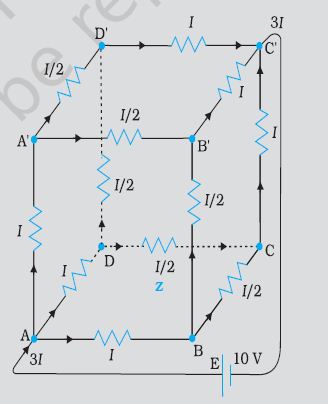
A battery of 10 V and negligible internal resistance is connected across the diagonally opposite corners of a cubical network consisting of 12 resistors each of resistance 1 \(\Omega\) (Figure). Determine the equivalent resistance of the network and the current along each edge of the cube.
6.
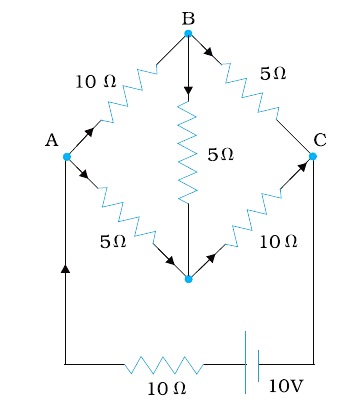
Determine the current in each branch of the network shown in Figure
7.
The four arms of a Wheatstone bridge Figure have the following resistances:
AB = 100Ω, BC = 10Ω, CD = 5Ω, and DA = 60Ω.
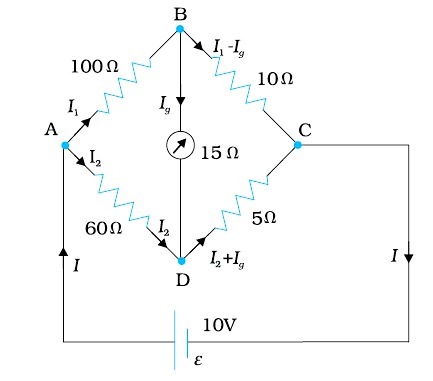
A galvanometer of 15Ω resistance is connected across BD. Calculate the current through the galvanometer when a potential difference of 10 V is maintained across AC.
8.
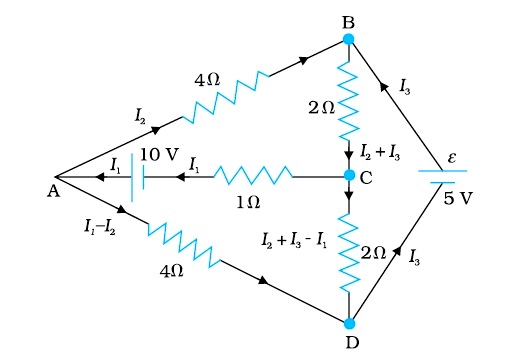
Determine the current in each branch of the network shown in Figure.
9.
(a) Estimate the average drift speed of conduction electrons in a copper wire of cross-sectional area 1.0 x 10⁻⁷ m2 carrying a current of 1.5 A. Assume that each copper atom contributes roughly one conduction electron. The density of copper is 9.0 x 10³ kg/m3, and its atomic mass is 63.5 u.
(b) Compare the drift speed obtained above with,
(i) thermal speeds of copper atoms at ordinary temperatures,
(ii) speed of propagation of electric field along the conductor which causes the drift motion.
10.
A battery of emf 10 V and internal resistance 3 Ω is connected to a resistor. If the current in the circuit is 0.5 A, what is the resistance of the resistor? What is the terminal voltage of the battery when the circuit is closed?
11.
A heating element using nichrome connected to a 230 V supply draws an initial current of 3.2 A which settles after a few seconds to a steady value of 2.8 A. What is the steady temperature of the heating element if the room temperature is \({ 27.0 }^{ \circ }C\)? Temperature coefficient of resistance of nichrome averaged over the temperature range involved is \(1.70\times { 10 }^{ -4\circ }{ C }^{ -1 }\)?
12.
A storage battery of emf 8.0 V and internal resistance 0.5 \(\Omega\) is being charged by a 120V dc supply using a series resistor of 15.5 \(\Omega\). What is the terminal voltage of the battery during charging? What is the purpose of having a series resistor in the charging circuit?
13.
The resistance of the platinum wire of a platinum resistance thermometer at the ice point is 5 Ω and at steam point is 5.23 Ω. When the thermometer is inserted in a hot bath, the resistance of the platinum wire is 5.795 Ω. Calculate the temperature of the bath.
14.
(a) In the electron drift speed is estimated to be only a few mm s-1 for currents in the range of a few amperes? How then is current established almost the instant a circuit is closed?
(b) The electron drift arises due to the force experienced by electrons in the electric field inside the conductor. But force should cause acceleration. Why then do the electrons acquire a steady average drift speed?
(c) If the electron drift speed is so small, and the electron’s charge is small, how can we still obtain large amounts of current in a conductor?
(d) When electrons drift in a metal from lower to higher potential, does it mean that all the ‘free' electrons of the metal are moving in the same direction?
(e) Are the paths of electrons straight lines between successive collisions (with the positive ions of the metal) in the
(i) absence of electric field,
(ii) presence of electric field?
15.
A negligibly small current is passed through a wire length 15 m and uniform cross-section \(6.0\times { 10 }^{ -7 }m^{ 2 }\) and its resistance is measured to be \(5.0\Omega \). What is the resistivity of the material at the temperature of the experiment?
16.
The storage battery of a car has an emf of 12 V. If the internal resistance of the battery is 0.4\(\Omega \), what is the maximum current that can be drawn from the battery?
1.
When the current through the element is very small, heating effects can be ignored and the temperature T1 of the element is the same as room temperature. When the toaster is connected to the supply, its initial current will be slightly higher than its steady value of 2.68 A. But due to heating effect of the current, the temperature will rise. This will cause an increase in resistance and a slight decrease in current. In a few seconds, a steady state will be reached when temperature will rise no further, and both the resistance of the element and the current drawn will achieve steady values. The resistance R2 at the steady temperature T2 is
\(R_{2}=\frac{230 \mathrm{~V}}{2.68 \mathrm{~A}}=85.8 \Omega\)
Using the relation
R2 = R1 [1 + α (T2 - T1)]
with α = 1.70 x 10⁻⁴ °C-1, we get
\(T_{2}-T_{1}=\frac{(85.8-75.3)}{(75.3) \times 1.70 \times 10^{-4}}=820^{\circ} \mathrm{C}\)
that is, T2 = (820 + 27.0) °C = 847 °C
Thus, the steady temperature of the heating element (when heating effect due to the current equals heat loss to the surroundings) is 847 °C.
2.
Number density of free electrons in a copper conductor, n = 8.5 x 1028 m-3 Length of the copper wire, l = 3.0 m
Area of cross-section of the wire, A = 2.0 x 10⁻⁶ m2
Current carried by the wire, I = 3.0 A, which is given by the relation,
I = nAeVd
Where,
e = Electric charge = 1.6 x 10⁻¹⁹ C
Vd = Drift velocity = \(\frac{\text { Length of the wire (l) }}{\text { Time taken to cover l(t) }}\)
\(I=n A e \frac{l}{t}\)
\(t=n A e \frac{l}{I}\)
\(=\frac{3 \times 8.5 \times 10^{28} \times 2 \times 10^{-6} \times 1.6 \times 10^{-19}}{3.0}\)
\(=2.7 \times 10^{4} s\)
Therefore, the time taken by an electron to drift from one end of the wire to the other is 2.7 x 10⁴ s.
3.
Temperature, T1 = 27.5°C
Resistance of the silver wire at T1, R1 = 2.1 Ω
Temperature, T2 = 100°C
Resistance of the silver wire at T2, R2 = 2.7 Ω
Temperature coefficient of silver = α
It is related with temperature and resistance as
\(\alpha=\frac{R_{2}-R_{1}}{R_{2}\left(T_{2}-T_{1}\right)}\)
\(=\frac{2.7-2.1}{2.1(100-27.5)}=0.0039^{\circ} \mathrm{C}^{-1}\)
Therefore, the temperature coefficient of silver is 0.0039°C−1.
4.
Given, resistance of heating element at temperature 27°C,
R27 = 100 \(\Omega\)
Resistance of heating element at temperature t°C,
Rt = 117 \(\Omega\)
\(\alpha\)=1.70 \(\times\)10-4 °C-1, t = ?
By using the formula of temperature coefficient of resistance,
\(\alpha=\frac{R_2-R_1}{R_1\left(t_2-t_1\right)}\) ...(i)
Here, R1 = Rt, R1 = R27, t2 = t and t1 = 27°C
Such that, \(\alpha=\frac{R_t-R_{27}}{R_{27}(t-27)}\)
Substituting given values in Eq. (i), we get
\(\begin{aligned} 1.70 \times 10^{-4} & =\frac{117-100}{100(t-27)} \\ \end{aligned}\)
\(\begin{aligned} \text { or } \quad t-27 & =\frac{17}{100 \times 1.70 \times 10^{-4}} \end{aligned}\)
or t = 1000 + 27 = 1027°C
5.
The network is not reducible to a simple series and parallel combinations of resistors. There is, however, a clear symmetry in the problem which we can exploit to obtain the equivalent resistance of the network.
The paths AA', AD and AB are obviously symmetrically placed in the network. Thus, the current in each must be the same, say, I. Further, at the corners AA', B and D, the incoming current I must split equally into the two outgoing branches. In this manner, the current in all the 12 edges of the cube are easily written down in terms of I, using Kirchhoff’s first rule and the symmetry in the problem. Next take a closed loop, say, ABCC'EA, and apply Kirchhoff’s second rule:
–IR – (1/2)IR – IR + \(\epsilon\) = 0
where R is the resistance of each edge and e the emf of battery. Thus,
\(\epsilon = \frac{5}{2}IR\)
The equivalent resistance Req of the network is
\(R_{eq}= \frac{\epsilon}{3I}=\frac{5}{6}R\)
For R = 1 Ω, Req = (5/6) Ω and for e = 10 V, the total current (= 3I ) in
the network is
3I = 10 V/(5/6) Ω = 12 A, i.e., I = 4 A
The current flowing in each edge can now be read off from the figure.
6.
Current flowing through various branches of the circuit is represented in the given figure.
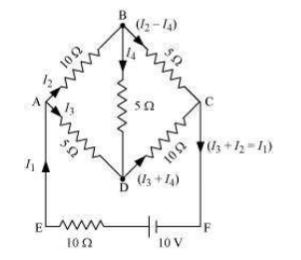
I1 = Current flowing through the outer circuit
I2 = Current flowing through branch AB
I3 = Current flowing through branch AD
I2 - I4 = Current flowing through branch BC
I3 + I4 = Current flowing through branch CD
I4 = Current flowing through branch BD
For the closed circuit ABDA, potential is zero i.e.,
10I2 + 5I4 - 5I3 = 0
2I2 + I4 - I3 = 0
I3 = 2I2 + I4 … (1)
For the closed circuit BCDB, potential is zero i.e.,
5(I2 - I4) - 10(I3 + I4) - 5I4 = 0
5I2 + 5I4 - 10I3 - 10I4 - 5I4 = 0
5I2 - 10I3 - 20I4 = 0
I2 = 2I3 + 4I4 … (2)
For the closed circuit ABCFEA, potential is zero i.e.,
-10 + 10 (I1) + 10(I2) + 5(I2 - I4) = 0
10 = 15I2 + 10I1 - 5I4
3I2 + 2I1 - I4 = 2 … (3)
From equations (1) and (2), we obtain
I3 = 2(2I3 + 4I4) + I4
I3 = 4I3 + 8I4 + I4
- 3I3 = 9I4
- 3I4 = + I3 … (4)
Putting equation (4) in equation (1), we obtain
I3 = 2I2 + I4
- 4I4 = 2I2
I2 = - 2I4 … (5)
It is evident from the given figure that,
I1 = I3 + I2 … (6)
Putting equation (6) in equation (1), we obtain
3I2 +2(I3 + I2) - I4 = 2
5I2 + 2I3 - I4 = 2 … (7)
Putting equations (4) and (5) in equation (7), we obtain
5(- 2 I4) + 2(- 3 I4) - I4 = 2
- 10I4 - 6I4 - I4 = 2
17I4 = - 2
\(I_{4}=-\frac{2}{17} A\)
Equation (4) reduces to
I3 = - 3(I4)
\(=-3\left(-\frac{2}{17}\right)=\frac{6}{17} A\)
\(I_{2}=-2\left(I_{4}\right)\)
\(=-2\left(-\frac{2}{17}\right)=\frac{4}{17} A\)
\(I_{2}-I_{4}=\frac{4}{17}-\left(-\frac{2}{17}\right)=\frac{6}{17} A\)
\(I_{3}+I_{4}=\frac{6}{17}+\left(-\frac{2}{17}\right)=\frac{4}{17} A\)
\(I_{1}=I_{3}+I_{2}\)
\(=\frac{6}{17}+\frac{4}{17}=\frac{10}{17} A\)
Therefore, current in branch \(A B=\frac{4}{17} A\)
In branch BC \(=\frac{6}{17} A\)
In branch CD = \(-\frac{4}{17} A\)
In branch AD = \(\frac{6}{17} A\)
In branch BD = \(\left(-\frac{2}{17}\right) A\)
Total current = \(\frac{4}{17}+\frac{6}{17}+\frac{-4}{17}+\frac{6}{17}+\frac{-2}{17}=\frac{10}{17} A\)
7.
Considering the mesh BADB, we have
100I1 + 15Ig - 60I2 = 0
or 20I1 + 3Ig - 12I2 = 0
Considering the mesh BCDB, we have
10 (I1 - Ig) - 15Ig - 5 (I2 + Ig) = 0
10I1 - 30Ig - 5I2 = 0
2I1 - 6Ig - I2 = 0
Considering the mesh ADCEA,
60I2 + 5 (I2 + Ig) = 10
65I2 + 5Ig = 10
13I2 + Ig = 2
Multiplying by 10
20I1 - 60Ig - 10I2 = 0
From we have
63Ig - 2I2 = 0
I2 = 31.5Ig
Substituting the value of I2 into we get
13 (31.5Ig ) + Ig = 2
410.5 Ig = 2
Ig = 4.87 mA
8.
Each branch of the network is assigned an unknown current to be determined by the application of Kirchhoff’s rules. To reduce the number of unknowns at the outset, the first rule of Kirchhoff is used at every junction to assign the unknown current in each branch. We then have three unknowns I1, I2 and I3 which can be found by applying the second rule of Kirchhoff to three different closed loops. Kirchhoff’s second rule for the closed loop ADCA gives,
10 - 4(I1 - I2) + 2(I2 + I3 - I1) - I1 = 0
that is, 7I1 - 6I2 - 2I3 = 10
For the closed loop ABCA, we get
10 - 4I2 - 2 (I2 + I3) - I1 = 0
that is, I1 + 6I2 + 2I3 = 10
For the closed loop BCDEB, we get
5 - 2 (I2 + I3) - 2 (I2 + I3 - I1) = 0
that is, 2I1 - 4I2 - 4I3 = -5
Equations (3.61 a, b, c) are three simultaneous equations in three unknowns. These can be solved by the usual method to give
\(I_1=2.5 \mathrm{~A}, \quad I_2=\frac{5}{8} \mathrm{~A}, \quad I_3=1 \frac{7}{8} \quad \mathrm{~A}\)
The currents in the various branches of the network are
\(\mathrm{AB}: \frac{5}{8} \mathrm{~A}, \quad \mathrm{CA}: 2 \frac{1}{2} \mathrm{~A}, \quad \mathrm{DEB}: 1 \frac{7}{8} \mathrm{~A}\)
\(\mathrm{AD}: 1 \frac{7}{8} \mathrm{~A}, \quad \mathrm{CD}: 0 \mathrm{~A}, \quad \mathrm{BC}: 2 \frac{1}{2} \mathrm{~A}\)
It is easily verified that Kirchhoff’s second rule applied to the remaining closed loops does not provide any additional independent equation, that is, the above values of currents satisfy the second rule for every closed loop of the network. For example, the total voltage drop over the closed loop BADEB
\(5 \mathrm{~V}+\left(\frac{5}{8} \times 4\right) \mathrm{V}-\left(\frac{15}{8} \times 4\right) \mathrm{V}\)
equal to zero, as required by Kirchhoff’s second rule.
9.
(a) The direction of drift velocity of conduction electrons is opposite to the electric field direction, i.e., electrons drift in the direction of increasing potential. The drift speed vd is given vd = (I/neA)
Now, e = 1.6 x 10⁻¹⁹ C, A = 1.0 x 10⁻⁷ m2, I = 1.5 A. The density of conduction electrons, n is equal to the number of atoms per cubic metre (assuming one conduction electron per Cu atom as is reasonable from its valence electron count of one). A cubic metre of copper has a mass of 9.0 x 10³ kg. Since 6.0 x 10²³ copper atoms have a mass of 63.5 g,
\(n=\frac{6.0 \times 10^{23}}{63.5} \times 9.0 \times 10^{6}\)
= 8.5 x 1028 m-3
which gives,
\(v_{d}=\frac{1.5}{8.5 \times 10^{28} \times 1.6 \times 10^{-19} \times 1.0 \times 10^{-7}}\)
= 1.1 x 10⁻³ m s-1 = 1.1 mm s-1
(b) (i) At a temperature T, the thermal speed of a copper atom of mass M is obtained from \(\left[<(1 / 2) M v^{2}>=(3 / 2) k_{\mathrm{B}} T\right]\) and is thus typically of the order of \(\sqrt{k_{B} T / M}\), where kB is the Boltzmann constant. For copper at 300 K, this is about 2 x 10² m/s. This figure indicates the random vibrational speeds of copper atoms in a conductor. Note that the drift speed of electrons is much smaller, about 10-5 times the typical thermal speed at ordinary temperatures.
(ii) An electric field travelling along the conductor has a speed of an electromagnetic wave, namely equal to 3.0 x 10⁸ m s-1 The drift speed is, in comparison, extremely small; smaller by a factor of 10-11.
10.
Given, E = 10 V, r = 3 \(\Omega\), I = 0.5 A
As, \(\begin{aligned} I & =\frac{E}{R+r} \end{aligned}\)
\(\begin{aligned} R & =\frac{E}{I}-r \end{aligned}\)
\(\begin{aligned} =\frac{10}{0.5}-3=17 \Omega \end{aligned}\)
and terminal voltage, V = IR = 0.5 \(\times\)17 = 8.5 V
11.
Given, potential difference = 230 V
Initial current at 27°C = I27°C = 3.2 A
Final current at t°C = It°C = 2.8 A
Room temperature = 27°C
Temperature coefficient of resistance, \(\alpha=1.70 \times 10^{-4}{ }^{\circ} \mathrm{C}^{-1}\)
Resistance at 27°C, R27°C\(=\frac{V}{I_{27^{\circ} \mathrm{C}}}=\frac{230}{3.2}=\frac{2300}{32} \Omega\)
Resistance at t°C, Rt°C = \(\frac{V}{I_{t^{\circ} \mathrm{C}}}=\frac{230}{2.8}=\frac{2300}{28} \Omega\)
Temperature coefficient of resistance
\(\begin{aligned} \alpha & =\frac{R_t-R_{27}}{R_{27}(t-27)} \end{aligned}\)
\(\begin{aligned} \Rightarrow 1.70 \times 10^{-4} & =\frac{\frac{2300}{28}-\frac{2300}{32}}{\frac{2300}{32}(t-27)} \\ \end{aligned}\)
\(\begin{aligned} \text { or } \quad t-27 & =\frac{82.143-71.875}{71.875 \times 1.70 \times 10^{-4}}=840.347 \end{aligned}\)
or t = 840.3 + 27 = 867.3 °C
Thus, the steady temperature of heating element is 867.3 °C
12.
Emf of the storage battery, E = 8.0 V
Internal resistance of the battery, r = 0.5 Ω
DC supply voltage, V = 120 V
Resistance of the resistor, R = 15.5 Ω
Effective voltage in the circuit = V1
R is connected to the storage battery in series. Hence, it can be written as
V1 = V - E
V1 = 120 - 8 = 112 V
Current flowing in the circuit = I, which is given by the relation,
\(I=\frac{V^{1}}{R+r}\)
\(=\frac{112}{15.5+5}=\frac{112}{16}=7 A\)
Voltage across resistor R given by the product, IR = 7 x 15.5 = 108.5 V
DC supply voltage = Terminal voltage of battery + Voltage drop across R
Terminal voltage of battery = 120 - 108.5 = 11.5 V
A series resistor in a charging circuit limits the current drawn from the external source. The current will be extremely high in its absence. This is very dangerous.
13.
R0 = 5 Ω, R100 = 5.23 Ω and Rt = 5.795 Ω
Now, \(t=\frac{R_{t}-R_{0}}{R_{100}-R_{0}} \times 100, \quad R_{t}=R_{0}(1+\alpha t)\)
\(=\frac{5.795-5}{5.23-5} \times 100\)
\(=\frac{0.795}{0.23} \times 100=345.65^{\circ} \mathrm{C}\)
14.
(a) Electric field is established throughout the circuit, almost instantly (with the speed of light) causing at every point a local electron drift. Establishment of a current does not have to wait for electrons from one end of the conductor travelling to the other end. However, it does take a little while for the current to reach its steady value.
(b) Each ‘free’ electron does accelerate, increasing its drift speed until it collides with a positive ion of the metal. It loses its drift speed after collision but starts to accelerate and increases its drift speed again only to suffer a collision again and so on. On the average, therefore, electrons acquire only a drift speed.
(c) Simple, because the electron number density is enormous, ~1029 m-3.
(d) By no means. The drift velocity is superposed over the large random velocities of electrons.
(e) In the absence of electric field, the paths are straight lines; in the presence of electric field, the paths are, in general, curved.
15.
Let the resistivity of the material be \(\rho \).
∴ Resistance of wire,\(\ R=\rho \frac { l }{ A } \)
or \(\rho =\frac { RA }{ l } \)
= \(\quad \frac { 5\times 6\times { 10 }^{ -7 } }{ 15 } \)
= \(2\times { 10 }^{ -7 }\Omega -m\)
Thus the resistivity of the material at the temperature of the experiment is \(2\times { 10 }^{ -7 }\Omega -m\)
16.
Emf of the battery, E = 12 V
Internal resistance of the battery, r = 0.4 Ω
Maximum current drawn from the battery = I
According to Ohm’s law,
E = Ir
\(I=\frac{E}{r}\)
\(=\frac{12}{0.4}=30 A\)
The maximum current drawn from the given battery is 30 A.

12th Standard CBSE Syllabus & Materials
12th Standard CBSE
CBSE 12th Computer Science Python Revision Tour I - New Previous year Question Papers Study Material - QB365 Set A
NEW12th Standard CBSE
CBSE 12th Business Studies Planning Important Questions And Answers Study Material - QB365 Set A
NEW12th Standard CBSE
CBSE 12th Business Studies Business Environment Important Questions And Answers Study Material - QB365 Set A
NEW12th Standard CBSE
CBSE 12th Business Studies Principles of Management Important Questions And Answers Study Material - QB365 Set A



NCERT Books

Syllabus

Exam Pattern

Sample Question Papers

Previous year Question Papers

Important Notes

MCQ Practice test

NCERT Exemplers

Case study Questions

Image Based Questions

Passage based Questions

HOT Questions

Value Based Questions

Model Questions Papers
NCERT ( Book Back ) Questions

Assertion and Reason
Important Questions And Answers

CBSE 12th Standard CBSE Subjects
CBSE Standards








