
 100% FREE ACCESS
12th Standard CBSE Syllabus & Materials
12th Standard CBSE
CBSE 12th Economics Government Budget and the Economy Previous year Question Papers Study Material - QB365 Set A
NEW12th Standard CBSE
CBSE 12th Computer Science Interface Python with MySQL - New Previous year Question Papers Study Material - QB365 Set A
NEW12th Standard CBSE
CBSE 12th Computer Science Database Concept - New Previous year Question Papers Study Material - QB365 Set A
NEW12th Standard CBSE
CBSE 12th Computer Science Data Communication - New Previous year Question Papers Study Material - QB365 Set A
NEW12th Standard CBSE
CBSE 12th Computer Science Data Structures - New Previous year Question Papers Study Material - QB365 Set A
NEW12th Standard CBSE
CBSE 12th Computer Science Functions - New Previous year Question Papers Study Material - QB365 Set A

Published on: 07/03/2026
Download CBSE Class 12th Standard CBSE Physics question papers, sample papers, important questions, and previous year solved papers in PDF format. Get free study materials, NCERT solutions, and exam preparation resources for Class 12th Standard CBSE Physics
Questions + Answers key
Take MCQ Physics Test
1.
Which orientation of a magnetic dipole in a uniform magnetic field will correspond to its stable equilibrium?
2.
A charged particle oscillates about its mean position with frequency 109 Hz. What is the frequency of electromagnetic wave produced by the oscillators?
3.
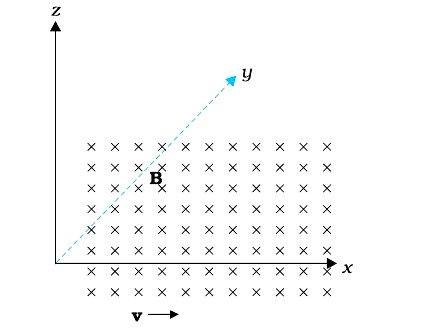
If the magnetic field is parallel to the positive y-axis and the charged particle is moving along the positive x-axis (Figure), which way would the Lorentz force be for
(a) an electron (negative charge),
(b) a proton (positive charge).
4.
Draw the graph showing the variation of reactance of
(i) a capacitor
(ii) an inductor with the angular frequency of an AC circuit.
5.
Define the term self-inductance of a coil. Write its SI unit.
6.
Draw a plot showing the variation of resistivity of a (i) conductor and (ii) semiconductor, with the increase in temperature. How does one explain this behaviour in terms of number density of charge carriers and the relaxation time?
7.
A permanent magnet in the shape of a thin cylinder of length 10 cm has \(M={ 10 }^{ 6 }\)A/m. Calculate the magnetization current \( { I }_{ m }\)
8.
A 12pF capacitor is connected to a 50V battery. How much electrostatic energy is stored in the capacitor?
9.
Obtain the frequency of revolution of the electron in its circular orbit. Does the answer depend on the speed of the electron? Explain.
10.
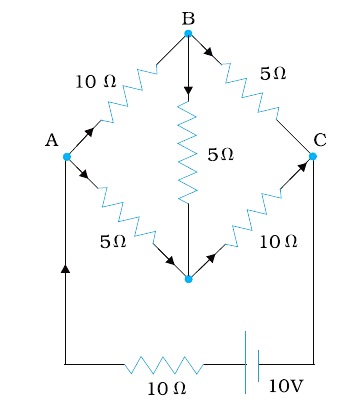
Determine the current in each branch of the network shown in Figure
11.
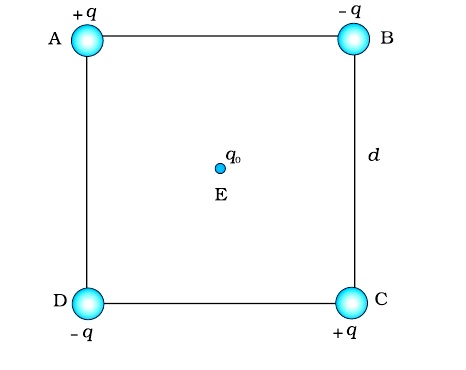
Four charges are arranged at the corners of a square ABCD of side d, as shown in Fig.
(a) Find the work required to put together this arrangement.
(b) A charge q0 is brought to the centre E of the square, the four charges being held fixed at its corners. How much extra work is needed to do this?
12.
(a) The peak voltage of an AC supply is 300 V. What is its rms voltage?
(b) The rms value of current in an AC circuit is 10 A. What is the peak current?
13.
The terminology of different parts of the electromagnetic spectrum is given in the text. Use the formula E = hv (for energy of a quantum of radiation: photon) and obtain the photon energy in units of eV for different parts of the electromagnetic spectrum. In what way are the different scales of photon energies that you obtain related to the sources of electromagnetic radiation?
14.
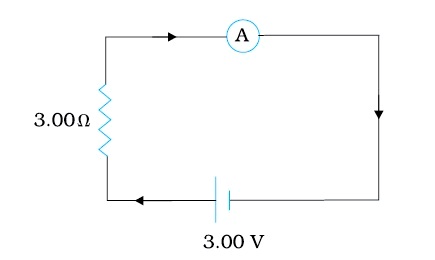
In the circuit the current is to be measured. What is the value of the current if the ammeter shown
(a) is a galvanometer with a resistance RG = 60.00 Ω;
(b) is a galvanometer described in (a) but converted to an ammeter by a shunt resistance rs = 0.02 Ω;
(c) is an ideal ammeter with zero resistance?
15.
Current in a circuit falls from 5.0 A to 0.0 A in 0.1 s. If an average emf of 200 V induced, give an estimate of the self-inductance of the circuit.
16.
A 60 μF capacitor is connected to a 110 V, 60 Hz ac supply. Determine the rms value of the current in the circuit.
17.
A short bar magnet of magnetic moment 0.1J/T is placed with its axis perpendicular to the horizontal component of the earth's magnetic field of strength 0.4 x 10⁻⁴T. Calculate the position of points on
(i) its axis and
(ii) its normal bisector.
Where does the resultant field make an angle of 45° with the earth's field?
18.
An electron in a hydrogen atom is moving with a speed of 2.3 x 10⁶ ms-1 in an orbit of radius 0.53 \(\overset{o}{A.}\) A Calculate the magnetic moment of the revolving electron.
19.
A point charge causes an electric flux -3\(\times\)10-14N-m2/C to pass through a spherical Gaussian Surface.
(i) Calculate the value of the point charge.
(ii) If the radius of the Gaussian surface is doubled, how much flux would pass through the surface?
20.
Four resistances of \(16 \ \Omega\), \(12 \ \Omega\), \(4 \ \Omega\) and \(9 \ \Omega\) respectively are connected in cyclic order to form a Wheatstone bridge. Calculate the resistance to be connected in parallel with \(9 \ \Omega\) resistance to balance the bridge.
21.
Two solenoids A and B spaced close to eachother and sharing the same cylindrical axis have 400 and 700 turns respectively. A current of 3.5 A in coil A produced an average flux of \(300\mu \ T-m {^2 }\) through each turns of A and a flux of \(90\mu \ T-{ m }^{ 2 }\) through each turns of B Calculate.
(a) mutual inductance of two solenoids.
(b) the self inductance of A.
What emf is induced in B when the current in A increases at the rate of 0.5 A/s?
22.
A plane electromagnetic wave of frequency 25 MHz travels in free space along the x-direction. At a particular point in space and time, \( { E } =6.3 \hat { j } \)V/m. What is B at this point?
23.
Which of the following has its permeability less than that different space?
Copper
Aluminium
Copper chloride
Nickel
24.
From Maxwell's hypothesis, a charging electric field gives rise to
an electric field
an induced emf
a magnetic field.
a magnetic dipole.
25.
A transformer works on the principle of
converter
inverter.
mutual inductance
self-inductance
26.
The primary origines of magnetism lies in
Pauli exclusion principle.
polar nature of molecules
intrinsic spin of electron.
None of these
27.
The area of a circular ring is 1 cm2 and current of 10 A is passing through it. If a magnetic field of intensity 0.1 T is applied perpendicular to the plane of the ring. The torque due to magnetic field on the ring will be
zero
10-4 N-m
10- 2 N-m
1 N-m
28.
The electric field strength at a distance x from a charge Q is E. What will be electric field strength if the distance Of the observation point is increased by 2K?
E/2
E/3
E/4
None of these
29.
The dielectric constant of an insulator cannot be
1.5
3
4.5
∞
30.
What is the resistance across A and B in the fig?
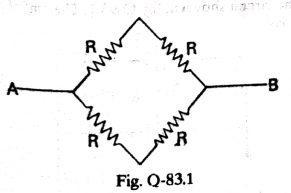
\(\frac{R}{2}\)
R
2R
4R
31.
An induced of reactance 1 and a resistor of 2 are connected in series to the terminals of a 6V(rms) a.c. source. The power dissipated in the circuit is
8 W
12 W
14.4 W
18 W
32.
Which one is not an application of eddy currents?
Magnetic brakes
speedometers
Induction furnace
Transformers
1.
In stable equilibrium, the dipole moment vector and the magnetic field vector are in same direction.
2.
It is given that a charged particle oscillates about its mean equilibrium position and the frequency of charged particle is 109 Hz.
The frequency of an electromagnetic wave produced by the oscillator will be same to the value of frequency of a charged particle that is oscillating about its mean position.
Thus, the value of the frequency of an electromagnetic wave produced by oscillator is 109 Hz.
3.
The velocity v of particle is along the x-axis, while B, the magnetic field is along the y-axis, so v x B is along the z-axis (screw rule or right-hand thumb rule). So,
(a) for electron it will be along –z axis.
(b) for a positive charge (proton) the force is along + z axis.
4.

5.
Self-inductance is the property of a coil by virtue of which, the coil opposes any change in the strength of current flowing through it by inducing an emf in itself. Its SI unit is henry (H).
6.
(i) Conductor
(ii) Semiconductor
In conductors, average relaxation time decreases with increase in temperature, resulting in an increase in resistivity.
In semiconductors, the increase in number density (with increase in temperature) is more than the decrease in relaxation time; the net result is, therefore, a decrease in resistivity.
7.
\(Here, \ l=10cm=0.1 \ m; \ M={ 10 }^{ 6 } \ A/m\)
\(As \ M=\frac { { I }_{ M }(magnetisation \ current) }{ l(length) } \)
\(\\ { I }_{ M }=M\times l={ 10 }^{ 6 }\times 0.1={ 10 }^{ 5 }\)
8.
Given,
Capacitance of the capacitor, C = 12pF = 12 x 10-12 F
Potential difference, V = 50 V
Electrostatic energy stored in the capacitor is given by the relation,
\(\mathrm{E}=\frac{1}{2} \mathrm{CV}^{2}=\frac{1}{2} \times 12 \times 10^{-12} \mathrm{\times}(50)^{2} \mathrm{~J}=1.5 \times 10^{-8} \mathrm{~J}\)
Therefore, the electrostatic energy stored in the capacitor is 1.5 x 10⁻⁸ J. was disconnected.
9.
Magnetic field strength, B = 6.5 x 10⁻⁴ T
Charge of the electron, e = 1.6 x 10⁻¹⁹ C
Mass of the electron, me = 9.1 x 10⁻³¹ kg
Velocity of the electron, v = 4.8 x 10⁶ m/s
Radius of the orbit, r = 4.2 cm = 0.042 m
Frequency of revolution of the electron = ν
Angular frequency of the electron = ω = 2πν
Velocity of the electron is related to the angular frequency as:
v = rω
In the circular orbit, the magnetic force on the electron is balanced by the centripetal force. Hence, we can write:
\(e v B=\frac{m v^{2}}{r}\)
\(e B=\frac{m}{r}(r \omega)=\frac{m}{r}(2 \pi r v)\)
\(v=\frac{B e}{2 \pi m}\)
This expression for frequency is independent of the speed of the electron.
On substituting the known values in this expression, we get the frequency as:
\(V=\frac{6.5 \times 10^{-4} \times 1.6 \times 10^{-19}}{2 \times 3.14 \times 9.1 \times 10^{-31}}\)
= 18.2 x 10⁶ Hz
\(\approx\) 18 MHz
Hence, the frequency of the electron is around 18 MHz and is independent of the speed of the electron.
10.
Current flowing through various branches of the circuit is represented in the given figure.
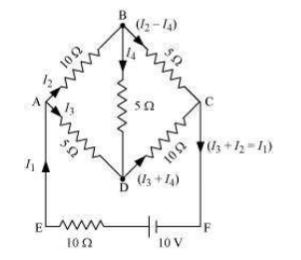
I1 = Current flowing through the outer circuit
I2 = Current flowing through branch AB
I3 = Current flowing through branch AD
I2 - I4 = Current flowing through branch BC
I3 + I4 = Current flowing through branch CD
I4 = Current flowing through branch BD
For the closed circuit ABDA, potential is zero i.e.,
10I2 + 5I4 - 5I3 = 0
2I2 + I4 - I3 = 0
I3 = 2I2 + I4 … (1)
For the closed circuit BCDB, potential is zero i.e.,
5(I2 - I4) - 10(I3 + I4) - 5I4 = 0
5I2 + 5I4 - 10I3 - 10I4 - 5I4 = 0
5I2 - 10I3 - 20I4 = 0
I2 = 2I3 + 4I4 … (2)
For the closed circuit ABCFEA, potential is zero i.e.,
-10 + 10 (I1) + 10(I2) + 5(I2 - I4) = 0
10 = 15I2 + 10I1 - 5I4
3I2 + 2I1 - I4 = 2 … (3)
From equations (1) and (2), we obtain
I3 = 2(2I3 + 4I4) + I4
I3 = 4I3 + 8I4 + I4
- 3I3 = 9I4
- 3I4 = + I3 … (4)
Putting equation (4) in equation (1), we obtain
I3 = 2I2 + I4
- 4I4 = 2I2
I2 = - 2I4 … (5)
It is evident from the given figure that,
I1 = I3 + I2 … (6)
Putting equation (6) in equation (1), we obtain
3I2 +2(I3 + I2) - I4 = 2
5I2 + 2I3 - I4 = 2 … (7)
Putting equations (4) and (5) in equation (7), we obtain
5(- 2 I4) + 2(- 3 I4) - I4 = 2
- 10I4 - 6I4 - I4 = 2
17I4 = - 2
\(I_{4}=-\frac{2}{17} A\)
Equation (4) reduces to
I3 = - 3(I4)
\(=-3\left(-\frac{2}{17}\right)=\frac{6}{17} A\)
\(I_{2}=-2\left(I_{4}\right)\)
\(=-2\left(-\frac{2}{17}\right)=\frac{4}{17} A\)
\(I_{2}-I_{4}=\frac{4}{17}-\left(-\frac{2}{17}\right)=\frac{6}{17} A\)
\(I_{3}+I_{4}=\frac{6}{17}+\left(-\frac{2}{17}\right)=\frac{4}{17} A\)
\(I_{1}=I_{3}+I_{2}\)
\(=\frac{6}{17}+\frac{4}{17}=\frac{10}{17} A\)
Therefore, current in branch \(A B=\frac{4}{17} A\)
In branch BC \(=\frac{6}{17} A\)
In branch CD = \(-\frac{4}{17} A\)
In branch AD = \(\frac{6}{17} A\)
In branch BD = \(\left(-\frac{2}{17}\right) A\)
Total current = \(\frac{4}{17}+\frac{6}{17}+\frac{-4}{17}+\frac{6}{17}+\frac{-2}{17}=\frac{10}{17} A\)
11.
(a) Since the work done depends on the final arrangement of the charges, and not on how they are put together, we calculate work needed for one way of putting the charges at A, B, C and D. Suppose, first the charge +q is brought to A, and then the charges –q, +q, and –q are brought to B, C and D, respectively. The total work needed can be calculated in steps:
(i) Work needed to bring charge +q to A when no charge is present elsewhere: this is zero.
(ii) Work needed to bring –q to B when +q is at A. This is given by (charge at B) x (electrostatic potential at B due to charge +q at A)
\(=-q \times\left(\frac{q}{4 \pi \varepsilon_{0} d}\right)=-\frac{q^{2}}{4 \pi \varepsilon_{0} d}\)
(iii) Work needed to bring charge +q to C when +q is at A and –q is at B. This is given by (charge at C) x (potential at C due to charges at A and B)
\(=+q\left(\frac{+q}{4 \pi \varepsilon_{0} d \sqrt{2}}+\frac{-q}{4 \pi \varepsilon_{0} d}\right)\)
\(=\frac{-q^{2}}{4 \pi \varepsilon_{0} d}\left(1-\frac{1}{\sqrt{2}}\right)\)
(iv) Work needed to bring –q to D when +q at A,–q at B, and +q at C. This is given by (charge at D) x (potential at D due to charges at A, B and C)
\(=-q\left(\frac{+q}{4 \pi \varepsilon_{0} d}+\frac{-q}{4 \pi \varepsilon_{0} d \sqrt{2}}+\frac{q}{4 \pi \varepsilon_{0} d}\right)\)
\(=\frac{-q^{2}}{4 \pi \varepsilon_{0} d}\left(2-\frac{1}{\sqrt{2}}\right)\)
Add the work done in steps (i), (ii), (iii) and (iv). The total work required is
\(=\frac{-q^{2}}{4 \pi \varepsilon_{0} d}\left\{(0)+(1)+\left(1-\frac{1}{\sqrt{2}}\right)+\left(2-\frac{1}{\sqrt{2}}\right)\right\}\)
\(=\frac{-q^{2}}{4 \pi \varepsilon_{0} d}(4-\sqrt{2})\)
The work done depends only on the arrangement of the charges, and not how they are assembled. By definition, this is the total electrostatic energy of the charges.
(Students may try calculating same work/energy by taking charges in any other order they desire and convince themselves that the energy will remain the same.)
(b) The extra work necessary to bring a charge q0 to the point E when the four charges are at A, B, C and D is q0 x (electrostatic potential at E due to the charges at A, B, C and D). The electrostatic potential at E is clearly zero since potential due to A and C is cancelled by thatdue to B and D. Hence no work is required to bring any charge to point E.
12.
a) Given: The peak voltage of supply is 100 V.
The rms voltage is give as,
v m = 2 ×V
Where, the peak value of supply voltage is v m and its rms value is V.
By substituting the given values in the above equation, we get
300= 2 ×V V= 300 2 =212.1 V
Thus, the value of rms voltage is 212.1V.
b) Given: The rms current in an ac circuit is 10 A.
The peak current in the circuit is given as,i m = 2 ×I
Where, the peak current in an ac circuit is i m and its rms value is I.
By substituting the given values in the above equation, we get
i m = 2 ×10 =14.1 A
Thus, the value of peak current in the given ac circuit is 14.1 A.
13.
Energy of photon, \(\mathrm{E}=\mathrm{hv}\)
This implies,\(\mathrm{E}=\mathrm{h} \frac{\mathrm{c}}{\lambda}\)
Where, \(\mathrm{h}=6.62 \times 10^{-34} \mathrm{js}\)
\( \mathrm{c}=3 \times 10^8 \mathrm{~ms}^{-1}\)
If wave length \(\lambda\) is in meter and energy is in joule then, we will divide E by \(1.6 \times 10^{-19}\) to convert into eV (Electron volt).
\(\therefore \mathrm{E}=\frac{\mathrm{hc}}{\lambda \times 1.6 \times 10^{-19}} \mathrm{eV}\)
(1) For y - rays wave length ranges from to less that \(10^{-14} \mathrm{~m}\)
Therefore, \(\text { Energy }=\frac{6.62 \times 10^{-34} \times 3 \times 10^8}{10^{-10} \times 1.6 \times 10^{-19}} \mathrm{eV} \)
\(=12.4 \times 10^3 \mathrm{eV} \approx 10^4 \mathrm{eV}\)
Thus, \( \lambda=10^{-10} \mathrm{~m}, \text { energy }=10^4 \mathrm{eV} \text { and }\) \( \lambda=10^{-14} \mathrm{~m} \text {, energy }=10^8 \mathrm{eV}\)
Energy of y - rays ranges between 104 to \(10^8 \mathrm{eV}\)
(2) For X - rays wave length ranges from \(10^{-8} \mathrm{~m}\) to \(10^{-7} \mathrm{~m}\) For \(\lambda=10^{-8}\)
Therefore, \(\text { Energy }=\frac{6.62 \times 10^{-34} \times 3 \times 10^8}{10^{-8} \times 1.6 \times 10^{-19}} \mathrm{eV} \)
\(=12.4 \approx 10^2 \mathrm{eV}\)
\( \lambda=10^{-13} \mathrm{~m} \text {, energy }=10^7 \mathrm{eV}\)
(3) For violet radiation \(\lambda\) ranges from \(4 \times 10^{-7}\) to \(6 \times 10^{-10}\)
Therefore, for \(\lambda=4 \times 10^{-7}\)
\(\text { Energy }=\frac{6.62 \times 10^{-34} \times 3 \times 10^8}{4 \times 10^{-7} \times 1.6 \times 10^{-19}} \mathrm{eV} =3.1 \mathrm{eV} \approx 10^{10} \mathrm{eV}\)
\(\lambda=6 \times 10^{-10} \mathrm{~m} \text {, Energy }=10^3 \mathrm{eV}\)
Energy of ultraviolet radiation vary between \(10^{10}\) to \(10^3 \mathrm{eV}\).
(4) For visible radiations wave length range from \(4 \times 10^{-7} \mathrm{~m}\) to \(7 \times 10^{-7} \mathrm{~m}\)
Therefore,
For \(\lambda=4 \times 10^{-7} \mathrm{~m}\), and Energy \(=10^{10} \mathrm{eV}\)
\(\text { Energy }=\frac{6.62 \times 10^{-34} \times 3 \times 10^8}{7 \times 10^{-7} \times 1.6 \times 10^{-19}} \mathrm{VV} \)
\(=1.77 \mathrm{eV} \approx 10^{\circ} \mathrm{eV}\)
(5) For infrared radiation $\lambda$ range from \(7 \times 10^{-7} \mathrm{~m}\) to \(7 \times 10^{-14} \mathrm{~m}\)
Therefore, \(\lambda=7 \times 10^{-7} \text {, energy }=10^{\circ} \mathrm{eV}\)
For \(\lambda=7 \times 10^{-4} \text {, energy }=\frac{1}{1000} \text { times }\)
the other order of \(10^{-3}\)eV
(6) For micro waves $\lambda$ ranges from 1 mm to 0.3 m
For \(\lambda=1 \mathrm{~mm}\) or \(10^{-3}\)
energy is equal to \( \text { Energy }=\frac{6.62 \times 10^{-34} \times 3 \times 10^8}{10^{-3} \times 1.6 \times 10^{-19}} \mathrm{eV} \)
\(=1.24 \times 10^{-3} \mathrm{eV} \approx 10^{-3} \mathrm{eV}\)
For \(\lambda=0.3 \mathrm{~m} \text {, Energy }=4.1 \times 10^{-6} \mathrm{eV} \approx 10^{-6} \mathrm{eV} \text {. }\)
(7) For Radio waves $\lambda$ ranges from 1 m to few km For $\lambda=1 \mathrm{~m}$
For λ=1m
Energy is equal to
\(=\frac{6.62 \times 10^{-34} \times 3 \times 10^8}{10^0 \times 1.6 \times 10^{-19}} \mathrm{eV} \)
\(=1.24 \times 10^{-6} \mathrm{eV} \approx 10^{-6} \mathrm{eV}\)
Energy for λ of the order of few km≈10−6eV
The Energy of a photon that a source produces indicates the spacing of relevant energy levels of the source
14.
(a) Total resistance in the circuit is,
RG+3 = 63 Ω. Hence, I = 3 / 63 = 0.048 A.
(b) Resistance of the galvanometer converted to an ammeter is,
\(\frac{R_{G} r_{s}}{R_{G}+r_{s}}=\frac{60 \Omega \times 0.02 \Omega}{(60+0.02) \Omega}=0.02 \Omega\)
Total resistance in the circuit is,
0.02Ω + 3Ω = 3.02Ω . Hence, I = 3 / 3.02 = 0.99 A.
(c) For the ideal ammeter with zero resistance,
I = 3 / 3 = 1.00 A
15.
Initial current, I1 = 5.0 A
Final current, I2 = 0.0 A
Change in current dl = I-1- I-2 = 5A
Time taken for the change, t = 0.1 s
Average emf, e = 200 V
For self-inductance (L) of the coil, we have the relation for average emf as:
\(e=L\frac{di}{dt}\)
\(L=\frac{e}{\frac{di}{dt}}\)
\(=\frac{200}{\frac{5}{0.1}}=4H\)
Hence, the self induction of the coil is 4 H.
16.
The capacitance of the capacitor in the circuit is C = 60 μ F or 60 x 10 -6 F
The source voltage is V = 110 V
The frequency of the source is ν = 60 Hz
The angular frequency can be calculated using the following relation,
ω = 2πν
The capacitive reactance in the circuit is calculated as follows:
\(X_{C}=\frac{1}{\omega C}=\frac{1}{2 \pi \nu C}=\frac{1}{2 \pi \times 60 \times 60 \times 10^{-6}} \Omega\)
Now, the RMS value of the current is determined as follows:
\(I=\frac{V}{X_{C}}=\frac{220}{2 \pi \times 60 \times 60 \times 10^{-6}}=2.49 A\)
Therefore, the RMS current is 2.49 A.
17.
BH = Bcos \(\delta \), Bv = Bsin \(\delta \)
\({ Also } \tan \delta=\frac{B_{V}}{B_{H}}\)
18.
Given, v = 2.3 x 10⁶ ms -1 ,
r = 0.53 \(\overset{o}{A}\) = 0.53 x 10⁻¹⁰ m
Equivalent current, \( I=\frac{e}{T}=\frac{e}{\frac{2 \pi r}{v}}=\frac{e v}{2 \pi r}\)
\(=\frac{1.6 \times 10^{-19} \times 2.3 \times 10^{6}}{2 \times 3.14 \times 0.53 \times 10^{-10}}\)
\(\therefore\) Magnetic moment,
M = IA = I (\(\pi r\)2) = 1.105 x 10-3 x 3.14 x (0.53 x 10-10)2
= 9.75 x 10⁻²⁴ A - m2
19.
(i) By Gauss' theorem, total electric flux through closed Gaussian surface is given by
\(\phi =\frac { q }{ { \varepsilon }_{ 0 } } \)
\(\therefore\) \(q=\phi { \varepsilon }_{ 0 }\)
But electric flux passing through the surface
\(\phi =-3\times { 10 }^{ -14 }N-{ m }^{ 2 }/C\)
\(=-26.55\times { 10 }^{ -26 }C\)
\(q=-2.655\times { 10 }^{ -25 }C\)

(ii) Electric flux passing through the surface remains unchanged because it depends only on charge enclosed by the surface and is the independence of its size.
20.
Here, P = \(16 \ \Omega\), Q = \(12 \ \Omega\), R = \(9 \ \Omega\), S = \(4 \ \Omega\)
Let \(9 \ \Omega\) be shunted with resistance x to balance the bridge. Then effective resistance of \(9 \ \Omega\) and x ohm in parallel,
\(R'=\frac{9x}{9 + x}\)
For balanced bridge,
\(\frac{P}{Q}=\frac{R'}{S}\)
\(\therefore \frac{16}{12}=\frac{9x/(9+x)}{4}\)
or \(\frac{4}{3}=\frac{9x}{4(9+x)}\)
or 144 + 16 x = 27 x
or x = \(13.1 \ \Omega\)
21.
\(Here,{ N }_{ 1 }=400, \ { N }_{ 2 }=700\)
\( I_{ 1 }=3.5A \ \phi =300 \times { 10 }^{ -6 }{ Tm }^{ 2 }\)
\({ \phi }_{ 2 }=900 \times { 10 }^{ -6 }{ Tm }^{ 2 }\)
\(M=\frac { { N }_{ 2 }{ \phi }_{ 2 } }{ I_{ 1 } } =\frac { 700 \times 90 \times { 10 }^{ -6 } }{ 3.5 } =1.8 \times { 10 }^{ -2 }H\)
\({ L }_{ 1 }=\frac { { N }_{ 1 }{ \phi }_{ 1 } }{ I_{ 1 } } =\frac { 400 \times 300 \times { 10 }^{ -6 } }{ 3.5 } =3.43 \times { 10 }^{ -2 }H\)
\({ e }_{ 2 }=M(\frac { dI_{ 1 } }{ dt } )=1.8 \times { 10 }^{ -2 } \times (0.5)\)
\(=9 \times { 10 }^{ -3 }V\)
22.
Using Eq, the magnitude of B is
\(B=\frac { E }{ c } \)
\(=\frac { 6.3V/m }{ 3\times { 10 }^{ 8 }m/s } =2.1\times { 10 }^{ -8 }T\)
To find the direction, we note that E is along y-direction and the wave propagates along x-axis. Therefore, B should be in a direction perpendicular to both x- and y-axes. Using vector algebra, E × B should be along x-direction.
Since, \((+\overrightarrow{\mathbf{j}}) \times(+\hat{\mathbf{k}})=\overrightarrow{\mathbf{i}}, \mathbf{B}\) is along the z-direction.
Thus, \(\mathbf{B}=2.1 \times 10^{-8} \hat{\mathbf{k}} \mathrm{T}\)
23.
(a)
Copper
24.
(c)
a magnetic field.
25.
(c)
mutual inductance
26.
(c)
intrinsic spin of electron.
27.
(a)
zero
28.
(d)
None of these
29.
(d)
∞
30.
(b)
R
31.
(c)
14.4 W
32.
(d)
Transformers

12th Standard CBSE Syllabus & Materials
12th Standard CBSE
CBSE 12th Computer Science Python Revision Tour I - New Previous year Question Papers Study Material - QB365 Set A
NEW12th Standard CBSE
CBSE 12th Business Studies Planning Important Questions And Answers Study Material - QB365 Set A
NEW12th Standard CBSE
CBSE 12th Business Studies Business Environment Important Questions And Answers Study Material - QB365 Set A
NEW12th Standard CBSE
CBSE 12th Business Studies Principles of Management Important Questions And Answers Study Material - QB365 Set A



NCERT Books

Syllabus

Exam Pattern

Sample Question Papers

Previous year Question Papers

Important Notes

MCQ Practice test

NCERT Exemplers

Case study Questions

Image Based Questions

Passage based Questions

HOT Questions

Value Based Questions

Model Questions Papers
NCERT ( Book Back ) Questions

Assertion and Reason
Important Questions And Answers

CBSE 12th Standard CBSE Subjects
CBSE Standards








