
 100% FREE ACCESS
12th Standard CBSE Syllabus & Materials
12th Standard CBSE
CBSE 12th Economics Government Budget and the Economy Previous year Question Papers Study Material - QB365 Set A
NEW12th Standard CBSE
CBSE 12th Computer Science Interface Python with MySQL - New Previous year Question Papers Study Material - QB365 Set A
NEW12th Standard CBSE
CBSE 12th Computer Science Database Concept - New Previous year Question Papers Study Material - QB365 Set A
NEW12th Standard CBSE
CBSE 12th Computer Science Data Communication - New Previous year Question Papers Study Material - QB365 Set A
NEW12th Standard CBSE
CBSE 12th Computer Science Data Structures - New Previous year Question Papers Study Material - QB365 Set A
NEW12th Standard CBSE
CBSE 12th Computer Science Functions - New Previous year Question Papers Study Material - QB365 Set A

Published on: 07/03/2026
Download CBSE Class 12th Standard CBSE Physics question papers, sample papers, important questions, and previous year solved papers in PDF format. Get free study materials, NCERT solutions, and exam preparation resources for Class 12th Standard CBSE Physics
Questions + Answers key
Take MCQ Physics Test
1.
If n,e, ፒ and m have their usual meanings, then the resistance of a wire of length and cross-sectional area A is given by
\(\frac{n e^2 A}{2 m \tau l}\)
\(\frac{m l}{n e^2 \tau A}\)
\(\frac{m \tau A}{n e^2 l}\)
\(\frac{n e^2 \tau A}{2 m l}\)
2.
A car battery is charged by a 12 V supply and energy stored in it is 720 x 105 J. The charge passed through the battery is
6.0 × 10⁴ C
5.8 × 10³ J
8.64 × 10⁶ J
1.6 × 10⁵ C
3.
In a DCcircuit,the direction of current inside the battery and outside the battery, respectively are
positive to negative terminal and negative to positive terminal
positive to negative terminal and positive to negative terminal
negative to positive terminal and positive to negative terminal
negative to positive terminal and negative to positive terminal
4.
A cell of emf (E) and internal resistance is connected across a variable external resistance R. The graph of terminal potential difference V as a function of R is
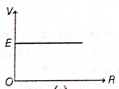
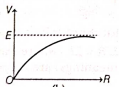
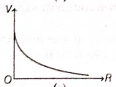
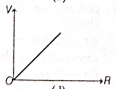
5.
In a DC circuit, the direction of current inside the battery and outside the battery, respectively are
positive to negative terminal and negative to positive terminal
positive to negative terminal and positive to negative terminal
negative to positive terminal and positive to negative terminal
negative to positive terminal and negative to positive terminal
6.
A constant voltage is applied between the two ends of a uniform metallic wire, heat His developed in it. If another wire of the same material, double the radius and twice the length as compared to original wire is used, then the heat developed in it will be
\(\frac{\mathrm{H}}{2}\)
Η
2H
4H
7.
If the potential difference V applied across a conductor is increased to 2V with its temperature kept constant, then the drift velocity of the free electrons in a conductor will
remain the same
become half of its previous value
be double of its initial value
become zero
8.
Which of the following has negative temperature coefficient of resistivity?
Metal
Metal and semiconductor
Semiconductor
Metal and alloy
9.
Kirchhoff's first rule, EI = 0 and second rule, ΣΙΑ = ΣΕ (where the symbols have their usual meanings) are respectively, based on
conservation of momentum and conservation of charge
conservation of energy and conservation of charge
conservation of charge and conservation of momentum
conservation of charge and conservation of energy
10.
If an ammeter is to be used in place of a voltmeter, then we must connect with the ammeter a
low resistance in parallel
low resistance in series
high resistance in parallel
high resistance in series
11.
The electric power consumed by a 220 V-100 W bulb, when operated at 110 V is
25 W
30 W
35 W
45 W
12.
A current of 0.8 A flows in a conductor of 40\(\Omega\) for 1 min. The heat produced in the conductor will be
1445 J
1536 J
1569 J
1640 J
13.
The current density due to drift of electrons in a conductor is given by (symbols have their usual meanings)
\(n e A v_d\)
\(\frac{n A v_d}{e}\)
\(\frac{n v_d}{e A}\)
\(n e v_d\)
14.
A conductor of 10\(\Omega\) is connected across a 6V ideal source. The power supplied by the source to the conductor is
1.8W
2.4W
3.6W
7.2W
15.
Pieces of copper and silicon are initially at room temperature. Both are heated to temperature T.
The conduction of
both increases
both decreases
copper increases and silicon decreases
copper decreases and silicon increases
16.
The current in a device varies with time t as I=6t, whereI is in mÁ and t is in s. The amount of charge that passes through thedevice during t=0s to t= 3s is
10 mC
18 mC
27 mC
54 mC
17.
A steady current of 8 mA flows through a wire.The number of electrons passing through a cross-section of the wire in 10 s is
\(4.0 \times 10^{16}\)
\(5.0 \times 10^{17}\)
\(1.6\times 10^{16}\)
\(1.0 \times 10^{17}\)
18.
If the length of potentiometer wire is increased, then the length of the previously obtained balance point will
increase.
decrease.
remain unchanged.
become two times.
19.
The terminal potential difference of a cell is greater than its e.m.f. when it is
being discharged.
in open circuit
being charged.
being either charged or discharged.
20.
The magnitude and direction of the current in the circuit shown will be
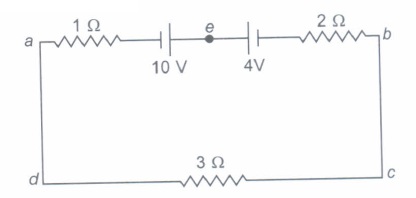
7/3A from a to b through e
7/3A from b to a through e
1 A from b to a through e
1 A from a to b through e
21.
Kirchhoff's junction rule is a reflection of
conservation of current density vector.
conservation of potential
the fact that the momentum with which a charged particle approaches a junction is unchanged (as a vector) as the charged particle leaves the junction
the fact that there is no accumulation of charges at a junction.
22.
From the graph between current I and voltage V shown below, identify the portion corresponding to negative resistance
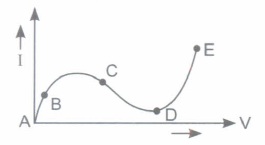
AB
BC
CD
DE
23.
Three resistors each of 2 ohm are connected together in a triangular shape. The resistance between any two vertices will be
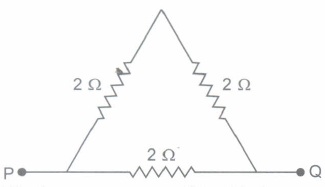
4/3 ohm
3/4 ohm
3 ohm
6 ohm
24.
For a cell, the graph between the potential difference (V) across the terminals of the cell and the current (I) drawn from the cell is shown in the figure.
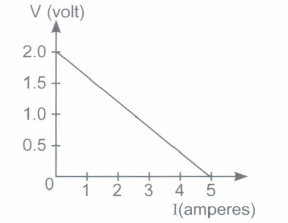
\(2 \mathrm{~V}, 0.5 \Omega\)
\(2 \mathrm{~V}, 0.4 \Omega\)
\(>2 \mathbf{V}, \mathbf{0 . 5} \Omega\)
\(>2 \mathbf{V}, \mathbf{0 . 4} \Omega\)
25.
Drift velocity vd varies with the intensity of electric field as per the relation
\(v_{d} \propto E\)
\(v_{d} \propto \frac{1}{E}\)
vd = constant
\(\boldsymbol{v}_{d} \propto \boldsymbol{E}^{2}\)
26.
The emf of the battery shown in figure is
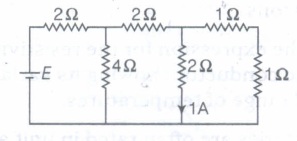
12 V
13 V
16 V
18 V
27.
A potential difference of 100 V is applied to the ends of a copper wire one metre long. What is the average drift velocity of electrons?
(given. σ = 5.81 x 10⁷ Ω-1or ncu = 8.5 x 1028 m-3)
0.43 ms -1
0.83 ms -1
0.52 ms-1
0.95 ms-1
28.
2 mA current is flowing in the wire of potentiometer of 5m long and 5 Ω resistance. The potential gradient is
2 x 10⁻³ V/m
2.5 x 10⁻² V/m
1.6 x 10⁻³ V/m
2.3 x 10⁻³ V/m
29.
If each of the resistance in the network in figure is R, the equivalent resistance between terminals A and B is
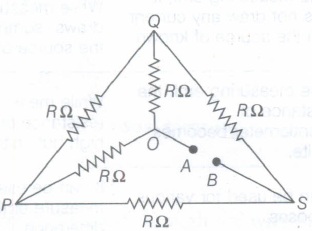
5 R
2 R
4 R
R
30.
If 2 A current is flowing in the shown circuit, then potential difference (VB - VD) in balanced condition is
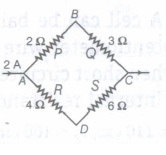
12 V
6 V
4 V
zero
31.
Which of the following draws no current from the voltage source being measured?
Meter bridge
Wheatstone bridge
Potentiometer
None of these
32.
Kirchhoff's current law is consequence of conservation of
energy
momentum
charge
mass
33.
Two batteries of emf ε1 and ε2, (ε2 >ε1) and internal resistances r1 and r2 respectively are connected in parallel as shown in figure.
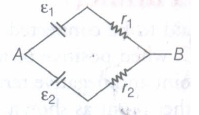
Two equivalent emf εeq of the two cells is between ε1 and ε2 i.e., ε2 < εeq < ε2
The equivalent emf εeq is smaller than ε1
The εeq is given by εeq = ε1 + ε2 always
εeq is independent of internal resistances ε1 and ε2
34.
In the following diagram, equivalent resistance between A and D is
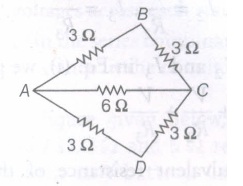
5 Ω
4 Ω
3Ω
2Ω
35.
The relation between electric current density (J) and drift velocity (vd) is
J = nevd
J = \(\frac{n e}{v_{d}}\)
J = \(\frac{v_{d} e}{n}\)
J = nev2d
36.
The resistivity of material is investment proportional to:
number density of electrons as well and relaxation time
number density of electrons and direction proportional to relaxation time
relaxation time and directly proportional to the number density of electron
neither relaxation time nor number density of electrons.
37.
For ohmic conductor the drift velocity vd and the electric field applied across it are related as:
\({ v }_{ d }\propto \sqrt { E } \)
vd \(\propto \) E
\({ v }_{ d }\propto { E }^{ \frac { 3 }{ 2 } }\)
vd \(\propto \) E2
38.
Ohms law is valid when the temperature of the conductor is:
constant
very high
very low
varying
39.
The length and area of cross - section of a conductor are doubled, its resistance will be:
halved
unchanged
doubled
quadrupled
40.
The length of a conductor is halved. Its conductivity will be
halved
unchanged
doubled
quadrupled
41.
Resistivity of a conductor depends upon its:
resistance
length
area of cross - section
none of the above characteristics
42.
For higher sensitivity which of the following is essential for the potentiometer?
Higher emf of quxiliary battery
Higher resistivity of the wire
Larger length of the wire
None of the above
43.
Why the wheatstone bridge is more accurate than the other methods of measuring resistance?
It has four resistor arms
It is based on Kirchhoff's laws
It does not involve ohm's law
It is a null method
44.
According to the Kirchhoff's law the sum of the products of current and resistance as well as emfs in a closed loop is:
greater than zero
zero
less than zero
determained by the emf
45.
What is the resistance between A and B in the fig.
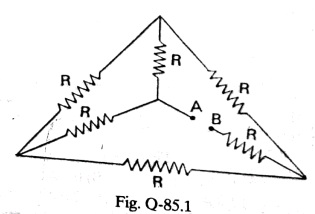
R/2
R
2R
3R
46.
What is the resistance across A and B in the fig?
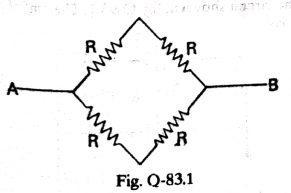
\(\frac{R}{2}\)
R
2R
4R
47.
What is the resistance across A and B in the fig
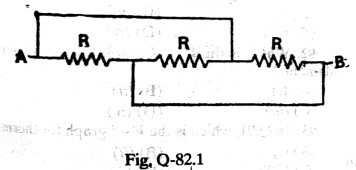
3R
R
R/3
None of the above
48.
Four wires each of same length, diameter and material are connected to each other to form a square. If the resistance of each wire is R, then equivalent resistance across the opposite corners is:
R/4
R/2
R
none of the above
49.
Two resistance when connected in parallel have equivalent resistance of 3\(\Omega\). When one of the resistance is burnt and broken, the net resistance is 12\(\Omega\). What is the resistance of the burnt resistor?
4\(\Omega\)
8\(\Omega\)
12\(\Omega\)
16\(\Omega\)
50.
The equivalent resistance of n resistors each of same resistance when connected in parallel is Rp. If they are connected in series, the equivalent resistance will be:
Rp/n2
Rp/n
nRp
n2Rp
51.
When a current I is set up in a wire of radius r, the drift speed id vd. If the same current is set up through a wire of radius 2r the drift speed will be
vd/4
vd/2
2vd
4vd
52.
53.
54.
Assertion (A) : Higher the range, lower is the resistance of an ammeter.
Reason (R) : To increase the range of an ammeter, additional shunt is added in series to it
(a) Both Assertion and Reason are true and Reason is the correct explanation of Assertion.
(b) Both Assertion and Reason are true but Reason is not the correct explanation of Assertion.
(c) Assertion is true but Reason is false.
(d) Assertion is false but Reason is true.
55.
Assertion (A) : As the temperature of a 147 B conducting wire increases, the drift velocity of the electrons also increases.
Reason (R) : With an increase in temperature, the average time of collision decreases.
(a) Both Assertion and Reason are true and Reason is the correct explanation of Assertion.
(b) Both Assertion and Reason are true but Reason is not the correct explanation of Assertion.
(c) Assertion is true but Reason is false.
(d) Assertion is false but Reason is true.
56.
(a) Both Assertion and Reason are true and Reason is the correct explanation ofAssertion.
(b)Both Assertion and Reason are true but Reason is not the correct explanation ofAssertion.
(c) Assertion is true but Reason is false.
(d) Assertion is false but Reason is true.
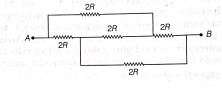
Assertion (A) The equivalent resistance between' points A and B in the given network is 2R.
Reason (R) All the resistors are connected in
57.
Assertion (A) When electrons drift in a conductor, it does not mean that all free electrons in the conductor are moving in the same direction.
Reason (R) The drift velocity is superimposed over large random velocities of electrons.
(a) If both Assertion (A) and Reason (R) are true and Reason (R) is the correct explanation of Assertion (A).
(b) If both Assertion (A) and Reason (R) are true but Reason (R) is not the correct explanation of Assertion (A).
(c) If Assertion (A) is true and Reason (R) is false.
(d) If both Assertion (A) and Reason (R) are false.
58.
Assertion: The current in a wire is due to flow of free electrons in a definite direction.
Reason: A current carrying wire should have non -zero charge.
Codes:
(a) Both A and R are true and R is the correct explanation of A
(b) Both A and R are true but R is NOT the correct explanation of A
(c) A is true but R is false
(d) A is false and R is also false
59.
Assertion: A person touching a high power line gets stuck with the line.
Reason: The current carrying wire attracts the man towards it.
Codes:
(a) Both A and R are true and R is the correct explanation of A
(b) Both A and R are true but R is NOT the correct explanation of A
(c) A is true but R is false
(d) A is false and R is also false
60.
Assertion: Two electric bulbs of 50 and 100 watt are given. When connected in series 50 watt bulb glows more but when connected in parallel 100 watt bulb glows more .
Reason: In series combination, power is directly proportional to the resistance of circuit. But in parallel combination, power is inversely proportional to the resistance of the circuit.
Codes:
(a) Both A and R are true and R is the correct explanation of A
(b) Both A and R are true but R is NOT the correct explanation of A
(c) A is true but R is false
(d) A is false and R is also false
61.
Assertion: In a chain of bulbs, 50 bulbs are joined in series. One bulb is removed now the circuit is again completed. If the remaining 49 bulbs are again connected in series across the same supply, then light gets decreased in the room.
Reason: The resistance of 49 bulbs will be more than 50 bulbs.
Codes:
(a) Both A and R are true and R is the correct explanation of A
(b) Both A and R are true but R is NOT the correct explanation of A
(c) A is true but R is false
(d) A is false and R is also false
62.
Assertion: Fuse wire must have high resistance and low melting point.
Reason: Fuse is used for small current flow only.
Codes:
(a) Both A and R are true and R is the correct explanation of A
(b) Both A and R are true but R is NOT the correct explanation of A
(c) A is true but R is false
(d) A is false and R is also false
63.
Assertion: Heater wire must have high resistance and high melting point.
Reason: If resistance is high, the electric conductivity will be less.
Codes:
(a) Both A and R are true and R is the correct explanation of A
(b) Both A and R are true but R is NOT the correct explanation of A
(c) A is true but R is false
(d) A is false and R is also false
64.
Assertion: kWhr is a commercial unit used for expressing consumed electric energy.
Reason: Kilo-watt hour is the unit of electric power.
Codes:
(a) Both A and R are true and R is the correct explanation of A
(b) Both A and R are true but R is NOT the correct explanation of A
(c) A is true but R is false
(d) A is false and R is also false
65.
Assertion: Material used in the construction of a standard resistance is constant an or manganin.
Reason: Temperature coefficient of constantan is very small.
Codes:
(a) Both A and R are true and R is the correct explanation of A
(b) Both A and R are true but R is NOT the correct explanation of A
(c) A is true but R is false
(d) A is false and R is also false
66.
Assertion: If the length of the conductor is doubled, the drift velocity will become half of the original value (keeping potential difference unchanged).
Reason : At constant potential difference, drift velocity is inversely proportional to the length of the conductor.
Codes:
(a) Both A and R are true and R is the correct explanation of A
(b) Both A and R are true but R is NOT the correct explanation of A
(c) A is true but R is false
(d) A is false and R is also false
67.
Assertion: The drift velocity of electrons in a metallic wire will decrease, if the temperature of the wire is increased.
Reason: On increasing temperature, conductance of metallic wire decreases.
Codes:
(a) Both A and R are true and R is the correct explanation of A
(b) Both A and R are true but R is NOT the correct explanation of A
(c) A is true but R is false
(d) A is false and R is also false
1.
(b)
\(\frac{m l}{n e^2 \tau A}\)
2.
(a)
6.0 × 10⁴ C
3.
(c)
negative to positive terminal and positive to negative terminal
4.
(b)
5.
(c)
negative to positive terminal and positive to negative terminal
6.
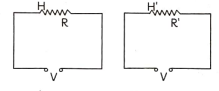
\(\begin{array}{ll} R=\rho \frac{l}{A} & R^{\prime}=\rho \frac{2 l}{\pi(2 r)^2} \\ R=\rho \frac{l}{\pi r^2} & R^{\prime}=\rho \frac{2 l}{\pi 4 r^2} \\ H=\frac{V^2}{R} t \quad \& H^{\prime}=\frac{V^2}{R^{\prime}} t \end{array}\)
V= constant
\(\begin{aligned} \frac{H^{\prime}}{H} & =\frac{V^2}{R^{\prime}} \frac{R}{V^2} \frac{t}{t} \\ & =\frac{R}{R^{\prime}}=\rho \frac{l}{\pi r^2} \frac{2 \pi r^2}{\rho l} \\ \frac{H^{\prime}}{H} & =\frac{2}{1} \\ H^{\prime} & =2 H \end{aligned}\)
7.
We know,
\(\begin{aligned} & v_d=\frac{e \mathrm{E}}{m} \tau \\ & v_d=e \frac{\mathrm{~V}}{m l} \tau \end{aligned}\)
If temperature is kept constant, relaxation time \(\tau-\) will remain constant, and e, m are also constants.
\(\begin{aligned} v_d & \propto \mathrm{~V} \\ 2 v_d & \propto 2 \mathrm{~V} \end{aligned}\)
Thus,correct option is (c).
8.
(c)
Semiconductor
9.
(d)
conservation of charge and conservation of energy
10.
(a)
low resistance in parallel
11.
(a)
25 W
12.
(b)
1536 J
13.
(d)
\(n e v_d\)
14.
(c)
3.6W
15.
(d)
copper decreases and silicon increases
16.
(c)
27 mC
17.
(b)
\(5.0 \times 10^{17}\)
18.
(a)
increase.
19.
(c)
being charged.
20.
(d)
1 A from a to b through e
21.
(d)
the fact that there is no accumulation of charges at a junction.
22.
(c)
CD
23.
(a)
4/3 ohm
24.
(b)
\(2 \mathrm{~V}, 0.4 \Omega\)
25.
(a)
\(v_{d} \propto E\)
26.
(b)
13 V
27.
(a)
0.43 ms -1
28.
(a)
2 x 10⁻³ V/m
29.
(d)
R
30.
(d)
zero
31.
(c)
Potentiometer
32.
(c)
charge
33.
(a)
Two equivalent emf εeq of the two cells is between ε1 and ε2 i.e., ε2 < εeq < ε2
34.
(d)
2Ω
35.
(c)
J = \(\frac{v_{d} e}{n}\)
36.
(a)
number density of electrons as well and relaxation time
37.
(b)
vd \(\propto \) E
38.
(a)
constant
39.
(b)
unchanged
40.
(b)
unchanged
41.
(d)
none of the above characteristics
42.
(c)
Larger length of the wire
43.
(d)
It is a null method
44.
(b)
zero
45.
(c)
2R
46.
(b)
R
47.
(c)
R/3
48.
(d)
none of the above
49.
(a)
4\(\Omega\)
50.
(d)
n2Rp
51.
(a)
vd/4
52.
53.
54.
(a) Both Assertion and Reason are true and Reason is the correct explanation of Assertion.
55.
(d) Assertion is false but Reason is true.
As temperature increases, collison becomes more frequent so average time of collison decreases. More collison means less drift velocity.
56.
(c) Assertion is true but Reason is false.
57.
(a) No, all the free electrons do not move in the same direction. The net movement of the electrons is from lower to higher potential. As a result, there is definite small drift velocity of electrons, which is superimposed on the random motion of free electrons.
58.
(c): The current in a wire is due to flow of free electrons in a definite direction. But the number of protons in the wire at any instant is equal to number of electrons and charge on electrons is equal and opposite to that of proton. Hence, net charge on the wire is zero.
59.
(d): Because there is no special attractive force that keeps a person stuck with a high power line. The actual reason is that a current of the order of 0.05 A or even less is enough to bring disorder in our nervous system. As a result of it, the affected person may lose temporarily his ability to control his nervous system to get himself free from the high power line.
60.
(a): Resistance of 50 watt bulb is two times the resistance of 100 watt bulb. When bulbs are connected in series, 50 watt bulb will glow more as P = i2R (current remains same in series). In parallel, the 100 watt bulb will glow more as P = V2/R (potential difference remain same in parallel).
61.
(d): Since the bulbs are joined in series, so when one bulb is removed from chain then the resistance of the chain is decreased, hence current flowing through each bulb is increased. As heat produced \(\propto i^{2}\) hence light gets increased in the room.
62.
(c): Fuse wire must have high resistance because in series, current remains same. Therefore according to Joule's law \(H=\frac{i^{2} R t}{4.2}\) heat produced is high if R is high. The melting point must be low so that wire may melt with increase in temperature. As a current larger than the specified value flows through the circuit the temperature of the fuse wire increases. This melts the fuse wire and breaks the circuit.
63.
(b): Heater wire must have high resistance and high melting point, because in series current remains same, therefore according to Joule's lawH = i2Rt / 4.2, heat produced is high if R is high. Melting point must be high, so that wire may not melt with increase in temperature.
64.
(c): 1 kWhr = 1 kW x 1 hour
= 1000 (joule/see) x 3600 see = 36 x 105 joule
i.e., kWhr is the unit of electric energy and used for expressing consumed electric energy.
65.
(a): These alloys (constantan or manganin) are used for making standard resistance because they possess high resistivity and low temperature coefficient of resistance
66.
(a): Drift velocity of free electrons is given by \(v_{d}=\frac{e E}{m} \tau\)
where,\(E=\frac{\text { Potential difference }}{\text { length }}=\frac{V}{l}\)
\(\therefore \quad v_{d}=\frac{e V}{m l} \tau \text { i.e., } v_{d} \propto 1 / l \text { where, } \frac{e V \tau}{m}\)
It mean if I is doubled, the drift velocity will become half of the original value.
67.
(b): On increasing temperature of wire the kinetic energy of free electrons increase and so they collide more rapidly with each other and hence their drift velocity decreases. Also when temperature increases, resistance increase and resistance is inversely proportional to conductivity of material.

12th Standard CBSE Syllabus & Materials
12th Standard CBSE
CBSE 12th Computer Science Python Revision Tour I - New Previous year Question Papers Study Material - QB365 Set A
NEW12th Standard CBSE
CBSE 12th Business Studies Planning Important Questions And Answers Study Material - QB365 Set A
NEW12th Standard CBSE
CBSE 12th Business Studies Business Environment Important Questions And Answers Study Material - QB365 Set A
NEW12th Standard CBSE
CBSE 12th Business Studies Principles of Management Important Questions And Answers Study Material - QB365 Set A



NCERT Books

Syllabus

Exam Pattern

Sample Question Papers

Previous year Question Papers

Important Notes

MCQ Practice test

NCERT Exemplers

Case study Questions

Image Based Questions

Passage based Questions

HOT Questions

Value Based Questions

Model Questions Papers
NCERT ( Book Back ) Questions

Assertion and Reason
Important Questions And Answers

CBSE 12th Standard CBSE Subjects
CBSE Standards








