
 100% FREE ACCESS
12th Standard CBSE Syllabus & Materials
12th Standard CBSE
CBSE 12th Economics Government Budget and the Economy Previous year Question Papers Study Material - QB365 Set A
NEW12th Standard CBSE
CBSE 12th Computer Science Interface Python with MySQL - New Previous year Question Papers Study Material - QB365 Set A
NEW12th Standard CBSE
CBSE 12th Computer Science Database Concept - New Previous year Question Papers Study Material - QB365 Set A
NEW12th Standard CBSE
CBSE 12th Computer Science Data Communication - New Previous year Question Papers Study Material - QB365 Set A
NEW12th Standard CBSE
CBSE 12th Computer Science Data Structures - New Previous year Question Papers Study Material - QB365 Set A
NEW12th Standard CBSE
CBSE 12th Computer Science Functions - New Previous year Question Papers Study Material - QB365 Set A

Published on: 02/11/2025
Download CBSE Class 12th Standard CBSE Physics question papers, sample papers, important questions, and previous year solved papers in PDF format. Get free study materials, NCERT solutions, and exam preparation resources for Class 12th Standard CBSE Physics
Questions + Answers key
Take MCQ Physics Test
1.
In a typical nuclear reaction, e.g.
\(_{1}^{2}{H}+_{1}^{2}{H}\longrightarrow_{2}^{3}{He}+n+3.27\)
although number of nucleons is conserved yet energy is released. How? Explain.
Show that nuclear density in a given nucleus is independent of mass number A.
2.
Draw a plot showing the variation of potoelectric current with collector plate potential for two different frequencies, v1 > v2 of incident radiation having the same intensity. In which case will the stopping potential be hgiher ? Justify your answer.
3.
Show that the electron revolving around the nucleus in a radius 'r' with orbital speed 'v' has magnetic movement evr/2.
Hence, using Bohr's postulate of the quantization of angular momentum, obtain the expression for the magnetic of hydrogen atom in its ground state.
4.
Calculate the energy of the following nuclear reaction:
\(_{ 1 }{ { H }^{ 2 } }+_{ 1 }{ { H }^{ 3 } }\rightarrow _{ 2 }{ { He }^{ 4 }+ }_{ 0 }{ { n }^{ 1 } }+Q\)
\(Given \ m(_{ 1 }{ { H }^{ 2 } })=2.014102 \ u\)
\( m(_{ 1 }{ { H }^{ 3 } })=3.016049 \ u\)
\(m(_{ 2 }{ { He }^{ 4 } })=4.002603 \ u\)
\(m(_{ 0 }{ { n }^{ 1 } })=1.008665 \ u\)
5.
Define the term:
(a) (i)Work function
(ii) threshold frequency and
(iii) stopping potential with reference to photoelectric effect
(b) Calculate the maximum kinetic energy of electrons emitted from a photosensitive surface of work function 3.2 eV for the incident radiation of wavelength 300 nm.
6.
Write Einstein's photoelectric equation.Explain the terms of threshold frequency
7.
Explain the term stopping potential and a threshold frequency.
8.
Which semiconductor has more mobility : \(p\)-type or \(n\)-type? Explain.
9.
When a forward bias applied to a p-n junction, it
(a) raises the potential barrier
(b) reduces the majority carrier current to zero
(c) lowers the potential barrier
(d) None of the above
10.
(a) Write two important limitations of Rutherford model which could not explain the observed features of atomic spectra. How were these explained in Bohr's model of hydrogen atom? Use the Rydberg formula to calculate the wavelength of the H∝ line.
(b) Using Bohr's postulates, obtain the expression for the radius of the nth orbit in hydrogen atom.
11.
(a) Describe briefly, with the help of a diagram, the role of the two important processes involved in the formation of a p-n junction.
(b) Name the device which is used as a voltage regulator. Draw the necessary circuit diagram and explain its working.
12.
(a) Draw the circuit arrangement for studying the V - I characteristics of a p-n junction diode in (i) forward and (ii) reverse bias. Briefly explain how the typical V - I characteristics of a diode are obtained and draw these characteristics.
(b) With the help of necessary circuit diagram explain the working ot a photo diode used for detecting optical signals.
13.
(a) Explain with the help of a diagram, how a depletion layer and barrier potential are formed in a junction diode
(b) Draw a circuit diagram of full wave rectifier. Explain its working and draw input and output waveforms full wave rectifier. Explain its working and draw input and output waveforms
14.
(a) Using Bohr's postulates derive the expression for the total energy of the electron in the stationary states of the hydrogen atom.
(b) Using Ryberg formula, calculate the wavelengths of the spectral lines of the first member of the Lyman series and of the Balmer series.
15.
Radiation has dual nature,i.e., it possesses the properties of both; wave and particle.This prompted de-Broglie to predict dual nature of moving material particles.Thus waves are associated with moving material particles which are called matter waves. The wavelength of matter wave is given by \(\lambda =\frac { h }{ mv } \), where m is the mass, v is the speed of the particle and h is Plank's constant. Read the above paragraph and answer the following questions;
(i) How was the wave nature of the electron established?
(ii) What are the de-Broglie wavelength associated with a particle (i) at rest (ii) moving with infinite speed?
(iii) What are the basic values displayed with this study?
1.
In a nuclear reaction, the sum of the masses of the target nucleus \((_{1}^{2}{H})\) and the bombarding particle \((_{1}^{2}{H})\) may be greater less than the sum of the masses of the product nucleus \((_{1}^{3}{He})\) and the outgoing particle \((_{0}^{1}{n})\). So, from the law of conservation of mass-energy, some energy (3.27 MeV) is evolved or involved iRjjl nuclear reaction. This energy is called Q -value of the nuclear reaction.
Density of nuclear matter is the ratio of mass of the nucleus and its volume.
Density of the nuclear matter
= \({{Mass\ of \ nucleus}\over{Volume\ of\ nucleus}}\) ..(i)
If m is average mass of a nucleon and R is the nuclear radius, then mass of nucleus = mA, where, A is the mass number of the element.
Volume of the nucleus = \({{4}\over{3}}\pi{R}^{3}\)
= \({{4}\over{3}}(\pi{R}_{0}{A}^{1/3})^{1/3}={{4}\over{3}}\pi{R}^{3}_{0}A\)
But put the value in Eq. (i).
Thus, density of nucleus = \({ { mA } \over { { { 4 } \over { 3 } } }\pi{R}^{3}_{0} A}={ { 3m } \over { 4\pi{R}^{3}_{0} } }\)
where, m = mass of one nucleon
A = mass
As, m and Ro are constants, therefore density of the nuclear matter is the same for all elements. Now, using m = 1.66 x 10⁻²⁷ kg.
\(={{3\times1.66\times{10}^{-27}}\over{4\pi{R}^{3}_{0}}}\)
Using Ro = 1.1 x 10⁻¹⁵ m
and density = 2.97 x 10¹⁷ kg m-3
which shows that the density is independent of mass number A.
2.
Stopping potential is more for the curve corresponding to frequency V1
Stopping po ential is directly proportional to the frequency of incident radiation.
3.
Magnetic momentum,
\(\mu=\left(\frac{e}{2m}\right)L\)
where (-) indicates \(\mu\) direction to L.
As Bohr's atomic model
L = mvr
\(\mu = - \left(\frac{e}{2m}\right)\times mvr\)
\(\mu = \frac {evr}{2}\)
Energy levels of hydrogen atom
\({E}_{n}=\frac{{2\pi}^{2}{m}{K}^{2}{e}^{4}}{{n}^{2}{h}^{2}}\)
For lowest energy level n = 1
\({E}_{n}=-\frac{{2\pi}^{2}{m}{K}^{2}{e}^{4}}{{n}^{2}{h}^{2}}\)
\({E}_{2}=-\frac{{2\pi}^{2}{m}{K}^{2}{e}^{4}}{{h}^{2}}\)
\(E_1=-\left(\frac{{4\pi}^{2}{m}{Ke}^{2}}{{h}^{2}}\right)\frac{{Ke}^{2}}{2}\)
While \(r=\frac { { h }^{ 2 } }{ { 4n }^{ 2 }{ kme }^{ 2 } } \)
\({ E }_{ n }=-\frac { { Ke }^{ 2 } }{ 2r } =\frac { -3.6 }{ { n }^{ 2 } } eV\)
\(\therefore \mu =\frac { eVr }{ 2 } \)
\({ E }_{ 1 }=-\frac { Kev.er }{ { 2vr }^{ 2 } } =-13.6\)
\(\frac { k\mu e }{ { vr }^{ 2 } } =-13.6\)
\(\mu =13.6\left( \frac { { ur }^{ 2 } }{ Ke } \right) \)
4.
In the given nuclear reaction,
Mass of reactants = \(m(_{ 1 }{ { H }^{ 2 } })+m(_{ 1 }{ { H }^{ 3 } })\)
\( =2.014102+3.016049\)
\( =5.030151u\)
Mass of products
\(m(_{ 2 }{ { He }^{ 4 } })+m(_{ 0 }{ { n }^{ 1 } })\)
\(=4.002603+1.008665\)
\( =5.011268u\)
\(Mass \ defect,\Delta m=5.030151-5.011268\)
\(=0.018883u\)
\(Energy \ released=0.018883\times 931 \ MeV\)
\( =17.58MeV\)
5.
0.9 eV
6.
Einstein's photoelectric equation,
K.E. of photoelectron = Incident energy of photons - Work function
or K.E = hv - W0
or K.E = hv - hv0
where v0 is called threshold frequency
Threshold Frequency : For a given metal, there exists a certain minimum frequency of the incident radiation below which no emission of photoelectrons takes place. This frequency is called threshold frequency.
7.
It is the minimum negative potential given to the anode in a photocell for which the photoelectric current becomes zero. If \({ v }_{ 0 }\) is the stopping potential, then maximum K.E. of emitted photoelectron is
\({ \left( K.E \right) }_{ max }={ eV }_{ 0 }=hv-{ \phi }_{ 0 }\)
\(V_{ 0 }=\frac { hv }{ e } -\frac { { \phi }_{ 0 } }{ e } \)
Threshold frequency It is the minimum frequency of the incident radiation for which just emission of photoelectrons takes place from a metal surface without any K.E. If \(V_{ 0 }\)is the threshold frequency, then using Einstein's photoelectric equation
\(0={ hv }_{ 0 }-{ \phi }_{ 0 }\quad or\quad V_{ 0 }=\frac { { \phi }_{ 0 } }{ h } \)
8.
The mobility of electrons in \(n\)-type semiconductor is more than the mobility of holes in \(p\)-type semiconductor. Since the \(n\)-type semiconductor has electrons as majority carriers and holes as minority carriers, whereas the \(p\)-type semiconductor has holes as majority carriers and electrons as minority carriers, therefore mobility of \(n\)-type is more than that of \(p\)-type.
9.
The correct statement is (c).
When a forward bias is applied to a p-n junction, it lowers the value of potential barrier. In the case of a forward bias, the potential barrier opposes the applied voltage. Hence, the potential barrier across the junction gets reduced.
10.
(a) (i) Electron moving in a circular orbit around the nucleus would get accelerated, therefore it would spiral into the nucleus, as it looses its energy.
(ii) It must emit a continuous spectrum. According to Bohr's model of hydrogen atom
(i) Electron in an atom can revolve in certain stable orbits without the emission of radiant energy
11.
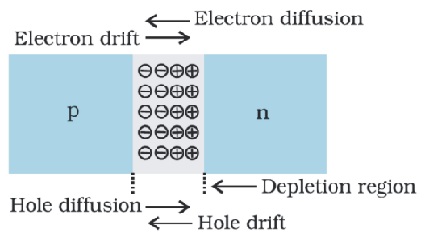
The two processes are
(i) Diffusion
(ii) Drift
Diffusion : Holes diffuse from p-side to n-side (p \(\rightarrow \) n) and electrons diffuse from n-side to p-side (n\(\rightarrow \) p)
Drift: The motion of charge carriers, due to the applied electric field \((\vec { E } )\) which results in drifting of holes along E and of electrons opposite to that of electric field \((\vec { E } )\)).
(b) Name of device: Zener Diode
Working:
Any increase I decrease in the input voltage results in an increase I decrease of the voltage drop across R,; without any change in voltage across the Zener diode. Thus Zener diode acts as voltage regulator.
12.
.png)
Reverse biasing
.png)
The VI characteristics are obtained by connecting the battery, to the diode, through a potentiometer (or rheostat). The applied voltage to the diode is changed. The values of current, for different values of voltage, are noted and a graph between V and I is plotted. The V-I characteristics, of a diode, have the form shown here.
.png)
(b) The circuit diagram, for the photodiode, is shown here.
.png)
The photodiode is illuminated by optical signal, whose photon energy is greater than the energy gap of the semiconductor used.
The electric field, at the junction, separates the electrons and holes and thus gives rise to an emf.
When an external load is connected, a (photo) current flows through it. The magnitude of this current is proportional to the intensity of light incident on the photodiode.
13.
.png)
(a) Due to the diffusion of electrons and the holes, from their majority zone to minority zone, a layer of positive and negative space charge region on either side on the junction is formed. This is called the depletion region.
The loss of electrons, from n-region and gain of electrons by the p-region, causes a difference of potential across the junction. This tends to prevent the movement of charge carriers across the junction and is, therefore, termed as barrier potential.
.png)
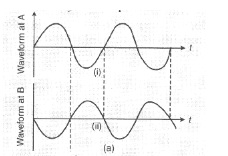
For positive half cycle of input ac, one of the two diodes gets forward biased and conducts and output current is obtained across the load RL, For negative half cycle of input ac, the other diode
gets forward biased and thus output current is obtained due to it. Therefore, output is obtained for both the cycles of input ac.
.png)
14.
\(mvr = \frac {nh}{2\pi}\)
\(\frac { { mv }^{ 2 } }{ r } =\frac { 1 }{ 4\pi { \varepsilon }_{ 0 } } \frac { { e }^{ 2 } }{ { r }^{ 2 } } \)
\(r=\frac { { e }^{ 2 } }{ { 4\pi \varepsilon }_{ 0 }{ mv }^{ 2 } } \)
\(r=\frac { { Ze }^{ 2 } }{ { 4\pi \varepsilon }_{ 0 }m{ \left( \frac { nh }{ 2\pi mr } \right) }^{ 2 } } \)
\(\Rightarrow\) \(r=\frac { { \epsilon }_{ 0 }{ n }^{ 2 }{ h }^{ 2 } }{ { \pi me }^{ 2 } } \)
Potential energy U \(=-\frac { 1 }{ 4{ \pi \epsilon }_{ 0 } } .\frac { { e }^{ 2 } }{ { r } } \)
\(=\frac { { me }^{ 4 } }{ { 4\epsilon }_{ 0 }{ n }^{ 2 }{ h }^{ 2 } } \)
\(KE=\frac { 1 }{ 2 } { mv }^{ 2 }=\frac { 1 }{ 2 } m{ \left( \frac { nh }{ 2\pi mr } \right) }^{ 2 }\)
\(=\frac { { n }^{ 2 }{ h }^{ 2 }{ \pi }^{ 2 }{ m }^{ 2 }{ e }^{ 4 } }{ { 8\pi }^{ 2 }{ me }_{ 0 }^{ 2 }{ n }^{ 2 }{ h }^{ 2 } } \)
\(KE=\frac { { me }^{ 4 } }{ { 8\varepsilon }_{ 0 }^{ 2 }{ n }^{ 2 }{ h }^{ 2 } } \)
TE = KE + PE
\(=-\frac { { me }^{ 4 } }{ { 8\epsilon }_{ 0 }^{ 2 }{ n }^{ 2 }{ h }^{ 2 } } \)
(b)Rydberg formula: For first member of Lyman series
\(\frac { 1 }{ \lambda } =R\left( \frac { 1 }{ { 1 }^{ 2 } } -\frac { 1 }{ { 2 }^{ 2 } } \right) \)
\(=\frac { 4 }{ 3R } \)
For first member of Balmer Series
\(\frac { 1 }{ \lambda } =R\left( \frac { 1 }{ { 2 }^{ 2 } } -\frac { 1 }{ { 3 }^{ 2 } } \right) \)
\(\lambda =\frac { 36 }{ 5R } \)
15.
(i) Davisson and Germer observed diffraction patterns of slow moving electrons. And G.P. Thomson observed a diffraction pattern of fast moving electrons. As diffraction is essentially a wave phenomenon, therefore, it was concluded that wave must be associated with moving electrons.
(ii) (a) At rest, v = 0, \(=\frac { h }{ mv } =\frac { h }{ m\times 0 } =\infty \)
(b) Particle moving with infinite speed, v = \(\infty \)
\(\lambda =\frac { h }{ mv } =\frac { h }{ m\times \infty } \)
(iii) The dual nature of moving material particles reveals in a way the nature of Almighty God. He is in a visible form (i.e., Sakar) like a visible particle and also without any form (i.e., Nirakar) like a wave.It depends on us how we realize him.

12th Standard CBSE Syllabus & Materials
12th Standard CBSE
CBSE 12th Computer Science Python Revision Tour I - New Previous year Question Papers Study Material - QB365 Set A
NEW12th Standard CBSE
CBSE 12th Business Studies Planning Important Questions And Answers Study Material - QB365 Set A
NEW12th Standard CBSE
CBSE 12th Business Studies Business Environment Important Questions And Answers Study Material - QB365 Set A
NEW12th Standard CBSE
CBSE 12th Business Studies Principles of Management Important Questions And Answers Study Material - QB365 Set A



NCERT Books

Syllabus

Exam Pattern

Sample Question Papers

Previous year Question Papers

Important Notes

MCQ Practice test

NCERT Exemplers

Case study Questions

Image Based Questions

Passage based Questions

HOT Questions

Value Based Questions

Model Questions Papers
NCERT ( Book Back ) Questions

Assertion and Reason
Important Questions And Answers

CBSE 12th Standard CBSE Subjects
CBSE Standards








