
 100% FREE ACCESS
12th Standard CBSE Syllabus & Materials
12th Standard CBSE
CBSE 12th Economics Government Budget and the Economy Previous year Question Papers Study Material - QB365 Set A
NEW12th Standard CBSE
CBSE 12th Computer Science Interface Python with MySQL - New Previous year Question Papers Study Material - QB365 Set A
NEW12th Standard CBSE
CBSE 12th Computer Science Database Concept - New Previous year Question Papers Study Material - QB365 Set A
NEW12th Standard CBSE
CBSE 12th Computer Science Data Communication - New Previous year Question Papers Study Material - QB365 Set A
NEW12th Standard CBSE
CBSE 12th Computer Science Data Structures - New Previous year Question Papers Study Material - QB365 Set A
NEW12th Standard CBSE
CBSE 12th Computer Science Functions - New Previous year Question Papers Study Material - QB365 Set A

Published on: 07/03/2026
Download CBSE Class 12th Standard CBSE Physics question papers, sample papers, important questions, and previous year solved papers in PDF format. Get free study materials, NCERT solutions, and exam preparation resources for Class 12th Standard CBSE Physics
Questions + Answers key
Take MCQ Physics Test
1.
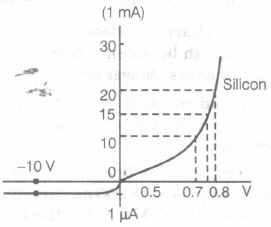
The V-I characteristic of a silicon diode is as shown in the figure. Calculate the resistance of the diode at
(i) I = 15 mA and
(ii) V = -10 V
2.
(i) How does one explain the emission of electrons from a photosensitive surface with the help of Einstein's photoelectric equation?
(ii) The work function of the following metals is given as Na = 2.75 eV, K = 2.3eV, MO = 4.17 eV and Ni = 5.15eV. Which of these metals will not cause photoelectric emission for radiation of wavelength 3300 Å from a laser source placed 1 m away from these metals? What happens if the laser source is brought nearer and placed 50 cm away?
3.
(i) The radius of the innermost electron orbit of a hydrogen atom is \({ r }_{ 1 }=5.3\times 10^{ -11 }\) Calculate its radius in n=2 orbit.
(ii) The total energy of an electron in the second excited state of the hydrogen atom is -1.51eV. Find out its
(a) kinetic energy and
(b) potential energy in this state
4.
Write Einstein's photoelectric equation and mention which important features in photoelectric effect can be explained with the help of this equation. The maximum kinetic energy of the photoelectrons gets doubled when the wavelength of light incident on the surface changes from \({ \lambda }_{ 1 } \ to \ { \lambda }_{ 2 }\). Derive the expressions for the threshold wavelength \({ \lambda }_{ 0 }\)and work function for the metal surface.
5.
The work function for cesium is 1.8eV. Light of \(4500\mathring { A } \) is incident on it. Calculate
(i) the maximum kinetic energy of the emitted photoelectron
(ii) maximum velocity of the emitted photoelectron
(iii) if the intensity of the incident light is doubled, then find the maximum kinetic energy of the emitted photoelectron
Given \(h=6.6\times { 10 }^{ -34 }Js,\ { m }_{ e }=9.1\times { 10 }^{ -31 }kg, \ c=3\times { 10 }^{ 8 }{ ms }^{ -1 }\)
6.
The ground state energy of hydrogen atom is -13.6 eV.
(i) What are the potential energy and K.E of electron is 3rd excited state?
(ii) If the electron jumps to the frequency of photon emitted.
7.
The neutron separation energy is defined to be the energy required to remove a neutron from a nucleus. Obtain the neutron separation energies of the nuclei \(\begin{matrix} 41 \\ 20 \end{matrix}Ca \ and \ \begin{matrix} 27 \\ 13 \end{matrix}Al\) from the following data: \(m(\begin{matrix} 40 \\ 20 \end{matrix}Ca)=39.962591u,\)
\(\\ m(\begin{matrix} 41 \\ 20 \end{matrix}Ca)=40.962278u,\)
\(m(\begin{matrix} 26 \\ 13 \end{matrix}Al)=25.986895u,\)
\(\\ m(\begin{matrix} 27 \\ 13 \end{matrix}Al)=26.986895u,\)
8.
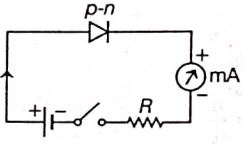
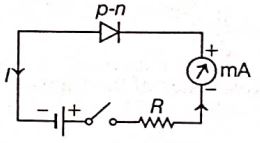
Draw the circuit diagram of a p-n junction diode in
(i) forward biasing and
(ii) reverse biasing, Also, draw its I-V characteristics in the two cases.
9.
If light of wavelength 412.5 nm is incident on each of the metals given below, which ones will show photoelectric emission and why?
| Metal | Work Function (eV) |
| Na | 1.92 |
| K | 2.15 |
| Ca | 3.20 |
| Mo | 4.17 |
10.
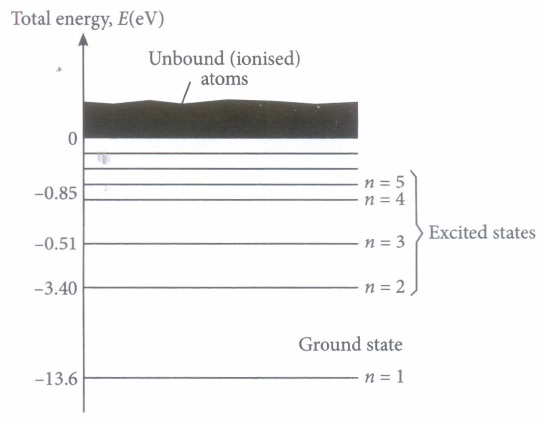
The figure shows energy level diagram of hydrogen atom.
(i) Find out the transition which results in the emission of a photon of wavelength 496 nm.
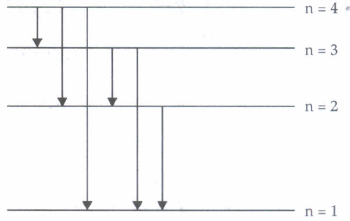
(ii) Which transition corresponds to the emission of radiation of maximum wavelength? justify your answer.
11.
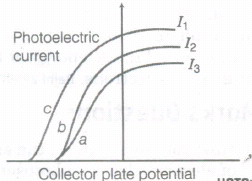
The figure shows a plot of three curves a, b, c showing the variation of photocurrent versus collector plate potential for three different intensities I1,I2 and I3 having frequencies v1, v2 and v3, respectively incident on a photosensitive surface.
Point out the two curves for which the incident radiations have same frequency but different intensities.
12.
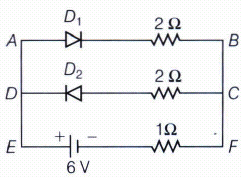
Assuming that the two diodes D1 and D2 used in the electric circuit as shown in the figure are ideal, find out the value of the current flowing through 1 \(\Omega \) resistor.
13.
Consider a metal exposed to light of wavelength 600nm.The maximum energy of the electron doubles when light of wavelength 400nm is used.Find the work function in eV.
14.
The de-Broglie Wavelength of a particle of kinetic energy K is \({ \lambda }\) What would be the de-Broglie wavelength of the particle, if its kinetic energy were K/4?
15.
Two beams one of red light and other of blue light of the same intensity are incidents on a metallic surface to emit photoelectrons. Which one of the two beam emits photoelectrons. Which one of the two beam emits electrons of greater kinetic energy?
16.
In Rutherford scattering experiment, if a proton is taken instead of an alpha particle, then for same distance of closest approach, how much K.E. in comparison to K.E of \(\alpha \) particle will be required?
17.
(a) Explain with the help of a diagram, how a depletion layer and barrier potential are formed in a junction diode
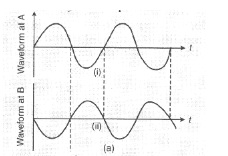
(b) Draw a circuit diagram of full wave rectifier. Explain its working and draw input and output waveforms full wave rectifier. Explain its working and draw input and output waveforms
18.
The number of silicon atoms per m3 is 5 x 1028. This is doped simultaneously with 5 x 10²² atoms per m3 of Arsenic and 5 x 10²⁰ atoms per m3 of Indium. Calculate the number of electrons and holes. Given that ni = 1.5 x 10¹⁶ m–3. Is the material n-type or p-type?
19.
At room temperature, most of the H-atoms are in ground state. When an atom receives some energy (i.e., by electron collisions), the atom may acquire sufficient energy to raise electron to higher energy state. In this condition, the atom is said to be in excited state. From the excited state, the electron can fall back to a state of lower energy emitting a photon equal to the energy difference of the orbit.
In a mixture of H-He+ gas (He+ is single ionized He atom), H-atoms and He+ ions are excited to their respective first excited states. Subsequently, H-atoms transfer their total excitation energy to He+ ions (by collisions).
(i) The quantum number n of the state finally populated in He+ ions is
| (a) 2 | (b) 3 | (c) 4 | (d) 5 |
(ii) The wavelength of light emitted in the visible region by He+ ions after collisions with H-atoms is
| (a) 6.5 x 10⁻⁷ m | (b) 5.6 x 10⁻⁷ m | (c) 4.8 x 10⁻⁷ m | (d) 4.0 x 10⁻⁷ m |
(iii) The ratio of kinetic energy of the electrons for the H-atoms to that of He+ ion for n = 2 is
| \(\text { (a) } \frac{1}{4}\) | \(\text { (b) } \frac{1}{2}\) | (c) 1 | (d) 2 |
(iv) The radius ofthe ground state orbit of H-atoms is
| \(\text { (a) } \frac{\varepsilon_{0}}{h \pi m e^{2}}\) | \(\text { (b) } \frac{h^{2} \varepsilon_{0}}{\pi m e^{2}}\) | \(\text { (c) } \frac{\pi m e^{2}}{h}\) | \(\text { (d) } \frac{2 \pi h \varepsilon_{0}}{m e^{2}}\) |
(v) Angular momentum of an electron in H-atom in first excited state is
| \(\text { (a) } \frac{h}{\pi}\) | \(\text { (b) } \frac{h}{2 \pi}\) | \(\text { (c) } \frac{2 \pi}{h}\) | \(\text { (d) } \frac{\pi}{h}\) |
20.
Niels Bohr introduced the atomic Hydrogen model in 1913. He described it as a positively charged nucleus, comprised of protons and neutrons, surrounded by a negatively charged electron cloud. In the model, electrons orbit the nucleus in atomic shells. The atom is held together by electrostatic forces between the positive nucleus and negative surroundings.
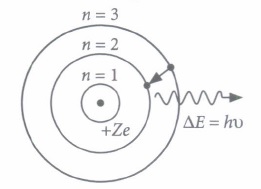
Bohr correctly proposed that the energy and radii of the orbits of electrons in atoms are quantized, with energy for transitions between orbits given by
\(\Delta E=h v=E_{i}-E_{f}\) Where \(\Delta E\) is the change in energy between the initial and final orbits and hv is the energy of an absorbed or emitted photon.
(i) In the Bohr model of the hydrogen atom, discrete radii and energy states result when an electron circles the atom in an integer number of
| (a) de Broglie wavelengths | (b) wave frequencies |
| (c) quantum numbers | (d) diffraction patterns. |
(ii) The angular speed of the electron in the nth orbit of Bohr's hydrogen atom is
| (a) directly proportional to n | (b) inversely proportional to \(\sqrt{n}\) |
| (c) inversely proportional to n2 | (d) inversely proportional to n3 |
(iii) When electron jumps from n = 4 level to n = 1 level, the angular momentum of electron changes by
| \(\text { (a) } \frac{h}{2 \pi}\) | \(\text { (b) } \frac{h}{\pi}\) | \(\text { (c) } \frac{3 h}{2 \pi}\) | \(\text { (d) } \frac{2 h}{\pi}\) |
(iv) The lowest Bohr orbit in hydrogen atom has
| (a) the maximum energy | (b) the least energy |
| (c) infinite energy | (d) zero energy |
(v) Which of the following postulates of the Bohr modelled to the quantization of energy of the hydrogen atom?
| (a) The electron goes around the nucleus in circular orbits. |
| (b) The angular momentum of the electron can only be an integral multiple of h/2\(\pi\) |
| (c) The magnitude of the linear momentum of the electron is quantized. |
| (d) Quantization of energy is itself a postulate of the Bohr model. |
1.
Considering the diode characteristics as a straight line between I = 10 mA to I = 20 mA passing through the origin, we can calculate the resistance using Ohm’s law.
(a) From the curve, at I = 20 mA, V = 0.8 V, I = 10 mA, V = 0.7 V
\(r_{f b}=\Delta V / \Delta I=0.1 \mathrm{~V} / 10 \mathrm{~mA}=10 \ \Omega\)
(b) From the curve at V = –10 V, I = –1 \(\mu\) A,
Therefore,
\(r_{r b}=10 \mathrm{~V} / 1 \mu \mathrm{A}=1.0 \times 10^{7} \ \Omega\)
2.
(i) From Einstien's photoelectric equation, we have,
Kmax = hf\({ \phi }_{ 0 }\)
where, Kmax is maximum kinetic energy of the photoelectrons, G>o is work function and hf is energy of the incident photon.
As Kmax ≥ 0
So, \(hf-{ \phi }_{ 0 }\ge 0 \ or \ f\ge \frac { { \phi }_{ 0 } }{ h } \)
Thus, photoemission occurs, when frequency is greater than threshold frequency, \({ f }_{ 0 }\ge \frac { { \phi }_{ 0 } }{ h } \)
Energy of the incident radiation of wavelength \(\lambda \),
\(E=\frac { hc }{ \lambda } =\frac { \left( { 6.63\times 10 }^{ -34 } \right) \times \left( { 3\times 10 }^{ 8 } \right) }{ 3300\times { 10 }^{ -10 }\times 1.6\times { 10 }^{ -19 } } =3.76eV\)
This energy of the incident radiation is greater than the work function of Na and K but less than those of Mo and Ni. so photoelectric emission will occur only in Na and K metals and not in Mo and Ni.
If the laser is brought closer, the intensity of incident radiation increases. This does not affect the result regarding Mo and Ni metals, while photoelectric current from Na and K will increase in proportion to intensity.
3.
Given, Bohr's radius, \({ r }_{ 1 }=5.3\times 10^{ -11 }\)
We know that, \({ r }_{ n }=n^{ 2 }{ r }_{ 1 }\)
Let be radius of the orbit for n = 2
Therefore, \(r_{ 2 }=(2)^{ 2 }\times 5.3\times 10^{ -11 }\quad =2.12\times 10^{ -10 }m\)
(ii) Given, total energy of an electron in second excited state,
E = 1.51 eV
(a) Kinetic energy of electron is equal to negative of the total energy
\(\Rightarrow \) K = -E = -(-1.51) = 1.51 eV
(b) Potential energy of electron is equal to negative of twice of its kinetic energy
\(\Rightarrow \) U = -2K = -2 x 1.51 = -3.02 eV
4.
Einstein's photoelectric equations and its features
According to the photoelectric equation,
\({ K }_{ max }=\frac { 1 }{ 2 } { mv }_{ max }^{ 2 }=hv-{ \phi }_{ 0 }\)
\({ K }_{ max }=\frac { hc }{ { \lambda }_{ 1 } } -{ \phi }_{ 0 }\ ........... (i)\)
Let the maximum kinetic energy for the incident radition (of wavelength \({ \lambda }_{ 2 }\)) be \({ K }_{ max }^{ ' }\).
\(\Rightarrow \ { K }_{ max }^{ ' }=\frac { hc }{ { \lambda }_{ 2 } } -{ \phi }_{ 0 } ........... (ii)\)
From Eqs. (i) and (ii), we get
\(\frac { hc }{ { \lambda }_{ 0 } } -{ \phi }_{ 0 }=2\left( \frac { hc }{ { \lambda }_{ 1 } } -{ \phi }_{ 0 } \right) \quad \quad [\because { K }_{ max }^{ ' }=2\quad { K }_{ max }]\)
\( \Rightarrow \quad { \phi }_{ 0 }=hc(\frac { 2 }{ { \lambda }_{ 1 } } -\frac { 1 }{ { \lambda }_{ 2 } } )\)
\( \Rightarrow h{ v }_{ 0 }=hc(\frac { 2 }{ { \lambda }_{ 1 } } -\frac { 1 }{ { \lambda }_{ 2 } } )\)
\( \frac { c }{ { \lambda }_{ 0 } } =c(\frac { 2 }{ { \lambda }_{ 1 } } -\frac { 1 }{ { \lambda }_{ 2 } } )\)
\(\\ \Rightarrow \frac { 1 }{ { \lambda }_{ 0 } } =(\frac { 2 }{ { \lambda }_{ 1 } } -\frac { 1 }{ { \lambda }_{ 2 } } )\)
\(\Rightarrow { \lambda }_{ 0 }=(\frac { { \lambda }_{ 1 }{ \lambda }_{ 2 } }{ 2{ \lambda }_{ 2 }-{ \lambda }_{ 1 } } )\)
5.
\(Here \ { \phi }_{ 0 }=1.8eV,\lambda =4500 \ A=4.5\times { 10 }^{ -7 }m\)
(i) Max K.E of emitted photoelectron is
\({ K }_{ max }=\frac { hc }{ \lambda } -{ \phi }_{ 0 }\)
\( =\frac { (6.6\times { 10 }^{ -34 })(3\times { 10 }^{ 8 }) }{ 4.5\times { 10 }^{ -7 } } -1.8\times 1.6\times { 10 }^{ -19 }\)
\( =4.4\times { 10 }^{ -19 }-2.88\times { 10 }^{ -19 }=1.52\times { 10 }^{ -19 }J\)
(ii)Max. velocity of emitted photoelectron
\({ v }_{ max }=\sqrt { \frac { { 2K }_{ max } }{ m } } =\sqrt { \frac { 2\times 1.52\times { 10 }^{ -19 } }{ 9.1\times { 10 }^{ -31 } } }\)
\( =5.78\times { 10 }^{ 5 }{ ms }^{ -1 }\)
(iii) The kinetic energy of the emitted photoelectron is an incident of the intensity of the incident light. Hence, if the intensity of incident light is doubled the max. K.E of the emitted photoelectron electrons remains unchanged.
6.
\((i) \ -1.7eV; \ 0.85 \ eV; \ (ii) \ 3\times { 10 }^{ 15 }Hz\)
Here, \({ E }_{ 1 }=-13.6\quad eV\)
For third excited state, n = 4
\(\therefore \ { E }_{ 4 }=\frac { -13.6 }{ { 4 }^{ 2 } } =-0.85 \ eV\)
\( \therefore K.E=-{ E }_{ 4 }=0.85eV\)
\( P.E=-2(K.E)=-2(0.85)eV=-1.70eV\)
Energy emitted, \(\Delta E={ E }_{ 4 }-{ E }_{ 1 }\)
\(hv=-0.85-(-13.6)eV=12.75 \ eV\)
\(v=\frac { 12.75\times 1.6\times { 10 }^{ -19 } }{ 6.6\times { 10 }^{ -34 } } =3\times { 10 }^{ 15 }Hz\)
7.
Neutron separation energy \({ S }_{ n }\) of a nucleus \(\\ \begin{matrix} A \\ X \end{matrix}X\)
Given by \({ S }_{ n }=[{ m }_{ N }(\begin{matrix} A-1 \\ Z \end{matrix}X)+{ m }_{ n }-{ m }_{ N }(\begin{matrix} A \\ X \end{matrix}X)]{ c }^{ 2 }\).
Adding and subtracting the term \({ Zm }_{ C }\) in the bracket above ignoring mass defects due to electronic binding energies we get \({ S }_{ n }\) in terms of atomic masses.
\({ S }_{ n }=[{ m }_{ N }=(\begin{matrix} A-1 \\ Z \end{matrix}X)+{ m }_{ n }-{ m }(\begin{matrix} A \\ Z \end{matrix}X)]{ c }^{ 2 }\)
\({ S }_{ n }(\begin{matrix} 41 \\ 20 \end{matrix}X)=[39.96259+1.008665-40.962278)]u,\)
\(=[40.971255-40.962278]931.5\)
\(=0.008978 \times 931.5\)
\(=8.363 \ MeV.\)
\(\\ Neutron \ separation \ energy \ for \ \begin{matrix} 27 \\ 13 \end{matrix}Al\)
\({ S }_{ n }(\begin{matrix} 27 \\ 13 \end{matrix}Al)=[{ m }_{ N }(\begin{matrix} 26 \\ 13 \end{matrix}Al)+{ m }_{ n }-{ m }_{ N }(\begin{matrix} 27 \\ 13 \end{matrix}Al)]{ c }^{ 2 }\)
\({ S }_{ n }(\begin{matrix} 27 \\ 13 \end{matrix}Al)=[25.986895+1.0008665-26.981541]u\)
\( =[26.99556-26.981541]931.5\)
\( =0.014019 \times 931.5\)
\(=13.06 \ MeV.\)
8.
Circuit diagram of a p-n junction diode in
(i) Forward biasing
(ii) Reverse biasing
I-V characteristics of p-n junction diode
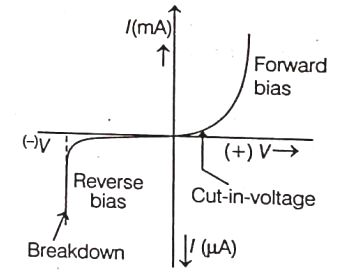
9.
Given, \(\lambda=412.5 \mathrm{nm}=412.5 \times 10^{-9} \mathrm{~m}\)
\( \therefore \ E =\frac{h c}{\lambda}=\frac{6.63 \times 10^{-34} \times 3 \times 10^{8}}{412.5 \times 10^{-9} \times 1.6 \times 10^{-19}} \mathrm{eV}\)
\( =3.01 \mathrm{eV}\)
From the given question, work function (\(\phi\))of the following metals are given as
\(\mathrm{Na} \rightarrow 1.92, \mathrm{~K} \rightarrow 2.15 \)
\(\mathrm{Ca} \rightarrow 3.20, \mathrm{Mo} \rightarrow 4.17 \)
As the given energy is greater than the work function of Na and K only, hence these metals shows photoelectric emission.
10.
(i) For hydrogen atom,
E1 = -13.6 eV
E2 = -3.4 eV
E3 = -1.51 eV
E4 = -0.85 eV
h = 6.63x10⁻³⁴ Js;
c = 3 x 10⁸ ms-1
Photon Energy = \(\frac{hc}{\lambda}\)
=\(\frac{6.63\times 10^{-34}\times 3\times 10^{8}}{496\times 10{-9}\times 1.6\times10^{-19}}\)
= 2.5 eV
This equals (nearly) the difference (E4- E2).
Hence the required transition is (n = 4) to ( n = 2)
(ii) The transition n = 4 to n = 3 corresponds to emission of radiation of maximum wavelength.
It is so because this transmission gives out the photon of least energy.
11.
The photoelectric current is directly proportional to the intensity of incident radiation. Energy of photoelectrons or cut-off potential depends on frequency of incident radiation. Curves, a and b have got same cut-off potential, so for these two curves frequencies will be same.
12.
According to the question,
D2 is in reverse bias, so it acts as open circuit
\(\begin{aligned}
R_{\mathrm{eq}} & =2+1=3 \Omega
\end{aligned}\)
\(\begin{aligned}
I & =\frac{V}{R_{\mathrm{eq}}}=\frac{6}{3}=2 \mathrm{~A}
\end{aligned}\)
13.
Given, for the first condition, \(\lambda\) = 600 nm
For the second condition, \(\lambda\)' = 400nm
K'max = 2Kmax
Here, \(K_{\max }^{\prime}=\frac{h c}{\lambda}-\phi \Rightarrow 2 K_{\max }=\frac{h c}{\lambda^{\prime}}-\phi_0\)
\( \Rightarrow 2\left(\frac{1240}{600}-\phi\right) \approx\left(\frac{1240}{400}-\phi\right)[\because h c \approx 1240 \mathrm{eV}-\mathrm{nm}] \\ \Rightarrow \phi=\frac{1240}{1200}=1.03 \mathrm{eV} \)
14.
As we know, de-Broglie wavelength \(\lambda=\frac{h}{p}=\frac{h}{\sqrt{2 m K}}\)
\(K_1=\frac{h^2}{2 m \lambda_1^2}\)
If according of the questions
\( K_2 =\frac{K_1}{4} \\ K_2 =\frac{h^2}{2 \lambda_2^2} \\ \frac{K_1}{4} =\frac{h^2}{2 m \lambda_2^2} \)
From Eqs. (i) and (ii), we get
\( \frac{\frac{K_1}{4}}{K_1}=\frac{h^2}{2 m \lambda_2^2} \times \frac{2 m \lambda_1^2}{h^2} \\ \frac{1}{4}=\frac{\lambda_1^2}{\lambda_2^2} \\ \Rightarrow \quad \frac{\lambda_1}{\lambda_2}=\frac{1}{2} \)
Hence, wavelength of the particle double the wavelength when kineettiic energy is 1/4th.
15.
The energy of blue light \((h v)_{b l u e}\) is greater than the energy of red light. \((h v)_{r e d}\) In photoelectric emission, max K.E. of emitted electron
\(=h v-\phi_0, \text { i.e., } \max K . E \alpha(h v)\)
So, K.E of emitted electrons is more with blue light than that of red light.
16.
At the distance of closest approach \(\left( { r }_{ 0 } \right) \),
\(K{ E }_{ \alpha }=\frac { \left( Ze \right) \left( 2e \right) }{ 4\pi { \epsilon }_{ 0 }{ r }_{ 0 } } \) and \(K{ E }_{ p }=\frac { \left( Ze \right) \left( e \right) }{ 4\pi { \epsilon }_{ 0 }{ r }_{ 0 } }\).
Clearly, \(K{ E }_{ p }=\frac { 1 }{ 2 } K{ E }_{ \alpha } \)
17.
.png)
(a) Due to the diffusion of electrons and the holes, from their majority zone to minority zone, a layer of positive and negative space charge region on either side on the junction is formed. This is called the depletion region.
The loss of electrons, from n-region and gain of electrons by the p-region, causes a difference of potential across the junction. This tends to prevent the movement of charge carriers across the junction and is, therefore, termed as barrier potential.
.png)
For positive half cycle of input ac, one of the two diodes gets forward biased and conducts and output current is obtained across the load RL, For negative half cycle of input ac, the other diode
gets forward biased and thus output current is obtained due to it. Therefore, output is obtained for both the cycles of input ac.
.png)
18.
For each atom doped with arsenic, one free electron is received. Similarly, for each atom doped of indium, a vacancy is created. So, number of free electrons introduced by pentavalent impurity is
\(N_{\mathrm{As}}=5 \times 10^{22} \mathrm{~m}^{-3}\)
The number of holes introduced by trivalent impurity added is
\(N_{\mathrm{I}}=5 \times 10^{20} \mathrm{~m}^{-3}\)
So, net number of electrons added is
ne = NAs - N1
\(\begin{aligned}
=5 \times 10^{22}-5 \times 10^{20}
\end{aligned}\)
\(\begin{aligned}
=4.95 \times 10^{22} \mathrm{~m}^{-3}
\end{aligned}\)
We know that, \(n_e n_h=n_i^2\)
So, \(n_h=\frac{n_i^2}{n_e}=\frac{\left(1.5 \times 10^{16}\right)^2}{4.95 \times 10^{22}}\)
\(=4.54 \times 10^9 \mathrm{~m}^{-3}\)
As, ne > nh (number of holes). So, the material is n-type semiconductor.
19.
(i) (c) : \(E_{n}=\frac{-13.6}{n^{2}}\left(Z^{2}\right)\)
In first excited state \(E_{\mathrm{H}_{2}}=3.4 \mathrm{eV} \text { and } E_{\mathrm{He}}=-13.6 \mathrm{eV}\)
So, H2 atom gives excitation energy
(13.6- 3.4 = 10.2 eV) to helium atom
Now, energy of He ion = -13.6 + 10.2 = -3.4 eV
Again, \(E=\frac{-13.6}{n^{2}} \times Z^{2}\)
\(\Rightarrow \quad-3.4=\frac{-13.6}{n^{2}} \times(2)^{2} \Rightarrow n=4\)
(ii) (c): \(\frac{1}{\lambda}=\frac{13.6 Z^{2}}{h c}\left[\frac{1}{n_{1}^{2}}-\frac{1}{n_{2}^{2}}\right]\)
Here, \(n_{1}=3 \text { and } n_{2}=4 \Rightarrow \lambda=4.8 \times 10^{-7} \mathrm{~m}\)
(iii) (a): \(\text { Kinetic energy, } K \propto \frac{Z^{2}}{n^{2}}\)
\(\frac{K_{\mathrm{H}_{2}}}{K_{\mathrm{He}}}=\left(\frac{Z_{\mathrm{H}_{2}}}{Z_{\mathrm{He}}}\right)^{2}=\left(\frac{1}{2}\right)^{2}=\frac{1}{4}\)
(iv) (b): Radius of the permitted orbit is \(r=\frac{n^{2} h^{2} \varepsilon_{0}}{\pi m Z e^{2}}\) For hydrogen atom in ground state, i.e.,|
\(n=1, Z=1 \Rightarrow r=\frac{h^{2} \varepsilon_{0}}{\pi m e^{2}}\)
(v) (a): Angular momentum for hydrogen atom is
\(L=\frac{n h}{2 \pi}\)
For first excited state \(n=2, \quad L=\frac{h}{\pi}\)
20.
(i) (c)
(ii) (d): \(\omega=\frac{v}{r} . \text { Further } v \propto \frac{1}{n} \text { and } r \propto n^{2},\)
\(\text { Hence } \omega \propto\left(1 / n^{3}\right)\)
(iii) (c)
(iv) (b): The energy of nth Bohr orbit in hydrogen atom is
\(E_{n}=-\frac{13.6}{n^{2}} \mathrm{eV}\)
For lowest orbit, n = 1
\(\therefore \quad E_{1}=-13.6 \mathrm{eV}\)
Thus, the lowest Bohr orbit in hydrogen atom has the least energy
(v) (b)

12th Standard CBSE Syllabus & Materials
12th Standard CBSE
CBSE 12th Computer Science Python Revision Tour I - New Previous year Question Papers Study Material - QB365 Set A
NEW12th Standard CBSE
CBSE 12th Business Studies Planning Important Questions And Answers Study Material - QB365 Set A
NEW12th Standard CBSE
CBSE 12th Business Studies Business Environment Important Questions And Answers Study Material - QB365 Set A
NEW12th Standard CBSE
CBSE 12th Business Studies Principles of Management Important Questions And Answers Study Material - QB365 Set A



NCERT Books

Syllabus

Exam Pattern

Sample Question Papers

Previous year Question Papers

Important Notes

MCQ Practice test

NCERT Exemplers

Case study Questions

Image Based Questions

Passage based Questions

HOT Questions

Value Based Questions

Model Questions Papers
NCERT ( Book Back ) Questions

Assertion and Reason
Important Questions And Answers

CBSE 12th Standard CBSE Subjects
CBSE Standards








