
 100% FREE ACCESS
12th Standard CBSE Syllabus & Materials
12th Standard CBSE
CBSE 12th Economics Government Budget and the Economy Previous year Question Papers Study Material - QB365 Set A
NEW12th Standard CBSE
CBSE 12th Computer Science Interface Python with MySQL - New Previous year Question Papers Study Material - QB365 Set A
NEW12th Standard CBSE
CBSE 12th Computer Science Database Concept - New Previous year Question Papers Study Material - QB365 Set A
NEW12th Standard CBSE
CBSE 12th Computer Science Data Communication - New Previous year Question Papers Study Material - QB365 Set A
NEW12th Standard CBSE
CBSE 12th Computer Science Data Structures - New Previous year Question Papers Study Material - QB365 Set A
NEW12th Standard CBSE
CBSE 12th Computer Science Functions - New Previous year Question Papers Study Material - QB365 Set A

Published on: 07/03/2026
Download CBSE Class 12th Standard CBSE Physics question papers, sample papers, important questions, and previous year solved papers in PDF format. Get free study materials, NCERT solutions, and exam preparation resources for Class 12th Standard CBSE Physics
Questions + Answers key
Take MCQ Physics Test
1.
The photoelectric cut-off voltage in a certain experiment is 1.5V. What is the maximum kinetic energy of photoelectrons emitted?
2.
Monochromatic light of frequency \(6.0\times { 10 }^{ 14 }Hz\) is produced by a laser.The power emitted is \(2.0\times { 10 }^{ -3 }W\).
(a) What is the energy of a photon in the light beam?
(b) How many photons per second, on the average, are emitted by the source?
Given \(h=6.63\times { 10 }^{ -34 }Js\)
3.
The work function of caesium is 2.14 eV. Find
(a) the threshold frequency for caesium and
(b) wavelength of the incident light if the photocurrent is brought to zero by a stopping potential of 0.60 V
4.
Find the energy that should be added to an electron of energy 2eV to reduce its de-Broglie wavelength from 1nm to 0.5nm.
5.
The de-Broglie wavelength of an electron moving with a velocity \(1.5\times { 10 }^{ 8 }{ ms }^{ -1 }\)is equal to that of a photon. Calculate the ratio of the kinetic energy of the electron to that of photon
6.
Write the basic features of photon pictures of electromagnetic radiation on which Einstein's photoelectric equation is based.
7.
What is the de Broglie wavelength associated with
(a) an electron moving with a speed of 5.4 x 10⁶m/s
(b)a ball of mass 150g travelling at 30.0m/s?
8.
What happens to the wavelength of a photon after it collides with an electron?
9.
Two metals X and Y, when illuminated with appropriate radiation, emit photoelectrons. The work function of X is higher than of Y. Which metal will have higher value of threshold frequency?
10.
Show graphically how the stopping potential for a given photosensitive surface varies with the frequency of incident radiations.
11.
Radiations of frequencies \({ v }_{ 1 }and{ v }_{ 2 }\)are made to fall in turn, on a photosensitive surface. The stopping potentials required for stopping the mist energetic photoelectrons in the two cases are respectively\({ v }_{ 1 }and{ v }_{ 2 }\). Obtain a formula for determining the threshold frequency in terms of these parameters.
12.
The threshold wavelength for photoelectric emission for a material is 5200\(\mathring { A } \). Will the photoelectrons be emitted when this material is illuminated with monochromatic radiation from the 1-watt ultraviolet lamp?
13.
Work function of metal is
the minimum energy required to free an electron from surface against coulomb forces.
the minimum energy required to free an nucleon
the minimum energy to ionise an atom.
the minimum energy required to eject an electron orbit.
14.
The stopping potential Vo for photoelectric emission from a metal surface is plotted along y-axis and frequency v of incident light along x-axis. A straight line is obtained as shown. Planck's constant is given by
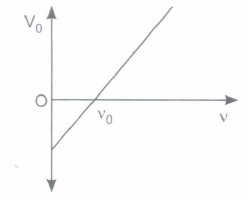
slope of the line
product of the slope of the line and charge on electron
intercept along y-axis divided by charge on the electron
product of the intercept along x-axis and mass of the electron
15.
Light of wavelengths \(\lambda\)A and \(\lambda\) B falls on two identical metal plates A and B respectively. The maximum kinetic energy of photoelectrons is K A and KB respectively, then which one of the following relations is true?\(\left(\lambda_{A}=2 \lambda_{B}\right)\)
\(K_{A}<\frac{K_{B}}{2}\)
\(2 K_{A}=K_{B}\)
\(K_{A}=2 K_{B}\)
\(K_{A}>2 K_{B}\)
16.
The formula for kinetic mass of a moving photon is
hv/ \(\lambda\)
h\(\lambda\)/e
hv/e
h/c\(\lambda\)
17.
An electron and proton have the same de-Broglie wavelength. The K.E of the electron is
zero
infinity
equal to K.E of the proton
greater than K.E. of proton
18.
Electrons used in an electron microscope are accelerated by a voltage of 25kV. If the voltage is increased to 100 kV then the de-Broglie wavelength associated with the electrons would
increase by 2 times
decrease by 2 times
decrease by 4 times
increase by 4 times
19.
A 200 W sodium street lamp emits yellow light of wavelength. Assuming it to be 25% efficient in converting electrical energy to light, the number of photons of yellow light it emits per second is
\(5\times { 10 }^{ 20 }\)
\(6\times { 10 }^{ 18 }\)
\(62\times { 10 }^{ 20 }\)
\(3\times { 10 }^{ 19 } \)
20.
In a photoelectric effect experiment, the maximum kinetic energy of the emitted electron is 1eV for incoming radiation of frequency v0 and 3eV for incoming radiation of frequency 3v0/2. What is the maximum kinetic energy of electrons emitted fro incoming radiation of frequency 9v0/4?
3 eV
4.5 eV
6 eV
9 eV
21.
If E1, E2, E3 and E4 are the respective kinetic energies of electron, deutron, proton and neutron having same de-Broglie wavelength. Select the correct order in which those values would increase.
E1, E3, E4, E2
E2, E4, E3, E1
E2, E4, E1, E3
E3, E1, E2, E4
22.
When radiation is incident on a photoelectron emitter, the stopping potential is found to be 9V.If e/m for the electron is \(1.8\times { 10 }^{ 11 }C/kg\) the maximum velocity of the ejected electron is
\(6\times { 10 }^{ 5 }m/s\)
\(8\times { 10 }^{ 5 }m/s\)
\({ 10 }^{ 6 }{ ms }^{ -1 }\)
\(1.8\times { 10 }^{ 6 }m/s\)
23.
__________ experiment has varified and confirmed the wave nature of electrons.
24.
In photoelectric effect, the energy of the free electron does not depend on.........of light.
25.
The minimum frequency required to eject an electron from the surface of a metal is called.............
26.
Find the typical de-Broglie wavelength associated with a He atom in helium gas at room temperature\((27°C)\)and 1 atm pressure; and compare it with the mean separation between two atoms under these conditions.
27.
Show that the wavelength of electromagnetic radiation is equal to the de-Broglie wavelength of its quantum (photon)
28.
Find the
(a) maximum frequency and
(b) minimum wavelength of X-rays produced by 30 kv electrons.
29.
30.
Assertion (A) : The de-Broglie wavelength of a neutron when its kinetic energy is K is \(\lambda\). Its wavelength is 2\(\lambda\) when its kinetic energy is 4 K.
Reason (R) : The de-Broglie wavelength \(\lambda\) is directly proportional to square root of the kinetic energy.
Codes:
(a) Both A and R are true and R is the correct explanation of A
(b) Both A and R are true but R is NOT the correct explanation of A
(c) A is true but R is false
(d) A is false and R is also false
31.
32.
1.
Given, cut-off voltage, V0 = 1.5 V
Maximum kinetic energy is given by,
\(\begin{aligned}
\mathrm{KE}_{\text {max }} & =e V_0=1.5 \space \mathrm{eV}=1.5 \times 1.6 \times 10^{-19}
\end{aligned}\)
\(=2.4 \times 10^{-19} \mathrm{~J}\)
2.
(a) Each photon has an energy
\(E=hv=6.63\times { 10 }^{ -34 }J s\times 6.0\times { 10 }^{ 14 }Hz\)
(b) If N is the number of photons emitted by the source per second, the power P transmitted in the beam equals N times the energy per photon E, so that P = N E. Then
\(n=\frac { P }{ E } =\frac { 2.0\times { 10 }^{ -3 }W }{ 3.98\times { 10 }^{ -19 }J } \)
\(=5.0\times { 10 }^{ 15 }\) photons per second.
3.
(a) For the cut-off or threshold frequency, the energy h v0 of the incident radiation must be equal to work function Φ0, so that
\({ V }_{ 0 }=\frac { { \phi }_{ 0 } }{ h } =\frac { 2.14eV }{ 6.63\times { 10 }^{ -34 }Js }\)
\(=\frac { 2.14\times 1.6\times { 10 }^{ -19 }J }{ 6.63\times { 10 }^{ -34 }Js } =5.16\times { 10 }^{ 14 }Hz\)
Thus, for frequencies less than this threshold frequency, no photoelectrons are ejected.
(b) Photocurrent reduces to zero, when maximum kinetic energy of the emitted photoelectrons equals the potential energy eV0 by the retarding potential V0. Einstein’s Photoelectric equation is
\(e{ V }_{ 0 }=\frac { hc }{ \lambda } -{ \phi }_{ 0 }\)
\(or\ \lambda =\frac { hc }{ \left( e{ V }_{ 0 }+{ \phi }_{ 0 } \right) }\)
\(or \ \lambda =\frac { \left( 6.63\times { 10 }^{ -34 }Js \right) \times \left( 3\times { 10 }^{ 8 }m/s \right) }{ \left( e\times 0.6V+2.14eV \right) } \)
\(\lambda =\frac { 19.89\times { 10 }^{ -26 }Jm }{ 2.74\times 1.6\times { 10 }^{ -19 }J } =454nm\)
4.
6 eV
5.
1/4
6.
According to photon picture:
(i) Each quantum of radiation has energy hv
(ii) In photo - electric effect the electrons in the metal absorbs this quantum of energy (hv).
(iii) When this energy exceeds the minimum energy needed for the ejection of photoelectron, flow of photo current starts.
7.
(a) For the electron:
Mass m = 9.11 x 10⁻³¹ kg, speed v = 5.4 x 10⁶ m/s. Then, momentum
p = m v = 9.11 x 10⁻³¹ (kg) x 5.4 x 10⁶ (m/s)
p = 4.92 x 10⁻²⁴ kg m/s
de Broglie wavelength,\(\lambda\) = h/p
\(=\frac{6.63 \times 10^{-34} \mathrm{Js}}{4.92 \times 10^{-24} \mathrm{~kg} \mathrm{~m} / \mathrm{s}}\)
\(\lambda=0.135 \mathrm{nm}\)
(b) For the ball:
Mass m’ = 0.150 kg, speed v’ = 30.0 m/s.
Then momentum p’ = m’ v ’ = 0.150 (kg) x 30.0 (m/s)
p ’= 4.50 kg m/s
de Broglie wavelength \(\lambda\)’ = h/p’.
\(=\frac{6.63 \times 10^{\pm 34} \mathrm{Js}}{4.50 \times \mathrm{kg} \mathrm{m} / \mathrm{s}}\)
\(\lambda^{\prime}=1.47 \times 10^{-34} \mathrm{~m}\)
The de Broglie wavelength of electron is comparable with X-ray wavelengths. However, for the ball it is about 10–19 times the size of the proton, quite beyond experimental measurement.
8.
The wavelength of a photon increases
9.
Since, work function is given as,
\(
W_0=h v_o \\
W_0 \propto v_0
\)
As work function of metal X is higher than metal Y, so metal X has higher threshold frequency than metal Y.
10.

11.
If vo is the threshold frequency, then from photoelectric equation, we have
\({ ev }_{ 1 }=h{ v }_{ 1 }-{ \phi }_{ 0 } \ and \ { ev }_{ 2 }={ hv }_{ 2 }-{ \phi }_{ 0 }\)
\(e({ v }_{ 2 }-{ v }_{ 1 })=h({ v }_{ 2 }-{ v }_{ 1 })or \ h=\frac { e({ v }_{ 2 }-{ v }_{ 1 }) }{ ({ v }_{ 2 }-{ v }_{ 1 }) } \)
\(Now,{ ev }_{ 1 }={ hv }_{ 1 }-{ \phi }_{ 0 }={ hv }_{ 1 }-{ hv }_{ 0 }\)
\(or \ { v }_{ 0 }={ v }_{ 1 }-\frac { { ev }_{ 1 } }{ h } ={ v }_{ 1 }-{ ev }_{ 1 }\left[ \frac { { v }_{ 2 }-{ v }_{ 1 } }{ e({ v }_{ 2 }-{ v }_{ 1 }) } \right]\)
\(={ v }_{ 1 }-\frac { { v }_{ 1 }({ v }_{ 2 }-{ v }_{ 1 }) }{ ({ v }_{ 2 }-{ v }_{ 1 }) } =\frac { { v }_{ 1 }{ V }_{ 2 }-{ v }_{ 1 }{ V }_{ 1 }-{ v }_{ 2 }{ V }_{ 1 }+{ v }_{ 1 }{ V }_{ 1 } }{ ({ v }_{ 2 }-{ v }_{ 1 }) } \)
12.
Yes; because the wavelength of ultraviolet light is less than the threshold wavelength 5200\(A˚\)
13.
(a)
the minimum energy required to free an electron from surface against coulomb forces.
14.
(b)
product of the slope of the line and charge on electron
15.
(a)
\(K_{A}<\frac{K_{B}}{2}\)
16.
(d)
h/c\(\lambda\)
17.
18.
(b)
decrease by 2 times
19.
(a)
\(5\times { 10 }^{ 20 }\)
20.
(c)
6 eV
21.
(c)
E2, E4, E1, E3
22.
(d)
\(1.8\times { 10 }^{ 6 }m/s\)
23.
()
Davisson and Germer
24.
()
intensity
25.
()
threshold frequency
26.
De Broglie wavelength associated with He atom = 0.7268 x 10⁻¹⁰m
Room temperature, T = 27°C = 27 + 273 = 300 K
Atmospheric pressure, P = 1 atm = 1.01 x 10⁵ Pa
Atomic weight of a He atom = 4
Avogadro’s number, NA = 6.023 x 10²³
Boltzmann constant, k = 1.38 x 10⁻²³ J mol−1 K−1
Average energy of a gas at temperature T,is given as:
\(E=\frac{3}{2} k T\)
De Broglie wavelength is given by the relation:
\(\lambda=\frac{h}{\sqrt{2 m E}}\)
Where,
m = Mass of a He atom
\(=\frac{\text { Atomic weight }}{N_{A}} \)
\(=\frac{4}{6.023 \times 10^{23}} \)
\(=6.64 \times 10^{-24} g=6.64 \times 10^{-27} \mathrm{~kg} \)
\(\therefore \lambda=\frac{h}{\sqrt{3 m k T}} \)
\(=\frac{6.6 \times 10^{-34}}{\sqrt{3 \times 6.64 \times 10^{-27} \times 1.38 \times 10^{-23} \times 300}} \)
\(=0.7268 \times 10^{-10 \mathrm{~m}}\)|
We have the ideal gas formula:
PV = RT
PV = kNT
\(\frac{V}{N}=\frac{\mathrm{kT}}{P}\)
Where,
V = Volume of the gas
N = Number of moles of the gas
Mean separation between two atoms of the gas is given by the relation:
\(r=\left(\frac{V}{N}\right)^{\frac{1}{3}}=\left(\frac{\mathrm{kT}}{P}\right)^{\frac{1}{3}} \)
\(=\left[\frac{1.38 \times 10^{-23} \times 300}{1.01 \times 10^{5}}\right]^{\frac{1}{3}} \)
\(=3.35 \times 10^{-9} \mathrm{~m}\)
Hence, the mean separation between the atoms is much greater than the de Broglie wavelength.
27.
The momentum of an electromagnetic wave of frequency v, wavelength \(\lambda\) is given by
\(p=\frac{b v}{c}=\frac{b}{\lambda} \text { or } \lambda=\frac{b}{p}\)
de-Broglie wavelength of photon, \(\lambda=\frac{b}{p}\)
Thus, wavelength of electromagnetic radiation is equal to the de-Broglie wavelength.
28.
(i) Energy = eV= hv
or \(v=\frac{e V}{h}=\frac{1.6 \times 10^{-19} \times 30 \times 10^3}{6.63 \times 10^{-34}}\)
= 7.24 \(\times\) 1018 Hz
(ii) As, \(c=v \lambda\)
\(\therefore\) Wavelength, \(\lambda=\frac{c}{v}=\frac{3 \times 10^8}{7.24 \times 10^{18}}=0.0414 \mathrm{~nm}\)
29.
30.
(d) : \(\lambda=\frac{h}{\sqrt{2 m K}}, \text { i.e., } \lambda \propto \frac{1}{\sqrt{K}}\)
\(\therefore \ \frac{\lambda^{\prime}}{\lambda}=\sqrt{\frac{K}{K^{\prime}}}=\sqrt{\frac{K}{4 K}}=\frac{1}{2} \text { or } \lambda^{\prime}=\frac{\lambda}{2}\)
31.
32.

12th Standard CBSE Syllabus & Materials
12th Standard CBSE
CBSE 12th Computer Science Python Revision Tour I - New Previous year Question Papers Study Material - QB365 Set A
NEW12th Standard CBSE
CBSE 12th Business Studies Planning Important Questions And Answers Study Material - QB365 Set A
NEW12th Standard CBSE
CBSE 12th Business Studies Business Environment Important Questions And Answers Study Material - QB365 Set A
NEW12th Standard CBSE
CBSE 12th Business Studies Principles of Management Important Questions And Answers Study Material - QB365 Set A



NCERT Books

Syllabus

Exam Pattern

Sample Question Papers

Previous year Question Papers

Important Notes

MCQ Practice test

NCERT Exemplers

Case study Questions

Image Based Questions

Passage based Questions

HOT Questions

Value Based Questions

Model Questions Papers
NCERT ( Book Back ) Questions

Assertion and Reason
Important Questions And Answers

CBSE 12th Standard CBSE Subjects
CBSE Standards








