
 100% FREE ACCESS
12th Standard CBSE Syllabus & Materials
12th Standard CBSE
CBSE 12th Economics Government Budget and the Economy Previous year Question Papers Study Material - QB365 Set A
NEW12th Standard CBSE
CBSE 12th Computer Science Interface Python with MySQL - New Previous year Question Papers Study Material - QB365 Set A
NEW12th Standard CBSE
CBSE 12th Computer Science Database Concept - New Previous year Question Papers Study Material - QB365 Set A
NEW12th Standard CBSE
CBSE 12th Computer Science Data Communication - New Previous year Question Papers Study Material - QB365 Set A
NEW12th Standard CBSE
CBSE 12th Computer Science Data Structures - New Previous year Question Papers Study Material - QB365 Set A
NEW12th Standard CBSE
CBSE 12th Computer Science Functions - New Previous year Question Papers Study Material - QB365 Set A

Published on: 07/03/2026
Download CBSE Class 12th Standard CBSE Physics question papers, sample papers, important questions, and previous year solved papers in PDF format. Get free study materials, NCERT solutions, and exam preparation resources for Class 12th Standard CBSE Physics
Questions + Answers key
Take MCQ Physics Test
1.
What are matter waves ? A proton and an alpha particle are accelerated through the same potential difference. Find the ratio of the de-Broglie wavelength associated with the proton to that with the alpha particle.
2.
Light of wavelength 2500 \(\overset { \circ }{ A } \) falls on a metal surface of work function 3.5 eV. What is the kinetic energy (in eV) of (i) the fastest and (ii) the slowest electrons emitted from the surface?
If the same light falls on another surface of work function 5.5. eV, what will be the energy of emitted electrons?
3.
Red light, however bright it is, cannot produce the emission of electrons from a clean zinc surface. But even weak ultraviolet radiation can do so. Why? X-rays of wavelength λ fall on a photosensitive surface, emitting electrons. Assuming that the work function of the surface can be neglected, prove that the de Broglie wavelength of electrons emitted will be \(\sqrt{\frac{h \lambda}{2 m c}}\).
4.
Find de-Broglie wavelength of neutron at 1270 mass of neutron = 1.66 x 10⁻²⁷ kg Boltzmann constant k = 1.38 x 10⁻²³ j mol-1 K-1 and planck' constant h = 6.63 x 10⁻³⁴ J-s
5.
A proton and an electron have same de-Broglie Wavelength. Which of them moves fast and which possesses more kinetic energy? Justify your answer.
6.
A given coin has a mass of 3.0 g. Calculate the nuclear energy that would be required to separate all the neutrons and protons from each other. For simplicity, assume that the coin is entirely made of \(_{ 29 }{ { Cu }^{ 63 } }\) atoms.
7.
A radioactive material is reduced to of\(\frac { 1 }{ 16 } \) its original amount in 4 days. How much material should one begin with so that of \(4\times { 10 }^{ -3 }kg\) the material is left after 6 days?
8.
Given that a photon of light of wavelength has\(10000\mathring { A } \) an energy equal to 1.23eV. When the light of wavelength \(5000\mathring { A } \)and intensity \({ I }_{ 0 }\)falls on a photoelectric cell and the saturation current is ampere\(0.40\times { 10 }^{ -6 }\) and the stopping potential is 1.36 volt, made, then (i) what is the work function? (ii) If the intensity of made,\(4{ I }_{ 0 }\) what should be the saturation current and stopping potential?
9.
Find the number of photons emitted per minute by a 25W source of monochromatic light of wavelength \(5000\mathring { A } \)Given \(h=6.6\times { 10 }^{ -34 }Js\)
10.
Find the frequency of light, which ejects electrons from a metal surface fully stopped by retarding potential of 3V. The photoelectric effect begins in this metal at a frequency of \(6\times { 10 }^{ 14 }{ s }^{ -1 }\) Find the work function of this metal.
11.
The neutron separation energy is defined to be the energy required to remove a neutron from a nucleus. Obtain the neutron separation energies of the nuclei \(\begin{matrix} 41 \\ 20 \end{matrix}Ca \ and \ \begin{matrix} 27 \\ 13 \end{matrix}Al\) from the following data: \(m(\begin{matrix} 40 \\ 20 \end{matrix}Ca)=39.962591u,\)
\(\\ m(\begin{matrix} 41 \\ 20 \end{matrix}Ca)=40.962278u,\)
\(m(\begin{matrix} 26 \\ 13 \end{matrix}Al)=25.986895u,\)
\(\\ m(\begin{matrix} 27 \\ 13 \end{matrix}Al)=26.986895u,\)
12.
Define ionization energy. How would the ionization energy change when electron in a hydrogen atom is replaced by a particle of mass 200 times that of the electron but having the same charge?
13.
Two metals X and Y, when illuminated with appropriate radiation, emit photoelectrons. The work function of X is higher than of Y. Which metal will have higher value of threshold frequency?
14.
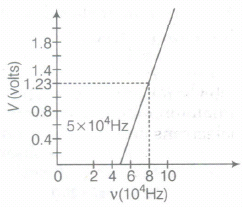
Using the graph shown in the figure for stopping potential versus the incident frequency of photons, calculate Planck's constant.
15.
A radioactive nucleus A undergoes a series of decays according to the following scheme
\(A\overset { \alpha }{ \longrightarrow } { A }_{ 1 }\overset { \beta }{ \longrightarrow } { A }_{ 2 }\overset { \alpha }{ \longrightarrow } { A }_{ 3 }\overset { \gamma }{ \longrightarrow } { A }_{ 4 }\)
The mass number and atomic number of A4 are 172 and 69, respectively. What are these numbers for A?
16.
Define the term stopping potential in relation to photoelectric effect.
17.
The radius of the innermost electron orbit of a H-atom is 5.3 x 10⁻¹¹ m. What are the radii of the n = 2 and n = 3 orbits?
18.
The graph shows the variation of stopping potential with the frequency of incident radiation for two photosensitive metals A and B.
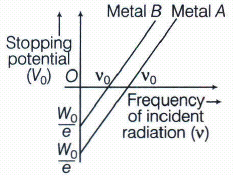
Which one of the two has higher value of work function? Justify your answer.
19.
Green light ejects photoelectrons from a given photosensitive surface whereas yellow light does not. What will happen in the case of violet and red light? Give a reason for your answer.
20.
Write two characteristic features observed in photoelectric effect which support the photon picture of electromagnetic radiation.
21.
Two beams one of red light and other of blue light of the same intensity are incidents on a metallic surface to emit photoelectrons. Which one of the two beam emits photoelectrons. Which one of the two beam emits electrons of greater kinetic energy?
22.
(i) Give one point of difference between nuclear fission and nuclear fusion.
(ii) Suppose we consider fission of a \({ }_{26}^{56} \mathrm{Fe}\) into two equal fragments of \({ }_{13}^{28} \mathrm{Al}\) nucleus. Is the fission energetically possible? Justify your answer by working out Q-value of the process.
Given (m) \({ }_{26}^{56} \mathrm{Fe}\) = 55.93494 u
and (m) \({ }_{13}^{28} \mathrm{Al}\) = 27.98191.
23.
Using Bohr's postulates, derive the expression for the frequency of radiation emitted when electron in hydrogen atom undergoes transition from higher energy state (quantum number ni) to the lower state (nf).
When electron in hydrogen atom jumps from energy state ni = 4 to nf = 3, 2, 1, identify the spectral series to which the emission lines belong.
24.
The photoelectric effect is a phenomenon of emission of electrons from the surface of a metal when the light of suitable frequency falls on it.
If light of frequency v falls on a photosensitive surface of work function increases or work function then the maximum kinetic energy of photoelectric emitted is given by Einstein's photoelectric equation.
\({ (KE) }_{ max }=\frac { 1 }{ 2 } { { mv }^{ 2 } }_{ max }=hv-{ { \phi }_{ 0 } }\)
The value \({ (KE) }_{ max }\) will increase if the energy of the incident light(hv) increases or work function \({ { \phi }_{ 0 } }\) is decreased.
Read above passage and answer the following questions:
(i) Why can visible light not eject photoelectrons from every metal surface?
(ii) Light of frequency \(7.21\times { 10 }^{ 14 }Hz\) is incident on a metal surface.Electrons with a maximum speed of \(6.0\times { 10 }^{ 5 }{ ms }^{ -1 }\) are ejected from the surface. What is the threshold frequency for photo emission of electrons?\(h=6.63\times { 10 }^{ -34 }Js;\ { m }_{ e }=9.1\times { 10 }^{ -31 }kg\)
(iii) What do you learn basically from the above study?
25.
(a) Estimate the speed with which electrons emitted from a heated cathode of an evacuated tube impinge on the anode maintained at a potential difference of 500V with respect to the cathode. Ignore the small initial speeds of the electrons. The specific charge of the electron, i.e., its e/m is given to be \(1.76\times { 10 }^{ 11 }C{ kg }^{ -1 }\)
(b) Use the same formula you employ in (a) to obtain electron speed for an anode potential of 10MV. Do you see what is wrong? In what way is the formula to be modified?
26.
The wavelength of light from the spectral emission line of sodium is 589nm. Find the kinetic energy at which (a) an electron (b) a neutron, would have the same de-Broglie wavelength.\(h=6.63\times { 10 }^{ -34 }Js;1eV=1.6\times { 10 }^{ -19 }J;{ m }_{ e }=9.1\times { 10 }^{ -31 }kg;\)
27.
The half-life of \(_{ 92 }{ { U }^{ 238 } }\)against \(\alpha -decay\)is \(4.5\times { 10 }^{ 9 }years\). What is the activity of 1g sample of \(_{ 92 }{ { U }^{ 238 } }\) ?
28.
Find the energy equivalent of one atomic mass unit, first in joule and then in MeV. Using this, express the mass defect of \(_{ 8 }{ { O }^{ 16 } }\) in \(MeV/{ c }^{ 2 }\)
Given \({ m }_{ p }=1.00727 \ amu, \ { m }_{ n }=1.00866 \ amu,\)
\({ m }_{ oxy }=15.99053 \ amu\)
\(Take \ 1amu=933.75 \ MeV/{ c }^{ 2 }\)
29.
Light of wavelength \(5000\overset { \circ }{ A } \)falls on a metal surface of work function 1.9eV. Find
(i) the energy of photons in eV
(ii) the kinetic energy of photoelectrons and
(iii) the stopping potential.Use \(h=6.63\times { 10 }^{ -34 }Js,c=3\times { 10 }^{ 8 }{ ms }^{ -1 };e=1.6\times { 10 }^{ 19 }C\)
1.
1. Matter-wave is an important part of quantum physics.
2. It is said that all matter shows wave-like behavior
3. The wavelength (\(\lambda\)) of a matter-wave can be determined by is \(\lambda=\frac{h}{p}\)
where h represents Planck's constant, and p represents the traveling particle's momentum.
4. The matter wave is also called as de Broglie wave.
5. The matter-wave describes the relationship between momentum and wavelength
6. The wavelength is inversely proportional to the momentum (mass and velocity) of the particle
7. The smaller the wavelength of the matter wave, the faster the particle moves.
8. The De-Broglie wavelength increases as the particle become lighter.
\(V_{\mathrm{a}}=V_P=V\)
\(\therefore \quad \frac{\lambda_{p}}{\lambda_a}=\frac{\sqrt{2 m e V_a}}{\sqrt{2 m e V_p}}=\sqrt{\frac{V_a}{V_p}}=1\)
\(\therefore \quad \lambda_p: \lambda_a=1: 1\)
2.
The energy of incident photon is calculated as
\(
E =\frac{h c}{\lambda}
\)
\(=\frac{6.63 \times 10^{-34} \times 3 \times 10^{8}}{2.5 \times 10^{-7} \times 1.6 \times 10^{-19}}=4.9 \mathrm{eV}
\)
\(\text { (i) } \because \quad E_{k(\max )} =\frac{h c}{\lambda}-\phi_{0}=4.9-3.5=1.4 \mathrm{eV}
\)
(ii) The slowest electrons emitted from the surface will have zero kinetic energy.
As the work function of metal surface (5.5 eV) is more than the energy of incident photon, it will not emit any photoelectron.
3.
It is due to the fact that photoelectric emission takes place only above threshold frequency. As frequency of red light is less than this threshold frequency, it cannot cause photoelectric emission whatsoever be the intensity.
We know that, \(\frac{h c}{\lambda}=\frac{h c}{\lambda_{0}}+\frac{1}{2} m v^{2}\)
On neglecting work function, we get
\( \frac{h c}{\lambda}=\frac{1}{2} m v^{2} \)
\(\therefore m v=\sqrt{\frac{2 m h c}{\lambda}} \) .......(i)
De Broglie wavelength is given by the relation
\(\lambda_{e}=\frac{h}{m v}\) .........(ii)
On substituting (i) in (ii), we get
\(\lambda_{e}=\frac{h \sqrt{\lambda}}{\sqrt{2 m h c}}=\sqrt{\frac{h \lambda}{2 m c}}\)
4.
T = 270 C = 127 + 273 = 400 K
Energy of neutron at 1270 C,
E = 3/2 kT = (3/2) x 1.38 x 10-23 x 400
= 8.28 x 10⁻²¹ J
Now, \(\lambda =\frac { h }{ \sqrt { 2mE } } =\frac { 6.63\times 10^{ -34 } }{ \sqrt { 2\times 1.66\times 10^{ -27 }\times } 8.28\times 10^{ -21 } }\)
\(=1.264 \ \mathring { A } \)
5.
Kinetic energy of particle of mass m having momentum p is given by
\(k=\frac { p^{ 2 } }{ 2m } \quad p=\sqrt { 2mK } \)
The de-Broglie wavelength \(\lambda =\frac { h }{ p } =\frac { h }{ \sqrt { 2mK } }\)
\( \\ p=\frac { h }{ \lambda } \)
\(\\ K=\frac { h^{ 2 } }{ 2m\lambda ^{ 2 } } \)
If \(\lambda \) is constant then from Eq (i) we get
p = constant,i.e mpvp = meve
\(\text { or } \frac{v_{p}}{v_{e}}=\frac{m_{e}}{m_{p}}<1\)
or vp < ve
If \(\lambda \) is constant then from (ii) \(K \propto \frac{1}{m}\)
\((\therefore \frac{K_{p}}{K_{e}}=\frac{m_{e}}{m_{p}}<1 \text { or } K_{p})\)
It means that the velocity of electron is greater than that of proton. Kinetic energy of electron is greater than that of proton.
6.
Number of atoms in 3g coin = \(\frac { 6.023\times { 10 }^{ 23 }\times 3 }{ 63 } =2.868\times { 10 }^{ 22 }\)
Each atom of copper contains 29 protons and 34 neutrons. Therefore, mass defect of each atom
\(=\left[ 29\times 1.00783+34\times 1.00867 \right] -62.92960=0.59225u\)
Total mass defect for all the atoms = \(0.59225\times 2.868\times { 10 }^{ 22 }u\)
\( \Delta m=1.6985\times { 10 }^{ 22 }u\)
As 1u = 931 MeV,
Nuclear energy required = \(1.6985\times { 10 }^{ 22 }\times 931MeV=1.58\times { 10 }^{ 25 }MeV\)
7.
\(\frac { N }{ { N }_{ 0 } } =\frac { 1 }{ 16 } ,\ t=4\quad days,{ N }_{ 0 }=?N=4\times { 10 }^{ -3 }kg.\)
\(As \ \frac { N }{ { N }_{ 0 } } ={ \left( \frac { 1 }{ 2 } \right) }^{ n }=\frac { 1 }{ 16 } ={ \left( \frac { 1 }{ 2 } \right) }^{ 4 },n=4or\frac { t }{ T } =4,\)
\(T=\frac { t }{ 4 } =\frac { 4 }{ 4 } =1 \ day\)
\(Again, \ \frac { N }{ { N }_{ 0 } } ={ \left( \frac { 1 }{ 2 } \right) }^{ n }={ \left( \frac { 1 }{ 2 } \right) }^{ 1/T }={ \left( \frac { 1 }{ 2 } \right) }^{ 6/1 }=\frac { 1 }{ 64 }\)
\({ N }_{ 0 }=64N=64\times 4\times { 10 }^{ -3 }kg=0.256kg\)
8.
(i) 1.1 eV
(ii) \(1.6\times { 10 }^{ -6 }A\)
(iii) unchanged
9.
\(3.77\times { 10 }^{ 21 }\)
10.
\(Here \ { v }_{ 0 }=3V, \ { v }_{ 0 }=6\times { 10 }^{ 14 }{ s }^{ -1 },v=?,{ \phi }_{ 0 }=?\)
\(e{ v }_{ 0 }=hv-h{ v }_{ 0 }\)
\(or \ v={ v }_{ 0 }+\frac { e{ v }_{ 0 } }{ h } =6\times { 10 }^{ 14 }+\frac { { \left( 1.6\times { 10 }^{ -19 } \right) }^{ 3 } }{ 6.6\times { 10 }^{ -34 } }\)
\(=6\times { 10 }^{ 14 }+7.27\times { 10 }^{ 14 }=13.27\times { 10 }^{ 14 }{ s }^{ -1 }\)
\(=\frac { 6.6\times { 10 }^{ -34 }\times 6\times { 10 }^{ 14 } }{ 1.6\times { 10 }^{ -19 } } eV=2.48eV\)
11.
Neutron separation energy \({ S }_{ n }\) of a nucleus \(\\ \begin{matrix} A \\ X \end{matrix}X\)
Given by \({ S }_{ n }=[{ m }_{ N }(\begin{matrix} A-1 \\ Z \end{matrix}X)+{ m }_{ n }-{ m }_{ N }(\begin{matrix} A \\ X \end{matrix}X)]{ c }^{ 2 }\).
Adding and subtracting the term \({ Zm }_{ C }\) in the bracket above ignoring mass defects due to electronic binding energies we get \({ S }_{ n }\) in terms of atomic masses.
\({ S }_{ n }=[{ m }_{ N }=(\begin{matrix} A-1 \\ Z \end{matrix}X)+{ m }_{ n }-{ m }(\begin{matrix} A \\ Z \end{matrix}X)]{ c }^{ 2 }\)
\({ S }_{ n }(\begin{matrix} 41 \\ 20 \end{matrix}X)=[39.96259+1.008665-40.962278)]u,\)
\(=[40.971255-40.962278]931.5\)
\(=0.008978 \times 931.5\)
\(=8.363 \ MeV.\)
\(\\ Neutron \ separation \ energy \ for \ \begin{matrix} 27 \\ 13 \end{matrix}Al\)
\({ S }_{ n }(\begin{matrix} 27 \\ 13 \end{matrix}Al)=[{ m }_{ N }(\begin{matrix} 26 \\ 13 \end{matrix}Al)+{ m }_{ n }-{ m }_{ N }(\begin{matrix} 27 \\ 13 \end{matrix}Al)]{ c }^{ 2 }\)
\({ S }_{ n }(\begin{matrix} 27 \\ 13 \end{matrix}Al)=[25.986895+1.0008665-26.981541]u\)
\( =[26.99556-26.981541]931.5\)
\( =0.014019 \times 931.5\)
\(=13.06 \ MeV.\)
12.
The minimum energy required to emit the electron, from the ground state of the atom, is called ionization energy.
\(\therefore \text { Ionization energy, } E_{n}=\frac{m e^{4}}{8 n^{2} \varepsilon_{0}^{2} h^{2}}\)
Therefore, the ionization energy of a particle will become 200 times, the ionization energy required by an electron.
13.
Since, work function is given as,
\(
W_0=h v_o \\
W_0 \propto v_0
\)
As work function of metal X is higher than metal Y, so metal X has higher threshold frequency than metal Y.
14.
Using Einstein's photoelectric equation,
eV = hv - \(\phi \)
On differention, we get eΔV = hΔv
or \(h=\frac { e\Delta V }{ \Delta N } =\frac { 1.6\times { 10 }^{ -19 }\times \left( 1.23-0 \right) }{ \left( 8-5 \right) \times { 10 }^{ 14 } } \)
\(=6.56\times { 10 }^{ -34 }J-s\)
15.
In α-decay, the atomic number decreases by 2 units and mass number decreases by 4 units. In ß-decay, the atomic number increases by I unit but mass number does not change. In y-decay, there is no change in atomic number and mass number.
Let the mass number and atomic number of A be X and Y, respectively.
So, \(_{ Y }{ A }^{ x }\overset { \alpha }{ \longrightarrow } _{ Y-2 }{ A_{ 1 } }^{ x-4 }\overset { \beta }{ \longrightarrow } _{ Y-2+1 }{ A_{ 2 } }^{ x-4 }\)
\(\ or\ _{ Y-1 }{ A }_{ 2 }^{ x-8 }\overset { \alpha }{ \longrightarrow } _{ Y-1-2 }{ A }_{ 3 }^{ x-4-4 }\)
\(\ or\ _{ Y-3 }{ A }_{ 3 }^{ x-8 }\overset { \gamma }{ \longrightarrow } _{ Y-3 }{ A }_{ 4 }^{ x-8 }\)
According to the question, the mass number and atomic number of A4 are 172 and 69.
∴ X - 8 = 172 ⇒ X = 172 + 8 = 180
Y - 3 = 69 ⇒ Y = 72
16.
For a particular frequency of incident radiation, the minimum negative (retarding) potential Vo given to plate A for which the photoelectric current becomes zero, is called cut-off or stopping potential.
17.
\(2.12\times { 10 }^{ -10 }\ m\ and\ 4.47\times { 10 }^{ -10 }\ m\)
18.
Metal A has higher value of work function because the slopes of both materials are constant and the intercept of the line depends on the work function.
19.
The photoelectrons can be emitted from a metal surface if the frequency of incident radiation is more than the threshold frequency, i.e., more than that of green light for the given surface. As the frequency of violet light is more than that of green light, hence violet light will eject photoelectrons. But the frequency of red light is less than that of the green light, hence red light can not eject photoelectrons from the given surface.
20.
The following features observed in photoelectric effect helped to establish the photon picture of the electromagnetic radiation.
(i) The maximum kinetic energy of the emitted photoelectron is independent of the intensity of the incident light but depends upon the frequency of the incident light.
(ii) For every metal, there is a certain minimum frequency of the incident light below which, no photoelectric emission takes place.
(iii) The photoelectric emission is an instantaneous process.
21.
The energy of blue light \((h v)_{b l u e}\) is greater than the energy of red light. \((h v)_{r e d}\) In photoelectric emission, max K.E. of emitted electron
\(=h v-\phi_0, \text { i.e., } \max K . E \alpha(h v)\)
So, K.E of emitted electrons is more with blue light than that of red light.
22.
(i) Distinction between Nuclear Fission and Nuclear Fusion Fission is the splitting of large nucleus into two or more smaller ones, on the other hand, fusion is the combining of two or more lighter nuclei to form larger one.
(ii) The given reaction for decay process,
\({ }_{26}^{56} \mathrm{Fe} \longrightarrow 2_{13}^{28} \mathrm{Al}\)
Mass defect,
\(\Delta\)m = m \(\left({ }_{26}^{56} \mathrm{Fe}\right)-2 m\left({ }_{13}^{28} \mathrm{Al}\right)\)
= 55.93494- 2(27.98191)
= - 0.02888
Q = \(\Delta\)m x 931 MeV
= - 0.02888 x 931 MeV
= - 26.88728 MeV
23.
For a dynamically stable orbit in a hydrogen atom,
\( F_{e}=F_{c} \)
\(\frac{1}{4 \pi \varepsilon_{0}} \frac{e^{2}}{r_{n}^{2}} =\frac{m v_{n}^{2}}{r_{n}} \)
\(\Rightarrow \quad v_{n} =\frac{e}{\sqrt{4 \pi \varepsilon_{0} r_{n} m}} \) .......(i)
According to the Bohr's second postulate of quantisation,
\(m v_{n} r_{n}=\frac{n h}{2 \pi}\) .........(ii)
Combining equations (i) and (ii), we get
\( r_{n} =\left(\frac{n^{2}}{m}\right)\left(\frac{h}{2 \pi}\right)^{2} \frac{4 \pi \varepsilon_{0}}{e^{2}} \)
\(=\frac{\varepsilon_{0} n^{2} h^{2}}{\pi m e^{2}} \) ...........(iii)
\( \because \text { P.E. } =-\frac{1}{4 \pi \varepsilon_{0}} \cdot \frac{e^{2}}{r_{n}}=-\frac{1}{4 \pi \varepsilon_{0}} \cdot \frac{e^{2}}{\frac{\varepsilon_{0} n^{2} h^{2}}{\pi m e^{2}}} \)
\(=-\frac{m e^{4}}{4 \varepsilon_{0}^{2} n^{2} h^{2}} ; \text { K.E. }=\frac{1}{2} m v_{n}^{2}=\frac{m e^{4}}{8 \varepsilon_{0}^{2} n^{2} h^{2}} \)
Total energy of an electron in the stationary states of hydrogen atom is
\(E_{n}=\text { P.E. }+\mathrm{K} . \mathrm{E} .=\frac{-m e^{4}}{4 \varepsilon_{0}^{2} n^{2} h^{2}}+\frac{m e^{4}}{8 \varepsilon_{0}^{2} n^{2} h^{2}}=\frac{-m e^{4}}{8 \varepsilon_{0}^{2} n^{2} h^{2}} .. ..(iv)\)
According to the third postulate of Bohr's model, \(h v_{i f}=E_{n_{i}}-E_{n_{f}}\)
Using equation above, we get \(h v_{i f}=\frac{m e^{4}}{8 \varepsilon_{0}^{2} h^{2}}\left(\frac{1}{n_{f}^{2}}-\frac{1}{n_{i}^{2}}\right)\)
The frequency of radiation emitted is given by \(v_{i f}=\frac{m e^{4}}{8 \varepsilon_{0}^{2} h^{3}}\left(\frac{1}{n_{f}^{2}}-\frac{1}{n_{i}^{2}}\right)\)
Now higher energy state, ni = 3, 2, 1
Lower energy state, nf = 4
For the transition, ni = 4 to nf = 3 \(\rightarrow\) Paschen series
ni = 4 to nf = 2 \(\rightarrow\) Balmer series
ni = 4 to nf = 1 \(\rightarrow\) Lyman series
24.
(i) This is because the energy of visible photons is less than work function of most of the metals.
(ii) \(\frac { 1 }{ 2 } { { mv }^{ 2 } }_{ max }=hv-{ { \phi }_{ 0 }=hv-{ hv }_{ 0 } }\)
\({ v }_{ 0 }=v-\frac { { { mv }^{ 2 } }_{ max } }{ 2h } =7.21\times { 10 }^{ 14 }-\frac { \left( 9.1\times { 10 }^{ -31 }kg \right) \times { \left( 6\times { 10 }^{ 5 } \right) }^{ 2 } }{ 2\times \left( 6.63\times { 10 }^{ -34 } \right) } =4.74\times { 10 }^{ 14 }Hz\)
(iii) We find that KE of electron ejected can be increased by increasing the incident energy or by decreasing the work function. In day-to-day life we can prosper by increasing our sincere efforts or by decreasing our requirements.
25.
(a)Potential difference across the evacuated tube, V = 500 V
Specific charge of an electron, e/m = 1.76 x 10¹¹ C kg−1
The speed of each emitted electron is given by the relation for kinetic energy as:
\(K E=\frac{1}{2} m v^{2}=e V\)
\(\therefore v=\left(\frac{2 e V}{m}\right)^{\frac{1}{2}}=\left(2 V \times \frac{e}{m}\right)^{\frac{1}{2}}\)
\(=\left(2 \times 500 \times 1.76 \times 10^{11}\right)^{\frac{1}{2}}=1.327 \times 10^{\mathrm{m} / \mathrm{s}}\)
Therefore, the speed of each emitted electron is \(1.327 \times 10^{7} \mathrm{~m} / \mathrm{s}\)
(b)Potential of the anode, V = 10 MV = 10 x 106 V
The speed of each electron is given as:
\(v=\left(2 V \frac{e}{m}\right)^{\frac{1}{2}}\)
\(=\left(2 \times 10^{7} \times 1.76 \times 10^{11}\right)^{\frac{1}{2}}\)
\(=1.88 \times 10^{9} \mathrm{~m} / \mathrm{s}\)
This result is wrong because nothing can move faster than light. In the above formula, the expression (mv2/2) for energy can only be used in the non-relativistic limit, i.e., forv << c.
For very high speed problems, relativistic equations must be considered for solving them. In the relativistic limit, the total energy is given as:
E = mc2
Where,
m = Relativistic mass
\(=m_{0}\left(1-\frac{v^{2}}{c^{2}}\right)^{\frac{1}{2}}\)
m0 = Mass of the particle at rest
Kinetic energy is given as:
K = mc2 − m0c2
26.
Wavelength of light of a sodium line, λ = 589 nm = 589 x 10−9 m
Mass of an electron, me= 9.1 x 10⁻³¹ kg
Mass of a neutron, mn= `1.66 x 10⁻²⁷ kg
Planck’s constant, h = 6.6 x 10⁻³⁴ Js
(a) For the kinetic energy K, of an electron accelerating with a velocity v, we have the relation:
\(K=\frac{1}{2} m_{e} v^{2}\)
We have the relation for de Broglie wavelength as:
\(\lambda=\frac{h}{m_{e} v}\)
\(\therefore v^{2}=\frac{h^{2}}{\lambda^{2} m_{e}^{2}}\)
Substituting equation (2) in equation (1), we get the relation:
\(K=\frac{1}{2} \frac{m_{e} h^{2}}{\lambda^{2} m e_{e}^{2}}=\frac{h^{2}}{2 \lambda^{2} m_{e}}\)
\(=\frac{\left(6.6 \times 10^{-34}\right)^{2}}{2 \times\left(589 \times x 10^{-9}\right)^{2} \times 9.1 \times 10^{-31}}\)
\(= 6.9 \times 10^{-25} J\)
\(=\frac{6.9 \times 10^{-25}}{1.6 \times 10^{-19}}=4.31 \times 10^{-6} \mathrm{eV}=4.31 \mu \mathrm{eV}\)
Hence, the kinetic energy of the electron is 6.9 x 10⁻²⁵ J or 4.31 μeV.
(b) Using equation (3), we can write the relation for the kinetic energy of the neutron as:
\(\frac{h^{2}}{2 \lambda^{2} m_{n}}\)
\(=\frac{\left(6.6 \times 10^{-34}\right)^{2}}{2 \times\left(589 \times 10^{-9}\right)^{2} \times 1.66 \times 10^{-27}}\)
\(=3.78 \times 10^{-28} J\)
\(=\frac{3.78 \times 10^{-28}}{1.6 \times 10^{-19}}=2.36 \times 10^{-9} e V=2.36 \neq V\)
Hence, the kinetic energy of the neutron is 3.78 x 10⁻²⁸ J or 2.36 neV.
27.
\(Here,T=4.5\times { 10 }^{ 9 }years\)
\( =4.5\times { 10 }^{ 9 }\times 365\times 24\times 60\times 60s\)
\(=1.42\times { 10 }^{ 17 }s\)
\(As \ number \ of \ atoms \ in \ 238 \ g\)
\(=Avagadro's\ no.=6.023\times { 10 }^{ 23 }\)
\( \therefore \ number \ of \ atoms \ in \ 1g \ of \ sample\)
\( N=\frac { 6.023\times { 10 }^{ 23 } }{ 238 }\)
\(R=-\frac { dN }{ dt } =\lambda N=\frac { 0.693 }{ T } N\)
\( =\frac { 0.693\times 6.023\times { 10 }^{ 23 } }{ 1.42\times { 10 }^{ 17 }\times 238 }\)
\( =1.235\times { 10 }^{ 3 }Bq\)
28.
\(we \ know, \ 1 \ amu=1.66\times { 10 }^{ -27 }kg\)
\(From \ E={ mc }^{ 2 }=(1.66\times { 10 }^{ -27 }){ \left( 3\times { 10 }^{ 8 } \right) }^{ 2 }\)
\( =1.494\times { 10 }^{ -10 }J\)
\(E=\frac { 1.494\times { 10 }^{ -10 } }{ 1.6\times { 10 }^{ -13 } } MeV=933.75MeV\)
\(For \ oxygen_{ 8 }{ { O }^{ 16 } }, \ mass \ defect\)
\(=8{ m }_{ p }+8{ m }_{ n }-{ M }_{ oxy }\)
\(=8\times 1.00727+8\times 1.00866-15.99053\)
\( =0.13691 \ amu\)
\(=0.13691\times 933.75MeV/{ c }^{ 2 }\)
\( =127.8MeV/{ c }^{ 2 }\)
29.
\(Here,\lambda =5000\overset { \circ }{ A } =5\times { 10 }^{ -7 }m,{ \phi }_{ 0 }=1.9eV\)
(i) Energy of photon in eV,
\(E=\frac { hc }{ \lambda } =\frac { \left( 6.63\times { 10 }^{ -34 } \right) \times \left( 3\times { 10 }^{ 8 } \right) }{ \left( 5\times { 10 }^{ -7 } \right) \times \left( 1.6\times { 10 }^{ 19 } \right) }\)
\(=2.4825eV\)
(ii) Kinetic energy of photelectron
\(=\frac { hc }{ \lambda } -{ \phi }_{ 0 }=2.4825-1.9\)
\( =0.5825eV\)
(iii) If \({ V }_{ 0 }\) is the stopping potential, then \({ eV }_{ 0 }=K.E.\) of emitted photoelectron = 0.5825 eV or \({ V }_{ 0 }=\frac { 0.5825eV }{ e } =0.5825V\)

12th Standard CBSE Syllabus & Materials
12th Standard CBSE
CBSE 12th Computer Science Python Revision Tour I - New Previous year Question Papers Study Material - QB365 Set A
NEW12th Standard CBSE
CBSE 12th Business Studies Planning Important Questions And Answers Study Material - QB365 Set A
NEW12th Standard CBSE
CBSE 12th Business Studies Business Environment Important Questions And Answers Study Material - QB365 Set A
NEW12th Standard CBSE
CBSE 12th Business Studies Principles of Management Important Questions And Answers Study Material - QB365 Set A



NCERT Books

Syllabus

Exam Pattern

Sample Question Papers

Previous year Question Papers

Important Notes

MCQ Practice test

NCERT Exemplers

Case study Questions

Image Based Questions

Passage based Questions

HOT Questions

Value Based Questions

Model Questions Papers
NCERT ( Book Back ) Questions

Assertion and Reason
Important Questions And Answers

CBSE 12th Standard CBSE Subjects
CBSE Standards








