100% FREE ACCESS
12th Standard CBSE Syllabus & Materials
12th Standard CBSE
CBSE 12th Economics Government Budget and the Economy Previous year Question Papers Study Material - QB365 Set A
NEW12th Standard CBSE
CBSE 12th Computer Science Interface Python with MySQL - New Previous year Question Papers Study Material - QB365 Set A
NEW12th Standard CBSE
CBSE 12th Computer Science Database Concept - New Previous year Question Papers Study Material - QB365 Set A
NEW12th Standard CBSE
CBSE 12th Computer Science Data Communication - New Previous year Question Papers Study Material - QB365 Set A
NEW12th Standard CBSE
CBSE 12th Computer Science Data Structures - New Previous year Question Papers Study Material - QB365 Set A
NEW12th Standard CBSE
CBSE 12th Computer Science Functions - New Previous year Question Papers Study Material - QB365 Set A

Published on: 02/11/2025
Download CBSE Class 12th Standard CBSE Physics question papers, sample papers, important questions, and previous year solved papers in PDF format. Get free study materials, NCERT solutions, and exam preparation resources for Class 12th Standard CBSE Physics
Questions + Answers key
Take MCQ Physics Test
1.
Prove that when an electric dipole is placed in a uniform electric field, potential energy U is given by U = -p.E.
2.
Two point charges of 4\(\mu\)C and -2 \(\mu\)C are separated by a distance of 1 m in air. Find the location of a point on the line joining the two charges, where the electric potential is zero.
3.
An electric dipole with dipole moment 4 × 10⁻⁹ C m is aligned at 30° with the direction of a uniform electric field of magnitude 5 × 10⁴ N/C. Calculate the magnitude of the torque acting on the dipole.
4.
Given a uniformly charged plane/sheet of surface charge density \(\sigma \)= 2\(\times \)1017 C/M2
(i) Find the electric field interest at a point a, 5 mm away from the sheet on the left side.
(ii) Giveb a straight line with three points X,Y, Z placed 50 cm away from the charge sheet on the right side. At Which of these points, the field due to the sheet remains tha same as that of point A and why ?
.png)
5.
A regular hexagon of side 10 cm has a charge 5\(\mu\) C at each of its vertices. Calculate the potential at the centre of the hexagon.
6.
(i) Calculate the maximum torque experienced by a water molecule whose electric dipole moment is 6.2 x 10⁻³⁰ C-m, when it is placed in an electric field of intensity 106 N/C.
(ii) Determine the work that must be done to take a water molecule aligned with the above field and set it anti-parallel to the field.
7.
A point charge causes an electric flux of –1.0 × 10³ Nm2/C to pass through a spherical Gaussian surface of 10.0 cm radius centred on the charge.
(a) If the radius of the Gaussian surface were doubled, how much flux would pass through the surface?
(b) What is the value of the point charge?
8.
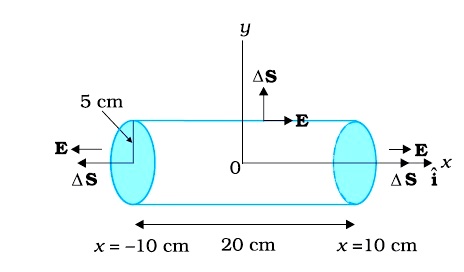
An electric field is uniform, and in the positive x direction for positive x, and uniform with the same magnitude but in the negative x direction for negative x. It is given that E = 200 \(\hat{i}\) N/C for x > 0 and E = –200 \(\hat{i}\) N/C for x < 0. A right circular cylinder of length 20 cm and radius 5 cm has its centre at the origin and its axis along the x-axis so that one face is at x = +10 cm and the other is at x = –10 cm (Fig.)
(a) What is the net outward flux through each flat face?
(b) What is the flux through the side of the cylinder?
(c) What is the net outward flux through the cylinder?
(d) What is the net charge inside the cylinder.
9.
A small particle carrying a negative charge of \(1.6\times 10^{-19}C\) is suspended in equilibrium between the horizontal metal plates 5cm apart, having a potential difference of 3000 V across them. Find the mass of the particle.
10.
Three capacitors of capacitance 2pF, 3pF and 4pF are connected in parallel.
(a) What is the total capacitance of the combination?
(b) Determine the charge on each capacitor, if the combination is connected to a 100 V supply.
11.
A spherical conductor of radius 12 cm has a charge of 1.6 \(\times\)10 7C distributed uniformly on its surface. What is the electric field.
(a) inside the sphere
(b) just outside the sphere
(c) at point 18 cm from the centre of the sphere?
12.
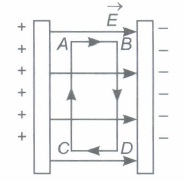
A uniform electric field E exists between two charged plates as shown in figure. What would be the work done in moving a charge q along the closed rectangular path ABCDA?
13.
What is the cause of quantisation of electric charge?
14.
Two charges 2 μC and –2 μC are placed at points A and B 6 cm apart.
(a) Identify an equipotential surface of the system.
(b) What is the direction of the electric field at every point on this surface?
15.
An electric dipole consists of two charges of 0.1 \(\mu\)C separated by a distance of 2.0 cm. The dipole is placed in an external field of 105 N/C. What maximum torque does the field exert on the dipole?
16.
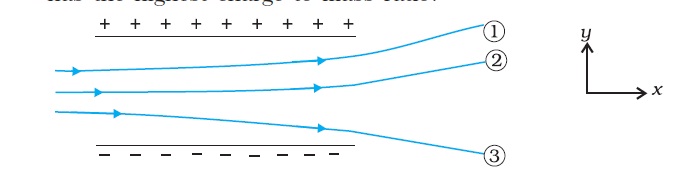
The Figure shows tracks of three charged particles in a uniform electrostatic field. Give the signs of the three charges. Which particle has the highest charge to mass ratio?
17.
In what form is the energy stored in a charged capacitance?
18.
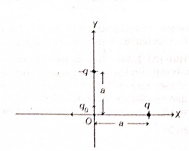
Three charges q1 -q and q0 are placed as shown in figure. The rnagnitude of the net force on the 1 charge q0 at point O is \(\left(\text { Take, } K=\frac{1}{4 \pi \varepsilon_0}\right)\)
0
\(\frac{2 K q q_0}{a^2}\)
\(\frac{\sqrt{2} K q q_0}{a^2}\)
\(\frac{1}{\sqrt{2}} \frac{K q q_0}{a^2}\)
19.
A parallel plate air capacitor having a capacitance C is half-filled with a dielectric of dielectric constant 5, the percentage increases in the capacitance will be
200%
33.3%
400%
66.6%
20.
A conductor with a positive charge
is always at +ve potential
is always at zero potential
is always at negative potential
may be at +ve, zero or -ve potential
21.
Two equal and opposite charges each of 2C are placed at a distance of 0.04 m. Dipole moment of the system will be
6 x 10⁻⁸ C-m
8 x 10⁻² C-m
1.5 x 10² C-m
8 x 10⁻⁶ C-m
22.
An object of mass 1kg contains 4 x 10²⁰ atoms. If one electron is removed from every atom of the solid, the charge gained by the solid of 1g is _______
2.8 C
6.4 x 10⁻² C
3.6 x 10⁻³ C
9.2 x 10⁻⁴ C
23.
One metallic sphere A is given positive charge whereas another identical metallic sphere B of exactly same mass as of A is given equal amount of negative charge. Then
mass of A and mass of B still remain equal
mass of A increases
mass of B decreases
mass of B increases
24.
What is the angle between the electric dipole moment and the electric field strength due to it on the equatorial line?
00
900
1800
None of these
25.
Two charge q1 and q2 repell each other with a force of 0.1 N. What will be the force exerted by q1, on q2, when a third charge is placed near them?
Less than 0.1 N
More than 0.1 N
0.1N
Less than 0.1 N if q1 and q2 are similar and more than 0.1 N if q1, and q2 are dissimilar
26.
Quantization of charge Implies:
charge exists on particles
there is a minimum permissible magnitude of charge
charge, which is a fraction of coulomb is not possible
none of the above
27.
When two capacitors charged to different potentials are connected by a conducting wire, what is not true?
charge lost by one is equal to charge gained by the other
potential lost by one is equal to potential gained by the other
some energy is lost
both the capacitor acquire a common potential
1.
When an electric dipole is placed in a uniform electric field, it experiences torque and tends to align it in such a way to attain stable equilibrium. Small amount of work done in rotating the dipole through a small angle d \(\theta\) against the torque is given by
dW = \(\tau\) d \(\theta\) = pE sin \(\theta\) d \(\theta\)
\(\therefore\) Total work done in rotating the dipole from orientation \(\theta\)1 to \(\theta\)2, \( W=\int_{\theta _{1}}^{\theta_{2}}\)pE sin \(\theta\) d \(\theta\)
= pE(cos\(\theta\)1 - cos\(\theta\)2)
\(\Rightarrow\) W = pE (cos\(\theta\)1 - cos \(\theta\)2)
Similarly, potential energy of electric dipole, when it rotates
from \(\theta\)1 = 90° to \(\theta\)2 = \(\theta\),
W = pE(cos90° - cos\(\theta\)) = -pEcos\(\theta\) = - p.E
W = -p . E
2.
Let the electrostatic potential be zero at point P between the two charges separated by a distance x metre.
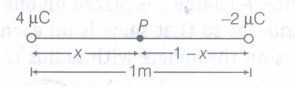
At point P, Vp = V1 + V2 = 0
\(\Rightarrow \quad \frac{1}{4 \pi \varepsilon_{0}} \cdot \frac{q_{1}}{r_{1}}+\frac{1}{4 \pi \varepsilon_{0}} \cdot \frac{q_{2}}{r_{2}}=0\)
\(\Rightarrow \frac{1}{4 \pi \varepsilon_{0}} \cdot \frac{4 \times 10^{-6}}{x}+\frac{1}{4 \pi \varepsilon_{0}} \cdot \frac{\left(-2 \times 10^{-6}\right)}{(1-x)}=0\)
\(\Rightarrow \quad \frac{4 \times 10^{-6}}{x}=\frac{2 \times 10^{-6}}{(1-x)}\)
\(\Rightarrow \quad \frac{4}{x}=\frac{2}{(1-x)}\)
\(\Rightarrow\) 2 (1-x)= x
\(\Rightarrow \ 2=3 x \ \text { or } \ x=\frac{2}{3}\)
\(\therefore\) Electrostatic potential is zero at a distance 2/3 m from charge 4\(\mu\)C between the two charges.
3.
Given, p = 4 \(\times\)10-9 C-m, E = 5 \(\times\) 104,
\(\theta\) = 30°
\(\therefore\) \(\tau\) = pE sin \(\theta\)
= 4 \(\times\)10-9 \(\times\)5 \(\times\)104 \(\times\)sin 30°
\(=4\times 10^{-9}\times 5\times 10^{4}\times \frac{1}{2}\) [\(\because\)sin 30° =\(\frac{1}{2}\)]
= 10 \(\times\)10-5 = 10-4 N-m
4.
(i) At point A, E =\(\frac { \sigma }{ 2{ \varepsilon }_{ 0 } } =\frac { 2\times{ 10 }^{ 17 } }{ 2\times8.85\times{ 10 }^{ -12 } } \)
= 1.12 x 1028 N/C
(ii) At point Y. Because at some, the charge sheet acts as a finite sheet acts thus the magnitude remains same towards the middle region of the plane sheet
5.
ABCDEF is a regular hexagon of side 10 cm each. At each corner, the charge q =5 \(\mu\)C is placed. O is the centre of the hexagon.
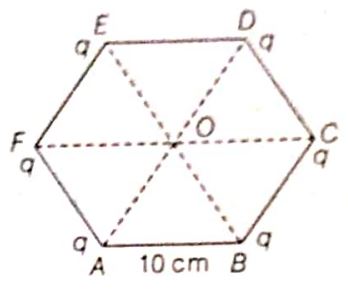
Given, AB = BC = CD = DE
= EF = FA = d = 10 cm
As, the hexagon has six equilateral triangles, so the distance of centre O from every vertex is 10 cm.
i.e. OA = OB = OC = OD
= OE = OF = d = 10 cm
\(\therefore\) Potential at point O = Sum of potentials at centre O due to individual point charge
i.e. VO = VA + VB + VC + VD + VE + VF
\(=\frac{1}{4\pi \varepsilon_{0}}.\left [ \frac{q}{OA}+\frac{q}{OB}+\frac{q}{OC}+\frac{q}{OD}+\frac{q}{OE}+\frac{q}{OF} \right ]\)
\(=\frac{1}{4\pi \varepsilon _{0}}.\frac{6q}{d}\) \(\left [ \because V=\frac{1}{4\pi \varepsilon _{0}.\frac{q}{r}} \right ]\)
Putting the values, we get
\(=9\times 10^{9}\times \frac{6\times 5 \times 10^{-6}}{10\times 10^{-2}}\)
= 2.7 \(\times\)106 V
6.
(i) Here, p = 6.2 x10⁻³⁰ C-m and E = 106 N/C
\(\therefore\) \(\tau\) = pE sin\(\theta\) [for maximum value \(\theta\)= 90°]
= pE sin 90° = 6.2 x 10-30 x 106 x 1
= 6.2 x 10⁻²⁴ N-m
(ii) When dipole is aligned anti-parallel to the field, \(\theta\) = 180o
\(\therefore\) W = pE(1 - cos\(\theta\) )
= 6.2 x 10-30 x 106(1- cos180o) [\(\because\) cos 180°= -1]
= 6.2 x 10-30 x 106(1 -(-1))
= 6.2 x 10-30 x 106 x 2
= 1.24 x 10⁻²³ J
7.
Electric flux, Φ = −1.0 x 10³ N m2/C
Radius of the Gaussian surface,
r = 10.0 cm
Electric flux piercing out through a surface depends on the net charge enclosed inside a body. It does not depend on the size of the body. If the radius of the Gaussian surface is doubled, then the flux passing through the surface remains the same i.e., −103 N m2/C.
(b) Electric flux is given by the relation,
\(\phi=\frac{q}{\epsilon_{0}}\)
Where,
q = Net charge enclosed by the spherical surface
∈0 = Permittivity of free space = 8.854 x 10⁻¹² N−1C2 m−2
\(\therefore q=\phi \in_{0}\)
= −1.0 x 103 x 8.854 x 10−12
= −8.854 x 10⁻⁹ C
= −8.854 nC
Therefore, the value of the point charge is −8.854 nC.
8.
(a) We can see from the figure that on the left face E and ΔS are parallel. Therefore, the outward flux is
φL= E.ΔS = – 200 \(\hat{i}\). ΔS
= + 200 ΔS, since\(\hat{i}\) . ΔS = – ΔS
= + 200 x \(\pi \) (0.05)2 = + 1.57 N m2 C–1
On the right face, E and ΔS are parallel and therefore φR = E.ΔS = + 1.57 N m2 C–1
(b) For any point on the side of the cylinder E is perpendicular to ΔS and hence E.ΔS = 0. Therefore, the flux out of the side of the cylinder is zero
(c) Net outward flux through the cylinder
φ = 1.57 + 1.57 + 0 = 3.14 N m2 C–1
(d) The net charge within the cylinder can be found by using Gauss’s law which gives
q = ε0φ
= 3.14 x 8.854 × 10–12 C
= 2.78 x 10⁻¹¹ C
9.
Here, \(q=-1.6\times 10^{-19}C\)
\(dr=5 cm=5\times 10^{-2}m, dV=3000V, m=?\)
\(E=-{dV\over dr}={-3000\over 5\times 10^{-2}}=-6\times 10^4 Vm^{-1}\)
As the charged particle remains suspended in equilibrium, therefore
F = mg = qE
or \(m={qE\over g}={-1.6\times 10^{-19}\times (-6\times 10^4)\over 9.8}\)
\(=9.8\times 10^{-16}kg\)
10.
(1) Given, C1 = 2pF, C2 = 3pF and C3 = 4pF.
Equivalent capacitance for the parallel combination is given by Ceq .
Therefore, Ceq = C1 + C2 + C3 = 2 + 3 + 4 = 9pF
Hence, the total capacitance of the combination is 9pF.
(2) Supply voltage, V = 100V
The three capacitors are having the same voltage, V = 100v
q = VC
where,
q = charge
C = capacitance of the capacitor
V = potential difference
for capacitance, c = 2pF
q = 100 x 2 = 200pC = 2 x 10⁻¹⁰C
for capacitance, c = 3pF
q = 100 x 3 = 300pC = 3 x 10⁻¹⁰C
for capacitance, c = 4pF
q = 100 x 4 = 400pC = 4 x 10⁻¹⁰ C
11.
(1) Given,
Radius of spherical conductor, r = 12cm = 0.12m
Charge is distributed uniformly over the surface, q = 1.6 x 10⁻⁷ C.
The electric field inside a spherical conductor is zero.
(2) Electric field E, just outside the conductor is given by the relation
\(\mathrm{E}=\frac{1}{4 \pi \epsilon_{o}} \cdot \frac{q}{r^{2}}\)
Here, permittivity of free space and \(\frac{1}{4 \pi \epsilon_{o}}=9 \times 10^{9} \mathrm{Nm}^{2} \mathrm{C}^{-2}\)
Therefore,
\(\mathrm{E}=\frac{9 \times 10^{9} \times 1.6 \times 10^{-7}}{(0.12)^{2}}=10^{5} \mathrm{NC}^{-1}\)
Therefore, just outside the sphere the electric field is 4.4 x 10⁴ NC-1.
(3) From the centre of the sphere the electric field at a point 18m = E1.
From the centre of the sphere, the distance of point d = 18 cm = 0.18m
\(\mathrm{E}_{1}=\frac{1}{4 \pi \epsilon_{o}} \cdot \frac{q}{d^{2}}=\frac{9 \times 10^{9} \times 1.6 \times 10^{-7}}{\left(1.8 \times 10^{-2}\right)^{2}}=4.4 \times 10^{4} \mathrm{NC}^{-1}\)
So, from the centre of sphere the electric field at a point 18 cm away is 4.4 x 10⁴ NC-1.
12.
Work done in moving a charge q along a closed rectangular path ABCD is calculated as
\(
W=W_{A B}+W_{B C}+W_{C D}+W_{D A}
W=q E+0-q E+0=0[\because A B=C D]
\)
13.
The minimum charge that is stable, is charge of an electron. Since electrons are transferred from one object to another, therefore, electric charge is said to be quantised.
14.
(1) An equipotential surface is defined as the surface over which the total potential is zero. In the given question the plane is normal to line AB. The plane is located at the mid – point of the line AB as the magnitude of the charges are same.
(2) At every point on this surface the direction of the electric field is normal to the plane in the direction of AB.
15.
Here, q = 01 \(\mu\)C = 10-7C , 2l = 2.0 cm = 2 x 10⁻²m,
E = 105 N/C \(\Rightarrow\) \(\tau\) = pEsin \(\theta\) = q x 2l x E sin\(\theta\)
\(\therefore\) \(\tau\)max = 10-7x 2 x 10 -2 x 105 x 1 [\(\because\) sin \(\theta\) 90o =1]
= 2 x 10⁻⁴ N-m
16.
Opposite charges attract each other and same charges repel each other. It can be observed that particles 1 and 2 both move towards the positively charged plate and repel away from the negatively charged plate. Hence, these two particles are negatively charged. It can also be observed that particle 3 moves towards the negatively charged plate and repels away from the positively charged plate. Hence, particle 3 is positively charged.
The charge to mass ratio (emf) is directly proportional to the displacement or amount of deflection for a given velocity. Since the deflection of particle 3 is the maximum, it has the highest charge to mass ratio.
17.
Energy is stored in the form of electrostatic potential energy in the electric field between the plates of capacitors.
18.
(a)
0
19.
(c)
400%
20.
(d)
may be at +ve, zero or -ve potential
21.
(b)
8 x 10⁻² C-m
22.
(b)
6.4 x 10⁻² C
23.
(d)
mass of B increases
24.
(c)
1800
25.
(c)
0.1N
26.
(b)
there is a minimum permissible magnitude of charge
27.
(b)
potential lost by one is equal to potential gained by the other

12th Standard CBSE Syllabus & Materials
12th Standard CBSE
CBSE 12th Computer Science Python Revision Tour I - New Previous year Question Papers Study Material - QB365 Set A
NEW12th Standard CBSE
CBSE 12th Business Studies Planning Important Questions And Answers Study Material - QB365 Set A
NEW12th Standard CBSE
CBSE 12th Business Studies Business Environment Important Questions And Answers Study Material - QB365 Set A
NEW12th Standard CBSE
CBSE 12th Business Studies Principles of Management Important Questions And Answers Study Material - QB365 Set A



NCERT Books

Syllabus

Exam Pattern

Sample Question Papers

Previous year Question Papers

Important Notes

MCQ Practice test

NCERT Exemplers

Case study Questions

Image Based Questions

Passage based Questions

HOT Questions

Value Based Questions

Model Questions Papers
NCERT ( Book Back ) Questions

Assertion and Reason
Important Questions And Answers

CBSE 12th Standard CBSE Subjects
CBSE Standards