
 100% FREE ACCESS
12th Standard CBSE Syllabus & Materials
12th Standard CBSE
CBSE 12th Economics Government Budget and the Economy Previous year Question Papers Study Material - QB365 Set A
NEW12th Standard CBSE
CBSE 12th Computer Science Interface Python with MySQL - New Previous year Question Papers Study Material - QB365 Set A
NEW12th Standard CBSE
CBSE 12th Computer Science Database Concept - New Previous year Question Papers Study Material - QB365 Set A
NEW12th Standard CBSE
CBSE 12th Computer Science Data Communication - New Previous year Question Papers Study Material - QB365 Set A
NEW12th Standard CBSE
CBSE 12th Computer Science Data Structures - New Previous year Question Papers Study Material - QB365 Set A
NEW12th Standard CBSE
CBSE 12th Computer Science Functions - New Previous year Question Papers Study Material - QB365 Set A

Published on: 02/11/2025
Download CBSE Class 12th Standard CBSE Physics question papers, sample papers, important questions, and previous year solved papers in PDF format. Get free study materials, NCERT solutions, and exam preparation resources for Class 12th Standard CBSE Physics
Questions + Answers key
Take MCQ Physics Test
1.
Two point charges qA = 3 μC and qB = –3 μC are located 20 cm apart in vacuum.
(a) What is the electric field at the midpoint O of the line AB joining the two charges?
(b) If a negative test charge of magnitude 1.5 x 10⁻⁹ C is placed at this point, what is the force experienced by the test charge?
2.
"An object becomes positively charged through the removal of negatively charged electrons rather than through the addition of positively charged protons". Explain, why?
3.
What is the basic cause of quantisation of charge?
4.
Which property of dielectrics make them different from conductors?
5.
The sum of two point charges is 7 \(\mu\)C. They repel each other with a force of 1 N when kept 30 cm apart in free space. Calculate the value of each charge
6.
Describe some of the differences between charging by induction and charging by contact.
7.
What is the angle between the electric dipole moment and the electric field strength due to it on the equatorial line?
0o
90o
180o
None of these
8.
Two equal and opposite charges each of 2C are placed at a distance of 0.04 m. Dipole moment of the system will be
6 x 10⁻⁸ C-m
8 x 10⁻² C-m
1.5 x 10² C-m
8 x 10⁻⁶ C-m
9.
A point charge + q is placed at a distance d from an isolated conducting plane. The field at a point P on the other side of the plane is
directed perpendicular to the plane and away from the plane.
directed perpendicular to the plane but towards the plane
directed radially away from the point charge
directed radially towards the point charge
10.
A hemisphere is uniformly charged. The electric field at a point on a diameter away from the centre is directed
perpendicular to the diameter
parallel to the diameter
at an angle tilted towards the diameter
at an angle tilted away from the diameter
11.
A force of 2.25 N acts on a chrage of 15 x 10-4 C. The intensity of electric field at that point is
150 NC-1
15 NC-1
1500 NC -1
1.5 NC-1
12.
Surface charge density is defined as the charge per unit surface area of surface charge distribution.
i.e. \(\sigma=\frac{d q}{d S}\)
Two large, thin metal plates are parallel and close to each other. On their inner faces, the plates have surface charge densities of opposite signs having magnitude of 17.0 x 10⁻²² Cm-2 as shown below.
The intensity of electric field at a point is \(E=\frac{\sigma}{\varepsilon_0}\)
where, E = permittivity of free space.
(i) E in the outer region of the first plate is
(a) 17 x10-22 N/C
(b)1,5x10⁻¹⁵ N/C
(c)1.9x10⁻¹⁶ N/C
(d) zero
(ii) E in the outer region of the second plate is
(a) 17 x 10-22 N/C
(b) 1.5 x 10⁻³⁵ N/C
(c) 1.9 x10⁻¹⁰ N/C
(d) zero
(ii) E between the plates is
(a) 17 x10-22 N/C
(b) 1.5 x 10⁻¹⁵ N/C
(c) 1.9 x10⁻¹⁰ N/C
(d) zero
(iv) The ratio of E from right side of B at distances 2 cm and 4 cm, respectively is
(a) 1 : 2
(b) 2 : 1
(c) 1 : 1
(d) 1 : √2
(v) In order to estimate the electric field due to a thin finite plane metal plate, the gaussian surface considered is
(a) spherical
(b) cylindrical
(c) straight line
(d) None of these
13.
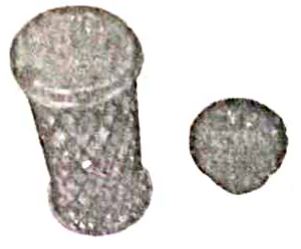
A Faraday cage or Faraday shield is an enclosure made of a conducting material. The fields within a conductor cancel out with any external fields,so the electric field within the enclosure is zero. These Faraday cages act as big hollow conductors. You can put things to shield them from electrical fields. Any electrical shocks the cage receives, pass harmlessly around the outside of the cage.
(i) Which of the following material can be used to make a Faraday cage?
(a) Plastic (b) Glass (c) Copper (d) Wood
(ii) Example of a real-world Faraday cage is
(a) car (b) plastic box (c) lightning rod (d) metal rod
(iii) What is the electrical force inside a Faraday cage, when it is struck by lightning?
(a) The same as the lightning
(b) Half that of the lightning
(c) Zero
(d) A quarter of the lightning
(iv) An isolated point charge +q is placed inside the Faraday cage. Its surface must have charge equal to
(a) zero (b) + q (c) - q (d) + 2q
(v) A point charge of 2 C is placed at centre of Faraday cage in the shape of cube with surface of 9 cm edge. The number of electric field lines passing through the cube normally wiil be
(a) 1.9 \(\times\)105 N-m2/C, entering the surface
(b) 1.9 \(\times\)105 N-m2/C, leaving the surface
(c) 2.01\(\times\)1011 N-m2/C, leaving the surface
(d) 2.01 \(\times\)105 N-m2/C, entering the surface
1.
The situation is represented in the given figure. O is the mid-point of line AB.

Distance between the two charges, AB = 20 cm
∴ AO = OB = 10 cm
Net electric field at point O = E
Electric field at point O caused by +3μC charge,
\(E_{1}=\frac{3 \times 10^{-6}}{4 \pi \in_{0}(A O)^{2}}=\frac{3 \times 10^{-6}}{4 \pi \in_{0}\left(10 \times 10^{-2}\right)^{2}} \frac{N}{C} \text { along OB }\)
Where,
∈0 = Permittivity of free space
\(\frac{1}{4 \pi \in_{0}}=9 \times 10^{9} N m^{2} C^{-2}\)
Magnitude of electric field at point O caused by −3μC charge,
\(E_{1}=\frac{-3 \times 10^{-6}}{4 \pi \in_{0}(O B)^{2}}=\frac{3 \times 10^{-6}}{4 \pi \in_{0}\left(10 \times 10^{-2}\right)^{2}} \frac{N}{C}\) along OB
\(\therefore\) E = E1 + E2
\(2 \times\left[\left(9 \times 10^{9}\right) \times \frac{3 \times 10^{-6}}{\left(10 \times 10^{-2}\right)^{2}}\right]\) [since the value of E1 and E2 are same, the value is multiplied with 2]
= 5.4 x 10⁶ N/C along OB
Therefore, the electric field at mid-point O is 5.4 x 10⁶ N C−1 along OB.
(b) A test charge of amount 1.5 × 10⁻⁹ C is placed at mid-point O.
q = 1.5 x 10⁻⁹ C
Force experienced by the test charge = F
∴ F = qE
= 1.5 x 10−9 x 5.4 x 106
= 8.1 x 10⁻³ N
The force is directed along line OA. This is because the negative test charge is repelled by the charge placed at point B but attracted towards point A.
Therefore, the force experienced by the test charge is 8.1 x 10⁻³ N along OA.
2.
In ordinary matter, a positive charge is much less mobile than a negative charge. For this reason, an object becomes positively charged through the removal of negatively charged electrons rather than through the addition of positively charged protons.
3.
The basic cause of quantisation of charge is only the integral number of electrons which is transferred from one body to another, i.e. ± ne.
4.
Dielectrics do not have free electrons at all. They offer high resistance to passage of electricity through them.
e.g. Glass, rubber, plastic, etc
5.
Let one of two charges be X \(\mu\)c. Therefore, other charge will be (7 - x )\(\mu\) c.
By Coulomb's law,
\(F=\frac{1}{4 \pi \varepsilon_{0}} \cdot \frac{q_{1} q_{2}}{r^{2}}\)
\(\Rightarrow \) 1 = 9 x 10 9 x \(\frac{\left(x \times 10^{-6}\right)(7-x) \times 10^{-6}}{(0.3)^{2}}\)
\(\Rightarrow \) 9 x 10-2 =9 x 10⁹-12 x (7 - x)
\(\Rightarrow \) 10 = x (7 - x)
\(\Rightarrow \) x2 -7x + 10= 0
\(\Rightarrow \) (x - 2) (x - 5) = 0
\(\therefore\) x = 2\(\mu\)C or 5\(\mu\)C
Therefore, charges are 2\(\mu\)C and 5\(\mu\)C.
6.
(i) When an object is charged by induction, there is no physical contact between the object being charged and the object used to do the charging. In contrast, charging by contact, as the name implies, involves the direct physical contact to transfer charge from one object to the another.
(ii) When an object is charged by induction, the sign of the charge that the object acquires is opposite to that of the object used to do the charging. Charging by contact gives the object being charged the same sign of charge as the original charged object.
7.
(c)
180o
8.
(b)
8 x 10⁻² C-m
9.
(a)
directed perpendicular to the plane and away from the plane.
10.
(a)
perpendicular to the diameter
11.
(c)
1500 NC -1
12.
(i) (d) There are two plates A and B having surface charge densities σA = 17.0 x 10⁻²² C/m2 on A and σB = -17.0 x 10⁻²² C/m2 on B, respectively.
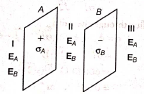
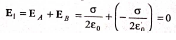
According to Gauss' theorem, if the plates have same surface charge density buthaving opposite signs, then the electric field in region I is zero.
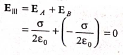
(i) (d) The electric field in region III is also zero.
13.
(i) (c), (ii) (a), (iii) (c), (iv) (b)
(v) (c) According to Gauss' law, electric flux,
\(\phi=\frac{q}{\varepsilon _{0}}=\frac{2}{8.86\times 10^{-12}}=2.01\times 10^{11}N-m^{2} /C\)
(leaving the surface)

12th Standard CBSE Syllabus & Materials
12th Standard CBSE
CBSE 12th Computer Science Python Revision Tour I - New Previous year Question Papers Study Material - QB365 Set A
NEW12th Standard CBSE
CBSE 12th Business Studies Planning Important Questions And Answers Study Material - QB365 Set A
NEW12th Standard CBSE
CBSE 12th Business Studies Business Environment Important Questions And Answers Study Material - QB365 Set A
NEW12th Standard CBSE
CBSE 12th Business Studies Principles of Management Important Questions And Answers Study Material - QB365 Set A



NCERT Books

Syllabus

Exam Pattern

Sample Question Papers

Previous year Question Papers

Important Notes

MCQ Practice test

NCERT Exemplers

Case study Questions

Image Based Questions

Passage based Questions

HOT Questions

Value Based Questions

Model Questions Papers
NCERT ( Book Back ) Questions

Assertion and Reason
Important Questions And Answers

CBSE 12th Standard CBSE Subjects
CBSE Standards









